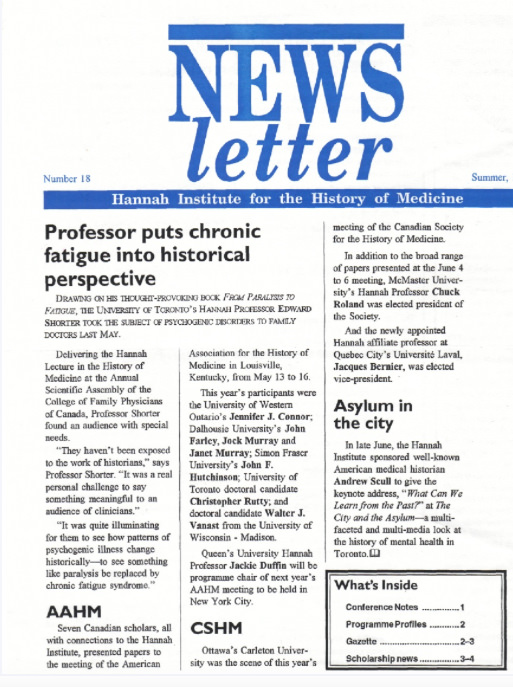
Drawing on his thought-provoking book From Paralysis to Fatigue, the University of Toronto’s Hannah Professor Edward Shorter took the subject of psychogenic disorders to family doctors last May.
Delivering the Hannah Lecture in the History of Medicine at the Annual Scientific Assembly of the College of Family Physicians of Canada, Professor Shorter found an audience with special needs.
“They haven’t been exposed to the work of historians,” says Professor Shorter. “It was a real personal challenge to say something meaningful to an audience of clinicians.
“It was quite illuminating for them to see how patterns of psychogenic illness change historically – to see something like paralysis be replaced by chronic fatigue syndrome.”
I worked as Editor and Writer for the newsletter of the Hannah Institute for the History of Medicine (under the direction of the Editor-in-Chief and Hannah Executive Director Dr. J.T. H. Connor) in the early 1990s. Located close to the University of Toronto and within a neighbourhood claiming a long association with medical and scientific discovery (Sir Frederick Banting, co-developer of insulin for the treatment of diabetes, lived at 46 Bedford Road,), the goal was to better connect Canada’s medical history community of scholars and raise the profile of the funding resources available to further the study of medical history in Canada.
World water resources are being depleted quickly as populations grow, urbanize and demand better living standards. Many scientists believe we are reaching peak water – the point at which fresh water is consumed faster than it is replenished.
According to Ensia (ensia.com), a magazine showcasing environmental solutions in action, 70 per cent of the earth’s fresh water reserves are locked up in snow or ice, and are expensive to tap and bring to the world’s water-stressed places. Of the remainder, most is in groundwater, soil moisture, swamps or permafrost, while just 0.3 per cent is easy to access in freshwater lakes and rivers.
By far the biggest user of water in the world – accounting for 69 per cent of the total – is farm irrigation. That’s a serious concern when considering the world will need to grow more food to feed an increasing population. Just 1 per cent of water is used for livestock, while 15 per cent is used for electricity generation and 7 per cent for manufacturing. More water is currently being pumped from underground resources than is being replaced from underground aquifers.
The average person needs to consume 0.6 to 1.3 gallons (2.72 liters to 6 liters) of water per day to survive in a moderate climate. For drinking, cooking, bathing and sanitation, an individual needs 13 gallons (59 liters) a day (Ensia).
In many places, obtaining water requires a long trek to a well or stream. But non-desert climates have water as a resource readily available all around – trapped in the air. The clue to this resource’s existence is in the air’s humidity levels, the most visible sign of which is the dew that is found covering the grass and leaves every morning when people wake up. The trick is to extract that water from the air and create a steady supply of this essential resource.
Italian architect and designer Arturo Vittori (http://www.vittori-lab.com/team/arturo-vittori), a lecturer on aerospace architecture, technology transfer and sustainability, believes he has an answer.
Wired magazine (http://www.wired.com/2014/03/warka-water-africa/) reported that Vittori was inspired by a trip to Ethiopia, where he observed the daily struggle to get water. Access to water in northeastern Ethiopia often requires a long walk, which reduces the amount of time left in the day to do other things. Parents often take along their children, meaning the children cannot go to school. The time consumed by gathering water leaves people poorer and unable to dedicate more of their day to income-earning activities.
And there is no guarantee the water is safe to drink or free of chemical contaminants. This situation left Vittori pondering ways of coming up with an inexpensive solution that would eliminate the daily hassle of finding water and guarantee its quality.
The water collector is inspired by the Warka tree, or Ficus vasta (http://en.wikipedia.org/wiki/Ficus_vasta). Native to Ethiopia, it is known for providing shade and as a rendezvous point for traditional gatherings.
A WarkaWater Tower stands 8 meters in height and is made from either bamboo or reeds. Inside, a mesh traps humidity from the air and the water drips down into a basket. One tower can gather around 94 liters of water a day. The water is right there in the community and not kilometers away, meaning time and energy saved for income-generating tasks.
A WarkaWater Tower is constructed in sections, which are assembled and then stacked on top of each other. The construction does not need special scaffolding or special machinery. Once the tower is in place, it can also be used as a solar-power generator.
The tower is still a prototype and Vittori plans to build two towers for a launch in 2015.
In Peru, reports the Latin American Herald Tribune (http://www.laht.com/article.asp?ArticleId=700400&CategoryId=14095), another innovative solution to the water crisis has been developed by students at the University of Engineering and Technology (UTEC) (http://www.utec.edu.pe/Utec.aspx). The students have developed a highway advertising billboard that can draw drinking water out of the air. Inspired by a campaign called “Ingenuity in Action”, the students teamed up with a local advertising agency to design the billboard. It is capable of extracting water from the air and processing it through a filtration system as it flows down to a series of taps at the bottom.
The water-making billboard is at the 89.5 kilometer distance marker of the Pan-American Highway and has five electric-powered tanks that can hold a total of 96 liters of drinkable water. It is capable of providing enough water for hundreds of families. A true sign of our times!
2) The geopolitical difficulties of access to water covered in The Devil and the Disappearing Sea: A True Story about the Aral Sea Catastrophe by Robert Ferguson. Website: amazon.com
The Environmental Public Awareness Handbook: Case Studies and Lessons Learned in Mongolia was funded by the European Union and published by the UNDP Mongolia Communications Office in 1999.
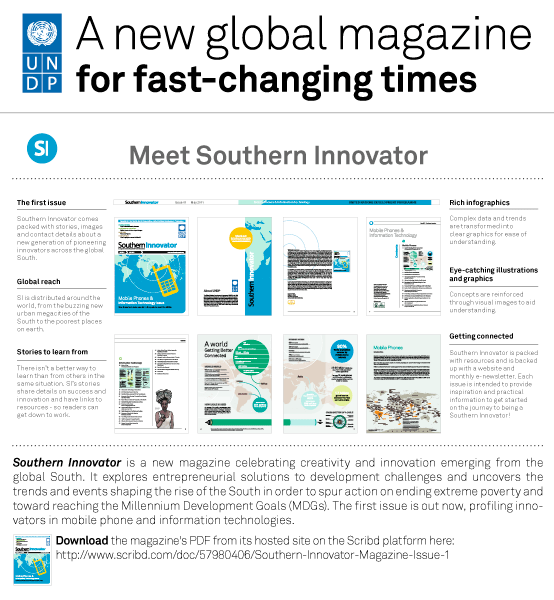
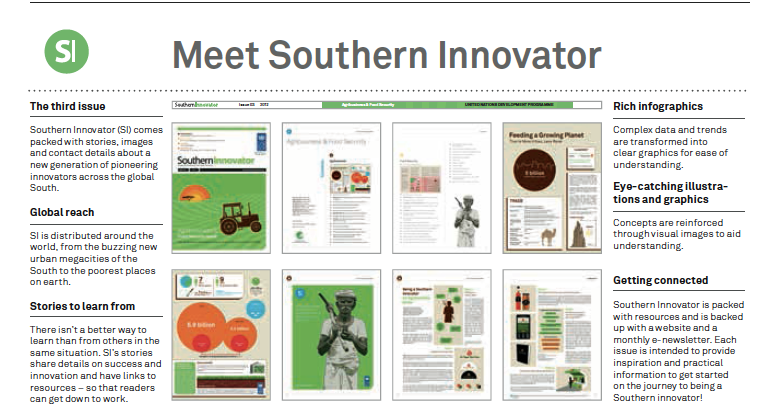
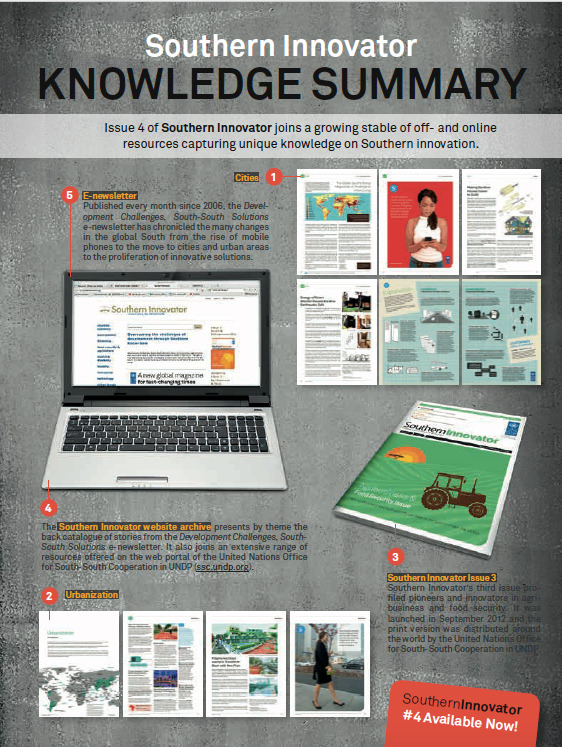
Development Challenges, South-South Solutions was launched as an e-newsletter in 2006 by UNDP’s South-South Cooperation Unit (now the United Nations Office for South-South Cooperation) based in New York, USA. It led on profiling the rise of the global South as an economic powerhouse and was one of the first regular publications to champion the global South’s innovators, entrepreneurs, and pioneers. It tracked the key trends that are now so profoundly reshaping how development is seen and done. This includes the rapid take-up of mobile phones and information technology in the global South (as profiled in the first issue of magazine Southern Innovator), the move to becoming a majority urban world, a growing global innovator culture, and the plethora of solutions being developed in the global South to tackle its problems and improve living conditions and boost human development. The success of the e-newsletter led to the launch of the magazine Southern Innovator.
The beep-beep of a received text on a mobile phone is now becoming a much-needed lifeline to Africans. Zimbabweans, who continue to struggle every day with inflation that has shot to 3,731 percent (Zimbabwe Central Statistical Office), have usd African ingenuity and 21st century technology to survive another day.
New website services have become a literal lifeline for millions suffering from economic and social hardships. At least four new web-based services have stepped in to link expatriate Zimbabweans working outside the country with their relatives back home. All share a common service: people can log into the websites and shop and select what they like to purchase or transfer to their relativs. Once a purchase has been made, a message is sent by mobile phone text to Zimbabwe, either transferring money credits or credits for fuel, food or medical services.
Mukuru.com is the most elaborate and ambitious of the services, and is expanding across Africa (currently in Zimbabwe and South Africa, it is expanding to Kenya, Malawi and Zambia). Started in 2006, it now boasts 8,000 customers and is averaging 1,200 orders per month, ranging from money transfers to fuel and digital satellite television subscriptions. A voucher number sent by mobile phone also allows the recipient to swap a PIN (personal identification) number for coupons redeemable at certain garages.
One of the great advantages of this new technology is its ability to give real-time updates and tracking throughout the transaction. Senders are informed about every stage of the transaction, right up until the gas is gushing into the car’s tank.
“Basically anybody who is able to work will do their best to support family back home,” said Mukuru’s UK-based Nix Davies. “Mukuru’s birth is the result of our inability to sit back and watch, as well as the desperate need to help those back home. The power of an instant SMS being able to provide value to its recipient is inspiring.
“Launching Mukuru.com has not been without its hurdles,” continues Davies. “Promoting a brand with one foot in the first world and having to deal with third world inconsistencies is always challenging.” Mukuru also has plans to expand into travel, freight, mail (letters are printed out and sent within Zimbabwe), and music to help local musicians.
Over at another website, Zimbuyer.com, expatriate Zimbabweans can buy groceries for their relatives at home and make sure that the money is not spent on the wrong thing. “They’re a lot of people who left Zimbabwe and, for example, have left their children over there,” a spokesman told the BBC’s website. “But sometimes the money they have sent home for the care of the children is diverted into other things. With our service, people buy the stuff – and we deliver them to the recipients so they know what they’re buying.”
Zimbuyer’s website is similar to food shopping websites in developed countries. Prices are listed in British pounds, but the food items are Zimbabwean staples like sadza maize, Cashel Valley Baked Beans and Ingrame Camphor Cream – all delivered to people living in Harare, Chitungwiza and Bulawayo.Zimbuyer’s most popular products are cooking oil and sugar, while “power generators are proving popular because the electricity always goes off nearly every day.”
Another service is Zimland.com, which has a network of 52 supermarkets nationwide. As it starkly boasts on its website, it gives Zimbabweans abroad “a quick and efficient way of ensuring their families do not starve in Zimbabwe.”
The Zimland Superstore offers a variety of hampers of food and essentials for families, from the Madirativhange to the Mafidhlongo to the Hotch Potch Delux, and boys and girls ‘Back to School’ hampers.
Yet another service has taken on the problem of paying for medical and health services. Beepee Medical Services allows Zimbabweans to pay for doctors’ appointments, prescription drugs and surgery for relatives.
Launched in September 2006 by Dr Brighton Chireka and his wife Prisca, a nurse, the business is small but growing.
“Mostly we’re running it as a service to help people,” said Dr Chireka, adding he gets about two consultation bookings a day (US $30 an appointment). “It should be able to pay for itself… We’ve employed people who are working full-time in Zimbabwe. This side (the UK), it’s on a part-time basis to answer the calls.”
Please visit the following link for more information:
An up-to-date report from The Economist magazine on the country situation in Zimbabwe: www.economist.com
Published: November 2008
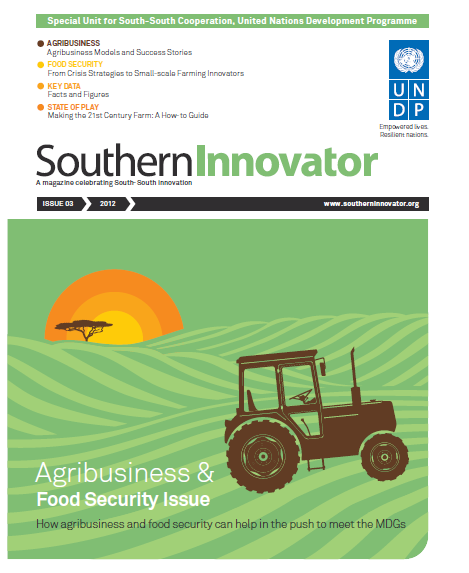
By 2012, Southern Innovator had completed its global reader impact study.
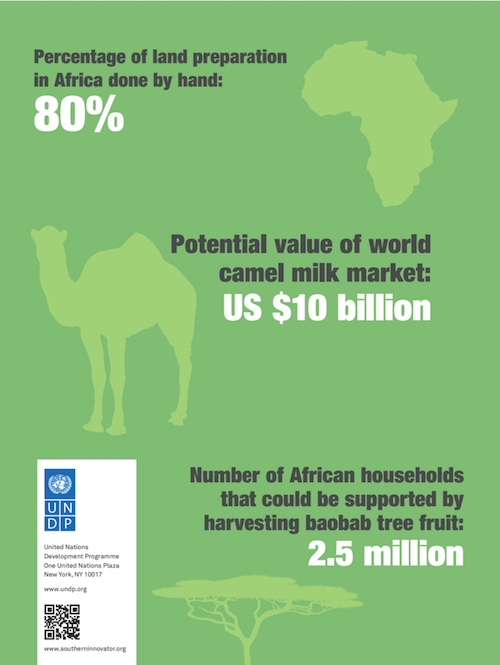
The fruit of the highly revered African baobab tree is being seen as a great new opportunity for the poor, after a recent decision by the European Commission to allow its importation. According to one study, gathering the fruit has the potential to earn an extra US $1 billion a year for Africa, and bring work and income to 2.5 million households, most of them African bush dwellers (Britain’s Natural Resources Institute).
The fruit of the African baobab tree is mostly collected in the wild from the ancient trees, which can live for 500 years, with some as old as 5,000 years. The baobob enjoys the veneration and respect traditionally accorded to age in Africa, and features in many stories and myths.
The fruit is seen as highly nutritious and a new taste option for the European market. This could be a major potential boost to Africa; the European Union is the world’s biggest trader, accounting for 20 percent of global imports and exports, and a major trading partner of most African countries. South Africa alone exports Euro 20.9 billion a year to Europe (2007).
But serious concerns have been raised about how the harvesting of the fruit will be done, and under what conditions. Getting this right is critical if the sustainability of the fruit is to be maintained, local populations are to benefit, and local use of this food source — eaten by both people and animals — does not suffer.
European food and drink companies are looking to use the fruit of the tree to flavour a large range of products, from cereal to drinks.
Baobab fruit is valued for its alleged medicinal properties in treating fevers and diarrhoea, and as a calcium supplement.
“The potential is huge … We’re quite confident that it’s going to represent significant returns for rural producers,” Dr. Lucy Welford, marketing manager of PhytoTrade Africa, a trade organisation that campaigns for the sustainable use of African natural products, told Reuters.
“I’d say it’s somewhere between grapefruit and tamarind as a kind of flavour,” said Welford, who expects baobab fruit to be used at first to flavour smoothies and cereal bars. It could also be used in juices, ice-creams and jams or bakery products.
PhytoTrade works with South African firm Afriplex, which supplies baobab fruit pulp and extracts.
A refreshing juice made from baobab fruit pulp, known as “bouye” is widely served.
“The tart flavour, the interesting vitamin and nutrition profile and the sexy story that goes with it — that it’s wild harvested from a very lovely tree — these things add value to the existing products,” said marketing economist Ben Bennet, who wrote the 2007 Natural Resources Institute’s report.
In the baobab forests around Tandene village in Senegal, local farmers said they looked forward to earning much more from the trees. Prices for a kilo of baobab fruit varied between 40 US cents and a dollar, they said.
“If people know (that European consumers will buy the product) then they’ll look after the trees better and feed them less to their animals,” said farmer Alassane Sy.
Chido Makunike, an active commentator on food and agricultural issues in Africa, raises some serious concerns about how this is handled. “Being a non-cultivated forest product, who ‘owns’ the baobab fruit? Can anybody just take a truck into the forest, collect the fruit and export it? Obviously the sudden dramatic change in the economic importance of the baobab will open up many questions that will need regulation.”
He worries the fruit will just be exported in its raw form, and processed into products in Europe – leaving Africa and Africans the ones who benefit least economically.
“Yet baobab is a dry, not-easily perishable, easy to process fruit,” he said. “It would not be difficult to have the smoothies and cereal bars that are being contemplated for its use made in Africa and exported as finished product, producing many downstream benefits and keeping more of the wealth to be generated within the continent.”
Published: October 2008
Resources
The Chamber of Commerce for Switzerland is specially targeting trade deals with Africa and its entrepreneurs. Website: www.swisscham-africa.ch
EMN Europe is a company that organises all logistics for importing goods into Europe, including making sure all legal requirements are met. Website: www.eurotradeconcept.nl
The Baobab Fruit Company Senegal has been producing organic baobab products for the nutrition and cosmetics industries. Website:http://www.baobabfruitco.com/
The Fairtrade Labelling Organization sets the standards for fair-trade and is the place to go to receive official certification. Website:www.fairtrade.org.uk
Just Food is a web portal packed with the latest news on the global food industry and packed with events and special briefings to fill entrepreneurs in on the difficult issues and constantly shifting market demands. Website: http://www.just-food.com








 David South Consulting
You must be logged in to post a comment.