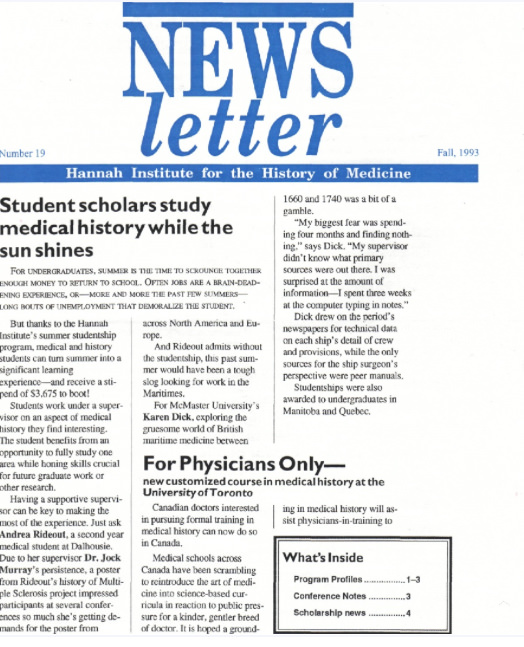
Though many feel a golly-gee-whiz response when medical science leaps another hurdle towards genetic manipulation, research by two recent Royal Society Hannah Medal winners into the history of eugenics sends a chill up the spine.
Both University of Toronto’s professor Pauline Mazumdar, author of Eugenics, Human Genetics and Human Failings: The Eugenics Society, its Sources and its Critics in Britain (Routledge, 1992), and Angus McLaren, University of Victoria professor of history and author of Our Own Master Race: Eugenics in Canada, 1885-1945 (McClelland and Stewart, 1990), disclose how mainstream genetic selection once was – and possibly still remains.
“Ever since the test tube baby breakthrough a decade ago, there’s been a new concern for the spin-offs of this research,” says McLaren. “In Canada there’s a woman who was sterilized in Alberta who is now suing the Alberta government, so that is bringing it back into the consciousness that these things actually did happen.”
“Many quite respectable individuals took it as given that there must be something in eugenics. That was the difficulty in writing the book, determining who was a eugenist and who wasn’t. It was so widely believed that it was very hard to make a serious demarcation.”
Professor McLaren found winning the medal helped raise his profile. And the resulting media interest allowed him to put the issue in historical perspective.
“The problem as ever is people looking for some sort of a quick fix to social problems – hoping that some sort of genetic tampering will allow very complex problems to be surgically dealt with.”
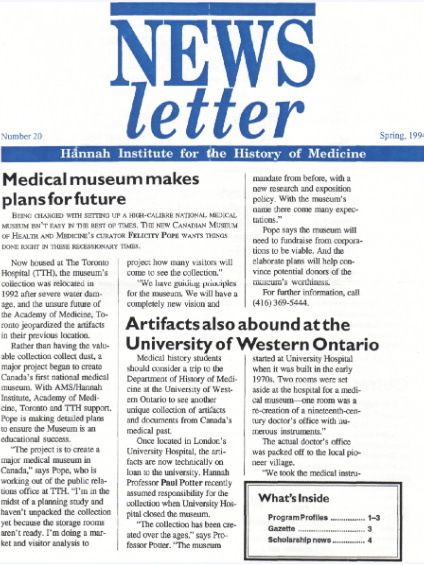
Cars, mostly olive green Russian jeeps, weave in and out of the five-storey apartment blocks of downtown Dalanzadgad. Running through the centre of the capital of Omnogobi is a gardened boulevard, where families hide from the hot sun under trees.
That one road, and the few feeding into it, are the only enforced guides for drivers. It can be seen across Mongolia – settlements crisis-crossed by drivers looking for the shortest route to their destination. It doesn’t help that there are no natural or manmade barriers to prevent drivers going their own way.
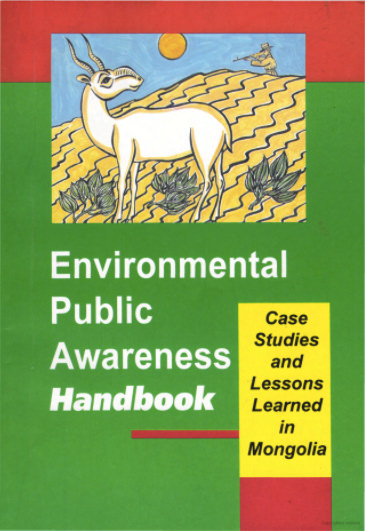
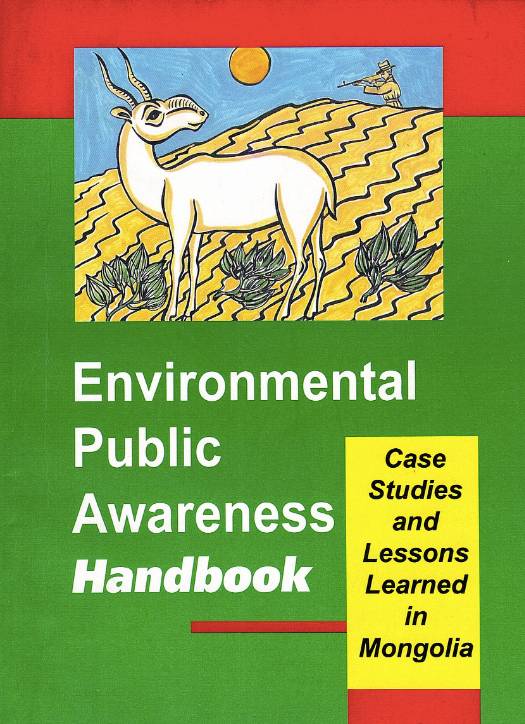
In Dalanzadgad, a UNDP project to protect the environment from off-road driving has had an unexpected outcome: it has galvanized the community to make the streets safer by adding over 100 traffic signs. The project “Soil and Road” under UNDP’s Environmental Public Awareness Programme (EPAP), started modestly. According to project director and local Khural head Mr. Byambasuren, the number of vehicles in the area shot up from 800 three years ago, to 1,500 today. Most of these vehicles drive off-road, kicking up dust and destroying flora, contributing to desertification.
“The disease rate here is very high because of the dust and we have many traffic accidents involving children,” says Byambasuren.
With a small grant of Tg 2.5 million from EPAP the project was able to organize workshops for local drivers where they signed a contract to not drive off-road, facing stiff penalties from the traffic police if caught.
A media campaign was also organized and posters and brochures distributed. The local traffic police were so impressed by the project they decided to chip in a further Tg 2 million to construct traffic signs and install concrete calming barriers.
At first they explored the possibility of buying ready-made signs but found the costs too prohibitive.
“We wanted to get signs that glowed at night but they were too expensive. We decided to make our own out of old oil drums.”
In a room thick with the smell of fresh paint sits the traffic signs. They all use internationally recognized symbols and only upon closer inspection, reveal their past life sitting on top of an oil drum. Each sign costs Tg 2,000 to make. In addition to the signs traffic calming concrete barriers have been installed in 20 places throughout Dalanzadgad.
Next year Byambasuren will target the large ger districts that surround the centre of Dalanzadgad. He has a message for any driver who doesn’t obey: “We will be banging on their heads with lectures if they break the rules!,” he says with a laugh.
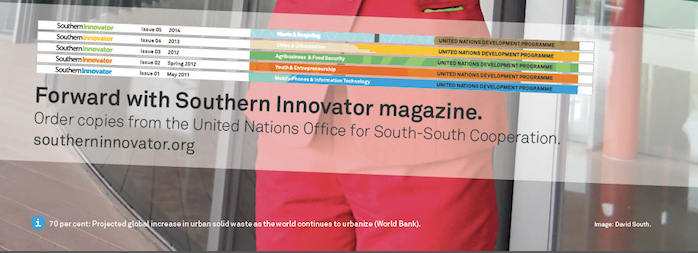
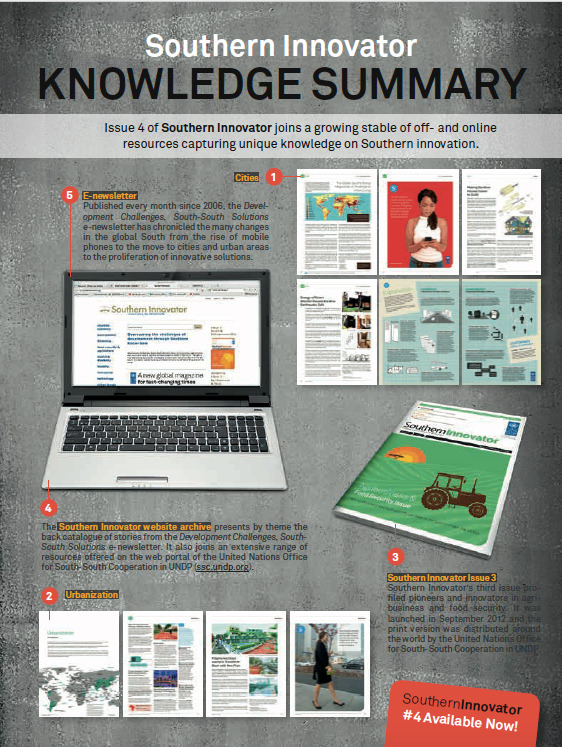
If you would like hard copies of the magazine for distribution, then please contact the United Nations Office for South-South Cooperation: Website:http://ssc.undp.org/content/ssc.html. If you would like to either sponsor an issue of Southern Innovator or place an advertisement in the magazine, then please contact southerninnovator@yahoo.co.uk. This is a great opportunity to reach millions around the world and to connect with the pioneers and innovators shaping this new world. With Issue 5 tackling the timely theme of Waste and Recycling, this is the moment to get on board and help support SI. With global urbanization levels continuing to rise, fresh thinking of the kind found in Southern Innovator‘s fifth issue is urgently required.
The ongoing economic crisis in Europe is forecast to harm the economies of the world’s poorest countries if it continues, according to a study by the United Kingdom’s Overseas Development Institute (ODI) (odi.org.uk).
As an example, Kenya’s shilling currency has weakened and increased the cost of imports, leading to a surge in inflation, while the number of European tourists has declined, according to Business Daily.
Raging since 2009 (http://www.bbc.co.uk/news/business-13856580), the eurozone crisis has seen several European countries struggling to pay debts built up during the boom years, and this has threatened the currency compact among countries that use the euro single currency (http://www.ecb.europa.eu/euro/html/index.en.html). Several countries have introduced harsh austerity measures to try and rein in the debts and stabilize economies while keeping countries within the eurozone.
This has had the consequence of dramatically raising unemployment levels, reducing consumption of goods and services and increasing poverty rates in many European countries. Some governments have responded by reducing the amount of legal labour migration allowed into their countries.
The study estimates that the euro crisis could amount to a loss of US $238 billion for poorer countries from 2012 to 2013 as aid, trade, investment and remittance payments sent home to relatives and friends are damaged by the crisis.
This would particularly harm export-dependent, emerging-market countries. The study found demand was weakening for products from low and low-to-middle income countries. This would in turn harm growth in these countries. Growth in the past decade has helped many countries lift millions of people out of poverty and enabled the growth of new middle classes, who in turn use their rising incomes to purchase consumer goods and invest.
The crisis will cause developing countries’ currencies to drop in value if they are pegged to the euro, and for countries to be economically harmed because of austerity policies in European countries, said the study’s author, Dr. Isabella Massa.
“The EU remains the largest single export market for poorer countries, although it is the emerging BRIC economies which are their main source of imports.”
The European Union (EU) (http://europa.eu/index_en.htm) is the biggest market in the world and the largest importer of goods from developing countries. The ODI report found a 1 per cent drop in global export demand has the knock-on affect of reducing growth in poor countries by 0.5 per cent. The countries most at risk from the crisis are Mozambique, Kenya, Niger, Cameroon, Cape Verde and Paraguay.
For example, 17 per cent of Ivory Coast’s exports go to the EU. Mozambique sends 14 per cent of its exports to the EU and Nigeria sends 10 per cent.
Tajikistan in Central Asia was the most highly dependent economy on remittance payments from its workers living outside the country to prop up its GDP (gross domestic product). Remittance payments from Tajik citizens outside the country made up 40 per cent of GDP.
Liberia and the Democratic Republic of Congo were both heavily dependent on foreign direct investment (FDI) from Europe in 2010.
Many countries have also grown used to strong demand for their resources in recent years as China has rapidly developed and urbanized, sucking in more and more resources from around the world, including sub-Saharan Africa.
“Poor countries are vulnerable to the euro crisis not only because of their exposure (due to dependence on trade flows, remittances, private capital flows and aid) but also because of their weaker resilience compared to 2007, before the onset of the global financial crisis,” said Massa.
“The ability of developing countries to respond to the shock waves emanating from the euro area crisis is likely to be constrained if international finance dries up and global conditions deteriorate sharply.
“The escalation of the euro crisis and the fact that growth rates in emerging BRIC economies, which have been the engine of the global recovery after the 2008-9 financial crisis, are now slowing down make the current situation really worrying for developing countries.”
Despite the gloom, there are many positive and powerful antidotes to this economic crisis, including rising South-South trade and innovation, which shows it is possible to reduce dependency on wealthy-developed countries alone for economic prosperity.
Published: September 2013
Resources
1) UNRISD: United Nations Research Institute for Social Development: The United Nations Research Institute for Social Development (UNRISD) is an autonomous research institute within the UN system that undertakes multidisciplinary research and policy analysis on the social dimensions of contemporary development issues. Website: unrisd.org/
2) The Global Urbanist: News and analysis of cities around the world: planning, governance, economy, communities, environment, international. Website: globalurbanist.com
3) OECD: The global economic crisis is entering a new phase amid signs of a return to positive growth in many countries. But unemployment is likely to remain high and much still needs to be done to underpin a durable recovery. This website will track the recovery. Website: http://www.oecd.org/general/tacklingthecrisisastrategicresponse.htm
4) African Union: This vision of a new, forward looking, dynamic and integrated Africa will be fully realized through relentless struggle on several fronts and as a long-term endeavor. The African Union has shifted focus from supporting liberation movements in the erstwhile African territories under colonialism and apartheid, as envisaged by the OAU since 1963 and the Constitutive Act, to an organization spear-heading Africa’s development and integration. Website: http://www.au.int/en/
5) Youth-Inclusive Financial Services (YFS-Link) Program website: The first space for financial services providers (FSPs) and youth-service organizations (YSOs) to gather, learn and share about youth-inclusive financial services. Website: http://www.makingcents.com/ourWork/yfsLink.php
6) Triple Crisis Blog: Global Perspectives on Finance, Development and Environment: Website: http://triplecrisis.com/
7) African Economic Outlook: A unique online tool that puts rigorous economic data, information and research on Africa at your fingertips. A few clicks gives access to comprehensive analyses of African economies, placed in their social and political contexts. This is the only place where African countries are examined through a common analytical framework, allowing you to compare economic prospects at the regional, sub-regional and country levels. Website: africaneconomicoutlook.org/en


















 David South Consulting
You must be logged in to post a comment.