Tag: Canada

  • African Media Changing to Reach Growing Middle Class

    African Media Changing to Reach Growing Middle Class

    By David SouthDevelopment Challenges, South-South Solutions

    SOUTH-SOUTH CASE STUDY

    Africa’s growing middle classes are being targeted by a new generation of media entrepreneurs. This growing group of Africans is ambitious and intelligent, and they want media that matches their aspirational ways. Clever media people are stepping up to feed this trend.

    The continent as a whole forms the 10th largest economy in the world. Of Africa’s more than 1 billion people, 900 million can be classified as part of the consumer economy. Out of this group, there a third – approximately 300 million people – make modest sums by Western standards, about US $200 a month, but have spare cash to buy things like mobile phones, DVDs and new clothes, or pay for better schools. They are the population that is overlooked when attention is focused only on the very poor living on less than US $2 a day.

    Pulitzer Prize-winning Nigerian journalist Dele Olojede is one of several African media pioneers re-shaping the continent’s media and taking it to the next level. Another is Godfrey Mwampembwa, whose popular puppet television show satirizes contemporary politics and current events and brings a welcome local flavour to a programming schedule packed with foreign imports.

    A book by University of Texas professor Vijay Mahajan, Africa Rising, details the phenomenon of Africa’s middle class consumer society. He calls this group of middle class consumers ‘Africa 2’, with the desperately poor called Africa 3s, and the extremely rich Africa 1s.

    This new group has expanded far beyond just the ruling elites and government workers. Many of its members work in the private sector, as secretaries, computer entrepreneurs, merchants and others who have benefited from consistent growth rates in many African countries.

    And because these people consume products and services – and advertising products and services are the lifeblood of private media – the opportunities are plentiful.

    “I’m convinced that Africa is going to be built by Africa 2s,” Mahajan told the Washington Post newspaper. “These are the people sending their kids to school . . . who are the most optimistic, the most forward-thinking.”

    Olojede, owner and publisher of Next newspaper (http://234next.com/csp/cms/sites/Next/Home/index.csp) in Nigeria’s biggest city, Lagos, has been able to grab readers by breaking original stories and offering a quality, well-designed publication. Launched in 2008, it has its sights set on going continent-wide by 2011.

    “There is a need for a newspaper for the African metropolitan middle classes, along the lines of the International Herald Tribune,” he told Monocle magazine.

    Olojede cut his teeth as a foreign editor for the US newspaper Newsday and has used this experience to make Next such a success.

    Next has become the number one news website in Nigeria’s highly competitive media scene.

    Wisely, Olojede put design at the centre of making his newspaper and website stand out from the competition. He commissioned the experienced newspaper design team of Garcia Media (http://garciamedia.com/blog/articles/in_west_africa_a_new_newspaper_is_born_—online_first) – who have designed for The Wall Street Journal, The Miami Herald and Die Zeit – to develop the template and prototypes.

    Kenyan economist James Shikwati (http://en.wikipedia.org/wiki/James_Shikwati) believes Africa’s middle-income consumers are also a driving force for political change.

    “It’s empowering,” he told the Washington Post. “If you give people a sense of freedom in the economic sector, then you deny it in the political sector, you have a problem.”

    Kenya-based newspaper cartoonist Gado (Godfrey Mwampembwa) has profited from this phenomenon. Fed up with TV channels sticking to a menu of foreign imports and dull news programmes, he looked to famous puppet TV shows Spitting Image (from Britain) and Les Guignols (from France) for inspiration. The result is the XYZ Show (http://xyzshow.com/blog), which features grotesque puppet caricatures of well-known public and political figures. The show’s blog makes for an excellent entry point into African TV programme-making and its ups and downs. The show is broadcast on Citizen TV in Kenya’s capital, Nairobi.

    “I moved to Nairobi in 1992 when I was 23,” Mwampembwa explained to Monocle. “The Daily Nation, the biggest newspaper in Kenya, had lost its editorial cartoonist so they ran a competition to look for his replacement. I sent in my drawings and came second.”

    “I took a year off in 2000-2001 to study film and animation in Vancouver. When I got back to Nairobi I started thinking about the sort of TV programme I would like to make. Kenya needed a show that would make fun of our politicians and expose hypocrisy and I thought a puppet show like Les Guignols or Spitting Image would be a great way to do it.”

    “We managed to raise funds for a pilot in 2007 and Citizen TV (http://www.facebook.com/pages/Citizen-TV-Kenya/261061365404), a private station, eventually agreed to broadcast a series.”

    Each episode costs US $16,740 and the puppets are US $3,600 to make. The programme-makers could only get money from foreign donors: the French, Dutch, and Finnish embassies and the Ford Foundation.

    Despite initial complaints from politicians, the show is preparing for its second season – and, Mwampembwa said, “there will be a lot of big stories for us to cover.”

    Making a popular TV show is not an easy thing to do. Mwampembwa maintains a furious work pace to straddle his many roles:

    “I have to draw a cartoon every day but editorial cartooning is not a nine-to-five job, it’s 24/7. Whenever I get ideas I have to sketch them.

    “It was a steep learning curve in the first season. The show is important for Kenyan TV and everything is done here in Nairobi. We won’t change any of the politics though. We are very hard-hitting and we will stay that way.

    “Over the years I’ve got nasty letters, emails and phone calls but that’s OK, it’s part of it.”

    As these media innovators show, there is nothing but opportunity for entrepreneurs feeding the hungry news and information appetite of the continent’s ambitious middle class.

    And Mwampembwa says becoming better informed doesn’t have to be dull: “We are informing the public but I’d like to think we are entertaining them too.”

    Published: September 2010

    Resources

    • Africa Rising: A book by Professor Vijay Mahajan on how Africa’s consumer economy is growing and growing. Website: http://tinyurl.com/2vk3m9n

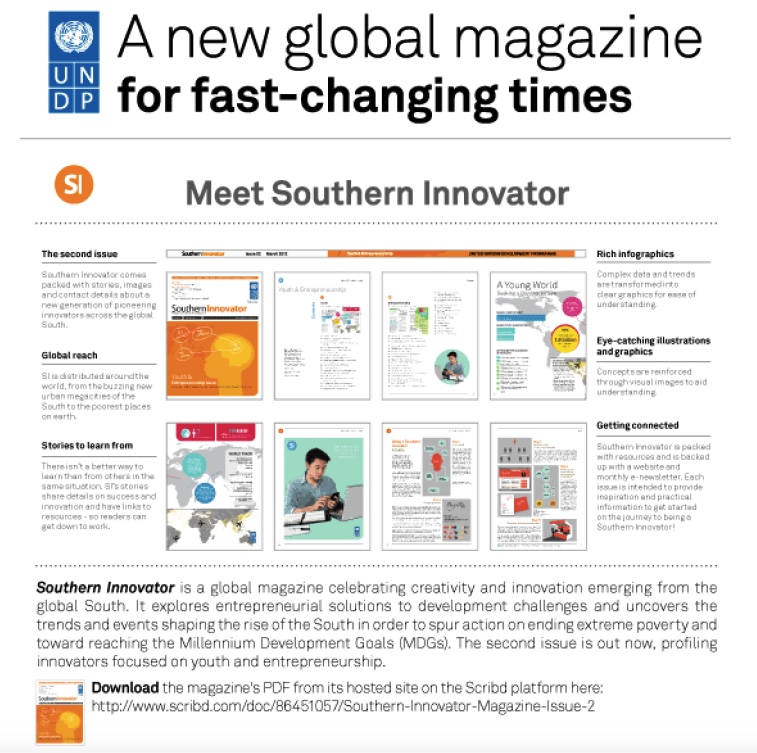
    Development Challenges, South-South Solutions was launched as an e-newsletter in 2006 by UNDP’s South-South Cooperation Unit (now the United Nations Office for South-South Cooperation) based in New York, USA. It led on profiling the rise of the global South as an economic powerhouse and was one of the first regular publications to champion the global South’s innovators, entrepreneurs, and pioneers. It tracked the key trends that are now so profoundly reshaping how development is seen and done. This includes the rapid take-up of mobile phones and information technology in the global South (as profiled in the first issue of magazine Southern Innovator), the move to becoming a majority urban world, a growing global innovator culture, and the plethora of solutions being developed in the global South to tackle its problems and improve living conditions and boost human development. The success of the e-newsletter led to the launch of the magazine Southern Innovator. 

    Creative Commons License

    This work is licensed under a
    Creative Commons Attribution-Noncommercial-No Derivative Works 3.0 License.

    ORCID iD: https://orcid.org/0000-0001-5311-1052.

    © David South Consulting 2023

  • Trade to Benefit the Poor Up in 2006 and to Grow in 2007

    Trade to Benefit the Poor Up in 2006 and to Grow in 2007

    By David SouthDevelopment Challenges, South-South Solutions

    SOUTH-SOUTH CASE STUDY

    The global fair trade market – in which goods and services are traded under the Fairtrade logo, guaranteeing a minimum fair price to producers experienced unprecedented growth in 2006. In the UK alone, 2006 sales totalled £290 million – a jump of 46 percent from 2005. The Fairtrade Foundation predicts sales will reach UK £300 million in 2007.

    In 2005 Fairtrade sales were € 1.1 billion in the brand’s main markets of Switzerland, the UK, New Zealand, Australia and the US. At present fair trade works with 5 million farmers in the global South, and it represents an ever-increasing opportunity for Southern entrepreneurs.

    A tipping point has been reached in Western awareness of and demand for the Fairtrade brand and concept, and it is now being adopted by major supermarkets. In the UK, 62 percent of consumers know the logo and understand what it means.

    The concept of fair trade began in the Netherlands in 1988, when the Max Havelaar Foundation launched the Fairtrade consumer label with coffee from Mexico. Unlike conventional businesses, where the price paid to a producer is what the market dictates, fair trade guarantees the producer a minimum price for their product. This amount is set at a level that ensures the producer can live a life with dignity and meet all the essentials. A portion of the profits is also kept in a communal fund which the producers democratically elect to spend as they wish (many choose to spend it on community projects).

    Fair trade has been criticized for a number of reasons. It has been seen as too small and marginal to really make inroads on poverty, and has been accused of privileging a small number of producers while ignoring the rest. It has also been criticized for not focusing enough on innovation and increasing production to really eradicate poverty in the developing world.

    For all its faults and shortcomings, it is a fact that the Fairtrade brand is a runaway success and offers a wide range of opportunities for entrepreneurs.

    In the UK, fair trade now includes 2,500 products, ranging from footballs, to tea, cotton and honey – up from just 150 in 2003, an astonishing rate of growth. Where fair-trade products were once confined to co-operative and charity shops, they are now widely sold in major supermarkets.

    The success of fair trade is not confined to Europe and the US. It is growing in Japan, where, says fair trade retailer Sonoko Iwasa, “the concept of using trade to equalize the world by buying goods from developing countries from Asia and Africa was a notion that had no connection with everyday lives.”

    Iwasa’s Rumaba Goods store just outside Tokyo sells organic chocolates from Africa, woollen gloves and hats from Nepal, and elegant clothes from Thailand. Iwasa found that the key in the highly competitive Japanese consumer market was to focus on quality, not fairness. This, she says, has made these products fashionable.

    At present, the fair trade market is worth only about US $6 to $7 million a year in Japan and includes 1,500 products. But according to Michiko Ono of Japan’s best-known fair trade label, People Tree, the trend is catching on among the country’s socially aware youth.

    To start a fair trade business, entrepreneurs or producers need first to contact the international body that certifies fair trade products and ensure that production meets the ethical standards required.

    Published: January 2007

    Resources

    https://davidsouthconsulting.org/2022/06/02/afghanistans-juicy-solution-to-drug-trade/

    https://davidsouthconsulting.org/2022/11/02/african-online-supermarket-set-to-boost-trade/

    https://davidsouthconsulting.org/2022/10/26/african-trade-hub-in-china-brings-mutual-profits-2/

    https://davidsouthconsulting.org/2022/11/21/chinese-trade-in-angola-helps-recovery/

    https://davidsouthconsulting.org/2022/11/19/cooking-up-a-recipe-to-end-poverty/

    https://davidsouthconsulting.org/2022/04/12/djibouti-re-shapes-itself-as-african-trade-hub/

    https://davidsouthconsulting.org/2022/10/24/flurry-of-anti-poverty-innovations/

    https://davidsouthconsulting.org/2021/07/19/global-south-trade-boosted-with-increasing-china-africa-trade-in-2013/

    https://davidsouthconsulting.org/2022/10/21/local-animation-a-way-out-of-poverty/

    https://davidsouthconsulting.org/2022/10/26/perfume-of-peace-helps-farmers-switch-from-drug-trade/

    https://davidsouthconsulting.org/2022/10/21/social-networking-websites-a-way-out-of-poverty/

    https://davidsouthconsulting.org/2021/07/19/south-south-trade-helping-countries-during-economic-crisis/

    https://davidsouthconsulting.org/2021/03/05/southern-innovator-issue-2/

    https://davidsouthconsulting.org/2021/01/23/a-steppe-back-economic-liberalisation-and-poverty-reduction-in-mongolia/

    https://davidsouthconsulting.org/2021/01/23/the-sweet-smell-of-failure-the-world-bank-and-the-persistence-of-poverty/

    https://davidsouthconsulting.org/2022/11/18/web-2-0-networking-to-eradicate-poverty/

    https://davidsouthconsulting.org/2022/10/05/women-empowered-by-fair-trade-manufacturer/

    https://davidsouthconsulting.org/2022/06/16/women-mastering-trade-rules/

    Development Challenges, South-South Solutions was launched as an e-newsletter in 2006 by UNDP’s South-South Cooperation Unit (now the United Nations Office for South-South Cooperation) based in New York, USA. It led on profiling the rise of the global South as an economic powerhouse and was one of the first regular publications to champion the global South’s innovators, entrepreneurs, and pioneers. It tracked the key trends that are now so profoundly reshaping how development is seen and done. This includes the rapid take-up of mobile phones and information technology in the global South (as profiled in the first issue of magazine Southern Innovator), the move to becoming a majority urban world, a growing global innovator culture, and the plethora of solutions being developed in the global South to tackle its problems and improve living conditions and boost human development. The success of the e-newsletter led to the launch of the magazine Southern Innovator. 
    Creative Commons License

    This work is licensed under a
    Creative Commons Attribution-Noncommercial-No Derivative Works 3.0 License.

    ORCID iD: https://orcid.org/0000-0001-5311-1052.

    © David South Consulting 2023

  • China Consumer Market: Asian Perspective Helps

    China Consumer Market: Asian Perspective Helps

    By David SouthDevelopment Challenges, South-South Solutions

    SOUTH-SOUTH CASE STUDY

    The rise of China since 1989 has been the most remarkable development story of our times. The number of people lifted out of poverty is historically unprecedented: 65 percent of Chinese people lived below the poverty line in 1981; in 2007 it was 4 percent (World Bank).

    Many commentators have focused on China’s astonishing work ethic, vast labour resources and ability to export great quantities of products. But while China has been busy meeting the needs of the world economy, domestic Chinese consumption has received less attention.

    Yet, with the Chinese firmly established as keen savers and very ambitious to improve their living standards, a vast new opportunity has emerged: the Chinese consumer market. But it will be a tricky market to tap. Chinese consumers are notorious bargain hunters and prefer to save and invest rather than consume. Poor rural families earning less than US $200 per person a year still are able to save 18 percent of their income.

    This makes a lot of sense: social supports have been stripped away as China’s economy embraced the market system. If you do not save and invest, then you will not have the resources to meet the costs of education and health care, for example. China has also seen a dramatic move to urban areas, with over 43 percent of the population now urban.

    China, despite all the hype, is still a marketplace that is difficult to easily enter for Western brands and businesses. And this makes for an opportunity for local brands to raise their game.

    In order to compete in the consumer market, businesses need to do more than compete on price: they need to also offer something more and that usually involves building a strong brand.

    The Chinese urban consumer market could grow from around US $570 billion in 2005 to around US $4.7 trillion by 2025 (PWC) (http://www.pwc.co.uk). Fast growth will be seen in discretionary spending, things other than food, clothing and utilities.

    While Chinese businesses have focused on export markets and meeting the needs of the global marketplace – a focus which has been very successful and led to remarkable wealth gains – the Chinese consumer has come lower down the list of priorities.

    Growing the domestic consumer market offers a substantial wealth-creating opportunity. Since the global economic crisis erupted in 2008, it has become apparent that the old model of exporting vast quantities of products to Western consumers alone will not be enough to keep living standards rising. Western economies are highly indebted and will take many years to recover from the mistakes and debts from the boom years and the economic crisis.

    This is an opportunity for South-South trade, which made up 20 percent of global exports by 2010. Foreign direct investment to developing economies rose by 10 percent in 2010 due to a rapid economic recovery and increasing South-South flows.

    One company successfully targeting this market is the Singapore-based Banyan Tree Hotels and Resorts brand (www.banyantree.com), which bills itself as specializing in luxury sanctuaries to rejuvenate the body, mind and soul. It is notable for deliberately not competing on price but on its brand reputation and for tailoring its offering explicitly to Asian tastes. The company claims its resorts are “naturally-luxurious, ecologically sensitive, culture-aware experiences for the discerning, responsible traveller.”

    The first Banyan Tree resort was built in Phuket, Thailand in 1987. It now employs 8,200 people from 50 nationalities in 26 resorts. Founder and executive chairman Ho Kwon Ping focused from the start on the business’s brand as critical to driving the growth of the company.

    He told INSEAD Knowledge: “The difference between us and some others is that, for many other companies having a strong brand is a reward for being successful in many things that you do but it’s sort of coincidental. It comes afterward; it’s a reward for success in other areas. For us, we’ve always said from the very beginning – having a strong brand is imperative for our survival.”

    Banyan Tree has also eschewed quick-growth models, instead trying to do as little environmental damage as possible and to include community development and environmental projects at each resort.

    Its Banyan Tree Ringha resort in China’s Yunnan province tries to bring the atmosphere of the fictional earthly paradise of Shangri-La to China. Ringha Valley sits near the Temple of the Five Wisdom Buddhas, 3,600 meters above sea level. The resort has 15 one-bedroom suites, 11 two-bedroom lodges, and six spa suites, decorated in a Tibetan style. The area is home to the Naxi people who trace their origins to nearby Tibet (http://en.wikipedia.org/wiki/Naxi_people).

    The accommodation is rustic and the resort is located in the middle of a village. Visitors can see farmers at work right from the resort. Overlooked by Tibetan mountains and settled in a lush, fertile valley the sight was picked for its tranquillity and isolation. The appeal of the area to tourists is clear: mountain peaks, deep canyons, rivers, valleys, streams and tranquil lakes. And in polluted urban China, it is an area free from pollution.

    The resort is built from transplanted Tibetan farm houses and offers hikes, mountain lakes, hot springs, gorges, forests. There are Asian touches like a welcome at the resort of Tibetan horns, songs and a tea ceremony.

    Tourism is transforming the area. Towns and villages have been renovated to showcase traditional architecture.

    The hotel and resort chain gets its name from the tradition of ancient merchants gathering under the branches of the banyan tree to conduct business in the cool shade.

    “The 21st century is really going to be the age of Asia – both India and China,” said Ho Kwon Ping. “The huge consumer markets are going to be Asian … Now there’s a real opportunity for people of Asian origin, who have an instinctive cultural feel for where their consumers are moving towards, to come out and create a brand which can be primarily rooted in their own Asian context, but have a global relevance.”

    Published: March 2011

    Resources

    1) How big will the Chinese consumer market get by 2025? A report by PriceWaterhouseCoopers. Website: http://tinyurl.com/5upqew8

    2) An interactive map of Africa’s new wealth and where to find it. Website: http://online.wsj.com/article/SB10001424052748704720804576009672053184168.html#project%3DAFRICAMAP0111%26articleTabs%3Dinteractive

    3) A video on the rising African consumer market. Website: http://annansi.com/blog/2010/12/growth-and-spending-of-african-consumer-video/

    4) Environmental Public Awareness Handbook: Case Studies and Lessons Learned in Mongolia: Tested approaches to community development and environmental protection in Asia. Website: http://www.scribd.com/doc/28633063/Environmental-Public-Awareness-Handbook-Case-Studies-and-Lessons-Learned-in-Mongolia-Part-One?in_collection=2521442

    https://davidsouthconsulting.org/2022/10/26/african-trade-hub-in-china-brings-mutual-profits-2/

    https://davidsouthconsulting.org/2022/10/26/africas-consumer-market-in-spotlight-for-2011/

    https://davidsouthconsulting.org/2020/12/10/china-sets-sights-on-dominating-global-smartphone-market/

    https://davidsouthconsulting.org/2022/11/21/chinese-trade-in-angola-helps-recovery/

    https://davidsouthconsulting.org/2021/03/20/computer-gold-farming-turning-virtual-reality-into-real-profits/

    https://davidsouthconsulting.org/2021/01/26/designed-in-china-to-rival-made-in-china/

    https://davidsouthconsulting.org/2022/11/15/indonesian-middle-class-recycle-wealth-back-into-domestic-economy/

    https://davidsouthconsulting.org/2022/10/04/popular-chinese-social-media-chase-new-markets/

    https://davidsouthconsulting.org/2022/11/17/pulque-aztec-drink-ferments-new-economy/

    https://davidsouthconsulting.org/2022/10/26/shopping-and-flying-in-africas-boom-towns/

    https://davidsouthconsulting.org/2020/04/17/virtual-supermarket-shopping-takes-off-in-china/

    Development Challenges, South-South Solutions was launched as an e-newsletter in 2006 by UNDP’s South-South Cooperation Unit (now the United Nations Office for South-South Cooperation) based in New York, USA. It led on profiling the rise of the global South as an economic powerhouse and was one of the first regular publications to champion the global South’s innovators, entrepreneurs, and pioneers. It tracked the key trends that are now so profoundly reshaping how development is seen and done. This includes the rapid take-up of mobile phones and information technology in the global South (as profiled in the first issue of magazine Southern Innovator), the move to becoming a majority urban world, a growing global innovator culture, and the plethora of solutions being developed in the global South to tackle its problems and improve living conditions and boost human development. The success of the e-newsletter led to the launch of the magazine Southern Innovator. 

    https://davidsouthconsulting.org/2021/03/05/southern-innovator-issue-1/

    https://davidsouthconsulting.org/2021/03/05/southern-innovator-issue-2/

    Creative Commons License

    This work is licensed under a
    Creative Commons Attribution-Noncommercial-No Derivative Works 3.0 License.

    ORCID iD: https://orcid.org/0000-0001-5311-1052.

    © David South Consulting 2023

  • Online Education Could Boost African Development

    Online Education Could Boost African Development

    By David SouthDevelopment Challenges, South-South Solutions

    SOUTH-SOUTH CASE STUDY

    Education is recognized as a major catalyst for human development. During a high-level meeting on the Millennium Development Goals (MDGs) (http://www.undp.org/content/undp/en/home/mdgoverview.html) in 2010, UNESCO – the United Nations Educational, Scientific and Cultural Organization – pointed out the necessity of making rapid gains in education if all the MDGs are to be achieved. The goals deadline is 2015 – just two years away.

    Two of the eight goals are directly related to education systems. MDG2 focuses on boosting universal primary education by 2015, and MDG3 calls for the elimination of barriers to primary and secondary education for women and girls.

    UNESCO found that between 2000 and 2007, the share of total government education expenditure devoted to primary education across sub-Saharan Africa fell from 49 per cent to 44 per cent (Rawle, 2009). It also found total aid for education was on the decline and foreign aid for basic education began to stagnate in 2008. This contrasted, UNESCO stated, with the “strong advances made over the past decade.”

    Overall, in the countries of sub-Saharan Africa, resources for education fell by US $4.6 billion a year on average in 2009 and 2010 (UNESCO, 2010).

    With funding for education dependent on fluctuating factors such as foreign aid, government budgets and the state of the global economy, alternatives are needed to retain the gains made in education and to improve them even further.

    Thankfully, one new innovative learning tool, dubbed massive open online courses (MOOCs) (http://en.wikipedia.org/wiki/Massive_open_online_course), is about to have a major impact in Africa. Rapid improvements in access to the Internet in Africa means that online learning tools could be a growing solution to the education deficit.

    MOOCs mean people will have access to a global treasure trove of free online courses in science, technology, engineering and math. Many believe the leapfrog into digital education will do for education what mobile phones have done for African’s ability to communicate and do business.

    These online courses vary in approach – some have set start and finish dates and can last from six to 10 weeks, while others are more loosely structured. But they all offer students the ability to learn from online video lectures and use online forums as a replacement for seminars, debates and question-asking.

    According to a recent paper by Harvard University Professor of International Development Calestous Juma, “There is a real possibility for Africa to dramatically improve its teaching – especially in science, technology, engineering, and math – through the deployment of MOOCs.”

    The diffuse nature of the Internet means many of the drivers behind promoting this trend in Africa will be found at the regional rather than the national level. The Internet helps remove the dependence on national governments and their education policies and funding – or lack thereof – to further education goals. This means the ability to make the most of the powerful new resource of MOOCs will be amplified by innovators within Africa, from entrepreneurs to information technology pioneers.

    Their solutions will help make it easier to access these learning resources.

    MOOCs are a variation on OpenCourseWare (http://en.wikipedia.org/wiki/OpenCourseWare) university courses, created for free distribution on the Internet. MOOCs bypass the hazard in the past of digital courses going missing or being mislaid: they are online and always available. Nobody can mislay the content by accident.

    The Khan Academy (khanacademy.org) is one of the best-known popular MOOCs pioneers. It was founded in the United States in 2008 by Salman Khan, who quit his job as a hedge fund manager to run the business full time. Khan is academically highly accomplished – he has three degrees from MIT and an MBA from Harvard University. The Khan Academy targets mainly secondary school students and claims to have 5.5 million unique users a month. It is run as a not-for-profit and receives donations to keep it going.

    It does this with a staff of just 37: proof of how much can be achieved when the power of the Internet is leveraged to pass on knowledge.

    The Khan Academy platform greets readers with questions such as “What is the eccentricity of an ellipse?” or “What if there’s a negative exponent?” And if you do not know, you better get cracking doing their problem sets. Students can practice their math skills, answer other students’ questions or watch a video walk-through of the services on offer on the website. The main categories are math, science and economics, computer science, the humanities and help with preparing for various standardized tests such as the GMAT (Graduate Management Admission Test). There are over 4,000 videos on offer on the website.

    “Each video is a digestible chunk, approximately 10 minutes long, and especially purposed for viewing on the computer,” the website states.

    “I teach the way that I wish I was taught. The lectures are coming from me, an actual human being who is fascinated by the world around him,” states Khan.

    MOOCs offer not just course materials, videos, readings and problem sets but also discussion forums for the students, professors/teachers and tutorial assistants to build a community. This is considered an ideal model for reaching students over great distances and in remote regions. So-called “open” educational resources are used and often no fees or tuition are charged.

    The OpenCourseWare (OCW) (http://ocw.mit.edu/index.htm) project at the Massachusetts Institute of Technology (MIT) seeks to “publish all of our course materials online and make them widely available to everyone,” according to Dick K.P. Yue, Professor at MIT’s School of Engineering.

    Through its website, it offers nearly all of MIT’s course content, a treasure trove from one of the top research universities in the world, a long-standing home for pioneers and innovators in science and technology.

    By way of the Internet, anybody anywhere in the world can access this resource. The most visited courses online as of February 2013 included undergraduate “Introduction to Computer Science and Programming,” “Physics I: Classical Mechanics,” “Introduction to Electrical Engineering and Computer Science I,” “Principles of Microeconomics,” “Introduction to Algorithms,” and “Principles of Chemical Science.” There are 2,150 courses and so far 125 million visitors to the website.

    Having access to the courses allows teachers to gain new insights into the subjects they teach and benefit from the impressive resources of MIT.

    MIT also sees it as a way to aid people to tackle the big development issues of our time, including climate change and health problems such as cancer.

    Other MOOCs providers include Peer-to-Peer University (https://p2pu.org/en/), Udemy (udemy.com), Coursera (coursera.org), Udacity (udacity.com), and
edX (edx.org), a not-for-profit partnership between Harvard and MIT to develop courses for interactive study on the Internet.

    In the United Kingdom, the Open University (open.ac.uk) and Futurelearn (http://futurelearn.com/) also offer online courses, as does Open2Study (http://www.open.edu.au/open2study) in Australia.

    Boosting access to MOOCs presents a great business opportunity for Africa’s mobile phone entrepreneurs and its mushrooming information technology (IT) hubs (https://africahubs.crowdmap.com/).

    “I view online learning as a rising tide that will lift all boats,” Anant Agarwal, professor of electrical engineering and computer science at MIT and president of edX, told The Financial Times. “It will not only increase access, it will also improve the quality of education at all our universities.”

    All of this matters because it means Africans will increasingly have the tools to participate in the global marketplace of ideas and products and services on a more level playing field. By far the biggest obstacle to competing is the lack of timely information and knowledge about what is happening in the global economy. It is a frequent complaint, from the farmer desperate for the latest news on market prices and trends and innovations, to the strivers in the growing megacities of the continent who have their sights set on global success.

    Published: May 2013

    Resources

    1) African Union’s High Level Panel on Science, Technology and Innovation. Website: http://belferinthenews.wordpress.com/2012/08/03/calestous-juma-to-co-chair-new-au-panel-on-science-technology-and-innovation/

    2) Queen Elizabeth Prize for Engineering: The Queen Elizabeth Prize for Engineering is a new global engineering prize that will reward and celebrate an individual (or up to three individuals) responsible for a ground-breaking innovation in engineering that has been of global benefit to humanity. Website: http://www.qeprize.org/

    3) Belfer Center for Science and International Affairs: The Belfer Center is the hub of the Harvard Kennedy School’s research, teaching, and training in international security affairs, environmental and resource issues, and science and technology policy. Website: http://belfercenter.ksg.harvard.edu/

    4) A place to host MOOC news and information. Website: http://mooc.ca/

    5) OpenCourseWare Consortium: The OpenCourseWare Consortium is a collaboration of higher education institutions and associated organizations from around the world creating a broad and deep body of open educational content using a shared model.  Website: http://www.ocwconsortium.org/

    6) Engineering the Future by Calestous Juma, Professor of the Practice of International Development at Harvard Kennedy School. Website: http://www.technologyandpolicy.org/2013/03/18/engineering-the-future/#.UUeWY1fm8
g4

    7) Hiobo MoPC: Joining the ongoing push to drive down the price of personal computers in Africa is the latest offering from Mauritian information technology company, Hiobo. Website: http://www.hiobo.com/mopc/

    Southern Innovator logo

    London Edit

    31 July 2013

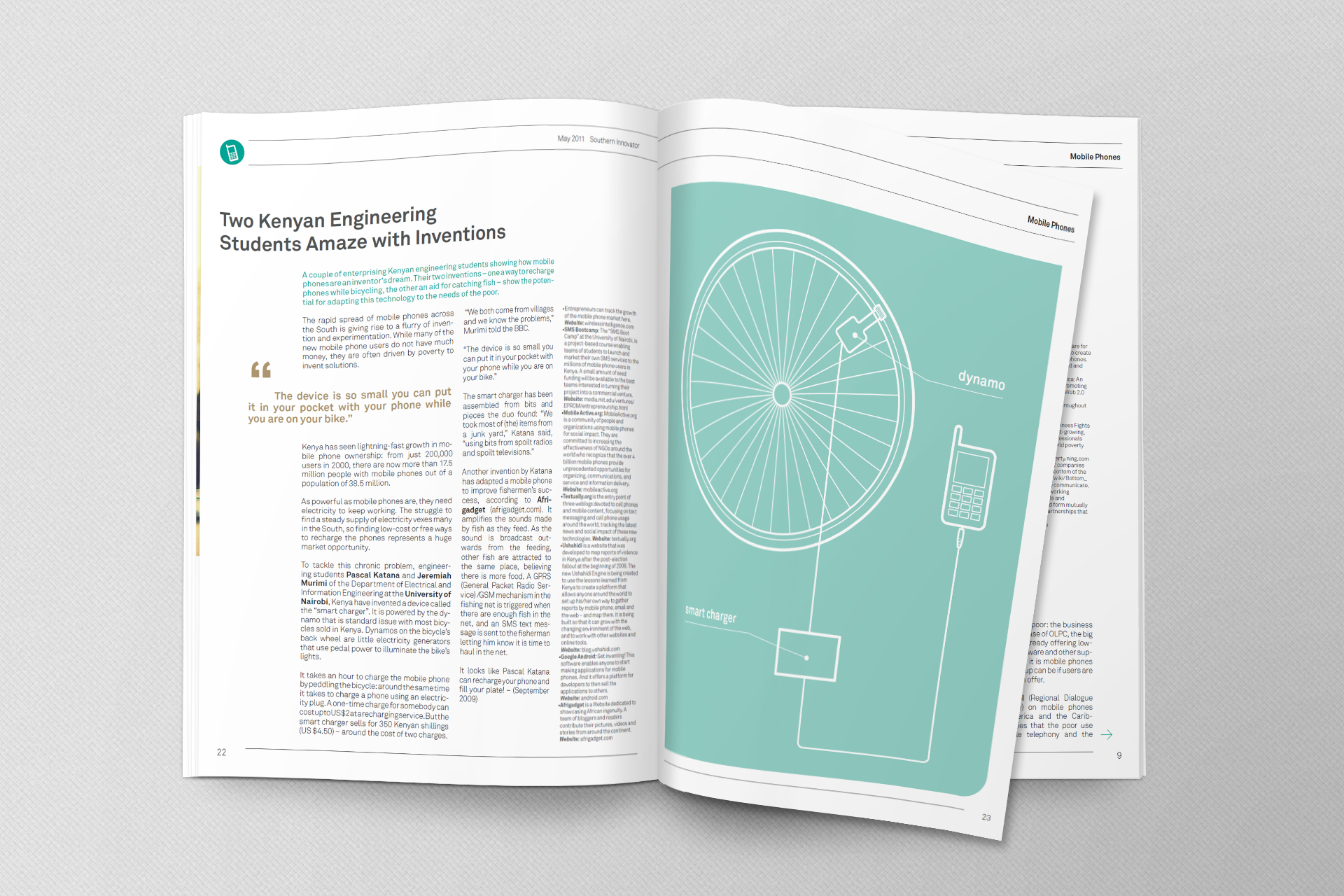
    Development Challenges, South-South Solutions was launched as an e-newsletter in 2006 by UNDP’s South-South Cooperation Unit (now the United Nations Office for South-South Cooperation) based in New York, USA. It led on profiling the rise of the global South as an economic powerhouse and was one of the first regular publications to champion the global South’s innovators, entrepreneurs, and pioneers. It tracked the key trends that are now so profoundly reshaping how development is seen and done. This includes the rapid take-up of mobile phones and information technology in the global South (as profiled in the first issue of magazine Southern Innovator), the move to becoming a majority urban world, a growing global innovator culture, and the plethora of solutions being developed in the global South to tackle its problems and improve living conditions and boost human development. The success of the e-newsletter led to the launch of the magazine Southern Innovator. 
    Creative Commons License

    This work is licensed under a
    Creative Commons Attribution-Noncommercial-No Derivative Works 3.0 License.

    ORCID iD: https://orcid.org/0000-0001-5311-1052.

    © David South Consulting 2023