It was the decade of the happy face, bell-bottoms, avocado fridges, disco and the Bay City Rollers; in short, the 70s was a pimple on the ass of history, better evaporated in a pot haze on a waterbed. Not so says 70s-obsessed author Pagan Kennedy, who believes the much-maligned decade is the victim of a bum rap perpetuated by the idolization of the 60s.
Kennedy says the 70s saw all the radical ideas and culture of the 60s go mainstream and mutate in a way the hippies couldn’t imagine.
Social relations and culture were profoundly reshaped during this decade as the non-traditional family took form, women flooded the workplace and unions became rich monoliths.
The social turmoil spawned blue collar red-necks with Confederate flags customizing fuck trucks – vans complete with waterbed, eight-track stereo, bong and sleazy airbrushed exteriors of naked women – to cruise the nation’s highways enjoying the liberal sexual values while keeping conservative political views. Sexual liberation for these clowns consisted of bumper stickers saying “Ass, gas or grass – nobody rides for free!”. Kennedy remembers it all too well.
“This was the midst of the energy crisis, so big cars that wasted a lot of gas were really cool,” she says. “I guess it came out of the whole drug culture, sex culture thing. It was like a basement kids have, only it was on wheels – a party on wheels. It’s not just the mattress for the fuck truck, you’re supposed to be doing your bong hits in there – so the police can’t see you.”
Sex holidays
“Our lives are much more constrained than they were in the 70s,” continues Kennedy. “I think the 70s must seem like an exotic time to grow up in. One of my favourite parts in Douglas Coupland’s Generation X is when the characters want to take a sex holiday to 1974.
“There was a lot of obsession in the early 70s with swingers and wife-swapping. It was the one time when suddenly the sexual revolution was kicking in, not just for white, privileged college kids, but for everybody – for the working class. There were discos and orgy clubs. There was Plato’s Retreat in New York City where you would go in and there was an orgy in full progress.”
In music, the 70s rocketed between extremes. There was nauseating soft rock, concept albums and “progressive” rock. There was the outrageous glam, with artists like Slade and Gary Glitter jacked up on elevator shoes in sequin one-piece flare suits. There was disco and punk. But the sickest phenomena says Kennedy was corporate rock.
David Cassidy
“In the 60s, people were just learning how to package rock and make it a big corporate thing. By the 70s they had learned a lot. The Partridge Family was a group that was entirely fabricated. David Cassidy had a bigger fan club than Elvis. This was a guy who didn’t become a rock star until he went on TV. In the 60s, FM was alternative radio – you could play anything. Corporate guys got their hooks into FM by the 70s. They were formatting. It was no longer what the DJ wanted to hear. You were getting playlists. The money came from big rock concerts, so there was a desire to push these mega-groups and superstars.”
Another truly 70s phenomena was TV as social conscience. Before the 70s, TV variety shows focused on pure entertainment. But now writers, directors and producers schooled in the 60s political milieu were in control.
Blaxploitation
“All in the Family, Maude and Good Times were all part of the same world. All in the Family acknowledged the deep rifts in American society – America was at war with itself. Yet it did it in a soft enough way to not offend people.”
US blacks had been ignored until the civil rights struggle of the 1960s woke up a dopey white America. In the 1970s, blacks were being portrayed like never before in the media and popular culture. But all of this awareness took a twisted turn.
“I think what happened among blacks was they saw their leaders either killed or put in jail. And that was devastating. Blacks really turned to electoralism in the 70s. A lot of black people started running for office. While trying to change things from outside the system, they realized the price was too high. A lot of black people were involved in making those blaxploitation movies, but so were a lot of white people. Shaft and Superfly are like the bookends of the genre. They were really made by black filmmakers. But then there were all these ripoff versions starring football players – whitebread ideas of what black culture was like.”
Pagan Kennedy’s latest book, Platforms: A Microwaved Cultural Chronicle of the 1970s, is published by St. Martin’s Press and available in most book shops. She’s got a really cool collection of eight-track tapes and drives a yetch! 1974 Plymouth Valiant.
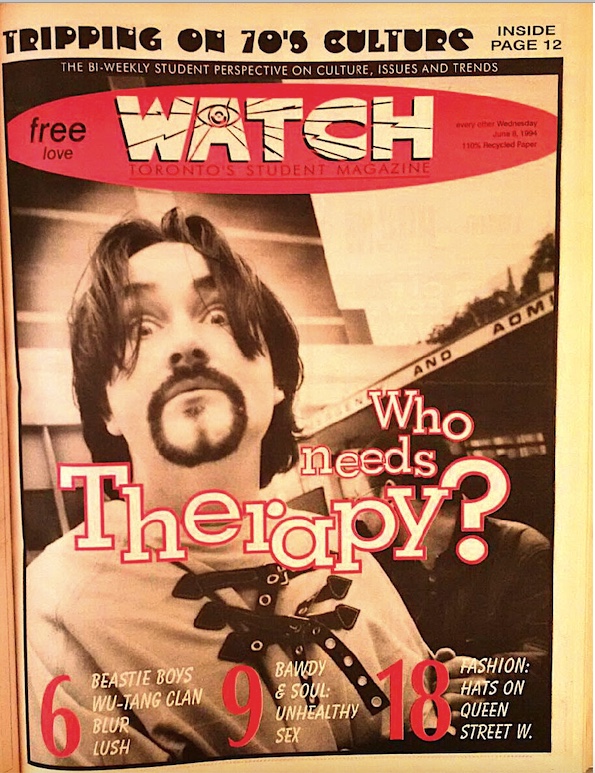
“Tripping on 70s Culture”: Watch Magazine was published in Toronto, Canada in the 1990s. “The Bi-Weekly Student Perspective on Culture, Issues and Trends.”
Check your prejudices at the door, look beyond your self-interest, and open your mind, because the Grey Panthers are here in Canada.
Joe Moniz, the 26-year-old founder of the Canadian Grey Panthers, is confident that his ambitious plans for a new national seniors’ organization are just what Canadian seniors need.
That’s right: 26-years-old. Modelled on the U.S. Grey Panthers, the Canadian Grey Panthers believe in harnessing the power of all age groups, making the connection that everybody will eventually be a senior and that seniors benefit from a better society for everyone.
“The major difference between us and any other organization is our slogan, “Age and Youth Working Together,” he says. “Look at our pension fund. It’s depleting. I’m concerned about my future as a senior citizen – will there be a pension fund? We want to act now, to bring youth and age together to improve the situation of seniors today and improve our situation in the future.
“Membership is open to all age groups. We want to bring seniors into day care to interact with children. We want to deal with the universities, give people the opportunity to discuss and unite. It’s a different approach, but it can make a huge difference.”
Moniz has already organized the group’s first chapter, in Hamilton, complete with a board of retired university professors and doctors. The group has put together insurance packages that will “blow the others out of the water.”
“All seniors’ attempts at lobbying in the past have been short term,” says a blunt Moniz. “We are the organization that will make the difference. We will lobby provincially, federally, and municipally, and we are non-partisan.
“The reason I’m introducing the Grey Panthers is to keep grey power alive in Canada, and to provide the necessary channels to do so through lobbying efforts. If anyone has problems with local politicians, they can call us, and we in turn let them know the channels they should use. There are a lot of seniors out there being cheated, and it is up to us to help them.”
The Canadian Grey Panthers (which uses the British spelling, as opposed to its American counterpart) will initially concentrate on four issues: pensions, drug plans, affordable housing and long-term care, and will communicate information through newsletters, surveys and meetings.
Moniz promises to make the Panthers accessible to all, no matter what their income. He plans to hit the streets and visit institutions to inform seniors of the group’s presence. As if to prove the group’s potential for excitement, an enthusiastic gentleman from a local retirement home interrupts Moniz during a coffee shop interview. “That’s the best thing I’ve heard from a young person in Toronto,” he says.
The U.S. Panthers were formed by political activist Maggie Kuhn and five friends in 1970. Back then, their name wasn’t as exciting. It was the convoluted and unsexy “Consultation of Older and Younger Adults for Social Change.” In 1972, they adopted the media’s pet name – a grey twist on radical African-American rights organization the Black Panthers.
The radical milieu of political activism was contagious – and the Panthers symbolized its jump from the youth of America to other generations.
“When we formed, we were an intergenerational group,” says Panthers’ U.S. national chair, Charlotte Flynn. “The first issue the group addressed was mandatory retirement. We combat the stigma of ageism, which is making decisions about people based on chronological age. Ageism isn’t just confined to the elderly – ageism exists for young people as well.”
The agenda of the Panthers is just as radical today. Flynn, who is candid about the group’s failures as well as its successes, admits that it isn’t the easiest route to popularity. With membership at about 45,000, the U.S. Panthers have spoken out on now-popular issues like health care, the environment, affordable housing – and taken brave stands against mainstream opinion when it came to the Gulf War and the invasion of Panama.
And they think big. Not content with just influencing the American political scene, the Panthers have taken on the world, gaining official advisor status at the United Nations.
Although involved in a broad range of issues, Flynn says the Panthers are primarily seen as a strong voice for the rights of American seniors.
“We have tried very hard to let people know we are not a special interest group for the elderly,” says Flynn. “But we are always getting called upon to highlight what any legislation is doing to older people.”
With Panther groups sprouting in Europe and now in Canada, the important issue of maintaining the integrity of the Panther name has arisen, says Flynn. She points to the flip side of having a reputation for action: people want to start branches without being interested in the full agenda of the Panthers, using the name for shock value. At the last convention in November 1992, the Panthers formed a committee to act as quality control monitors for the name.
One thing is clear from the ambitious agenda of the Grey Panthers – they aren’t for everyone.
But Moniz’s pragmatic approach seems distinct from the American Panthers. He shies away from some of the American group’s positions, emphasizing a balance between insurance policies and political policies.
“If you read the American Panthers’ position sheet, it’s anti-this and anti-that,” he says. “We aren’t going to take that approach. It would be suicide.”
But he is quick in his praise of the group and its founder Maggie Kuhn. “People may consider her actions to be radical, but they’re not. Look at the achievements. She is one of the top 25 active women in the U.S.
“The Gray Panthers are achievers. They have proven the effectiveness of intergenerational attempts at social justice.”
A quick call to seniors’ groups drew many surpised faces.
“I can’t say anything about them – I don’t know who they are,” responded Murray Morgenthau, executive director of the Canadian Association of Retired Persons (CARP).
Jane Leitch at the United Senior Citizens of Ontario had heard something was happening but wonders why a new group is forming “with so many groups out there.”
One Voice spokesperson Andrew Aitkens says his group is closer to the American Association of Retired Persons than the Panthers in their approach, and that they “have found that there are much more effective ways for advocacy. We don’t march on the Hill at the drop of the hat.”
But Flynn says the Panthers embody a philosophy distinct from all other seniors’ groups. “As Maggie Kuhn said, ‘those of us who are older are the elders of the tribe and should be concerned about survival.’ We look at all issues that deny people the ability to realize their full potential, whether young or old. We are really interested in empowering people rather than being a special interest for the elderly.”
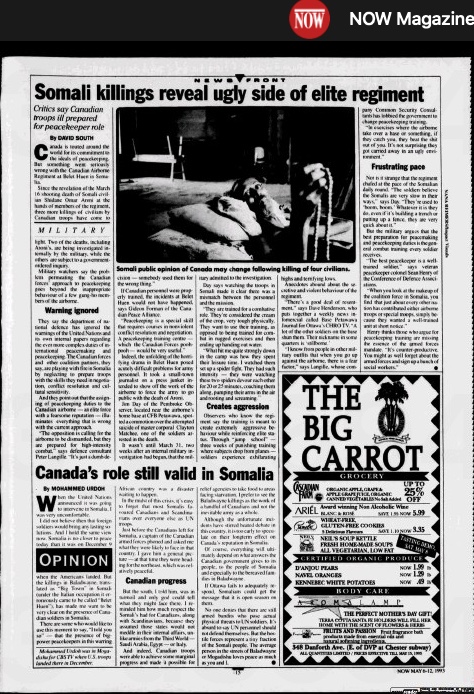
Canada is touted around the world for its commitment to the ideals of peacekeeping. But something went seriously wrong with the Canadian Airborne Regiment at Belet Huen in Somalia.
Since the revelation of the March 16 shooting death of Somali civilian Shidane Omar Aroni at the hands of members of the regiment, three more killings of civilians by Canadian troops have come to light. Two of the deaths, including Aroni’s, are being investigated internally by the military, while others are subject to a government-ordered inquiry.
Military watchers say the problem permeating the Canadian Armed Forces’ approach to peacekeeping goes beyond the inappropriate behaviour of a few gung-ho members of the airborne.
Warning ignored
They say the department of national defence has ignored the warnings of the United Nations and its own internal papers regarding the ever more complex duties of international peacemaking and peacekeeping. The Canadian forces and other coaltion partners, they say, are playing with fire in Somalia by neglecting to prepare troops with the skills they need in negotiation, conflict resolution and cultural sensitivity.
And they point out that the assigning of peacekeeping duties to the Canadian airborne – an elite force with a fearsome reputation – illuminates everything that is wrong with the current approach.
“The opposition is calling for the airborne to be dismantled, but they are prepared for high-intensity combat,” says defence consultant Peter Langille. “It’s just a dumb decision – somebody used them for the wrong thing.”
“The opposition is calling for the airborne to be dismantled, but they are prepared for high-intensity combat,” says defence consultant Peter Langille. “It’s just a dumb decision – somebody used them for the wrong thing.”
If Canadian personnel were properly trained, the incidents at Belet Huen would not have happened, says Gideon Forman of the Canadian Peace Alliance.
“Peacekeeping is a special skill that requires courses in non-violent conflict resolution and negotiation. A peacekeeping training centre – which the Canadian Forces pooh-pooh – would be very useful.”
Indeed, the unfolding of the horrifying drama in Belet Huen posed acutely difficult problems for army personnel. It took a small-town journalist on a press junket intended to show off the work of the airborne to force the army to go public with the death of Aroni.
Jim Day of the Pembroke Observer, located near the airborne’s home base at CFB Petawawa, spotted a commotion over the attempted suicide of master corporal Clayton Matchee, one of the soldiers arrested in the death.
It wasn’t until March 31, two weeks after an internal military investigation had begun, that the military admitted to the investigation.
Day says watching the troops in Somalia made it clear there was a mismatch between the personnel and the mission.
“They are trained for a combative role. They’re considered the cream of the crop, very tough physically. They want to use their training, as opposed to being trained for combat in rugged exercises and then ending up handing out water.
“What hit me quite strongly down in the camp was how they spent their leisure time. I watched them set up a spider fight. They had such intensity – they were watching these two spiders devour each other for 20 or 25 minutes, coaching them along, pumping their arms in the air and rooting and screaming.”
Creates aggression
Observers who know the regiment say the training is meant to create extremely aggressive behaviour while reinforcing elite status. Through “jump school” – three weeks of punishing training where subjects drop from planes – soldiers experience exhilarating highs and terrifying lows.
Anecdotes abound about the secretive and violent behaviour of the regiment.
“There’s a good deal of resentment,” says Dave Henderson, who puts together a weekly news infomercial called Base Petawawa Journal for Ottawa’s CHRO TV. “A lot of the other soldiers on the base shun them. Their nickname in some quarters is ‘stillborne.’
“I know from people in other military outfits that when you go up against the airborne, there is a fear factor,” says Langille, whose company Common Security Consultants, has lobbied the government to change peacekeeping training.
“In exercises where the airborne take over a base or something, if they catch you, they bet the shit out of you. It’s not surprising they got carried away in an ugly environment.”
Frustrating pace
Nor is it strange that the regiment chafed at the pace of the Somalian daily round. “The soldiers believe the Somalis are very slow in their ways,” says Day. “They’re used to ‘boom, boom.’ Whatever it is they do, even if it’s building a trench or putting up a fence, they are very quick about it.”
But the military argues that the best preparation for peacemaking and peacekeeping duties is the general combat training every soldier receives.
“The best peacekeeper is a well-trained soldier,” says veteran peacekeeper colonel Sean Henry of the Conference of Defence Associations.
“When you look at the make-up of the coalition force in Somalia, you find that just about every other nation has contributed either airborne troops or special troops, simply because they wanted a well-trained unit at short notice.”
“When you look at the make-up of the coalition force in Somalia, you find that just about every other nation has contributed either airborne troops or special troops, simply because they wanted a well-trained unit at short notice.”
Henry thinks those who argue for peacekeeping training are missing the essence of the armed forces’ mandate. “It’s counter-productive. You might as well forget about the armed forces and sign up a bunch of social workers.”
Does the UN know what it’s doing?
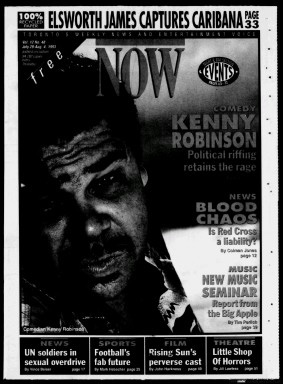
Now Magazine (Toronto, Canada), July 22-28, 1993. This incident was the basis of the 2001 film Black Hawk Down.
The United Nations’ bloody hunt for elusive Mogadishu warlord general Mohamed Farah Aideed has many observers wondering whether the world body is making up the rules as it goes along.
Some critics, such as George Cram of the Canadian Council for International Cooperation, an influential umbrella group for Canadian non-governmental organizations of NGOs, question if the obsession with Aideed isn’t just burying the UN in a deeper image problem with the Third World.
Critics point to the fallout of growing resentment from the July 12 attack on Aideed’s compound – killing more than 70 civilians – boding ill for a peaceful reconstruction of Somali society.
The fact that among those killed within the compound were clan elders who were negotiating a peace has upset Somalis even more, says Cram, a Horn of Africa researcher.
“The UN has lost its credibility, its moral authority, lost its blue-beret neutrality,” says Cram bluntly.
The degree to which Aideed should be the main focus of current UN actions has some relief agencies scratching their heads. Aideed has become Somalian bogey man number one with UNOSOM’s (United Nations Operations in Somalia) head, US Admiral Johnathon Howe. He has placed a $25,000 price on Aideed for an arrest.
“I don’t recall the UN ever going out and actually attempting to arrest individuals – they certainly haven’t done it in other conflict zones,” says reverend David Hardy of Saskatoon-based Lutheran Relief, who has organized relief flights into Somalia.
Cambodian example
He cites the example of Cambodia, where the UN brokered a controversial peace with those purveyors of the genocidal killing fields, the Khmer Rouge, in order to secure free elections.
David Isenverg of the Center for Defense Information, a liberal Washington-based think tank, worries that doggedly going after Aideed while ignoring the other factions will paint the UN as siding with one faction over another.
“The protracted effect is to turn the US and UN into partisans to the conflict.”
Hardy believes Aideed, who is adept at seeing which way the wind blows, has inflated his stature as an opponent of the UN as foreign invader.
Then there are other criticisms. Some observers wonder whether the UN is too proud or too blind, or simple oblivious when it comes to seeking advice from the locals it went in to protect.
Even Canada, while supporting the UN’s military effort since Aideed “is obstructing relief supplies,” believes that national reconciliation should be a main focus, says external affairs spokesperson Rodney Moore.
He says Canada continues to urge the UN to move quickly on national reconciliation, bringing together women’s groups, clan elders and other non-warlord groups.
“One of the areas where the UN operation went wrong is the tendency to deal with the ‘superpowers’ of Somalia while ignoring groups like women’s collectives,” says World Visions’ Philip Maher, who has just returned from Somalia.
“Part of the problem is misunderstanding,” Maher says. “The UN hasn’t done a great job of telling Somalis what they are doing.”
Many point to the peaceful north, where the as yet internationally unrecognized Somaliland offers a successful model, combining women’s groups and elders to wrest control.
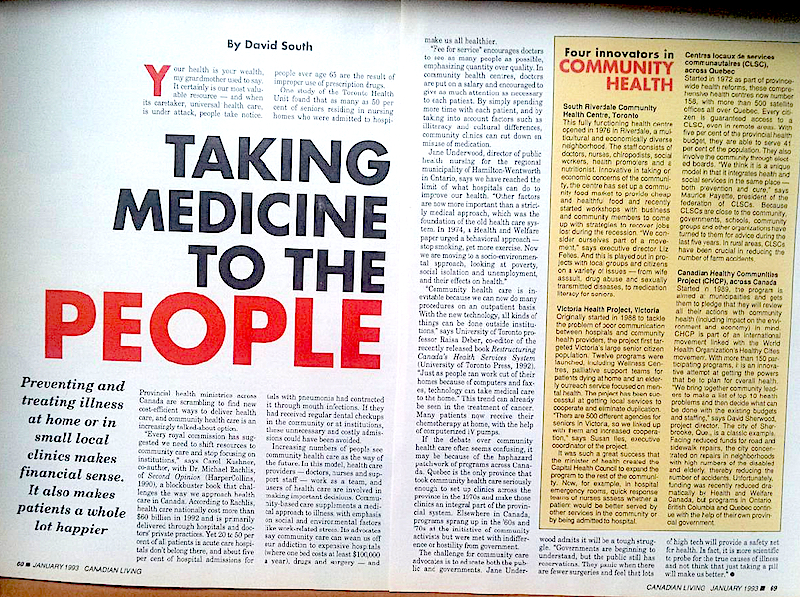
Your health is your wealth, my grandmother used to say. It certainly is our most valuable resource – and when its caretaker, universal health care, is under attack, people take notice.
Provincial health ministries across Canada are scrambling to find new cost-efficient ways to deliver health care, and community health care is an increasingly talked-about option.
“Every royal commission has suggested we need to shift resources to community care and stop focusing on institutions,” says Carol Kushner, co-author, with Dr. Michael Rachlis, of Second Opinion (HarperCollins, 1990), a blockbuster book that challenges the way we approach health care in Canada. According to Rachlis, health care nationally cost more than $60 billion in 1992 and is primarily delivered through hospitals and doctors’ private practices. Yet 20 per cent of all patients in acute care hospitals don’t belong there, and about five per cent of hospital admissions for people over age 65 are the result of improper use of prescription drugs.
One study of the Toronto Health Unit found that as many as 50 per cent of seniors residing in nursing homes who were admitted to hospitals with pneumonia had contracted it through mouth infections. If they had received regular dental check-ups in the community or at institutions, these unnecessary and costly admissions could have been avoided.
Increasing numbers of people see community health care as the way of the future. In this model, health care providers – doctors, nurses and support staff – work as a team, and users of health care are involved in making important decisions. Community-based care supplements a medical approach to illness, with emphasis on social and environmental factors like work-related stress. Its advocates say community care can wean us off our addication to expensive hospitals (where one bed costs at least $100,000 a year), drugs and surgery – and make us all healthier.
“Fee for service” encourages doctors to see as many people as possible, emphasizing quantity over quality. In community health centres, doctors are put on a salary and encouraged to give as much attention as necessary to each patient. By simply spending more time with each patient, and by taking into account factors such as illiteracy and cultural differences, community clinics can cut down on misuse of medication.
Jane Underwood, director of public health nursing for the regional municipality of Hamilton-Wentworth in Ontario, says we have reached the limit of what hospitals can do to improve health. “Other factors are now more important than a strictly medical approach, which was the foundation of the old health care system. In 1974, a Health and Welfare paper urged a behavioral approach – stop smoking, get more exercise. Now we are moving to a socio-environmental approach, looking at poverty, social isolation, and unemployment, and their effects on health.”
“Community health care is inevitable because we can now do many procedures on an outpatient basis. With the new technology, all kinds of things can be done outside institutions,” says University of Toronto professor Raisa Deber, co-editor of the recently released book Restructuring Canada’s Health Services System (University of Toronto Press, 1992).
“Just as people can work out of their homes because of computers and faxes, technology can take medical care to the home.” This trend can already be seen in the treatment of cancer. Many patients now receive their chemotherapy at home, with the help of computerized IV pumps.”
If the debate over community health care often seems confusing, it may be because of the haphazard patchwork of programs across Canada. Quebec is the only province that took community health care seriously enough to set up clinics across the province in the 1970s and make those clinics an integral part of the provincial system. Elsewhere in Canada, programs sprang up in the ’60s and ’70s at the initiative of community activists but were met with indifference or hostility from government.
The challenge for community care advocates is to educate both the public and governments. Jane Underwood admits it will be a tough struggle. “Governments are beginning to understand, but the public still has reservations. They panic when there are fewer surgeries and feel that lots of high tech will provide a safety net for health. In fact, it is more scientific to probe for the true causes of illness and not think that just taking a pill will make us better.”
Four Innovators in Community Health
South Riverdale Community Health Centre, Toronto
This fully functioning health centre opened in 1976 in Riverdale, a multicultural and economically diverse neighborhood. The staff consists of doctors, nurses, chiropodists, social workers, health promoters and a nutritionist. Innovative in taking on economic concerns of the community, the centre has set up a community food market to provide cheap and healthful food and recently started workshops with business and community members to come up with strategies to recover jobs lost during the recession. “We consider ourselves part of a movement,” says executive director Liz Feltes. And this is played out in projects with local groups and citizens on a variety of issues – from wife assault, drug abuse and sexually transmitted diseases, to medication literacy for seniors.
Victoria Health Project, Victoria
Originally started in 1988 to tackle the problem of poor communication between hospitals and community health providers, the project first targeted Victoria’s large senior citizen population. Twelve programs were launched, including Wellness Centres, palliative support teams for patients dying at home and elderly outreach service focused on mental health. The project has been successful at getting local services to cooperate and eliminate duplication. “There are 500 different agencies for seniors in Victoria, so we linked up with them and increased cooperation,” says Susan Lles, excutive coordinator of the project.
It was such a great success that the minister of health created the Capital Health Council to expand the program to the rest of the community. Now, for example, in hospital emergency rooms, quick response teams of nurses assess whether a patient would be better served by other services in the community or by being admitted to hospital.
Centres locaux de services communautaires (CLSC), across Quebec
Started in 1972 as part of province-wide health reforms, these comprehensive health centres now number 158, with more than 500 satellite offices all over Quebec. Every citizen is guaranteed access to a CLSC, even in remote areas. With five per cent of the provincial health budget, they are able to serve 41 pr cent of the population. They also involve the community through elected boards. “We think it is a unique model in that it integrates health and social services in the same place – both prevention and cure,” says Maurice Payette, president of the federation of CLSCs. Because CLSCs are close to the community, governments, schools, community groups and other organizations have turned to them for advice during the last five years. In rural areas, CLSCs have been crucial in reducing the number of farm accidents.
Canadian Healthy Communities Project (CHCP), across Canada
Started in 1989, the program is aimed at municipalities and gets them to pledge that they will review all their actions with community health (including impact on the environment and economy) in mind. CHCP is part of an international movement linked with the World Health Organization’s Healthy Cities movement. With more than 150 participating programs, it is an innovative attempt at getting the powers that be to plan for overall health. “We bring together community leaders to make a list of top 10 health problems and then decide what can be done with the existing budgets and staffing,” says David Sherwood, project director. The city of Sherbrooke, Que., is a classic example. Facing reduced funds for road and sidewalk repairs, the city concentrated on repairs in neighborhoods with hig numbers of the disabled and elderly, thereby reducing the number of accidents. Unfortunately, funding was recently reduced dramatically by Health and Welfare Canada, but programs in Ontario, British Columbia and Quebec continue with the help of their own provincial government.
“… in recent years it has become a pursuit for a growing number of researchers. … Behind much of this growth has been the Hannah Institute for the History of Medicine …”












 David South Consulting
You must be logged in to post a comment.