Toronto’s innovative crime-fighting and crime-prevention experiments face elimination if and when the city is swallowed up by the monolithic megacity. And the Annex’s status as one of Toronto’s safest neighbourhoods could be destroyed by the resulting tax increases.
Since the late 1980s, thinking about crime in Toronto has focused on public safety rather than just cops in cars. Taking what can be called a holistic approach, the city has poured millions into public health programs, street lighting, safety audits and social services, and it has led the region in putting cops back on foot patrol.
Carolyn Whitzman, coordinator of the Safe City Committee – founded in 1989 and a symbol of that attitude change – worries many of the services will find their funds cut or their street-level approach altered.
“I don’t know if people in Toronto realize how privileged they are,” she says. “All these programs have led us to be one of the safest cities in the world. There is nothing like the Safe City Committee in surrounding municipalities. There is nothing like it at Metro – though they do fund safety initiatives.”
The Safe City Committee was the first of its kind in North America and subsequently has been copied by other cities. Initiatives funded by the committee include pamphlets on ending sibling violence, self-defense tips for volunteer workers, a youth drop-in centre at Dufferin Mall an community safety audits.
Whitzman also worries the new meagcity will follow the advice of government consultants KPMG, who recommended replacing some police duties with volunteer labour.
“They recommended store fronts (community police booths) and reporting of accidents be run by volunteers. What if you want a police officer?”
Whitzman also doesn’t like plans to encourage police to spend more time in their cars filing reports on laptop computers. She would rather see them out on the beat.
She also fears school safety programs, like extra lighting, will be jettisoned as school boards chase savings. This also applies to the TTC and public housing. (Whitzman says some housing projects have already cut security due to provincial funding reductions.)
Another factor could jeopardize the Annex’s status as one of the safest neighbourhoods in the city. Higher taxes may chase out homeowners, and the Annex many once again become a haven for transient populations living in rooming houses, as it was in the 1960s and 1970s.
According to Joe Page, a crime analyst at 52 Division for the past quarter century, the Annex had the dubious reputation in the late 1970s of being the busiest neighbourhood in Toronto for police.
It’s a different story today. For example, in the portion of the Annex between Avenue Road and Spadina Road from Dupont south to Bloor, there was one murder in 1995 and none in 1996, and major assaults were down from nine in 1995 to five in 1996. There was one murder in the Little Italy area west of Bathurst in 1996.
If there is a good side to rising crime rates in the surrounding municipalities, it’s that councillors there can no longer ignore public safety issues. This could mean greater sympathy for Toronto’s plight from once-smug suburban councillors.
Whitzman sees hypocrisy in the attitudes of many of the satellite cities. “Scarborough has a bad reputation and other municipalities are not immune to safety issues.”
“Anybody going into medicine should read a whole bunch of good novels.” Dr. Alvin Newman isn’t kidding. The head of curriculum renewal at the largest English-speaking medical school in the world, the University of Toronto, feels strongly that doctors have been ill-prepared for their profession’s challenges.
How doctors become doctors is being hotly debated as Ontario’s five medical schools institute a potpourri of curriculum reforms. After a century of taking a back seat to scientific achievement, bedside manners and the art of medicine are in vogue again.
“Around the world, medical education is undergoing significant changes,” says Newman. “Medical schools must strike a balance between the incredible explosion of scientific knowledge and re-establish the role of the physician as wise counsel and empathic healer.”
It’s a role that many feel doctors have ignored. An American Medical Association poll, conducted between 1985 and 1988, found that fewer than 50 per cent of respondents said they thought doctors listened well and half believed doctors no longer care as much about patients as they used to.
In response to these criticisms, current reforms are shifting medical education away from reliance on the turn-of-the-century science-based approach, says Professor Jackie Duffin, a medical historian at Queen’s University who helped organize the new curriculum introduced there in 1991.
“In the old days doctors could probably make a diagnosis and tell people what was happening to them, but not do very much for them,” says Newman.
“Yet society had more trust and fondness for physicians than they do now. Much of the condemnation of the medical profession is because we have become the custodians of high-tech medicine.”
While the Ontario government embarks on the most sweeping reforms to health care since the 1966 introduction of comprehensive health insurance in Ontario and the founding of national medicare in 1968, many doctors feel their profession cannot afford to maintain the status quo.
The concensus at Ontario’s five medical schools – U of T, Queen’s, University of Western Ontario, University of Ottawa and McMaster University – has gelled around a belief that doctors need to be as comfortable dealing with people as they are with scientific medicine. To this end, revamped curricula supplement basic science and clinical medicine with emphasis on early exposure to patients, communication skills, psychological issues, medical ethics, medical literacy and health promotion.
These schools hope to produce new doctors to fit into a rapidly-changing health care system – one that many believe will rely far less on large hospitals.
Instead, many procedures will take place in the home or in the day clinics. Expanding community health care care centres will try to tackle extensive social and health problems. This preventive approach ot medical education was pioneered by Hamilton’s McMaster medical school.
Since its founding in 1967, McMaster has experimented with teaching methods that steer away from mass lectures to concentrate on the individual student. The evolution of McMaster’s curriculum has placed greater emphasis on communication skills, psychosocial aspects of medicine, community issues, and disease prevention and health promotion.
How do McMaster students rate against other medical students?
Last year they scored above the national average on licencing exams. A higher proportion of McMaster students enter research and academic medicine than their counterparts from other schools. One study comparing them to U of T suggested they were more motivated to be life-long learners.
Dr. Rosana Pellizzari practices the kind of medicine everyone is talking about these days. Working out of renovated church, Pellizzari’s practice at the Davenport/Perth Community Health Centre in west end Toronto serves a working class neighbourhood that has been home to generations of recent immigrants.
A member of the Medical Reform Group – which has long advocated significant reforms to health care – and trained at McMaster, Pellizzari can be seen to represent the doctor of the future: Sensitive, salaried and working in community health.
“McMaster’s curriculum attracts people with innovative ideas,” says Pellizzari, who was active in community health education before going to medical school. “It is a very supportive environment.
“I think the important question is: Who do we choose to be medical students? They should open up medical schools to those who know what it’s like to be a parent, a mother or disabled. Doctors should represent the population they serve. We are still getting mostly white, inexperienced young males as physicians. They aren’t going to practice the way that is necessary.”
In Ontario, many doctors see the 1986 doctors’ strike as a watershed for public opinion.
As a result of the negative fallout from the strike and perceived gap between physicians andhe public they serve, a five-year project entitled Educating Future Physicians for Ontario became a major advocate for reform.
Started in 1988, EFPO has examined fundamental issues in designing and implementing new medical school curricula. These issues include defining societal health care needs and expectations, faculty development and student evaluation. While each medical school has adapted reforms to its particular situation, EFPO hopes to prod further reforms.
“This is a unique venture in Canada, and could have implications far beyond Ontario if successful,” says Dr. William Seidelman, a key player in EFPO. “It captures the unique sense of the Canadian scene, and will build on the implied contact in the Canadian health system.”
Pellizzari sees the attitude of medical schools and teaching hospitals towards medical students as a significant factor in creating insensitive doctors. She recalls the high rate of suicide among medical students and the abusive work environment that forces doctors-in-training to work shifts unthinkable for other workers.
“The way we train doctors is inhumane,” she says. “We don’t expect other workers to put in 30-hour shifts. It creates in new physicians the attitude that they paid their dues and now society owes them.”
Many critics feel that changing training methods isn’t enough; the whole ethos and selection process must be changed. If doctors are to better serve the population, they must better reflect it.
“We are getting very close to gender equality and a laudable distribution of ethnic and racial backgrounds,” says Newman. “But students still come from a fairly narrow social spectrum, very middle class kids. Their exposure to the extremes of society, to poverty, to homelessness and related illnesses have been very limited.”
Pellizzari found how out-of-date the medical profession was in her first year. One teacher wanted her to work till 10 at night. When told that she needed 24 hours notice for a babysitter, the teacher shot back that motherhood and medicine don’t mix.
“I was a mother before I was a physician. When I get a call at night from a mother, I understand this. With 30 per cent of visits to doctors having no biological basis – like depression due to unemployment – you can’t do anything unless you have experienced life.
“If we don’t address this, you can design the best training in the world, but things won’t change.”
But Newman also feels many factors outside of medical school discourage a more diverse student body.
“To go through medical school in the United States requires large indebtedness. That’s not true in Canada. You can calculate what a year of medical school costs in terms of a finite number of CDs, a leather jacket and ghetto blaster. So something is dissuading people from pursuing this career, and it isn’t money.”
While there is a concensus among academics that medical schools haven’t prepared doctors well enough, there is little support for a dramatic change in selection criteria. “I can’t muster a lot of support from colleagues for serious changes,” says Newman.
Dr. Jock Murray, the former dean of Dalhousie medical school in Halifax, recently told an EFPO meeting he doesn’t see any significant changes ahead.
“Physicians have a reputation for being conservative and self-serving,” says Murray. “If reform is going to be successful we have to be clear that it is about what is good for the people.”
Pellizzari believes life experience and empathy with social circumstances just can’t be taught.
“I grew up in this neighbourhood. I understand their powerlessness, the conditions. Doctors have to see themselves as a member of a team of health professionals, not as the top of the social and medical totem pole.”
U of T’s experience is a classic example of the hurdles ahead. Newman admits it has come as a shock to students loaded with society’s ingrained expectations.
“They spend half a day a week in the community seeing things like drug rehab clinics and community health centres. But being out in the community doesn’t make the students feel comfortable. Their image of what they are going to do involves big buildings, chrome and steel, scurrying personnel and banks of computers.”
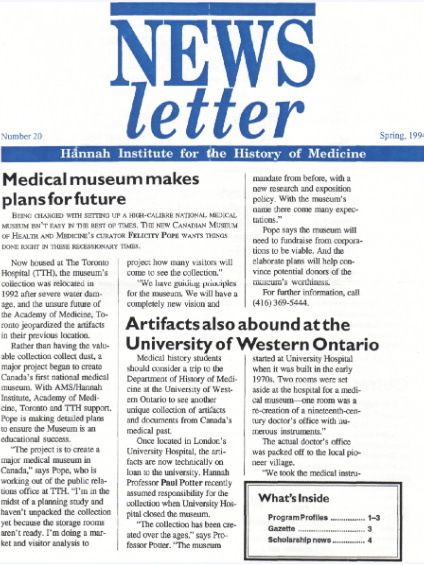
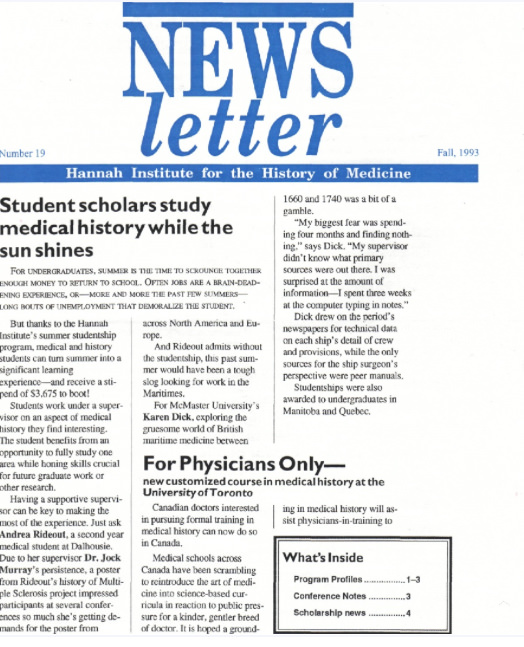
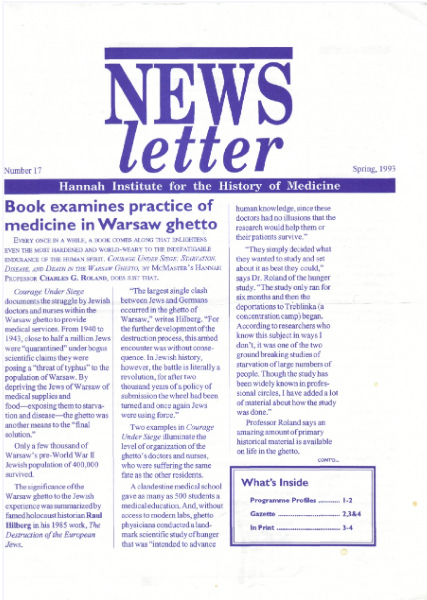
“… in recent years it has become a pursuit for a growing number of researchers. … Behind much of this growth has been the Hannah Institute for the History of Medicine …”








 David South Consulting
You must be logged in to post a comment.