Tag: Canada)

  • Somali Killings Reveal Ugly Side Of Elite Regiment

    Somali Killings Reveal Ugly Side Of Elite Regiment

    By David South

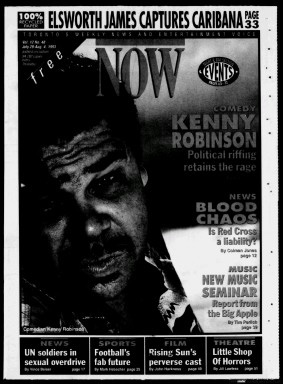
    Now Magazine (Toronto, Canada), May 6-12, 1993

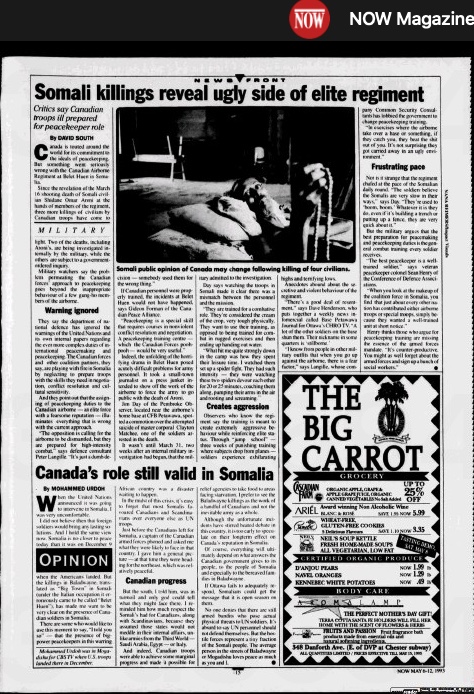
    Canada is touted around the world for its commitment to the ideals of peacekeeping. But something went seriously wrong with the Canadian Airborne Regiment at Belet Huen in Somalia.

    Since the revelation of the March 16 shooting death of Somali civilian Shidane Omar Aroni at the hands of members of the regiment, three more killings of civilians by Canadian troops have come to light. Two of the deaths, including Aroni’s, are being investigated internally by the military, while others are subject to a government-ordered inquiry.

    Military watchers say the problem permeating the Canadian Armed Forces’ approach to peacekeeping goes beyond the inappropriate behaviour of a few gung-ho members of the airborne.

    Warning ignored

    They say the department of national defence has ignored the warnings of the United Nations and its own internal papers regarding the ever more complex duties of international peacemaking and peacekeeping. The Canadian forces and other coaltion partners, they say, are playing with fire in Somalia by neglecting to prepare troops with the skills they need in negotiation, conflict resolution and cultural sensitivity.

    And they point out that the assigning of peacekeeping duties to the Canadian airborne – an elite force with a fearsome reputation – illuminates everything that is wrong with the current approach.

    “The opposition is calling for the airborne to be dismantled, but they are prepared for high-intensity combat,” says defence consultant Peter Langille. “It’s just a dumb decision – somebody used them for the wrong thing.”

    “The opposition is calling for the airborne to be dismantled, but they are prepared for high-intensity combat,” says defence consultant Peter Langille. “It’s just a dumb decision – somebody used them for the wrong thing.”

    If Canadian personnel were properly trained, the incidents at Belet Huen would not have happened, says Gideon Forman of the Canadian Peace Alliance.

    “Peacekeeping is a special skill that requires courses in non-violent conflict resolution and negotiation. A peacekeeping training centre – which the Canadian Forces pooh-pooh – would be very useful.”

    Indeed, the unfolding of the horrifying drama in Belet Huen posed acutely difficult problems for army personnel. It took a small-town journalist on a press junket intended to show off the work of the airborne to force the army to go public with the death of Aroni.

    Jim Day of the Pembroke Observer, located near the airborne’s home base at CFB Petawawa, spotted a commotion over the attempted suicide of master corporal Clayton Matchee, one of the soldiers arrested in the death.

    It wasn’t until March 31, two weeks after an internal military investigation had begun, that the military admitted to the investigation.

    Day says watching the troops in Somalia made it clear there was a mismatch between the personnel and the mission.

    “They are trained for a combative role. They’re considered the cream of the crop, very tough physically. They want to use their training, as opposed to being trained for combat in rugged exercises and then ending up handing out water.

    “What hit me quite strongly down in the camp was how they spent their leisure time. I watched them set up a spider fight. They had such intensity – they were watching these two spiders devour each other for 20 or 25 minutes, coaching them along, pumping their arms in the air and rooting and screaming.”

    Creates aggression

    Observers who know the regiment say the training is meant to create extremely aggressive behaviour while reinforcing elite status. Through “jump school” – three weeks of punishing training where subjects drop from planes – soldiers experience exhilarating highs and terrifying lows.

    Anecdotes abound about the secretive and violent behaviour of the regiment.

    “There’s a good deal of resentment,” says Dave Henderson, who puts together a weekly news infomercial called Base Petawawa Journal for Ottawa’s CHRO TV. “A lot of the other soldiers on the base shun them. Their nickname in some quarters is ‘stillborne.’

    “I know from people in other military outfits that when you go up against the airborne, there is a fear factor,” says Langille, whose company Common Security Consultants, has lobbied the government to change peacekeeping training.

    “In exercises where the airborne take over a base or something, if they catch you, they bet the shit out of you. It’s not surprising they got carried away in an ugly environment.”

    Frustrating pace

    Nor is it strange that the regiment chafed at the pace of the Somalian daily round. “The soldiers believe the Somalis are very slow in their ways,” says Day. “They’re used to ‘boom, boom.’ Whatever it is they do, even if it’s building a trench or putting up a fence, they are very quick about it.”

    But the military argues that the best preparation for peacemaking and peacekeeping duties is the general combat training every soldier receives.

    “The best peacekeeper is a well-trained soldier,” says veteran peacekeeper colonel Sean Henry of the Conference of Defence Associations.

    “When you look at the make-up of the coalition force in Somalia, you find that just about every other nation has contributed either airborne troops or special troops, simply because they wanted a well-trained unit at short notice.”

    “When you look at the make-up of the coalition force in Somalia, you find that just about every other nation has contributed either airborne troops or special troops, simply because they wanted a well-trained unit at short notice.”

    Henry thinks those who argue for peacekeeping training are missing the essence of the armed forces’ mandate. “It’s counter-productive. You might as well forget about the armed forces and sign up a bunch of social workers.”

    Does the UN know what it’s doing?

    Now Magazine (Toronto, Canada), July 22-28, 1993. This incident was the basis of the 2001 film Black Hawk Down. 

    By David South

    Now Magazine (Toronto, Canada), July 22-28, 1993

    The United Nations’ bloody hunt for elusive Mogadishu warlord general Mohamed Farah Aideed has many observers wondering whether the world body is making up the rules as it goes along.

    Some critics, such as George Cram of the Canadian Council for International Cooperation, an influential umbrella group for Canadian non-governmental organizations of NGOs, question if the obsession with Aideed isn’t just burying the UN in a deeper image problem with the Third World.

    Critics point to the fallout of growing resentment from the July 12 attack on Aideed’s compound – killing more than 70 civilians – boding ill for a peaceful reconstruction of Somali society.

    The fact that among those killed within the compound were clan elders who were negotiating a peace has upset Somalis even more, says Cram, a Horn of Africa researcher.

    “The UN has lost its credibility, its moral authority, lost its blue-beret neutrality,” says Cram bluntly.

    The degree to which Aideed should be the main focus of current UN actions has some relief agencies scratching their heads. Aideed has become Somalian bogey man number one with UNOSOM’s (United Nations Operations in Somalia) head, US Admiral Johnathon Howe. He has placed a $25,000 price on Aideed for an arrest.

    “I don’t recall the UN ever going out and actually attempting to arrest individuals – they certainly haven’t done it in other conflict zones,” says reverend David Hardy of Saskatoon-based Lutheran Relief, who has organized relief flights into Somalia.

    Cambodian example

    He cites the example of Cambodia, where the UN brokered a controversial peace with those purveyors of the genocidal killing fields, the Khmer Rouge, in order to secure free elections.

    David Isenverg of the Center for Defense Information, a liberal Washington-based think tank, worries that doggedly going after Aideed while ignoring the other factions will paint the UN as siding with one faction over another.

    “The protracted effect is to turn the US and UN into partisans to the conflict.”

    Hardy believes Aideed, who is adept at seeing which way the wind blows, has inflated his stature as an opponent of the UN as foreign invader.

    Then there are other criticisms. Some observers wonder whether the UN is too proud or too blind, or simple oblivious when it comes to seeking advice from the locals it went in to protect.

    Even Canada, while supporting the UN’s military effort since Aideed “is obstructing relief supplies,” believes that national reconciliation should be a main focus, says external affairs spokesperson Rodney Moore.

    He says Canada continues to urge the UN to move quickly on national reconciliation, bringing together women’s groups, clan elders and other non-warlord groups.

    “One of the areas where the UN operation went wrong is the tendency to deal with the ‘superpowers’ of Somalia while ignoring groups like women’s collectives,” says World Visions’ Philip Maher, who has just returned from Somalia.

    “Part of the problem is misunderstanding,” Maher says. “The UN hasn’t done a great job of telling Somalis what they are doing.”

    Many point to the peaceful north, where the as yet internationally unrecognized Somaliland offers a successful model, combining women’s groups and elders to wrest control.

    Update: War crimes: former minister reveals why Canada disbanded its special airborne force after scandal: The drastic step was judged the best way to fix systemic problems after an affair similar to allegations against Australian forces in Afghanistan (Wed 2 Dec 2020)

    Further reading: 

    Canada evolves from peacekeeper to war-fighter by A. Walter Dorn, The Toronto Star, Dec. 21, 2013

    IS CANADA A NATION OF WARRIORS OR PEACEKEEPERS? HOW TO REFOCUS ON UNITED NATIONS PEACE OPERATIONS by Maj M.C.C. Lafortune, Canadian Forces College, 2016-2017

    Law in Times of Crisis: Emergency Powers in Theory and Practice by Oren Gross and Fionnuala Ní Aoláin  (2006)

    Manitoba Law Journal: The New Emergencies Act: Four Times the War Measures Act, 1991 CanLIIDocs 129

    Doug Ford declared a state of emergency. Should Justin Trudeau do the same? 

    October 1970 by Louis Hamelin (Publisher: House of Anansi, 2013). “October 1970 is a thrilling fictional account of the events that shaped one of the most volatile moments in recent history.”

    Trudeau’s Darkest Hour: War Measures in Time of Peace, October 1970 Editors: Guy Bouthillier, Édouard Cloutier (2010)

    Warrior Nation: Rebranding Canada in an Age of Anxiety by Ian McKayJamie Swift (2012)

    Warriors Or Peacekeepers? Building Military Cultural Competence, Editors: Kjetil EnstadPaula Holmes-Eber (2020)

    Canadian Peacekeeping Is Under the Gun by Craig Turner, Los Angeles Times, Aug. 1, 1996

    My journalism:

    1992

    Top Reporters Offer Military Media Handling Tips

    1993

    Continental Drift And Military Complexities

    Somali Killings Reveal Ugly Side Of Elite Regiment

    Does the UN know what it’s doing?

    Peaceniks Questioning Air-Raid Strategy In Bosnia

    1996

    State Of Decay: Haiti Turns To Free-Market Economics And The UN To Save Itself

    U.S. Elections Update: Clinton is using Canada to keep control of Haiti

    Creative Commons License

    This work is licensed under a
    Creative Commons Attribution-Noncommercial-No Derivative Works 3.0 License.

    ORCID iD: https://orcid.org/0000-0001-5311-1052.

    © David South Consulting 2023

  • Top Reporters Offer Military Media Handling Tips

    Top Reporters Offer Military Media Handling Tips

    Ryerson’s course on handling media has raised eyebrows

    By David South

    Now Magazine (Toronto, Canada), November 12-18, 1992

    The whimsical Certificate of Military Achievement hanging in the offices of the Ryersonian newspaper at Ryerson journalism school is testament to the warm relationship between the armed forces and one of Canada’s top journalism schools.

    But a two-month crash course in journalism for military public affairs officers hosted by Ryerson this summer has left a bad taste in the mouths of some participants and critics.

    The course, which involved 18 soldiers, included two weeks of classes in each of print, radio and TV journalism, wrapping up with two weeks of “crisis management” training. The 60 instructures included such prominent journalists as Ann Medina and Pamela Wallin.

    According to an administration newsletter, the course netted Ryerson more than $350,000. Organizers say the course was merely an exercise in familiarizing soldiers with the needs of working journalists. But given the often conflicting roles of the military and the media, some fear journalistic ethics may have taken some collateral damage.

    “The course had nothing to do with national defence or the armed forces,” says course teacher and organizer Shelley Robertson. “They just wanted to understand the roles of journalists from the other side. The military didn’t ask us to teach what we teach our students.”

    Robertson says the course also benefited the participating journalists by giving them contacts in the military.

    But according to media critic Barrie Zwicker, the exercise blurs what should be the distinctly different interests of journalists and the military. “It’s similar to press and politicians. By getting close to the politician, journalists can get information they couldn’t normally obtain. The negative side is that the media can get sucked in and lose a larger perspective. The same tensions exist with covering the military.

    Managing media

    “It’s up to the media to break the rules and try and get the story. The military always wants to hide its victims. If a Ryerson journalist strikes up a friendship with a public affairs officer, will the reporter be true to their journalistic tradition?”

    Colloquially known as spin doctors, hype-meisters and flak catchers, public affairs officers perform much the same tasks in the military as their civilian counterparts in industry and government – including managing information that gets to the public or media.

    In the past, Canadian soldiers had to go to the US for special training at the Defense Information School at Fort Benjamin Harrison. But, according to Robertson, the armed forces were looking for a Canadian spin.

    With 4,600 Canadian peacekeepers now stationed around the world, including a contingent in the dangerous and volatile former Yugoslav republics, the chances for conflict – and casualties – have increased.

    Lieutenant-commander Glen Chamberlain, who helped coordinate the course, says the military’s increased profile means that the forces have to become more adept at media relations. “There is a great desire among Canadians to know what troops on peacekeeping duties are up to. We have a wonderful story to tell.”

    Chamberlain says he works on journalists’ behalf with stubborn military commanders. “The armed forces are finding there is a real benefit to having specialized PA officers. We want to help journalists to tell our story well.”

    The crisis management section of the course offered participants a hands-on approach to managing journalists. The officers were presented with two scenarios – a murder at Moss Park armoury and a highway helicopter crash – and then practised handling a group of journalists investigating the events.

    Course lecturer Kevin Donovan, who covered the Gulf war for the Toronto Star, remembers the effectiveness and sophistication of PA officers in the field.

    “When I was in Riyadh, Saudi Arabia, I walked into a hotel and on the wall were pool reports – news briefs written by US military public affairs officers – that journalists were encouraged to use for stories. There were some journalists going out into the field to cover stories, but a huge number just sat in this beautiful hotel.”

    “Canadian journalists are ignorant of the military and could do with getting closer. You almost never find a full-time journalist in Canada who knows anything about them. The more you know about the military, the less you will be manipulated.”

    Stop information

    Donovan feels uncomfortable about teaching on the course.

    “I was asked by Ryerson to give a talk on my experiences in Saudi Arabia, Kuwait and Iraq,” he says. “My initial reaction was no. I hate the existance of public affairs people with a passion. Their job is to stop information.

    “I’m uncomfortable with Ryerson being hired by the department of national defence. One officer in the course got very upset when I told them to make contacts with the media and leak stories.”

    Course organizer Clive Vanderburgh admits organizers had concerns about conflicts between the role of journalists and military officers. “There was a lot of discussion concerning the potential for conflict – especially that the people hired to teach might think they were there to help the department of national defence to avoid the media

    “But we were trying to give a general understanding of the media’s needs. We didn’t sell the country down the drain.”

    Another teacher was Robert Fulford, the well-known writer and lecturer on journalistic ethics. “I don’t have a problem with Ryerson teaching the military,” says Fulford. “It’s a way of spreading journalistic technique to people in the DND. It seems to be a natural extension of the work of Ryerson.

    “Canadian journalists are ignorant of the military and could do with getting closer. You almost never find a full-time journalist in Canada who knows anything about them. The more you know about the military, the less you will be manipulated.”

    But Gideon Forman, coordinator of the Canadian Peace Alliance, fears Ryerson may be helping the military mislead the public.

    “Why do these guys practise handling the media so much of there’s nothing to hide? This is just better packaging for the military so they can get what they want from the public.

    “I have problems with public money being spent teaching the military to be more effective with the media, while other organizations have their budgets cut or eliminated.

    “Is there a similar program for food banks or women’s shelters?”

    Note on story context: This story was researched and written after two key events involving Canada’s military: the first Gulf War from 1990-1991; and the Oka Crisis in 1990, where the Canadian Armed Forces confronted an armed group of Mohawk “Warriors” in Oka, Quebec.

    More investigative journalism here: 

    Peaceniks Questioning Air-Raid Strategy In Bosnia

    Somali Killings Reveal Ugly Side Of Elite Regiment

    Study Says Jetliner Air Quality Poses Health Risks: CUPE Takes On Airline Industry With Findings Of Survey

    Creative Commons License

    This work is licensed under a
    Creative Commons Attribution-Noncommercial-No Derivative Works 3.0 License.

    ORCID iD: https://orcid.org/0000-0001-5311-1052.

    © David South Consulting 2023

  • The Big Dump: CP’s New Operational Plan Leaves Critics With Questions Aplenty

    The Big Dump: CP’s New Operational Plan Leaves Critics With Questions Aplenty

    By David South

    Scan Magazine (Toronto, Canada), June/July, 1997

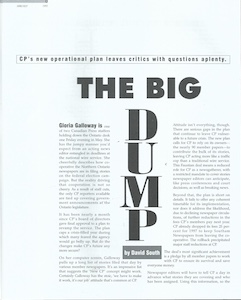
    Gloria Galloway is one of two Canadian Press staffers holding down the Ontario desk one Friday evening in May. She has the jumpy manner you’d expect from an acting news editor entangled in deadlines at the national wire service. She cheerfully describes how cooperative the Northern Ontario newspapers are in filing stories on the federal election campaign. But the reality driving that cooperation is not so cheery. As a result of staff cuts, the only CP reporters available are tied up covering government announcements at the Ontario legislature.

    It has been nearly a month since CP’s board of directors gave final approval to a plan to revamp the service. The plan caps a crisis-filled year during which many feared the agency would go belly up. But do the changes make CP’s future any more secure?

    On her computer screen, Galloway pulls up a long list of stories filed that day by various member newspapers. It’s an impressive list that suggests the ‘New CP’ concept might work. Certainly Galloway has the stoic, ‘we have to make it work, it’s our job’ attitude that’s common at CP.

    Attitude isn’t everything, though. There are serious gaps in the plan that continue to leave CP vulnerable to a future crisis. The new plan calls for CP to rely on its owners – the nearly 90 member papers – to contribute the bulk of its stories, leaving CP acting more like a traffic cop than a traditional wire service. This Faustian deal means a reduced role for CP as a newsgatherer, with a restricted mandate to cover stories newspaper editors can anticipate, like press conferences and court decisions, as well as breaking news.

    Beyond that, the plan is short on details. It fails to offer any coherant timetable for its implementation, nor does it address the likelihood, due to declining newspaper circulations, of further reductions in the fees CP’s members pay next year. CP already dropped its fees 25 percent for 1997 to keep Southam Newspapers from leaving the cooperative. The rollback precipitated major staff reductions at CP.

    The deal’s most significant achievement is a pledge by all member papers to work with CP to ensure its survival and save everyone money.

    Newspaper editors will have to tell CP a day in advance what stories they are covering and who has been assigned. Using this information, so the theory goes, it will be possible to avoid assigning several reporters from competing papers to cover a story when one will do. A reporter will not only be working for his or her own paper that day, but for every CP paper, and will be expected to file updates throughout the day to a CP editor, who in turn will write the story that is then ‘wired’ to all the members. That way, it is hoped, no superfluous stories will be going out on the wire. Member papers will still file analytical and feature stories to CP but, as is the case now, they are under no obligation to give away their prized family jewels – exclusive stories – to other CP papers.

    In practical terms, the new approach has been creeping into CP’s way of doing things by stealth rather than command. CP has been increasing its reliance on member papers to pick up the slack when CP reporters aren’t available. The most recent example was the federal election campaign: only one CP reporter was assigned full-time to cover the whole campaign. The rest of the coverage was handled by a combination of CP bureau staff and member paper reporters.

    While many smaller papers are dependent on CP for their provincial, national and international stories, the bigger papers, who are the main sources of these stories, can afford to be blase’. Their willingness to co-operate will decide the success or failure of the member-exchange component of CP.

    Southam’s vice-president of editorial, Gordon Fisher, maintains his papers will support the plan because it will save his company approximately $2.5 million a year. “We pay a significant amount of money towards this cooperative,” he maintains. “A member exchange is one of the more efficient ways we can find to deliver news without incurring a huge amount of expense.”

    “What is CP needs a story earlier than a reporter normally files?” asks managing editor Jane Perves of Halifax’s Chronicle-Herald and Mail-Star. “Theoretically, they should be spending all their time doing the story for our paper.”

    Jane Purves is an enthusiastic supporter of CP. Nonetheless she wonders if CP editors will be caught in a contest of wills with editors at member papers. She would like to see a reporter’s CP obligations involve simply calling in a quote or raw data. She would have a problem if a reporter working on a major story for her paper was distracted by CP’s needs.

    The Globe and Mail is conidering hiring a full-time co-ordinator to handle the heavy volume of stories that paper generates for CP. Newspaper managers elsewhere are split on the question of whether the plan will increase workloads. The extent that it does so will be a crucial test of their commitment.

    Not only will editors need to regularly ‘loan’ reporters to CP, they will have to change how they do things on a daily basis if the plan is to work. Editors will have to file an assignment list one day in advance to CP, a task that could get easily overlooked when papers get hit with multiple big stories.

    “It’s pretty minor stuff,” says Perry Beverley, the co-publisher of Brockville’s Recorder and Times. Although the Recorder and Times is an afternoon paper where copy is edited in the morning, Beverley has no plans to switch an editor to an evening shift to fit CP’s deadlines.

    Deadlines are a particularly thorny question in a country that spans six time zones. Newspapers on the East coast can file stories at the end of the day and still meet CP deadlines that are pegged at Toronto time. The problem is with newspapers west of Ontario; they will have to file stories well before the end of the day. In the case of B.C., filing will have to be done in the morning so that stories picked up by CP will be ready in time for East coast papers.

    The copy will have to go out to CP unedited.

    At the Edmonton Sun, editor-in-chief Paul Stanway isn’t sanguine about sending out unedited copy. Stanway had editorial deadlines pushed back to 6 p.m. 18 months ago as part of a re-organization at the paper, but they still mean copy would be sent straight from reporters to CP, where copy needs to be in between 4 p.m. and 9 p.m. Toronto time. Stanway is concerned the CP staff will not have the time to fact-check stories to weed out mistakes, which would reflect poorly on his paper.

    The anticipated deadline crunch has been nicknamed “the big dump” in CP circles: a tidal wave of material hitting the wire service’s desks all at once, leaving editors scrambling to do re-writes before newspapers are put to bed.

    CP general manager Jim Poling, who vacates he job in June, believes this problem will be solved by the restructuring, not exacerbated by it. “The volume of copy has already dropped significantly,” he says. “We are hoping for a wider spectrum of deadlines. Hopefully you are going to get your copy spread out over a longer period, instead of over the course of a couple of hours. You might not need a massive shift of people to a certain time.”

    Poling claims the resolution is in better planning which will result in fewer unwanted stories. Fewer stories, so Poling maintains, means more time for editors to re-write.

    At CP’s Winnipeg bureau, Canadian Media Guild vice-president Scott Edmonds is sceptical. He isn’t convinced the slimmed down CP will have the staff to handle what he sees as an increasing workload.

    “It sounds like the meatgrinder approach to journalism,”says Edmonds. “There is no way these desks are going to be able to cope with any degree of thoughtfulness with this copy. The pressure is going to be too great.”

    Edmonds also sees a bigger problem in staff moral. “The majority of people working for Canadian Press don’t want their career to end up as a re-writer… It will require a lot more attention on the desk for this material, so we will be taking resources away from reporting. In other words, taking somebody away from doing the story to redoing the story.”

    CP’s raison d’etre is its ability to turn out stories written in a homogenous national voice that can be tailored for a specific paper’s readers. Another important asset is the agency’s ability to quickly add knowledge and background to stories, drawing on the experience of its reporters and editors. According to Martin O’Hanlon at CP’s Ontario Desk, cut-backs have compromised this ability. Three business reporters have been poached by the Financial Post, including Ian Jack and Sandy Rubin. Over 40 talented reporters and editors took buyouts in the fall of 1996.

    This means CP isn’t as well equipped as it once was to turn raw copy from reporters into high-quality journalism that can draw the respect and admiration of its subjects.

    “Our reporters are not trained to write for a national audience,” emphasizes Jane Purves in Halifax.

    Scott Edmonds doesn’t believe member contributors are a substitute for CP staff. “I’m very concerned about attempting to replace quality staf-written material that caters to a national audience and is written to uniform standards, with material picked up from newspapers that in some cases may be very good, but in some cases may not be of the same quality.”

    There is a great deal of confusion over when the plan is supposed to kick in. One camp, which includes Jim Poling, sees it more as a gradual, evolutionary change that will take several years to fine tune. There are others who want to see trial runs. Still others believe there will be a date set for a total national switch-over.

    Perry Beverley favours test sites and single switch-over date.

    “Once that D-Day time is chosen for the switch-over into the restructured CP,” she says, “there will be an appointed person in the newsroom responsible for sending the schedule to CP.”

    Purves favours a gradual switch. “A shot-gun approach might backfire. I’d rather have a gradual approach providing we had a starting date and an aim.”

    “We don’t have to have a roll-out day,” says Poling. “But if all the managers and staff rise up and say ‘shit, we need test sites,’ then I will listen. Anybody who is waiting for a date will be disappointed. All of this started a long time ago and is a continuing process that will take a couple of years to get everything in place.”

    Seven regional news committees will co-ordinate and oversee this new approach, each one staffed by representatives from member papers and CP. According to the plan, these regional news committees will act as enforcers for the new regime. They will work out the logistics of member exchange and use fines to penalize papers that miss deadlines or obstruct exchange.

    How such an approach would work in practice is still up in the air. “At some point everybody is going to act against the interests of the co-op,” maintains Purves. “They will be wondering, ‘will I be fined for this?’”

    Nobody contacted by SCAN could tell us what these fines would be, how violations would be investigated or what constituted offences. Purves wondered what deterrence value the fines would have if a paper thought it had acted in its best interests. If paper X decided to hold back a juicy scoop that was supposed to be that day’s CP story, a fine of $2,000 might be worth incurring if it sells more newspapers. It was generally agreed none of these committees would meet until after the federal election at the earliest.

    For now, Poling is generally optimistic (though he won’t around past June and a replacement has yet to be found). He is talking about raising salaries for the first time in five years, about hiring new staff, about stabilizing life at CP.

    The lower fees have lured back one newspaper group, British Columbia’s Sterling. A trial use of CP stories started at the beginning of May. It remains to be seen whether New Brunswick’s Telegraph Journal/Times Globe papers will return, after pulling out of CP in 1993 and hiring more of its own reporters with the money saved. Publisher Jamie Milne remains coy as to his interest in returning to CP, but Poling thinks a deal will be worked out by the fall.

    And what about the mood of the man charged with overseeing CP’s transition? Jim Poling, as some CP staffers like to mention, is losing that cautious reserve managers usually have for talking to the media. He isn’t happy with the state of the print media in Canada.

    “There has been a lot of cutting in this industry,” says an audibly frustrated Poling. “The fact of the matter is this: cutting isn’t the only answer to having an efficient operation. There has to be some money available to allow journalists to walk around a bit. People who walk around and poke at things and stare at things write good stories.”

    With phones ringing all around us, Galloway begins to think out loud about possible wrinkles in the new CP plan: how newspaper reporters at trials will have to keep leaving the courtroom to file updates for CP, how stories written for local papers will translate for national readers, how hard it can be for local, non-CP reporters to cover elections when they don’t know what questions have been asked elsewhere on the campaign trail.

    But Galloway has to get back to work. She has to push the Toronto Star to file a story early so the Hamilton Spectator can pick it up.

    Scan magazine was published for media professionals in Toronto, Canada in the 1990s.
    “The Big Dump”
    Breaking the news to CP staff.

    https://davidsouthconsulting.org/2022/10/21/african-media-changing-to-reach-growing-middle-class/

    https://davidsouthconsulting.org/2021/06/14/case-study-1-investigative-journalism-1991-1997-2/

    https://davidsouthconsulting.org/2021/07/14/freedom-of-expression-introducing-investigative-journalism-to-local-media-in-mongolia-1999-25-january-2016/

    https://davidsouthconsulting.org/2021/05/25/ger-mongolias-first-web-magazine-and-a-pioneering-web-project-for-the-united-nations-12-january-2016/

    https://davidsouthconsulting.org/2022/05/16/high-impact-communications-in-a-major-crisis-undp-mongolia-1997-1999-18-february-2016/

    https://davidsouthconsulting.org/2021/07/25/in-their-own-words-selected-writings-by-journalists-on-mongolia-1997-1999-6-january-2010/

    https://davidsouthconsulting.org/2022/11/01/indian-newspapers-thrive-with-economy/

    https://davidsouthconsulting.org/2022/05/27/media/

    https://davidsouthconsulting.org/2022/11/01/new-journal-celebrates-vibrancy-of-modern-africa/

    https://davidsouthconsulting.org/2021/12/08/new-media-markets-and-screen-finance/

    https://davidsouthconsulting.org/2022/10/04/popular-chinese-social-media-chase-new-markets/

    https://davidsouthconsulting.org/2022/11/23/publications/

    https://davidsouthconsulting.org/2021/01/16/redneck-renaissance-a-coterie-of-journalists-turn-cracker-culture-into-a-leisure-lifestyle/

    https://davidsouthconsulting.org/2021/01/14/from-special-report-nmm-new-media-markets-spotlight-on-the-emergence-of-satellite-porn-channels-in-the-uk/

    https://davidsouthconsulting.org/2020/12/11/top-reporters-offer-military-media-handling-tips/

    https://davidsouthconsulting.org/2020/12/11/undercurrents-a-cancellation-at-cbc-tv-raises-a-host-of-issues-for-the-future/

    https://davidsouthconsulting.org/2022/05/27/undp-travelling-seminar-environment-and-development-mongolia-1998/

    Creative Commons License

    This work is licensed under a
    Creative Commons Attribution-Noncommercial-No Derivative Works 3.0 License.

    ORCID iD: https://orcid.org/0000-0001-5311-1052.

    © David South Consulting 2023

  • False Data Makes Border Screening Corruptible

    False Data Makes Border Screening Corruptible

    “Big Brother” system could violate rights of Canada’s visitors

    By David South

    Now Magazine (Toronto, Canada), May 21-27, 1992

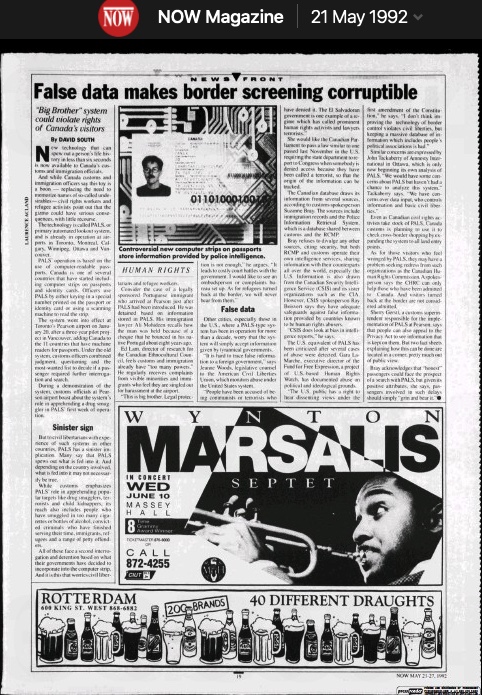
    New technology that can spew out a person’s life history in less than six seconds is now available to Canada’s customs and immigration officials.

    And while Canada customs and immigration officers say this toy is a boon – replacing the need to memorize names of so-called undesirables – civil rights workers and refugee activists point out that the gizmo could have serious consequences, with little recourse.

    The technology is called PALS, or primary automated look out system, and is already in operation at airports in Toronto, Montreal, Calgary, Winnipeg, Ottawa and Vancouver.

    PALS’ operation is based on the use of computer-readable passports. Canada is one of several countries that have started including computer strips on passports and identity cards. Officers use PALS by either keying in a special number printed on the passport or identity card or using a scanning machine to read the strip.

    The system went into effect at Toronto’s Pearson airport on January 20, after a three-year pilot project in Vancouver, adding Canada to the 11 countries that have machine readers for passports. Under the old system, customs officers combined judgement, questioning and the most-wanted list to decide if a passenger required further interrogation and search.

    During a demonstration of the system, customs officials at Pearson airport boast about the system’s role in apprehending a drug smuggler in PALS’ first week of operation.

    Sinister sign

    But to civil libertarians with experience of such systems in other countries, PALS hasa sinister implication. Many say that PALS spews out what is fed into it. And depending on the country involved, what is fed into it may not necessarily be true.

    While customs emphasizes PALS’ role in apprehending popular targets like drug smugglers, terrorists and child kidnappers, its reach also includes people who have smuggled in too many cigarettes or bottles of alcohol, convicted criminals who have finished serving their time, immigrants, refugees and a range of petty offenders.

    All of these face a second interrogation and detention based on what their governments have decided to incorporate into the computer strip. And it is this that worries civil libertarians and refugee workers.

    Consider the case of a legally sponsored Portuguese immigrant who arrived at Pearson just after PALS had been introduced. He was detained based on information stored in PALS. His immigration lawyer Ali Mohideen recalls how the man was held because of a cheque that he bounced in his native Portugal about eight years ago.

    Ed Lam, director of research for the Canadian Ethnocultural Council, feels customs and immigration already have “too many powers.” He regularly receives complaints from visible minorities and immigrants who feel they are singled out for harassment at the airport.

    “This is big brother. Legal protection is not enough,” he argues. “It leads to costly court battles with the government. I would like to see an ombudsperson or complaints bureau set up. As for refugees turned back at the border, we will never hear from them.”

    False data

    Other critics, especially those in the US, where a PALS-type system has been in operation for more than a decade, worry that the system will simply accept information given by tyrannical governments.

    “It is hard to trace false information to a foreign government,” says Jeanne Woods, legislative counsel to the American Civil Liberties Union, which monitors abuse under the United States system.

    “People have been accused of being communists or terrorists who have denied it. The El Salvadoran government is one example of a regime which has called prominent human rights activists and lawyers terrorists.”

    She would like the Canadian Parliament to pass a law similar to one passed last November in the US requiring the state department to report to Congress when somebody is denied access because they have been called a terrorist, so that the origin of the information can be tracked.

    “People have been accused of being communists or terrorists who have denied it. The El Salvadoran government is one example of a regime which has called prominent human rights activists and lawyers terrorists.”

    The Canadian database draws its information from several sources, according to customs spokesperson Suzanne Bray. The sources include immigration records and the Police Information Retrieval System, which is a database shared between customs and the RCMP.

    Bray refuses to divulge any other sources, citing security, but both RCMP and customs operate their own intelligence services, sharing information with their counterparts all over the world, especially the US. Information is also drawn from the Canadian Security Intelligence Service (CSIS) and its sister organizations such as the CIA. However, CSIS spokesperson Ray Boisvert says they have adequate safeguards against false information provided by countries known to be human rights abusers.

    “CSIS does look at bias in intelligence reports,” he says.

    The US equivalent of PALS has been criticized after several cases of abuse were detected. Gara LaMarche, executive director of the Fund for Free Expression, a project of US-based Human Rights Watch, has documented abuse on political and ideological grounds.

    “The US public has a right to hear dissenting views under the first amendment of the Constitution,” he says. “I don’t think improving the technology of border control violates civil liberties, but keeping a massive database of information which includes people’s political associations is bad.”

    Similar concerns are expressed by John Tackaberry of Amnesty International in Ottawa, which is only now beginning its own analysis of PALS. “We have concerns over data input, who controls information and basic civil liberties.”

    Even as Canadian civil rights activists take stock of PALS, Canada customs is planning to use it to check cross-border shopping by expanding the system to all land entry points.

    As for those visitors who feel wronged by PALS, they may have a problem seeking redress from such organizations as the Canadian Human Rights Commission. A spokesperson says the CHRC can only help those who have been admitted to Canada. And visitors turned back at the border are not considered admitted.

    Sherry Gerstl, a customs superintendent responsible for the implementation of PALS at Pearson, says that people can also appeal to the Privacy Act to see information that is kept on them. But two fact sheets explaining how this can be done are located in a corner, pretty much out of public view.

    Bray acknowledges that “honest” passengers could face the prospect of a search with PALS, but given its positive attributes, she says, passengers involved in such delays should simply “grin and bear it.”

    Facial recognition AI software triangulates facial features to produce a recognition match.
    “Computers Track Travellers” by David South. Now Magazine published investigative journalism from David South, Naomi Klein and others in the early 1990s.

    More on biometrics:

    https://davidsouthconsulting.org/2022/02/09/african-health-data-revolution/

    https://davidsouthconsulting.org/2020/12/04/big-data-can-transform-the-global-souths-growing-cities/

    https://davidsouthconsulting.org/2020/12/04/data-surge-across-global-south-promises-to-re-shape-the-internet/

    https://davidsouthconsulting.org/2021/03/04/indian-id-project-is-foundation-for-future-economic-progress/

    https://davidsouthconsulting.org/2021/03/31/new-weapon-against-crime-in-the-south/

    Creative Commons License

    This work is licensed under a
    Creative Commons Attribution-Noncommercial-No Derivative Works 3.0 License.

     ORCID iD: https://orcid.org/0000-0001-5311-1052.

    © David South Consulting 2023