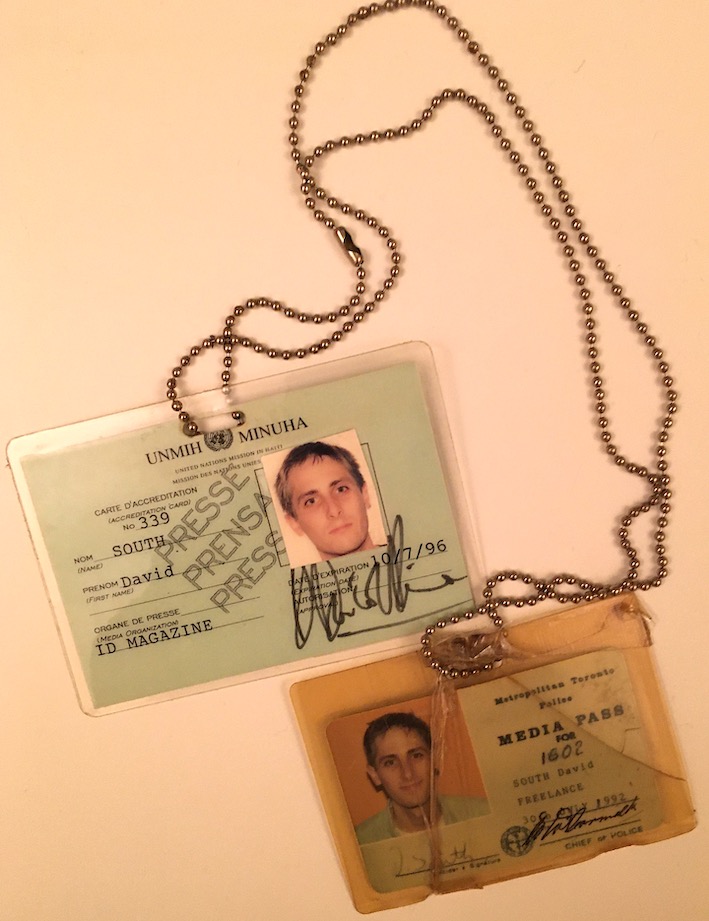
Tag: Can the U.N. help remake a country?

  • CASE STUDY 3: Id Magazine | 1996 – 1997

    CASE STUDY 3: Id Magazine | 1996 – 1997

    Expertise: Editing, investigative journalism, art direction, managing teams, strategy, content development.

    Location: Guelph, Ontario, Canada 1996 to 1997

    ISSN : 1208-4468

    Features Editor: David South  

    Abstract

    In 1996 I was hired as Features Editor for Id Magazine, a bi-weekly alternative magazine in Guelph, Ontario, Canada. 

    About 

    In 1996 Id Magazine, an Ontario, Canada alternative biweekly, was expanding and needed to improve the quality of its journalism, while also making the difficult shift to being a more consistently professional offering. I was hired as Features Editor and set about swiftly assembling a team of investigative journalists. My strategy involved targeting stories overlooked by Canadian newspapers and TV news. In the 1990s, it was often the case the best journalism and the best investigative journalism in Canada could be found in the country’s alternative media. This led to a number of firsts, including an extensive investigation into Canada’s flourishing sex industry, the government’s addiction to casinos to boost revenues, unearthing a plot by neo-nazis to infiltrate Ontario high schools with hate rock, university students’ catastrophic debt culture, reporting from the streets of Port-au-Prince, Haiti on Canada’s UN mission, and probing the government’s public services privatisation plans (including being invited to debate this topic on CBC TV’s programme, Face Off). With a keen eye for new media trends, the magazine covered the fast-rising Internet economy, early experiments with digital currencies and smart cards (Mondex) (Canadian Town Tries Out Cash Cards) being carried out in Guelph, Ontario, and concerns about data privacy.

    There clearly was a gap in the news marketplace Id could better fill with solid investigative journalism and features writing aimed at a younger demographic. 

    How large a market gap can be confirmed by various analyses on the state of the Canadian media at the time and since. According to the book The Missing News: Filters and Blind Spots in Canada’s Press (Robert A. Hackett and Richard S. Garneau, Canadian Centre for Policy Alternatives, University of Toronto Press 2000), Canada’s media was in a mess in the 1990s resulting from declining resources, staff layoffs and media closures reducing the breadth and depth of news coverage.  

    My challenge: Could I bring together a talented, young team and improve the quality and consistency of journalism for a start-up magazine seeking to grow? The proof came in the form of improved audited pick-up of the magazine by readers, the magazine’s confident push to expand on the Internet, and the fact many from that original team have gone on to not only have successful careers in the media and film, but also to be influential in their own right – proof the original belief in their talent was correct.  

    Pressure on journalists to toe the line and not upset advertisers was also increasing in the context of ongoing high unemployment, a stagnant economy in a recession, and government austerity. Canadian media as whole also has a “great dependence on advertising, which accounts for more than 70% of daily newspaper revenues, about 64% of magazine revenues,” which means there is enormous pressure to only publish stories that do not upset advertisers. And monopolies exert great control over news content in Canada: “In the United States, ten companies control 43.7% of total daily newspaper circulation. By contrast, in Canada since 1996, one single company controls a comparable share of the media pie.” 

    Quoting Jeffrey Simpson in the book, newspapers are “shrinking in size, personnel, ambition and, as a consequence, in their curiosity,” …. “I believe the result has been a diminution in quality.” (p64) 

    Fast forward to “Today, we have a crisis in the journalism industry unprecedented in scope. A media implosion. Newspapers being reduced to digital editions, large numbers losing their jobs, circulation falling, ad revenues plunging, near monopoly ownership of big-city dailies, the old business model in a state of collapse.” (Canada’s media: A crisis that cries out for a public inquiry by Lawrence Martin, The Globe and Mail, Feb. 02, 2016). 

    Brief descriptions of sample issues are below: 

    Can Harris be Stopped? Cover 

    My first Id Magazine cover. It was thrown together in a few days after being hired. While a work of resourcefulness under pressure, it did capture the spirit of the times as multiple demonstrations and strikes tried to bring down the much-hated Conservative government in Ontario. 

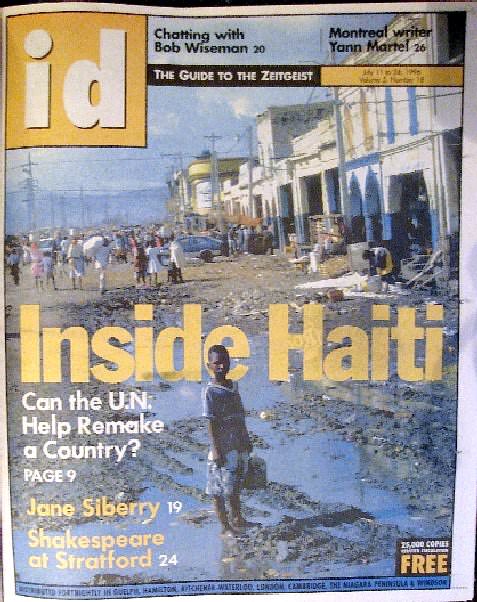
    “Can the UN Help Remake a Country?” Cover 

    This cover photo by Phillip Smith was taken in the market area of Port-au-Prince, Haiti. I had never seen such squalor and desperation in my life. It got worse as we visited the city’s morgue, packed to the rafters with the dead and mutilated bodies of children and adults. It was a tough assignment and one that was captured with professionalism by Phillip’s camera.  

    Christmas Issue Cover 

    Back in 1996, the Thatcher thirst for privatisation came to Ontario with a vengeance. In this issue, we asked if it showed a lack of imagination to just sell publicly paid for assets to wealthy investors. We offered other ownership models and I debated this topic on CBC TV’s Face Off.  

    “Pulling the Plug on Hate Rock” Cover 

    This excellent cover by Gareth Lind was, as far as I know, the first use of pop art on a biweekly magazine cover in Ontario at that time (I certainly hadn’t seen anyone else do it). It sold the excellent investigation into skinhead rock bands infiltrating Ontario high schools very well. It was timed for release during the North-by-Northeast music festival in Toronto, and had zero returns (as in all issues were picked up). 

    Sarah Polley Cover 

    A regular contributor to Id, Canadian actor and director Sarah Polley challenged the stale Canadian left with her spiky views. In this issue we tackled the decline in the quality of TV programmes and asked if it was a moral vacuum being hoovered up by consumerism.  

    Student Issue Cover 

    This cover is by great Canadian political cartoonist and illustrator Jack Lefcourt. Always funny, Jack captures well the corporate take-over of the country’s universities and the introduction of the catastrophic debt culture that leaves so many students in a financial pickle. It was also Id’s first student issue.  

    “The Great Education Swindle: Are Reforms Destroying Your Future?”

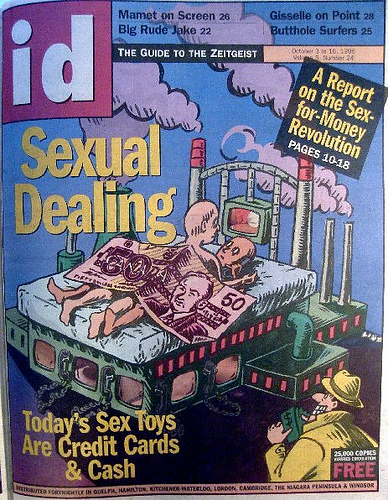
    “Today’s Sex Toys are Credit Cards and Cash” Cover 

    As Ontario’s economy experienced year-after-year of high unemployment and stagnant salaries, its sex economy flourished. In another first, the Id team tackled all aspects of the growth of the sex economy and changing attitudes to sexual behaviour. Beating the big papers to this story, they wrote with honesty and verve and made a refreshing break from the limp journalism of most Canadian newspapers. 
    Timeline

    1996: Hired as Features Editor and assembled editorial and creative team.

    1997: Id Magazine begins to simultaneously publish its content online, a pioneering move at the time. 

    Impact 

    Micro 

    • reducing returns and boosting audited pick-ups of the free magazine – a key metric for a publication reliant on local advertising
    • assembled talented investigative team and graphic design and photo team
    • introduced pop art front covers
    • increased news coverage, especially impact of austerity in Canada
    • increased foreign coverage, including on Canada’s United Nations mission in Haiti
    • introduced high-profile contributors, including actor and director Sarah Polley
    • debated stories on other media, including CBC TV’s Face Off 

    Macro

    • most of the team have gone on to very successful careers in the media
    • magazine still receives good comments on Facebook many years after its closure
    • one of the first Canadian magazines to embrace the Internet and publish simultaneously online

    A sample of published stories is below:  

    Casino Calamity: One Gambling Guru Thinks The Province Is Going Too Far 

    Will Niagara Falls Become the Northern Vegas? 

    Land of the Free, Home of the Bored 

    Man Out Of Time: The World Once Turned On the Ideas of this Guelph Grad, But Does the Economist John Kenneth Galbraith Know the Way Forward? 

    Porn Again: More Ways to Get Off, But Should We Regulate the Sex Industry? 

    Redneck Renaissance: A Coterie of Journalists Turn Cracker Culture into a Leisure Lifestyle

    Swing Shift: Sexual Liberation is Back in Style 

    State of Decay: Haiti Turns to Free-market Economics and the UN to Save Itself 

    TV’s Moral Guide in Question – Again 

    Citations 

    Political Governance of Capitalism: A Reassessment Beyond the Global Crisis by Helmut WillkeGerhard WillkeEdward Elgar, 2012

    Schizophrenia: A Patient’s Perspective by Abu Sayed Zahiduzzaman, Publisher: Author House, 2013 

    Other Resources 

    Freedom of Expression: Introducing Investigative Journalism to Local Media in Mongolia 

    Ger Magazine Issue 1 

    Ger Magazine Issue 2 

    In Their Own Words: Selected Writings by Journalists on Mongolia, 1997-1999 (ISBN 99929-5-043-9) 

    The back issues of id magazine reside at the Bibliothèque et Archives Canada / Library and Archives Canada [has v.5(1995)-v.8(1999)] collection.

    OCLC Number/Unique Identifier: 1082496695

    ISSN: 1208-4476

    https://davidsouthconsulting.org/2021/06/01/case-study-2-watch-magazine-1994-and-1996-2/

    https://davidsouthconsulting.org/2021/05/25/ger-mongolias-first-web-magazine-and-a-pioneering-web-project-for-the-united-nations-12-january-2016/

    https://davidsouthconsulting.org/2021/03/12/southern-innovator-magazine/

    Creative Commons License

    This work is licensed under a Creative Commons Attribution 4.0 International License.

    ORCID iD: https://orcid.org/0000-0001-5311-1052.

    © David South Consulting 2025
  • CASE STUDY 1: Investigative Journalism | 1991 – 1997

    CASE STUDY 1: Investigative Journalism | 1991 – 1997

    Expertise: Investigative journalism, editing, start-ups, content and magazine design, digital content, digital strategy.

    Locations: Toronto and Guelph, Ontario, Canada and London, UK 1991 to 1997

    Investigative Journalist, Editor, Reporter, Writer: David South

    Abstract

    I worked as a journalist for magazines and newspapers from 1991 to 1997 in Canada and the United Kingdom and as a radio host for a weekly spoken word interview programme, Word of Mouth (CKLN-FM). 

    CKLN-FM’s “Word of Mouth 6 pm-6:55 pm Hosts: David South, Jill Lawless This show goes well behind the headlines for the real story behind the events.”

    This included working as an investigative journalist for Now Magazine, “Toronto’s alternative news and entertainment source”, as a Medical and Health Correspondent for Today’s Seniors, and as an investigative journalist and reporter for two Financial Times newsletters, New Media Markets and Screen Finance.  

    Samples of published stories can be found here (below) and on the Muck Rack platform here: https://muckrack.com/david-south

    About

    Could it be possible to do high-quality investigative journalism in the context of a shrinking economy undergoing austerity, and where the media sector is contracting and consolidating around a small number of media companies? Is it possible to launch new media products in the face of a contracting economy and reach new audiences and create new markets?

    In Canada, the early to mid 1990s were the years of government austerity and economic crisis. After the crash of 1989/1990*, institutions came under great stress. Health care, for example, was pitched into a period of turmoil and change. Drawing on my experience working in the health sector (Princess Margaret Hospital/Ontario Cancer Institute), I covered this crisis in many stories for various publications, in particular Today’s Seniors.

    The Canadian economy severely contracted and unemployment was at 11.4 per cent by 1993 (Statistics Canada), and as Statistics Canada says, “Because employment recovered at a snail’s pace after the recession of the early 1990s, the decline in the unemployment rate was delayed until 1994”. 

    The media in general could not avoid the wider economic crisis. According to the book The Missing News: Filters and Blind Spots in Canada’s Press (Robert A. Hackett and Richard S. Garneau, Canadian Centre for Policy Alternatives, University of Toronto Press 2000), Canada’s media was also in a crisis throughout the 1990s, as declining resources, staff layoffs and media closures reduced the breadth and depth of news coverage. Canadian media as a whole also has a “great dependence on advertising, which accounts for more than 70% of daily newspaper revenues, about 64% of magazine revenues,” which means there is enormous pressure to only publish stories that do not upset advertisers. And monopolies exert great control over news content in Canada: “In the United States, ten companies control 43.7% of total daily newspaper circulation. By contrast, in Canada since 1996, one single company controls a comparable share of the media pie.”

    The impact of this crisis was summed up by Jeffrey Simpson in the book The Missing News, where he said newspapers are “shrinking in size, personnel, ambition and, as a consequence, in their curiosity,” …. “I believe the result has been a diminution in quality.” (p64)

    This is the context in which, ironically, it was possible to flourish as a much-sought-after investigative journalist who could get the story and get the quotes and as an editor. And it was also a time for opportunity, in particular as new media rose in importance, from cable and satellite television, to the rise of the Internet.

    I broke original stories for Now Magazine as a member of their investigative reporting team, for Today’s Seniors as its Medical and Health Correspondent, and as a reporter for two Financial Times newsletters in London, UK. I also broke original stories as a freelancer for many other magazines and newspapers, including Hospital News, The Toronto Star, This Magazine, The Annex Gleaner, Flare, The Financial Post Magazine, Canadian Living, and others. I drew on strong contacts in health care, media, politics, international relations and the military. 

    I was an editor for magazines, newspapers and newsletters as well, gaining invaluable experience and contacts. This included as Editor-in-Chief for start-up youth publication, Watch Magazine (see Case Study 2), and as Features Editor for Id Magazine (see Case Study 3). 

    Themes covered included the uses – and abuses – of data, the impact of military engagements to uphold international law, how to re-structure health care when budgets are tight, with populations ageing, and technology and scientific advances quickly expanding options, the emerging new media world of cable and satellite television and the Internet, the sexual revolution 2.0, urbanization and how it re-shapes politics and community, international development, and youth culture. 

    Story highlights include covering data concerns over Canada’s border screening measures, questions about the air quality of aircraft cabins, the debate over airstrikes in Bosnia, scandals involving peacekeepers in Somalia and reporting on the UN peacekeeping mission in Haiti, reforms to medical education in Canada, innovators in health care, the tug of war over health care spending during austerity measures, London, UK designers, the growing role of Nordic countries in cable and satellite television, the film financing scene in Europe and the UK, the new sexual revolution and its impact on cable and satellite television and the rising Internet, changes to Canada’s media industry, and Toronto’s embracing of the megacity concept and the political battles it sparked. 

    I edited newsletters and newspapers aimed at specific communities, from Canada’s medical history community to part-time students. And had the privilege of helming a start-up youth magazine as its Editor-in-Chief to its commercial success (see Case Study 2). 

    It was an exciting time of great change, best reflected by the fact in 1997 Id Magazine (Features Editor: see Case Study 3) was one of the first Canadian publications to regularly publish an online version (https://web-beta.archive.org/web/19970207103121/www.idmagazine.com).  

    * “The last two recessions in Canada occurred in 1982 and 1990. … The most recent Canadian recession began in the second quarter of 1990 and over the next 12 months GDP fell by 3.2%. … The recovery from this recession was unusually slow; there was almost no growth between mid-1991 and mid-1992. This slow recovery was export driven.” (The Canadian Encyclopedia)

     “In early 1994, Canada’s economic situation was not that favourable—our economy was facing some rather serious problems.

     “… the recession here was more severe than in the United States.

    “Working their way out of these difficulties was disruptive and painful for Canadian businesses. Defaults, restructurings, and downsizings became the order of the day. With all this, unemployment took a long time to recover from the 1990–91 recession and, in many instances, wages and salaries were frozen or reduced (Bank of Canada: Canada’s Economic Future: What Have We Learned from the 1990s?)

    A small sample of published stories with links is below:  

    Investigative Journalism 

    An Abuse of Privilege?

    Aid Organization Gives Overseas Hungry Diet Food

    Artists Fear Indifference From Megacity

    Casino Calamity: One Gambling Guru Thinks The Province Is Going Too Far

    Counter Accusations Split Bathurst Quay Complex: Issues of Sexual Assault, Racism at Centre of Local Dispute

    False Data Makes Border Screening Corruptible

    New Student Group Seeks 30 Percent Tuition Hike

    Peaceniks Questioning Air-raid Strategy in Bosnia

    Safety at Stake

    Somali Killings Reveal Ugly Side of Elite Regiment

    Study Says Jetliner Air Quality Poses Health Risks: CUPE Takes on Airline Industry with Findings on Survey

    Top Reporters Offer Military Media Handling Tips

    Will the Megacity Mean Mega-privatization?

    Will Niagara Falls Become the Northern Vegas?

    Health and Medical

    Changing Health Care Careers a Sign of the Times

    Critics Blast Government Long-Term Care Reforms

    Cut Services to Elderly, Says Doctors’ Survey … But Leave Our Salaries Alone!

    Feds Call for AIDS, Blood System Inquiry: Some Seniors Infected

    Government Urged to Limit Free Drugs for Seniors

    Health Care on the Cutting Block: Ministry Hopes for Efficiency with Search and Destroy Tactics

    Health Care in Danger

    Lamas Against AIDS

    New Legislation Will Allow Control of Medical Treatment

    New Seniors’ Group Boosts ‘Grey Power’: Grey Panthers Chapter Opens with a Canadian Touch

    Philippine Conference Tackles Asia’s AIDS Crisis

    Private Firms Thrive as NDP ‘Reinvents’ Medicare

    Psychiatric Care Lacking for Institutionalised Seniors

    Seniors Falling Through the Health Care Cost Cracks

    Specialists Want Cancer Treatments Universally Available

    Take Two Big Doses of Humanity and Call Me in the Morning

    Taking Medicine to the People: Four Innovators In Community Health

    US Health Care Businesses Chasing Profits into Canada

    Magazines

    The Ethics of Soup: Grading Supermarket Shelves – For Profit

    Freaky – The 70s Meant Something

    Land of the Free, Home of the Bored

    Man Out Of Time: The World Once Turned On the Ideas of this Guelph Grad, But Does the Economist John Kenneth Galbraith Know the Way Forward?

    Oasis Has Arrogance, A Pile of Attitude and the Best Album of 1994

    From Special Report: Sexual Dealing: Today’s Sex Toys Are Credit Cards & Cash: A Report On The Sex-For-Money Revolution

    Redneck Renaissance: A Coterie of Journalists Turn Cracker Culture into a Leisure Lifestyle

    Safety at Stake

    Swing Shift: Sexual Liberation is Back in Style

    Time Machines

    Too Black

    Media 

    The Big Dump: CP’s New Operational Plan Leaves Critics with Questions Aplenty

    Channel Regulation: Swedes will Fight Children’s Advertising all the Way

    Do TV Porn Channels Degrade and Humiliate?

    Is the UK Rushing to Watch TV Porn? 

    Playboy ‘is not for sad and lonely single men’

    TV’s Moral Guide in Question – Again

    UK Laws on Satellite Porn Among Toughest in Europe

    Undercurrents: A Cancellation at CBC TV Raises a Host of Issues for the Future

    Special Reports

    From Special Report: NMM (New Media Markets) Spotlight on the Emergence of Satellite Porn Channels in the UK

    From Special Report: Sexual Dealing: Today’s Sex Toys Are Credit Cards & Cash: A Report on the Sex-for-Money Revolution

    United Nations

    Freedom of Expression: Introducing Investigative Journalism to Local Media in Mongolia

    Starting from Scratch: The Challenge of Transition

    State of Decay: Haiti Turns to Free-market Economics and the UN to Save Itself

    Traffic Signs Bring Safety to the Streets

    Magazines

    Watch Magazine

    Id Magazine

    Newsletters

    Hannah Institute for the History of Medicine

    New Media Markets

    Screen Finance

    Blue Sky Bulletin

    Other Resources

    Ger Magazine: Issue 1

    Ger Magazine: Issue 2

    In Their Own Words: Selected Writings by Journalists on Mongolia, 1997-1999 (ISBN 99929-5-043-9) 

    Mongolian Rock and Pop Book (ISBN 99929-5-018-8) 

    Wild East: Travels in the New Mongolia (ISBN 1-55022-434-4)

    Timeline 

    1991: Begin career as investigative journalist and editor.

    1992: Work as a Medical and Health Reporter for Today’s Seniors and as an Investigative Journalist for Now Magazine. Work as Editor and Writer for the Hannah Institute for the History of Medicine’s newsletter. 

    1993: Published in many publications, including The Toronto Star, Canadian Living and This Magazine.

    1994: Work on re-launch of Watch Magazine 2.0 and its expansion (see Case Study 2). 

    1995: Work as reporter for two Financial Times newsletters in London, UK.

    1996: Work on re-launch of Watch Magazine 3.0 and its expansion. Begin work at Id Magazine as its Features Editor (see Case Study 3).

    1997: Begin two-year assignment with the United Nations mission in Mongolia (see Case Study 4). 

    Testimonials 

    David South … proved himself to be a penetrating, thorough and hard-working journalist. He produced a lot of very good stories …” Neil McCartney, Editor, Screen Finance, Telecom Markets and Mobile Communications, London, UK

    This work is licensed under a Creative Commons Attribution 4.0 International License.

    ORCID iD: https://orcid.org/0000-0001-5311-1052.

    © David South Consulting 2025

  • U.S. Elections Update: Clinton is using Canada to keep control of Haiti

    U.S. Elections Update: Clinton is using Canada to keep control of Haiti

    By David South

    Id Magazine (Canada), October 31 to November 13, 1996

    Canadian troops are not only on the frontline of peacekeeping in Haiti but also the frontline of U.S. foreign policy – a policy that is unravelling during the run-up to the November 5 presidential election. While the living standards of Haitians in the poorest country in the Western Hemisphere continue to decline despite free elections, Canadian troops are charged with keeping the island nation peaceful. It’s a task that is proving more and more difficult as Haiti suffers a crime wave and violent political unrest. 

    While American president Bill Clinton tries to snatch another victory from a grumpy U.S. electorate, his advisors are desperately trying to keep the lid on his foreign policy “victories” in Bosnia and Haiti. 

    Things are so bad, Clinton sent his secretary of state, Strobe Talbott, and his national security advisor, Anthony Lake, to Haiti on August 30 in response to high-profile assassinations of right-wing leaders. 

    “The administration are hoping, with fingers crossed, nothing will happen before November 5,” says Larry Birn of the Washington-based Centre for Hemispheric Affairs. “What the United States would like to do is cryogenically freeze all its foreign policy engagements so they don’t produce any problems. But we are losing very valuable time in Haiti because of Washington’s paralysis over negative developments occurring there. 

    “Washington didn’t realize an economic success story had to be bred there in a couple of years. The USAID programme is a scandal waiting for an investigation.”

    There is also another election-year factor: Republicans are not fond of anything that whiffs of a humanitarian approach to Haiti. Since they dominate Congress, this is also Clinton’s problem. 

    Given the history of American support for dictatorships in Haiti, the Clinton administration has chosen a low-key approach. After the 1994 invasion, the Americans pulled out the vast majority of their troops within a year, handing over responsibility for internal security to a UN peacekeeping force. But the U.S. never fully cut itself off from interfering in Haiti, keeping a military base operating in the country’s only industrial park in Port-au-Prince. 

    And Canada is key to U.S. plans because of that sour legacy. Canadians are seen as free from the burden of colonialism, and as a plus, our 700 mostly French-speaking troops can communicate better with the local population. 

    This policy has gone as far as hiring a Canadian public relations company to promote structural adjustment programmes that are conditional upon Haiti receiving any foreign aid from the International Monetary Fund and the World Bank, both based in Washington. 

    Gilles Morin is co-ordinating manager for Montreal firm Gervais-Gagnon-Covington Associates, who won the contract. Morin says, while his company did win the contract, like many other things to do with Haiti, they have heard nothing since Fall 1995 because of disorganization.  

    “On a personal basis there was a strong anti-American feeling among the population because of the past,” says Morin. “A lot of the financial institutions are based in Washington and they needed international support because banks in Washington are seen as American.”

    But there is a risk that a switch in U.S. priorities during the heat of an election will endanger Canadian troops.

    “If the president feels he has political risk in Haiti, he’s not going to take Canadian concerns into consideration,” warns Birns. “The UN mission gets caught up in the wake of U.S. efforts and it’s not able to define an independent course. Right now, the problem really is the USAID mission in Haiti is a total failure. The international donor function, you couldn’t exaggerate how disappointing it’s been in terms of almost no relief. The unemployment rate of 80 per cent is exactly what the unemployment rate was when the UN arrived.”

    On August 28, American troops from the 82nd Airborne plopped down on the streets of Port-au-Prince to spend a week patrolling. Many observers questioned the motives for this intervention. Was it to say to Haitians the UN isn’t the real deal, and if they get out of line, the Americans will kick their butts? Why doesn’t Canada protest the U.S. undermining the credibility of our peacekeeping mission?

    To Birn, sending in the 82nd was the foreign-policy equivalent of fast-food. “Sending in the 82nd Airborne merely aimed at getting a one-day headline,” he says. “The administration’s position has been staked on the fact there has been a number of foreign policy wins. But each of these victories is held together by corn starch and could unravel at any moment.”

    Birn sees an escalation in political violence just around the corner. He fears the current economic crisis will help the formation of a violent left-wing guerrilla movement to rival existing right-wing paramilitaries. 

    “Without former president Jean Bertrand Aristide,” he explains, “there is growing apprehension that president Rene Preval will not be able to project a sufficient leadership to keep the average Haitian, who is sacrificing with no expectation of an improved standard of living, happy.”

    While it has been almost two years since Haiti was the media’s darling, observers point out the cycle of violence has returned to the country’s streets despite the presence of UN peacekeepers and American troops. 

    When id reported from the Haitian capital of Port-au-Prince in July (id July 11 to 24, Number 18), it was obvious no progress had been made to improve the standard of living or rebuild the country’s crumbling infrastructure. 

    In an ironic twist, attempts to step up deportations of Haitian-Americans convicted of crimes in the U.S. has led to an increase in killings in Haiti according to the October 22 issue of New York weekly, The Village Voice

    More and more, the UN troops are propping up an increasingly unpopular government. A government that is seen by many Haitians to be getting its orders from Washington, not Port-au-Prince. Canadian troops lead the UN mission in Haiti and make up 700 of the 1500 soldiers stationed there (the rest are from Pakistan and Bangladesh).

    There is a serious danger Canadian troops will be caught in the crossfire of any uprising or coup attempt, since Canadian troops shadow president Rene Preval 24 hours a day and also guard the National Palace, which was attacked August 20, killing two Haitians.

    “U.S. Elections Update: Clinton is using Canada to control Haiti”.

    Read a 1996 report on the UN mission in Haiti here: State Of Decay: Haiti Turns To Free-Market Economics And The UN To Save Itself 

    ORCID iD: https://orcid.org/0000-0001-5311-1052.

    © David South Consulting 2021

  • State Of Decay: Haiti Turns To Free-Market Economics And The UN To Save Itself

    State Of Decay: Haiti Turns To Free-Market Economics And The UN To Save Itself

    By David South

    Id Magazine (Canada), July 11-25, 1996

    Port-au-Prince – Brand-new four-by-four jeeps in various shapes and sizes bounce over the moon-like craters of Port-au-Prince’s roads. The presence of so many expensive vehicles in a country unable to feed all its citizens is hard to take, but it is not one of the worst paradoxes of Haiti.

    The appalling state of the roads – more like occassional stretches of asphalt to break up the monotony of potholes – is an apt symbol of Haiti, a reminder with every jar of the tailbone of the public squalor of the many and the private wealth of the few. The shiny new jeeps are not a sign of recent good times, but reveal who has all the money in this nation of almost seven million: the tiny Haitian elite, thieves, the United Nations and the multitude of non-governmental aid agencies.

    When democratically-elected president Jean-Bertrand Artistide, deposed in a 1991 coup, returned to complete his term in office in 1994, many Haitians hoped that this country would at last begin to shake off centuries of exploitation at the hands of a selfish elite backed by American corporate masters and begin to build a democratic future.

    The United Nations mission in Haiti, which includes 700 Canadian troops, is intended to support the country’s fledgling democracy. But Haiti’s future remains uncertain – as does the role the UN will play in shaping it.

    Despite negotiating a peaceful and democratic transition last February 7 from Aristide – a firebrand former priest and passionate advocate of Haiti’s poor – to successor Rene Garcia Preval, Haiti hasn’t stopped its economic freefall. Economists predict the country won’t match 1991 earning levels until the next century. Political unrest resulting from opposition to the government’s privatization plans could also spell trouble ahead.

    The United Nations presence, due to end June 30, has been extended another five months at the request of the Haitian government. The newly-minted UN Support Mission in Haiti, a military force of 600 UN troops supported by 700 soldiers paid through voluntary contributions, is being assembled. It will replace the current force of 1900.

    Lousy loans

    Meanwhile, the government of Rene Preval is negotiating with the International Monetary Fund (IMF), the World Bank and the United States to get much-needed loans to help balance the budget. Critics say the world’s banks are trying to lock the poorest country in the Western hemisphere further into crippling debt. The Haitian budget is US $750 million, 60 per cent of which the government hopes to raise from loans.

    But there is a condition. Haiti must embark on a structural adjustment programme: widespread firings of the public service, privatization of most of the public sector, loosening of controls over foreign capital, adherance to the ethos of global trading blocks espoused by the North American Free Trade Agreement (NAFTA). Some call this neo-liberalism, others neo-conservatism. Either way, it forces this impoverished country to limit how it can address rebuilding a crumbling infrastructure.

    The government’s hands are tied, though, as the conditions were part of the deal to return Aristide to power.

    A Canadian public relations company, Gervais-Gagnon-Covington Associates, has been paid US $800,000 by the American government to sell the idea of privatization of Haiti’s handful of idle and near-bankrupt state enterprises.

    In order to plunge deep into this Haitian quagmire, I pitch up at the legendary Hotel Oloffson – made famous by novelist Graham Greene in The Comedians – and begin interviewing in the languid atmosphere by the pool.

    “Aristide has put Haitians in a giant trap with the IMF plan,” says Jane Regan, who runs an independent news service based in Port-au-Prince. “The US $1 billion in loans will double the national debt.

    “Haiti used to be self-sufficient in rice – last year they bought US $56 billion in US rice. The roads are worse now than a year ago. Right now the UN mission is of questionable worth and Canadians are getting taken advantage of.  They have been sent to clean up after the Americans. These are the same neo-liberal economic policies that hurt Canadian workers – just imagine what Haitians are feeling!”

    Regan thinks that, so far, the only people to make any money out of this arrangement are businesses and the more than 800 NGOs operating in Haiti. And on that note, the feisty Regan disrobes and plunges into the Hotel’s pool.

    According to Kim Ives, a reporter with the Haitian newspaper Haiti Progres, there are a few cracks in the solidarity between Preval and Aristide: “Aristide is hitting out against privatizations. In a two-hour TV interview, he drew a line between himself and Preval.”

    One of the few visible signs of change in Haiti is the dusty Octobre 15 road leading from the airport past former president Aristide’s palatial home on its way to the wealthy suburb of Petionville. It is bordered on one side by Camp Maple Leaf, and on the other by dilapidated shanty towns and desperate street vendors.

    Cynics point out the road conveniently serves the interests of the elite once again. It offers a direct and more or less pothole-free route from the secluded mansions of Petionville to the airport – a crucial escape route in a politically volatile developing country. In fact, a development of monster homes that would make a Canadian suburbanite blush is going up near the airport to capitalise on this.

    Canadian troops

    Caught between the Haitian government and its people is the United Nations, including Canada’s troops. Canadian troops form the first line of defence – along with Preval’s personal secuity guards – to defend the National Palace. They accompany the president wherever he goes, 24 hours a day.

    Some fear growing resentment among Haitians for government policies will pitch the population against the soldiers.

    At Camp Maple Leaf, the home base of Canada’s military contingent in Haiti, the troops are scrambling to adjust to a new mission sanctioned by the United Nations. As of June 30, they must take a back seat to the troubled Haitian police force as it tries to prove that the intensive training provided by police from around the world has paid off.

    In the first week of July, the Canadian soldiers of the Royal 22nd Regiment – the famous Vandoos  – receive confusing news about a change in their firing orders or Rules of Engagement. ROEs dictate the tone and behaviour of peacekeepers on a UN mission and, as the experience of Somalia demonstrates, they can be the difference between success and disaster.

    As the new mandate starts, the Canadians are first told they will be only able to use deadly force to defend themselves and not Haitians. If a member of the government is assassinated, they must stand by. If a Haitian is clubbed to death before their eyes, they must stand back. It is a qualitative change from their ROEs prior to June 30.

    Ottawa military spokesman Captain Conrad Bellehumour says the change is indicative of an evolving mandate. But a military spokesman in Haiti says the old ROEs are now back in force, and Canadians can intervene to save a Haitian’s life.

    “Maybe somebody’s been listening to Jean-Luc Picard too much,” quips retired Brigadier-General Jim Hanson, in a reference to TV show Star Trek’s prime directive of non-interference in a culture.

    Preval’s police

    A large banner hangs over a Port-au-Prince street: “Police + Population = Securite + Paix”. The UN has placed its greatest emphasis on reforming Haiti’s policing and justice system. The Police Nationale d’Haiti (PNH) was formed, and the RCMP and the American Federal Bureau of Investigation (FBI) were asked to provide training. The idea is to break from the past – when the military used policing as an opportunity to terrorize the population – and establish a police force to serve and protect.

    But the efforts of the Haitians and their international police advisers have had a mixed success. According to Canadian soldiers, the Haitian police need to be coaxed into conducting routine patrols and have not given up patrolling in large numbers in the back of a pick up truck with rifles at the ready. To be fair, seven police officers have been killed since January, in what many believe is an organized campaign of terror orchestrated by sympathizers of the old dictatorship and drug gangs.

    According to Sergeant Serge Martin of the Vandoos, “The PNH use 15 police officers to patrol and don’t talk to anybody.”

    “You don’t depend on police to protect you,” claims Regan. “The Haitian government has no control over them. You don’t know if there is going to be a coup tomorrow.”

    Jean-Yves Urfie, editor of the pro-democracy Libete newspaper in Port-au-Prince, believes the campaign to kill police goes back to the United States. “I am convinced the coup d’etat was financed by the Republican administration. I believe the Republicans want to destroy things here to show (President) Clinton wasted his time bringing Aristide back.

    “The government was forced to incorporate former members of the military into the police force. And it would be terrible if the population develops the impression all cops are bad.”

    “They are 10 years away from a viable police force,” concludes Hanson.

    A stop at the fourth precinct police station shows just how far things still need to go. At the counter is a lone police officer, sharply turned out in his beige shirt and yellow-striped navy pants, courtesy of the Royal Canadian Mounted Police. But this proves to be a veneer of change. Canadian soldiers ask if everything is alright. They then ask to see tonight’s prisoners. The officer sheepishly leads the troops down a narrow corridor to 9 ‘ by 12 ‘ foot cell stuffed with nine prisoners. It is very hot and the stench from an open drain overflowing with sewage is nauseating.

    Outside the Penitencier National in downtown Port-au-Prince, a yellow concrete structure with peeling pain, Haitians lined up to feed the inmates, talk about their frustrations with a justice system that has collapsed. Many complain that only the rich, who can hire lawyers, can enjoy the fruits of democracy. While state-directed beatings and killings have been dramatically reduced, most prisoners rot on remand until they are charged with a crime. Heiner Rosentdahl, the UN representative in Haiti in charge of prison reform, tries to be upbeat. “There have been no changes in conditions in Haiti’s prisons. Treatment of the prisoners is better, though there have been some abuses. We have developed a nation-wide register book of prisoners to help keep track of who is in prison.”

    Another mixed blessing, according to Rosendahl, is the new requirement that all prisoners be fed two meal a day. The food is so poor, prisoners have been getting sick.

    He is frustrated with the pace of penal reform. “The Haitian prison system hasn’t had a budget since October 1995, because of battles within the parliament,” he says. “The Haitian government didn’t ask for a plan to change this situation despite the minister of justice visiting the prison for the first time.”

    According to Rosendahl, it is not the routine killing of thieves by mobs that worries the elite. Nor is it the assassination of police officers, or the untold thousands dying of disease and hunger. The only thing that is beginning to rock their world is a new phenomenon for Haiti: kidnapping and extortion.

    Voodoo economics

    For such a seriously depressed economy, there is an astonishingly large number of lottery booths – or Borlettes – on Haitian streets. They are so plentiful, they join gas stations as the main landmarks of the streets.

    The industrial park which is now home to the remaining American troops stationed in Port-au-Prince, is a good monument to Haiti’s economic problems. Dilapidated and only barely functioning, this facility once supported, directly and indirectly, a large portion of the city’s population. As crummy as the sweatshop jobs were, they provided valuable income for the capital’s poor.

    The Haitian economy under Francois Duvalier and his son, Jean-Claude, before the chaos of the late 1980s and 1990s, was based on assembling manufactured goods for the US market. Haiti was the world’s largest producer of baseballs, and ranked as “top three in the assembly of such diverse products as stuffed toys, dolls and apparel, especially brassieres. All told, the impact of international subcontracting was considerable,” according to author Paul Farmer in his book, The Uses of Haiti.

    Today, Pierre Joseph, a Haitian-American from New York City, has a new job: he screens the ID cards of Haitian workers as they enter the park. He says there were once over 50 factories operating here; now there are 30.

    Evidence of Haiti’s economic collapse is everywhere. On the walls outside the National Palace is scrawled Aba Preval Granhanje – Preval is a liar. Across the wide boulevard in a square are around 75 homeless children. They joke with the Canadian soldiers, especially boyish 2nd Lt. Marc Verret, who looks like a baby in soldiers clothes. The kids beg him for water and money.

    In the market area, the piles of garbage, rotting meat and excrement make a muddy devil’s stew. Homeless children sleep on top of the abandoned crates. One small child is curled up in an American flag, asleep.

    Desecrating dead

    The dead also suffer the indignities of economic ruin. Outside the gates of the Hopital Generale, a man lies dead on a broken trolley in the yard. Others still alive, with limbs missing, are sprawled out on the ground. Chickens and goats roam the grounds. In the back is the main morgue for Port-au-Prince. The odour just 25 feet from the entrance to the morgue is normal for this city strewn with rotting garbage and stewed by a hot sun.

    Inside, an overpowering odour like rotten chicken meat is the product of 450 human cadavers. Like rag dolls laid out in a ghoulish toy store, row upon row of children dead from starvation and disease – Haiti’s infant mortality rate is 127 per 1,000 babies born – are stacked almost to the ceiling. There are also adults. Old women, young men badly mutilated for stealing, are strewn out on the dirty concrete floor and on shelves.

    There is no refrigeration, and according to military doctor Major Tim Cook, “something really nasty is going to come out of there if they don’t do something.”

    Proving peacekeeping

    More is at stake in Haiti than the re-building of a politically and economically devastated nation. For Canada’s armed forces, shaken and little stirred by the Somalia scandal, it is an opportunity to make amends. This time around, the peacekeepers are keeping the needs of the local population foremost in their gun sights. When the Vandoos head out on another one of their 24-hour patrols, the atmosphere is friendly and filled with gentle ribbing with the locals. They have the advantage of being able to speak French, a language understood to varying degrees by most of the population.

    The approach of the individual soldiers varies widely. On a routine patrol, Alpha Company engaged in good-natured kidding around, with splashing the locals the worst offence. But a day out with Charlie Company, led by Sergeant Serge Martin, proved another story. The two privates assigned to accompany a group of journalists were a couple of operators. The day included a visit to a perfume shop, a trip through the wharf area looking for prostitutes and constant propositioning of the local women.

    One Canadian corporal with the Vandoos, Eric Charbonneau, has been trying to make a small difference to the lives of the 400 people living in the community of Cazeau, a shanty town near the international airport. He has started literacy and hygiene lessons and raised money to help the residents build concrete houses to replace the mud dwellings they currently inhabit.

    “I was walking along the fence and started to build a relationship with the kids,” he explains. “Some guy approached me and needed some help. It took three weeks to build a relationship. They are too used to white people giving away things for doing nothing. They were surprised when they had to work for it.”

    At the gates to Camp Maple Leaf is a spray-painted sign. In Creole, French and English beside a Canadian flag, it says “No More Jobs.” While it could look at home back in Canada, it illustrates how important the presence of soldiers, the United Nations and charities are right now to the economy.

    Some observers see the UN presence as part of a slide back into dependency on foreign money, restricting Haiti’s ability to assert itself. But others believe the turn to the international community is Haiti’s last hope of breaking with a past littered with dictatorships and poverty.

    According to Captain Roberto Blizzard – an erudite and wise observer of the situation – the base has been stampeded with desperate Haitians looking for work. Blizzard has tried to find work for as many Haitians as he can, even helping them to form a laundry co-operative he hopes will survive long past the Canadians’ stay.

    “There is a danger of the Haitian people turning into full-time beggars,” he says with sadness.

    Further reading:

    Failed States and Institutional Decay: Understanding Instability and Poverty in the Developing World by Natasha M. Ezrow and Erica Frantz, Bloomsbury Academic, 18 July 2013.

    Towards a taxonomy of failed states in the New World Order: decaying Somalia, Liberia, Rwanda and Haiti by Jean-Germain Gros, Third World Quarterly, Vol. 17 No. 3 September 1996 Section 5 Page 455

    https://davidsouthconsulting.org/2021/10/28/ending-gang-violence-while-cleaning-the-streets-in-haiti/

    https://davidsouthconsulting.org/2021/09/01/haiti-earthquake-prompts-tech-aid/

    https://davidsouthconsulting.org/2021/01/08/haitian-coffee-becoming-a-hit-with-american-connoisseurs/

    https://davidsouthconsulting.org/2021/10/28/milk-co-operatives-help-hungry-haiti/

    https://davidsouthconsulting.org/2022/09/23/opinion-canada-is-allowing-u-s-to-dictate-haitis-renewal-more-news-and-opinion-on-what-the-un-soldiers-call-the-haitian-vacation/

    https://davidsouthconsulting.org/2021/01/26/u-s-elections-update-clinton-is-using-canada-to-keep-control-of-haiti/

    Creative Commons License

    This work is licensed under a
    Creative Commons Attribution-Noncommercial-No Derivative Works 3.0 License.

    ORCID iD: https://orcid.org/0000-0001-5311-1052.

    © David South Consulting 2025