Tag: BSHF

  • Housing Solution for World’s Growing Urban Population

    Housing Solution for World’s Growing Urban Population

    By David SouthDevelopment Challenges, South-South Solutions

    SOUTH-SOUTH CASE STUDY

    Across the South, cities are expanding and urban populations growing at a phenomenal rate — the cities of Africa and Asia are growing by a million people a week. Megacities and sprawling slums will be the hallmarks of this majority urban world. In sub-Saharan Africa, 72 percent of the population already lives in slum conditions.

    How people will be housed is an urgent problem. There are many ways to build a dwelling, from scavenged materials, to labour-intensive and expensive custom-built construction, yet affordable and safe construction techniques for the poor are sorely needed.

    The danger of building unsafe housing can be seen in the recent devastating earthquake in Haiti, where many buildings collapsed, killing an estimated 212,000 people. If the rapid growth in urban populations is to be safe and sustainable, then new dwellings will need to be built that meet high standards of durability.

    In South Africa, one company believes it has the right technology for an age of rapid urban population growth and the need for quick and safe housing construction.

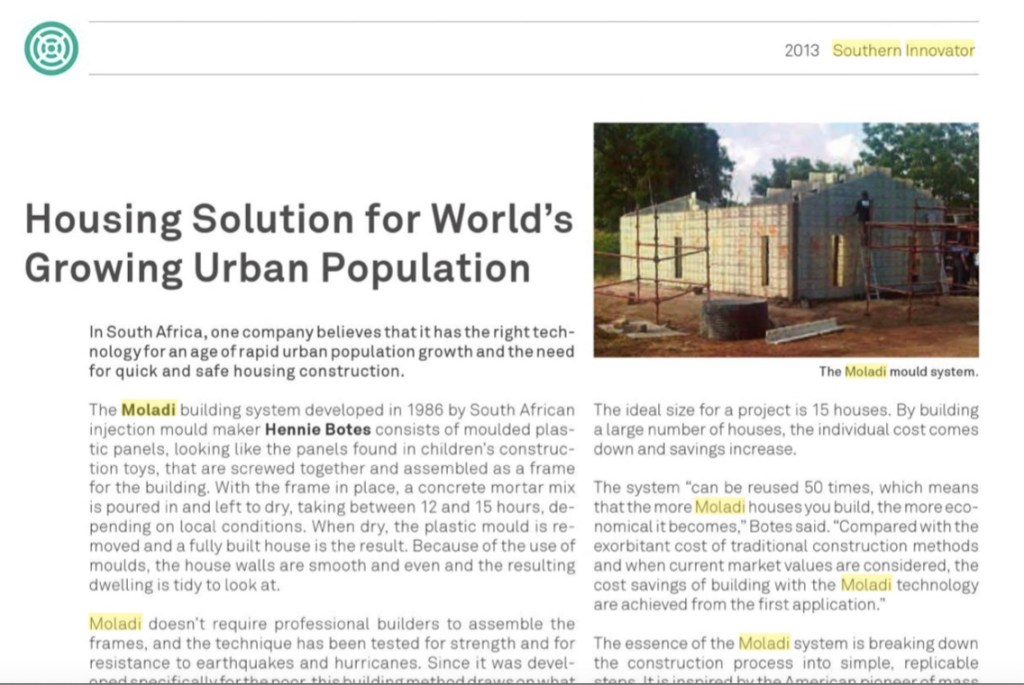
    The Moladi building system (http://moladi.com/) (http://www.moladi.net/default.aspx?AspxAutoDetectCookieSupport=1) developed in 1986 by South African injection mold maker Hennie Botes consists of molded plastic panels, looking like the panels found in children’s construction toys that are screwed together and assembled as a frame for the building. With the frame in place, a concrete mortar mix is poured in and left to dry: depending on local conditions, taking between 12 and 15 hours. When dry, the plastic mold is removed and a fully built house is the result. Because of the use of molds, the home’s walls are smooth and even and the resulting home is tidy to look at.

    Moladi doesn’t require professional builders to assemble the frames, and the technique has been tested for strength and for resistance to earthquakes and hurricanes. Since it was developed specifically for the poor, this building method draws on what is called ‘sweat equity’: often the only asset a poor person has to contribute to the cost of building a home is their free labour.

    Because the dimensions of the home have already been established when the plastic frames were molded, common on-site mistakes are avoided.

    Moladi benefits from South Africa’s Black Economic Empowerment programme (http://www.southafrica.info/business/trends/empowerment/bee.htm) and is certified for its quality with the South African Bureau of Standards (SABS) (https://www.sabs.co.za/). Moladi contractors and developers are working in 15 countries and the technique is distributed in a further seven countries.

    The Moladi construction technique was born of frustration with the traditional approach of laying one brick on top of another. This traditional construction method, dating back thousands of years, just doesn’t match the needs of our times. It is slow and requires highly skilled bricklayers to be done right. Across the developing world, it is possible to see poorly constructed brick dwellings – often built unevenly with poor quality mortar holding the bricks together – that are unsafe in an earthquake.

    Training in the Moladi technique takes from one to two weeks for unskilled workers depending on the size of the home. Moladi provides handbooks and all the necessary resources to complete the project. Each project has its own custom-built plastic frames made based on the home’s design.

    “There is no flat fee for on-site training; the client is only responsible for covering the travel and living expenses for the Moladi representative or training foreman,” said Hennie Botes.

    The ideal size for a project is 15 homes. By building a large number of homes, the individual cost comes down and savings increase.

    The system “can be reused 50 times, which means that the more Moladi houses you build, the more economical it becomes,” Botes said. “Compared with the exorbitant cost of traditional construction methods and when current market values are considered, the cost savings of building with the Moladi technology are achieved from the first application.”

    As the world’s cities grow, and slums become larger and more prevalent, the urgent need for affordable and decent housing will go hand-in-hand with a need for jobs — particularly jobs for unskilled workers. There just won’t be enough skilled workers to go around to build the homes. Even in developed countries, this has become a problem.

    “The recent earthquake disaster in Haiti could benefit from the Moladi system,” Botes said. “Job creation for Haitians is desperately needed and Moladi can immediately facilitate an income for family groups, as over 95 percent of the construction team consists of unskilled labourers. There is no requirement for heavy machinery, or even electricity, and remote areas can be easily accessed; Moladi also allows for the utilisation of building rubble resulting from the earthquake in the construction of new buildings.”

    The essence of the Moladi system is breaking down the construction process into simple, replicable steps. It is inspired by the American pioneer of mass production, car maker Henry Ford (http://en.wikipedia.org/wiki/Henry_Ford), who achieved efficiency and low costs in production by simplifying production into standardized and modulated steps.

    “The Moladi construction process should be viewed as a workflow process similar to that of a vehicle assembly line,” Botes said. “Through the simplification, standardization, modularization, and industrialization of the construction process, efficiency and cost savings are achieved and maintained by managing the continuous flow process on site.

    “Contractors must make sure that they have planned their project roll-out and budget well and have clearly defined goals as to what they want to achieve. It is very important to have all team players and professionals on the same page with regards to their roles and responsibilities.”

    In the beginning, Botes encountered resistance to his innovative production methods. “I was highly motivated and really believed in my idea, but when I presented it to investors, they’d shoot holes in it. … It’s been a 22-year journey, but I always kept the goal in mind. Moses spent 40 years in the desert … I’m quite happy my desert experience was only 20-odd years, though,” he told Men’s Health magazine.

    South Africa is facing a population growth rate of 1.73 percent a year (UNICEF). It also has 61 percent of the urban population trying to live on four percent of the land, according to Botes. This urban population grows at 2.7 percent a year, yet existing housing needs are not being met. There is already a backlog of 2.2 million homes needed to be built, and this grows by 180,000 every year, according to the Banking Association of South Africa (http://www.banking.org.za/default.aspx).

    “Even though the need for housing has always been a fundamental requirement to sustain one’s health and welfare, the advances in this area have been seriously lacking,” said Botes. “The brick and mortar method of construction was recorded as early as 1458 B.C, which means that very little has changed in terms of building structures over a period of almost 3.5 millennia.

    “We cannot expect to resolve the housing crisis in our age with a technique developed for the requirements of society 3468 years ago.”

    With the success of the Moladi building system, Hennie is working on “producing windows, doors, toilet seats, window frames, sinks and washbasins. If I can include these as part of my product, I’ll reduce the total unit cost of the house.”

    Published: February 2010

    Resources

    1) Cradle to Cradle: Remaking the Way We Make Things: This radical concept is about how products, can be used, recycled, and used again without losing any material quality—in cradle to cradle cycles. Website:http://www.mcdonough.com/cradle_to_cradle.htm

    2) Builders Without Borders: Is an international network of ecological builders who advocate the use of straw, earth and other local, affordable materials in construction. Website:http://builderswithoutborders.org/

    3) World Hands Project: An NGO specialising in simple building techniques for the poor. Website:http://www.worldhandsproject.org

    4) CIDEM and Ecosur specialise in building low-cost community housing using eco-materials. They have projects around the world and are based in Cuba. Website:http://www.ecosur.org

    5) The Rural Development Institute focuses on land rights for the poor and has a series of articles on China’s land reforms. Website: http://www.rdiland.org

    6) More Urban, Less Poor: The first textbook to explore urban development and management and challenge the notion unplanned shanty towns without basic services are the inevitable consequence of urbanization. Website:http://www.earthscan.co.uk/

    7) Building and Social Housing Foundation: The Building and Social Housing Foundation (BSHF) is an independent research organisation that promotes sustainable development and innovation in housing through collaborative research and knowledge transfer. Website: http://www.bshf.org/

    https://davidsouthconsulting.org/2022/05/23/debt-free-homes-for-the-poor/

    https://davidsouthconsulting.org/2021/11/11/decent-and-affordable-housing-for-the-poor/

    https://davidsouthconsulting.org/2022/11/16/housing-innovation-in-souths-urban-areas/

    https://davidsouthconsulting.org/2021/02/12/rammed-earth-houses-china-shows-how-to-improve-and-respect-traditional-homes/

    https://davidsouthconsulting.org/2021/02/12/rebuilding-after-chinese-earthquake-beautiful-bamboo-homes/

    https://davidsouthconsulting.org/2022/11/19/securing-land-rights-for-the-poor-now-reaping-rewards/

    https://davidsouthconsulting.org/2022/05/23/solar-bottle-bulbs-light-up-dark-homes/

    https://davidsouthconsulting.org/2022/11/17/tiny-homes-to-meet-global-housing-crisis/

    https://davidsouthconsulting.org/2021/03/05/southern-innovator-issue-4/

    Creative Commons License

    This work is licensed under a
    Creative Commons Attribution-Noncommercial-No Derivative Works 3.0 License.

    ORCID iD: https://orcid.org/0000-0001-5311-1052.

    © David South Consulting 2023

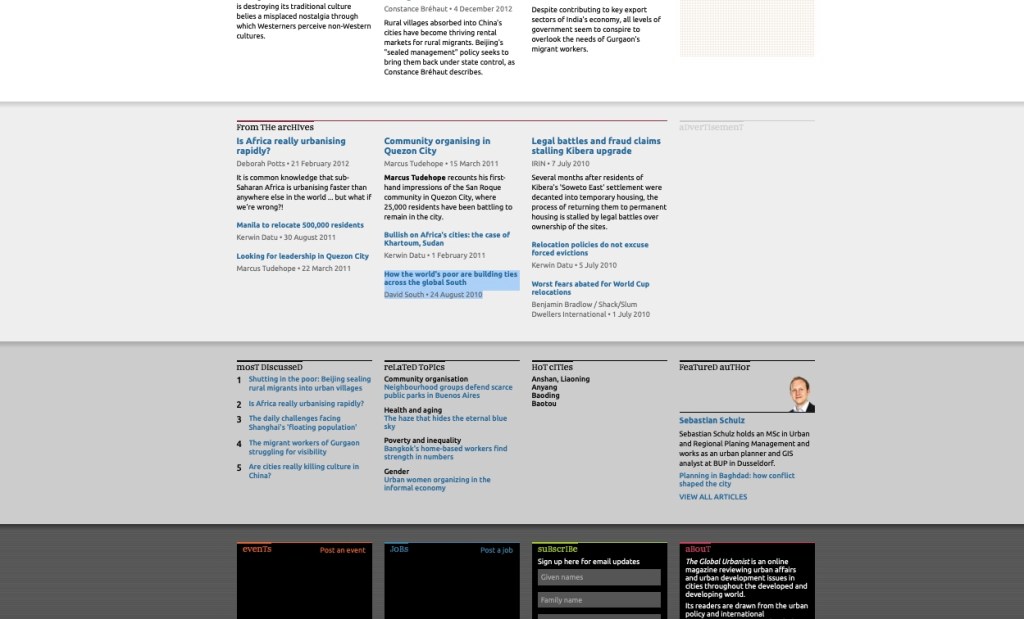
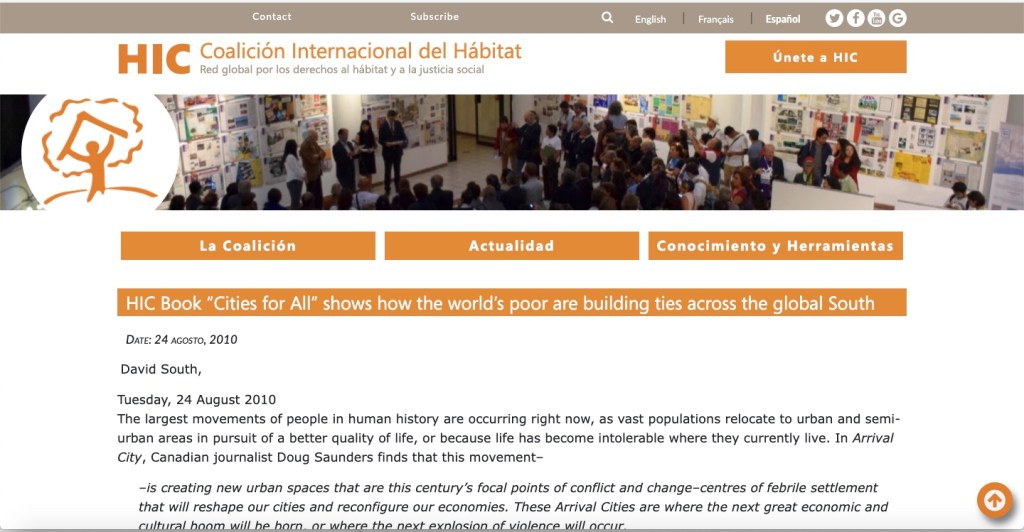
  • Cities For All Shows How The World’s Poor Are Building Ties Across The Global South

    Cities For All Shows How The World’s Poor Are Building Ties Across The Global South

    By David SouthDevelopment Challenges, South-South Solutions

    SOUTH-SOUTH CASE STUDY

    Cities for All, recently published by Habitat International Coalition, draws together thinkers and innovators in a compilation of case studies addressing the challenges of inclusive cities in the global South. The book seeks to articulate experiences of South-South cooperation and enhance the links between different regions. David South interviews the co-editor, Charlotte Mathivet.

    Published: 24 August 2010

    Global Urbanist (http://globalurbanist.com/2010/08/24/cities-for-all-shows-how-the-worlds-poor-are-building-ties-across-the-global-south)

    The largest movements of people in human history are occurring right now, as vast populations relocate to urban and semi-urban areas in pursuit of a better quality of life, or because life has become intolerable where they currently live. In Arrival City, Canadian journalist Doug Saunders finds that this movement —

    — is creating new urban spaces that are this century’s focal points of conflict and change — centres of febrile settlement that will reshape our cities and reconfigure our economies. These Arrival Cities are where the next great economic and cultural boom will be born, or where the next explosion of violence will occur.

    For most, this process is chaotic, unplanned, and fraught with risk, hardship, poverty and stress; yet, because so many are also able to dramatically improve their life chances, many millions will continue to follow this path.

    The speed of urbanisation makes the question of how to build liveable cities increasingly urgent. A new book hopes to help people get closer to solutions to these vexing problems.

    Cities for All: proposals and experiences towards the right to the city, published by Habitat International Coalition (HIC) in Santiago, Chile, and co-edited by HIC’s Ana Sugranyes and Charlotte Mathivet, was launched during this year’s World Urban Forum in Rio de Janeiro, and highlights ways in which urban residents across the South are defining how they would like their cities to evolve, refusing to accept social exclusion and demanding a “right to the city”.

    The book is published in three languages — EnglishSpanish and Portuguese.

    “A lot of social initiatives based on the right to the city are coming from these ‘new cities of the South’”, says Mathivet. “The book highlights original social initiatives: protests and organising of the urban poor, such as the pavement dwellers’ movements in Mumbai where people with nothing, living on the pavements of a very big city, organise themselves to struggle for their collective rights, just as the park dwellers did in Osaka.”

    “Another innovative experience came from the children’s workshops in Santiago, aimed at including children in urban planning in order to make a children-friendly city.”

    The cities of Africa and Asia are growing by a million peole a week. If current trends continue, mega-cities and sprawling slums will be the hallmarks of this majority urban world. In sub-Saharan Africa, 72 per cent of the population lives in slum conditions. And by 2015, there will be 332 million slum-dwellers in Africa, with slums growing at twice the speed of cities.

    “The consequences have produced a deeper gap between the city and countryside, and also within the city between the rich and poor,” said Mathivet.

    Cities for All details African experiences from Nigeria, Cameroon, Ghana and South Africa. Mathivet believes “one common topic affecting these countries is the problem of forced evictions, due to the rural exodus and growing urbanisation. It is therefore very important for the right to the city to include a perspective of linking the struggle between rural and urban movements, because problems in cities and the countryside are closely connected, especially in Africa.”

    And the current surge to cities in Africa raises the issue of what type of development will occur. The book argues that cities aren’t automatically a solution to the plight of the poor. Cities need to be worked on, and many of the problems faced by the South’s fast-growing cities stem from a power imbalance.

    “A very important thing to realise is that a city life is not a synonym for a better life or a miracle solution for poor people, nor for the ‘capitalist’ way of life,” says Mathivet. “African nations and their people have to find effective solutions on their own to overcome poverty — which they are doing — without copying development models from the North.”

    “In my understanding, urban growth is not haphazard or poorly planned in ‘developing’ countries. Rather, I think that urban ‘planning’ or lack of planning is done with a goal of generating more benefits for powerful interests and fewer benefits for poor people.”

    The book argues for a two-way relationship with the people who make up the majority of these fast-growing cities. And it says each city will have to customise its solutions.

    “It is very difficult to apply social innovations to other countries without understanding the history and the social, economic, cultural and political context,” says Mathivet.

    “Hope comes from learning of different experiences. For example, if a social movement in South Africa succsesfully avoided an eviction from a slum, it may help another social movement in Brazil to strengthen its own strategy. One of the book’s goals was to articulate the various South-South experiences and enhance the links between different regions.”

    In one chapter, contributor David Harvey argues that “the right to the city is not simply the right to what already exists in the city; it is also the right to transform the city into something radically different.”

    “The right to the city itself will not stop the over-whelming phenomenon of urban growth,” believes Mathivet. “The consequences produced by implementing this collective right would rather change people’s daily lives by achieving more equality in cities as well as in the relationship between the city and coutnryside in regards to growing urban populations.”

    Cities for All highlights the existence of ‘cities without citizens’: the vast numbers of slum dwellers and the poor who live mostly ignored by authorities (unless they are in the way of commercial development).

    “The expression ‘cities without citizens’ means the exact opposite of the right to the city proposal,” Mathivet says. “This alternative to the present global paradigm proposes to allow people to participate in the process of creating the city in terms of urban planning, decision-making, budget, public policies, etc. It is possible for people to influence their own lives and the community.”

    “There is no miracle solution, and the right to the city is a banner around which people can organise themselves to articulate their struggles and demand social justice.”

    The book concludes by arguing for the advantages of a ‘slow city’ approach. But how does this work in fast-growing urban areas where people are looking to quickly escape poverty, or are seeking rapid improvements to their quality oflife? Would they not find a slow city approach frustrating?

    Mathivet believes a leap of imagination is required: “Cities for All is not intended to be a recipe book. The slow city experience was chosen as a conclusion to the book in order to present a different approach, but not to propose a clear solution to follow. Concluding with the slow city experience, which is radically different and difficult to apply in African and Asian cities, where the spread of urbanisation is uncontrollable and leads to major problems, emphasises that the fight for the right to the city involves imagination and the desire for another possible city …

    “Moreover, slow city experiences have been developed otuside of wealthy European countries, for example in some small Argentine and South Korean cities.”

    And with the coming decade unfolding, what will cities in the South be like? Are we on the cusp of a new, dark age akin to the misery of Europe’s cities during the industrial revolution?

    Mathivet acknowledges that “we can see a dark future where the interests of the most vulnerable will not be the priority. However, looking at the experiences by and for the people, we cannot consider them poor, but rich of knowledge, cognitive capital, and with courage to change their lives and their communities, through self-management and autonomy.

    Cities for All aimed to show this richness … the challenges are for civil society to deepen links between different movements to build a stronger global strategy, during events like the next World Social Forum in Dakar, February 2011.”

    David South is an international development consultant and writer. He writes the Development Challenges: South-South solutions e-newsletter for UNDP’s Special Unit for South-South Cooperation. He led the Communications Office for the UN in Ulaanbaatar from 1997 to 1999 and has worked for the UN in South Africa, Turkmenistan and Ukraine.

    The Special Unit for South-South Cooperation is mandated to promote, coordinate and support South-South and triangular cooperation on a global and UN-systemwide basis.

    This story is adapted from a piece in the July 2010 edition of Development Challenges.

    http://globalurbanist.com/2010/08/24/cities-for-all-shows-how-the-worlds-poor-are-building-ties-across-the-global-south

    https://www.hic-net.org/es/hic-book-cities-for-all-shows-how-the-worlds-poor-are-building-ties-across-the-global-south/

    Development Challenges, South-South Solutions was launched as an e-newsletter in 2006 by UNDP’s South-South Cooperation Unit (now the United Nations Office for South-South Cooperation) based in New York, USA. It led on profiling the rise of the global South as an economic powerhouse and was one of the first regular publications to champion the global South’s innovators, entrepreneurs, and pioneers. It tracked the key trends that are now so profoundly reshaping how development is seen and done. This includes the rapid take-up of mobile phones and information technology in the global South (as profiled in the first issue of magazine Southern Innovator), the move to becoming a majority urban world, a growing global innovator culture, and the plethora of solutions being developed in the global South to tackle its problems and improve living conditions and boost human development. The success of the e-newsletter led to the launch of the magazine Southern Innovator. 

    Creative Commons License

    This work is licensed under a
    Creative Commons Attribution-Noncommercial-No Derivative Works 3.0 License.

    ORCID iD: https://orcid.org/0000-0001-5311-1052.

    © David South Consulting 2021

  • Rammed-Earth Houses: China Shows how to Improve and Respect Traditional Homes

    Rammed-Earth Houses: China Shows how to Improve and Respect Traditional Homes

    By David SouthDevelopment Challenges, South-South Solutions

    (Havana, Cuba), November 2008

    SOUTH-SOUTH CASE STUDY

    The pace of change across the South has been blistering. Over the past decade, the overall population has moved from being primarily rural to majority urban. In the process, rural communities have suffered, as they have seen their young and ambitious leave in droves seeking a better life in cities.

    More than 200 million Chinese farmers have moved to cities in recent years. It’s easy to see why. Chinese farms are tiny, with the average rural household farming just 0.6 hectares. And incomes are low compared to the cost of living: average annual income was just US$606 in 2007, a third of city salaries.

    But it is possible to improve the quality of life in rural areas and in turn boost economic fortunes.

    In China, projects that upgrade homes to modern standards while respecting traditional designs and architecture are breathing new life into rural communities. A return to the age-old technique of using earth as the principal building material is saving energy and keeping house costs low.

    The tradition of packing earth to build a wall dates back to some of the earliest stretches of the Great Wall of China in 220 BC.

    Currently it is estimated that half the world’s population-approximately 3 billion people on six continents – lives or works in buildings constructed of earth.

    This traditional building technique is being used in the reconstruction effort to build new homes after the May 12, 2008 earthquake in Sichuan Province. The earthquake left millions of people homeless in the country’s worst natural disaster in 30 years, and has made low-cost but efficient house building critical.

    In western China, villages have been entirely rebuilt from scratch. The application of research and science to the traditional designs – roofs in the pagoda style, with buildings arranged around courtyards – enabled the development of homes that are energy efficient to run, and are more hygienic and earthquake safe. In Yongren County of Yunnan Province, over 7,000 mountain dwellers were moved to better farming land and over 2,000 homes were built in the new village of BaLaWu. Over 30 of the homes were built using rammed earth by the Xi-an team. 

    “The original homes had very low living quality,” said team member Hu Rong Rong of the Green Building Research Centre of Xi’an University of Architecture and Technology (http://www.xauat.edu.cn/jdeg/about.html), which oversees building of the new homes. “The architecture layout of the indoor space and courtyard was not reasonable. In the courtyard the areas for living, raising livestock, storing and processing crops were mixed up. The indoor environment was not comfortable. It was cold in the houses during winter and hot during summer. Most of the rooms lacked natural lighting and were dark in the daytime.

    “In the poor areas, many people still live in earth houses because of the low cost. However, most of the earth houses have low living quality.

    “After we finished the project, through our design, the living quality was improved very much. The dwellers were satisfied with their new houses.”

    Land reform in China has brought more hope to the country’s 750 million rural poor, many of whom live on less than US$1 a day. It is hoped that giving the rural poor more control over their lives will bring an improvement in agricultural production, food security and economic prosperity. Reforms also mean the poor have more secure land rights.

    Hu said gaining the trust and buy-in of the villagers was critical to the success of the project.

    “We built the first home as a demonstration. After we finished, the villagers could experience the advantages of the new home. Most of them decided to use our design and they could choose the one they liked from several proposals.”

    Poverty is a big problem in the villages. Incomes are very low, at 2000 RMB per year (US $290). Hu said “families were given a house-building allowance of 8000 RMB (US $1,160) to meet the cost of building materials – and the land was free for them to use.”

    “The villagers built the houses by self-help. We helped them to design and build the houses for free,” Hu said.

    The houses are pioneering in using natural sources to provide light, heat, waste disposal and gas for cooking and heating.

    “We used natural material like earth as a main building material to get good thermal mass and also to reduce CO2 emission,” Hu said.

    “We designed a simple family sewage-purge-pool and marsh-gas-well system to reduce pollution and get energy from wastes.”

    Using rammed earth has a long history in China. Across Western China, there are many buildings constructed with rammed earth. And using earth has many advantages when resources are scarce or expensive: “Earth buildings avoid deforestation and pollution, and can achieve low energy costs throughout their lifetime,” said Hu.

    “With living standards increasing, more and more people would like to use burned bricks and concrete to build new houses, which will consume more energy and bring pollution,” said Hu.

    But like any technology, the application of modern science and environmental knowledge to the traditional designs, can reap huge improvements in the quality of the homes and comfort levels. And win people back to the benefits of rammed earth dwellings.

    “Building with earth materials can be a way of helping with sustainable management of the earth’s resources,” said Hu.

    And Hu is adamant the new, environmentally designed homes respect the wisdom of traditional design.

    “The new earth house design should consider the local culture. It should be proved that both the house style and the construction technique can be accepted by the users.”

    Published: December 2008

    Resources

    • The Rural Development Institute focuses on land rights for the poor and has a series of articles on China’s land reforms. Website: www.rdiland.org
    • Rural DeveIopment Institute has recently been given an award from the World Bank’s Development Marketplace competition to create Legal Aid and Education Centres in China’s countryside. Website:www.rdiland.org/PDF/092808_WorldBankComp.pdf
    • A blog gives more details on the Chinese rammed earth project. 
      Website:www.51xuewen.com
    • Earth Architecture, a book and blog on the practice of building with earth, including contemporary designs and projects. 
      Website: www.eartharchitecture.org

    https://davidsouthconsulting.org/2022/05/23/debt-free-homes-for-the-poor/

    https://davidsouthconsulting.org/2021/11/12/energy-efficient-wooden-houses-are-also-earthquake-safe/

    https://davidsouthconsulting.org/2022/10/26/making-bamboo-houses-easier-to-build/

    https://davidsouthconsulting.org/2021/02/12/rebuilding-after-chinese-earthquake-beautiful-bamboo-homes/

    https://davidsouthconsulting.org/2022/05/23/solar-bottle-bulbs-light-up-dark-homes/

    https://davidsouthconsulting.org/2022/09/26/3d-home-printing-landmark-10-houses-in-a-day/

    https://davidsouthconsulting.org/2022/11/17/tiny-homes-to-meet-global-housing-crisis/
    Sponsored by BSHF. BSHF is now called World Habitat and it aims to seek out and share the best solutions to housing problems from around the world.

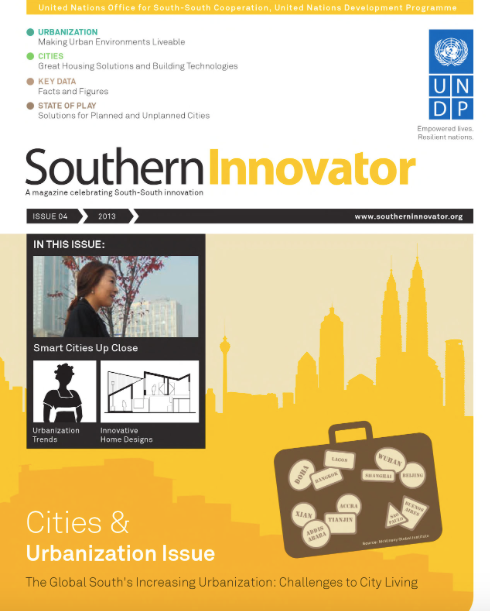
    https://davidsouthconsulting.org/2021/03/05/southern-innovator-issue-4/

    Creative Commons License

    This work is licensed under a
    Creative Commons Attribution-Noncommercial-No Derivative Works 3.0 License.

    ORCID iD: https://orcid.org/0000-0001-5311-1052.

    © David South Consulting 2023

  • Cuba’s Hurricane Recovery Solution

    Cuba’s Hurricane Recovery Solution

    By David SouthDevelopment Challenges, South-South Solutions

    (Havana, Cuba), November 2008

    SOUTH-SOUTH CASE STUDY

    The frequency of extreme weather in the past decade has been attributed to global warming (http://tinyurl.com/5peel). Many scientists believe the future will bring even more turbulent weather events and disasters. The devastation and hardship brought by natural disasters can eradicate development gains, and destroy livelihoods and health. It is critical countries help people to get back to their normal lives as fast as possible.

    The Intergovernmental Panel on Climate Change (http://www.ipcc.ch) says extreme weather events will become more frequent, more widespread and/or more intense during the 21st century. Extreme weather is already costly for countries in the global South. The United Nations Environment Program (UNEP) found that the cost of droughts, storm surges, hurricanes and floods reached a record US$210 billion in 2005.

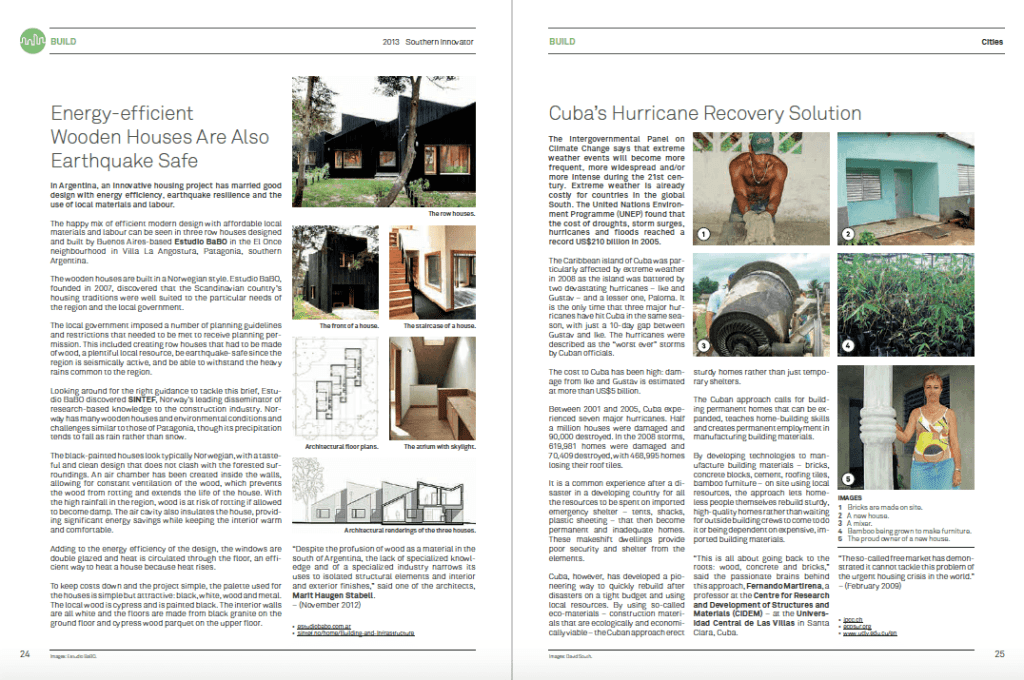
    The Caribbean island of Cuba (http://en.wikipedia.org/wiki/Cuba) was particularly affected in 2008 by extreme weather, as the island was battered by two devastating hurricanes – Ike and Gustav – and a lesser one, Paloma.  It was the only time that three major hurricanes have hit Cuba in the same season, with just a 10 day gap between Gustav and Ike. The hurricanes were described as the “worst ever” storms by Cuban officials

    The cost to Cuba has been high: Damages from Ike and Gustav are estimated at more than US$5 billion (http://tinyurl.com/ba7xny).

    Between 2001 and 2005, Cuba experienced seven major hurricanes. Half a million houses were damaged, and 90,000 destroyed. In the 2008 storms, 619,981 homes were damaged and 70,409 destroyed, with 468,995 homes losing their roof tiles.

    But Cuba has developed a pioneering way to quickly rebuild after disasters on a tight budget and using local resources. By using so-called ecomaterials – construction materials that are ecologically and economically viable – the Cuban approach erects sturdy homes, rather than just temporary shelters.

    It is a common experience after a disaster in a developing country for all the resources to be spent on imported emergency shelter – tents, shacks, plastic sheeting – that then become permanent and inadequate homes. These makeshift dwellings provide poor security and shelter from the elements. For Cuba, the enormous scale of the repair and reconstruction job is especially difficult because of the fuel shortages and building supply restrictions brought on by the United States’ embargo on the country (http://tinyurl.com/4alwrb). In turn, Cubans are adaptable and creative with their solutions.

    The Cuban approach builds permanent homes that can be expanded, teaches homebuilding skills and creates permanent employment in manufacturing building materials.

    By developing technologies to manufacture building materials – bricks, concrete blocks, cement, roofing tiles, bamboo furniture – on site using local resources, the approach lets homeless people themselves rebuild sturdy, high-quality homes, rather than waiting for outside building crews to come and do it, or being dependent on expensive, imported building materials. By doing this, jobs are created and wealth and gets the community back on its feet after the disaster.

    “This is all about going back to the roots: wood, concrete and bricks,” said the passionate brains behind this approach, Fernando Martirena, a professor at CIDEM  — the Centre for Research and Development of Structures and Materials — at the Universidad Central de Las Villas, in Santa Clara , Cuba (www.ecosur.org).

    “The so-called free market has demonstrated it can not tackle this problem of the urgent housing crisis in the world.”

    At the heart of the Cuban approach are easy-to-use machines that produce the building materials. They range from hand-cranked presses that make mud and clay bricks, to vibrating presses for concrete brick making.

    Training the homeless population to do the building themselves allows reconstruction work to begin straight away, rather than waiting for professional building crews to arrive on the scene. It is also psychologically more empowering for the people to be active participants in the rebuilding of their lives. The pride the people have in their new homes is visible.

    And quality has been critical for the programme so it can become sustainable and long-lasting:

    “The driving force for this project is need,” Martirena said. “If we want to obtain sustainability, we must go beyond need. After disaster, need is the driving force. But after two years, when most things have been completed, it must be a business. Good, beautiful, cheap. Normally, this technology is cheaper than industrial technology.”

    To stay prepared for future natural disasters that destroy or damage homes, the Cubans have established strategic reserves of micro-concrete roofing tiles. The lightweight but strong tiles can be used to quickly erect a small module home, and then the home can be expanded and built on as resources and time allow.

    Martirena, a former UNHABITAT award-winner, believes this approach to building materials brings prosperity back to rural areas and helps stem the flood of people to cities and urban sprawl seen across the global South.

    “You have to go back to the origin of the problem: people are looking for money and better jobs. It is not because they like the cities; they hate the cities!”

    “Bamboo harvesting (for furniture making) can bring people three times more income than they would make in the cities. They are really making money.”

    For Cuba, this has been a journey from a highly centralised and fuel-dependent approach to house building, to a decentralised, low-fuel approach. From 1959, the year of the revolution, until 1988, Cuba built housing using a centralised factory method to make building materials. Prefabricated houses were erected across the country. The materials were delivered by road and rail, all fuelled by cheap oil from the former Soviet Union.

    After the collapse of the Soviet Union in the early 1990s, oil became scarce and the transport network the building industry depended on fell apart. This time was called the “special period.”

    Apart from natural disasters, Cuba’s housing stock has suffered under the US embargo. The country’s housing began to decay as repairs were not happening and new houses were not being built. When people did want to do the repairs themselves, the lack of building supplies made it difficult for them to do so. Cuba realized it had to do things differently: the solutions had to be local, energy-efficient, and easy to use.

    CIDEM oversees workshops, training and building teams across the country. It tests new materials and designs in its labs before they are deployed as building solutions. The ecomaterials are chosen for low energy use and the ability to recycle waste. Being inexpensive, they offer a sustainable solution for the poor.

    In the community of Jatibonico, single mothers make up 40 percent of those who have benefited from the building projects. One woman proudly showed off the home she had built in the Spanish style, complete with Greco-roman columns on the porch. It has a clean, modern bathroom with shower and toilet.

    Martirena is currently working on a book of case studies about CIDEM’s projects helping Cubans cope with reduced oil dependency.

    CIDEM collaborates with universities around the world and has 19 workshops employing over 200 people in Cuba, and 15 in other countries in Latin America and Africa. It works with the Ecosur initiative and all the machines and advice on how to use them is available from the Ecosur website (www.ecosur.org).

    Published: November 2008

    Resources

    • “How Cuba Survived Peak Oil” is an award-winning film on how Cuba transitioned from a highly mechanized, industrial agricultural system to one using organic methods of farming and local, urban gardens. It is an unusual look into the Cuban culture during this economic crisis, which they call “The Special Period.” Website:http://www.powerofcommunity.org/cm/index.php
    • Global Greenhouse Warming is a website that tracks extreme weather events around the world: drought, flooding, severe storms, severe winter, tropical cyclone, wildfires, and extreme heat waves.Website:http://www.global-greenhouse-warming.com/extreme-weather.html
    • Cuba Hurricanes: Real-time reports of current hurricane threats to Cuba provided by an office in Old Havana. Also information on hurricanes of historical significance to Cuba. Website: http://www.cubahurricanes.org/
    • Gerd Niemoeller has developed flat pack, cardboard homes that can be deployed quickly after a disaster and can become permanent homes. Website: http://tinyurl.com/6t6jtf and the company website: http://www.wall.de/en/home
    • CIDEM and Ecosur specialise in building low-cost community housing using eco-materials. They have projects around the world and are based in Cuba. Website: http://www.ecosur.org

    https://davidsouthconsulting.org/2021/10/03/a-new-house-kit-for-slum-dwellers-that-is-safe-and-easy-to-build/

    https://davidsouthconsulting.org/2022/05/23/debt-free-homes-for-the-poor/

    https://davidsouthconsulting.org/2021/11/11/decent-and-affordable-housing-for-the-poor/

    https://davidsouthconsulting.org/2022/11/16/housing-innovation-in-souths-urban-areas/

    https://davidsouthconsulting.org/2021/11/11/housing-solution-for-worlds-growing-urban-population/

    https://davidsouthconsulting.org/2021/02/12/rammed-earth-houses-china-shows-how-to-improve-and-respect-traditional-homes/

    https://davidsouthconsulting.org/2021/02/12/rebuilding-after-chinese-earthquake-beautiful-bamboo-homes/

    https://davidsouthconsulting.org/2022/05/23/solar-bottle-bulbs-light-up-dark-homes/

    https://davidsouthconsulting.org/2022/09/26/3d-home-printing-landmark-10-houses-in-a-day/

    https://davidsouthconsulting.org/2022/11/17/tiny-homes-to-meet-global-housing-crisis/

    https://davidsouthconsulting.org/2021/03/05/southern-innovator-issue-4/

    Sponsored by BSHF. BSHF is now called World Habitat and it aims to seek out and share the best solutions to housing problems from around the world.

    Creative Commons License

    This work is licensed under a
    Creative Commons Attribution-Noncommercial-No Derivative Works 3.0 License.

    ORCID iD: https://orcid.org/0000-0001-5311-1052.

    © David South Consulting 2023