Categories
Archive Development Challenges, South-South Solutions Newsletters

Brazil’s Agricultural Success Teaches South How to Grow

By David SouthDevelopment Challenges, South-South Solutions

SOUTH-SOUTH CASE STUDY

Inflation, environmental stresses and population and economic growth are testing the world’s food supply systems. There is a strong need to boost yields and improve the quality of food.

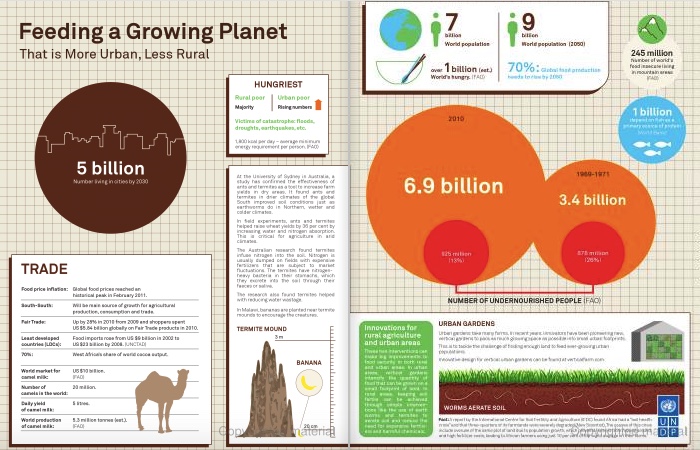
Between now and 2050 the world’s population will rise from 7 billion to 9 billion. Urban populations will probably double and incomes will rise. City dwellers tend to eat more meat and this will boost demand.

The UN’s Food and Agriculture Organization (FAO) reckons grain output will have to rise by around half but meat output will have to double by 2050 to meet demand.

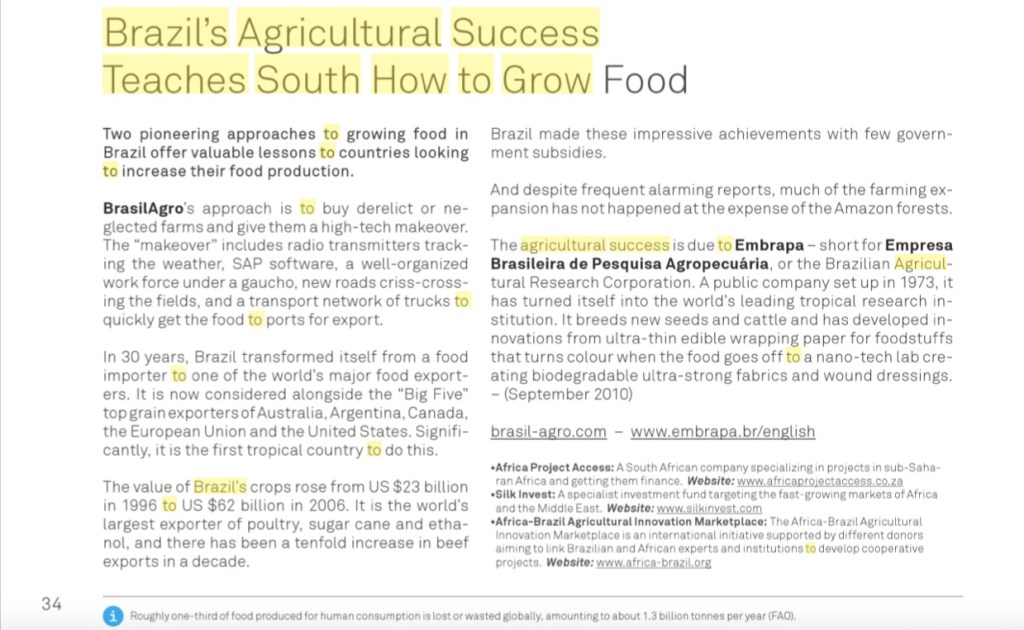
Two pioneering approaches to growing food in Brazil offer valuable lessons to countries looking to increase their food production.

One is taking place in Bahia state in north-eastern Brazil. On Brazil’s cerrado (savannah) (http://en.wikipedia.org/wiki/Cerrado), enormous farms grow cotton, soybeans and maize. One of them, Jatoba farm, has 24,000 hectares of land: vastly larger than comparable farms in the United States.

On the Cremaq farm in the north of the country in Piaui state, a transformation has taken place. Once a failed cashew farm, it is now a highly modern operation. Owned by BrasilAgro, it is benefiting from clever agricultural innovation that gets results.

BrasilAgro’s approach is to buy derelict or neglected farms and give them a high-tech makeover. The ‘makeover’ includes radio transmitters tracking the weather, SAP software (http://en.wikipedia.org/wiki/SAP_AG), a well-organized work force under a gaucho (http://en.wikipedia.org/wiki/Gaucho), new roads criss-crossing the fields, and a transport network of trucks to quickly get the food to ports for export. Piaui is an isolated place with few services: it can take half a day to get to a health clinic. Dependence on state welfare payments for survival is the norm for many residents.

Brazil, over 30 years, transformed itself from a food importer to one of the world’s major food exporters. It is now considered alongside the ‘Big Five’ top grain exporters of America, Canada, Australia, Argentina and the European Union. Importantly, it is the first tropical nation to do this.

The value of Brazil’s crops rose from US $23 billion in 1996, to US $62 bn in 2006. It is the world’s largest exporter of poultry, sugar cane and ethanol, and there has been a tenfold increase in beef exports in a decade.

Brazil made these impressive achievements with few government subsidies. According to the Organization for Economic Co-operation and Development (OECD), state support accounted for just 5.7 percent of total farm income in Brazil from 2005-07. In the US it was 12 percent, while the OECD average is 26 percent and the level in the European Union is 29 percent.

And despite frequent alarming reports, much of the farming expansion has not happened at the expense of the Amazon forests.

The agricultural success is down to Embrapa (http://www.embrapa.br/english) – short for Empresa Brasileira de Pesquisa Agropecuária, or the Brazilian Agricultural Research Corporation. A public company set up in 1973, it has turned itself into the world’s leading tropical research institution. It breeds new seeds and cattle and has developed innovations from ultra-thin edible wrapping paper for foodstuffs that turns colour when the food goes off to a nano-tech lab creating biodegradable ultra-strong fabrics and wound dressings.

Its biggest achievement has been turning the vast expanses of the cerrado green for agriculture. Norman Borlaug, an American plant scientist often called the father of the Green Revolution, told the New York Times that “nobody thought these soils were ever going to be productive.” They seemed too acidic and too poor in nutrients.

Embrapa uses what its scientists call a “system approach”: all the interventions work together. Improving the soil and developing new tropical soybeans were both needed for farming the cerrado. The two together also made possible the changes in farm techniques which have boosted yields further.

Many believe this approach can be applied to Africa as well. There are several reasons to think it can. Brazilian land is like Africa’s: tropical and nutrient-poor. The big difference is that the cerrado gets a decent amount of rain and most of Africa’s savannah does not (the exception is the swathe of southern Africa between Angola and Mozambique).

Another approach that Brazil has been pioneering is making small, family farms sustainable and productive for the 21st century.

There has long been a tension between those who believe in very large farms, agribusiness and mono-crops (http://en.wikipedia.org/wiki/Mono-cropping), and those who believe in having a large number of smaller farms with a wide variety of crops and animals.

But small farms have endured. The livelihoods of more than 2 billion people depend on the 450 million smallholder farms across the world. With their families, they account for a third of the world’s population.

Family farms are critical to weathering economic crises and ensuring a steady and secure food supply. The International Fund for Agricultural Development (IFAD) (www.ifad.org)called in 2008 for small family farms to be put at the heart of the global response to high food prices and uncertain food security.

In Brazil, this call is being answered by a bold initiative to create what is termed a “social technology”, combining a house building programme with diverse family farms.

The Brazilian farmers’ cooperative Cooperhaf: Cooperativa de Habitacao dos Agricultores Familiares (http://www.cooperhaf.org.br) – a World Habitat Awards winner – combines housing and farm diversification to support family farmers.

“Family farming is very important for the country – 70 percent of food for Brazilians comes from family farming,” said Adriana Paola Paredes Penafiel, a projects adviser with the Cooperhaf. “The government wants to keep people in rural areas.”

“We see the house as the core issue,” she continued.  “The farmers can improve their productivity but the starting point is the house.”

Started in 2001 by a federation of farmers unions, the Cooperhaf works in 14 Brazilian states with family farmers. In Brazil farmers have a right to a house in the law and the cooperative was formed to make sure this happened.

“We promote diversification to make farmers less vulnerable: if they lose a crop in macro farming, they lose everything. We encourage diversification and self-consumption to guarantee the family has food everyday. We help to set up a garden.”

The concept is simple: a good quality home acts as an anchor to the family farm, making them more productive as farmers. The farmers receive up to 6,000 reais (US $2,290) for a house, and can choose designs from a portfolio of options from the Cooperhaf.

As in other countries, the Cooperhaf and other co-ops encourage markets and certification programmes to promote family farmed food and raise awareness. Penafiel says promoting the fact that the food is family farmed is critical: to the consumer it is healthier, fresher and contains fewer chemicals than imported produce.

“Most agri business is for export,” said Penafiel. “If we don’t have food in the country, food for poor communities would not be available. This enables farmers to be more autonomous, not having to buy fertilizers and equipment and take on too much debt. That approach is not sustainable as we saw with the so-called Green Revolution.”

Published: September 2010

Resources

  • Africa Project Access: A South African company specializing in projects in sub-Saharan Africa and getting them finance. Website:http://www.africaprojectaccess.co.za/
  • Silk Invest: A specialist investment fund targeting the fast-growing markets of Africa and the Middle East. Website:http://www.silkinvest.com/
  • Olam: A global food supply company in ‘agri-products’ that got its start in Nigeria  and shows how a Southern brand can grow and go global and overcome the difficulties of cross-border trade. Website: www.olamonline.com

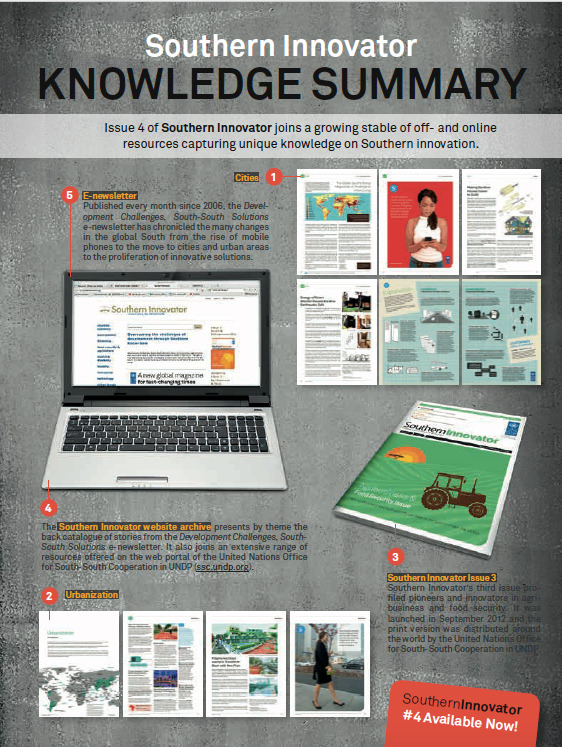
Development Challenges, South-South Solutions was launched as an e-newsletter in 2006 by UNDP’s South-South Cooperation Unit (now the United Nations Office for South-South Cooperation) based in New York, USA. It led on profiling the rise of the global South as an economic powerhouse and was one of the first regular publications to champion the global South’s innovators, entrepreneurs, and pioneers. It tracked the key trends that are now so profoundly reshaping how development is seen and done. This includes the rapid take-up of mobile phones and information technology in the global South (as profiled in the first issue of magazine Southern Innovator), the move to becoming a majority urban world, a growing global innovator culture, and the plethora of solutions being developed in the global South to tackle its problems and improve living conditions and boost human development. The success of the e-newsletter led to the launch of the magazine Southern Innovator. 
Creative Commons License

This work is licensed under a
Creative Commons Attribution-Noncommercial-No Derivative Works 3.0 License.

ORCID iD: https://orcid.org/0000-0001-5311-1052.

© David South Consulting 2022

Categories
Archive Development Challenges, South-South Solutions Newsletters

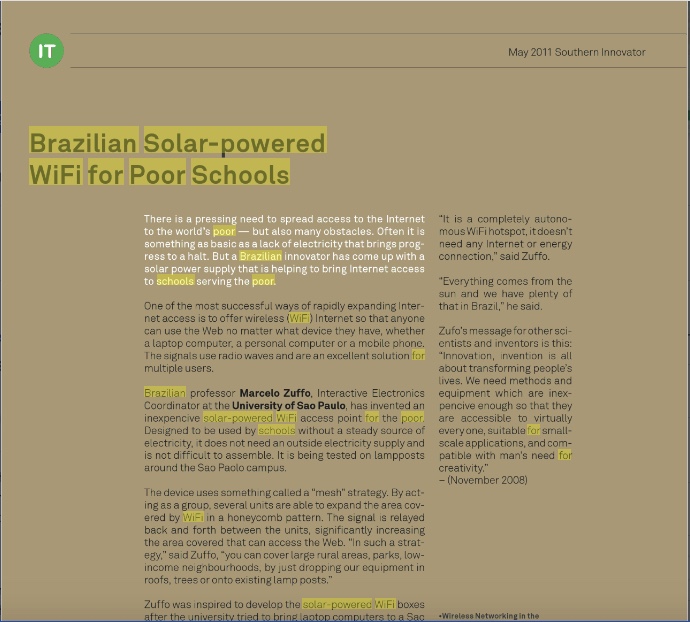
Brazilian Solar-powered WiFi for Poor Schools

By David SouthDevelopment Challenges, South-South Solutions

SOUTH-SOUTH CASE STUDY

There is a pressing need to spread access to the internet to the world’s poor — but also many obstacles. Often it is something as basic as a lack of electricity that brings progress to a halt. But a Brazilian innovator has come up with a solar power supply that is helping to bring internet access to schools serving the poor.

Many initiatives are trying to bring inexpensive access to the internet to rural and remote regions around the world. Schools in poor areas are receiving laptop computers through schemes like the One Laptop Per Child project, but it is common that schools do not have a steady electricity supply to power the computers or the internet connection. One of the most successful ways of rapidly expanding access is to offer wireless (WiFi) internet so that anyone can use the Web, no matter what device they have, whether a laptop computer, a personal computer or a mobile phone. The signals use radio waves, and are an excellent solution for multiple users.

Brazilian professor Marcelo Zuffo, Interactive Electronics Coordinator at the University of Sao Paulo, has invented a cheap solar-powered WiFi access point for the poor. Designed to be used by schools without a steady source of electricity, it doesn’t need outside electricity supply, and is not difficult to assemble. It is being tested on lampposts around the Sao Paolo campus.

The device uses something called a ‘mesh’ strategy. By acting as a group, several units are able to expand the area covered by WiFi in a honeycomb pattern. The signal is relayed back and forth between the units, significantly increasing the area covered that can access the Web. “In such a strategy,” said Zuffo,”you can cover large rural areas, parks, low income neighbourhoods, by just dropping our equipment in roofs, trees or on to existing lamp posts.”

Zuffo was inspired to develop the solar-powered WiFi boxes after the university tried to bring laptop computers to a Sao Paulo school, and found they didn’t have a steady electricity supply.

“We came up with the idea of taking energy that is most plentiful and cheap, i.e. the sun,” he told the BBC. “We have a solar panel, a cheap motorcycle battery and a circuit that is responsible for energy management. We can have up to two days of full internet coverage and our goal is to increase that to 10 days – so that in the rainy season and the winter, you can have the internet for free.

“The natural plan is to miniaturize the system so that we can save on costs. So by the end you can imagine these WiFi solar mesh devices being the size of a cellphone or playing card.”

The low cost, solar-powered access point is ready as soon as it is unpacked and needs neither maintenance nor a power socket to get going.

“It is a completely autonomous WiFi hotspot, it doesn’t need any internet or energy connection,” said Zuffo.

“Everything comes from the sun and we have plenty of that in Brazil,” he said.

The volunteer organization Green WiFi initiative is also developing solar powered technologies to bring ubiquitous internet access to the world’s poor.

Zufo’s message for other scientists and inventors is this: “Innovation, invention is all about transforming people’s lives. We need methods and equipment which are cheap enough so that they are accessible to virtually every one, suitable for small scale applications, and compatible with man’s need for creativity.”

The issue of inequality in access to the internet has stark consequences for global economic development. Already, according to the World Information Society Report 2007, “Europe has achieved the largest overall gain in digital opportunity over the last two years, followed by the Americas… Asia and Africa have witnessed smaller gains in digital opportunity. The implications for the digital divide are clear: digital opportunity is becoming more sharply divided by region, not less.”

Published: November 2008

Resources

  • Wireless Networking in the Developing World: A Practical Guide to Planning and Building Low-cost Telecommunications Infrastructure. Website:
  • World Information Society Report 2007: A progress report on pledges to bring digital opportunity to all. Website:
  • The Wireless Geographic Logging Engine: This is a website with maps tracking the presence of WiFi access around the globe. So far it maps over 10 million separate WiFi networks. Entrepreneurs only have to log into the website to start searching for wireless networks near them.
  • iTrike: The world’s first solar powered wireless internet rickshaw.
  • The KyaTera lab where the technology was developed. Website: http://kyatera.incubadora.fapesp.br/portal/research/laboratories/interactive-electronic-media

Development Challenges, South-South Solutions was launched as an e-newsletter in 2006 by UNDP’s South-South Cooperation Unit (now the United Nations Office for South-South Cooperation) based in New York, USA. It led on profiling the rise of the global South as an economic powerhouse and was one of the first regular publications to champion the global South’s innovators, entrepreneurs, and pioneers. It tracked the key trends that are now so profoundly reshaping how development is seen and done. This includes the rapid take-up of mobile phones and information technology in the global South (as profiled in the first issue of magazine Southern Innovator), the move to becoming a majority urban world, a growing global innovator culture, and the plethora of solutions being developed in the global South to tackle its problems and improve living conditions and boost human development. The success of the e-newsletter led to the launch of the magazine Southern Innovator. 

Creative Commons License

This work is licensed under a
Creative Commons Attribution-Noncommercial-No Derivative Works 3.0 License.

ORCID iD: https://orcid.org/0000-0001-5311-1052.

© David South Consulting 2023

Categories
Archive Development Challenges, South-South Solutions Newsletters Southern Innovator magazine

Technological Innovation Alive in Brazil

By David SouthDevelopment Challenges, South-South Solutions

SOUTH-SOUTH CASE STUDY

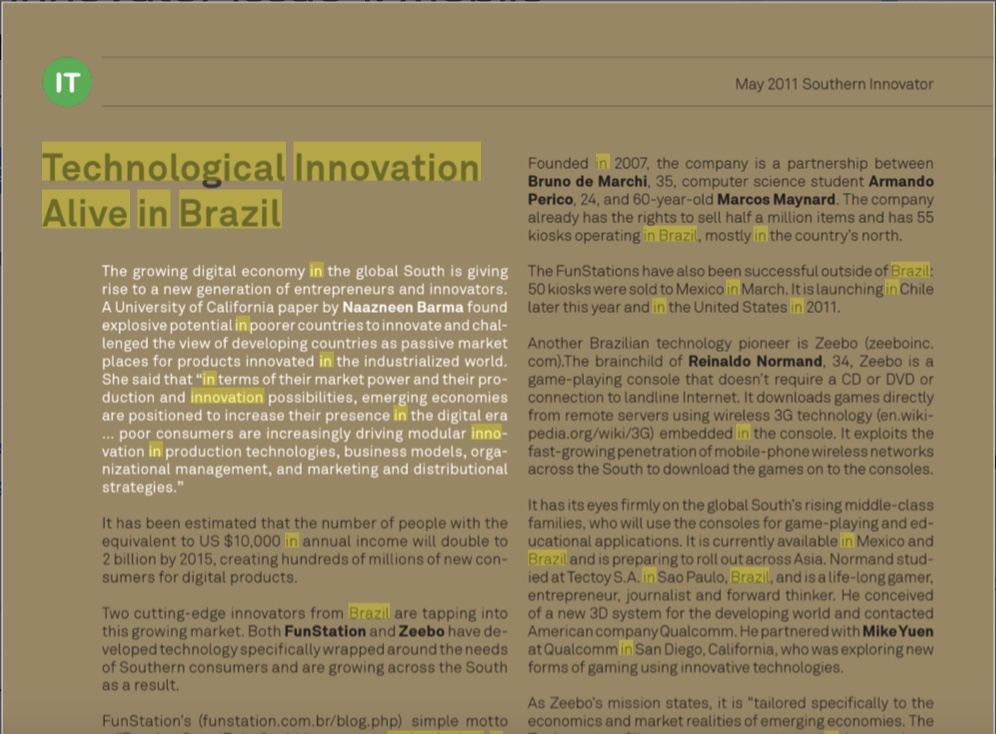
The growing digital economy in the global South is giving rise to a new generation of entrepreneurs and innovators.

A University of California paper by Naazneen Barma found explosive potential in poorer countries to innovate, and challenged the view of developing countries as passive market places for products innovated in the industrialized world. She said that “in terms of their market power and their production and innovation possibilities, emerging economies are positioned to increase their presence in the digital era … poor consumers are increasingly driving modular innovation in production technologies, business models, organizational management, and marketing and distributional strategies.”

It has been estimated that the number of people with equivalent to US $10,000 in annual income will double to 2 billion by 2015, creating hundreds of millions of new consumers for digital products.

Two cutting-edge innovators from Brazil are tapping into this growing market. Both FunStation and Zeebo have developed technology specifically wrapped around the needs of Southern consumers and are growing across the South as a result.

FunStation’s (http://www.funstation.com.br/blog.php)simple motto – “Touch – Get – Enjoy” – hides a savvy technological innovation aimed at the growing army of digital downloaders on the march across the South. Sao Paulo’s FunStation entertainment kiosk system serves up video, audiobooks, songs, and ringtones to mobile phones and MP3 (http://en.wikipedia.org/wiki/MP3) players. Customers just need to plug into one of the large futuristic white kiosks, scroll through the choices, select what they want, pay and download. By going to the kiosk, customers avoid the need to download from the internet, which can take a lot of time depending on the connection and bandwidth. The kiosk is speedy, with 14 musical tracks downloaded to a device in 10 seconds.

Apart from the convenience and speed of the kiosks, they also have other benefits: customers do not need to register with a download site like iTunes on the internet. This means they do not have to run the risks of giving away bank details or other personal information.

Customers buy something called a Funcard which is similar to a pre-pay phone plastic phone card, with a PIN number. Cards are sold with values ranging from US $2 to US $50. The user just punches the number into the kiosk to pay for the download.

The kiosks are being located in high-traffic places like festivals, airports, universities, retail shopping centres and transport systems.

Founded in 2007, the company is a partnership between Bruno de Marchi, 35, computer science student Armando Perico, 24, and 60-year-old Marcos Maynard. The company already has the rights to sell half a million items and has 55 kiosks operating in Brazil, mostly in the country’s north. “People are poorer in those places,”de Marchi told Monocle magazine. “Usually they have an MP3 player but no computer.”

The FunStations have also been successful outside of Brazil: 50 kiosks were sold to Mexico in March. It is launching in Chile later this year and in the United States in 2011. Always evolving, the business is also working with the University of Lugano in Switzerland to develop new software and keep the kiosks fresh and lively.

Another Brazilian technology pioneer is Zeebo (http://www.zeeboinc.com). The brainchild of Reinaldo Normand, 34, Zeebo is a game-playing console that doesn’t require a CD or DVD, or connection to landline internet. It downloads games directly from remote servers using wireless 3G technology (http://en.wikipedia.org/wiki/3G)embedded in the console. It exploits the fast-growing penetration of mobile phone wireless networks across the South to download the games on the consoles.

It has its eyes firmly on the global South’s rising middle-class families, who will use the consoles for game-playing and educational applications. It is currently available in Mexico and Brazil and is preparing to roll out across Asia. Normand studied at Tectoy S.A. in Sao Paulo, Brazil, and is a life-long gamer, entrepreneur, journalist and forward thinker. He conceived of a new 3D system for the developing world and contacted American company Qualcomm. He partnered with Mike Yuen at Qualcomm in San Diego, California, who was exploring new forms of gaming using innovative technologies.

As Zeebo’s mission states, it is “tailored specifically to the economics and market realities of emerging economies. The Zeebo system fills an enormous unmet need in these regions. At the same time it opens an immense new market for interactive content and products.”

Normand is ambitious and wants to reach a vast market of 340 million Chinese families. “By 2011, I want to close deals in China to manufacture televisions with this technology built in, therefore entering the homes of millions of families,” he told Monocle.

Zeebo makes some games for the console and also buys in other games from big-name game makers like Electronic Arts and Activision. The games are downloaded from the internet using a 3G mobile chip already built in to the consoles. The games are priced between US $5 and US $13.

The Zeebo system will roll out to China, the US and India in 2011, and Eastern Europe in 2012.

Published: August 2010

Resources

  • Afrinnovator: Is about telling the stories of African start-ups, African innovation, African made technology, African tech entrepreneurship and entrepreneurs. Their mission is to ‘Put Africa on the Map’ by covering these kinds of stories from all over Africa. As their website says, “if we don’t tell our own story, who will tell it for us?” Website: http://afrinnovator.com
  • AfricaUnsigned: This African alternative way of producing African music started this year. Unsigned artists record their music, funded by fans. Music fans from all over the world listen to the selection of artists, pick their favorite(s) and chip in a minimum of $1 dollar to the recording of a professional EP. The music is then distributed to the fans who backed the artist and sold on all major online stores (incl. Amazon & iTunes). Website: www.AfricaUnsigned.com
  • TechMasai: Pan-African start-up news and reviews. Website: www.techmasai.com
  • The Emerging Economies in the Digital Era: Market Places, Market Players, and Market Makers by Naazneen Barma, University of California. Website: http://tinyurl.com/3xjf2ps

https://davidsouthconsulting.org/2022/02/17/african-digital-laser-breakthrough-promises-future-innovation/

https://davidsouthconsulting.org/2022/10/05/african-innovation-eco-system-taking-shape/

https://davidsouthconsulting.org/2021/05/18/african-innovation-helps-make-banking-transactions-safer/

https://davidsouthconsulting.org/2022/11/16/brazils-agricultural-success-teaches-south-how-to-grow/

https://davidsouthconsulting.org/2022/11/10/brazilian-restaurant-serves-amazonian-treats/

https://davidsouthconsulting.org/2022/10/10/bringing-the-invention-and-innovation-mindset-to-young-kenyans/

https://davidsouthconsulting.org/2022/11/17/cashing-in-on-music-in-brazil/

https://davidsouthconsulting.org/2020/04/25/china-looking-to-lead-on-robot-innovation/

https://davidsouthconsulting.org/2022/10/24/flurry-of-anti-poverty-innovations/

https://davidsouthconsulting.org/2021/03/24/frugal-innovation-trend-meets-global-souths-innovation-culture/

https://davidsouthconsulting.org/2017/10/18/innovation-agenda-and-timeline-2007-2015/

https://davidsouthconsulting.org/2020/04/27/innovation-from-the-global-south/

https://davidsouthconsulting.org/2020/12/14/innovation-in-growing-cities-to-prevent-social-exclusion/

https://davidsouthconsulting.org/2022/11/11/innovation-cairos-green-technology-pioneers/

https://davidsouthconsulting.org/2021/03/04/innovation-villages-tackling-mdgs/

https://davidsouthconsulting.org/2021/10/22/innovations-in-green-economy-top-three-agenda/

https://davidsouthconsulting.org/2022/10/27/kenyan-mobile-phone-innovations/

https://davidsouthconsulting.org/2021/03/02/new-3d-technology-makes-innovation-breakthrough-and-puts-mind-over-matter/

https://davidsouthconsulting.org/2022/10/09/next-generation-of-innovation-for-the-grassroots/

https://davidsouthconsulting.org/2016/04/14/southern-innovator-and-the-growing-global-innovation-culture-14-april-2016/

https://davidsouthconsulting.org/2021/03/05/southern-innovator-issue-1/

Creative Commons License

This work is licensed under a
Creative Commons Attribution-Noncommercial-No Derivative Works 3.0 License.

ORCID iD: https://orcid.org/0000-0001-5311-1052.

© David South Consulting 2023

Categories
Archive Development Challenges, South-South Solutions Newsletters Southern Innovator magazine

Brazilian Design For New Urban, Middle-Class World

By David SouthDevelopment Challenges, South-South Solutions

SOUTH-SOUTH CASE STUDY

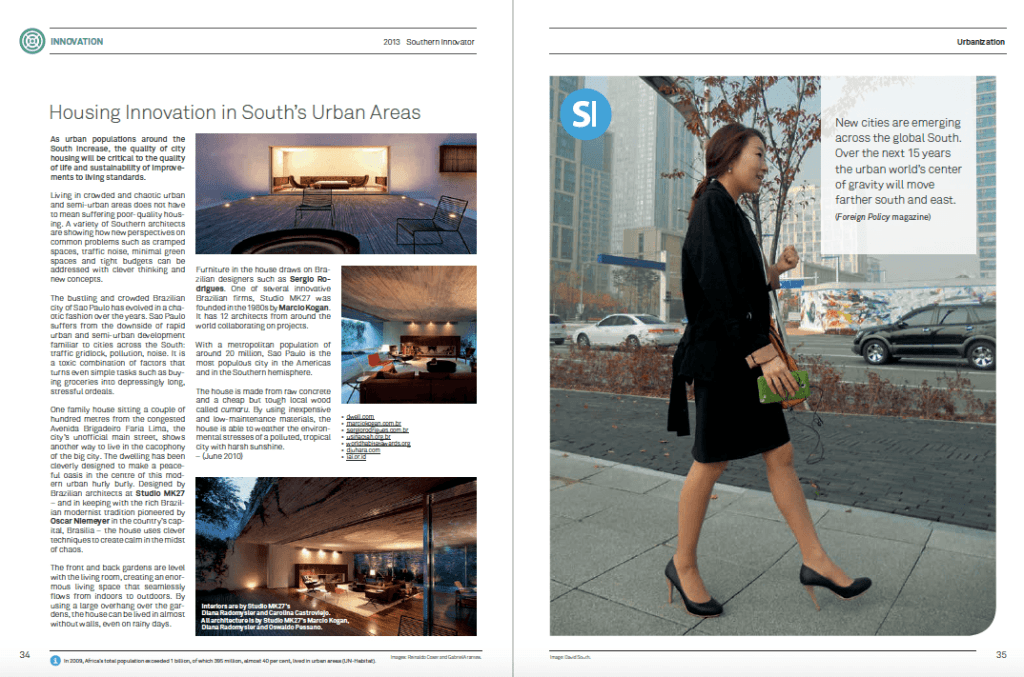
Countries across the global South are experiencing rapid urbanization as people move to cities for better economic opportunities — and this massive social change is creating new business opportunities. Those who recognize how fundamentally people’s lifestyles are changing will be those who will benefit from this big shift in populations.

Finding ways to live well in urban areas will be critical to determining whether this move repeats past urban failures — from the favelas of Brazil to the slums of India — or introduces a new way of living that is exciting and colorful. Design and designers will be critical to this change.

One young design company in Brazil, Sao Paulo-based furniture studio NUUN  (nuun.nu), is attempting to resolve a dilemma common across the rapidly urbanizing global South: How to create a design aesthetic that fits with the new way of living and being?

The company consists of designer and founder João Eulálio Kaarah and architects Renato Périgo and Carolina Sverner.

Périgo specializes in furniture and interior design, while Carolina Sverner worked with respected Japanese architect, Shigeru Ban (shigerubanarchitects.com), who is well known for designing buildings and houses made from paper and for creating easy-to-build homes for people after a disaster has struck (http://www.ted.com/talks/shigeru_ban_emergency_shelters_made_from_paper).

A collaboration among upcoming artists, designers and architects, NUUN tries to infuse its designs with a sense of “brazilianness”. Brazilianness is a modern aesthetic, made for modern lifestyles in the new urban landscape, that draws on aspects of Brazil’s culture and environment.

The young studio’s first collection of furniture offers simplicity. Called Eos, it tries to blend urban cosmopolitanism with raw nature. Brazil is known for its jam-packed urban cities as well as its vast expanse of Amazon rainforest. In practice, NUUN’s look is a mix of contrasts redolent of what used to be called brutalism: concrete mixed with glass, steel, wood and semi-precious gems. NUUN takes inspiration from NASA’s Earth Observation System (EOS): the collection vibes off of space satellites, antennae and the dry soil of the backwoods. NUUN says that “despite its Martian features, [the collection] is as Brazilian as it comes”. There is the modular Panorama sofa (http://nuun.nu/products/panorama) in five colors, capable of being re-shaped to fit a variety of living arrangements. A glass-topped coffee table with a concrete base and a side table with a carbon steel metallic structure to complement the sofa.

Elsewhere in the world of Brazilian design, footwear brand Grendene S.A. (http://ri.grendene.com.br/EN/Company/Profile) has become one of the world’s largest producers of footwear and made one of its founders a billionaire. And Grendene has boosted its international success by turning to another Brazilian success: supermodel Gisele Bündchen (giselebündchen.com.br).

Grendene began in 1971 and owns various successful shoe brands, including Melissa (melissa.com.br/en/), Grendha, Ilhabela, Zaxy, Cartago, Ipanema, Pega Forte, Grendene Kids and Grendene Baby.

It has six industrial zones with 13 footwear factories and can produce 240 million pairs of shoes a year. It undertakes all areas of production— from making its own moulds for the shoes to creating PVC (polyvinyl chloride) (http://en.wikipedia.org/wiki/Polyvinyl_chloride) – and handles its own distribution.

While Grendene is already a well-known shoe brand in Brazil, it wanted to expand its presence overseas to increase profits. Named after the two brothers who founded the company, Alexandre Grendene Bartelle and Pedro Grendene Bartelle, Grendene started working with supermodel Gisele Bündchen in 2002 to help her launch her own line of affordable flip-flops, iPanema (ipanemaflipflops.co.uk). The brightly colored sandals with elaborate patterns became an instant success.

But do celebrity endorsements really work? In the case of Bündchen and Grendene, the answer is yes. According to Forbes, 25 million pairs of the flip-flops and sandals are sold every year, accounting for 60 per cent of Grendene’s annual exports of about US $250 million.

Brazil was able to produce 864 million pairs of shoes in 2012, up 5.5 per cent from 2011.

Of these, 113 million pairs were exported to the United States, Argentina and France.

Brazil, like many other countries, has had to work out how it could compete with cheaper shoe imports from China. The strategy it chose was to target the growing number of middle-class people both in Brazil and elsewhere, as well as the high end of the market.

In 1979, Grendene created the Melissa brand, which has now become a coveted style leader. It collaborates with top design names such as Karl Lagerfeld and architect Zaha Hadid.

Making a partnership with Bündchen is part of the company’s strategy to reach higher-income buyers.

And it is working: Grendene increased its export revenue by 50 per cent in 2013.

Co-founder Alexandre Grendene Bartelle became a billionaire according to Forbes World’s Billionaires list and is worth US $1.4 billion. He owns 41 per cent of Grendene S.A. and close to 40 per cent of the Dell Anno brand.

This is a critical lesson for manufacturers in the global South. Grendene had achieved strong market dominance at home, and was already benefiting from growing wealth among Brazil’s middle classes. But it was the overseas market that had the potential to clinch even more profits for the company.

Bündchen’s high brand profile has enabled the company to compete head-to-head with the well-known Brazilian flip-flop brand, Havaianas (havaianas-store.com).

Another modern design leader owned by Grendene, Dell Anno (lojasdellanno.com.br), is a maker of modernist cabinets and furniture.

Dell Anno only use wood from renewable forest sources, to protect and preserve the Amazon and other native forests. Dell Anno tries to recycle as much as possible: up to 80 per cent of the water used in manufacturing is recycled, and byproducts from the production process such as a sawdust, wood, plastic and cardboard are also reused.

Dell Anno makes a full range of furniture for kitchens, bedrooms, closets, home theatres, home offices, service areas, restrooms and commercial environments. Dell Anno uses research and development to study trends and advise customers on the best options. The brand offers its staff training to help standardize customer service, and also has an excellent blog covering developments in modern design around the world (http://www.lojasdellanno.com.br/blog/).

Published: May 2014

Development Challenges, South-South Solutions was launched as an e-newsletter in 2006 by UNDP’s South-South Cooperation Unit (now the United Nations Office for South-South Cooperation) based in New York, USA. It led on profiling the rise of the global South as an economic powerhouse and was one of the first regular publications to champion the global South’s innovators, entrepreneurs, and pioneers. It tracked the key trends that are now so profoundly reshaping how development is seen and done. This includes the rapid take-up of mobile phones and information technology in the global South (as profiled in the first issue of magazine Southern Innovator), the move to becoming a majority urban world, a growing global innovator culture, and the plethora of solutions being developed in the global South to tackle its problems and improve living conditions and boost human development. The success of the e-newsletter led to the launch of the magazine Southern Innovator.  

Follow @SouthSouth1

Google Books: https://books.google.co.uk/books?id=NhQ9BQAAQBAJ&dq=development+challenges+may+2014&source=gbs_navlinks_s

Slideshare: http://www.slideshare.net/DavidSouth1/may-2014-development-challenges

Southern Innovator Issue 1: https://books.google.co.uk/books?id=Q1O54YSE2BgC&dq=southern+innovator&source=gbs_navlinks_s

Southern Innovator Issue 2: https://books.google.co.uk/books?id=Ty0N969dcssC&dq=southern+innovator&source=gbs_navlinks_s

Southern Innovator Issue 3: https://books.google.co.uk/books?id=AQNt4YmhZagC&dq=southern+innovator&source=gbs_navlinks_s

Southern Innovator Issue 4: https://books.google.co.uk/books?id=9T_n2tA7l4EC&dq=southern+innovator&source=gbs_navlinks_s

Southern Innovator Issue 5: https://books.google.co.uk/books?id=6ILdAgAAQBAJ&dq=southern+innovator&source=gbs_navlinks_s

Creative Commons License
This work is licensed under a
Creative Commons Attribution-Noncommercial-No Derivative Works 3.0 License.

ORCID iD: https://orcid.org/0000-0001-5311-1052.

© David South Consulting 2023