Categories
Archive Blogroll Development Challenges, South-South Solutions Newsletters Southern Innovator magazine

Creating Green Fashion in China

By David SouthDevelopment Challenges, South-South Solutions

SOUTH-SOUTH CASE STUDY

China is the world’s largest manufacturer (Euromonitor) and the largest clothing maker, producing a quarter of all textiles and clothing. It is a global fashion production hub, and many major global clothing brands have their products made there – whether they admit it or not.

Although most people probably do not give it a second thought, the fashion and clothing industries can be highly polluting and exploitive. The use of toxic fertilizers to boost cotton yields leaves behind a legacy of contaminated soil and water tables. Dyes used to colour clothing also can be toxic and pollute water. For people working in this industry – many of whom are women – conditions can vary widely and include low pay and high stress.

According to the Ethical Fashion Forum, “it is difficult for companies sourcing from China to be sure of fair working practices. There have been many reports of low wages, long hours, and unfair working conditions in factories in China.”

But one innovative fashion brand is out to transform the way the garment business works in China and to develop a template that could be used in other places such as Africa.

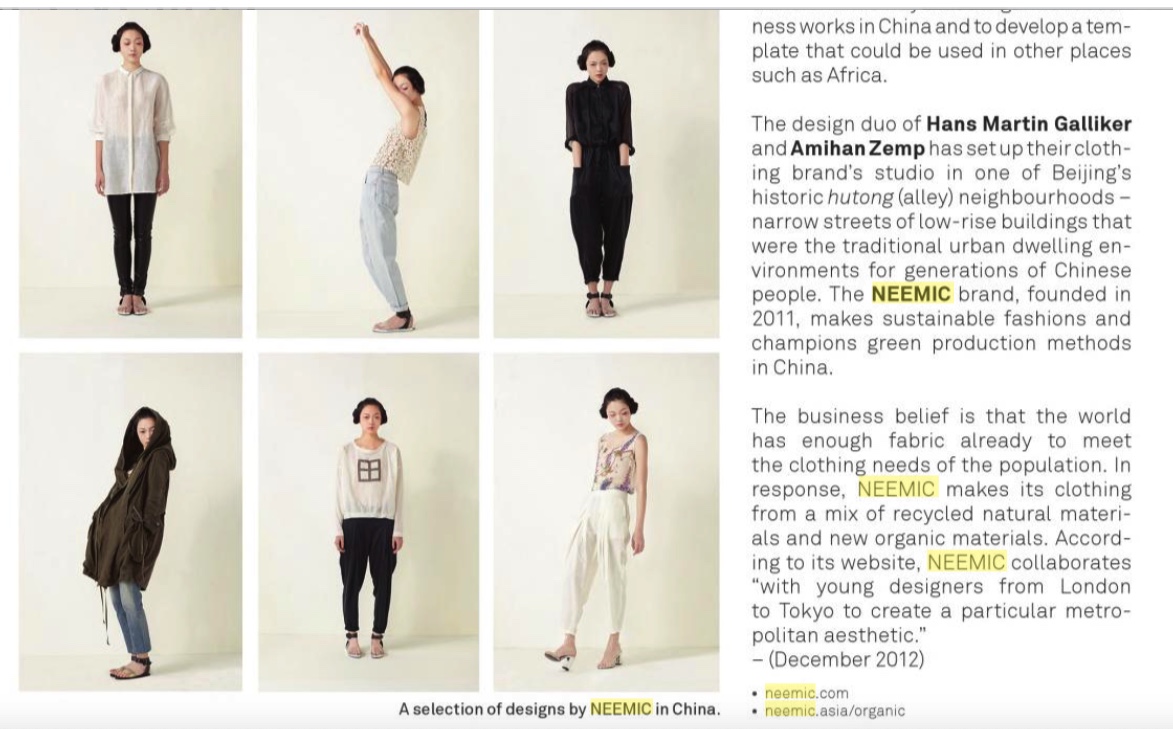
The design duo of Hans Martin Galliker and Amihan Zemp has set up their clothing brand’s studio in one of Beijing’s historic hutong (alley) neighbourhoods – narrow streets of low-rise buildings that were the traditional urban dwelling environments for generations of Chinese people. The NEEMIC (neemic.com) brand, founded in 2011, makes sustainable fashions and champions green production methods in China.

The business’s belief is that the world has enough fabric already to meet the clothing needs of the population. In response, NEEMIC makes its clothing from a mix of recycled natural materials and new organic materials. According to its website, NEEMIC collaborates “with young designers from London to Tokyo to create a particular metropolitan aesthetic.”

“We use the finest natural fabrics for a perfectly comfortable feel,” Galliker said. “We pick the finest natural materials from leftovers of the industry, recycle used clothes, and strive to order new fabrics only from certified organic producers.”

Hans Martin Galliker began as a farming apprentice in his native Switzerland, and brings a practical bent to his approach to fashion. He draws on his knowledge of farming and agriculture to create a unique eco-conscious fashion product in China.

Galliker got his start in fashion working for a brand in Shenzhen, southern China. He worked with the organic farms there, and this inspired him to explore sustainability in fashion design and ways of introducing the principles of fair trade to the fashion and textile industries in China.

Galliker is passionate about taking a different attitude to fashion: “There are many fashion brands and many of them are … meaningless,” he told the China Daily newspaper. “They do fashion which looks more or less … the same, which has no creativity and does a lot of harm to the environment.

“Growing cotton is highly chemicals and labour-intensive, which degrades the soil and pays people very low salaries. And the dyeing and colouring processes pollute rivers and people receive low salaries but have to work long hours. The whole textile industry is really bad for the environment.”

NEEMIC has completed three collections of clothing since it was founded in 2011.

“We started selling some of our designs at a boutique in Beijing that focuses on upcycling fashion. People like it and want to buy more,” said Galliker.

Upcycling is the process of converting waste material into new products (http://en.wikipedia.org/wiki/Upcycling).

And to counter any negative perceptions that organic cotton clothing can only ever be unfashionable, Galliker is out to prove it is possible to create stylish organic clothing.

On top of building the brand, Galliker also works to educate the industry and change ways. He is also setting up a branch in China of the Hong Kong Organic Textile Association (http://neemic.asia/organic), which encourages fashion designers to jointly buy organic materials. He also publishes a website on sustainable agricultural practices in China, with details on current policies on organic farming.

“It is very normal for Chinese farmers to use many fertilizers, but the environment is going bad and consumers do not like this kind of farming,” Galliker points out. “For farmers, it’s not meaningful to produce only to make money to live a decent life. It should be more than that.”

The NEEMIC operation is lean: the Beijing studio does all the designing of the clothes, programming of the multilingual websites and runs the online shopping and payment sites.

For now, the goal is to not only increase the use of organically grown materials but also to introduce the fair trade concept into China.

“In two years we want to do fair trade production,” Galliker said.

And he has Africa in his sights with his green fashion template.

“In the long term we will have many successful projects here or non-profit companies … a lot of creative force and investment so that we can help rural regions in Africa to do sustainable agriculture projects.”

Published: December 2012

Resources

1) Ethical Fashion Forum: The Ethical Fashion Forum is the industry body dedicated to a sustainable future for fashion. A not for profit organisation, EFF aims to make it easy for fashion professionals to integrate sustainability at the heart of what they do. Website: http://www.ethicalfashionforum.com/

2) Hong Kong Organic Textile Association: Its mission is to promote organic textiles in Hong Kong Website: http://www.facebook.com/HKOrganicTextileAssociation

3) Tips on how to upcycle. Website: http://www.independent.co.uk/property/interiors/the-insider–how-to-upcycle-without-much-effort-2343100.html

4) How to create a Lookbook for a fashion brand. Website: http://noisetteacademy.com/2011/05/creating-a-lookbook/

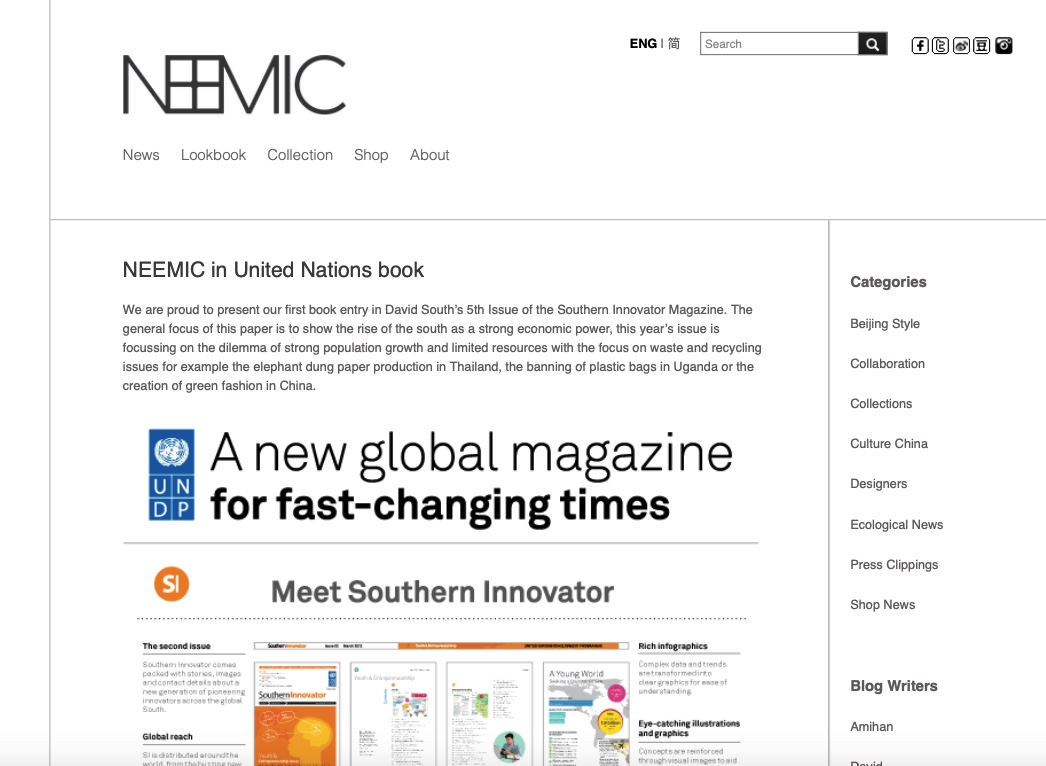
“We are proud to present our first book entry in David South’s 5th Issue of the Southern Innovator Magazine. The general focus of this paper is to show the rise of the south as a strong economic power, this year’s issue is focussing on the dilemma of strong population growth and limited resources with the focus on waste and recycling issues for example the elephant dung paper production in Thailand, the banning of plastic bags in Uganda or the creation of green fashion in China.” https://neemic.asia/ecological-news/neemic-southern-innovator-book

https://davidsouthconsulting.org/2021/02/09/african-fashions-growing-global-marketplace-profile/

https://davidsouthconsulting.org/2021/01/05/afropolitan-african-fashion-scene-bursting-with-energy/

https://davidsouthconsulting.org/2022/10/09/fashion-closes-gap-between-catwalk-and-crafts/

https://davidsouthconsulting.org/2022/11/17/fashion-recycling-how-southern-designers-are-re-using-and-making-money/

https://davidsouthconsulting.org/2022/11/16/favela-fashion-brings-women-work/

https://davidsouthconsulting.org/2020/04/30/local-fashions-pay-off-for-southern-designers/

https://davidsouthconsulting.org/2022/10/24/made-in-africa-fashion-brand-pioneers-aim-for-global-success/

https://davidsouthconsulting.org/2021/10/04/putting-quality-and-design-at-the-centre-of-chinese-fashion/

https://davidsouthconsulting.org/2021/03/05/southern-innovator-issue-5/

Development Challenges, South-South Solutions was launched as an e-newsletter in 2006 by UNDP’s South-South Cooperation Unit (now the United Nations Office for South-South Cooperation) based in New York, USA. It led on profiling the rise of the global South as an economic powerhouse and was one of the first regular publications to champion the global South’s innovators, entrepreneurs, and pioneers. It tracked the key trends that are now so profoundly reshaping how development is seen and done. This includes the rapid take-up of mobile phones and information technology in the global South (as profiled in the first issue of magazine Southern Innovator), the move to becoming a majority urban world, a growing global innovator culture, and the plethora of solutions being developed in the global South to tackle its problems and improve living conditions and boost human development. The success of the e-newsletter led to the launch of the magazine Southern Innovator.  

Follow @SouthSouth1

Google Books: https://books.google.co.uk/books?id=q1KeBgAAQBAJ&dq=development+challenges+december+2012&source=gbs_navlinks_s

Slideshare: http://www.slideshare.net/DavidSouth1/development-challengessouthsouthsolutionsdecember2012issue

Southern Innovator Issue 1: https://books.google.co.uk/books?id=Q1O54YSE2BgC&dq=southern+innovator&source=gbs_navlinks_s

Southern Innovator Issue 2: https://books.google.co.uk/books?id=Ty0N969dcssC&dq=southern+innovator&source=gbs_navlinks_s

Southern Innovator Issue 3: https://books.google.co.uk/books?id=AQNt4YmhZagC&dq=southern+innovator&source=gbs_navlinks_s

Southern Innovator Issue 4: https://books.google.co.uk/books?id=9T_n2tA7l4EC&dq=southern+innovator&source=gbs_navlinks_s

Southern Innovator Issue 5: https://books.google.co.uk/books?id=6ILdAgAAQBAJ&dq=southern+innovator&source=gbs_navlinks_s

Creative Commons License

This work is licensed under a
Creative Commons Attribution-Noncommercial-No Derivative Works 3.0 License.

ORCID iD: https://orcid.org/0000-0001-5311-1052.

© David South Consulting 2023

Categories
Archive Blogroll

A Local Drink Beats Global Competition

By David SouthDevelopment Challenges, South-South Solutions

SOUTH-SOUTH CASE STUDY

For many decades, strong American and multinational food brands have penetrated markets in the South. This is a global business success story for those companies, but the downside has been the marginalizing of local alternatives. This not only reduces wealth-creating opportunities for local entrepreneurs, but also leads to products like sugary soda pops (http://tinyurl.com/yzwal98) pushing aside healthier, local alternatives like tea.

But one company in Indonesia has been pioneering a healthy local drinks empire while also seeing off aggressive foreign rivals. Teh Botol Sosro, a tea drink in Indonesia bottled by family-owned business Sosro, was not only the first bottled tea brand in the country, but also in the world, it claims. The company started bottling the jasmine-flavoured black tea drink in the 1970s.

The Indonesian company has shown that it is possible for local flavours to beat powerful international brands like Coca Cola in the battle for drinkers’ palates. While Coca Cola has tried to sell many bottled tea drinks in the Indonesian market, they have not been able to push aside the local product, The Teh Botol Sosro. Brewed by the Sinar Sosro company, it has captured 70 percent of the non-carbonated drinks market.

It is a drink of cool, black, sweetened tea with a hint of jasmine. Invented by the Indonesian family of Sosrodjojos, Sosro (http://www.sosro.com/) was founded in central Java in the 1940s.

Culturally, Indonesians have either coffee or tea with their meals. The brand’s marketing slogan plays on this: “Whatever you eat, you drink Teh Sosro.”

The company has aggressively fought off competition not only from local rivals, but also from Coca Cola’s Frestea brand and Pepsi Cola’s Tekita. The company stayed sharp in its business strategy, never letting a rival product take hold. Just as a rival would introduce a new product, Sosro would reply with a new drink attuned to Indonesian tastes. This ability to not be complacent about the company’s success, and to use its knowledge of local tastes to always outsmart foreign competition, has kept the company where it is today.

Sosro pioneered bottled drinking tea with its launch in 1970 and started with a dried tea only distributed in Central Java.

The journey to cold, bottled tea is an amusing one. The company first wanted to promote its tea in Jakarta, the capital, by having public tastings. But by brewing the tea on the spot, the too-hot tea took too long to drink for impatient Jakartens. The solution was to not brew the tea on the spot, but instead to brew it off-site and deliver to markets in big pans on trucks. But the bad roads made this a bit of a mistake as well: the tea would spill on the journey.

The ‘aha’ moment came when the idea arose to store the brewed tea in bottles. The bottles were eye-catching and have evolved in design over the years.

The drink now comes in various packages, from a returnable glass bottle (220 ml) to a Tetra Pak (1 litre, 250 ml, and 200 ml) and a 230 ml pouch.

The Botol Sosro (http://www.sosro.com/teh-botol-sosro.php) is not the company’s only product: it also brews Fruit Tea, The Botol Kotak and S-Tee. The economic benefits of these popular brands stay local, as Sosro gets the tea from PT Gunung Slamet, which operates three tea estates covering 1,587 hectares in Indonesia.

Published: March 2010

Resources

1) Just Food is a web portal packed with the latest news on the global food industry and packed with events and special briefings to fill entrepreneurs in on the difficult issues and constantly shifting market demands. Website:http://www.just-food.com

2) Brandchannel: The world’s only online exchange about branding, packed with resources, debates and contacts to help businesses intelligently build their brand. Website:http://www.brandchannel.com

3) Small businesses looking to develop their brand can find plenty of free advice and resources here. Website: http://www.brandingstrategyinsider.com

4) Growing Inclusive Markets, a web portal from UNDP packed with case studies, heat maps and strategies on how to use markets to help the poor. Website:http://www.growinginclusivemarkets.org

5) Tea Genius: A website from Taiwan packed with information on tea, its health benefits and rituals. Website: http://www.teagenius.com/

Cited

As cited in Export Now: Five Keys to Entering New Markets by Frank Lavin and Peter Cohan (Wiley).

Creative Commons License

This work is licensed under a
Creative Commons Attribution-Noncommercial-No Derivative Works 3.0 License.

ORCID iD: https://orcid.org/0000-0001-5311-1052.

© David South Consulting 2022

Categories
Archive Blogroll data Development Challenges, South-South Solutions Newsletters digital ID Southern Innovator magazine

China Sets Sights on Dominating Global Smartphone Market

By David SouthDevelopment Challenges, South-South Solutions

SOUTH-SOUTH CASE STUDY

The rise of smartphones – mobile phones capable of Internet access and able to run ‘apps’ or applications – is the latest wave of the global connectivity revolution. Mobile phones rapidly made their way around the world to become almost ubiquitous – the most successful take-up of a piece of communications technology in history – and now smartphones are set to do the same. The number of mobile phone subscriptions in the world surpassed 6 billion in 2012 (out of a population of 7 billion) and, according to the International Telecommunications Union (ITU), the number of mobile phones will exceed the world’s population by 2014.

Over the last five years, with the increasing popularity of smartphones, the focus of the mobile industry has shifted from voice and messaging to apps and data services.

Smartphones are complex pieces of technology and any country that can develop the capability to make them and innovate is set to make a lot of money.

The high export value potential of designing and making “computer equipment, office equipment, telecommunication equipment, electric circuit equipment, and valves and transistors” was flagged up as a priority for developing nations back in 2005 at a UN meeting looking for “New and Dynamic Sectors of World Trade” (UNCTAD).

At present, smartphones have a long way to go to surpass old-style mobile phones: by the end of 2016, according to Portio Research (portioresearch.com), the number of non-smartphones in the Asia-Pacific region alone will still be bigger than the entire worldwide number of all smartphones. Even so, it’s predicted that by 2016, there will be 555 million active smartphones in China alone, as well as half a billion smartphones in Europe by the end of 2014. By 2013, North America’s smartphones will make up 50 per cent of all mobile phones. All in all, a lucrative market.

The main factor holding back the rise of smartphones is price. Smartphones tend to cost more than a basic mobile phone. But as China gets more heavily involved in the smartphone marketplace with its own smartphone and mobile phone brands, low income consumers will find themselves with a wider choice of affordable and powerful smartphones, each one a mini-computer.

Out of the 10 largest global manufacturers of smartphones, four are Chinese: Lenovo, Yulong, Huawei and ZTE (Gartner).

Huawei (http://www.huawei.com/en/), the world’s biggest smartphone seller (according to research firm Canalys) (canalys.com), has started to move some of its design team to London in the United Kingdom, to better tailor its products for foreign markets. It has revenues each year of US $35 billion.

China’s mobile phone market is vast, accounting for a third of all smartphones sold in the world. Getting a foothold in this marketplace places a company in a very strong position to build the expertise and capital to push into the wider global marketplace. And that is what Chinese brands are starting to do. So far, Chinese exports of branded smartphones make up a fifth of those sold around the world (Canalys).

The big global competitors to date have been South Korea’s Samsung (samsung.com) and the American Apple brand (apple.com). Other large competitors are Canada’s troubled Blackberry and Finland’s Nokia.

To compete with them, popular and successful Chinese brands include Xiaomi (xiaomi.cn), which sells more mobile phones in China than does the American Apple brand, and ZTE (http://wwwen.zte.com.cn/en/).

For years, many of the top global brands have had their phones and the components manufactured in China. This meant Chinese manufacturers were assembling the phones but not benefiting from the high value that can be extracted from being the owner of the brand name and the originator of the innovation and holder of the copyrights and trademarks.

But now China’s Lenovo brand (http://www.lenovo.com/uk/en/), for example, has successfully pulled past U.S. electronics maker Hewlett-Packard (www.hp.com) to become the largest seller of personal computers in the world. It is also selling more mobile phones and tablet computers than personal computers.

Lenovo Chief Executive Yang Yuanqing espouses a two-part strategy to defend market share at home in China while going hard at overseas markets. Lenovo started with so-called emerging markets in Russia, India and Indonesia.

“We have very aggressive plans to explore overseas markets,” Lenovo’s mobile phone division head Liu Jun told China Daily. “We hope the overseas market will contribute more than half of Lenovo’s total smartphone revenue in the long run.”

Xiaomi founder Lei Jun is considered part of a new generation of dynamic Chinese technology leaders. His casual clothing and charismatic public presentations have had some equate him to the late Apple founder Steve Jobs. But Jun is not happy with selling smartphones and instead sees the company’s future in software and that the phones are just a tool to access the software. Xiaomi hopes to make even more money from selling games, running online marketplaces and offering social media.

The Chinese-made smartphone brand Coolpad (http://coolpadamericas.com/) – made by Yulong Computer Telecommunication Scientific Co. – is the third best-selling in the Chinese marketplace, surpassing Huawei and Apple and has global annual revenue of US $1.8 billion, according to Forbes magazine. Sino Market Research found 10.2 per cent of China’s smartphone users own a Coolpad, behind Korean brand Samsung and China’s Lenovo.

Coolpad has succeeded by investing heavily in research and development (R&D) and innovation to make the phones cheap but also powerful.

Innovations include technology that lets users have more than one phone number for the same phone by being able to connect to two different network technologies. The phones also include security and privacy protections that make them popular with businesspeople and government officials.

The Coolpad brand has also been frenetic in launching different models of the phones to appeal to its customers. In 2012, it launched 48 different models, selling for between US $50 and US $500.

Coolpad was launched in 2012 in the US as part of the company’s global expansion plans.

China has placed innovation at the core of its economic development policies. China increased its R&D spending in 2009 to US $25.7 billion, a 25.6 per cent rise over 2008, according to Du Zhanyuan, vice minister of the Ministry of Science and Technology. In 2011, China surpassed South Korea and Europe in total patents filed and was in a neck-and-neck race with Japan and the United States.

China now boasts twice as many Internet users as the United States, and is the main global maker of computers and consumer electronics, from toys to games consoles to digital everything.

China is also on course to become the world’s largest market for Internet commerce and computing.

The drive to change and transform China’s global economic role was promoted in 2011’s Beijing International Design Week (http://www.bjdw.org/en/), with its theme of transforming “Made in China to Designed in China.”

Published: September 2013

Resources

1) iHub Nairobi: iHub – Nairobi’s Innovation Hub for the technology community is an open space for the technologists, investors, tech companies and hackers in the area. This space is a tech community facility with a focus on young entrepreneurs, web and mobile phone programmers, designers and researchers. Website: http://www.ihub.co.ke/

2) Venture Capital for Africa: Venture Capital for Africa (www.vc4africa.biz) is the continent’s leading founder’s network, the largest and fastest growing community of  entrepreneurs and investors building promising companies in Africa. Website: https://vc4africa.biz/

Red Dot: The red dot logo stands for belonging to the best in design and business. The red dot is an internationally recognized quality label for excellent design that is aimed at all those who would like to improve their business activities with the help of design. Website: http://www.red-dot.de

C3: C3 offers product design and product engineering services in Shanghai, China. Their strong point is managing innovative design processes from scratch (market research) until production: a one shop service: Website: chinacreativecompany.com

North Korea Tech: North Korea Tech is dedicated to covering and collecting information regarding the state of information technology and related industry in North Korea. You can expect to find articles related to Internet connectivity in the country (yes, it does exist), North Korea’s use of technology, and the country’s centrally-controlled and heavily-censored mass media. Website: http://www.northkoreatech.org/

ISSN 2227-3905

Google Snippit December 2020.

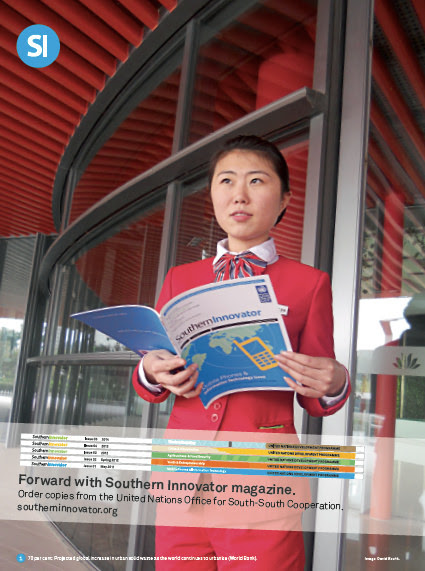
Note on story: Very few outside of China in 2013 were talking about this topic, let alone the increasing market share of smartphone manufacturer Huawei. This was one of many stories to result from a research trip to China. For the keen-eyed, try and spot the Huawei logo in the accompanying photo taken in Tianjin.

https://davidsouthconsulting.org/2020/04/30/crowdsourcing-mobile-phones-to-make-the-poor-money/

https://davidsouthconsulting.org/2020/05/01/diy-solution-charges-mobile-phones-with-batteries/

https://davidsouthconsulting.org/2022/10/09/entrepreneurs-use-mobiles-and-it-to-tackle-indian-traffic-gridlock/

https://davidsouthconsulting.org/2022/06/15/indian-mobile-phone-application-innovators-empower-citizens/

https://davidsouthconsulting.org/2022/11/01/innovative-mobile-phone-applications-storm-south/

https://davidsouthconsulting.org/2020/12/20/kenya-reaches-mobile-phone-banking-landmark/

https://davidsouthconsulting.org/2022/10/27/kenyan-mobile-phone-innovations/

https://davidsouthconsulting.org/2022/10/10/mobile-applications-market-opportunities-for-south/

https://davidsouthconsulting.org/2022/03/08/mobile-phone-microscopes-to-revolutionize-health-diagnostics/

https://davidsouthconsulting.org/2022/04/06/mobile-phone-peacekeeping/

https://davidsouthconsulting.org/2020/12/12/mobile-phone-shopping-to-create-efficient-markets-across-borders/

https://davidsouthconsulting.org/2020/12/20/mobile-phones-bring-the-next-wave-of-new-ideas-from-the-south/

https://davidsouthconsulting.org/2020/12/20/mobile-phones-engineering-souths-next-generation-of-entrepreneurs/

https://davidsouthconsulting.org/2020/12/12/mobile-phones-new-market-tools-for-the-poor/

https://davidsouthconsulting.org/2022/10/09/a-new-mobile-phone-aimed-at-the-poor/

https://davidsouthconsulting.org/2021/11/09/ring-tones-and-mobile-phone-downloads-are-generating-income-for-local-musicians-in-africa/

Development Challenges, South-South Solutions was launched as an e-newsletter in 2006 by UNDP’s South-South Cooperation Unit (now the United Nations Office for South-South Cooperation) based in New York, USA. It led on profiling the rise of the global South as an economic powerhouse and was one of the first regular publications to champion the global South’s innovators, entrepreneurs, and pioneers. It tracked the key trends that are now so profoundly reshaping how development is seen and done. This includes the rapid take-up of mobile phones and information technology in the global South (as profiled in the first issue of magazine Southern Innovator), the move to becoming a majority urban world, a growing global innovator culture, and the plethora of solutions being developed in the global South to tackle its problems and improve living conditions and boost human development. The success of the e-newsletter led to the launch of the magazine Southern Innovator.  

Follow @SouthSouth1

Google Books: https://books.google.co.uk/books?id=uXWUyfb4MacC&dq=development+challenges+september+2009&source=gbs_navlinks_s

Slideshare: http://www.slideshare.net/DavidSouth1/development-challengessouthsouthsolutionsseptember2009issue

Southern Innovator Issue 1: https://books.google.co.uk/books?id=Q1O54YSE2BgC&dq=southern+innovator&source=gbs_navlinks_s

Southern Innovator Issue 2: https://books.google.co.uk/books?id=Ty0N969dcssC&dq=southern+innovator&source=gbs_navlinks_s

Southern Innovator Issue 3: https://books.google.co.uk/books?id=AQNt4YmhZagC&dq=southern+innovator&source=gbs_navlinks_s

Southern Innovator Issue 4: https://books.google.co.uk/books?id=9T_n2tA7l4EC&dq=southern+innovator&source=gbs_navlinks_s

Southern Innovator Issue 5: https://books.google.co.uk/books?id=6ILdAgAAQBAJ&dq=southern+innovator&source=gbs_navlinks_s

This work is licensed under a Creative Commons Attribution 4.0 International License.

https://davidsouthconsulting.org/2021/03/05/southern-innovator-issue-1/

Creative Commons License

This work is licensed under a
Creative Commons Attribution-Noncommercial-No Derivative Works 3.0 License.

ORCID iD: https://orcid.org/0000-0001-5311-1052.

© David South Consulting 2023