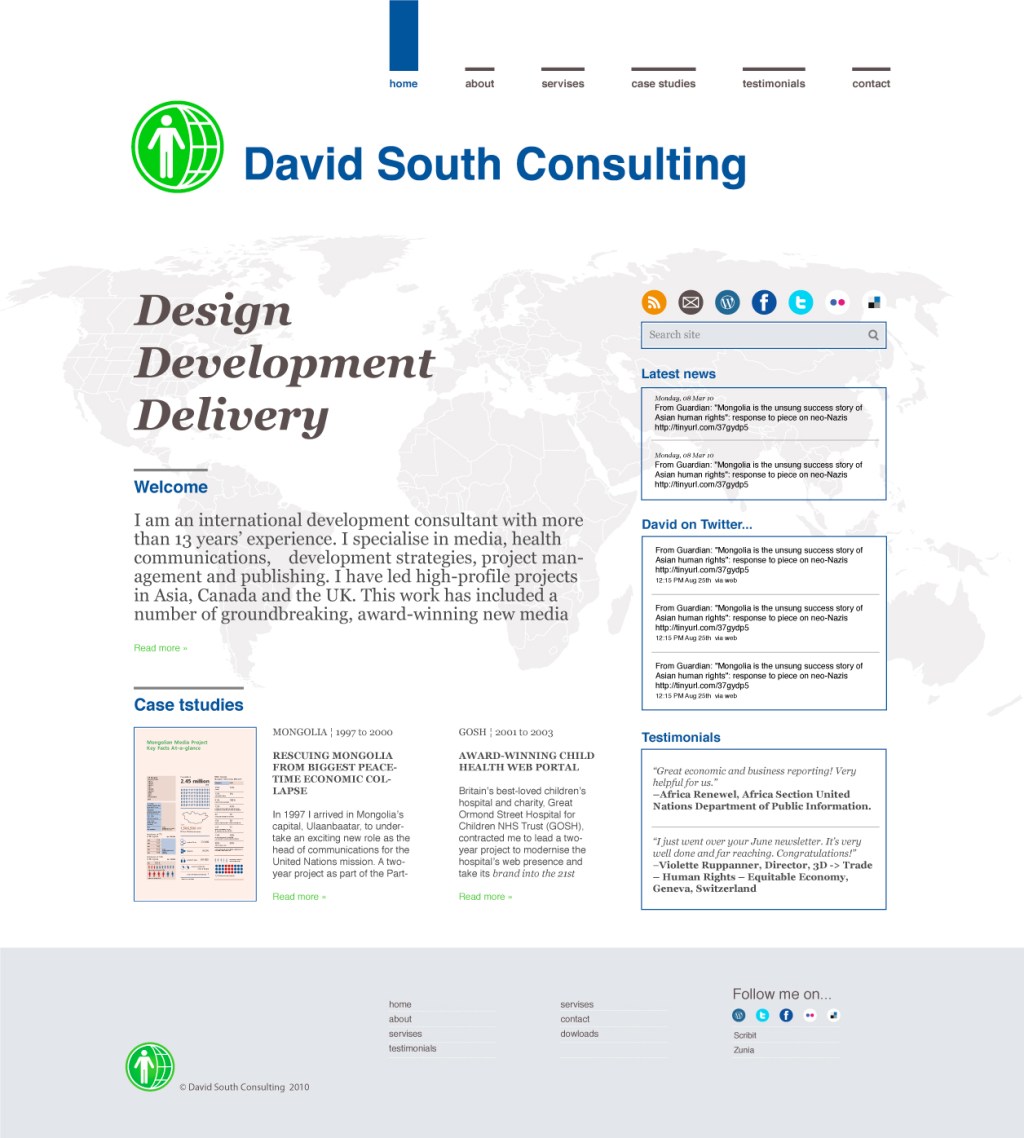
With summer break now behind us, and the autumn gradually unfolding (the pace seems slower with the economic uncertainties all around), my new public website is being assembled. Icelandic graphic designer Solveig Rolfsdottir is working on the project and I hope this is the beginning of many more collaborations.
David South Consulting Prototype Website Design 2010.David South Consulting branding and Squarespace website by Graphic Designer and Illustrator Solveig Rolfsdottir.In 2010, David South Consulting was relaunched with a new logo and branding for the 21st century. It represented a new phase, as work became global and very high-profile and influential. The foundations have been laid for future growth and expansion.
Across the global South, its thirsty people have long been a target market for Northern drinks companies. The ubiquity of the American soft drink Coca Cola, or even its rival Pepsi Cola, is testimony to that. Even the most remote village on the impoverished island of Haiti can offer an ice-cold Coke.
But the marketing power of these companies has a down side: it has pushed aside local drink brands based on traditional formulations. But in some countries, local brands are fighting back.
In India, the Cow Protection Department of the Rashtriya Swayamsevak (called RSS) based in Hardwar (www.hardwar.com), one of the four holy cities on the River Ganges, has produced a soft drink made from recycled cow urine. They call it ‘gau jal’ (Sanskrit for ‘cow water’) and it is set for a launch at the end of 2009.
The urine is highly processed to make the drink. “Don’t worry, it won’t smell like urine and will be tasty too,” Om Prakash told the Daily Mail. “Its unique selling point will be that it’s going to be very healthy. It won’t be like carbonated drinks and will be devoid of any toxins.”
The price will be less than American brands such as Coca Cola.
“We’re going to give them good competition as our drink is good for mankind,” he continued. “We may also think of exporting it.”
The drink contains not only cow urine but a blend of medicinal and ayurvedic herbs. Ayurveda is the 5,000-year-old ancient Indian health system.
The RSS was founded in 1925 and claims to have eight million members.
Cows are sacred to India’s Hindu population and killing them is illegal in many parts of India.Finding ways to make a living from cows’ waste products is common. Cow dung (manure) is already used as a fertilizer in villages. It is claimed the new soda pop will help with cancer, obesity and liver disease.
Another drink that has been consumed for its health-giving properties is Mongolian mare’s (female horse) milk. Studies by female scientists from Mongolia, South Korea and China for UNDP in the late 1990s found the milk was packed with vitamins and minerals and effective in treating liver diseases, cancer, intestine inflammations and tuberculosis.
Mongolians have used mare’s milk for centuries in their traditional diet. The drink, called airag in Mongolian, is consumed especially during traditional holidays.
There are eight times as many horses in Mongolia as the human population, which numbers 2.7 million, so the potential for this drink is enormous. The Food and Biotechnology Institute of the Mongolian University of Science and Technology (www.must.edu.mn/beta_new/) in association with the Swiss International Development Agency (www.sdc.admin.ch), has been developing technology to process mare’s milk, and make value-added products with it to create rural jobs. Under the project, eight kinds of beauty products have been manufactured so far using mare’s milk.
Published: July 2009
Resources
Just Food is a web portal packed with the latest news on the global food industry and packed with events and special briefings to fill entrepreneurs in on the difficult issues and constantly shifting market demands. Website: www.just-food.com
Brandchannel: The world’s only online exchange about branding, packed with resources, debates and contacts to help businesses intelligently build their brand. Website: www.brandchannel.com
Small businesses looking to develop their brand can find plenty of free advice and resources here. Website: www.brandingstrategyinsider.com
Growing Inclusive Markets, a new web portal from UNDP packed with case studies, heat maps and strategies on how to use markets to help the poor. Website: www.growinginclusivemarkets.org
Asia-Pacific Traditional Medicine and Herbal Technology Network: an excellent first stop for any entrepreneur, where they can find out standards and regulations and connect with education and training opportunities. Website: www.apctt-tm.net
Development Challenges, South-South Solutions was launched as an e-newsletter in 2006 by UNDP’s South-South Cooperation Unit (now the United Nations Office for South-South Cooperation) based in New York, USA. It led on profiling the rise of the global South as an economic powerhouse and was one of the first regular publications to champion the global South’s innovators, entrepreneurs, and pioneers. It tracked the key trends that are now so profoundly reshaping how development is seen and done. This includes the rapid take-up of mobile phones and information technology in the global South (as profiled in the first issue of magazine Southern Innovator), the move to becoming a majority urban world, a growing global innovator culture, and the plethora of solutions being developed in the global South to tackle its problems and improve living conditions and boost human development. The success of the e-newsletter led to the launch of the magazine Southern Innovator.
Southern Innovator’s online archive portal was launched in New York City, U.S.A. (home to the UN’s headquarters) in 2011 (southerninnovator.org).
Reviving traditional foods and drinks can be an income-boosting source of new economic activity. Many cultures can benefit from looking again at their rich traditions to find new ways to increase enterprise. This can be difficult at first. Big global brands have many initial advantages: they are backed by wealthy and experienced international companies and can deploy aggressive marketing and distribution power to get products into the hands of consumers. The power of Coca Cola to reach all corners of the earth is legendary.
But the case of Mexican drink pulque shows how marrying the power of an ancient taste with a younger demographic can rejuvenate businesses. This is important because many emerging countries across the South have young populations – and yet unemployment is also high among these youthful populations. Engaging the youth market will be critical to the future prosperity and development of these countries.
Pulque is also playing a part in Mexico’s tourism strategy: the state government in Tlaxcala (http://www.tlaxcala.gob.mx)has created a ‘Pulque Route’ to draw in tourists.
Having for decades lost ground to slickly marketed alternatives like beer and tequila, pulque drinking is being revived with the help of a new generation of Mexicans re-discovering a beverage that boasts origins reaching back to the Aztecs (http://en.wikipedia.org/wiki/Aztec).
There is also another benefit to reviving ancient food and drink: alarm has been raised over the diminishing range of food products consumed by people around the world. Throughout the history of farming, around 7,000 species of plants have been domesticated. Yet everyday diets only draw on 30 percent of these plants, and even this number has been going down as more people consume mass-market foods (FAO).
Once-rich culinary traditions have wilted and left many people unsure what to do with formerly common vegetables and fruits, even if they can actually find them in markets.
One consequence has been poor nutrition resulting from the reduction in consumption of high-vitamin foods, leading to stunted mental and physical development across the global South.
Pulque (http://en.wikipedia.org/wiki/Pulque) is made from the juice of maguey or agave (http://en.wikipedia.org/wiki/Agave), a spiky green plant. It has between three and four percent alcohol content. Unlike the well-known Mexican drink tequila, which is fermented and distilled to make a strong, clear alcoholic drink, pulque is a foamy and milky beverage that is fermented, not distilled.
Made from a sap harvested when the agave is mature, it appears in the Codex Borbonicus written by Aztec priests in the 1530s.
Advocates for the drink say it is high in Thiamine, Riboflavin, Niacin, Pantothenic Acid and packed with beneficial microbes for human digestion. It also has vitamins C, B-complex, D, E, amino acids and minerals such as iron and phosphorus.
Pulque had developed a bad reputation, with an image as a peasant drink lacking the class of tequila or beer. The stigma had built up over decades from its reputation as the favourite drink of alcoholic farmers, commonly depicted drinking pulque all day long.
Once pulque was available only at makeshift pulquerias: a few tables and chairs with farm animals roaming about. Portions were large, using gourds or, by the 1970s, plastic buckets. Some still sell the drink in this rough-and-ready fashion from containers hitched to donkeys.
Those behind the rebranding of the drink hope to move away from the former drinkers – largely poor, old and rural – to young urban drinkers. Pulque has taken on a “cool, retro” image tapping into a taste for connecting with Mexico’s Aztec roots.
In Pulqueria Las Duelistas in Mexico City, the young crowd like the new taste. “It is cooler than beer and a lot cheaper than Tequila,” Jaime Torres, a 22-year-old design student and computer tech for an advertising agency told the Washington Post. “It’s old Mexico.”
By 1886 a census found 817 pulquerias in Mexico City serving the residents of just 9,000 homes. By the 20th century, they had become so common that neighbourhoods would have a handful each. Now estimates place the number in Mexico City at between 60 and 100, with many closing when their owners die.
Las Duelistas is trying to buck that trend.
“This place has been in business for 92 years, and I have six as the owner, and I have totally changed the image of the pulqueria, a totally new concept, with different clientele,” said proprietor Arturo Garrido. “Most of my clients are young, and it is my way to continue giving life to the pulque.”
So, how have the pulquerias made themselves appealing to a new generation of drinkers? Music and new interior design have made the establishments more attractive to youth.
Pulque sells for 30 pesos, or about US $2.50, a litre. The most popular version is called curado (cured) and is infused with other flavours like strawberry, guava and celery to add greater appeal to a younger demographic.
“My customers aren’t old anymore. Now they’re young people,” said Nabor Martinez, the owner of another pulqueria, La Risa.
The drink is difficult to export because it keeps fermenting in the bottle or can. This makes it something special to Mexico, only enjoyed by a visit to the country.
Some, however, like Everado Gonzalez, director of the 2003 documentary “Pulque Song,” about an old-school establishment, lament the loss of the old atmosphere.
“A pulqueria is not a cantina. It’s not a bar,” Gonzalez said. “It is a refuge, or was, for the lowest classes of society. Your drink is cheap. You are not sitting at a table, with good manners. You don’t need a table. You sit on a bench, where you can do what you want, say what you want.
“It was a beautiful island of freedom.”
Published: September 2011
Resources
1) Teh Botol Sosro: It is a drink of cool, black, sweetened tea with a hint of jasmine. Invented by the Indonesian family of Sosrodjojos, Sosro was founded in central Java in the 1940s. Website: http://www.sosro.com
2) Just Food is a web portal packed with the latest news on the global food industry and packed with events and special briefings to fill entrepreneurs in on the difficult issues and constantly shifting market demands. Website:http://www.just-food.com
4) Brandchannel: The world’s only online exchange about branding, packed with resources, debates and contacts to help businesses intelligently build their brand. Website:http://www.brandchannel.com
Mezcal or mescal, is a distilled alcoholic beverage made from any type of agave (Wikipedia). In the summer of 2022 Southern Innovator was introduced to the brand Marin&Marin (https://www.marinymarinmezcal.com). Their mezcal is hand made in a traditional Mexican way and is 100% organic and Fair Trade.
Development Challenges, South-South Solutions was launched as an e-newsletter in 2006 by UNDP’s South-South Cooperation Unit (now the United Nations Office for South-South Cooperation) based in New York, USA. It led on profiling the rise of the global South as an economic powerhouse and was one of the first regular publications to champion the global South’s innovators, entrepreneurs, and pioneers. It tracked the key trends that are now so profoundly reshaping how development is seen and done. This includes the rapid take-up of mobile phones and information technology in the global South (as profiled in the first issue of magazine Southern Innovator), the move to becoming a majority urban world, a growing global innovator culture, and the plethora of solutions being developed in the global South to tackle its problems and improve living conditions and boost human development. The success of the e-newsletter led to the launch of the magazine Southern Innovator.
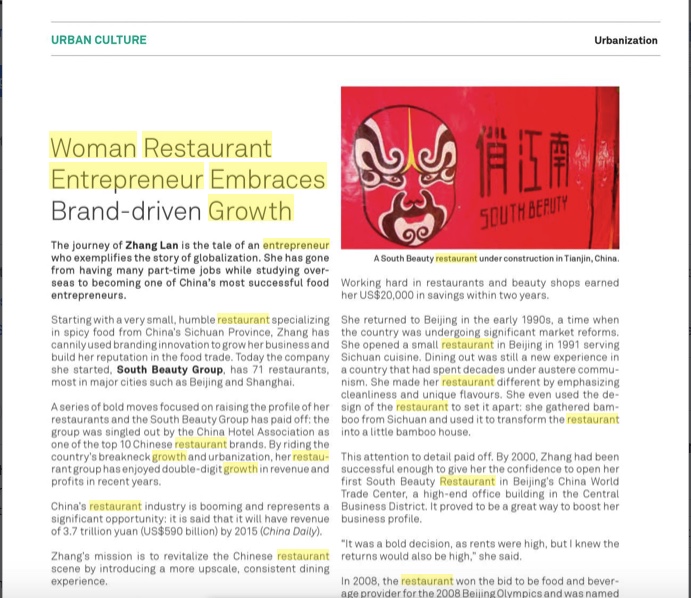
The journey of Zhang Lan is the tale of an entrepreneur who exemplifies the story of globalization. She has gone from working many part-time jobs while studying overseas, to becoming one of China’s most successful food entrepreneurs.
Starting with a very small and humble restaurant specializing in spicy food from China’s Sichuan province, Zhang has cannily used branding innovation to grow her business and build her reputation in the food trade. Today the company she started, South Beauty Group (southbeauty.com), has 71 restaurants, most in major cities such as Beijing and Shanghai.
A series of bold moves focused on raising the profile of her restaurants and the South Beauty Group has paid off: the group was singled out by the China Hotel Association as one of the top 10 Chinese restaurant brands. By riding the country’s breakneck growth and urbanization, her restaurant group has enjoyed double-digit growth in recent years in revenue and profits.
Zhang’s mission is to revitalize the Chinese restaurant scene by introducing a more upscale and consistent dining experience.
China’s restaurant industry is booming and represents a significant opportunity: it is said it will have revenue of 3.7 trillion yuan (US $590 billion) by 2015 (China Daily).
“Most people in China don’t know how to present food. I am happy that I have given some importance to the appearance of food,” Zhang told the China Daily newspaper.
“I strike a balance between popular and high-end brands in my daily life. This also works for South Beauty Group, which aims to attract customers to a modern place to enjoy high-grade and popular Chinese cuisine.”
Her business mission is to take the group outside of China and become a global brand.
“Buoyed by the booming domestic high-end catering market, South Beauty Group is looking to be a major luxury brand in the global catering industry. It is not an easy task considering that there are different cultures and eating habits. But my past experience has taught me that opportunities often come along with challenges,” she told China Daily.
Zhang’s business story started in a journey to Canada to pursue further education. To make ends meet, at one time she took on six part-time jobs, including washing dishes and food preparation.
Anybody who has gone to another country to work and better their life knows how hard this can be: “During that period, I was so tired by the end of the day that I had to lift my legs onto the bed with my hands,” Zhang said.
But working hard in restaurants and beauty shops earned her US $20,000 in savings within two years.
She returned to Beijing in the early 1990s, a time when the country was undergoing significant market reforms. She opened a small restaurant in Beijing in 1991 serving Sichuan cuisine. Dining out was still a new experience in a country that had spent decades under austere communism. She made her restaurant different by emphasizing cleanliness and unique flavours for the food. She even used the design of the restaurant to set it apart: she gathered bamboo from Sichuan and used it to transform the restaurant into a little bamboo house.
This attention to detail paid off. By 2000, Zhang had been successful enough to give her the confidence to open her first South Beauty Restaurant in Beijing’s China World Trade Center, a high-end office building in the Central Business District. It proved to be a great way to boost her business’s profile.
“It was a bold decision, as rents were high, but I knew the returns would also be high,” she said.
By 2006, she was successful enough to make another brave move: open a luxury restaurant called the Lan Club, in Beijing. Having learned about the importance of distinguishing herself in the ever-growing restaurant marketplace in China, she invited world-famous designer Philippe Starck (http://www.starck.com/en/) to design the restaurant.
For Zhang, there was a bigger strategy at work: “I was not disheartened when some people said that I threw money away like dirt and 12 million yuan (US $1.92 million) was too much for a design draft. But I got great publicity and brand recognition with this design, far more than what is received by most companies which spend millions of yuan on television advertisements. Not everyone in China can boast of a Starck design in their restaurant.”
In 2007, the company also started cooking meals for airlines flying between China and France, the Netherlands and South Korea. In 2008, it won the bid to be food and beverage provider for the 2008 Beijing Olympics and was named official caterer to the 2010 Shanghai World Expo.
“These international events have given us great confidence in planning overseas expansion,” Zhang said.
The hallmarks of the dining experience at a South Beauty Restaurant include dramatic food presentation, upscale décor, a pleasant dining atmosphere and critically, waiting staff who are informed about the dishes they are serving.
Dramatic food preparation includes cooking food at the table for the diners and serving stir-fried shrimp on a plate with a goldfish bowl filled with live fish.
“I want to change the cheap price and bad atmosphere tag that most Westerners have about Chinese food,” Zhang told China Daily.
She has attracted investors to take a stake in the business and become the second richest female entrepreneur in China, according to the 2011 China Restaurant Rich List.
While the international economic crisis is still damaging growth in the United States and Europe, Zhang still plans to go global. She is looking to initially expand into Asia before moving into Europe and North America.
“Our mission is to promote authentic Chinese cuisine across the world. With (the) Chinese economy growing steadily and its cultural influence gaining, it will not be long before we see some big global Chinese catering companies, much like McDonald’s,” Zhang concluded. And it looks like South Beauty Group wants to lead the way.
Published: November 2012
Resources
1) Restaurant Branding: A website dedicated to discussing restaurant branding and how to do it. Website:http://www.restaurantbranding.com/
Development Challenges, South-South Solutions was launched as an e-newsletter in 2006 by UNDP’s South-South Cooperation Unit (now the United Nations Office for South-South Cooperation) based in New York, USA. It led on profiling the rise of the global South as an economic powerhouse and was one of the first regular publications to champion the global South’s innovators, entrepreneurs, and pioneers. It tracked the key trends that are now so profoundly reshaping how development is seen and done. This includes the rapid take-up of mobile phones and information technology in the global South (as profiled in the first issue of magazine Southern Innovator), the move to becoming a majority urban world, a growing global innovator culture, and the plethora of solutions being developed in the global South to tackle its problems and improve living conditions and boost human development. The success of the e-newsletter led to the launch of the magazine Southern Innovator.







 David South Consulting
You must be logged in to post a comment.