Categories
Archive Development Challenges, South-South Solutions Newsletters

Online Free Knowledge Sharing

By David SouthDevelopment Challenges, South-South Solutions

SOUTH-SOUTH CASE STUDY

UNESCO’s Kronberg Declaration on the Future of Knowledge Acquisition and Sharing is blunt: the future of learning will increasingly be mediated by technology, and traditional educational processes will be revolutionized. Acquiring factual knowledge will decrease and instead people will need to find their way around complex systems and be able to judge, organize and creatively use relevant information.

According to Abdul Waheed Khan, UNESCO’s Assistant Director General for Communications and Information, “Lack of access to knowledge increasingly accentuates marginalization and economic deprivation, and we need to join efforts to bridge these gaps”

More and more initiatives are stepping in to break down barriers in the exchange of information and knowledge, and break out from the gatekeepers. The advent of Web 2.0 and its user-contributed resources is making this happen.

Connexions sees itself as the partner to go with the free and low-cost laptops being distributed by the One Laptop Per Child Project to schoolchildren in the developing world. Connexions is a Web 2.0 website that allows teachers and educators to upload their learning materials by subject for sharing with anyone who wants them. All content is broken down into modules for easy access. The content can be mixed to build courses, and adapted to suit local conditions. It represents a cornucopia of knowledge, ranging from mathematics to engineering to music lessons.

The content’s adaptability is its charm – users can add additional media like video and photos and modify and add on-the-ground case studies to really bring the material to life for students. The ability to re-mix and re-contextualise into the local circumstances is critical to get take-up of these resources argues Connexions.

Open Educational Resources is a global teaching and learning sharing website. It is all about getting teachers to open up and share their knowledge with other teachers. It contains full courses, course modules, syllabi, lectures, homework assignments, quizzes, lab and classroom activities, pedagogical materials, games and simulations, It is run by ISKME,an independent, non-profit educational think tank whose mission is to understand and improve how schools, colleges, and universities, and the organizations and agencies that support them, build their capacity to systematically collect and share information

Another excellent way to share information is the online publishing tool Lulu. While it is free to publish – whether a book, photo book, brochure, artwork, digital media, DVD and e-books – it does cost the person who wants to download or order a printed and bound copy. The creator of the content gets to choose how much should be charged and what is a fair price. The beauty of this website is the ability for anyone to publish and to bypass the limitations of traditional publishing.

Once you have created your content, and taken the decision to share it with the world, you can also make sure it is copyright protected so that nobody accept you makes money from it. It is aimed at authors, scientists, artists and educators, and lets them protect their work for free. The Creative Commons initiative allows repeat use for free of the content as long as the user attributes its source to its original author. Any content you publish online will be given a logo clearly stating what rights it has.

Published: August 2007

Resources

  • Professor Richard Baraniuk explains his concept in a video: click here to view
  • The Creative Commons provides free tools that let authors, scientists, artists and educators to easily define what rights they will allow people to have who use their work. The website has all the tools (including logos) to get started licensing work: www.creativecommons.org
  • Kronberg Declaration: Kronberg Declaration.pdf

Development Challenges, South-South Solutions was launched as an e-newsletter in 2006 by UNDP’s South-South Cooperation Unit (now the United Nations Office for South-South Cooperation) based in New York, USA. It led on profiling the rise of the global South as an economic powerhouse and was one of the first regular publications to champion the global South’s innovators, entrepreneurs, and pioneers. It tracked the key trends that are now so profoundly reshaping how development is seen and done. This includes the rapid take-up of mobile phones and information technology in the global South (as profiled in the first issue of magazine Southern Innovator), the move to becoming a majority urban world, a growing global innovator culture, and the plethora of solutions being developed in the global South to tackle its problems and improve living conditions and boost human development. The success of the e-newsletter led to the launch of the magazine Southern Innovator. 

Creative Commons License

This work is licensed under a
Creative Commons Attribution-Noncommercial-No Derivative Works 3.0 License.

ORCID iD: https://orcid.org/0000-0001-5311-1052.

© David South Consulting 2023

Categories
Archive Blogroll Southern Innovator magazine Special Unit for South-South Cooperation United Nations Development Programme United Nations Office for South-South Cooperation

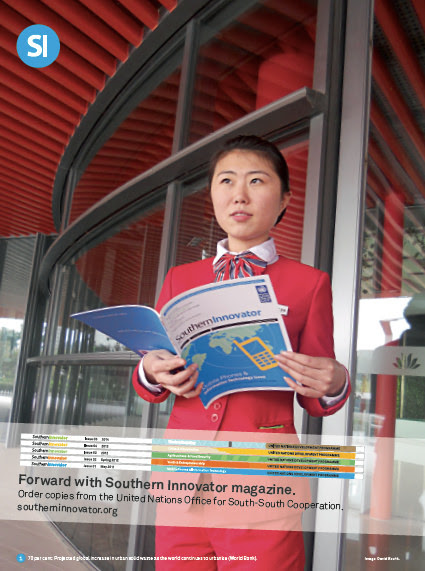
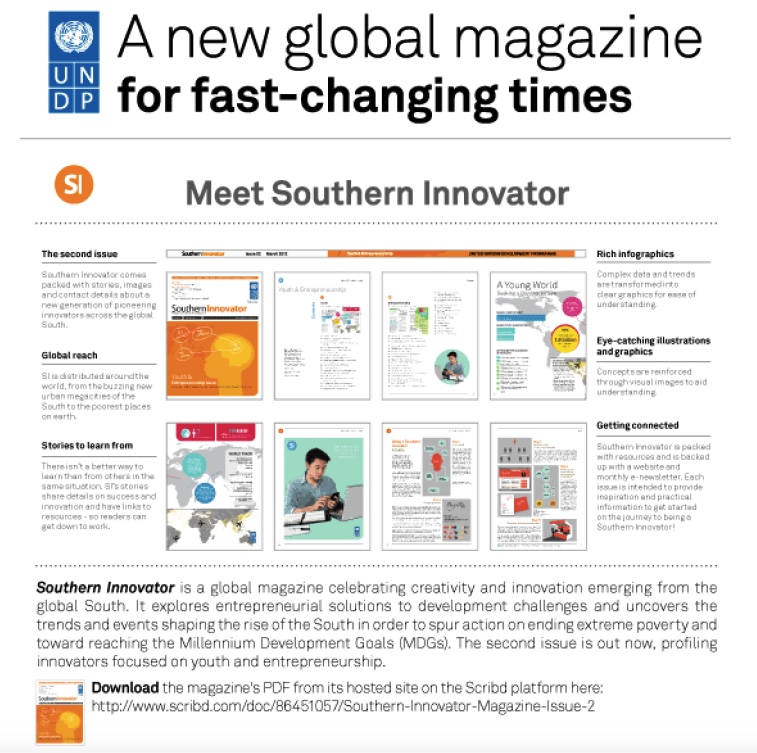
Southern Innovator Magazine | 2010 – 2014 

By David South

“I think you [David South] and the designer [Solveig Rolfsdottir] do great work and I enjoy Southern Innovator very much!” 

Ines Tofalo, Programme Specialist, United Nations Office for South-South Cooperation
Southern Innovator in Tianjin, China.
Issue 5 of Southern Innovator at the Global South-South Development Expo (GSSD Expo) 2014 held in Washington, D.C.
Volunteers in Nairobi, Kenya pose with Southern Innovator Issue 4 at the Global South-South Development Expo (GSSD Expo) in 2013.
Southern Innovator Editor and Writer David South in Australia.
Southern Innovator Graphic Designer and Illustrator Sólveig Rolfsdóttir in Iceland.

Some comments that have come in so far about SI’s first issue:

“What a tremendous magazine your team has produced! It’s a terrific tour de force of what is interesting, cutting edge and relevant in the global mobile/ICT space… Really looking forward to what you produce in issues #2 and #3. This is great, engaging, relevant and topical stuff.”, to “Looks great. Congratulations. It’s Brill’s Content for the 21st century!”

What they are saying about SI on Twitter: From @CapacityPlus Nice job RT @ActevisCGroup: RT @UNDP: Great looking informative @SouthSouth1 mag on South-South Innovation; @UNDP Great looking informative @SouthSouth1 mag on South-South Innovation; @JeannineLemaireGraphically beautiful & informative @UNDP Southern Innovator mag on South-South Innov. 

And on Pinterest:

Peggy Lee • 1 year ago 

“Beautiful, inspiring magazine from UNDP on South-South innovation. Heart is pumping adrenaline and admiration just reading it”

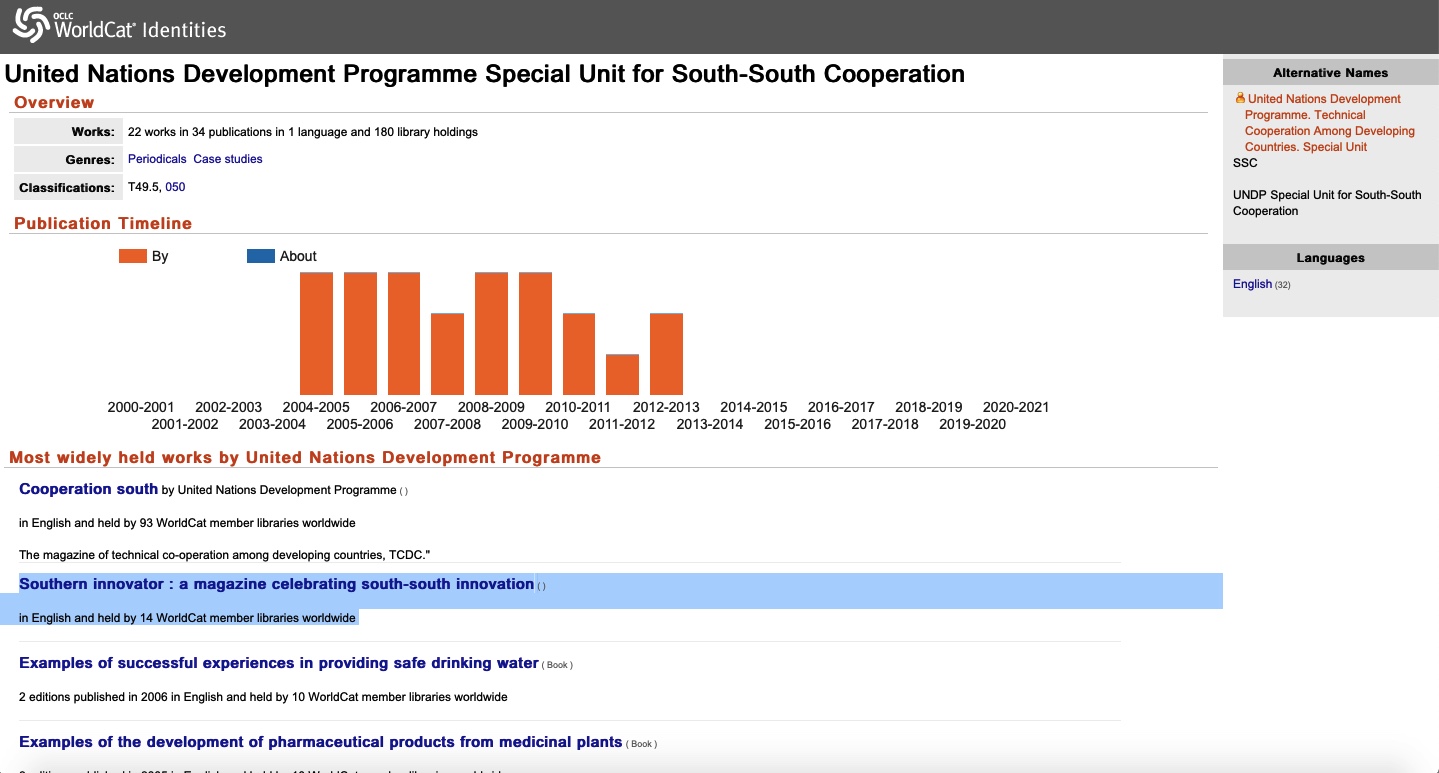
Southern Innovator Magazine can be found in libraries around the world.

Development Challenges, South-South Solutions was launched as an e-newsletter in 2006 by UNDP’s South-South Cooperation Unit (now the United Nations Office for South-South Cooperation) based in New York, USA. It led on profiling the rise of the global South as an economic powerhouse and was one of the first regular publications to champion the global South’s innovators, entrepreneurs, and pioneers. It tracked the key trends that are now so profoundly reshaping how development is seen and done. This includes the rapid take-up of mobile phones and information technology in the global South (as profiled in the first issue of magazine Southern Innovator), the move to becoming a majority urban world, a growing global innovator culture, and the plethora of solutions being developed in the global South to tackle its problems and improve living conditions and boost human development. The success of the e-newsletter led to the launch of the magazine Southern Innovator. 

https://davidsouthconsulting.org/southern-innovator-scale-up-fundraiser/

Creative Commons License

This work is licensed under a
Creative Commons Attribution-Noncommercial-No Derivative Works 3.0 License.

ORCID iD: https://orcid.org/0000-0001-5311-1052.

© David South Consulting 2022

Categories
Archive data Development Challenges, South-South Solutions Newsletters digital ID Southern Innovator magazine

Social Networking Websites: A Way Out of Poverty

By David SouthDevelopment Challenges, South-South Solutions

SOUTH-SOUTH CASE STUDY

Social networking websites also known as, Web 2.0 – the name given to the new wave of internet businesses and websites such as YouTube and MySpace that are transforming the way people interact with the Web – has been dubbed the social web for its power to bring people together. The label has been derided as a marketing gimmick by some, but many argue there are a number of characteristics to Web 2.0 that make it something different and a valuable tool for entrepreneurs seeking ways out of poverty.

The new Web 2.0 applications offer many free software tools stored online, from accounting and business related tools, to new multimedia ways to communicate for free. Unlike Web 1.0 sites, which offered information to passive users, Web 2.0 sites allow interaction and comment. These qualities have meant Web 2.0 can be used to build communities and social and business networks. By being able to store vast quantities of information online, it becomes faster to work and reduces the painful delays brought on by slow connections.

All these new tools are making it easier and easier for entrepreneurs to work from home, in internet centres, or anywhere there is a wireless connection, and is slashing the costs of managing a business. All the applications are online so there is no need to be hidebound by one operating system or hardware capability. The number of internet centres has increased significantly all over Asia and Africa, bringing the power of Web 2.0 to millions more people.

Linking mobile phones and the internet is also remarkable. It is becoming more and more possible in Africa to send messages to weblogs via text messaging, to post photos and videos, or to stay connected with a community, advocacy or business group via messaging to its website.

“Web 2.0 is a pre-occupation of ours that can be beneficial in fighting poverty,” said Tobias Eigan, founder and co-executive director of Kabissa.org, a web portal dedicated to promoting Web 2.0 in Africa. “It is really relevant for Africa. It makes the internet a read and write function, it is more user-friendly – that dynamic is going to make a big difference. It is so much easier to upload content with Web 2.0. It will build the capacity of local institutions and society and that will improve the lives of people – it will be much easier to fight poverty with this connectivity.”

Two other champions of the Web 2.0 way out of poverty are Waleed al-Shobakky, science and technology reporter for alJazeera.net, and Jack Imsdahl, a consultant and technology commentator. While they admit subsistence farmers and the illiterate will not directly benefit, those who are students or are working in proximity to computers will definitely benefit. They point out how rapidly mobile phones have been taken up by the poor and that this is being driven by the new services they offer.

There are still profound obstacles to more rapid take-up, however. Internet connection speeds will have to get better and more will need to be invested in this area. Web 2.0 tools will also need to be adapted to local languages if they hope to get past those who speak major web languages like English.

Entrepreneurs in the global South can now easily sign up to a vast array of e-newsletters that are sent to email accounts and keep on top of trends and innovations in their field. The relative anonymity of these email lists mean subscribers are less likely to be judged on their physical circumstances.

Published: March 2007

Resources

Afriville is a Web 2.0 service and an African Caribbean social network started by two Nigerian web entrepreneurs in their twenties, Folabi Ogunkoya and Lawrence Bassey-Oden.

Afriville is a community website along the lines of the famous MySpace. Users are free to message and post profiles. The difference is that the user is able to choose how closed or open the networks are. The site features a state of the art music management system which allows African and Caribbean artists to get straight in touch with their fans.

“We have created a solid app(lication) with features that will give the big players a run for their money,” said Ogunkoya.

African entrepreneurs have already stepped in with other Web 2.0 offerings. These include: Mooziko.com (an African YouTube), Afribian.com (news sharing), Afriqueka.com (social networking), Yesnomayb (online dating).

Both Yahoo! And Google offer extensive free online tools for entrepreneurs and businesses that integrate seamlessly with their email services.

Kabissa: Space for Change in Africa: An online African web community promoting and supporting the transition to Web 2.0 services in Africa. Offers lots of opportunities to meet people throughout Africa and learn more.

Alexa: Here can be found a detailed break down by country in Africa of web use and site popularity and trends.

Digital Divide Network: A website linking together initiatives and offering opportunities to debate current issues and problems.

Global Voices: An initiative from the Reuters news agency to aggregate the global conversation online from countries outside the US and Western Europe.

Free Web 2.0 tools for entrepreneurs:

Wikis: Here is a detailed article on wikis – collaborative websites that allow authorised users to rapidly and easily change the content of pages – and a detailed list of free or low-cost wiki services.

>> Blogging (an online diary):

Blogger.com – A free, easy-to-use, online service owned by Google.

BlogPlanet.net – Blog from your mobile phone, free.

Blogsome.com – An easy-to-use, free service with good support for photos.

Movable Type – An open-source, free, easy to use, online publishing system popular with bloggers.

WordPress – Another easy, free, and popular online publishing system popular with bloggers.

>> Aggregators (these are programmes that gather links and resources off the web):

AmphetaDesk – One of the first news aggregators to really catch on, it’s still popular.

Bloglines – Allows bloggers and webmasters to search, subscribe to, publish, and share RSS news feeds online.

Del.icio.us – Aggregate content from your favorite Web sites and share them with others.

Feed Demon – The news you want delivered to your desktop.

Technorati – A real-time search engine that keeps track of what is happening in the world of blogs.

Techsoup.org is an excellent resource for all the latest developments in Web 2.0 and how to access free or low-cost resources. Being based in the US, it gets the inside scoop on cutting edge developments in Silicon Valley.

Development Challenges, South-South Solutions was launched as an e-newsletter in 2006 by UNDP’s South-South Cooperation Unit (now the United Nations Office for South-South Cooperation) based in New York, USA. It led on profiling the rise of the global South as an economic powerhouse and was one of the first regular publications to champion the global South’s innovators, entrepreneurs, and pioneers. It tracked the key trends that are now so profoundly reshaping how development is seen and done. This includes the rapid take-up of mobile phones and information technology in the global South (as profiled in the first issue of magazine Southern Innovator), the move to becoming a majority urban world, a growing global innovator culture, and the plethora of solutions being developed in the global South to tackle its problems and improve living conditions and boost human development. The success of the e-newsletter led to the launch of the magazine Southern Innovator. 

Creative Commons License

This work is licensed under a
Creative Commons Attribution-Noncommercial-No Derivative Works 3.0 License.

ORCID iD: https://orcid.org/0000-0001-5311-1052.

© David South Consulting 2023

Categories
Archive Development Challenges, South-South Solutions Newsletters Southern Innovator magazine

Cambodian Bloggers Champion New, Open Ways

By David SouthDevelopment Challenges, South-South Solutions

SOUTH-SOUTH CASE STUDY

The Southeast Asian nation of Cambodia has had a very difficult history over the past few decades. In the 1950s and 1960s, it was seen as a glamorous and vibrant place. Dynamic, ambitious and newly independent from French colonial rule, Cambodia embarked on an extensive programme of building that is now called “New Khmer Architecture.” It is the most visible legacy of this modernizing time.

The book Cultures of Independence: An Introduction to Cambodian Arts and Culture in the 1950s and 1960s says architects of the period showed “a willingness to expand and incorporate new elements, looking both outside and inside the newly independent nation …. Whether consciously or not, most of their work took up questions of how to create forms that would be recognised as both Cambodian and modern.”

But with the war in nearby Vietnam worsening in the 1970s, the destabilising effect of the conflict gave rise to the Khmer Rouge (http://en.wikipedia.org/wiki/Khmer_Rouge), a radical and genocidal movement under the dictator Pol Pot which killed an estimated 2 million Cambodians. It came to an end when newly independent Vietnam invaded the country to overturn the Khmer Rouge regime and end the genocide that had raged between 1975 and 1979.

By the early 1990s, the United Nations was helping Cambodia make the transition to democracy and redevelop its economy after the trauma of the Khmer Rouge years.

Today’s Cambodia is a country with a fast-growing economy – at 5.5 percent in 2010 according to Prime Minister Hun Sen – but still trying to come to grips with the pain and damage of the Khmer Rouge period.

On the internet, pioneering bloggers are trying to bridge the gap between reluctance to speak out about those years and the need for the country to modernize and open up. In the past, keeping quiet in public was the best survival strategy and outspoken voices could end up dead.

The internet is still in its infancy in Cambodia, with only 78,000 users in 2010 (Internet World Stats) – up from 6,000 in 2000, but still tiny in a population of 14,805,358 (World Bank). Cambodia still has high levels of illiteracy of 26 percent (ILO) and poverty, leaving access to the internet and computers a minority pursuit.

The first connections to the internet in Cambodia were set up in 1994 and internet cafes have been flourishing since the mid 2000s.

One role model can be found at the Blue Lady Blog (http://blueladyblog.com/). Its author, Kounila Keo, blogs about her daily frustrations, passions, and life as a young woman who has been working as a newspaper journalist. Her blog tackles anything Cambodian, from education and politics to lifestyle, press freedom, culture and problems facing the country. She is a passionate explainer of Cambodia’s blogging culture.

She started the Blue Lady Blog in 2007 and in a talk at Phnom Penh’s TEDx in February (http://tedxphnompenh.com/) described how she found blogging has transformed her life in three ways:

1) Freedom of speech: She could now fully express herself and venture opinions she could not do even as a journalist.

2) Self-education and self esteem: she has had to learn things on her own and in turn this has boosted her confidence.

3) Knowledge and new perspectives: blogging connects her with people around the world she would not normally have contact with. And blogging is becoming the new voice of a new generation of youth, allowing them to redefine the country’s development challenges in their own terms.

Keo found blogging altered the challenges facing youth, posing the question “What can young Cambodians do for Cambodia?” She believes Cambodian youth should do something rather than wait for opportunities to come to them. Young people have told her her blog has spurred them into action.

“Cloggers” – Cambodian bloggers – are a group of young internet users championing the use of information technologies in everyday life.

In 2007, the first Clogger Summit (http://cloggersummit.wikispaces.com/) brought together bloggers, webmasters, media representatives and NGOs for the first time to exchange ideas and share and debate. Since then, there has been a proliferation of blogs in the Cambodian language.

Developing a vibrant – and open – information technology sector has many advantages. Pioneering work by the United Nations in Mongolia as it made its transition to free markets and democracy led to the country becoming one of world’s freest for internet use.

A vibrant and free information technology sector enables businesses to quickly modernize, connect with customers and markets around the world, spread information and ideas quickly, react to crises and build market efficiencies.

Honduras, Mali, and Mongolia (http://www.yuxiyou.net/open/) were highlighted as being some of the freest places in the world for the internet in a recent report by Reporters Without Borders (http://en.rsf.org/).

Published: March 2011

Resources

1) A presentation about the Cloggers scene and how it works. Website: http://www.slideshare.net/kalyankeo/cloggers-life-an-introduction-to-cambodian-blogophere 

2) Afrinnovator: Is about telling the stories of African start-ups, African innovation, African made technology, African tech entrepreneurship and entrepreneurs. Website: http://afrinnovator.com 

3) Changing Dynamics of Global Computer Software and Services Industry: Implications for Developing Countries: A report from UNCTAD on how computer software can become the most internationally dispersed high-tech industry. Website: http://www.unctad.org/templates/webflyer.asp?docid=1913&intitemid=2529&lang=1 

4) Advice on starting a business and succeeding in tough economic times. Website: http://www.businesslink.gov.uk/bdotg/action/layer?topicId=1073858805

5) Ger Magazine: Mongolia’s first online magazine in the late 1990s contributed to the country’s vibrant web culture. Website: http://en.wikipedia.org/wiki/Ger_magazine 

6) Phnom Penh Post: English-language newspaper. Website: http://www.phnompenhpost.com/

https://davidsouthconsulting.org/2022/11/21/asia/

https://davidsouthconsulting.org/2022/11/17/book-boom-rides-growing-economies-and-cities/

https://davidsouthconsulting.org/2021/09/23/david-south-consulting-books-1997-2014/

https://davidsouthconsulting.org/2021/07/14/freedom-of-expression-introducing-investigative-journalism-to-local-media-in-mongolia-1999-25-january-2016/

https://davidsouthconsulting.org/2021/05/25/ger-mongolias-first-web-magazine-and-a-pioneering-web-project-for-the-united-nations-12-january-2016/

https://davidsouthconsulting.org/2022/06/10/illiterate-get-internet-at-touch-of-a-button/

https://davidsouthconsulting.org/2022/06/10/info-ladies-and-question-boxes-reaching-out-to-the-poor/

https://davidsouthconsulting.org/2023/02/07/mongolian-rock-and-pop-book-mongolia-sings-its-own-song/

https://davidsouthconsulting.org/2022/11/01/new-journal-celebrates-vibrancy-of-modern-africa/

https://davidsouthconsulting.org/2021/03/05/southern-innovator-issue-1/

https://davidsouthconsulting.org/2022/12/01/southern-innovator-magazine-is-printed-and-readied-for-distribution-31-may-2011/

Development Challenges, South-South Solutions was launched as an e-newsletter in 2006 by UNDP’s South-South Cooperation Unit (now the United Nations Office for South-South Cooperation) based in New York, USA. It led on profiling the rise of the global South as an economic powerhouse and was one of the first regular publications to champion the global South’s innovators, entrepreneurs, and pioneers. It tracked the key trends that are now so profoundly reshaping how development is seen and done. This includes the rapid take-up of mobile phones and information technology in the global South (as profiled in the first issue of magazine Southern Innovator), the move to becoming a majority urban world, a growing global innovator culture, and the plethora of solutions being developed in the global South to tackle its problems and improve living conditions and boost human development. The success of the e-newsletter led to the launch of the magazine Southern Innovator.  

Cited here: https://kounila.com/title-cambodian-bloggers-champion-new-open-ways/.
Creative Commons License

This work is licensed under a
Creative Commons Attribution-Noncommercial-No Derivative Works 3.0 License

ORCID iD: https://orcid.org/0000-0001-5311-1052.

© David South Consulting 2023