A pioneering tool for gathering health data now being used in Kenya could herald a revolution in the way diseases are tracked and defeated around the world. It uses mobile phones to better connect patients with medical and health personnel, and allows data to be gathered in real-time and used to track health and improve the delivery of services, especially to remote and under-serviced areas.
In the past couple of years, Kenya has become a hotbed of mobile phone and information technology innovation. The now-famous Ushahidi crisis-mapping platform (www.ushahidi.com) is just one example. Social enterprise Data Dyne (www.datadyne.org) – with offices in Washington DC and Nairobi, Kenya – is offering its EpiSurveyor application (www.episurveyor.org) free to all to aid health data collection. It bills itself as “the first cloud-computing application for international development and global health … Think of it as like Gmail, but for data collection!”
EpiSurveyor claims to have more than 2,600 users around the world and is currently being upgraded to a second version.
“With the touch of a button I can see what’s going on across the country in real time,” Kenyan civil servant Yusuf Ibrahim told Britain’s Daily Telegraph newspaper. “It is amazing.”
Ibrahim works in Nairobi as the Kenyan Ministry of Health liaison to Data Dyne.
He uses maps and charts on mobile phones to track deadly disease outbreaks and vulnerable pregnancies.
The EpiSurveyor application works simply: A user logs into the website and builds and creates the sort of form they want. They then download it to a phone and start collecting data straight away.
Ibrahim gathers this data from mobile phones used by health care workers across the country.
“It used to take days, weeks or even a couple of months to find out about an outbreak of polio on the other side of the country,” he said. “Now we know almost instantly. The speed with which we can now collect information has catapulted healthcare and prevention to another level. It has completely changed healthcare and saved countless lives.”
He proudly points out Kenya’s mobile phone data collection system is “probably better than what they’ve got in the West.”
“Although we are a third world country, I’m pretty sure we’ve done this before
Western countries. While they are still collecting information in hard copy on clipboards, we are getting it instantly.”
Packed with data processing power, mobile phones are capable of an immense range of tasks and applications. Some see phones as key to a revolution in how healthcare is provided: the mobile phone becomes one-part clinic, another part mobile hospital dispensing advice and transmitting vital information back to healthcare professionals and scientists in hospitals and labs.
Despite dramatic improvements to the quality of hospitals in Africa and the number of qualified doctors, the continent’s healthcare services are still a patchwork, with rural and slum dwellers poorly served and the stresses of treating patients with contagious diseases like HIV/AIDS and malaria pushing resources to the limit.
The United Nations has a number of initiatives partnering with mobile phone manufacturers, networks and software developers as part of a global campaign to reduce HIV/AIDS, malaria and deaths in childbirth.
EpiSurveyor is being used by more than 15 countries’ ministries of health and is the adopted standard for the World Health Organization (www.who.int) (WHO) for electronic health data collection.
It began as a partnership with the United Nations Foundation, The Vodafone Group Foundation, WHO and the ministries of health of Kenya and Zambia in 2006 to pilot test the software for EpiSurveyor.
At the United Nations Foundation (www.unfoundation.org), chief executive Kathy Calvin equates the impact of mobile phones on global healthcare to the discovery of the antibiotic penicillin.
“Instead of building clinics and roads to remote towns and villages so that people can access healthcare, we are bringing healthcare directly to the people via mobile phones. You get a lot more healthcare for your money,” Calvin told the Telegraph.
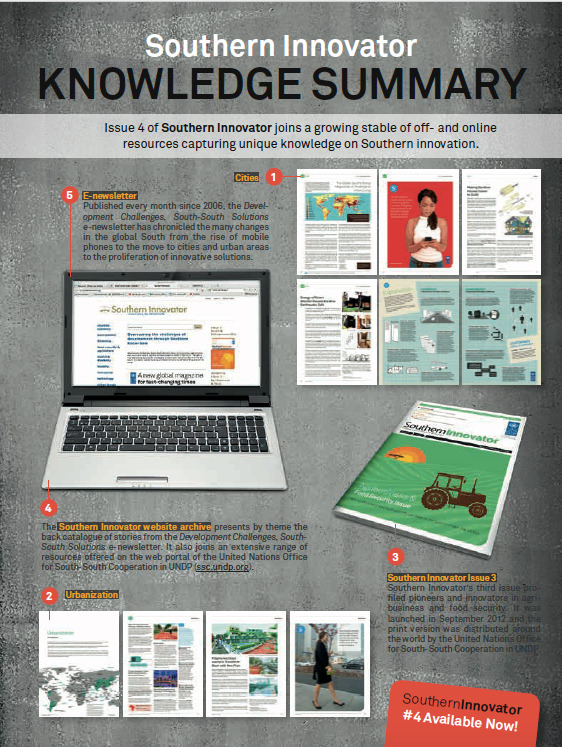
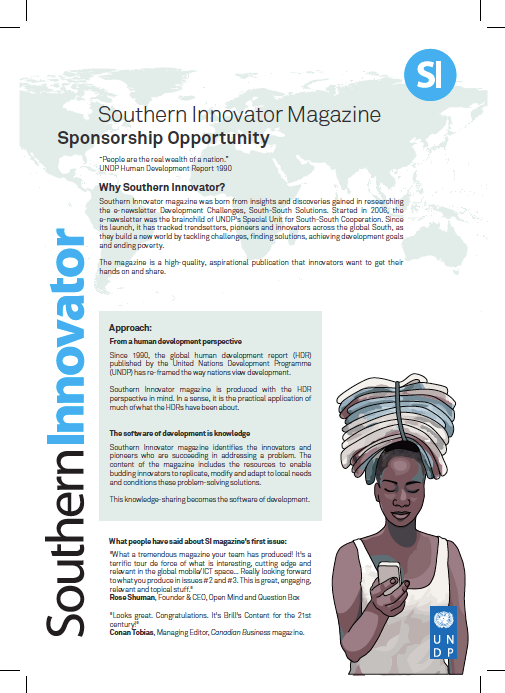
Development Challenges, South-South Solutions was launched as an e-newsletter in 2006 by UNDP’s South-South Cooperation Unit (now the United Nations Office for South-South Cooperation) based in New York, USA. It led on profiling the rise of the global South as an economic powerhouse and was one of the first regular publications to champion the global South’s innovators, entrepreneurs, and pioneers. It tracked the key trends that are now so profoundly reshaping how development is seen and done. This includes the rapid take-up of mobile phones and information technology in the global South (as profiled in the first issue of magazine Southern Innovator), the move to becoming a majority urban world, a growing global innovator culture, and the plethora of solutions being developed in the global South to tackle its problems and improve living conditions and boost human development. The success of the e-newsletter led to the launch of the magazine Southern Innovator.
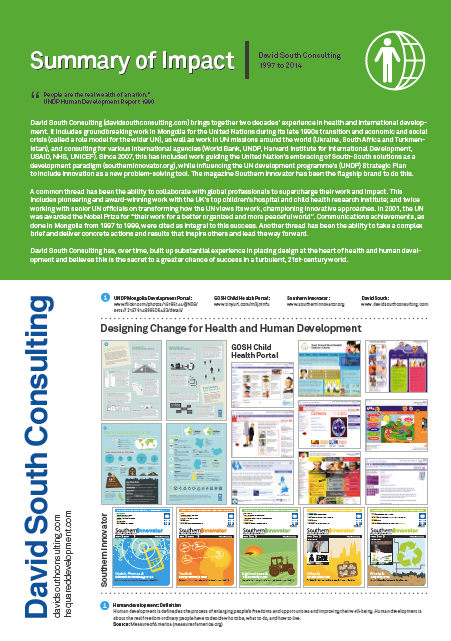
Background: This is the original text from the brochure UNDP in Mongolia: The Guide first published in 1997. It, for the first time, provided a rolling update on what the United Nations was doing in Mongolia, offering key contacts and data to help advance human development in the country. It introduced transparency to the UN’s work in the country and made it easier to hold programme and project staff to account.
Mongolia – Population
With an area of more than 1.5 million square kilometres and a population of 2.38 million as of October 1997, Mongolia has a population density of only 1.5 people per square kilometre, one of the lowest in the world. The country has a relatively low growth rate of 1.6 per cent (1995), down from 2.5 per cent in 1989. At this rate, Mongolia’s population will reach 2.5 million by the year 2000.
Despite the popular image of Mongolians as nomadic herders, it is an increasingly urbanized country – 51.9 per cent of the population is urban, 48.1 per cent rural. More than one quarter of Mongolians live in the capital city, Ulaanbaatar. The other major urban centres are Darhan (pop. 90,000) and Erdenet (pop. 65,000 ).
The country is divided into 21 aimags (provinces), plus the autonomous capital region. The aimags are:
In the centre: Tuv, Uvurhangai, Arhangai
In the north: Bulgan, Selenge, Hovsgul, Zavhan, Darhan-Uul, Orhon
In the east: Hentii, Dornod, Suhbaatar
In the west: Hovd, Uvs, Bayan-Olgii, Gov-Altai
In the south: Dundgov, Dornogov, Omnogov, Bayanhongor, Gobisumber
The People:
About 86 per cent of the country’s population are Kalkh Mongols. Another 7 per cent are Turkic in origin, mostly Kazakhs living in the western aimags of Bayan-Olgii and Hovd. The rest belong to a wide variety of ethnic groups, including the Buryat, Dariganga, Bayad, Zakchin and Uriankhai. Mongolia’s smallest ethnic group is the Tsaatan, about 200 of whom live as reindeer herders in the far north of the country.
During the communist period, Mongolia was home to tens of thousands of Russians. Few remain.
More than 4 million Mongols live outside Mongolia, in Russia and the Chinese province of Inner Mongolia.
Human Development:
– Mongolia’s per capita GDP is U.S. $359 (1995). But this fails to take into account the cashless subsistence and barter economy widespread in rural areas.
– Poverty, though widespread, is difficult to tabulate. 1996 government figures put the poverty rate at 19.2 per cent – 19.8 per cent for rural areas, 18.7 for urban areas. But State Statistical Office figures for October 1997 indicate 36.8 per cent of urban residents and 27.5 per cent of rural Mongolians live below the poverty line.
– Omnogov, Gobisumber, Hovsgol, Ovorhangai and Bayanhongor are the aimags with the highest poverty rates.
– The average monthly household income in September 1997 was 58,516.7 tugrugs (U.S. $73). Average expenditure was 58,124.8 tugrugs. In 1995, 48 per cent of household expenditure went on food. In poor households, the figure was 64 per cent.
Social Data:
Life expectancy: 63.8 years (1995)
Infant mortality rate: 40 per 1000
Under five mortality rate: 56.4 per 1000
Maternal mortality rate: 185.2 per 100,000 (1995)
One-year-old immunization rate: tuberculosis 94.4 per cent, measles 85.2 per cent (1995)
Access to safe drinking water: rural 89.9 per cent, urban 46.1 per cent (1995)
Access to sanitation: 74 per cent (1995)
Adult literacy rate:
men 97.5 per cent,
women 96.3 per cent
Primary school net enrollment: 93.4 per cent
Secondary school net enrollment: 56.9 per cent
Physicians: 26 per 10,000
Hospital beds: 9.9 per 1000
Daily calorie intake: 2278.2
Data 1996 unless otherwise indicated. Sources: State Statistical Office, Human Development Report Mongolia 1997
Mongolia – Economy
An Economy in Transition:
After 70 years of centrally planned economy, Mongolia is embracing free-market principles with a vengeance. Economic liberalization began under the Mongolian People’s Revolutionary Party government in the early 1990s. The Democratic Coalition government, elected in June 1996, has vowed sweeping economic changes, including privatization of state assets, liberalization of trade and promotion of foreign investment.
The foreign investment law now encourages foreign investment in the form of share purchases, joint ventures and wholly foreign-owned concerns. Mining companies are given significant tax holidays. In May, 1997 parliament abolished customs duties expect on alcohol, tobacco and oil products.
All of this has been a shock to Mongolia and Mongolians. The country’s GDP shrank by a third in the early 1990s, though it has slowly recovered since. Inflation topped 300 per cent in 1993, but was brought down to below 50 per cent by 1997. The tugrug fell from 40 to U.S. $1 in 1991 to 800 to the dollar in 1997. Unemployment officially stands at 6.5 per cent – unofficial estimates are much higher.
The government’s ambitious privatization scheme has stalled; manufacturing and exports are down; imports are up. Adding to the problems is the fact that world prices for Mongolia’s major export items – copper and cashmere – have fallen.
The state retains at least 50 per cent ownership of the nation’s flagship enterprises, including the national airline, MIAT, the Gobi cashmere company and the power stations.
Mongolia has a resource-based economy, exporting mostly raw materials and importing mostly processed goods. The top exports are mineral products, textiles, base minerals, hides, skins and furs and animals and animal products. The major imports include petroleum products, industrial equipment and consumer goods.
Mongolia’s major trading partners are its two neighbours, China and Russia, though Korea and Japan are becoming more important – and the number-one export destination is Switzerland.
Sidebar: The rural economy
Half of Mongolia’s population is rural, and herding remains the backbone of the Mongolian economy. Agriculture accounts for 30 per cent of the nation’s GDP. The number of herding households grew during the economic turmoil of the early 1990s, and now stands at more than 170,000; there are 30 million head of livestock in Mongolia. Herders produce meat, skins and furs; more and more herders are investing in cashmere goats, a substantial money-earner.
Cultivation of crops, on the other hand, is limited. Before 1990, Mongolia was self-sufficient in cereals and even exported to the Soviet Union. But the sector suffered badly in the early 1990s. The 1997 harvest was 239,000 tonnes, 56 per cent of 1991-95 levels and only 40 per cent of pre-1990 harvests. Mongolia must now import 40 per cent of its cereal needs, a factor that contributes to a vulnerable food-security situation. Cultivation of vegetables is up, but remains minor – only 31,000 tonnes in 1997.
Sidebar: Rich in resources
Mongolia is resource-rich. This vast territory contains 15 per cent of the world’s supply of fluorspar and significant deposits of copper, molybdenum, iron, phosphates, tin, nickel, zinc, tungsten and gold, as well as at least 100 billion tonnes of coal.
Copper is the nation’s number one export.
Minerals account for more than a third of Mongolia’s GDP and earn half of its hard currency. Gold production is increasing.
Mongolia also contains significant reserves of oil, which could transform the economy. But infrastructure and transportation limitations mean that commercial extraction is limited. The completion of a pipeline to China could change all this.
Economic Data:
Exchange rate: $1 = Tg 808 (Nov 1997)
GDP: Tg 185.5 billion (1996)
GDP per capita: Tg 228,605 (1996)
Inflation: 325 per cent (1992), 53 per cent (1996)
State budget expenditure: Tg 203.6 billion (Jan-Oct 1997)
State budget revenue: Tg 176 billion (Jan-Oct 1997)
Seven decades of communist rule in Mongolia began to crumble in 1990, when the collapse of the old Eastern Bloc brought the first pro-democracy demonstrations. The ruling Mongolian People’s Revolutionary Party, which had already initiated a Mongolian version of glasnost, permitted the nation’s first multiparty elections in July, 1990.
Superior organization helped the MPRP win both the 1990 and 1992 elections (taking 71 of 76 parliamentary seats in the latter), but reform picked up speed. In 1992, the country adopted a new Constitution that enshrined human rights, private ownership and a state structure based on separation of power between legislative and judicial branches.
In the June 1996 election, major opposition groups united to form the Democratic Coalition, made up of the National Democratic Party, the Social Democratic Party, the Believers’ Party and the Green Party. Somewhat to its own surprise, the Coalition won a healthy 50 of 76 seats in the State Ikh Hural, or parliament. The composition of the Hural is now: National Democrats 35, Social Democrats 15, MPRP 25, Mongolian Traditional United Party 1.
In addition to their economic reforms, the Democrats have carried out radical restructuring of government, slashing the number of Ministries from 14 to 9.
The government has a healthy majority, but tensions sometimes emerge between the coalition partners. Mongolia’s transition to democracy has been remarkably peaceful, and the young democracy is robust – there are now more than 20 political parties in the country.
But economic hardship has caused resentments. In the 1997 Presidential election, voters elected N. Bagabandi, the candidate of the MPRP. In the fall of 1997, the government had to face demonstrations from students and pensioners and an opposition campaign that led to a confidence vote in parliament — a vote the government easily survived.
Political structure:
Mongolia has a parliamentary system of government, with a 76-seat legislature called the State Ikh Hural. The President, directly elected for a four-year term, is second in authority to the legislature, but he appoints judges and has the power of veto (which can be overturned by a 2/3 vote in parliament).
Chronology:
1911 collapse of Manchu Qing Dynasty; Mongolia declares its independence
1919 China invades Mongolia
1921 with Soviet help, Mongolia gains final independence from China
1924 Mongolian People’s Republic declared
1990 pro-democracy protests; Constitution amended; first multiparty elections
1992 second multiparty elections; new Constitution adopted
1996 Democratic Coalition elected as Mongolia’s first non-communist government, headed by Prime Minister Enkhsaikhan
1997 N. Bagabandi from the MPRP elected President
Voter turnout:
1996 elections: 92.2 per cent
1996 local Hural: 64.0 per cent
1997 presidential: 85.1 per cent
Mongolia – Society and Culture
Mongolia has a unique and durable traditional culture, centred around the herding lifestyle. Herders remain semi-nomadic, moving their animals with the seasons as they have for centuries
Many urban Mongolians retain strong links to the land, both literal and sentimental, and the country’s performing and visual arts often celebrate the landscape and the animals — especially horses — that are central to Mongolian life. Mongolia has several distinctive musical instruments and styles, including the morin khuur (horsehead fiddle), the long song (urtyn duu) and the throat-singing style known as khoomi.
After seven decades of communism, Mongolians are once again celebrating their traditional culture, and embracing the image and legacy of the most famous Mongolian of all time – Chinggis Khan, who in the 13th century initiated the Mongol Empire, the greatest land empire the world has ever known. He gives his name to everything from a brand of vodka to a luxury hotel, and centres for academic Chinggis research have been set up.
In sports, Mongolians favour the “three manly sports” — wrestling, archery and horse racing — that form the core of the annual festival known as Naadam. Mongolian wrestlers have won a number of medals at international competitions and are even entering the field of Japanese Sumo.
The 1990s have seen a flowering of freedom of expression. Mongolia has an extraordinary 525 newspapers and a wide range of magazines, while the first private radio and television stations have been established.
Religion:
Mongolians have been Buddhists since the 16th century, when the Mongolian king, Altan Khan, was converted by Tibetan lamas. In the pre-revolutionary period, Mongolia was ruled by a series of Living Buddhas, or Jebtzun Damba. The eighth, and last, Jebtzun Damba was removed after the communist takeover.
Traditionally, monasteries were centres both of learning and of power. It’s estimated Mongolia had 100,000 monks, or lamas, in 1921 — one third of the male population. In the 1930s, this power became the focus of a ruthless series of purges that reached a climax in 1937. Most of the country’s monasteries were destroyed, and as many as 17,000 monks were killed.
Today, Mongolia is once again embracing its Buddhist heritage. Monasteries are being restored, and are once again crowded with worshippers. The Dalai Lama is an enormously popular figure and has visited the country several times.
For many Mongolians, Buddhism is flavoured with traces of Shamanism, an even more ancient spirituality.
Mongolia also has a significant Muslim community — about 6 per cent of the population. These are mostly ethnic Kazakhs living in the far west of the country. The opening-up of the country has led to an influx of Christian missionaries, and this remains a source of some tension and debate.
A Young Country:
Mongolia is a remarkably young country — more than 60 per cent of the population is below the age of 30, and 40 per cent of Mongolians are younger than 16. This young generation, with its embrace of Western styles and ideas, is changing the complexion of the country. Western pop music and North American sports like basketball have a huge following among Mongolia’s youth. So, too, do homegrown artists like the pop groups Nikiton and Spike and the singer Saraa.
Social Data:
Television sets: 6.2 per 100 (1995)
Newspapers: 2 per 100 (1995)
Number of telephones: 82,800
Marriage: 10.9 per 1000 over 18
Divorce: 0.7 per 1000 over 18
Number of pensioners: 287,200
Crimes reported: 20,454 (Jan-Oct 97)
As percentage of same period in 1996: 114.4 per cent
Data 1996 unless indicated. Sources: State Statistical Office, Human Development Report Mongolia 1997
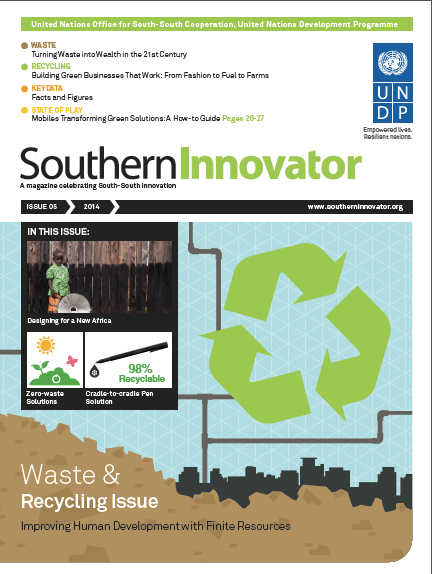
The fifth issue of Southern Innovator has launched online and in print. Order copies now for distribution. Email: southerninnovator@yahoo.co.uk.
Issue six will be on science, technology and innovation. This issue will be different from previous issues and will be including supplements and inserts to boost the impact of the magazine. Southern Innovator is seeking sponsors to fund this and also to help us expand the print run (currently 5,000 copies for global distribution).
July
3D Home Printing Landmark: 10 Houses in a Day Development Challenges: The global South is experiencing urban growth on a scale unprecedented in human history, far outstripping the great urbanization wave that swept across Europe and North America during the 19th and 20th centuries.
Old Boats Become New Furniture in SenegalDevelopment Challenges: Every country has its fair share of waste and the remnants of past economic activity. Old cars nobody wants, discarded tins of food, old plastic bags, spare copper wire, cast-off clothing – all can have a new life in the right hands.
Innovative Solutions Celebrated in Ashden Awards Development Challenges: The world’s population is heading towards 9.6 billion by 2050 (UN). Combined with a growing middle class and rising living standards across the global South, that means ever-greater demand on the world’s finite resources. This raises a crucial question: Where will the energy to power rising living standards come from, and how much damage will be done to the planet’s environment by pollution created generating it (https://www.un.org/en/development/desa/news/population/un-report-world-population-projected-to-reach-9-6-billion-by-2050.html)?
Innovative Ways to Collect Water from AirDevelopment Challenges: World water resources are being depleted quickly as populations grow, urbanize and demand better living standards. Many scientists believe we are reaching peak water – the point at which fresh water is consumed faster than it is replenished.
June
Caribbean Island St. Kitts Goes Green for Tourism Development Challenges: Going green may sound like the right thing to do but it can also be associated with being a costly burden and boring. But, as one island nation is proving, being green is a great selling point for attracting tourists and investors – especially in a world where many places are grappling with pollution and resource depletion.
Big Data Can Transform the Global South’s Growing Cities Development Challenges: The coming years will see a major new force dominating development: Big Data. The term refers to the vast quantities of digital data being generated as a result of the proliferation of mobile phones, the Internet and social media across the global South – a so-called ‘data deluge’ (UN Global Pulse). It is an historically unprecedented surge in data, much of it coming from some of the poorest places on the planet and being gathered in real time.
Indian Business Model Makes Green Energy Affordable Development Challenges: The technology already exists to provide renewable energy and electricity to all the world’s poor. The trick is finding a way to pay for it and to make it sustainable. Many innovators are experimenting with business models to reach the so-called Bottom of the Pyramid (BOP) cohort, and the 1.2 billion poorest people in the world who do not have access to electricity (World Bank) (http://tinyurl.com/n9p3f5x). A further 2.8 billion have to rely on wood or other biomass materials to cook and heat their homes.
South-South Trade Helping Countries During Economic CrisisDevelopment Challenges: Weathering the global economic crisis is testing the stability of countries across the global South. But many countries are finding South-South trade and catering to their domestic middle classes can lift incomes and maintain growth rates despite the global turmoil.
May
3D Printing Gives Boy a New Arm in SudanDevelopment Challenges: 3D printing is rapidly going mainstream and is now starting to make a big impact in health care. One innovative solution is using the technology to manufacture artificial arms for amputees harmed by war in Africa.
African Hotel Boom Bringing in New Investment and Creating JobsDevelopment Challenges: Africa is experiencing a boom not seen for decades. The IMF forecasts economic growth in sub-Saharan Africa of 6 per cent in 2014, compared to global growth of 3.6 per cent.
China’s Outsourced Airliner Development Model Development Challenges: Many emerging-market countries in the global South have built up substantial foreign currency reserves. Much of this has been a response to past foreign currency crises, particularly the Asian Crisis in the late 1990s (http://en.wikipedia.org/wiki/1997_Asian_financial_crisis).
Brazilian Design for New Urban, Middle-Class World Development Challenges: Countries across the global South are experiencing rapid urbanization as people move to cities for better economic opportunities — and this massive social change is creating new business opportunities. Those who recognize how fundamentally people’s lifestyles are changing will be those who will benefit from this big shift in populations.
April
Cheap Paper Microscope to Boost Fight Against Diseases Development Challenges: To tackle diseases in the developing world, the most important first step is diagnosis. Without effective diagnosis, it is difficult to go to the next steps of either treatment or cure. While much attention is given to the high costs involved in treating and curing ailments, screening for diagnosis is also expensive, especially if it involves lots of people. Anything that can reduce the cost of diagnosis will free up resources to expand the number of people who can be checked, and help eradicate contagious diseases.
Asian Factories Starting to go GreenDevelopment Challenges: Media headlines have recently highlighted the growing air pollution crisis in Asia’s expanding cities. This is caused by a mix of factors – the growing number of vehicles, coal-powered factories, people burning dirty fuels to heat their homes, and poor enforcement of standards – and has severe consequences for human health. If it’s not tackled, more and more countries will see large rises in respiratory problems, cancers and early deaths from pollution-caused illnesses (http://www.nrdc.org/air/).
Reality Television Teaches Business Skills in Sudan Development Challenges: Learning how to thrive in a market economy does not necessarily come naturally. But for young people who have grown up under a different economic system or known nothing but economic chaos, learning business skills can give them the tools to get on in life.
Popular Chinese Social Media Chase New Markets Development Challenges: China has a vast and growing market for the Internet and mobile devices. Over the past decade that market has been largely confined to China – most businesses have had enough domestic demand and opportunities inside the country to keep them busy.
The BRCK: Kenyan-Developed Solution to Boost Internet AccessDevelopment Challenges: Using the Internet in Africa has its challenges, as anyone who has worked there knows. Issues can include weak Wi-Fi signals, slow Internet service providers, electricity outages and power surges that can damage or destroy sensitive electronic devices.
March
Women Empowered by Fair Trade Manufacturer Development Challenges: There is sometimes a great deal of negativity surrounding the issue of manufacturing in Africa. Some claim the risks of doing business are too high or that the workers are not motivated enough. But one garment manufacturer is out to prove the skeptics wrong. It pays decent wages and gives its mostly female workforce a stake in the business in a bid to drive motivation and make it worthwhile to work hard.
Global South Trade Boosted with Increasing China-Africa Trade in 2013Development Challenges: It was announced in January 2014 that China has surpassed the United States to become the world’s number one trading nation, as measured by the total value of exports and imports. This new economic behemoth also continued to grow its trade relationships with Africa.
India 2.0: Can the Country Make the Move to the Next Level?Development Challenges: With the global economic crisis threatening to cause turmoil in the emerging markets of the global South, it is becoming clear that what worked for the past two decades may not work for the next two.
“Pocket-Friendly” Solution to Help Farmers Go Organic Development Challenges: Interest in organic food and farming is high, and organics have become a growing global industry. The worldwide market for organic food grew by more than 25 per cent between 2008 and 2011, to US $63 billion, according to pro-organic group the Soil Association. That is an impressive accomplishment given the backdrop of the global economic crisis, and evidence that people value quality food, even in tough times.
Cheap Farming Kit Hopes to Help More Become Farmers Development Challenges: Food security is key to economic growth and human development. A secure and affordable food supply means people can meet their nutrition needs and direct their resources to improving other aspects of their lives, such as housing, clothing, health services or education.
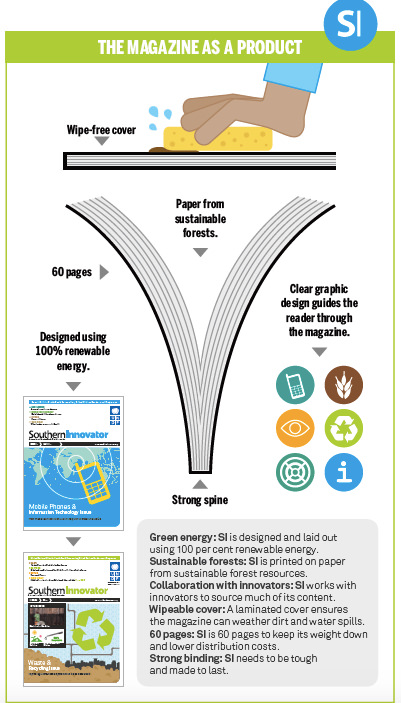
While Southern Innovator’s digital presence has been key to its success and global reach, the hard copy of the magazine was designed with special features. The magazine needed to be robust and able to stand a fair bit of abuse and hard wear. It needed to be easy to read in low light conditions. And it needed to look sharp and eye-catching to reach as wide an audience as possible.
South-South cooperation for development, SSC/17/3, High-level Committee on South-South Cooperation, 12 April 2012.
Development Challenges, South-South Solutions was launched as an e-newsletter in 2006 by UNDP’s South-South Cooperation Unit (now the United Nations Office for South-South Cooperation) based in New York, USA. It led on profiling the rise of the global South as an economic powerhouse and was one of the first regular publications to champion the global South’s innovators, entrepreneurs, and pioneers. It tracked the key trends that are now so profoundly reshaping how development is seen and done. This includes the rapid take-up of mobile phones and information technology in the global South (as profiled in the first issue of magazine Southern Innovator), the move to becoming a majority urban world, a growing global innovator culture, and the plethora of solutions being developed in the global South to tackle its problems and improve living conditions and boost human development. The success of the e-newsletter led to the launch of the magazine Southern Innovator.
A pioneering technology social enterprise has found a way to connect people around the world to the new digital economy, transforming their lives and providing long-term employment opportunities. It is closing the digital divide in a very practical way, teaching new skills and, most importantly, providing income to the poor and vulnerable.
The San Francisco, USA-based non-profit social enterprise Samasource (samasource.org) uses what it calls microwork – a virtual assembly line of small tasks broken down from a larger project so they can be completed over the Internet – to outsource work to its network of workers around the world.
The tasks in this virtual piecework range from writing to transcribing to organizing online content.
The company organizes the projects using its own online work distribution system connecting workers around the world to the SamaHub in San Francisco. Most of the workers are women, youth and refugees. When they complete their task, it is sent back to the SamaHub in San Francisco where the staff check it and assure its quality. Once approved and completed, the project is returned to the client.
The company was founded in 2008 and draws on experts in “distributed work, economic development, and outsourcing.”
The microwork is divided into three areas: content services, data enrichment and transcription.
Content services can include writing descriptions for online business listings, organizing large databases on information or creating brief descriptions of existing content to make it easier for search engines to find it. “Data enrichment” tackles the vast quantity of information on the Internet that needs to be kept up to date and reliable. It also includes ‘tagging’, where text or images on the Internet need to have appropriate ‘tags’ or labels. And finally, transcription services include digitizing paper documents like receipts or books or transcribing audio and video files for the web.
All these tasks are labour intensive and require high attention to detail. And they are critical to any online business’s success if it wants a reputation for accuracy and consistency.
Samasource is optimistic about its future potential because of the sheer size of the market for business process outsourcing: estimated to be worth over US $100 billion. What Samasource does, called ‘impact sourcing’ – outsourcing to people in the developing world living in poor or remote communities – is a market worth US $5 billion, according to Samasource’s website.
It differs from conventional business process outsourcing in a number of respects, including the educational background of the workers. Most conventional outsourcing goes to college graduates in cities in India, China and the Philippines. Impact outsourcing is done by people with at most a high school education.
The digital economy needs these workers to handle the many millions of detailed tasks required to link together information. It is easy to take this for granted because it is hidden from view, but it is what enables the Internet to function and businesses to thrive. Samasource provides outsourcing services including content moderation and data entry to clients like LinkedIn, Intuit and the US State Department.
“We bring dignified, computer-based work to women, youth, and refugees living in poverty,” said Samasource’s founder and chief executive officer, Leila Janah.
Janah has a background in development studies and formerly worked for the World Bank. This experience convinced her that much foreign aid was failing to target what poor people are really looking for: a job that pays well.
Samasource sees what it does as work, and not handouts.
It also believes it is changing perspectives, proving people from the poorest places on earth can become trustworthy, hard-working knowledge workers.
The Internet is a unique medium because it transcends borders and smooths contact between people with varying linguistic, cultural and educational capabilities.
“The Internet reduces the friction of collaboration across all of these centres and time zones, and with a highly distributed workforce,” said Janah.
Samasource claims to have paid out US $1 million in wages to more than 1,500 workers around the world. Ambitiously, it wants to expand this to reach some of the 144 million youth between 16 and 24 living on less than US $2 a day.
Youth are a particular focus for Samasource. Samasource targets young people who are literate and have received an education but still can’t get a job.
As for the many women employed by Samasource, they were either unemployed or earning poverty-level wages doing precarious work in low-level manufacturing and not building their skills.
Samasource currently has 16 partnerships in Haiti, India, Pakistan, Kenya, Uganda and South Africa. Criteria to work with Samasource includes being in a high-poverty region. Another criteria is for most of the money earned to stay within the region where the work is done and adhere to the standards laid down by Samasource.
Samasource’s success means it has attracted further funding. In December 2011, it was given a US $1.5 million grant from Google.org – the Google.com search engine’s charity. It has also raised US $5 million from non-profit investors, including the Ford Foundation, the Rockefeller Foundation and the eBay Foundation. The challenge for the Samasource model will be to prove, with this new funding, that it can scale its operations to pay out more to its workers than it is taking in to meet its operating costs.
Microwork is turning out to be big work indeed!
Published: January 2012
Development Challenges, South-South Solutions was launched as an e-newsletter in 2006 by UNDP’s South-South Cooperation Unit (now the United Nations Office for South-South Cooperation) based in New York, USA. It led on profiling the rise of the global South as an economic powerhouse and was one of the first regular publications to champion the global South’s innovators, entrepreneurs, and pioneers. It tracked the key trends that are now so profoundly reshaping how development is seen and done. This includes the rapid take-up of mobile phones and information technology in the global South (as profiled in the first issue of magazine Southern Innovator), the move to becoming a majority urban world, a growing global innovator culture, and the plethora of solutions being developed in the global South to tackle its problems and improve living conditions and boost human development. The success of the e-newsletter led to the launch of the magazine Southern Innovator.
Like this story? Here is a dirty secret: this website is packed with stories about global South innovators. We spent 7 years researching and documenting these stories around the world. We interviewed the innovators to learn from them and we visited them to see how they did it. Why not use the Search bar at the top and tap in a topic and see what stories come up? As for my work, I have been involved with start-ups and media ventures since the early 1990s. In the years since I have learned a great deal about innovation and digital and have shared these insights in the stories on this website as well as in the 5 issues of Southern Innovator magazine. So, stick around and read some more!
While Southern Innovator’s digital presence has been key to its success and global reach, the hard copy of the magazine was designed with special features. The magazine neded to be robust and able to stand a fair bit of abuse and hard wear. It needed to be easy to read in low light conditions. And it needed to look sharp and eye-catching to reach as wide an audience as possible.






 David South Consulting
You must be logged in to post a comment.