Categories
Archive Development Challenges, South-South Solutions Newsletters Southern Innovator magazine

Making Bamboo Houses Easier to Build

By David SouthDevelopment Challenges, South-South Solutions

SOUTH-SOUTH CASE STUDY

More than 1 billion people around the world lack decent shelter. Of these, the majority live in urban areas, usually in slums and informal settlements (UN-HABITAT). Latin America has a serious shortage of adequate housing: in Colombia, 43 percent of the population needs decent housing; in Brazil, 45 percent; Peru, 53 percent.

The challenge is to provide good quality homes without significantly harming the environment – and with constrained budgets. Bamboo – cheap, strong, quickly renewable and beautiful to look at (http://en.wikipedia.org/wiki/Bamboo) – is an ideal solution to replace traditional wood lumber. In Bolivia, pioneering work is underway to improve the quality of homes and buildings made with bamboo.

Bamboo is the fastest growing woody plant in the world, sometimes growing over 1 metre a day. Bolivia (http://en.wikipedia.org/wiki/Bolivia) has about 17 identified bamboo species, of which five have a significant economic value. Around the world, there are 1,000 species of bamboo. They grow in a wide variety of climates, from cold mountains to hot tropical regions.

Once called the “poor man’s timber” – a temporary building material to replace once there is more money – bamboo is now getting the respect it deserves. Bamboo for housing has a long history in Latin America, stretching back 4,500 years to ancient civilizations. In Asia, it has long been a traditional construction material. But most of the existing bamboo dwellings in Latin America are 50 to 100 years old.

The most popular species of bamboo used in South America is Guadua, which is known for being large, straight and attractive.

“In Bolivia, there is no other building material more competitive in costs,” said Jose Luis Reque Campero, coordinator of the Bolbambu Programme of the Architectural Research Institute, Universidad Mayor de San Simon, Bolivia (http://www.umss.edu.bo/).

“Bamboo is the material that requires less energy, followed by wood and concrete, with steel in last place, needing energy necessary for its production 50 times greater than that required by bamboo.”

Campero also says bamboo is much less expensive than traditional building materials.

“But the biggest advantage is certainly the possibility of planting bamboo, and then reaping houses,” he said.

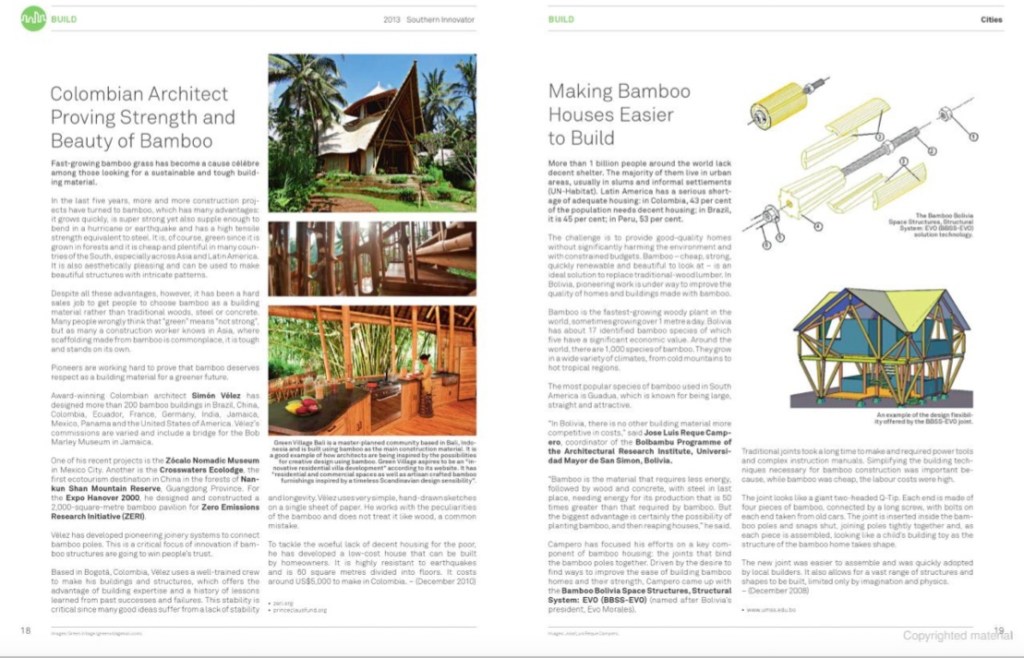
Campero has focused his efforts on a key component of bamboo housing: the joints that bind the bamboo poles together. Driven by the desire to find ways to improve the ease of building bamboo homes and their strength, Campero came up with the Bamboo Bolivia Space Structures, Structural System: EVO (BBSS-EVO) (named after Bolivia’s president, Evo Morales – http://en.wikipedia.org/wiki/Evo_Morales).

Traditional joints took a long time to make and required power tools and complex instruction manuals. Simplifying the building techniques necessary for bamboo construction was important because, while bamboo was cheap, the labour costs were high.

The joint looks like a giant two-headed Q-Tip. Each end is made of four pieces of bamboo, connected by a long screw with bolts on each end taken from old cars. The joint is inserted inside the bamboo poles and snaps shut, joining poles tightly together and, as each piece is assembled, looking like a child’s building toy as the structure of the bamboo home takes shape.

The new joint was easier to assemble and was quickly adopted by local builders. It also allows for a vast range of structures and shapes to be built, limited only by imagination and physics.

Devising joints made from bamboo has the advantage of avoiding the weight and cost of bringing in concrete, especially to remote areas.

“The manufacturing process is fully in the workshop and indoors,” said Campero, “which in addition to allowing a degree of quality control in production, improves working conditions for staff and protects the material.”

The whole building process adheres to “the principles of the famous phrase: ‘do-it-yourself’.”

The Evo joint allows for flexibility and easy assembly and disassembly, enabling the builder to move around parts of the structure and not be wedded to the original structural plan. This has the advantage of customizing the building to its physical location.

Working in the tropical forests of Cochabamba (http://en.wikipedia.org/wiki/Cochabamba), Campero has been testing his designs with the local people, who were looking to improve the tourist infrastructure in the resort town of Cristal Mayu.

Costa Rica in Central America – ironically a country without indigenous bamboo plants – has used its National Bamboo Project of Costa Rica (http://www.unesco.org/most/centram1.htm) to prove it is possible to both cultivate bamboo and use it to provide housing for the poor, confirming the wisdom of millions of people: bamboo is economical, convenient, safe and looks great.

Campero has received a great deal of interest in his innovations and is looking for funding partners in 2009 to take his work further.

He has this advice for other builders and designers: “Stick to developing local technologies, use what you have and innovate, use native materials and the local environment for the development of elements, components and construction systems. Don’t rely on advanced technology tools for manufacture, and stay in harmony with the human need for creativity.”

Published: December 2008

Resources

  • UNEP, the UN’s Environment Programme, has produced a report on bamboo biodiversity and how it can be preserved. Website: http://www.unep-wcmc.org
  • The Asian Development Bank is using its Markets for Poor programme to link bamboo products to marketplaces, helping poor communities. Website:http://www.markets4poor.org/
  • The United Nations Human Settlements Programme, UN-HABITAT, is the United Nations agency for human settlements. It is mandated by the UN General Assembly to promote socially and environmentally sustainable towns and cities with the goal of providing adequate shelter for all. Website: www.unhabitat.org

https://davidsouthconsulting.org/2022/10/26/bamboo-becomes-transport-option-for-the-south/

https://davidsouthconsulting.org/2022/10/26/colombian-architect-proving-strength-and-beauty-of-bamboo/

https://davidsouthconsulting.org/2021/11/11/decent-and-affordable-housing-for-the-poor/

https://davidsouthconsulting.org/housing/

https://davidsouthconsulting.org/2022/11/16/housing-innovation-in-souths-urban-areas/

https://davidsouthconsulting.org/2021/11/11/housing-solution-for-worlds-growing-urban-population/

https://davidsouthconsulting.org/2021/02/12/rebuilding-after-chinese-earthquake-beautiful-bamboo-homes/

https://davidsouthconsulting.org/2022/11/17/tiny-homes-to-meet-global-housing-crisis/

Development Challenges, South-South Solutions was launched as an e-newsletter in 2006 by UNDP’s South-South Cooperation Unit (now the United Nations Office for South-South Cooperation) based in New York, USA. It led on profiling the rise of the global South as an economic powerhouse and was one of the first regular publications to champion the global South’s innovators, entrepreneurs, and pioneers. It tracked the key trends that are now so profoundly reshaping how development is seen and done. This includes the rapid take-up of mobile phones and information technology in the global South (as profiled in the first issue of magazine Southern Innovator), the move to becoming a majority urban world, a growing global innovator culture, and the plethora of solutions being developed in the global South to tackle its problems and improve living conditions and boost human development. The success of the e-newsletter led to the launch of the magazine Southern Innovator. 

Creative Commons License

This work is licensed under a
Creative Commons Attribution-Noncommercial-No Derivative Works 3.0 License.

ORCID iD: https://orcid.org/0000-0001-5311-1052.

© David South Consulting 2023

Categories
Archive Development Challenges, South-South Solutions Newsletters Southern Innovator magazine

Colombian Architect Proving Strength and Beauty of Bamboo

By David SouthDevelopment Challenges, South-South Solutions

SOUTH-SOUTH CASE STUDY

Fast-growing bamboo grass (http://en.wikipedia.org/wiki/Bamboo) has become a cause celebre amongst those looking for a sustainable and tough building material.

In the last five years, more and more construction projects have turned to bamboo. It has many advantages: it grows quickly, is super-strong yet also supple enough to bend in a hurricane or earthquake and has a high tensile strength (http://en.wikipedia.org/wiki/Ultimate_tensile_strength) equivalent to steel. It is, of course, green since it is grown in forests, and is cheap and plentiful in many countries of the South, especially across Asia and Latin America.

It is also aesthetically pleasing and makes beautiful structures with intricate patterns.

But despite all these advantages, it has been a hard sales job to get people to choose bamboo as a building material rather than traditional woods, steel or concrete. Many people wrongly think green means not strong. But as many a construction worker knows in Asia, where scaffolding made from bamboo is commonplace, it is tough and stands on its own.

Pioneers are working hard to prove bamboo deserves respect as a building material for a greener future.

Award-winning Colombian architect Simón Vélez has designed more than 200 bamboo buildings in Germany, France, the United States, Brazil, Mexico, China, Jamaica, Colombia, Panama, Ecuador, and India.

Vélez’s commissions are varied, and include a bridge for the Bob Marley Museum in Jamaica.

One of his recent projects is the Zócalo Nomadic Museum (http://en.wikipedia.org/wiki/Nomadic_Museum) in Mexico City. Another is the Crosswaters Ecolodge (http://www.asla.org/2010awards/370.html), the first ecotourism destination in China in the forests of Nankun Shan Mountain Reserve, Guangdong Province. For the Expo Hanover 2000, he designed and constructed a 2000-square-meter bamboo pavilion for ZERI (Zero Emissions
Research Initiative) (http://www.zeri.org/).

Vélez has developed pioneering joinery systems to connect bamboo poles together. This is a critical focus of innovation if bamboo structures are going to win people’s trust.

Based in Bogotá, Colombia, Vélez uses a well-trained crew to make his buildings and structures. This has the advantage of building expertise and a history of lessons learned from past successes and failures. That stability is a critical insight: many good ideas suffer from a lack of stability and longevity. He uses very simple, hand-drawn sketches on a single sheet of paper. He works with the peculiarities of the bamboo and does not treat it like wood: a common mistake.

To tackle the woeful lack of decent housing for the poor, he has developed a low-cost house that can be built by home-owners. It is highly resistant to earthquakes and is 60 square metres divided on two floors. It costs
around US $5,000 to make in Colombia.

Winner of the Prince Claus Fund (http://www.princeclausfund.org/en/index.html), Vélez’s work promotes sustainable development, introducing new ideas on ecological issues and questions. The Fund calls him an architect “whose aesthetic and technical innovations have considerably expanded the possibilities of bamboo as a building material, providing a challenge to prevailing architectural trends.”

With more than 1 billion people around the world lacking decent shelter, many see plentiful bamboo as a key part of the solution. Most people with poor quality housing live in urban areas, usually in slums and informal settlements (UN-HABITAT). Latin America has a serious shortage of adequate housing: in Colombia, 43 percent of the population needs decent housing; in Brazil, 45 percent; Peru, 53 percent.

The challenge is to provide good quality homes without significantly harming the environment – and with constrained budgets. Bamboo – cheap, strong, quickly renewable and beautiful – is an ideal solution to replace traditional wood lumber.

Bamboo is the fastest growing woody plant in the world, sometimes growing over 1 metre a day. Around the world, there are 1,000 species of bamboo. They grow in a wide variety of climates, from cold mountains to hot tropical regions.

Once called the “poor man’s timber” – a temporary building material to replace once there is more money – bamboo is now getting the respect it deserves. Bamboo for housing has a long history in Latin America, stretching back 4,500 years to ancient civilizations. In Asia, it has long been a traditional construction material. But most of the existing bamboo dwellings in Latin America are 50 to 100 years old.

The most popular species of bamboo used in South America is Guadua, which is known for being large, straight and attractive.

Thoughtful and methodical pioneers like Vélez are proving bamboo has a viable future as a building material that will tackle the housing needs of the world’s poor and the fast-growing cities of the South.

Published: December 2010

Resources

Development Challenges, South-South Solutions was launched as an e-newsletter in 2006 by UNDP’s South-South Cooperation Unit (now the United Nations Office for South-South Cooperation) based in New York, USA. It led on profiling the rise of the global South as an economic powerhouse and was one of the first regular publications to champion the global South’s innovators, entrepreneurs, and pioneers. It tracked the key trends that are now so profoundly reshaping how development is seen and done. This includes the rapid take-up of mobile phones and information technology in the global South (as profiled in the first issue of magazine Southern Innovator), the move to becoming a majority urban world, a growing global innovator culture, and the plethora of solutions being developed in the global South to tackle its problems and improve living conditions and boost human development. The success of the e-newsletter led to the launch of the magazine Southern Innovator. 

Creative Commons License

This work is licensed under a
Creative Commons Attribution-Noncommercial-No Derivative Works 3.0 License.

ORCID iD: https://orcid.org/0000-0001-5311-1052.

© David South Consulting 2023

Categories
Archive Blogroll Development Challenges, South-South Solutions Newsletters Southern Innovator magazine

Rebuilding After Chinese Earthquake: Beautiful Bamboo Homes

By David SouthDevelopment Challenges, South-South Solutions

SOUTH-SOUTH CASE STUDY

It has been a year since the May 12, 2008 Sichuan earthquake in China that killed more than 70,000 people.

China’s strongest earthquake for more than half a century, with a magnitude of 8.0 (en.wikipedia.org), it devastated large parts of the province of Sichuan. More than 10 million people were made homeless, most of them poor and elderly villagers (cities were not badly damaged).

Getting Sichuan back to normal is critical for not only the province’s people, but for all of China. Sichuan is China’s rice bowl, growing more food than any other province. But despite the abundance of food, Sichuan remains poor and has seen its working age population move away for work. If it is to have a viable future then its communities need to get back to normal as fast as possible – and its farming economy back to full production.

The unprecedented media coverage of the disaster meant people across China saw the scenes of devastation and have since contributed large donations to help with the reconstruction. The Chinese government has pledged to spend US $151 billion on reconstruction projects.

Finding ways to re-house people after large disasters has become an urgent issue over the last five years. From the Asian tsunami to Hurricane Katrina in the United States and multiple hurricane disasters in the Caribbean, restoring communities is critical for the health of the people and the economies they rely on. Experience has shown that temporary shelters have many drawbacks, being usually of poor quality for long-term habitation and a source of health problems.

The temporary shelters erected for the Sichuan homeless are unsuitable for long-term housing: the 12 square metre grey boxes – two sheets of aluminium sandwiching a polystyrene core for insulation – have no heating. The occupants roast inside in the summer and freeze in the winter. They are also located away from the main source of income: the farms.

The dilemma is how to build new, long-term houses that will not cost too much. Inflation has increased the costs of conventional building materials: bricks, cement and steel.

But the use of traditional building materials and home designs offers an alternative. By drawing on the abundant bamboo and wood in Sichuan and by building to traditional designs, cheaper but sturdy and beautiful homes can be built.

An average home now costs around 80,000 yuan (US $11,688). The Chinese government estimates the price is now 820 yuan per square meter for a new home: bamboo homes cost between 300 and 400 yuan per square meter. Government compensation is between 16,000 yuan (US $2,337) and 23,000 yuan (US $3,360) per family. The bamboo houses range in size from 75 to 200 square metres, and in cost from 22,500 yuan to 80,000 yuan for a very large home.

In Daping village, Pengzhou Town, original homes destroyed by the earthquake sit at the edge of a forested hill. Their frames are more or less intact, but the walls and roofs have collapsed. The new houses replacing them are large, two stories high and have solid grey clay tile roofs. The beauty of the designs stands out and sits in stark contrast to the temporary shelters and concrete buildings.

“There are 43 houses and two public buildings being rebuilt in this project,” says team member Hu Rong Rong of the Green Building Research Centre of Xi’an University of Architecture and Technology. “The design and the main building material are based on the ecological and sustainable habitat idea. The place (Sichuan) is rich in bamboo and wood. These natural materials are cheap and friendly to the environment. In some buildings we use light steel which can be also recycled.”

The new homes are built to earthquake resistance standards. Led by Professor LiuJiaping, a team of 15 people from the research centre and two from a design institute developed the home designs and supervised the training of local people. They were joined by 10 people from an NGO called Global Village of Beijing, who managed the project to completion.

“All the designs were discussed with the local people,” continues Hu. “We trained a local construction team, which means the local people would build their own houses by themselves. Both our research center and the local people were involved in developing the home design.

“To get the trust from the local people is a challenge in the project. We resolved it by showing our respect to the local people. Before we started our design we discussed with the local people many times to know what kind of house they like. We built the first house to make them believe us.”

Hu believes it is possible to replicate the homes across Sichuan.

“The design is suitable for other villages in Sichuan which have a similar climate and culture with this village. To rebuild sustainable houses after a disaster we should know well about the local life, environment and culture – try to find the useful technique which was used in their traditional houses and upgrade the traditional house to meet the need of their modern life.”

Others have not been as lucky as these villagers. In the village of Yuan Bao, Chen Jingzhong, 66, has had to build a makeshift shack: “They wanted to get us to build our own houses but they didn’t give us enough money,” Chen told the Telegraph Magazine. “All we could afford was this shack, which we built ourselves, with our own hands and without any help from anyone.”

Published: May 2009

Resources

Architecture for Humanity: By tapping a network of more than 40,000 professionals willing to lend time and expertise to help those who would not otherwise be able to afford their services, they bring design, construction and development services where they are most critically needed. Website: www.architectureforhumanity.org

Chinese Red Cross: The Red Cross Society of China is accepting donations for disaster reconstruction and is coordinating rebuilding efforts in Sichuan Website: http://www.redcross.org.cn/ywzd/

Gerd Niemoeller has developed flat pack, cardboard homes that can be deployed quickly after a disaster and can become permanent homes.Website: http://tinyurl.com/6t6jtf and the company
Website: http://www.wall.de/en/home

Global Greenhouse Warming is a website that tracks extreme weather events around the world: drought, flooding, severe storms, severe winter, tropical cyclone, wildfires, and extreme heat waves.Website: www.global-greenhouse-warming.com

The Building and Social Housing Foundation: An independent research organization promoting sustainable development and innovation in housing through collaborative research and knowledge transfer. Website: www.bshf.org

https://davidsouthconsulting.org/2021/09/01/disaster-recovery-ten-years-after-the-gujarat-india-experience/

https://davidsouthconsulting.org/2021/11/12/energy-efficient-wooden-houses-are-also-earthquake-safe/

https://davidsouthconsulting.org/2021/09/01/haiti-earthquake-prompts-tech-aid/

https://davidsouthconsulting.org/2021/02/12/rammed-earth-houses-china-shows-how-to-improve-and-respect-traditional-homes/

https://davidsouthconsulting.org/2022/09/26/3d-home-printing-landmark-10-houses-in-a-day/

Development Challenges, South-South Solutions was launched as an e-newsletter in 2006 by UNDP’s South-South Cooperation Unit (now the United Nations Office for South-South Cooperation) based in New York, USA. It led on profiling the rise of the global South as an economic powerhouse and was one of the first regular publications to champion the global South’s innovators, entrepreneurs, and pioneers. It tracked the key trends that are now so profoundly reshaping how development is seen and done. This includes the rapid take-up of mobile phones and information technology in the global South (as profiled in the first issue of magazine Southern Innovator), the move to becoming a majority urban world, a growing global innovator culture, and the plethora of solutions being developed in the global South to tackle its problems and improve living conditions and boost human development. The success of the e-newsletter led to the launch of the magazine Southern Innovator.

https://davidsouthconsulting.org/2021/03/05/southern-innovator-issue-4/

Creative Commons License

This work is licensed under a
Creative Commons Attribution-Noncommercial-No Derivative Works 3.0 License.

ORCID iD: https://orcid.org/0000-0001-5311-1052.

© David South Consulting 2023