Categories
Archive Development Challenges, South-South Solutions Newsletters

New Battery Back-up Technology Targeting Developing Countries and Remote Regions

By David SouthDevelopment Challenges, South-South Solutions

SOUTH-SOUTH CASE STUDY

Africa’s greater global engagement and economic growth in the past few years has started to draw attention back towards the continent’s dearth of reliable power sources and inadequate power infrastructure. While demand grows at a fast pace, sadly political instability and lack of security in many countries scares off foreign investors and multinational companies who could help to expand capacity. This leaves people running small enterprises and organisations – especially in rural areas – significantly neglected. According to Zandile Mjoli, senior general manager for resources and strategy at South African utility Eskom, two-thirds of Africa’s 700 million people live in rural areas, and less than 10 per cent of the rural population has access to electricity. Each one per cent increase in available power will increase GDP by an estimated two to three per cent.

The extent of the looming crisis in 2007 can be seen in the problems of the Southern African Power Pool, which coordinates power production and trade in the Southern African Development Community (SADC). It predicts an energy shortfall in 2007 that will force countries like South Africa and Mozambique, which have provided about 40 percent of Zimbabwe’s power requirements for example, to scale down on exports in order to meet rising demand from their own domestic markets.

Plug Power is a research and development company in the US specializing in clean, reliable energy products for areas where power supply is unreliable or non-existent. It uses fuel cell technology to build back-up power supplies for telecommunications, utilities and uninterruptible power supply needs like refrigerators and medical supplies. It is now targeting Africa with its new GenCore back-up fuel cell system using ultra capacitor technology, basically the mechanism by which the fuel cell stores electricity. It is specifically built for remote regions with severe climates where the limited lifespan of a battery and harsh weather conditions can lead to power supply disruptions.

Fuel cells use chemicals to create electricity and heat similar to batteries, but when hydrogen is used, they only produce clean water as a by-product. Most importantly for those working in development, it provides a continuous power supply as long as the fuel is provided. Plug Power’s system allows for hydrogen to be taken from multiple sources to power the cells.

Published: January 2007

Website: http://www.plugpower.com/

Development Challenges, South-South Solutions was launched as an e-newsletter in 2006 by UNDP’s South-South Cooperation Unit (now the United Nations Office for South-South Cooperation) based in New York, USA. It led on profiling the rise of the global South as an economic powerhouse and was one of the first regular publications to champion the global South’s innovators, entrepreneurs, and pioneers. It tracked the key trends that are now so profoundly reshaping how development is seen and done. This includes the rapid take-up of mobile phones and information technology in the global South (as profiled in the first issue of magazine Southern Innovator), the move to becoming a majority urban world, a growing global innovator culture, and the plethora of solutions being developed in the global South to tackle its problems and improve living conditions and boost human development. The success of the e-newsletter led to the launch of the magazine Southern Innovator.

Creative Commons License

This work is licensed under a
Creative Commons Attribution-Noncommercial-No Derivative Works 3.0 License.

ORCID iD: https://orcid.org/0000-0001-5311-1052.

© David South Consulting 2022
Categories
Archive Blogroll Development Challenges, South-South Solutions Newsletters Southern Innovator magazine

DIY Solution Charges Mobile Phones With Batteries

By David SouthDevelopment Challenges, South-South Solutions

SOUTH-SOUTH CASE STUDY

There are now more than 3.5 billion mobile phones in use around the world. In the past five years, their use and distribution has exploded across the global South, including in once hard-to-reach places in Africa. In fact, Africa is the world’s fastest growing mobile phone market. Over the past five years the continent’s mobile phone usage has increased at an annual rate of 65 percent – twice the rate of Asia.

The world’s poor are creative users of mobile phones, adapting these powerful tools to help with business, saving and spending money, and communicating with the outside world. As powerful as mobile phones are, they need electricity to stay functioning. And it is the struggle to find a steady supply of electricity that vexes many in the South.

There are wind-up mobile phone chargers, solar powered chargers (http://tinyurl.com/bg3wac), and mobile phone chargers you wave about. But most of these devices are, to someone who is poor and living in the South, expensive and hard to find. So what to do when it is not possible to buy a solar powered mobile phone charger?

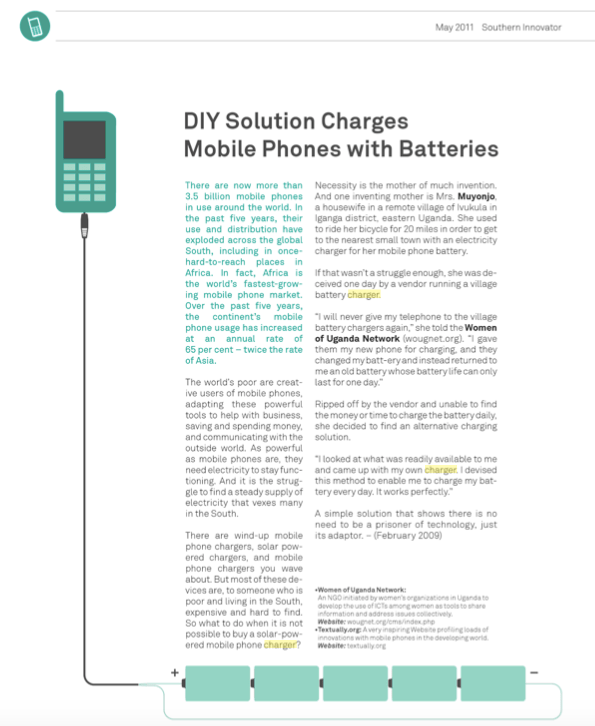
Necessity is the mother of much invention. And one inventing mother is Mrs. Muyonjo, a housewife in a remote village of Ivukula in Iganga district, Eastern Uganda. She used to ride her bicycle for 20 miles in order to get to the nearest small town with an electricity charger for her mobile phone battery.

If that wasn’t a struggle enough, she was one day deceived by a vendor running a village battery charger.

“I will never give my telephone to the village battery chargers again,” she told the Women of Uganda Network (www.wougnet.org). “I gave them my new phone for charging, and they changed my battery and instead returned to me an old battery whose battery life can only last for one day.”

Ripped off by the vendor and unable to find the money or time to charge the battery daily, she decided to find an alternative charging solution.

“I looked at what was readily available to me and came up with my own charger. I devised this method to enable me to charge my battery every day. It works perfectly.”

A simple solution that shows there is no need to be a prisoner of technology, just its adaptor.

Published: February 2009

Development Challenges, South-South Solutions was launched as an e-newsletter in 2006 by UNDP’s South-South Cooperation Unit (now the United Nations Office for South-South Cooperation) based in New York, USA. It led on profiling the rise of the global South as an economic powerhouse and was one of the first regular publications to champion the global South’s innovators, entrepreneurs, and pioneers. It tracked the key trends that are now so profoundly reshaping how development is seen and done. This includes the rapid take-up of mobile phones and information technology in the global South (as profiled in the first issue of magazine Southern Innovator), the move to becoming a majority urban world, a growing global innovator culture, and the plethora of solutions being developed in the global South to tackle its problems and improve living conditions and boost human development. The success of the e-newsletter led to the launch of the magazine Southern Innovator.  

Follow @SouthSouth1

Google Books: https://books.google.co.uk/books?id=mLKXBgAAQBAJ&dq=development+challenges+february+2009&source=gbs_navlinks_s

Slideshare: http://www.slideshare.net/DavidSouth1/development-challengessouthsouthsolutionsfebruary2009issue

Southern Innovator Issue 1: https://books.google.co.uk/books?id=Q1O54YSE2BgC&dq=southern+innovator&source=gbs_navlinks_s

Southern Innovator Issue 2: https://books.google.co.uk/books?id=Ty0N969dcssC&dq=southern+innovator&source=gbs_navlinks_s

Southern Innovator Issue 3: https://books.google.co.uk/books?id=AQNt4YmhZagC&dq=southern+innovator&source=gbs_navlinks_s

Southern Innovator Issue 4: https://books.google.co.uk/books?id=9T_n2tA7l4EC&dq=southern+innovator&source=gbs_navlinks_s

Southern Innovator Issue 5: https://books.google.co.uk/books?id=6ILdAgAAQBAJ&dq=southern+innovator&source=gbs_navlinks_s

Creative Commons License
This work is licensed under a
Creative Commons Attribution-Noncommercial-No Derivative Works 3.0 License.

ORCID iD: https://orcid.org/0000-0001-5311-1052.

© David South Consulting 2023