Categories
Archive Development Challenges, South-South Solutions Newsletters

Kenyan Bank Helps the Poor and Gets Rich

By David SouthDevelopment Challenges, South-South Solutions

SOUTH-SOUTH CASE STUDY

Good quality banking services are a basic building block to rising incomes. Yet the poor across the South are often overlooked and denied access to savings accounts and loans. Many low-income people are openly discriminated against as ‘bad risks’ by banks, and denied the sort of banking services middle and higher income people take for granted. Yet it is a myth that the poor do not have money or do not wish to save and invest for their future or for business.

The so-called Bottom of the Pyramid (BOP) – the 4 billion people around the world who live on less than US $2 a day – are being targeted by a wide range of businesses. Indian business consultant and professor CK Prahalad (http://en.wikipedia.org/wiki/C.K._Prahalad) , the man who coined the term BOP, has gone so far as to claim this is a market potentially worth US $13 trillion, while the World Resources Institute puts it at US $5 trillion in its report, “The Next 4 Billion” (http://www.nextbillion.net/thenext4billion).

A Kenyan commercial bank has proven it is possible to target the BOP and become successful doing it; so successful that they have seen off foreign rivals and were voted Kenya’s third most respected company.

By offering Kenya’s poor people savings accounts and microloans, Equity Bank (http://www.equitybank.co.ke/) has captured 50 percent of the Kenyan bank market. It now has more than 3 million customers and 2.8 million account holders and opens 4,000 new accounts a day.

Its chief executive officer, James Mwangi, said Equity Bank built its success by doing the opposite of what other banks have done – it doesn’t target the middle and upper classes, but the “the watchmen, tomato sellers and small-scale farmers”.

The Kenyan banking sector in the past was dominated by foreign banks. But by investing in the 46 percent of the population who still live below the food poverty line, Equity has become the third most profitable bank in the country. Its approach was once considered odd. Most of the bank’s borrowers work in the informal sector and have few assets to use as collateral for the loans. So Equity uses what it calls ‘social collateral’. This includes a mix of measures: in some cases, account holders join together to guarantee a person’s debt. Even more unusually, women offer their matrimonial beds as security – it would be shameful for a woman to admit her bed has been taken to pay for the debt.

“For us it’s psychological security. Nobody wants to be excommunicated and lose their inheritance,” said Mwangi.

“By focusing on the previously excluded, Equity has revolutionized the banking sector,” James Shikwati, a director of Kenyan think tank the Inter Region Economic Network (http://www.irenkenya.com/), told The Guardian newspaper. “It has forced the multinational banks to change their business strategies.”

Started in 1984, the bank was still insolvent by 1994, when Mwangi joined as an accountant. Things were looking grim as Kenya’s economy was in a slump and foreign banks like Barclays were closing branches outside big centres.

Mwangi and other Equity Bank managers realized there were millions of low-paid poor in Kenya – all BOP – but who wanted to save and borrow but had nowhere to go.

“Banking was the only industry in Kenya led by supply rather than demand,” said Mwangi. “There was no ‘bottom of the pyramid bank’.”

While absolute poverty in Kenya has declined in recent years, inequality remains high. The population of 37 million people make on average a per capita income of US $580.

By 2003, as the economy picked up, Equity Bank gained 256,000 account holders. It now has 100 branches across the country and 500 automatic teller machines (ATMs). It uses armoured trucks to go into rural areas so that the people can receive banking services. While traditional banks require pay slips and utility bills as proof of a person’s address before letting them open an account, and charge high monthly fees, Equity only requires an identity card.

Within just one year, the bank saw the number of account holders jump to 600,000. Mwangi likes to say that the bank’s competition is the bed mattress, since most people have never had a bank account before. Most savers have around US $148 in their savings account.

The bank’s micro credit operation makes loans of less than US $7 and gives borrowers a few months to repay them.

The bank claims loan defaults are less than 3 percent on 600,000 outstanding loans – the banking industry average is 15 percent.

It keeps its transaction costs down by using the latest in information technology. These efficiencies enabled the bank to earn pre-tax profits of more than US $40 million in 2007.

Equity does face competition, as its success attracts mainstream banks into the BOP market.

In Africa these days, banking is hot: a South African research and analysis company BMI-TechKnowledge (http://www.bmi-t.co.za/) in a report identifies a boom in banking services across Africa. In particular, South Africa, Botswana, Namibia, Angola, Mauritius, Tanzania, Kenya, Ghana, Nigeria, Egypt and Morocco – all have seen surges in profit and services as a result of improving banking regulations and political conditions.

Mwangi isn’t worried, however, since the number of people still without bank accounts is huge. Equity Bank is expanding its operations into Uganda, Rwanda and Sudan.

Elsewhere, mobile phone banking in Kenya is proving highly successful. Equity has a service, but so does Safaricom with M-PESA (http://www.safaricom.co.ke/index.php?id=745). Customers can deposit, transfer and withdraw money using their phones. Over 4 million are now using the service.

Published: January 2009

Resources

1) NextBillion.net: Hosted by the World Resources Institute, it identifies sustainable business models that address the needs of the world’s poorest citizens.
Websites: http://www.nextbillion.net/ and World Resources Institute

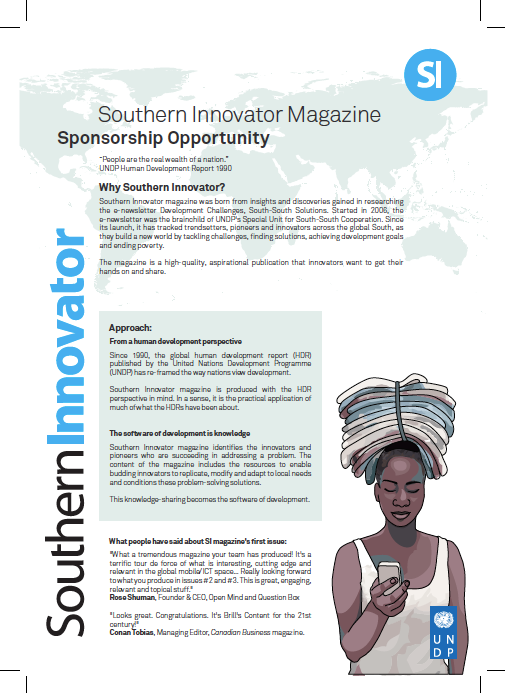
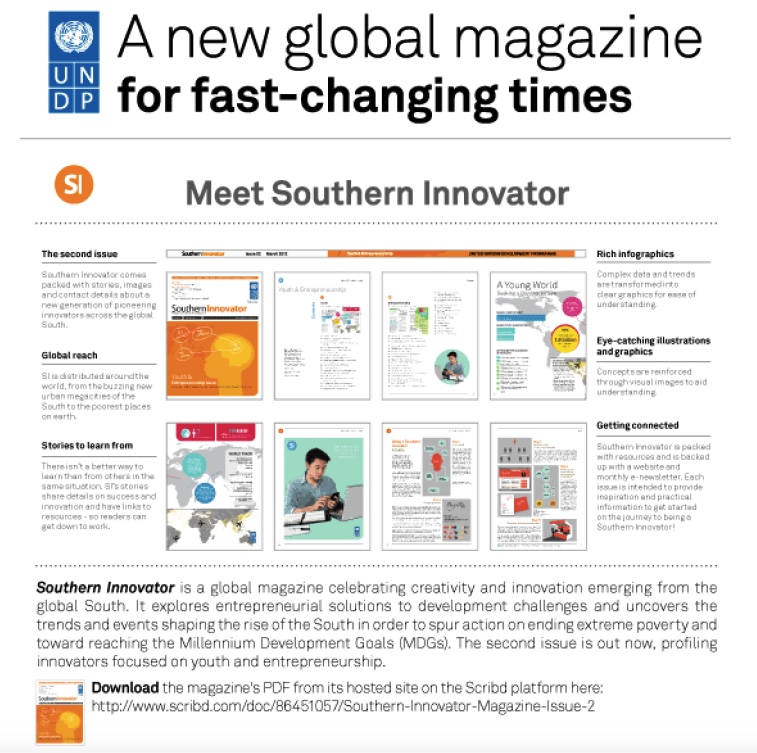
Development Challenges, South-South Solutions was launched as an e-newsletter in 2006 by UNDP’s South-South Cooperation Unit (now the United Nations Office for South-South Cooperation) based in New York, USA. It led on profiling the rise of the global South as an economic powerhouse and was one of the first regular publications to champion the global South’s innovators, entrepreneurs, and pioneers. It tracked the key trends that are now so profoundly reshaping how development is seen and done. This includes the rapid take-up of mobile phones and information technology in the global South (as profiled in the first issue of magazine Southern Innovator), the move to becoming a majority urban world, a growing global innovator culture, and the plethora of solutions being developed in the global South to tackle its problems and improve living conditions and boost human development. The success of the e-newsletter led to the launch of the magazine Southern Innovator. 
Creative Commons License

This work is licensed under a
Creative Commons Attribution-Noncommercial-No Derivative Works 3.0 License.

ORCID iD: https://orcid.org/0000-0001-5311-1052.

© David South Consulting 2023

Categories
Archive Development Challenges, South-South Solutions Newsletters

Iranian Savings Funds to Tackle Loan Drought

By David SouthDevelopment Challenges, South-South Solutions

SOUTH-SOUTH CASE STUDY

For entrepreneurs around the world, acquiring finance to start or expand a small business has become harder and harder as the global financial crisis has bitten hard. Across the globe, people with good ideas or successful businesses that need funds to expand are finding the door closed by traditional banks.

As banks and governments have focused on reducing debt and building up cash reserves, it is small businesses and small-scale entrepreneurs – often without business or family connections – who suffer the most. Opportunities are being missed to create new jobs and enterprises and lift poor communities out of poverty.

In that climate, the search is on for alternative ways to build up wealth. In Iran, a new phenomenon has arisen to address the lack of bank loans for small businesses brought about by the economic crisis. Iran is suffering under international sanctions as well as outstanding bank loans exceeding US $45 billion, according to the Financial Times.

The domestic banking crisis this has provoked has resulted in a tightening of credit for loans.

But in response, middle class Iranians are forming their own savings clubs to help each other with loans.

The savings clubs work like this: each member buys a share in the club costing around US $2 per day (around US $620 over 10 months). Each share makes the saver eligible for one loan during the year. For example in a club of 30 Tehran taxi drivers, every month four members of the club receive US $600 each in loans. The fund lasts 10 months and each member is guaranteed one loan per share.

“It is a savings fund and doesn’t have the uncertainty of the banking system, which might or might not give you a loan,” club member Ahmad told the Financial Times newspaper. As one of the drivers, he has four shares and is eligible for four loans.

“My mother is also saving money in a fund of housewives among our female relatives.”

The fund is managed by the head of the taxi agency and a driver who is a retired teacher. Both are trusted. “The retired teacher receives the money every day and puts a check mark by the names of those who pay. He is trusted by the head of the taxi agency, while other drivers respect him as an educated, honest man.”

Savings clubs are also good for the local economy, helping people to be able to buy goods on loans they would never be able to purchase otherwise. Another driver used the fund to “buy the things we cannot afford under normal conditions, like a washing machine, for instance, for which we have zero chance to get bank loans.”

Overdue loans by Iran’s banks grew by 66 percent from last year according to Asghar Abolhassani, the deputy economy minister.

The Financial Times reported that an estimated 25 percent of bank loans are outstanding, making Iran’s banking system technically bankrupt. International sanctions are also blocking the country’s banks from accessing global financial markets for support.

“Stagnation has gripped many parts of the economy,” said Hamid Tehranfar, the central bank’s director-general for banking supervision.

Turning to savings clubs can be an excellent alternative saving and loans model, but it requires very specific trust guarantees in place to ensure the holder of the funds doesn’t just take the money. For those who can’t find somebody local they trust, there are a number of online social lending and fundraising alternatives for raising funds and borrowing money. These include Kiva (www.kiva.org), which connects poor people looking for loans with people around the world willing to lend.

As the crisis continues and banks and governments hoard wealth for their own needs to pay down debt, alternative sources of loans will become ever more important for the poor.

Published: April 2010

Resources

1) Zopa: “Where people meet to lend and borrow money.” Website: www.zopa.com

2) Kiva: Kiva’s mission is to connect people, through lending, for the sake of alleviating poverty. Website: www.kiva.org

3) Betterplace: Started in 2007, Betterplace is an online marketplace for projects to raise funds. It is free, and it passes on 100 percent of the money raised on the platform to the projects. Website: www.betterplace.org

4) Kickstarter: Kickstarter is a funding platform for artists, designers, filmmakers, musicians, journalists, inventors, and explorers. Website: http://www.kickstarter.com/

Development Challenges, South-South Solutions was launched as an e-newsletter in 2006 by UNDP’s South-South Cooperation Unit (now the United Nations Office for South-South Cooperation) based in New York, USA. It led on profiling the rise of the global South as an economic powerhouse and was one of the first regular publications to champion the global South’s innovators, entrepreneurs, and pioneers. It tracked the key trends that are now so profoundly reshaping how development is seen and done. This includes the rapid take-up of mobile phones and information technology in the global South (as profiled in the first issue of magazine Southern Innovator), the move to becoming a majority urban world, a growing global innovator culture, and the plethora of solutions being developed in the global South to tackle its problems and improve living conditions and boost human development. The success of the e-newsletter led to the launch of the magazine Southern Innovator. 

Creative Commons License

This work is licensed under a
Creative Commons Attribution-Noncommercial-No Derivative Works 3.0 License.

ORCID iD: https://orcid.org/0000-0001-5311-1052.

© David South Consulting 2023

Categories
Archive data Development Challenges, South-South Solutions Newsletters digital ID Southern Innovator magazine

Cash Machines for the Poor

By David SouthDevelopment Challenges, South-South Solutions

SOUTH-SOUTH CASE STUDY

Access to basic banking services for the poor is weak at the best of times. Many are openly discriminated against as a ‘bad risk’ by banks, and denied the sort of banking services middle and higher income people take for granted. Yet it is a myth that the poor do not have money or do not wish to save and invest for their future or for business.

The so-called Bottom of the Pyramid (BOP) – the four billion people around the world who live on less than US $2 a day – are being targeted by a wide range of businesses. Indian business consultant and professor CK Prahalad, the man who coined the term BOP, has gone so far as to claim this is a market potentially worth US $13 trillion, while the World Resources Institute puts it at US $5 trillion in its report, The Next 4 Billion.

And contrary to popular perception, the poor do have buying power, as has been documented by Massachusetts Institute of Technology (MIT) professors Abhijit Banerjee and Esther Duflo in their paper “The Economic Lives of the Poor”. Surveying 13 countries, they found those living on less than a dollar a day, the very poor, actually spent 1/3 of their household income on things other than food, including tobacco, alcohol, weddings, funerals, religious festivals, radios and TVs. The researchers also found that the poor increasingly used their spending power to seek out private sector options when the public sector failed to provide adequate services.

India, where 63 percent of the BoP market is rural and 304.11 million people are illiterate (Human Development Report), makes for a particularly tricky market to reach with bank machines: the average transaction is just 100 rupees (£1.25).

But a Madras-based company has come up with the Gramateller – a low-cost, blue-and-white bank machine custom-designed for the poor and illiterate. Vortex received funding of 2 million rupees (US $48,000) from an investment company, Aavishkar, that specializes in micro-venture capital — small sums for new business ideas. The advantage of micro-venture capital funding is its longer payback time: a young company does not get driven out of business by having to pay back the cash before the idea has been realized. Normally, venture capital helps a business to grow quickly but the venture capitalist wants to see an immediate profit on the investment.

Vortex’s chief executive officer, V.Vijay Babu, said: “The idea was conceived by Prof. Jhunjhunwala of IITM (Indian Institute of Technology Madras) in the course of an exploratory project focused on using ICT to deliver modern banking services to rural India.”

“It was found that branch-based banking is too expensive to be extended to remote rural locations where the volume and size of transactions are small. Using conventional ATMs (automatic teller machines) as a channel posed many difficulties because these ATMs were not built to operate in [illiterate] environments. Hence the need for developing an ATM specific to this context.”

Costing just a 10th as much to build as an ordinary cash machine, Gramateller has a fingerprint scanner for the illiterate, and is able to accept dirty and crumpled bank notes. Vortex came up with an ingenious solution to do this, said Babu: “Vortex developed a beltless dispenser design that in many ways mimics the way a human teller would pick and count notes.”

Vortex hopes to massively expand access to cash machines: at present, India has just 30,000 machines, or one for every 43,000 people (the US has a machine for every 1,000 people). These machines are being piloted with India’s biggest private bank, ICICI, and they have garnered interest from Indonesian banks as well.

“We are running pilots for two leading banks with about 10 ATMs,” said Babu. “Though it is still early, the initial response has been very encouraging – rural users find fingerprint authentication intuitive and simple and the ATM convenient and easy to use. A few users also gave feedback that our ATMs look less intimidating, maybe because it is placed in a non-air conditioned room with easy access and also is different in shape from a typical ATM.”

Furthermore the cash machines have taken a beating to see if they are robust enough for rural India: “The ATMs were tested for extended operating cycles under the harshest of environments that would prevail in the rural context — using soiled currencies, operating in non-air conditioned and dusty environments, subjecting the machine to typical fluctuations in line voltages and power outages. User-acceptance was tested by enlisting the participation of rural and semi-urban people to carry out test transactions.”

As for thieves getting their hands on the cash before the poor, Vortex maintains the machines will not become the victim of thieves: each machine will only carry a fifth of the money of city-dwelling bank machines.

Elsewhere in the South, a South African research and analysis company BMI-TechKnowledge (http://www.bmi-t.co.za/) in its latest report identifies a boom in banking services across Africa. In particular, South Africa, Botswana, Namibia, Angola, Mauritius, Tanzania, Kenya, Ghana, Nigeria, Egypt and Morocco – all have seen surges in profit and services as a result of improving banking regulations and political conditions. Maybe future markets for the Gramateller to reach Africa’s poor lie ahead?

Published: August 2008

Resources

  • Unleashing India’s Innovation: Toward Sustainable and Inclusive Growth, a report by the World Bank.
    Website: web.worldbank.org
  • xigi.net (pronounced ‘ziggy’ as in zeitgeist) is a space for making connections and gathering intelligence within the capital market that invests in good. It’s a social network, tool provider, and online platform for tracking the nature and amount of investment activity in this emerging market also referred to as blended value investing. xigi’s goal is to help this international emerging market to grow through market formation activities that guide and educate a growing wave of new money, while connecting it to the emergent entrepreneurs and deals on the internet.
    Website: http://www.xigi.net/
  • The new report Global Savings, Assets and Financial Inclusion by the Citi Foundation is packed with innovative approaches that are allowing the BoP (bottom of the pyramid) to use their income to build assets and more sustainable livelihoods.
    Website: http://www.newamerica.net
  • NextBillion.net: Hosted by the World Resources Institute, it identifies sustainable business models that address the needs of the world’s poorest citizens.
    Websites: http://www.nextbillion.net/ and World Resources Insitute

Development Challenges, South-South Solutions was launched as an e-newsletter in 2006 by UNDP’s South-South Cooperation Unit (now the United Nations Office for South-South Cooperation) based in New York, USA. It led on profiling the rise of the global South as an economic powerhouse and was one of the first regular publications to champion the global South’s innovators, entrepreneurs, and pioneers. It tracked the key trends that are now so profoundly reshaping how development is seen and done. This includes the rapid take-up of mobile phones and information technology in the global South (as profiled in the first issue of magazine Southern Innovator), the move to becoming a majority urban world, a growing global innovator culture, and the plethora of solutions being developed in the global South to tackle its problems and improve living conditions and boost human development. The success of the e-newsletter led to the launch of the magazine Southern Innovator. 

Creative Commons License

This work is licensed under a
Creative Commons Attribution-Noncommercial-No Derivative Works 3.0 License.

ORCID iD: https://orcid.org/0000-0001-5311-1052.

© David South Consulting 2023

Categories
Archive Development Challenges, South-South Solutions Newsletters

African Innovation Helps Make Banking Transactions Safer

By David SouthDevelopment Challenges, South-South Solutions

SOUTH-SOUTH CASE STUDY

As economies grow in Africa, more and more people are conducting their financial transactions electronically. This can be either through mobile phones and digital devices, or through the hole-in-the-wall of the automatic teller machine, or ATM.

These short cuts mean many people no longer have to endure long line-ups at banks to conduct day-to-day financial transactions. This convenience is revolutionizing banking for many millions of people, but there is a risk: fraud and theft. Both are rising, and are costing customers and banks, both in cash and in damage to the reputation of electronic banking.

Criminal gangs and lone individuals alike are behind this crime. Most notorious are the “carding” and “skimming” gangs, who plant devices on ATMs to read plastic bank cards and steal victims’ money. Mobile devices can also be “hacked” by sophisticated criminal gangs and the data stolen and used to plunder bank accounts. Lone thieves also take people hostage and force them to use their card to withdraw money. A crime victim is usually forced to give over his or her Personal Identification Number (PIN), which the thief then uses to withdraw cash from the ATM.

But just as thieves have become cleverer about the new opportunities created by digital financial transactions, enterprising start-ups are developing innovations to improve financial security.

One Kenyan start-up is hoping to be a pioneer in innovative financial safety software for mobile devices and ATMs.
Usalama Innovative Systems, LTD. (http://usalama.biz/), co-owned by graduate student and lead programmer Denis Karema (deniskarema.com), has already been singled out for a CIO magazine’s CIO100 Award in Enterprise Innovation in 2011 (http://www.cio.com/cio-awards/cio100).

Karema has been working in information technology since 2008 and has a background in computer science. He has built his experience while working on various information technology projects in East Africa.

The ambitious company says it wants to be “the leading provider of innovative solutions to financial entities in Africa by 2015.”
Usalama has developed various systems pending patents and copyrights and has built up experience in deploying enterprise information technology.

Usalama is seeking additional funding from investors for multiple innovations to protect customer financial transactions. One of them is an ATM solution, which the company claims can reduce theft by over 90 per cent. Speaking with the Business Daily Africa website, Karema explained the anti-fraud application, dubbed Safety Pin.

“When someone approaches you or when you are involved in a carjacking, or one of those unfortunate incidences, you give them your card or PIN as they ask for it, but when they get to the machine it does not treat them the same way as it does you,” Karema said.

The thief is presented with what looks like the victim’s bank account but actually only has 10 per cent of their cash on display. The thief will then withdraw this cash and think they have cleaned out the victim’s bank account.

It is a clever solution which doesn’t entirely block the thief from receiving money from the ATM, but just gives them a small portion of the amount in the account. The idea is to fulfil the psychological need of the thief to get some cash in the robbery attempt, so they will then release the hostage and go away.

“We are working on reducing the amounts that can be lost by up to 90 per cent, so it means if I have 100,000 shillings in my account, only 10,000 shillings can be lost through fraud,” Karema said.

The amount that is stolen can be covered by bank insurance policies so that the customer does not suffer a serious financial loss.

“(The) good thing about this application, first of all, is this hasn’t been done before,” Karema said. “People have come close to creating ATM anti-fraud measures, like asking you to put your PIN in reverse. But they don’t seem to work. For each of them, you are ending up having your money stolen and then following up with the fraudster. So our application prevents the money from being stolen in the first place. So our preventative measure is better than a curative one when money is involved. And also the application is applicable globally.

“We intend to have this implemented in each and every commercial bank, not only in Africa, but the rest of the world.

“A bank can recoup investment in our application within the first year [by avoiding the loss of clients and funds from fraud]. Aside from that, the bank is also able to receive complete and detailed reports each and every time a fraud occurs and so it makes it easier for the bank to monitor trends and also to know which of their outlets are having more and more fraud-related cases.”

Other innovations Usalama has been developing include Usalama Pin, which helps commercial banks monitor fraud in real time; Usalama Spy, which gives more detailed fraud reports and analyzes the information; Home Bank, a way to offer 24/7 banking to customers so they can deposit the money directly into savings accounts without delay; and Usalama Mobile, a mobile banking and money service solution.

Usalama believes the suite of solutions will help banks to retain current customers and make their financial transactions safer, attracting so-called “high net worth” clients. Usalama believes this will help banks in Africa grow their number of customers and cash reserves.

“We are always thinking about innovation because we feel that innovation is the key thing to developing sustainable enterprises,” Karema believes.

Published: March 2013

Resources

1) Sinapis: Sinapis’ mission is to empower aspiring entrepreneurs in the developing world with innovative, scalable business ideas by providing them with a rigorous business education, world-class consulting and mentoring services and access to seed capital. Website:http://www.sinapisgroup.org/entrepreneurs.php

2) DarkMarket: How Hackers Became the New Mafia: We live our lives online – banking, shopping, working, dating – but have we become complacent? Website:http://www.randomhouse.co.uk/editions/darkmarket-how-hackers-became-the-new-mafia/9780099546559

3) Usalama is seeking investors via the Venture Capital for Africa platform. Website:http://vc4africa.biz/members/254innovative/

4) University Student Launches Startup Kenya, A Crowdmap Of All Startups In Kenya. Website:http://techmoran.com/2013/01/22/university-student-launches-startup-kenya-a-crowdmap-of-all-startups-in-kenya/

5) Southern Innovator Magazine Issue 1: Mobile Phones and Information Technology. Website:http://www.scribd.com/doc/95410448/Southern-Innovator-Magazine-Issue-1-Mobile-Phones-and-Information-Technology

Southern Innovator logo

London Edit

31 July 2013

Creative Commons License

This work is licensed under a
Creative Commons Attribution-Noncommercial-No Derivative Works 3.0 License.

ORCID iD: https://orcid.org/0000-0001-5311-1052.

© David South Consulting 2023