Categories
Archive Development Challenges, South-South Solutions Newsletters

Kenyan Bank Helps the Poor and Gets Rich

By David SouthDevelopment Challenges, South-South Solutions

SOUTH-SOUTH CASE STUDY

Good quality banking services are a basic building block to rising incomes. Yet the poor across the South are often overlooked and denied access to savings accounts and loans. Many low-income people are openly discriminated against as ‘bad risks’ by banks, and denied the sort of banking services middle and higher income people take for granted. Yet it is a myth that the poor do not have money or do not wish to save and invest for their future or for business.

The so-called Bottom of the Pyramid (BOP) – the 4 billion people around the world who live on less than US $2 a day – are being targeted by a wide range of businesses. Indian business consultant and professor CK Prahalad (http://en.wikipedia.org/wiki/C.K._Prahalad) , the man who coined the term BOP, has gone so far as to claim this is a market potentially worth US $13 trillion, while the World Resources Institute puts it at US $5 trillion in its report, “The Next 4 Billion” (http://www.nextbillion.net/thenext4billion).

A Kenyan commercial bank has proven it is possible to target the BOP and become successful doing it; so successful that they have seen off foreign rivals and were voted Kenya’s third most respected company.

By offering Kenya’s poor people savings accounts and microloans, Equity Bank (http://www.equitybank.co.ke/) has captured 50 percent of the Kenyan bank market. It now has more than 3 million customers and 2.8 million account holders and opens 4,000 new accounts a day.

Its chief executive officer, James Mwangi, said Equity Bank built its success by doing the opposite of what other banks have done – it doesn’t target the middle and upper classes, but the “the watchmen, tomato sellers and small-scale farmers”.

The Kenyan banking sector in the past was dominated by foreign banks. But by investing in the 46 percent of the population who still live below the food poverty line, Equity has become the third most profitable bank in the country. Its approach was once considered odd. Most of the bank’s borrowers work in the informal sector and have few assets to use as collateral for the loans. So Equity uses what it calls ‘social collateral’. This includes a mix of measures: in some cases, account holders join together to guarantee a person’s debt. Even more unusually, women offer their matrimonial beds as security – it would be shameful for a woman to admit her bed has been taken to pay for the debt.

“For us it’s psychological security. Nobody wants to be excommunicated and lose their inheritance,” said Mwangi.

“By focusing on the previously excluded, Equity has revolutionized the banking sector,” James Shikwati, a director of Kenyan think tank the Inter Region Economic Network (http://www.irenkenya.com/), told The Guardian newspaper. “It has forced the multinational banks to change their business strategies.”

Started in 1984, the bank was still insolvent by 1994, when Mwangi joined as an accountant. Things were looking grim as Kenya’s economy was in a slump and foreign banks like Barclays were closing branches outside big centres.

Mwangi and other Equity Bank managers realized there were millions of low-paid poor in Kenya – all BOP – but who wanted to save and borrow but had nowhere to go.

“Banking was the only industry in Kenya led by supply rather than demand,” said Mwangi. “There was no ‘bottom of the pyramid bank’.”

While absolute poverty in Kenya has declined in recent years, inequality remains high. The population of 37 million people make on average a per capita income of US $580.

By 2003, as the economy picked up, Equity Bank gained 256,000 account holders. It now has 100 branches across the country and 500 automatic teller machines (ATMs). It uses armoured trucks to go into rural areas so that the people can receive banking services. While traditional banks require pay slips and utility bills as proof of a person’s address before letting them open an account, and charge high monthly fees, Equity only requires an identity card.

Within just one year, the bank saw the number of account holders jump to 600,000. Mwangi likes to say that the bank’s competition is the bed mattress, since most people have never had a bank account before. Most savers have around US $148 in their savings account.

The bank’s micro credit operation makes loans of less than US $7 and gives borrowers a few months to repay them.

The bank claims loan defaults are less than 3 percent on 600,000 outstanding loans – the banking industry average is 15 percent.

It keeps its transaction costs down by using the latest in information technology. These efficiencies enabled the bank to earn pre-tax profits of more than US $40 million in 2007.

Equity does face competition, as its success attracts mainstream banks into the BOP market.

In Africa these days, banking is hot: a South African research and analysis company BMI-TechKnowledge (http://www.bmi-t.co.za/) in a report identifies a boom in banking services across Africa. In particular, South Africa, Botswana, Namibia, Angola, Mauritius, Tanzania, Kenya, Ghana, Nigeria, Egypt and Morocco – all have seen surges in profit and services as a result of improving banking regulations and political conditions.

Mwangi isn’t worried, however, since the number of people still without bank accounts is huge. Equity Bank is expanding its operations into Uganda, Rwanda and Sudan.

Elsewhere, mobile phone banking in Kenya is proving highly successful. Equity has a service, but so does Safaricom with M-PESA (http://www.safaricom.co.ke/index.php?id=745). Customers can deposit, transfer and withdraw money using their phones. Over 4 million are now using the service.

Published: January 2009

Resources

1) NextBillion.net: Hosted by the World Resources Institute, it identifies sustainable business models that address the needs of the world’s poorest citizens.
Websites: http://www.nextbillion.net/ and World Resources Institute

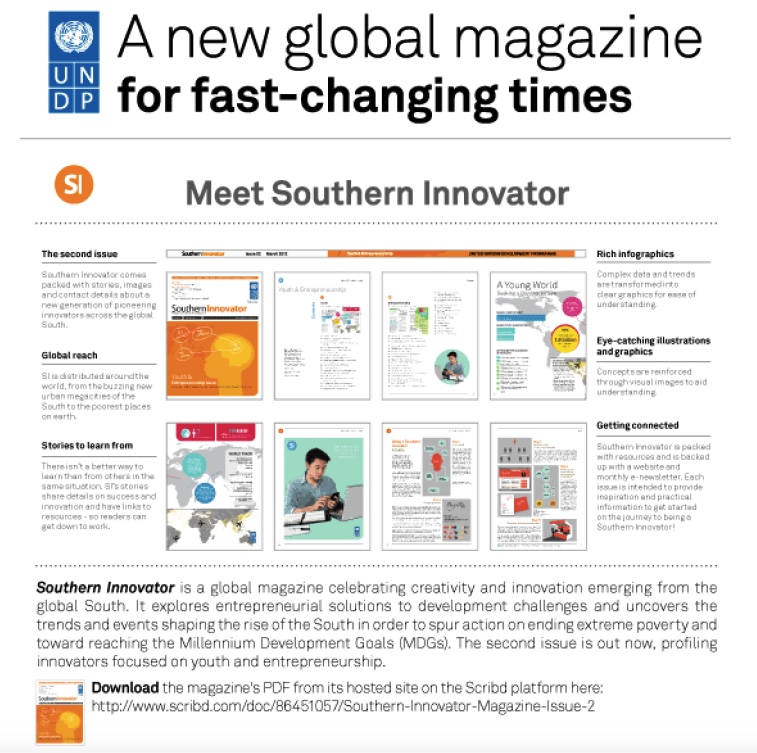
Development Challenges, South-South Solutions was launched as an e-newsletter in 2006 by UNDP’s South-South Cooperation Unit (now the United Nations Office for South-South Cooperation) based in New York, USA. It led on profiling the rise of the global South as an economic powerhouse and was one of the first regular publications to champion the global South’s innovators, entrepreneurs, and pioneers. It tracked the key trends that are now so profoundly reshaping how development is seen and done. This includes the rapid take-up of mobile phones and information technology in the global South (as profiled in the first issue of magazine Southern Innovator), the move to becoming a majority urban world, a growing global innovator culture, and the plethora of solutions being developed in the global South to tackle its problems and improve living conditions and boost human development. The success of the e-newsletter led to the launch of the magazine Southern Innovator. 
Creative Commons License

This work is licensed under a
Creative Commons Attribution-Noncommercial-No Derivative Works 3.0 License.

ORCID iD: https://orcid.org/0000-0001-5311-1052.

© David South Consulting 2023

Categories
Archive Development Challenges, South-South Solutions Newsletters

Floating Bank Floats New Dreams for Brazilian Middle Class

By David SouthDevelopment Challenges, South-South Solutions

SOUTH-SOUTH CASE STUDY

Brazil’s booming economy has seen a dramatic increase in the size of its middle class. More and more people have been lifted out of poverty as a growing, stable economy overcomes years of political and economic instability. In 2010, Brazil’s economy grew by a record 7.5 percent, surpassing a previous peak in 1986 (Brazilian Institute of Geography and Statistics) (IBGE) (www.ibge.gov.br/english). The country’s gross domestic product (GDP) reached 3.67 trillion reais (US $2.21 trillion) in 2010, making it Latin America’s largest economy.

This strong growth is being fuelled by growing domestic demand in Brazil.

One key component in building personal wealth is the ability to save and bank. It is common across the global South for the poor and lower middle classes to be ignored by traditional banking services.

Freezing large numbers of people out of banking services is a double problem. Individuals are being denied a safe way to store and grow wealth and borrow to improve their economic situation, and the wider economy suffers because many millions are left out of the mainstream economy and can neither consume high-value products nor use services beyond those that meet the basic needs of daily survival.

This leaves many economies experiencing what can be described as a whirlpool effect: wealth spiralling around small clusters of people – for example those with privileged access to natural resources – but failing to spread across the whole of society. This has the effect of discounting the contribution made by the majority of a nation’s people. That majority is a market that needs tending to, not ignoring, as pioneers like the late C.K. Prahalad (http://en.wikipedia.org/wiki/C._K._Prahalad) have shown.

In Brazil, one major bank has woken up to this fact and is pioneering services for millions of the nation’s “unbanked” (http://en.wikipedia.org/wiki/Unbanked). Even wealthy countries like the United States have large numbers of unbanked people, often those living paycheck to paycheck and with little or no savings. In the US in 2009, 7.7 percent of the population fell into this category (Federal Deposit Insurance Corporation) (FDIC).

Banco Bradesco SA (www.bradesco.com.br) has pioneered reaching the poor and marginalised by opening branches in long-neglected places like the impoverished and crime-ridden shanty town favelas (http://en.wikipedia.org/wiki/Favela) that surround major cities like Rio de Janeiro and Sao Paulo. It is creating a path other businesses can follow.

“Every bank will care about these people eventually,” Odair Rebelato, the executive heading Bradesco’s retail banking outreach programme, told The Wall Street Journal.

According to FEBRABAN (http://www.febraban.org.br), the Brazilian Banking Federation, the number of bank accounts in the country has tripled in the past decade. It has surged from 42 million in 1997, to 126 million by the end of 2008. That still leaves around 50 million Brazilians who do not have bank accounts.

It’s not just poverty that cuts many Brazilians off from banking services – there is also the problem of isolation.

Brazil is home to the largest portion of the vast Amazon rainforest (http://en.wikipedia.org/wiki/Amazon_Rainforest), whose population is spread out in isolated villages reachable only by boat. The capital of Amazonas state, Manaus, is the economic hub of the region but transport links only connect it to major cities and not the region’s many isolated villages.

A solution to both problems comes in the form of Bradesco bank’s Voyager III, a three-deck riverboat converted into a floating bank. Launched in November 2010, the white-and-blue 38 metre riverboat ventures up the Solimões River on a journey to 50 isolated communities in 11 municipalities.

“It was something never seen before in the world – a floating branch,” Nézio Vieira, a Bradesco bank manager in São Paulo, told Monocle magazine. “We are now present in 100 per cent of Brazil’s municipalities.”

Luzia Moraes is a former housewife and now the manager of the Voyager III’s floating bank. The bank offers savings and checking accounts, personal loans and direct deposits. Most of the customers are public servants, pensioners and the poor.

It is a simple operation: a red banner is hung in a cramped former storeroom on the boat. Sitting behind a desk, Moraes has just three tools to offer the full banking services: a laptop computer, a printer and an automated teller machine.

Enterprising and adventures, Moraes even uses canoes and rafts to reach out from the riverboat to even remoter villages.

“Before, there were cases where people would take 10 to 12 hours by boat to get to a bank. It wasn’t worth it,” Vieira said. “To be able to serve these river-dwellers you need to go to them. Today the Voyager goes there.”

The Voyager III has signed up more than 1,000 new account holders by touring the river. It heads off every two weeks from Manaus, reaching as far as a remote town on the border with Colombia and Peru, Tabatinga.

The boat’s computers communicate with a satellite, allowing 24-hour access to the bank’s servers so people can access accounts and apply for loans.

A regional lifeblood, the Voyager III also carries 500 tons of beans, chicken, bleach and other goods to sell on the 1,609 kilometre river journey. The boat can carry around 200 passengers for the trip.

“People don’t know what to think,” Moraes told The Wall Street Journal, “but it’s not hard to explain that a bank can make things easier.”

Published: May 2011

Resources

1) Kenya’s Equity Bank: By offering Kenya’s poor people savings accounts and microloans, Equity Bank has captured 50 percent of the Kenyan bank market. Website: http://www.equitybank.co.ke

2) Safaricom M-PESA: Mobile phone banking in Kenya is proving highly successful. Customers can deposit, transfer and withdraw money using their mobile phones. Website: http://www.safaricom.co.ke/index.php?id=123

https://davidsouthconsulting.org/2022/10/21/african-media-changing-to-reach-growing-middle-class/

https://davidsouthconsulting.org/2021/08/29/brazilian-design-for-new-urban-middle-class-world/

https://davidsouthconsulting.org/2022/10/20/global-souths-middle-class-is-increasing-prosperity/

https://davidsouthconsulting.org/2022/11/15/indonesian-middle-class-recycle-wealth-back-into-domestic-economy/

Development Challenges, South-South Solutions was launched as an e-newsletter in 2006 by UNDP’s South-South Cooperation Unit (now the United Nations Office for South-South Cooperation) based in New York, USA. It led on profiling the rise of the global South as an economic powerhouse and was one of the first regular publications to champion the global South’s innovators, entrepreneurs, and pioneers. It tracked the key trends that are now so profoundly reshaping how development is seen and done. This includes the rapid take-up of mobile phones and information technology in the global South (as profiled in the first issue of magazine Southern Innovator), the move to becoming a majority urban world, a growing global innovator culture, and the plethora of solutions being developed in the global South to tackle its problems and improve living conditions and boost human development. The success of the e-newsletter led to the launch of the magazine Southern Innovator. 

https://davidsouthconsulting.org/2021/03/05/southern-innovator-issue-2/

Creative Commons License

This work is licensed under a
Creative Commons Attribution-Noncommercial-No Derivative Works 3.0 License.

ORCID iD: https://orcid.org/0000-0001-5311-1052.

© David South Consulting 2023