It’s search and destroy time at Ontario’s ministry of health: search out savings and destroy inefficiency and waste. But many remain apprehensive that not all the cuts are going to be logical and fear the province’s health and well-being will be affected.
As part of the social contract deal, the Ontario Medical Association must find $20 million in cuts from the list of services covered by OHIP. The OMA and the provincial government are currently haggling over which procedures and examinations will be cut.
“We look at services that aren’t medically necessary,” says health ministry spokesperson Layne Verbeek. “Because we were wealthier in the past, we were able to cover some services. We aren’t in that position now. But I don’t see how eliminating medically unnecessary treatments will affect the population.”
The fallout of the Rae government’s attempts to reign in costs and recover lost revenues may take years to unfold, but it is already apparent that Ontarians will be paying more.
“Access to necessary treatment should not depend on a person’s ability to pay,” says health policy critic Carol Kushner. “What disturbs me about any delisting program is that virtually every medical service could be termed medially necessary. There are very few services that are an out-and-out waste of time.
“We often point to the fact that Ontario spends $200 million a year treating the common cold. Well, most of that is a waste of time. But delisting even that kind of service would be a detriment to the public’s health, because a small group of patients really do need to see a doctor when they have a cold.”
OMA spokesperson Jean Chow says it’s too early to pin down the exact cuts that will be made. “It’s a little premature to try and speculate what the final list will be.”
The newly-created Non-Tax Revenue Group is hard at work finding fees, fines and penalities the government can add or hike to boost revenue from this source from $5 billion to $10 billion a year.
The spring budget saw the first hit, with the addition of $240 million in non-tax revenue.
A radical reshaping of medicare is taking place. Private sector services – for which consumers pay directly or through insurance companies – now make up 34 per cent of Ontario’s health care funding, compared to 42 per cent in the United States, according to a recent study by the Canadian Medical Association.
Health minister Ruth Grier has also floated the idea of widespread hospital closures. Both the Toronto and Windsor district health councils (DHCs) are carrying out feasibility studies on “reconfiguration.” The ministry is remaining tight-lipped about which hospitals will get the chop.
“One suspects there’s room for efficiency – there are a lot of empty beds in a number of different places,” says ministry spokesperson Verbeek.
“All hospitals are being reviewed, with a view to closing one or two hospitals,” says health planner Lisa Paolatto, who is working on a feasibility study on “reconfiguration” for the Essex County District Health Council, along with Toronto’s DHC.
Closing hospitals could present a serious political hot potato for the government. In Britain, the Conservative government is still recovering from the bad feelings surrounding proposals to close world-renowned hospitals in the London area. The public feels great loyalty to local hospitals, a feeling that has been further fostered by hospital charities that raise millions a year from the communities’ good will.
“This is going to open up new discussions of money between doctors and patients,” says Kushner. “Seniors are a unique group in Canada because they remember what it was like before medicare – what it was like not to be able to pay for the doctor, to forgo treatment that they thought was necessary. They understand the financial hardship that could occur if they were unlucky enough to have a family member who needs expensive medical treatment.”
Canadian troops are not only on the frontline of peacekeeping in Haiti but also the frontline of U.S. foreign policy – a policy that is unravelling during the run-up to the November 5 presidential election. While the living standards of Haitians in the poorest country in the Western Hemisphere continue to decline despite free elections, Canadian troops are charged with keeping the island nation peaceful. It’s a task that is proving more and more difficult as Haiti suffers a crime wave and violent political unrest.
While American president Bill Clinton tries to snatch another victory from a grumpy U.S. electorate, his advisors are desperately trying to keep the lid on his foreign policy “victories” in Bosnia and Haiti.
Things are so bad, Clinton sent his secretary of state, Strobe Talbott, and his national security advisor, Anthony Lake, to Haiti on August 30 in response to high-profile assassinations of right-wing leaders.
“The administration are hoping, with fingers crossed, nothing will happen before November 5,” says Larry Birn of the Washington-based Centre for Hemispheric Affairs. “What the United States would like to do is cryogenically freeze all its foreign policy engagements so they don’t produce any problems. But we are losing very valuable time in Haiti because of Washington’s paralysis over negative developments occurring there.
“Washington didn’t realize an economic success story had to be bred there in a couple of years. The USAID programme is a scandal waiting for an investigation.”
There is also another election-year factor: Republicans are not fond of anything that whiffs of a humanitarian approach to Haiti. Since they dominate Congress, this is also Clinton’s problem.
Given the history of American support for dictatorships in Haiti, the Clinton administration has chosen a low-key approach. After the 1994 invasion, the Americans pulled out the vast majority of their troops within a year, handing over responsibility for internal security to a UN peacekeeping force. But the U.S. never fully cut itself off from interfering in Haiti, keeping a military base operating in the country’s only industrial park in Port-au-Prince.
And Canada is key to U.S. plans because of that sour legacy. Canadians are seen as free from the burden of colonialism, and as a plus, our 700 mostly French-speaking troops can communicate better with the local population.
This policy has gone as far as hiring a Canadian public relations company to promote structural adjustment programmes that are conditional upon Haiti receiving any foreign aid from the International Monetary Fund and the World Bank, both based in Washington.
Gilles Morin is co-ordinating manager for Montreal firm Gervais-Gagnon-Covington Associates, who won the contract. Morin says, while his company did win the contract, like many other things to do with Haiti, they have heard nothing since Fall 1995 because of disorganization.
“On a personal basis there was a strong anti-American feeling among the population because of the past,” says Morin. “A lot of the financial institutions are based in Washington and they needed international support because banks in Washington are seen as American.”
But there is a risk that a switch in U.S. priorities during the heat of an election will endanger Canadian troops.
“If the president feels he has political risk in Haiti, he’s not going to take Canadian concerns into consideration,” warns Birns. “The UN mission gets caught up in the wake of U.S. efforts and it’s not able to define an independent course. Right now, the problem really is the USAID mission in Haiti is a total failure. The international donor function, you couldn’t exaggerate how disappointing it’s been in terms of almost no relief. The unemployment rate of 80 per cent is exactly what the unemployment rate was when the UN arrived.”
On August 28, American troops from the 82nd Airborne plopped down on the streets of Port-au-Prince to spend a week patrolling. Many observers questioned the motives for this intervention. Was it to say to Haitians the UN isn’t the real deal, and if they get out of line, the Americans will kick their butts? Why doesn’t Canada protest the U.S. undermining the credibility of our peacekeeping mission?
To Birn, sending in the 82nd was the foreign-policy equivalent of fast-food. “Sending in the 82nd Airborne merely aimed at getting a one-day headline,” he says. “The administration’s position has been staked on the fact there has been a number of foreign policy wins. But each of these victories is held together by corn starch and could unravel at any moment.”
Birn sees an escalation in political violence just around the corner. He fears the current economic crisis will help the formation of a violent left-wing guerrilla movement to rival existing right-wing paramilitaries.
“Without former president Jean Bertrand Aristide,” he explains, “there is growing apprehension that president Rene Preval will not be able to project a sufficient leadership to keep the average Haitian, who is sacrificing with no expectation of an improved standard of living, happy.”
While it has been almost two years since Haiti was the media’s darling, observers point out the cycle of violence has returned to the country’s streets despite the presence of UN peacekeepers and American troops.
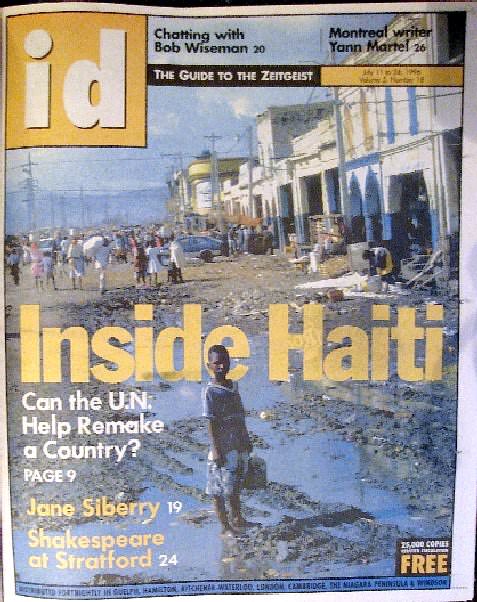
When id reported from the Haitian capital of Port-au-Prince in July (id July 11 to 24, Number 18), it was obvious no progress had been made to improve the standard of living or rebuild the country’s crumbling infrastructure.
In an ironic twist, attempts to step up deportations of Haitian-Americans convicted of crimes in the U.S. has led to an increase in killings in Haiti according to the October 22 issue of New York weekly, The Village Voice.
More and more, the UN troops are propping up an increasingly unpopular government. A government that is seen by many Haitians to be getting its orders from Washington, not Port-au-Prince. Canadian troops lead the UN mission in Haiti and make up 700 of the 1500 soldiers stationed there (the rest are from Pakistan and Bangladesh).
There is a serious danger Canadian troops will be caught in the crossfire of any uprising or coup attempt, since Canadian troops shadow president Rene Preval 24 hours a day and also guard the National Palace, which was attacked August 20, killing two Haitians.
“U.S. Elections Update: Clinton is using Canada to control Haiti”.
Paper delivered to the School of Politics and Government, Birkbeck College, University of London, London, UK, 2000
“… the neo-liberal claim that transition is most successful in situations where state organs wither away is highly problematic. The state, it seems, is required as a fundamental regulatory formation in transition (Pickles and Smith 1998: 15).”
This paper will explore the profound weaknesses of economic liberalisation as a tool of poverty reduction in the developing world. I have chosen to explore the experience of the Northeast Asian nation of Mongolia; a country sandwiched between Russia and China which has been held up as an example of how economic liberalisation policies and strong personal freedoms can help a country make the transition from a command-based Communist country to free markets and democracy (UNDP Mongolia: The Guide 1997-1999). I argue that the slate of policies that constitute economic liberalisation (or “shock therapy”) in the 1990s – privatisation, price liberalisation and a free-floating currency – are, by themselves, poor mechanisms for the alleviation of poverty; that in fact they increase poverty rates and leave a legacy of weak institutions that are either unwilling to, or incapable of, helping the poor. The author will also draw on firsthand evidence gained while working in the United Nations mission in Mongolia for two years.
Economic liberalisation policies have been inhibited from alleviating poverty by the cultural legacy of Mongolia’s economic development, which has de-emphasised private property and a money-based economy and placed a high emphasis on wealth being held in herds of animals and goods exchanged by barter.
Mongolia, with its relative isolation and small population of 2.4 million (Human Development Report Mongolia 2000: 55), has been seen as a self-contained petri dish by economic liberalisers hoping to incubate a robust transition to free markets and democracy that can serve as an example to other post-Communist states.
Mongolia’s journey towards neo-liberal ideas is unique. Unlike many other developing nations, Mongolia’s lively democratic movement that emerged at the end of the 1980s actively sought out these policies, and has enjoyed strong and widespread public support for them (though this has ebbed and flowed with the economic fortunes of the country). The 1996 election was fought and won by the Democratic Coalition based on these policies; the Coalition won 50 of the 76 seats in Mongolia’s parliament, and voter turnout was more than 90 per cent (Far Eastern Economic Review 1997: March 27). Thus, this is not a case of international institutions forcing upon a country policies against its wishes: the door was opened and the economic liberalisers were effectively invited in for a big bowl of fermented mare’s milk.
However, it is also a country in which economic liberalisation has failed to deliver anticipated reductions in poverty for the majority of the population, and a strong case exists that it has made things worse.
As the Human Development Report Mongolia 2000 states:
In recent years however, the predominant vision has been neo-liberal. Backed by some international donors, reformers have argued that the best thing the state can do is to largely withdraw from the economy – by rapidly privatising state enterprises, and dismantling as many regulations and controls as possible, and allowing market forces to determine the production and allocation of goods and services. (Human Development Report Mongolia 2000: 13)
Liberalisation policies in Mongolia: A potted history
With the fall of the Soviet Union at the beginning of the 1990s, Mongolia woke up to find itself without its financial benefactor for most of the 20th century, Russia, and in the grip of a severe economic decline (Rossabi 2000: 9).
But a new “big brother” was at hand. In 1991, economic liberaliser Jeffrey Sachs arrived in Mongolia (Fortune 1998: December 7). The arrival of Sachs and his ideas were to have a profound impact on the lives of Mongolians. He gathered a group of well-educated Mongolian economists to test economic liberalisation theories.
Smith and Swain neatly summerise the source of economic ideas for the transition states:
The roles played by Francis Fukuyama (1992), formerly of the US State Department, and Jeffrey Sachs (1990), as policy adviser … translated this agenda into the all too familiar programme of so-called ‘shock therapy’. Shock therapy has been based on the view that capitalism could be … imposed by fiat and that the unleashing of the power of capital will inevitably allow the institutions, regulations, habits and practices associated with the ‘normal’ functioning of a capitalist market economy to emerge (Smith and Swain 1998)
The economic liberalisation project in Mongolia can be split into two distinct phases. The first more tentative phase under the Communist government extended from 1990 to 1992 and included privatisation of some state firms, the issuing of stock-market vouchers to most of the population and a failed attempt to enter the foreign currency markets (as a result of which 80 per cent of the country’s reserves were lost). This phase coincided with a new constitution, democratic elections and significant improvements in personal freedoms.
The economic liberalisation project encountered serious difficulties from the start, and when all aid and subsidies from the Soviet Union were removed, the economy collapsed, with inflation spiralling to 320 per cent (Human Development Report Mongolia 2000: 13). Pro-economic liberalisation factions in the Communist government lost influence and the reforms stalled from 1992 until 1996, when they were re-started with a vengeance with the election of the Democratic Coalition. The Coalition was assembled from a hitherto fragmented opposition by the Washington-based International Republican Institute and mimicked the policies of the American Republican Party, including distributing a Newt Gingrich-style “Contract with the Mongolian Voter.”
The second phase of reforms, under Democratic Coalition Prime Minister M. Enkhsaikhan, was launched with the removal of price controls on fuel and electricity, increasing prices by 50 per cent (Rossabi 2000: 11). This phase of economic liberalisation also ran into difficulties, but its most successful policy achievements have been the privatisation of public housing, the removal of trade tariffs and the reining in of inflation.
Poverty and economic liberalisation
Prior to the introduction of economic liberalisation, there was no extreme poverty in Mongolia, though it is difficult to gauge relative poverty since this information was not gathered. Rossabi notes, however, an extensive public welfare system was spread throughout the country:
The Mongol economy required substantial subsidies from the Soviet Union. This command economy produced inefficient industries, few consumer goods, and scant increases in the size of the Mongol herds. The one-party system limited dissent and contributed to human rights abuses. On the other hand, the government provided extensive medical, educational, and welfare benefits to the young, women, the elderly, and indeed much of society. A growth in population, a longer life span, and high rate of literacy were byproducts of such state policies. (Rossabi 2000: 6)
All research data has shown an increase in poverty levels for a large portion of the population after 1990. Estimates vary wildly, but the United Nations Development Programme reports that 38.4 per cent of urban dwellers – and 32.6 per cent of rural residents – were poor in 1998 (Human Development Report Mongolia 2000: 23). School attendance is down, regional disparities have become more extreme, with the capital experiencing a boom fuelled by international aid (this totalled US $180 million in 1998 (Mongolia Update 1999: 27) and an expanding service sector. Provincial towns and smaller communities have seen local state-run businesses collapse, communications weaken, and a leaching of the population, either to the countryside to herd animals or to the capital to seek work.
To cite one graphic anecdotal example of the process, a consulant for the Asian Development Bank told a 1998 donor agencies meeting of the irony of going into former factory towns, and telling the well-educated residents to turn to small crafts and itinerant vegetable growing rather than restarting the existing factory.
Mongolia’s transition: theoretical dilemmas
As Pickles and Smith note in their work of political economy Theorising Transition: the Political Economy of Post-Communist Transformations, it is a profound mistake to ignore the distinctive evolution of each of the former Communist states. Mongolia’s attempts at transition to a market economy have been deeply marked by its cultural legacy, in spite of attempts to transcend this. While Ohmae may assert that “This movement up the ladder of development has nothing to do with culture and everything to do with the region’s ability to put the right policies, institutions, and infrastructure in place at the right time (Ohmae 1994: 21),” culture is crucial. It is simplistic to depend on a “stock set of policies to enable the supposed transition to capitalism at the end of the twentieth century to be achieved (Pickles and Smith 1998: 10).”
As Pickles and Smith add about post-Communist Eastern Europe:
Treating post-communist Eastern Europe as a whole fails to recognise the ever-present diversity of some 27 states and 270 million people. Even at the end of the nineteenth century, such political-economic diversity was central to what was unfolding in the region … The diversity of historical experiences was replicated under state socialism, and while we would not argue for some form of historical determination, the state socialist economy in part relied upon these spatial divisions of labour and forms of social organization and institutionalised practices, albeit that large-scale attempts at forced industrialisation were made to eradicate the legacies of ‘peasant societies’ and uneven capitalist development. (Pickles and Smith 1998: 12)
Historically, Mongolia had never experienced capitalism, even in its most basic and embryonic form. Prior to the 1921 revolution which made Mongolia the world’s second Communist country, the vast majority of its citizens were divided between two occupations: nomadic herding, and the herding of souls as Buddhist monks. There was a small trading community, including a tiny community of Jewish traders – a legacy of the long-gone silk route that once plied its way through the Mongol Empire. But modern, urban, industrial capitalism as was present at this time in Europe was nonexistent in Mongolia. Concepts of capitalism, market economics and private property were introduced anew after 1990.
Urbanisation, modernisation and industrialisation were wholly communist concepts in Mongolia prior to 1990. The traditional nomadic way of life measures wealth in terms of the size of the herd and places a high value on the ability to roam unencumbered by private property divisions and the ability to trade animals for other goods (though these needs are simple since a nomadic herder can only carry around a limited quantity of possessions).
Economic liberalisation policies have, ironically, only exacerbated this trend, driving more of the economy into barter relations and actually pushing a portion of the population out of urban areas and into subsistance herding in order to survive (Partnership for Progress 1998: 2-3).
Mongolia also offers some anomalies to theories of economic and democratic liberalisation. Lewis contends that democracy gives a nation a distinct economic advantage. “Average wealth, the degree of industrialisation and urbanisation and level of education are perceived to be much higher for countries which are democratic, education being of particular importance in this respect (Lewis: 1997).”
Yet as Fortune magazine noted, “No other Asian country enjoys more political freedom today than Mongolia. And no other Asian country has shown greater commitment to open markets. But Mongolia has received little reward for its efforts (Fortune 1998: December 7).”
The role of the state
Broad, Cavanagh and Bello see a strong argument for clear state direction in underdeveloped economies in the beginning stages, before allowing market mechanisms to dominate:
The South Korean economy’s resumption of growth after a brief period of stagnation at the onset of the 1980s and Eastern Europe’s slowdown after rapid growth in the 1960s confirm a more complex truth than the purveyed by free-market ideologues. Communist economies may propel societies through the first stages of development, but further growth into a more sophisticated economy necessitates a greater role for market mechanisms. (Broad/Bello/Cavanagh 2000: 392)
Strong state direction in economic development has been abandoned in Mongolia (it remains to be seen whether the re-election of the former Communist party in the summer of 2000 will alter this), and it can be argued that the over-dependence on market mechanisms has been premature.
In fact, “the neo-liberal claim that transition is most successful in situations where state organs wither away is highly problematic. The state, it seems, is required as a fundamental regulatory formation in transition (Pickles and Smith 1998: 15).”
The absence of this regulation in Mongolia means that where once economic transactions were transparent, they have now gone underground. The example of cashmere exports (one of the country’s major foreign-currency earners) is particularly interesting. In 1998 the Mongolian government, faced with ever-dwindling tax revenues, introduced a tax on cashmere exports, ostensibly to protect the domestic cashmere-manufacturing industry. Whatever the true intention, the result was catastrophic for government revenues. Recorded exports fell by more than 98 per cent, to US $306,000 in 1998 from US $16 million in 1997 (Far Eastern Economic Review: 1999). The trade went underground and a handful of customs officials could not make a dent in a border as vast as Mongolia’s. It is a graphic example of how weak the central government had become, unable to raise revenues when necessary.
Economic liberalisation also tends to pull economic activity into the capital, as has been witnessed across the transition states. Centrifugal forces leave great swathes of poverty in rural areas and drain marginal urban centres of their skilled workers (Pickles and Smith 1998: 17). Mongolia is no exception to this pattern (Rossabi 2000: 10).
Forces outside the market
After investigating the role economic liberalisers in non-communist developing nations, Robert Bates found that market-oriented economists routinely overlook the role politics and political power plays in wealth distribution:
One reason that market-oriented economists tend to deny the centrality of politics to the development process is that they tend to discount problems of distribution. Those who adhere to the efficiency-and-growth position counter that if development produces a maldistribution of income, those who are losers in the short run could become winners in the longer run … From this viewpoint, governments are not just irrelevant to the development process, the actually impede it. (Bates 1988: 239-240)
There is scant contemporary research into the role of clan or family elites in modern Mongolia, but Rossabi, a Mongolia historian, believes they wield significant influence to this day, and have glided from communism to capitalism with ease (Rossabi 2000: 12). He asks, “Has there been sufficient turnover in the political elite, or does it represent the same consitutency as in the past? Has it expanded sufficiently to make itself more broadly representative of the Mongol population, including the herders and the countryside in general?”
In search of a purpose
Mongolia today is undergoing a basic economic dilemma familiar to Ricardo. It is at once transforming political and economic relations while also exploring what advantages it has to offer to the world markets, that old chestnut of absolute and comparative advantage. To date, its absolute advantage has been to be the source of raw materials, the two key foreign currency earners being copper and cashmere wool (Human Development Report Mongolia 2000: 30).
Its large herds of animals (some 34 million) are under-utilised as foreign-currency earners, and for the most part provide food for domestic consumption. One of the main reasons for this has been the rudimentary livestock techniques that exclude these vast meat and dairy resources from foreign markets (while the herds are raised without any use of chemicals, there is no quality control – a service once provided by the state before 1990). The distortions to the economy caused by these policies are highlighted in the Gross Domestic Product (GDP). In 1985, agriculture accounted for 14.3 per cent of GDP, and industry was 31.8 per cent. By 1998, agriculture (now mostly nomadic herding) accounted for 32.8 per cent of GDP and industry shrank to 24.1 per cent (Human Development Report Mongolia 2000: 56). The economy had contracted and was more focused on meeting basic domestic food needs.
Mongolia has a number of strengths it can draw on, however, with its impressive steps at building democracy and personal freedom chief among them. Lewis categorises former communist states into two groups, with group two taking an undemocratic route. Mongolia would rank in group one, since these countries have: “relatively rapidly established a reasonably viable constitutional order and multiparty system, having held free elections, seen unequivocal changes of government and generally established civil liberties (Lewis: 1997).”
The economic model used by the Democratic Coalition was the United States; Mongolia’s new leaders, dismissed other Asian nations – with their stoic, thrifty populations taking direction from the state – as poor examples for Mongolia. Like the US, Mongolia’s nomadic heritage values freedom and individual effort over the state, assert government advisers such as Tserenpuntsag Batbold, an economic adviser to the Mongolian prime minister’s office.
Batbold is sanguine about finding a purpose for the country’s economy: “I’m always thinking about this, but I can’t give you an answer. This is exactly why we have to create a nondistortive economic environment, one which will show us the true comparative advantages of this nation (Asian Wall Street Journal 1997: May 27).”
Yet the process has been a difficult one. At a June 1998 international investors’ conference in Ulaanbaatar, the World Bank variously called Mongolia the “gateway to Russia”, the “gateway to China”, and the “gateway to Central Asia” (UB Post: 1998), giving the impression that both the global institutions and the Mongolian government would try anything in a desperate search for a purpose for the country’s economy. In fact, efforts in the 1990s to attract foreign direct investment (FDI) have not been fruitful. In 1999, FDI stood at US $70 million; it was US $200 million for all of the 1990s (Human Development Report Mongolia 2000). The belief that foreign private companies would pay for the country’s infrastructure improvements has run up against a wall: most foreign companies find it hard to see the benefits in investing in a country that only has a market of 2.4 million people and very high start-up costs.
By 1998, even Sachs was striking a pessimistic note. He told Fortune magazine he disagreed with the pace of reforms and insisted infrastructure improvements – more roads, improved livestock breeding, investment in information technology – were the only things that would improve the country’s economy (Fortune 1998: December 7).
Conclusion
Political power in Mongolia has switched from the hegemonic control of the Communist Party (and its overlords in Moscow) to be dispersed amongst a plethora of actors, including international aid organizations. Economic liberalisation has destroyed the state’s ability to guarantee a minimum standard of living. However, it has also expanded the number of small businesses in the country, and the GNP generated from the private sector has grown from 10 per cent of the total in 1990 to 64 per cent in 1999 (Human Development Report Mongolia 2000: 31). In spite of this, poverty rates remain stubbornly high, undermining assertions that free markets alone will generate wealth for the disadvantaged.
Unfortunately, Mongolia has significantly misdiagnosed the origins of prosperity in its current role model, the United States. Economic liberalisation policies cling to simplistic notions of the evolution of capitalist markets in the US, ignoring the complex relationship between state-funded or regulated infrastructure development and economic growth. Post-communist countries have been ill-advised on what policies will actually reduce poverty rates. These societies do not fit into conventional ideas of underdevelopment; on the whole their populations are highly literate and skilled. While products produced by these countries may not be able to compete head-on with more technologically sophisticated equivalents in Western markets, there is little evidence that wholesale destruction of these industries will spurn economic growth and reduce poverty.
Expertise: Crisis leadership, mission leadership, strategy, communications, web strategy, digital media, crisis recovery, public health, Northeast Asia, UN system.
Location: Ulaanbaatar, Mongolia 1997 to 1999
UN/UNDP Mongolia Communications Coordinator:David South
The question posed itself from the start of the assignment: In the middle of a major crisis, is it possible to recover quickly while simultaneously growing and modernizing the United Nations mission (this was the dawn of the digital revolution)? It was only possible by teaching and mentoring colleagues, offering leadership, vision, strategy, and practical actions to get there – all with a budget and mandate for two years.
The mission had to tackle in particular, three, severe crises: the country’s turbulent transition from Communism to free markets and democracy, the social and economic crash this caused, and, later in 1997, the Asian Financial Crisis (Pomfret 2000)* – all combined with the political instability this exacerbated. Richard Pomfret said in 1994, “In 1991 Mongolia suffered one of the biggest peacetime economic collapses ever (Mongolia’s Economic Reforms: Background, Content and Prospects, Richard Pomfret, University of Adelaide, 1994).” From Curbing Corruption in Asia: A Comparative Study of Six Countries by Jon S. T. Quah: “The combined effect of these three shocks was devastating as ‘Mongolia suffered the most serious peacetime economic collapse any nation has faced during this century’. Indeed, Mongolia’s economic collapse ‘was possibly the greatest of all the (peaceful) formerly’” Communist countries.
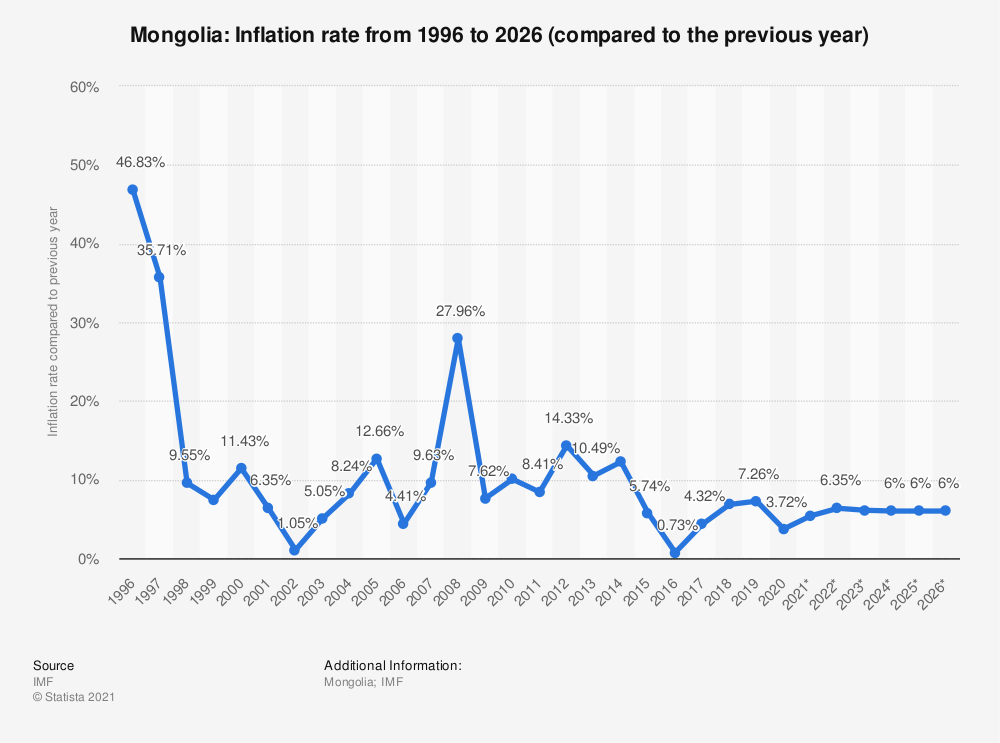
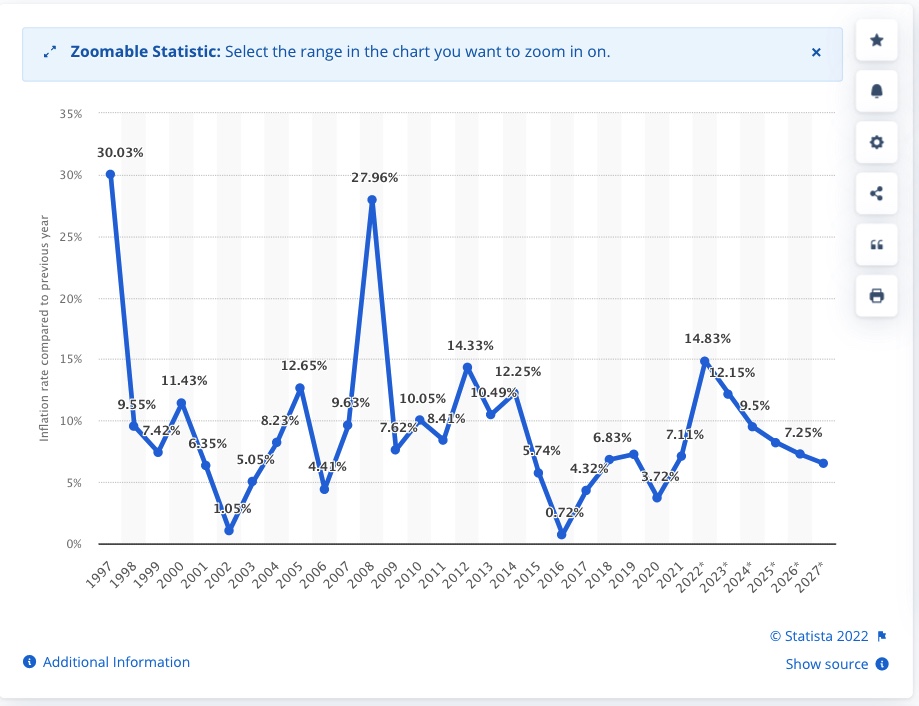
A dramatic decline in inflation paired with political and economic stabilisation allowed Mongolia to enjoy the fruits of the fast-growing economies of the 2000s. Source: Statista.
During the last 16 years the financial and monetary system of our country saw the worst crisis in 1991-1994, there was a recovery in 1995-1997 and another crisis in 1997-1999. However, it has entered a stable stage since 2000.
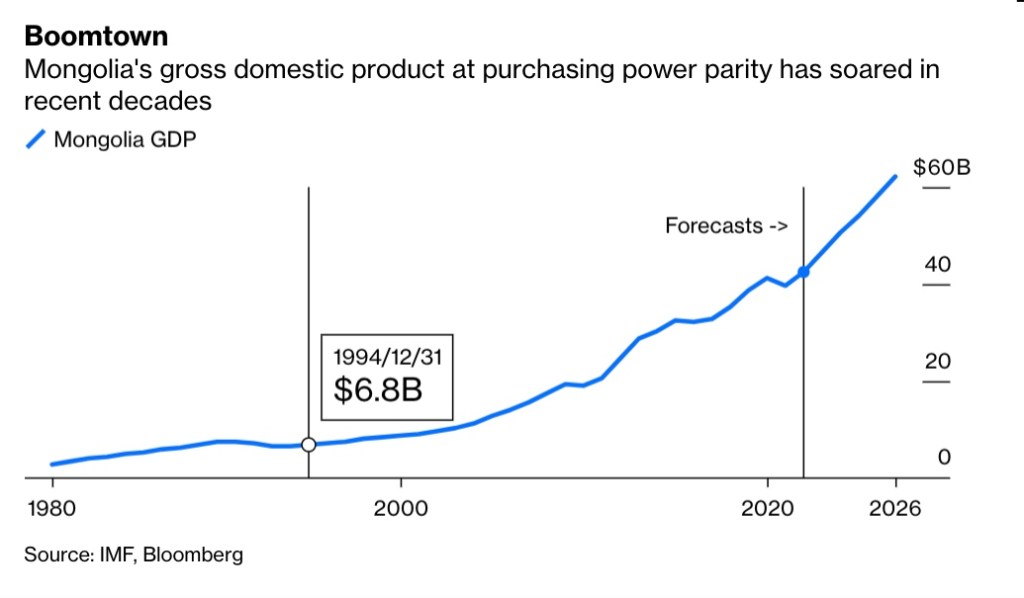
A resources “boomtown” throughout the 2000s. Source: Bloomberg. When I left in 1999, Mongolia’s PPP was US $8.8 bn; today (2021) it is US $42.4 bn. Graph from Migration under economic transition and changing climate in Mongolia, Journal of Arid Environments, Volume 185, February 2021. “Urbanization in Mongolia accounted for over 80% of all migration, mostly into the capital city Ulaanbaatar (UB), where nearly 70% of recent population growth was from migration.” As can be seen in this chart, Mongolia’s economic growth since 2000 has benefited greatly from its proximity to China.
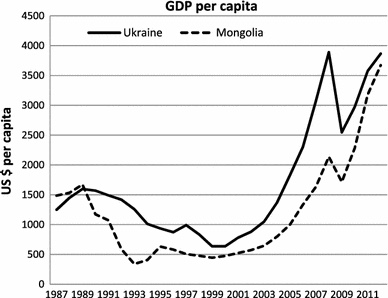
As this chart shows, increasing connectivity had a profound impact on living standards in Ukraine and Mongolia post-2000. The extreme turbulence Mongolia experienced in the 1990s – after the collapse of support mechanisms from the Soviet Union – calmed down as Mongolia integrated with the global economy, especially a booming China. Read about my work in Ukraine here: UN Ukraine Web Development Experience | 2000.
The Economist: “Those free-trading Mongolians” was published Apr 24th 1997. I arrived in May of 1997 to find a country on the cusp of great and turbulent change.
In this role, I pioneered innovative uses of the Internet and digital resources to communicate the UN’s work and Mongolia’s unfolding crises. The UN called this work a “role model” for the wider UN and country offices. A survey of United Nations country office websites in 2000 ranked the UN Mongolia website I launched in 1997 and oversaw for two years (1997-1999), third best in the world, saying: “A UN System site. A very nice, complete, professional site. Lots of information, easily accessible and well laid out. The information is comprehensive and up-to-date. This is a model of what a UNDP CO web site should be.” (http://www.scribd.com/doc/274319690/UNDP-Mongolia-United-Nations-2000-Survey-of-Country-Office-Websites)
“The years 1998 and 1999 have been volatile ones for Mongolia, with revolving door governments, the assassination of a minister, emerging corruption, a banking scandal, in-fighting within the ruling Democratic Coalition, frequent paralysis within the Parliament, and disputes over the Constitution. Economically, the period was unstable and rife with controversies.” Mongolia in 1998 and 1999: Past, Present, and Future at the New Millennium by Sheldon R. Severinghaus, Asian Survey, Vol. 40, No. 1, A Survey of Asia in 1999 (Jan. – Feb., 2000). pp. 130-139 (Publisher: University of California)
As part of a strategic plan to raise awareness of Mongolia’s development challenges and to spur action on meeting them, a Communications Office was established for the UN mission in 1997 – a structure that is commonplace in UN missions today. The Office also led on digital communications, marking many firsts, from the first digital photo and video library, the first online magazine, the first web portal, the first online newsletter, and many other firsts. It gathered numerous stories on resilience in a crisis, and documented in data and storytelling the country’s development challenges, while introducing a transparent way of working and communicating unprecedented for the time (the country was still recovering from the state secrecy of its years under Communism), and led on modernizing communications in the country. Acting as a strategic hub, the Communications Office and its dynamic and talented team, were able to leverage the existing budget to spur action on many fronts, including:
I launched it in 1997 in the middle of a major crisis, and oversaw its expansion and development for two years. A pioneering digital resource, this award-winning United Nations Mongolia development web portal was singled out by UN headquarters in New York as an example of what a country office website should be like. It featured extensive resources in both Mongolian and English and also was home to the bilingual online magazine, Ger – Mongolia’s first web magazine. It can be viewed at www.archive.org and there is more at Wikipedia here: https://en.wikipedia.org/wiki/Ger_(magazine).
Media
Working with journalists and media both within Mongolia and outside, the Communications Office was able to significantly raise awareness of Mongolia and its development challenges. This was reflected in a substantial increase in media coverage of the country and in the numerous books and other publications that emerged post-1997. The book In Their Own Words: Selected Writings by Journalists on Mongolia, 1997-1999 (ISBN 99929-5-043-9) published by UNDP Mongolia archived the stories by theme.
Ger Magazine
Ger Magazine (the Mongolian word for home and traditional tent dwelling) was published as the country’s first e-magazine in 1998. There were four issues in total from 1998 to 2000. The launch issue was on the theme of youth in the transition. Mongolia was transitioning from Communism to free markets and democracy and this had been both an exhilarating time and a wrenching time for young people. The magazine drew on talented journalists from Mongolia and the handful of international journalists based there to create a mix of content, from stories about life adapting to free markets to stories on various aspects of Mongolian culture and life.
The second issue of the magazine proved particularly effective and inspiring, with its modern life theme and cover story on a thriving Mongolian fashion scene.
Archived issues of the magazine can be found at the Wayback Machine here: https://archive.org/. Just type in the UN Mongolia website address for the years 1997 to 1999: http://www.un-mongolia.mn.
An online survey of the state of Mongolia’s media and its history (www.pressreference.com/Ma-No/Mongolia.html), had this to say: “An interesting variation from some of the other publications available is Ger Magazine (published online with guidance from the United Nations Development Program, UNDP), which is concerned with Mongolian youth in cultural transition. The name of the magazine is meant to be ironic because a ger is the Mongolian word for yurt—a yurt being traditional nomadic housing—but the magazine is about urbanization and globalization of Mongolian youth.”
Blue Sky Bulletin
The Blue Sky Bulletin newsletter was launched in 1997 initially as a simple, photocopied handout. It quickly founds its purpose and its audience, becoming a key way to communicate what was happening in the country and a crucial resource for the global development community, scholars, the media and anyone trying to figure out what was happening in a crazy and chaotic time. It eschewed the typical ‘grip and grin’ content found in many development newsletters and instead offered stories, data and insights useful to anyone seeking to understand Mongolia’s development challenges. The Blue Sky Bulletin was distributed via email and by post and proved to be a popular and oft-cited resource on the country. The quality of its production also paralleled Mongolia’s growing capacity to publish to international standards, as desktop publishing software became available and printers switched to modern print technologies. The Blue Sky Bulletin evolved from a rough, newsprint black and white publication to becoming a glossy, full-colour, bilingual newsletter distributed around Mongolia and the world.
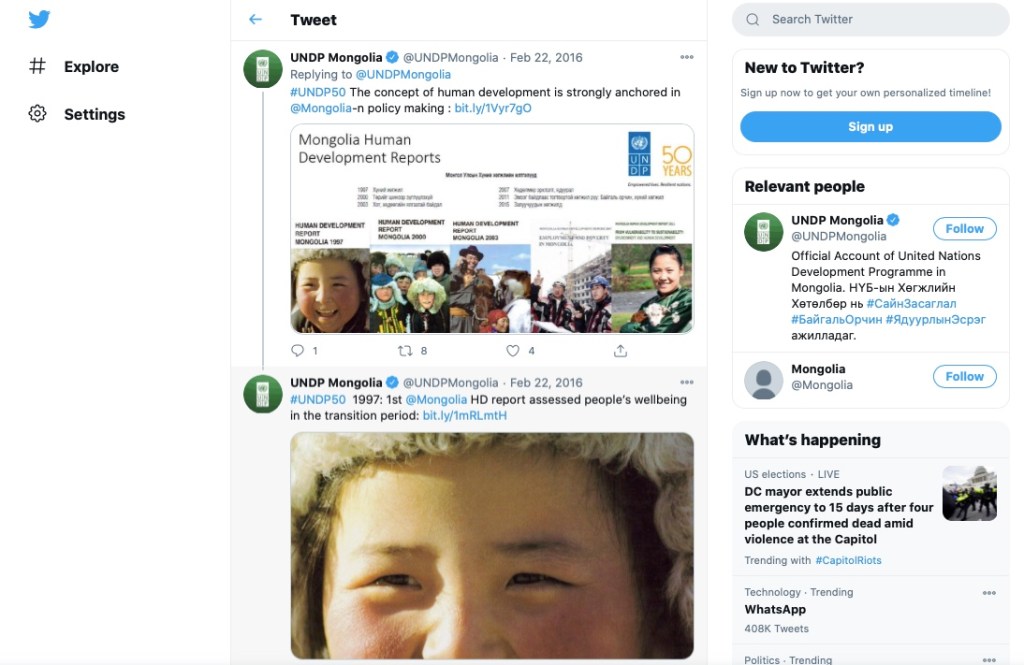
The Mongolian Human Development Report 1997 (MHDR), the country’s first, placed the story of the Mongolian people during the transition years (post-1989) at its heart, using photographs, stories and case studies to detail the bigger narrative at play.
This groundbreaking Mongolian Human Development Report – the country’s first – went beyond just chronicling Mongolia’s state of development in statistics and graphs. Designed, laid out and published in Mongolia, the report broke with the practices of many other international organisations, who would publish outside of Mongolia – denying local companies much-needed work and the opportunity to develop their skills. The report’s costs helped to kick-start a publishing boom in the country and significantly raised standards in design and layout in the Mongolia. The foundations laid down by the project producing the report ushered in a new age in publishing for Mongolia.
The report’s launch was innovative, not only being distributed for free across the country, but also part of a multimedia campaign including television programming, public posters, town hall meetings and a ‘roadshow’ featuring the report’s researchers and writers.
The initial print run of 10,000 copies was doubled as demand for the report increased. To the surprise of many, once hearing about the free report, herders would travel to the capital, Ulaanbaatar, to pick up their copy. The report proved people cared passionately about the development of their country and that development concepts are not to be the secret domain of ‘development practitioners’. The report also became an English language learning tool as readers compared the Mongolian and English-language versions.
1997 saw the launch of the first human development report for Mongolia.
Mongolian AIDS Bulletin
UNDP acted swiftly to address a breaking HIV/AIDS crisis in 1997, offering a key lesson for others working in public health (the Ebola Crisis and global air pollution crisis both show those lessons have still yet to be fully absorbed).
Assembled by a team of health experts after the Fourth International Congress on AIDS in Asia and the Pacific, the Mongolian AIDS Bulletin was published in 1997 in the middle of an HIV/AIDS crisis. It provided timely information and health resources in the Mongolian language and was distributed across the country.
“Mongolia’s first AIDS Bulletin marked the beginning of the UNDP Response to HIV/AIDS/STDs Project back in the autumn of 1997. Over 5,000 copies of the magazine were distributed across the country, offering accurate information on the HIV/AIDS situation. The project has been pivotal in the formulation of a national information, education and communication (IEC) strategy, bringing together NGOs, donors, UN agencies and the government.”
Source: YouandAids: The HIV/AIDS Portal for Asia Pacific
Green Book
In the Mongolian language, the Mongolian Green Book details effective ways to live in harmony with the environment while achieving development goals. Based on three years’ work in Mongolia – a Northeast Asian nation coping with desertification, mining, and climate change – the book presents tested strategies.
EPAP Handbook
The Environmental Public Awareness Handbook was published in 1999 and features the case studies and lessons learned by UNDP’s Mongolian Environmental Public Awareness Programme (EPAP). The handbook draws on the close to 100 small environmental projects the Programme oversaw during a two-year period. These projects stretched across Mongolia, and operated in a time of great upheaval and social, economic and environmental distress. The handbook is intended for training purposes and the practice of public participation in environmental protection.
In its 2007 Needs Assessment, the Government of Mongolia found the EPAP projects “had a wide impact on limiting many environmental problems. Successful projects such as the Dutch/UNDP funded Environmental Awareness Project (EPAP), which was actually a multitude of small pilot projects (most costing less than $5,000 each) which taught local populations easily and efficiently different ways of living and working that are low-impact on the environment.”
Mongolia Updates 1997, 1998, 1999
Mongolia Update 1998 detailed how the country was coping with its hyperinflation and the Asian economic crisis.
1998 proved a tumultuous year for Mongolia. The country’s existing economic crisis caused by the transition from Communism to free markets was made worse by the wider Asian Crisis. The government was destabilised, leading to an often-confusing revolving door of political figures. In order to help readers better understand the political changes in the country, a special edition of Mongolia Update was published that year.
UNDP Mongolia: The Guide
The Guide, first published in 1997, provided a rolling update on UNDP’s programmes and projects in Mongolia during a turbulent time (1997-1999). The mission simultaneously had to deal with the 1997 Asian Crisis (http://en.wikipedia.org/wiki/1997_Asian_financial_crisis) and the worst peacetime economic collapse in post-WWII history.
Each edition came with short project and context summaries, key staff contacts, and facts and figures on how the country was changing. For the first time, any member of the public could grasp what the UN was up to in the country and be able to contact the project staff. An unusual level of transparency at the time for a UN mission.
Memoranda of Understanding
Three Memoranda of Understanding were negotiated with the Mongolian Government to help focus efforts and aid the attainment of internationally-agreed resolutions. This was affirmed by a series of youth conferences, One World, held in 1998 and 1999.
Strategy and Leadership in a Crisis
The scale and gravity of the crisis that struck Mongolia in the early 1990s was only slowly shaken off by the late 1990s. The economic and social crisis brought on by the collapse of Communism and the ending of subsidies and supports from the Soviet Union, led to a sharp rise in job losses, poverty, hunger, and family and community breakdowns.
The challenge was to find inspiring ways out of the crisis, while building confidence and hope. The sort of challenges confronted by the UNDP Mongolia Communications Office included:
1) A food crisis: agricultural production was down sharply, and the traditional nomadic herding economy, while at peak herd, was failing to get the meat to markets and to a high enough standard to restore export levels to where they once were. As a result, a cross-border trading frenzy became the solution to falling domestic food production and availability.
2) HIV/AIDS/STDs crisis.
3) A major banking crisis.
4) Both the Asian Financial Crisis and the Russia Crisis.
5) An ongoing political crisis and an inability to form stable governments.
UN Annual Reports
Editor and designer. 1998 Report called by Under-Secretary-General Nafis Sadik “a clear, well-written, attractive and colourful report.”
One of many documents from that time held in the United Nations Archives Search Engine. In this case, reporting on Mongolia’s follow-up to global conferences to then-Secretary-General Kofi A. Annan in 1999.
Mongolia’s Follow-Up To The UN Global Conferences (1999) UNDP Mongolia Communications Office, Ulaanbaatar, Mongolia.
Production/Design Supervision: David South, UNDP Communications Coordinator; Proof Reading: N. Oyuntungalag, UNDP Communications Officer/David South (1999).
1998: International media tours of the country, launching of Mongolia’s first online magazine, Ger, distribute globally a regular newsletter on Mongolia’s development challenges, Blue Sky Bulletin. Open United Nations Info Shop for the public. Assist the Government of Canada to connect with Canadians working with the United Nations in Mongolia during the first official visit by a Canadian Government Minister.
1999: Launch a string of books documenting insights gleaned from the Mongolia development experience.
Testimonials
“Mongolia is not an easy country to live in and David [South] showed a keen ability to adapt in difficult circumstances. He was sensitive to the local habits and cultures and was highly respected by his Mongolian colleagues. … David’s journalism background served him well in his position as Director of the Communications Unit. … A major accomplishment … was the establishment of the UNDP web site. He had the artistic flare, solid writing talent and organizational skills that made this a success. … we greatly appreciated the talents and contributions of David South to the work of UNDP in Mongolia.” Douglas Gardner, UN Resident Coordinator and UNDP Resident Representative Mongolia
Impact
Micro
strategic communications approach including establishing the UN/UNDP Mongolia Communications Office and team and strategic communications plan
led on digital transformation, including use of digitial media (photo/video archive) and digital publishing (web site, online magazine and newsletter, etc.)
established and ran the United Nations Info Shop – a one-stop resource open to the public with archive of development publications and current periodicals and Internet access
began largest bilingual online and offline publishing programme in country – led on publishing and design modernisation
laid down the foundations for many UN initiatives in Mongolia that are still underway. Contributed to stabilizing the country in a turbulent time. Mongolia was briefly the fastest-growing economy in the world by 2011
championed transparency and access to information and media freedoms
oversaw a period in which Transparency International found lower levels of perceived corruption
managing editor for country’s first Human Development Report
Macro
raised profile of country and its development challenges. Donor pledges rose
2 international media tours
strong relationship with Mongolian and international journalists
championed innovators in commnications
crisis response: AIDS, economy, political
country’s largest website and one of its first. Called “Godfather of the Mongolian web”
called a “role model” for the wider UN
led on new approach to UN communications in the digital age
design-led approach
transparent and timely updates
negotiated three Memoranda of Understanding (MOUs): youth, food security and nutrition, STDs/HIV/AIDS
The response by the UNDP Mongolia Communications Office has been cited in numerous articles, books, publications and stories. It has also contributed to the development of the human development concept and understanding of human resilience in a crisis and innovation in a crisis.
This resource was praised for having: “Very useful references and original materials that documented UNDP Mongolia work. I needed to trace community-based development, and this book provided a valuable source.” Review on Google Books
In 2001, the UN won the Nobel Peace Prize for “their work for a better organized and more peaceful world” and its communications innovations, with work such as that in Mongolia being cited as a contributing factor to the awarding of the Prize.
The Nobel Peace Prize 2001 joint winners.
In 2000, the Millennium Development Goals (MDGs) were launched in a 15-year bid to use a focused approach to development centred around eight goals to accelerate improvements to human development. From 2000 to 2005, consulting work was undertaken in various UN missions (Mongolia, South Africa, Turkmenistan, Ukraine) to communicate the goals and to reshape communications activities around the goals.














 David South Consulting
You must be logged in to post a comment.