Categories
Archive Development Challenges, South-South Solutions Newsletters Southern Innovator magazine

More Futuristic African Cities in the Works

By David SouthDevelopment Challenges, South-South Solutions

SOUTH-SOUTH CASE STUDY

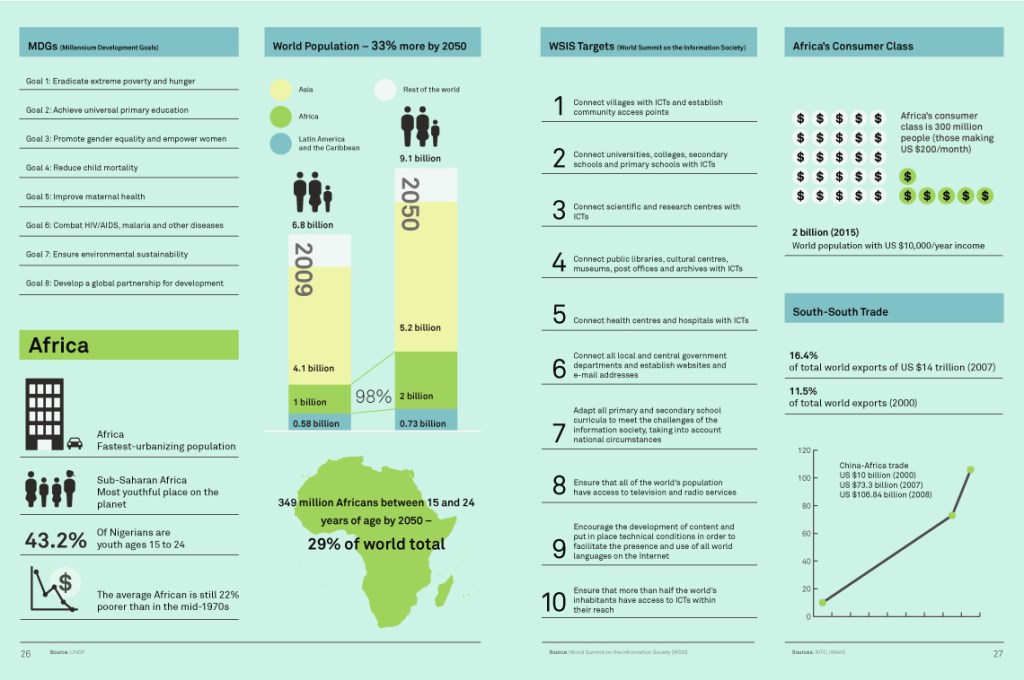
It has been well documented that China is undergoing the largest migration in human history from rural areas to cities. But this urbanization trend is occurring across the global South, including in Africa, as well. According to the UN, more than half the world’s population already lives in cities, and 70 per cent will live in urban areas by 2050. Most of the world’s population growth is concentrated in urban areas in the global South.

These emerging urban areas represent vast opportunities for innovators. Innovators will be needed to build them, and in turn they will provide modern facilities for innovators to operate in and engage with the global economy. And they will connect innovators to 21st-century information technology.

But while the government in China engages in significant planning and preparation to facilitate movements to urban areas – often building entire cities from scratch (http://www.time.com/time/photogallery/0,29307,1975397,00.html) – that has not been the case in Africa. People in Africa are on the move because they are seeking out opportunities, but much of this movement has been poorly planned and not well thought out.

But now more and more African governments are grappling with how to call time on chaotic and haphazard development and build sustainable, planned cities that will significantly improve human development and quality of life.

Across Africa, a host of ambitious new cities and urban developments are in the works.

Kenya’s Konza Technology City (konzacity.co.ke) is planned as a new centre 60 kilometres from the capital, Nairobi. Calling itself a “world-class technology hub and a major economic driver for the nation”, it offers a high-tech vision full of ultra-modern buildings and houses in order to spur the future growth of Kenya’s technology industry.

It is hoped Konza will create 100,000 jobs by 2030. There will be a central business district, a university campus for 1,500 students, a residential community, and parks and wildlife in green corridors.

The groundbreaking ceremony occurred on January 2013 but the Kenyan Ministry of Lands and Housing has halted operations to allow for greater community engagement, according to Urban Africa. A dispute had erupted with the current landowners who wanted to be better consulted about the development and had accused the government of locking them out of the physical planning process.

Tatu City, Kenya (tatucity.com) bills itself as “by Kenyans, for Kenyans”. It is being built by Rendeavour (rendeavour.com), the urban development division of Moscow-based Renaissance Group (rengroup.com), one of the largest urban developers of land in Africa. It joins Konza Technology City as a flagship project for the government’s Vision 2030, hoping to turn Kenya into a middle-income country and a role model for other countries in East Africa.

Tatu City is 15 kilometres from Nairobi. It will take up 1,035 hectares and will be completed in 10 phases. Construction began in May 2012 and is scheduled to be completed by 2022.

It is selling safety and a “beautiful urban environment” just a short journey away from Nairobi’s existing Central Business District. Tatu City wants to be “a model of the African city of the future” as a “dynamic mixed-use, mixed-income environment that will be home to an estimated 70,000 residents and 30,000 day visitors”.

Just 25 minutes from Jomo Kenyatta International Airport, it promises to be one of “the most modern, well-planned urban developments in East Africa”.

In Ghana, a number of innovative projects in development reflect the country’s impressive economic growth and information technology achievements in the past decade.

Two cities are being designed by Rendeavour. One, Appolonia, is being built in the Greater Accra area while the second, King City, is being built on the west coast of the country where there is an oil and gas boom underway.

Both will have houses, retail and commercial centres, schools, healthcare facilities and other social services.

“Our objective is to provide the basic infrastructure, planning and necessary management framework in creating satellite cities that reverses the current trend of unplanned development and urban congestion in most of Africa’s growing cities,” Tim Beighton of Rendeavour told CNN.

These projects are in an advanced stage, with all plans completed and approved by the government, according to their websites.

Appolonia City of Light near Accra (appolonia.com.gh) – due to break ground in the third quarter of 2013 – capitalizes on Accra’s status as one of Africa’s fastest-growing urban areas. The Appolonia development will be a “planned, sustainable, mixed-use and mixed-income city” to build a “work-live-play” community for 88,000 people living in 22,000 homes.

It will be built 30 kilometres northeast of Accra’s central business district and will have retail, commercial and industrial space combined with tourism, social and recreation facilities.

King City in Takoradi (kingcity.com.gh) calls itself “Western Ghana’s new holistic city”. It will offer homes, shops, offices, industries and public places. The plan includes building 25,000 new homes and, importantly, over 30 per cent of the city will be allocated for green space. It will take up 1,000 hectares on the outskirts of Sekondi-Takoradi.

Elsewhere in Accra, the Hope (Home Office People Environment) City (http://www.rlgghana.com/index.php/2013-02-07-11-25-04.html) is a much more ambitious concept. It is one of a cluster of projects in Africa focused on building the infrastructure for a 21st century, high-tech future. Costing US $10 billion, it will be built outside Accra and is focused on boosting Ghana’s already established reputation in the field of information and communications technology. It will be home to 25,000 people and create jobs for 50,000. There will be six towers including a 75-storey, 270 metre building that hopes to be the highest in Africa.

It is being financed by RLG Communications, a mix of investors and a stock-buying scheme.

There will be an assembly plant for high-tech products, business offices an information technology university, a hospital and restaurants, theaters and sports centres.

The design is hyper-modern and tries to create a vertical office environment that is dense and reduces the amount of time it takes to get around and circulate between businesses in the complex.

Eko Atlantic on Victoria Island in Lagos, Nigeria (ekoatlantic.com) is a coastal residential and business development that calls itself “The New Gateway to Africa”. To ease pressure in an already crowded city, it is being built on 10 square kilometres of reclaimed land from the Atlantic Ocean. It will be able to house 250,000 people and give work to 150,000.

The story began in 2003 when the Lagos State government was looking for a solution to protect the Bar Beach area of the city from coastal erosion. Land is being reclaimed from the sea and it will make up an area the equivalent of Manhattan in New York City. Just like Manhattan, it is hoped Eko Atlantic will become the new financial centre for West Africa by the year 2020.

Kilamba, or Nova Cidade de Kilamba (https://www.facebook.com/media/set/?set=a.231897596836631.80284.228497773843280), 30 kilometres outside Luanda, Angola is being built by the China International Trust and Investment Corporation (http://www.citic.com/wps/portal). It is on a vast scale and is designed to be home to 500,000 people with apartment blocks and commercial spaces. It has cost so far US $3.5 billion and is part of a government pledge to provide a million new homes within four years. Kilamba has come in for criticism for not being affordable enough for ordinary Angolans and for having much of the site unoccupied. With the apartments too expensive for ordinary Angolans, the government has decided to take action and ordered the prices to be reduced and made more affordable, according to Angola Press .

La Cite du Fleuve in the Democratic Republic of Congo (lacitedufleuve.com) is  a more conventional luxury housing development built on two islands in the capital, Kinshasa. Kinshasa, despite its problems and the turmoil from an ongoing civil war, is one of the continent’s fastest-growing cities. Developed by Hawkwood Properties, La Cite du Fleuve will need to reclaim 375 hectares of sandbanks and swamps to be able to build a collection of riverside villas, offices and shopping centres. It is is planned to take 10 years to complete.

And finally, Kigali, the capital of Rwanda, wants to transform itself into the “center of urban excellence in Africa”.

The 2020 Kigali Conceptual Master Plan (http://www.kigalicity.gov.rw/spip.php?article494) hopes to create a regional hub for business, trade and tourism, by building a mix of commercial and shopping districts with glass skyscrapers and modern hotels, parks and entertainment facilities.

Critics, however, believe these new cities and modern developments are tackling the problems of urban development by bypassing most of the population. They argue they are just developments for those with money who can buy their way out of the chaos and lack of planning of current African cities.

“They are essentially designed for people with money,” Vanessa Watson, professor of city planning at the University of Cape Town, told CNN. She believes most of the plans are unsustainable “urban fantasies” detached from the reality of African poverty and informal living.

But while it is easy to criticize these ambitious projects, they reflect not only optimism for the continent’s future but also a clear recognition the continent will not be able to get wealthier without modern cities and infrastructure in keeping with a 21st-century economy.

Published: August 2013

Resources

1) Southern Innovator Issue 4: Cities and Urbanization: SI’s fourth issue goes to the many new cities under construction to build the new 21st century world emerging in the global South. Website: http://www.scribd.com/doc/133622315/Southern-Innovator-Magazine-Issue-4-Cities-and-Urbanization

2) Urban Africa: Urban Africa is a digital entry point for knowledge sharing, interactive exchange and information dissemination on urbanization in Africa. Website: http://urbanafrica.net/

3) Arrival City: A third of humanity is on the move. History’s largest migration is creating new urban spaces that are this century’s focal points of conflict and change — unseen districts of rapid transformation and febrile activity that will reshape our cities and reconfigure our economies. Website: http://arrivalcity.net/

4) Global Urbanist: The Global Urbanist is an online magazine reviewing urban affairs and urban development issues in cities throughout the developed and developing world. Website: globalurbanist.com

5) Africa Renewal: The Africa Renewal information programme, produced by the Africa Section of the United Nations Department of Public Information, provides up-to-date information and analysis of the major economic and development challenges facing Africa today. Website: http://www.un.org/africarenewal/

Citations

Cited in Beyond Gated Communities by Samer Bagaeen and Ola Uduku (2015).
https://davidsouthconsulting.org/2022/02/09/african-megacity-makeovers-tackle-rising-populations/

https://davidsouthconsulting.org/2022/10/19/chinese-building-solution-for-rapidly-urbanizing-global-south/

https://davidsouthconsulting.org/2022/05/23/debt-free-homes-for-the-poor/

https://davidsouthconsulting.org/2022/10/17/east-africa-to-get-its-first-dedicated-technology-city/

https://davidsouthconsulting.org/2022/03/20/global-south-eco-cities-show-how-the-future-can-be/

https://davidsouthconsulting.org/2021/11/12/global-souths-rising-megacities-challenge-idea-of-urban-living/

https://davidsouthconsulting.org/2022/03/29/model-city-to-test-the-new-urbanism-concept-in-india/

https://davidsouthconsulting.org/2017/11/08/smart-cities-up-close-2013/

https://davidsouthconsulting.org/2022/09/26/3d-home-printing-landmark-10-houses-in-a-day/

https://davidsouthconsulting.org/2022/11/17/tiny-homes-to-meet-global-housing-crisis/

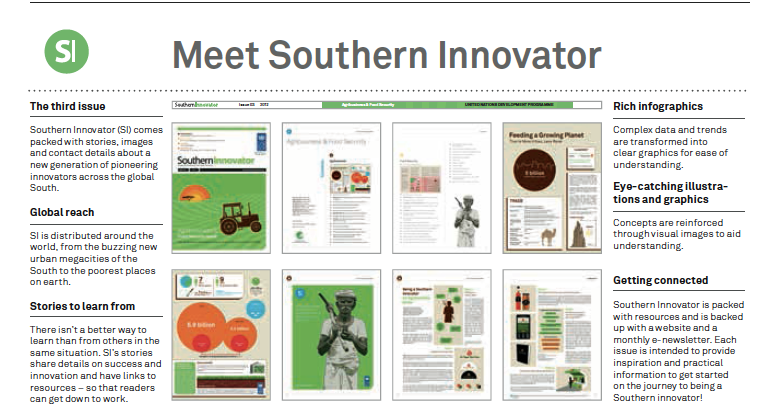
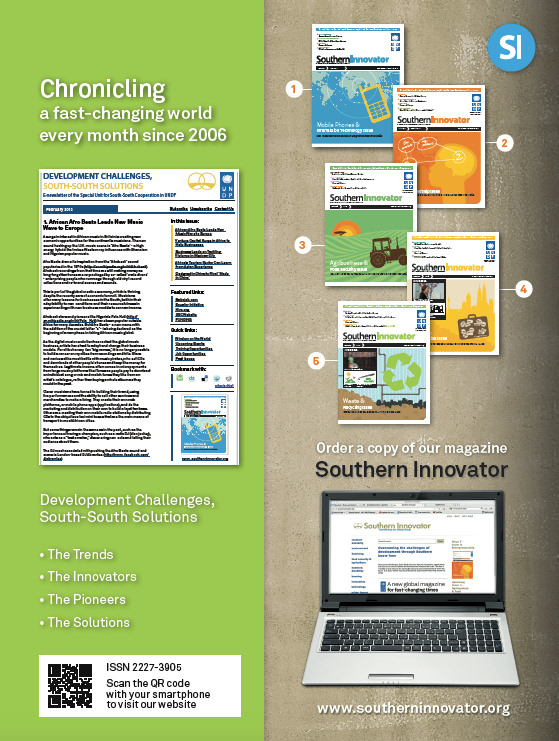
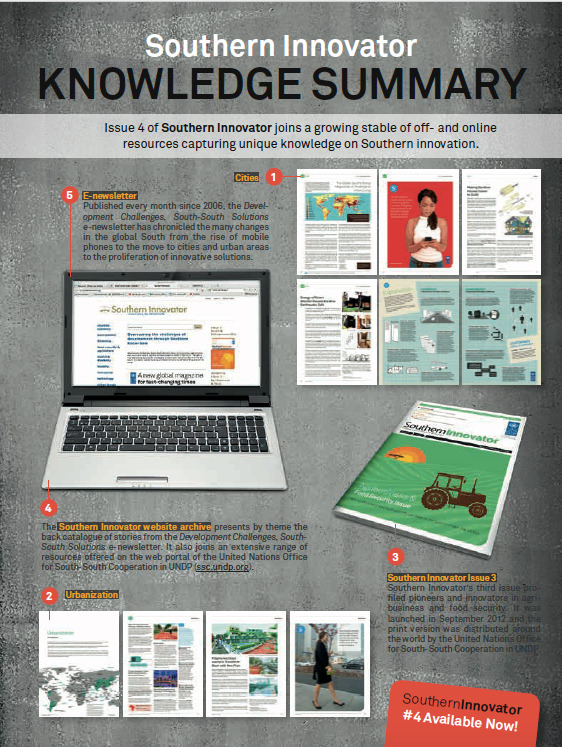
Development Challenges, South-South Solutions was launched as an e-newsletter in 2006 by UNDP’s South-South Cooperation Unit (now the United Nations Office for South-South Cooperation) based in New York, USA. It led on profiling the rise of the global South as an economic powerhouse and was one of the first regular publications to champion the global South’s innovators, entrepreneurs, and pioneers. It tracked the key trends that are now so profoundly reshaping how development is seen and done. This includes the rapid take-up of mobile phones and information technology in the global South (as profiled in the first issue of magazine Southern Innovator), the move to becoming a majority urban world, a growing global innovator culture, and the plethora of solutions being developed in the global South to tackle its problems and improve living conditions and boost human development. The success of the e-newsletter led to the launch of the magazine Southern Innovator. 

https://davidsouthconsulting.org/2021/03/05/southern-innovator-issue-4/

Creative Commons License

This work is licensed under a
Creative Commons Attribution-Noncommercial-No Derivative Works 3.0 License.

ORCID iD: https://orcid.org/0000-0001-5311-1052.

© David South Consulting 2022

Categories
Archive Development Challenges, South-South Solutions Newsletters

Solar-Powered Mobile Clinics to Boost Rural Healthcare in Africa

By David SouthDevelopment Challenges, South-South Solutions

SOUTH-SOUTH CASE STUDY

Around the world, innovative thinking is finding new ways of using solar power technology to bring electricity to underserved areas of the global South. Innovators are experimenting with new technologies, new business models and new ways to finance getting solar power into the hands of the poor.

One recently launched new solution is a solar-powered mobile health clinic that is bringing 21st-century medical diagnostic services to rural areas.

The US $250,000 Solar Powered Health Centre has been built by the Korean technology company Samsung (http://www.samsung.com/africa_en/news/localnews/2013/samsung-launches-solar-powered-health-centre-model-to-bring-quality-healthcare-to-rural-areas).

A truck packed with medical equipment that draws electricity from solar panels, it is traveling to rural, underserved parts of sub-Saharan Africa.

The truck is seven metres in length and comes packed with medical goodies, including a fully equipped eye and blood clinic and a dental surgery. It hopes to make it easier to reach the six in 10 residents of sub-Saharan Africa who live in rural areas, and who are often very far from affordable medical services. There is a blood analyzer, spectacle repair kit, and a non-contact tonometry test to measure the inside of a person’s eye. People can also be tested for HIV, malaria and many other conditions.

Samsung (samsung.com) developed the truck as part of its efforts to create “Built for Africa” technologies. The truck was built in Johannesburg, South Africa, helping create local jobs and skills.

Samsung hopes to scale the initiative to a million people in Africa by 2015.

The clinics were launched in Cape Town at the 2013 Samsung Africa Forum and are being rolled out by Samsung Electronics Africa (http://www.samsung.com/africa_en/#latest-home) as part of what the company calls a “large-scale medical initiative on the continent”.

The roaming trucks will be staffed by qualified medical professionals and will educate people about the importance of preventive medical screening.

Targeted conditions include diabetes, high blood pressure, tooth decay and cataracts. The clinics will also conduct public health education campaigns about the importance of preventive medicine (http://en.wikipedia.org/wiki/Preventive_medicine).

“What many see as minor health issues will not only get worse over time, but will affect other aspects of quality of life. The child that cannot see properly cannot learn properly,” said Dr. Mandlalele Mhinga, a member of the Nelson Mandela Children’s Hospital (http://nelsonmandelachildrenshospital.org/). “Mobile solutions help address this issue by making medical services accessible to more people in rural areas, and educating them about health care at the same time.”

The mobile clinics hope to reduce the vast difference between the quality of health care available to rural residents and people in urban areas.

Even in countries such as South Africa with the highest level of development in the region, medical care coverage is patchy and unreliable. For those who can afford it, 20 per cent of the population, there are private medical schemes. But everyone else must rely on an over-stretched and under-funded public health sector.

Samsung has based this innovation on its first-hand experience with providing medical services to rural areas in Africa.

“This experience has shown us how desperately medical treatment is needed across the continent, and inspired us to develop a sustainable and innovative solution to reach the people who need it most,” said Ntutule Tshenye, Business-to-Government and Corporate Citizenship Lead for Samsung Africa. “While our CSR (corporate social responsibility) strategy in Africa is largely focused on education, our efforts to enrich lives will not be felt if people’s basic needs, such as access to healthcare, are not met.”

Samsung’s “Built for Africa” product range (http://www.samsung.com/africa_en/africancitizenship/home4.html) also has a wide range of other projects and initiatives to boost health and living standards on the continent. These include education programmes, such as the Samsung Electronics Engineering Academy, Samsung Solar Powered Internet Schools, the Samsung Power Generator, and the Samsung eLearning Centres.

Samsung Electronics Co., Ltd. is a consumer electronics multinational and employs 227,000 people worldwide.

Published: August 2013

Development Challenges, South-South Solutions was launched as an e-newsletter in 2006 by UNDP’s South-South Cooperation Unit (now the United Nations Office for South-South Cooperation) based in New York, USA. It led on profiling the rise of the global South as an economic powerhouse and was one of the first regular publications to champion the global South’s innovators, entrepreneurs, and pioneers. It tracked the key trends that are now so profoundly reshaping how development is seen and done. This includes the rapid take-up of mobile phones and information technology in the global South (as profiled in the first issue of magazine Southern Innovator), the move to becoming a majority urban world, a growing global innovator culture, and the plethora of solutions being developed in the global South to tackle its problems and improve living conditions and boost human development. The success of the e-newsletter led to the launch of the magazine Southern Innovator.  

Follow @SouthSouth1

Google Books: https://books.google.co.uk/books?id=YfRcAwAAQBAJ&dq=development+challenges+august+2013&source=gbs_navlinks_s

Slideshare: http://www.slideshare.net/DavidSouth1/development-challenges-august-2013-issue

Southern Innovator Issue 1: https://books.google.co.uk/books?id=Q1O54YSE2BgC&dq=southern+innovator&source=gbs_navlinks_s

Southern Innovator Issue 2: https://books.google.co.uk/books?id=Ty0N969dcssC&dq=southern+innovator&source=gbs_navlinks_s

Southern Innovator Issue 3: https://books.google.co.uk/books?id=AQNt4YmhZagC&dq=southern+innovator&source=gbs_navlinks_s

Southern Innovator Issue 4: https://books.google.co.uk/books?id=9T_n2tA7l4EC&dq=southern+innovator&source=gbs_navlinks_s

Southern Innovator Issue 5: https://books.google.co.uk/books?id=6ILdAgAAQBAJ&dq=southern+innovator&source=gbs_navlinks_s

Creative Commons License

This work is licensed under a
Creative Commons Attribution-Noncommercial-No Derivative Works 3.0 License.

ORCID iD: https://orcid.org/0000-0001-5311-1052.

© David South Consulting 2023

Categories
Archive Blogroll Development Challenges, South-South Solutions Newsletters

Haitian Coffee Becoming a Hit with American Connoisseurs

By David SouthDevelopment Challenges, South-South Solutions

SOUTH-SOUTH CASE STUDY

The Caribbean country of Haiti has had to deal with the twin challenges of recovering from a devastating earthquake in 2010 while also pulling itself out of the economic and social chaos that has resulted in its status as the poorest place in the Western hemisphere.

Violence has also led to a number of UN peacekeeping missions in Haiti over the years, and there is now a substantial international presence in the country to aid in stabilization and economic recovery (http://www.un.org/en/peacekeeping/missions/minustah/).

Haiti has a lot of potential when it comes to agriculture, but this would require substantial changes in the way land and agriculture are managed.

Haiti is ranked 77 out of 79 countries in the 2012 Global Hunger Index. Access to sufficient quantities of nutritious food remains an issue for millions of Haitians. An estimated 3.8 million Haitians, or 38 per cent of the population, is food insecure (WFP 2012). Despite its fertile potential, Haiti is dependent on food aid and imports to meet its food security needs.

Fifty per cent of the country’s food requirements are imported, and food prices have been rising since the end of 2010, the year of Haiti’s devastating earthquake. This increase has led to an overall loss of purchasing power for the majority of Haitians. Low agricultural productivity and urban encroachment on arable land provide additional challenges for Haiti’s rural populations. Eighty per cent of farms fail to produce enough to feed their households (http://www.foodsecurityportal.org/haiti/resources).

But some are trying to create a new market for Haiti’s agricultural products to help boost farmers and farming as an occupation and an industry.

It’s hard to imagine now, but Haiti was once the world’s largest producer of coffee in the 18th century when it was a French colony. Today Haiti produces less than 1 per cent of the world’s coffee.

The targeting of niche coffee drinkers in the United States has introduced a new market to the special taste of the Haitian brew. While the market at present is small, some are hoping, with the right measures, it could be grown significantly, boosting both the country’s revenue from agricultural exports and incomes for coffee farmers.

Several US-based companies are carving out a market for Haitian coffee and boosting awareness about the country’s unique coffee beans. La Colombe Coffee Roasters (http://lacolombe.com/), based in the city of Philadelphia, has already been able to export four shipping containers of Haitian coffee to the United States since 2010. The company supplies high-end chefs such as Eric Ripert and Daniel Boulud.

In Florida, Kafe Pa Nou (kafepanou.com) – “our coffee” in Haitian Creole – is owned by Haitian-American Jean René Faustin and sells online coffee from Haitian suppliers Rebo and Cafe Selecto.

So far, Haitian coffee has not been able to gain wider distribution through mass buyers such as Starbucks because it has not been possible to supply the quantities required to fulfill such a contract.

Haiti would need to boost its current average coffee yield of 250 kilograms per hectare to double or triple that yield to gain large-scale contracts.

“Haiti was for a brief moment in time the biggest producer of coffee for export in the world,” Gilbert Gonzales, Vice President of coffee exporter Rebo (http://rebo.ht/The%20Technics.htm), told Medium for Haiti (https://medium.com/medium-for-haiti). But “right now, most people would say it’s impossible” for Haiti’s coffee sector to return to international prominence.

“We’re not saying that it’s possible in the next two years, maybe not even in the next 12 years,” he said. “But it is possible.”

The coffee cherries used to make the popular beverage are processed in one of two ways: a dry process and a wet process. In Haiti, the dry process is more commonly used to form a hard cocoon on the outside of the coffee cherries to help preserve them for a year or more.

This enables farmers to preserve the coffee cherries so they can keep a portion of the crop back as a safety reserve.

The wet processed beans are first immersed in water and then the pulp is washed away before the beans are dried (http://coffee.wikia.com/wiki/Wet_process). The superior flavor this creates has attracted fans in the United States, especially in the trendy neighbourhoods of Brooklyn, New York and San Francisco, California. By bucking the traditional Haitian dry processing method for the beans, it is possible to earn three times the market price by selling wet-processed beans.

Haiti’s history of coffee growing goes back to the 1700s. At the time, the country grew half the world’s coffee. This helped to make the French colony highly profitable.

This long heritage has left the country with a unique asset: original Arabica typica coffee trees first imported by Europeans to Haiti. These coffee trees are considered to be heirloom because they are so old and untainted by modern breeding methods. According to Douglas Weiner in Medium for Haiti, “when you drink coffee from Haiti, it’s like drinking coffee from 200 years ago.”

Weiner is part of a family business, Geo Weiner (http://selectohaiti.com/home/), which has been selling Haitian coffee for four generations and is one of the few surviving coffee exporters in the country.

The country has an estimated 200,000 coffee farmers. Because their methods have not changed much, they are effectively organic (https://en.wikipedia.org/wiki/Organic_food). Most farmers can not afford chemical fertilizers and pesticides.

The coffee farms are located in mountain areas with a rich biodiversity of plants and trees. This stands in stark contrast with much of the rest of the country, where deforestation has left the country with just 2 per cent of virgin forest left. Coffee-producing areas are lush and green because coffee is one of the few cash crops that makes enough money to keep it worthwhile to preserve the trees and foliage. In other parts of the country, many are making money from turning trees into charcoal for cooking fuel, the most common fuel for most of the country’s population.

Haiti’s coffee growers have had a hard time coping with the rise and fall of world coffee prices. The world market price for coffee dropped in the early 2000s as the markets were flooded with coffee from Brazil and Vietnam. In response, farmers then cut down the coffee trees and replaced them with subsistence crops such as corn and beans.

With the amount of coffee grown in Haiti dropping quickly, the number of exporters in the country plummeted from 20 companies to two companies today, Geo Weiner and Rebo.

Jobert Angrand, Executive Coordinator of the National Institute of Coffee (http://www.icefda.org/), believes coffee production declined in Haiti because of a wide range of problems, from diseases and pests to aging trees, too-small plots and inefficient production methods. Per-hectare coffee yields are as low as one-tenth of production in Latin America.

The Vice President of coffee exporter Rebo says these problems are holding things back. “I don’t think today we’re looking into going mainstream,” said Gilbert Gonzales. “We can’t. There is not enough volume for that.”

Because production will be small, Gonzales believes Haiti would be wise to target the higher end of the marketplace with American grocery stores such as Trader Joe’s and Whole Foods: “It’s looking into the higher-end gourmet shops, things like that,” he said, “so that we could really share with the rest of that world the quality available from Haiti.”

Significant purchases of Haitian coffee have been made by various overseas companies, which does give hope that this plan could work. Irish coffee company Java Republic bought 97 tonnes of Haitian coffee from the Rebo exporter in 2010.

Published: August 2013

Resources

1) National Coffee Association: Ten Steps to Coffee. Website: http://www.ncausa.org/i4a/pages/index.cfm?pageid=69

2) International Coffee Organization: The International Coffee Organization (ICO) is the main intergovernmental organization for coffee, bringing together exporting and importing governments to tackle the challenges facing the world coffee sector through international cooperation. Its member governments represent 97 per cent of world coffee production and over 80 per cent of world consumption. Website: http://www.ico.org/

3) Coffee Research: Growing Coffee Beans at Home. Website: http://www.coffeeresearch.org/coffee/homegrowing.htm

4) Puro Fairtrade Coffee: Puro is a leading brand of Fairtrade and Fair Trade Organic coffee that works in partnership with the World Land Trust to purchase and protect areas of precious rainforest in South America. Website: http://www.purocoffee.com/

More on Haiti here: State Of Decay: Haiti Turns To Free-Market Economics And The UN To Save Itself

https://davidsouthconsulting.org/2021/10/28/ending-gang-violence-while-cleaning-the-streets-in-haiti/

https://davidsouthconsulting.org/2021/09/01/haiti-earthquake-prompts-tech-aid/

https://davidsouthconsulting.org/2021/10/28/milk-co-operatives-help-hungry-haiti/

https://davidsouthconsulting.org/2020/04/22/state-of-decay-haiti-turns-to-free-market-economics-and-the-un-to-save-itself/

Development Challenges, South-South Solutions was launched as an e-newsletter in 2006 by UNDP’s South-South Cooperation Unit (now the United Nations Office for South-South Cooperation) based in New York, USA. It led on profiling the rise of the global South as an economic powerhouse and was one of the first regular publications to champion the global South’s innovators, entrepreneurs, and pioneers. It tracked the key trends that are now so profoundly reshaping how development is seen and done. This includes the rapid take-up of mobile phones and information technology in the global South (as profiled in the first issue of magazine Southern Innovator), the move to becoming a majority urban world, a growing global innovator culture, and the plethora of solutions being developed in the global South to tackle its problems and improve living conditions and boost human development. The success of the e-newsletter led to the launch of the magazine Southern Innovator.

https://davidsouthconsulting.org/2021/03/05/southern-innovator-issue-1/

https://davidsouthconsulting.org/2021/03/05/southern-innovator-issue-3/

Creative Commons License

This work is licensed under a
Creative Commons Attribution-Noncommercial-No Derivative Works 3.0 License.

ORCID iD: https://orcid.org/0000-0001-5311-1052.

© David South Consulting 2023