Categories
Archive Development Challenges, South-South Solutions Newsletters

Indians Fighting Inflation with Technology

By David SouthDevelopment Challenges, South-South Solutions

SOUTH-SOUTH CASE STUDY

Despite the global economic downturn, many countries of the South are seeing rapid economic growth. That can have a down side: inflation (http://en.wikipedia.org/wiki/Inflation). Inflation can be caused by variety of factors – too much money chasing too few goods, deliberate government policies to increase demand for goods and services, environmental disasters creating scarcity, or poor investment in infrastructure straining against rapid economic growth. But when it gets out of control for life-essential goods like food, then people need solutions to survive.

In India – home to more poor people than all of sub-Saharan Africa – rising inflation has prompted the Reserve Bank of India to raise interest rates, which in turn leads to more expensive loans and credit, just when funds need to be borrowed to invest in infrastructure improvements for the country.

India’s finance minister, Pranab Mukherjee, has warned that the rising interest rates necessary to fight inflation will hurt India’s economic growth.

India has seen inflation jump from single digits in 2008 to double digits this year. Consumer price inflation for industrial and farm workers in India rose by 14 percent, government data show – up from 5.51 percent in January 2008 (It hit 16.22 percent in January 2010, according to the Indian Ministry of Labour).

And it is the poorest who suffer the most from inflation. Inflation in India has led to worker protests for wage increases and rising prices for essentials like food: a life-and-death issue for the poor.

Other countries across the South are also experiencing high inflation, the worst being Venezuela. India has the highest inflation after Venezuela’s 32 percent rate, according to Bloomberg data compiled from 82 countries.

The UN’s trade and development body, UNCTAD, has called for new measures to tackle inflation. “In the past few decades, monetary policies have been more and more gradually based on inflation targeting,” said Supachai Panitchpakdi, secretary-general of UNCTAD. “I see there should be other instruments to contain inflation rather than monetary policies.”

Frustration with inflation has even been taken up by India’s vibrant entertainment industry, Bollywood (http://www.bollywoodworld.com).

The song “Mehangayi Daayan” (“The Inflation Witch”) in a film produced by acting star Aamir Khan has the lyrics, “my husband’s earnings are good but his second wife — inflation — is eating them up.”

Indian marketing consultant Suhasini Sakhare (http://www.suhasinisakhare.com/index.php?option=com_content&view=section&layout=blog&id=2&Itemid=12) from Nagpur has called for Indian consumers to be empowered, just as farmers are with the successful e-Choupal web portal.

E-Choupal (http://www.echoupal.com) has developed a reputation for both controlling prices and increasing incomes for poor farmers. Started in 2000 by the major Indian company ITC Limited (http://www.itcportal.com), it links farmers to the latest prices for products including soybeans, wheat, coffee and prawns.

E-Choupal works through computers set up in rural areas. It has built one of the largest internet initiatives in rural India, reaching 4 million farmers in 40,000 villages. It does this through 6,500 computer kiosks located in the homes of farmer-coordinators called Sanchalaks. The kiosks offer weather reports and the latest market prices, important scientific developments, risk management advice, and help with sales and marketing. The computer is in the Sanchalak’s house and connects to the internet by telephone. Each computer can serve around 600 farmers in the surrounding area.

Indian agriculture suffers from being very fragmented, with poor infrastructure and an army of middlemen looking to get the best price for themselves at the expense of farmers and consumers. Indian farmers are heavily in debt and plagued by a very high suicide rate as a result (http://en.wikipedia.org/wiki/Farmers’_suicides_in_India). This agricultural crisis has a direct impact on India’s ability to meet its development goals and lift many millions more out of poverty in the future.

E-Choupal sees itself as creating a “virtuous circle of higher productivity, higher incomes, enlarged capacity for farmer risk management, larger investments and higher quality and productivity.”

E-Choupal has increased yields for farmers, reduced transaction costs, and raised the quality of output leading to rising farmer incomes.

It is clear from experience in other countries that better access to price information helps control price inflation. E-Choupal has the advantage of providing both information and the means to access it: a big problem in rural India. Most poor Indian consumers do not have access to the internet and make food purchases from small vendors, whom they must trust to set the right price for products.

Online, there are plenty of price comparison websites for Indians (http://explore.oneindia.in/internet/portal/comparisonsites): computers, electronics and household goods (http://compareindia.in.com) for example. But this is of no use to poor Indians without access to the information.

Economic commentator Paranjoy Guha Thakurta told AFP of the political dangers: “There’s a huge amount of discontent and anger across the country and certainly among the poor. Speak to the person on the street and their biggest problem is inflation.”

Published: August 2010

Resources

  • Olam: A global food supply company in ‘agri-products’ that got its start in Nigeria. It shows how a Southern brand can grow and go global, and overcome the difficulties of cross-border trade. Website: www.olamonline.com
  • Model Village India: A pioneering initiative is reviving impoverished rural villages. Drawing on self-organizing methods used in India since 1200 BC, the Model Village India is based around India’s democratic system of Panchayats: a village assembly of people stemming back to pre-colonial times. Website: www.modelvillageindia.org.in
  • e-Choupal: Hope or Hype? By Neeraj Dangi and Harjit Singh, American Journal of Economics and Business Administration 2 (2): 179-184, 2010. Website: http://tinyurl.com/3682r3p
  • A book on the consequences of inflation when it gets out of control: When Money Dies: The Nightmare of the Weimar Hyper-Inflation by Adam Fergusson. Website: http://www.amazon.co.uk/When-Money-Dies-Nightmare-Hyper-Inflation/dp/1906964440
  • The American National Inflation Association: A website with educational videos and resources on inflation. Website: http://inflation.us

https://davidsouthconsulting.org/2022/10/14/anti-bribery-website-in-india-inspires-others/

https://davidsouthconsulting.org/2022/09/29/the-battle-for-indias-coffee-drinkers-in-buzzing-economy/

https://davidsouthconsulting.org/2022/11/22/bio-ethanol-from-sturdy-and-once-unwanted-indian-plant/

https://davidsouthconsulting.org/2022/02/07/boosting-tourism-in-india-with-surfing-culture/

https://davidsouthconsulting.org/2022/09/29/cheap-indian-tablet-seeks-to-bridge-digital-divide/

https://davidsouthconsulting.org/2021/09/01/disaster-recovery-ten-years-after-the-gujarat-india-experience/

https://davidsouthconsulting.org/2022/10/20/the-e-reader-battle-reaches-india/

https://davidsouthconsulting.org/2022/10/09/entrepreneurs-use-mobiles-and-it-to-tackle-indian-traffic-gridlock/

https://davidsouthconsulting.org/2022/04/04/help-is-at-hand-for-indias-beleaguered-bus-riders/

https://davidsouthconsulting.org/2022/09/27/india-2-0-can-the-country-make-the-move-to-the-next-level/

https://davidsouthconsulting.org/2022/10/14/indias-modernizing-food-economy-unleashing-new-opportunities/

https://davidsouthconsulting.org/2021/08/29/indian-business-model-makes-green-energy-affordable/

https://davidsouthconsulting.org/2022/10/25/indian-city-slum-areas-become-newly-desirable-places-to-live/

https://davidsouthconsulting.org/2021/08/28/indian-entrepreneur-brings-dignity-to-poor-women/

https://davidsouthconsulting.org/2021/03/04/indian-id-project-is-foundation-for-future-economic-progress/

https://davidsouthconsulting.org/2022/10/18/indian-initiatives-to-make-travel-safer-for-women/

https://davidsouthconsulting.org/2022/06/15/indian-mobile-phone-application-innovators-empower-citizens/

https://davidsouthconsulting.org/2022/11/01/indian-newspapers-thrive-with-economy/

https://davidsouthconsulting.org/2022/10/06/indian-solar-economy-brings-new-vocation-for-women/

https://davidsouthconsulting.org/2022/10/06/indian-solar-power-pack-powers-villages/

https://davidsouthconsulting.org/2022/10/25/indian-toilet-pioneer-champions-good-ideas/

https://davidsouthconsulting.org/2022/03/29/model-city-to-test-the-new-urbanism-concept-in-india/

https://davidsouthconsulting.org/2020/12/04/model-indian-villages-to-keep-rural-relevant/

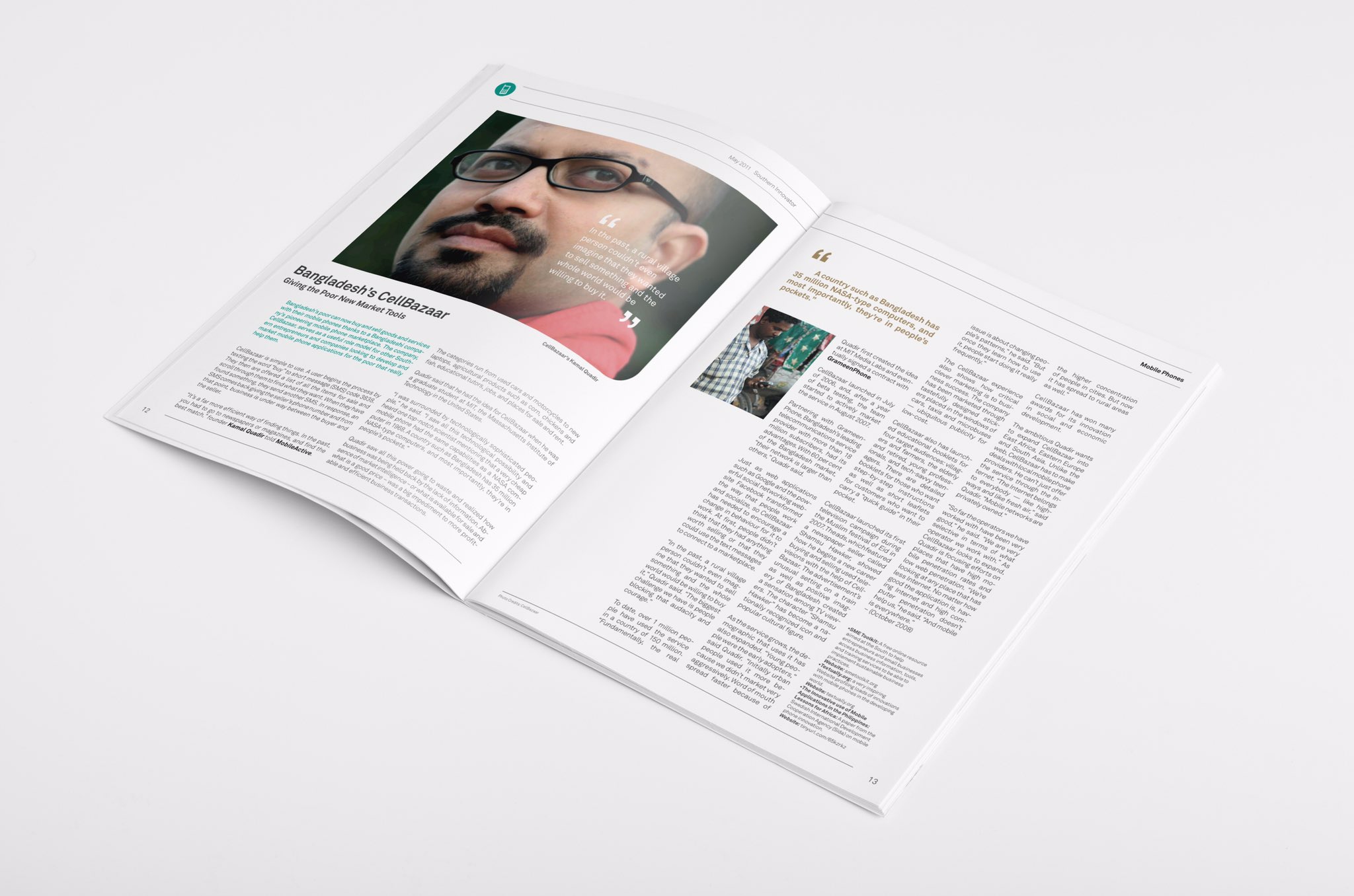
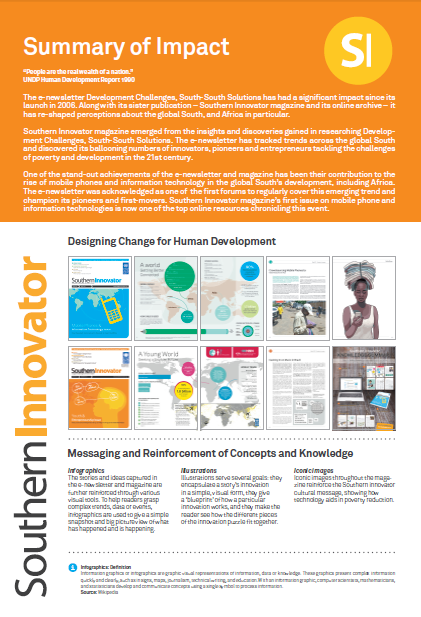
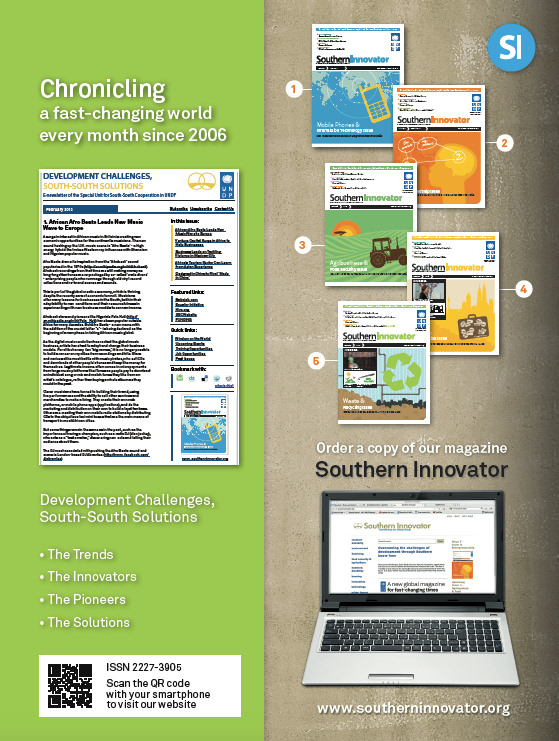
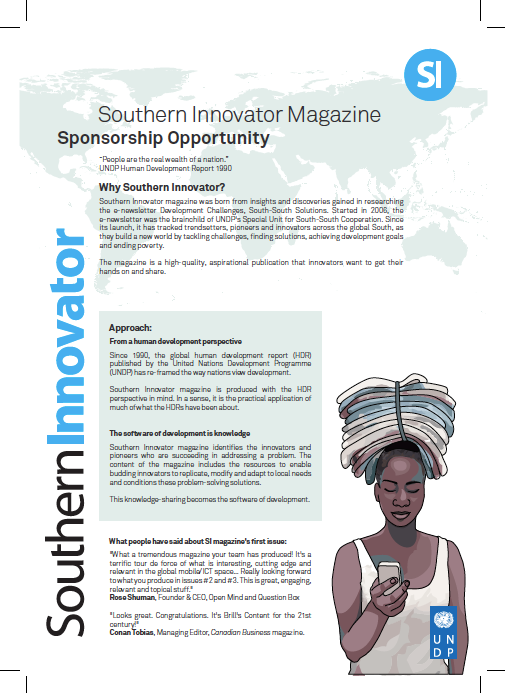
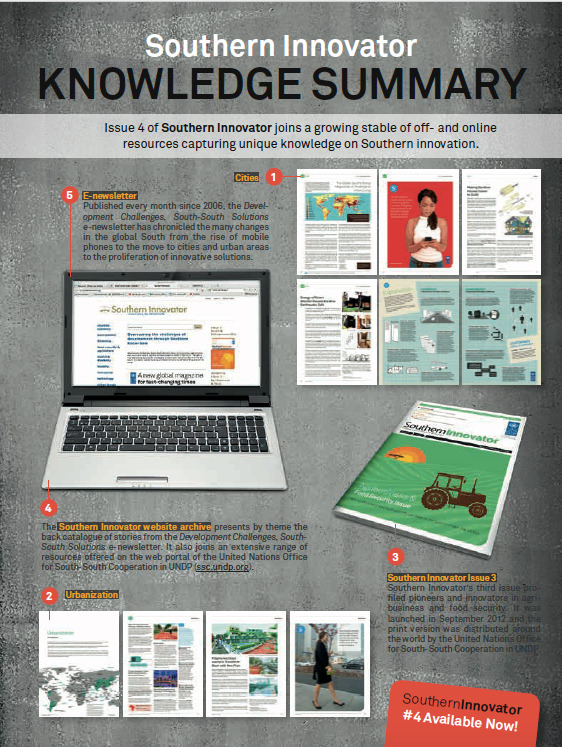
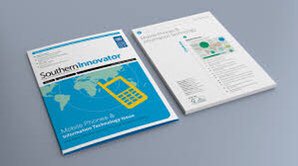
Development Challenges, South-South Solutions was launched as an e-newsletter in 2006 by UNDP’s South-South Cooperation Unit (now the United Nations Office for South-South Cooperation) based in New York, USA. It led on profiling the rise of the global South as an economic powerhouse and was one of the first regular publications to champion the global South’s innovators, entrepreneurs, and pioneers. It tracked the key trends that are now so profoundly reshaping how development is seen and done. This includes the rapid take-up of mobile phones and information technology in the global South (as profiled in the first issue of magazine Southern Innovator), the move to becoming a majority urban world, a growing global innovator culture, and the plethora of solutions being developed in the global South to tackle its problems and improve living conditions and boost human development. The success of the e-newsletter led to the launch of the magazine Southern Innovator. 

https://davidsouthconsulting.org/2021/03/05/southern-innovator-issue-1/

https://davidsouthconsulting.org/2021/03/05/southern-innovator-issue-5/

Creative Commons License

This work is licensed under a
Creative Commons Attribution-Noncommercial-No Derivative Works 3.0 License.

ORCID iD: https://orcid.org/0000-0001-5311-1052.

© David South Consulting 2023

Categories
Archive Development Challenges, South-South Solutions Newsletters

Rwandan Coffee Brand Boost

By David SouthDevelopment Challenges, South-South Solutions

SOUTH-SOUTH CASE STUDY

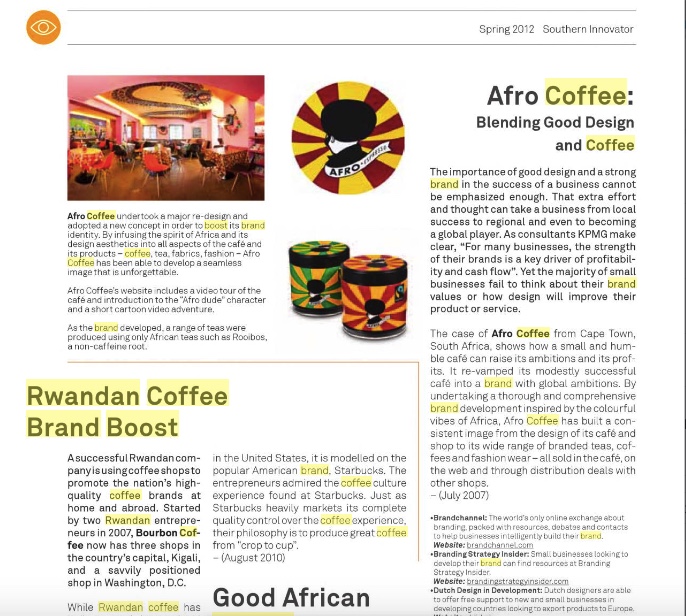
A successful Rwandan company is using coffee shops to promote the nation’s high-quality coffee brands at home and abroad. Started by two Rwandan entrepreneurs three years ago, Bourbon Coffee (http://www.bourboncoffeeusa.com) now has three shops in the country’s capital, Kigali, and a savvily positioned shop in Washington DC.

While Rwandan coffee has built a good international reputation, the country’s more than 500,000 coffee farmers (mostly small-scale) previously depended on the product’s reputation alone. But Bourbon Coffee joins several other initiatives changing this situation and starting to significantly raise the profile of Rwandan coffee and build the Rwanda brand.

The East African nation experienced the horrific genocide of almost 1 million people in 1994. Ever since, the country has been on a journey to reconcile with the damage done during this time and move on to a more prosperous future for all its citizens. A key part of the country’s future success will be its economic prosperity. And historically, coffee has played a critical role in Rwanda’s economy.

The Bourbon Coffee chain of shops (taking its name from the high quality Bourbon coffee varietal (http://en.wikipedia.org/wiki/List_of_coffee_varieties) which accounts for the majority of Rwandan coffee), started with its first shop in Kigali in 2007. Started by Emmanuel Murekezi and Arthur Karuletwa, two Rwandans living in the United States, it is modelled on the popular American brand Starbucks (http://www.starbucks.com). The entrepreneurs admired the coffee culture experience found at Starbucks. Just as Starbucks heavily markets its complete quality control over the coffee experience, their philosophy is to produce great coffee from “crop to cup.”

“There are over 500,000 farmers that own 100 to 200 trees in the back of their yards, so the only way they can come up with a product is to come together in a cooperative sense,” Karuletwa told the Washington Post. It is a learning experience for the Rwandan coffee farmers: they learn to work together, trust each other and be accountable to each other. “Neighbours that once killed each other and communities that once floated in the same bloodbath are now hand in hand producing one of the most amazing products.”

“If done right, it could be the platform to re-brand the country,” continued Karuletwa, a former chief executive and now a shareholder in the company. Coffee can “create awareness that there’s recovery, there’s trade, there’s investment opportunities, there’s tourism. There’s life after death.”

The importance of good design and a strong brand in the success of a business cannot be emphasised enough. That extra effort and thought can take a business from local success to regional and even global success. As consultants KPMG make clear, “For many businesses, the strength of their brands is a key driver of profitability and cash flow.” Yet the majority of small businesses fail to think about their brand values or how design will improve their product or service.

The shops have a very tasteful modern, African design and feel. African sculpture and furniture are surrounded by African artwork. The shop’s logo is an eye-catching orange and there is an overall recognizable brand identity for the entire Bourbon Coffee concept.

The founders see it as an opportunity to educate people about the health benefits of coffee culture and the joys of the lifestyle. They proudly serve only Rwandan coffee and promote the national brands they serve, including Akagera, Kivu Lake, Kizi Rift, Muhazi and Virunga.

Bourbon Coffee, in a clever move, opened the Washington branch in 2009 in a former Starbucks in a neighbourhood packed with aid organizations and NGOs, many of which work with Rwanda on projects.

Karuletwa says Bourbon Coffee’s ambitious vision “is to stand as a symbol of a new era in African economic development, one in which African nations rise to participate directly in the global marketplace.”

“Coffee is a very intimate, emotional product,” he said. “The preparation, the processes and the profiling of coffee is similar to wine.”

The Rwandan branches can be found at the Union Trade Centre (UTC) in Kigali’s city centre, the MTN centre in Nyarutarama and Kigali airport.

The business is funded by Rwandan investors Tristar (http://www.tri-starinvestments.com/index.html).

Another initiative is the Rwandan Farmers Brand (http://www.rwandanfarmers.com). It also hopes to raise the profile of Rwandan coffee and drive more of the profits made into the hands of farmers. It is a joint venture between the foundations of former U.S. President Clinton and philanthropist Sir Tom Hunter. They fund all the brand’s creation and operation in partnership with 8,700 farmers. They have started selling Rwanda Medium Roast Ground in the United Kingdom’s Sainsbury’s supermarkets. Sixteen percent of sales are clear profit and returned to the farmers via their own Trust Fund.

Karuletwa says he doesn’t want Rwandan coffee to be “a pity-driven mission”. It is all about the quality: “The value initiative here is because this coffee tastes great,” he says.

And Bourbon Coffee is looking further afield to grow the brand: “We hope to expand even further,” Murekezi told Monocle magazine. “Congo, Burundi, Tanzania, but also Europe. We think the concept can work there too.”

Published: August 2010

Resources

  • East African Fine Coffees Association: All the latest news on events and initiatives for East Africa’s coffee producers. Website: http://www.eafca.org/
  • Brandchannel: The world’s only online exchange about branding, packed with resources, debates and contacts to help businesses intelligently build their brand. Website: www.brandchannel.com
  • Small businesses looking to develop their brand can find plenty of free advice and resources here. Website: www.brandingstrategyinsider.com
  • The red dot logo stands for belonging to the best in design and business. The red dot is an internationally recognized quality label for excellent design that is aimed at all those who would like to improve their business activities with the help of design. Website: http://www.red-dot.de
  • Dutch Design in Development: The Dutch NGO works with producers to develop skills and adapt producers’ products to present and future demands in Europe. By following this approach, Southern producers can reduce the risk of making products nobody wants, or that lack originality in the marketplace and thus won’t sell. Website: http://www.ddid.nl/english/index.html

https://davidsouthconsulting.org/2021/03/12/afro-coffee-blending-good-design-and-coffee/

https://davidsouthconsulting.org/2022/09/29/the-battle-for-indias-coffee-drinkers-in-buzzing-economy/

https://davidsouthconsulting.org/2021/10/03/civet-cat-coffee-brews-filipino-opportunity/

https://davidsouthconsulting.org/2021/01/08/haitian-coffee-becoming-a-hit-with-american-connoisseurs/

Development Challenges, South-South Solutions was launched as an e-newsletter in 2006 by UNDP’s South-South Cooperation Unit (now the United Nations Office for South-South Cooperation) based in New York, USA. It led on profiling the rise of the global South as an economic powerhouse and was one of the first regular publications to champion the global South’s innovators, entrepreneurs, and pioneers. It tracked the key trends that are now so profoundly reshaping how development is seen and done. This includes the rapid take-up of mobile phones and information technology in the global South (as profiled in the first issue of magazine Southern Innovator), the move to becoming a majority urban world, a growing global innovator culture, and the plethora of solutions being developed in the global South to tackle its problems and improve living conditions and boost human development. The success of the e-newsletter led to the launch of the magazine Southern Innovator. 
https://davidsouthconsulting.org/2021/03/05/southern-innovator-issue-2/

Creative Commons License

This work is licensed under a
Creative Commons Attribution-Noncommercial-No Derivative Works 3.0 License.

ORCID iD: https://orcid.org/0000-0001-5311-1052.

© David South Consulting 2022

Categories
Archive Development Challenges, South-South Solutions Newsletters

Mobile Applications Market: Opportunities for South

By David SouthDevelopment Challenges, South-South Solutions

SOUTH-SOUTH CASE STUDY

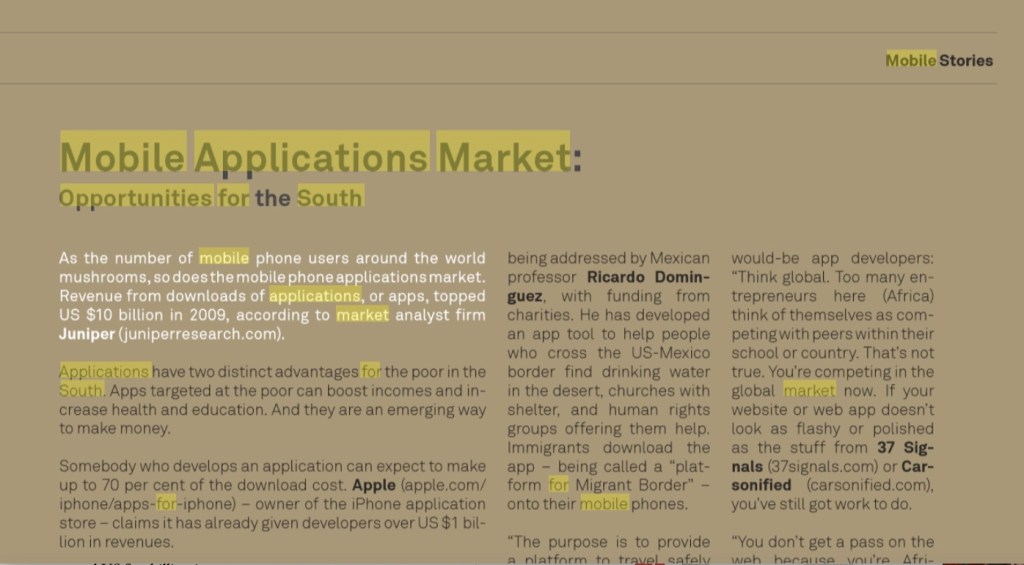
As the number of mobile phone users around the world mushrooms, so does the mobile phone applications market. Revenue from downloads of applications, or apps, topped US $10 billion in 2009, according to market analyst firm Juniper (http://juniperresearch.com).

Applications have two distinct advantages for the poor in the South. Apps targeted at the poor can boost incomes and increase health and education. And they are an emerging way to make money.

Somebody who develops an application can expect to make up to 70 percent of the download cost. Apple (http://www.apple.com/iphone/apps-for-iphone) – owner of the iPhone application store – claims it has already given developers over US $1 billion in revenues.

It is a growing industry. The market-leading Apple App Store now boasts more than 225,000 applications for download and sale. It says they have been downloaded an impressive 5 billion times.

Android Market (http://www.android.com/market/#app=com.com2us.HG), run by the search engine Google, has more than 60,000 apps on offer. GetJar (www.getjar.com), an independent mobile phone application store from Sweden, says it has 72,000 apps available and has had 1 billion downloads.

Now that the apps economy has been running for a couple years, it is possible to divine what increases a developer’s success. Some believe the apps marketplace mimics the dynamics of the music business, rather than the traditional software business.

GetJar chief executive Ilja Laurs told the Economist that it takes as long to write an app as a song. Apps on average cost about the same as a music download: US $1.90. And just like the pop music charts, a few become big hits but most never make it. Apps are also a quick hit: even after becoming successful they can quickly fade back to obscurity again. In short, they are fad and trend driven and are very much about the moment and a current need.

That means they are wide open to newcomers from the South.

With mobile phones now the main channel for information in East Africa, for example, and mobile penetration exceeding 40 percent of the population there, vast markets have opened for apps. East Africa has more than 120 million citizens, with a large majority living in rural areas: many needing poverty-fighting apps to change their lives.

Various new applications show the creative thinking already coming out of the South. South Africa’s Afridoctor (www.afridoctor.com) is Africa’s first personal mobile health clinic. Users submit photos of ailments and receive advice from a panel of professionals, or use the mapping feature to find doctors, clinics and all health industry related services nearby. The emergency feature notifies next of kin of your distress and location. Features include symptom checkers, first-aid information, health calculators and quizzes. Afridoctor hopes to make health care affordable and accessible to Africans. It is made by 24.com (http://store.ovi.com/publisher/24.com), South Africa’s largest digital brands group.

In Mexico, the tragedy of migrants dying as they try to cross the border to the United States is being addressed by Mexican professor Ricardo Dominguez, with funding from charities. He has developed an app tool to help people who cross the US-Mexico border find drinking water in the desert, churches with shelter, and human right groups offering them help. Immigrants download the app – being called a “platform for Migrant Border” – onto their mobile phones.

“The purpose is to provide a platform to travel safely through the desert,” said Dominguez, who led the design team.

App action has heated up in India, where Spice Mobiles (http://www.spiceglobal.com/SpiceMobiles/SpiceMobiles.aspx) – a wing of the Spice Group – is launching an application store with 250 content providers. India’s Bharti Airtel launched its first home-grown mobile application store in February of this year – Airtel App Central (http://www.airtel.in/apps). It clocked up over 13 million downloads in four months.

India’s Reliance Communications (http://www.rcom.co.in/Rcom/personal/home/index.html) also launched an application called Socially. It has been designed to enable users to follow the recent activity of friends, and also allows the user to update their status on different social networks like Facebook, Twitter and LinkedIn through a single client.

Jon Gosier, from Appfrica Labs (http://appfrica.net/blog) – behind the highly successful crisis crowdsourcing Ushahidi application (http://www.ushahidi.com) – explained the thinking behind apps in Africa:

“Our goal is to show the world that Africa is capable of solving some of its own problems,” he told CP-Africa.com. “Too often Africans aren’t even considered as a resource when discussing how to improve their own quality of life.”

He has the following advice for would-be app developers: “Think global. Too many entrepreneurs here (Africa) think of themselves as competing with peers within their school or country. That’s not true. You’re competing in the global market now. If your website or web app doesn’t look as flashy or polished as the stuff from 37 Signals (www.37signals.com) or Carsonified (www.carsonified.com), you’ve still got work to do.

“You don’t get a pass on the web because you’re African. You get the challenge of working harder.”

NEW: Apps4Africa Competition: Apps 4 Africa is a regional competition with the goal of promoting local technology entrepreneurs as they build tools to serve the needs of NGOs and the local community. This unprecedented partnership meshes civil society with developers and designers to create technical solutions to local challenges. The competition will ask civil society and citizens throughout the region to submit local community challenges on issues like transparency and better governance, health, education and more where technology can be a part of the solution. The burgeoning ranks of innovative techies in the region will then use this list of community challenges as the basis of their work, thus creating “an app for that.” Website:www.apps4africa.org

Published: August 2010

Deadline: August 31, 2010

Resources

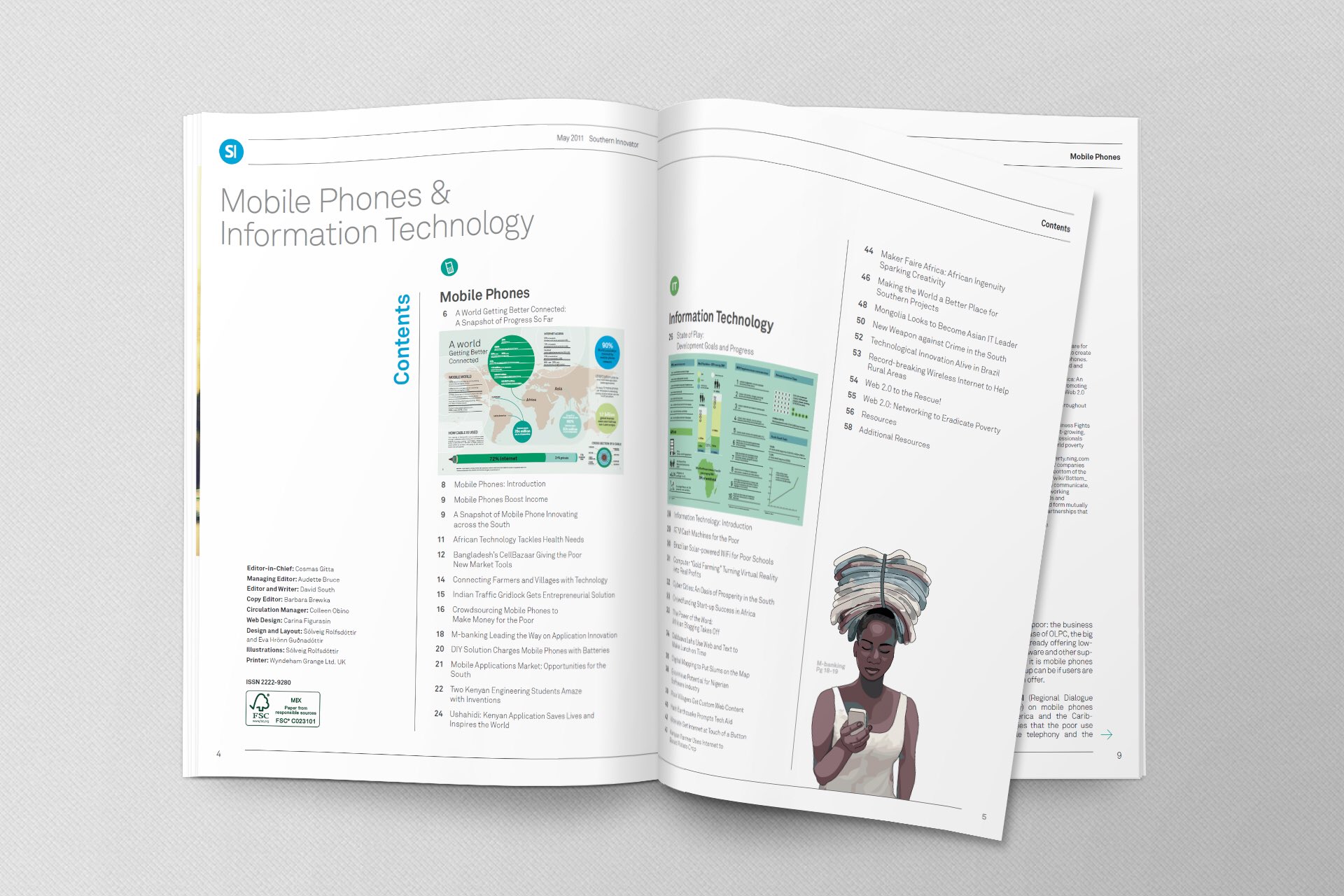
Development Challenges, South-South Solutions was launched as an e-newsletter in 2006 by UNDP’s South-South Cooperation Unit (now the United Nations Office for South-South Cooperation) based in New York, USA. It led on profiling the rise of the global South as an economic powerhouse and was one of the first regular publications to champion the global South’s innovators, entrepreneurs, and pioneers. It tracked the key trends that are now so profoundly reshaping how development is seen and done. This includes the rapid take-up of mobile phones and information technology in the global South (as profiled in the first issue of magazine Southern Innovator), the move to becoming a majority urban world, a growing global innovator culture, and the plethora of solutions being developed in the global South to tackle its problems and improve living conditions and boost human development. The success of the e-newsletter led to the launch of the magazine Southern Innovator.  
Creative Commons License

This work is licensed under a
Creative Commons Attribution-Noncommercial-No Derivative Works 3.0 License.

ORCID iD: https://orcid.org/0000-0001-5311-1052.

© David South Consulting 2022

Categories
Archive Development Challenges, South-South Solutions Newsletters Southern Innovator magazine

Technological Innovation Alive in Brazil

By David SouthDevelopment Challenges, South-South Solutions

SOUTH-SOUTH CASE STUDY

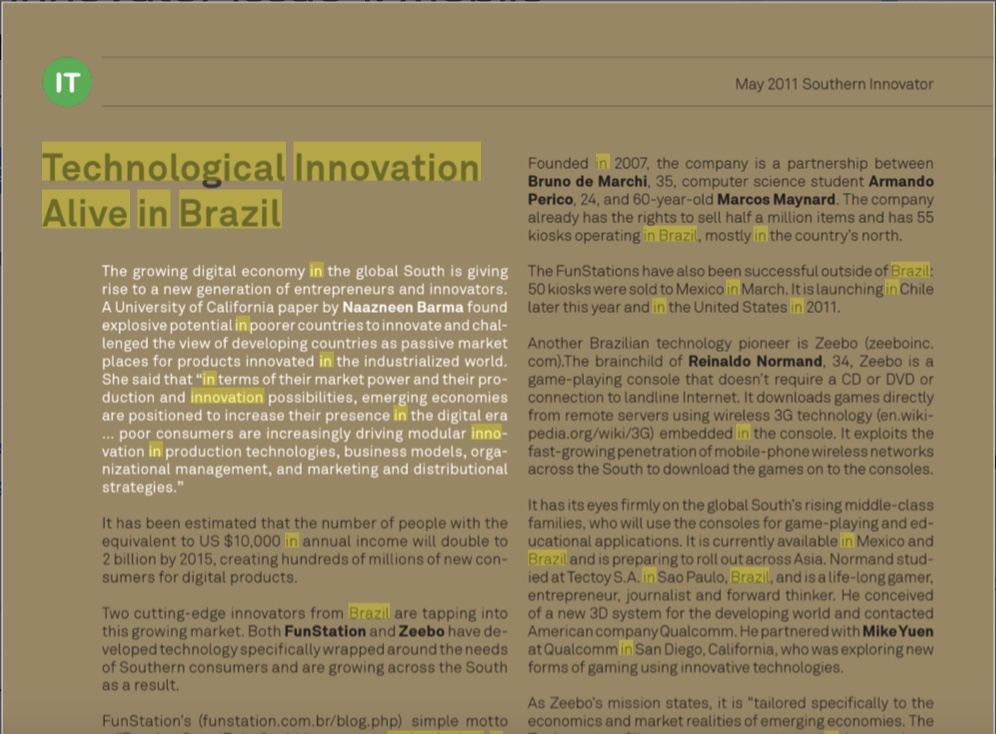
The growing digital economy in the global South is giving rise to a new generation of entrepreneurs and innovators.

A University of California paper by Naazneen Barma found explosive potential in poorer countries to innovate, and challenged the view of developing countries as passive market places for products innovated in the industrialized world. She said that “in terms of their market power and their production and innovation possibilities, emerging economies are positioned to increase their presence in the digital era … poor consumers are increasingly driving modular innovation in production technologies, business models, organizational management, and marketing and distributional strategies.”

It has been estimated that the number of people with equivalent to US $10,000 in annual income will double to 2 billion by 2015, creating hundreds of millions of new consumers for digital products.

Two cutting-edge innovators from Brazil are tapping into this growing market. Both FunStation and Zeebo have developed technology specifically wrapped around the needs of Southern consumers and are growing across the South as a result.

FunStation’s (http://www.funstation.com.br/blog.php)simple motto – “Touch – Get – Enjoy” – hides a savvy technological innovation aimed at the growing army of digital downloaders on the march across the South. Sao Paulo’s FunStation entertainment kiosk system serves up video, audiobooks, songs, and ringtones to mobile phones and MP3 (http://en.wikipedia.org/wiki/MP3) players. Customers just need to plug into one of the large futuristic white kiosks, scroll through the choices, select what they want, pay and download. By going to the kiosk, customers avoid the need to download from the internet, which can take a lot of time depending on the connection and bandwidth. The kiosk is speedy, with 14 musical tracks downloaded to a device in 10 seconds.

Apart from the convenience and speed of the kiosks, they also have other benefits: customers do not need to register with a download site like iTunes on the internet. This means they do not have to run the risks of giving away bank details or other personal information.

Customers buy something called a Funcard which is similar to a pre-pay phone plastic phone card, with a PIN number. Cards are sold with values ranging from US $2 to US $50. The user just punches the number into the kiosk to pay for the download.

The kiosks are being located in high-traffic places like festivals, airports, universities, retail shopping centres and transport systems.

Founded in 2007, the company is a partnership between Bruno de Marchi, 35, computer science student Armando Perico, 24, and 60-year-old Marcos Maynard. The company already has the rights to sell half a million items and has 55 kiosks operating in Brazil, mostly in the country’s north. “People are poorer in those places,”de Marchi told Monocle magazine. “Usually they have an MP3 player but no computer.”

The FunStations have also been successful outside of Brazil: 50 kiosks were sold to Mexico in March. It is launching in Chile later this year and in the United States in 2011. Always evolving, the business is also working with the University of Lugano in Switzerland to develop new software and keep the kiosks fresh and lively.

Another Brazilian technology pioneer is Zeebo (http://www.zeeboinc.com). The brainchild of Reinaldo Normand, 34, Zeebo is a game-playing console that doesn’t require a CD or DVD, or connection to landline internet. It downloads games directly from remote servers using wireless 3G technology (http://en.wikipedia.org/wiki/3G)embedded in the console. It exploits the fast-growing penetration of mobile phone wireless networks across the South to download the games on the consoles.

It has its eyes firmly on the global South’s rising middle-class families, who will use the consoles for game-playing and educational applications. It is currently available in Mexico and Brazil and is preparing to roll out across Asia. Normand studied at Tectoy S.A. in Sao Paulo, Brazil, and is a life-long gamer, entrepreneur, journalist and forward thinker. He conceived of a new 3D system for the developing world and contacted American company Qualcomm. He partnered with Mike Yuen at Qualcomm in San Diego, California, who was exploring new forms of gaming using innovative technologies.

As Zeebo’s mission states, it is “tailored specifically to the economics and market realities of emerging economies. The Zeebo system fills an enormous unmet need in these regions. At the same time it opens an immense new market for interactive content and products.”

Normand is ambitious and wants to reach a vast market of 340 million Chinese families. “By 2011, I want to close deals in China to manufacture televisions with this technology built in, therefore entering the homes of millions of families,” he told Monocle.

Zeebo makes some games for the console and also buys in other games from big-name game makers like Electronic Arts and Activision. The games are downloaded from the internet using a 3G mobile chip already built in to the consoles. The games are priced between US $5 and US $13.

The Zeebo system will roll out to China, the US and India in 2011, and Eastern Europe in 2012.

Published: August 2010

Resources

  • Afrinnovator: Is about telling the stories of African start-ups, African innovation, African made technology, African tech entrepreneurship and entrepreneurs. Their mission is to ‘Put Africa on the Map’ by covering these kinds of stories from all over Africa. As their website says, “if we don’t tell our own story, who will tell it for us?” Website: http://afrinnovator.com
  • AfricaUnsigned: This African alternative way of producing African music started this year. Unsigned artists record their music, funded by fans. Music fans from all over the world listen to the selection of artists, pick their favorite(s) and chip in a minimum of $1 dollar to the recording of a professional EP. The music is then distributed to the fans who backed the artist and sold on all major online stores (incl. Amazon & iTunes). Website: www.AfricaUnsigned.com
  • TechMasai: Pan-African start-up news and reviews. Website: www.techmasai.com
  • The Emerging Economies in the Digital Era: Market Places, Market Players, and Market Makers by Naazneen Barma, University of California. Website: http://tinyurl.com/3xjf2ps

https://davidsouthconsulting.org/2022/02/17/african-digital-laser-breakthrough-promises-future-innovation/

https://davidsouthconsulting.org/2022/10/05/african-innovation-eco-system-taking-shape/

https://davidsouthconsulting.org/2021/05/18/african-innovation-helps-make-banking-transactions-safer/

https://davidsouthconsulting.org/2022/11/16/brazils-agricultural-success-teaches-south-how-to-grow/

https://davidsouthconsulting.org/2022/11/10/brazilian-restaurant-serves-amazonian-treats/

https://davidsouthconsulting.org/2022/10/10/bringing-the-invention-and-innovation-mindset-to-young-kenyans/

https://davidsouthconsulting.org/2022/11/17/cashing-in-on-music-in-brazil/

https://davidsouthconsulting.org/2020/04/25/china-looking-to-lead-on-robot-innovation/

https://davidsouthconsulting.org/2022/10/24/flurry-of-anti-poverty-innovations/

https://davidsouthconsulting.org/2021/03/24/frugal-innovation-trend-meets-global-souths-innovation-culture/

https://davidsouthconsulting.org/2017/10/18/innovation-agenda-and-timeline-2007-2015/

https://davidsouthconsulting.org/2020/04/27/innovation-from-the-global-south/

https://davidsouthconsulting.org/2020/12/14/innovation-in-growing-cities-to-prevent-social-exclusion/

https://davidsouthconsulting.org/2022/11/11/innovation-cairos-green-technology-pioneers/

https://davidsouthconsulting.org/2021/03/04/innovation-villages-tackling-mdgs/

https://davidsouthconsulting.org/2021/10/22/innovations-in-green-economy-top-three-agenda/

https://davidsouthconsulting.org/2022/10/27/kenyan-mobile-phone-innovations/

https://davidsouthconsulting.org/2021/03/02/new-3d-technology-makes-innovation-breakthrough-and-puts-mind-over-matter/

https://davidsouthconsulting.org/2022/10/09/next-generation-of-innovation-for-the-grassroots/

https://davidsouthconsulting.org/2016/04/14/southern-innovator-and-the-growing-global-innovation-culture-14-april-2016/

https://davidsouthconsulting.org/2021/03/05/southern-innovator-issue-1/

Creative Commons License

This work is licensed under a
Creative Commons Attribution-Noncommercial-No Derivative Works 3.0 License.

ORCID iD: https://orcid.org/0000-0001-5311-1052.

© David South Consulting 2023