Last year’s fashion runways were dominated by one influence: Mongolian traditional design. If a designer wanted to show they were boldly embracing natural fibres and furs, then the refrain ” my show is all Mongolian” would be proudly boasted to the media. The country has become a synonym for sartorial flare and rugged beauty. It also doesn’t hurt that one of Mongolia’s top exports, cashmere wool, is in vogue, from Japan to Europe to the United States. After years of being isolated from the west under the umbrella of the Soviet Union, Mongolian fashion is proudly strutting the catwalks of the world.
Her square glasses reminiscent of Yves Saint Laurent (ysl.com), Mongolia’s top designer, Soyolmaa, talked to Ger about the ubiquitous nature of traditional clothes in the late 1990s. “There are few countries who still wear the national costume these days. Mongolia is one of them,” she says sitting regally in the studio of her home, surrounded by models draped in dresses for her latest collection: a tribute to the style and attitude of Mongolia’s ancient queens.
“Because the design of Mongolian national clothes is highly developed, no further changes are needed.” As head of the Mongolian National Designers’ Union, she has spent many years trying to find ways to improve the national costume to “no effect” she adds.
Busy tailors come and go, checking designs. The studio is crowded with four tailors and the models (not to mention this reporter). Two clients patiently wait in the hallway to see her. In a country where the soldiers and police wear uniforms designed by Pierre Cardin, it is no surprise Mongolians aren’t slouches when it comes to clothes. While budgets may be tight and the shops far from world standard, people still find a way to dress with flair.
It is still common to see the traditional del – a cloak of either wool, leather or silk – worn by men and women of all ages, even in the capital. As herders are quick to say, the del serves many practical purposes. It is padding for long rides on the steppe, it is a makeshift tent in bad weather, it is a warm blanket, and for women, a nod to modesty when nature calls on the open steppe. While it is standard wear for older generations, younger urban Mongolians turn to the del on special occasions like school graduation ceremonies.
Last year collections by Christian Dior (Dior.com), Chanel (chanel.com), UNGARO and Pierre Cardin (pierrecardin.com) all paid homage to Mongolian design, typically characterized by variations on the del cloak, flamboyant displays of fur and knee-high boots.
“Asian styles are now having a big impact on world fashion design,” continues Soyolmaa.
“It is because Asian clothes offer pure, simple patterns with eye-catching colours and adornments. There is a trend towards purism in the fashion world. They like high collars, askew lapels, loose sleeves and nudarga (long sleeves). The bright colors of Asia are showing up throughout Western design. You can see the askew lapel and high collar and bright colors from Christian Dior to Chanel.”
The Mongolian national costume is a classic example of purism. The pattern is very simple, with no separate sleeves or shoulder parts, and very economical with little waste of cloth.
And why did this style evolve over the generations? Soyolmaa has a simple answer: “It is because of the harsh weather of Mongolia.” The askew lapel doesn’t let wind pierce the body, nudarga or long sleeves don’t make arms cold in the minus 30 to 40 degrees Celsius winters. Winter dels have fur interiors, using wolf, fox, sheep or lamb’s wool. From ancient times to now, Mongolian men wear wolf fur coats in winter when guarding horses at night.
There are about a hundred styles of hat. Loovuus, made of fox fur with a cloth top, is a common hat in winter. The back part is open. “Fox fur is very dense. Without an open back one feels too hot and it causes high blood pressure and a headache,” according to Soyolmaa. The extraordinary design of boots with pointed toes is suitable for riding a horse while leaving enough dead air space to keep the toes warm.
Soyolmaa takes difference with those who claim “Fashion sense ends in Mongolia.” “It might because they have nothing to compare it with. But now that fashion shows are available on cable TV, Mongolians are learning how to compare Mongolian fashion and models with the global standard.” For Soyolmaa, as it is the time for Asian fashion, it is also the time for Asian models.
“Irina Pantieva, the world’s top model is Mongolian. She is from the Buriat Republic (a province of Russia directly north of Mongolia and populated by a large number of people of Mongolian heritage).” She says Mongolian models are ready to take on the world.
To the soothing sounds of Enigma, Mongolia’s top models parade Soyolmaa’s tributes to Mongolian queens in early May at the Las Vegas Entertainment Centre, a former communist-era cinema. Long silk dresses are complemented with furs and enormous hats, at times evoking Cleopatra, at other times something from a Dr. Seus cartoon, some hats reaching a meter high. Judging by the audience’s reaction and the quality of Soyolmaa’s creations, the time has come for Mongolian designers to take centre stage on the world fashion scene.
It could be said that there is no girl who does not dream of becoming a model. Many Mongolian girls, particularly Ulaanbaatar city girls, are flocking to attend courses in modelling in the last few years. Some say models are mushrooming in Mongolia, a country known for its fresh-faced people and robust physiques.
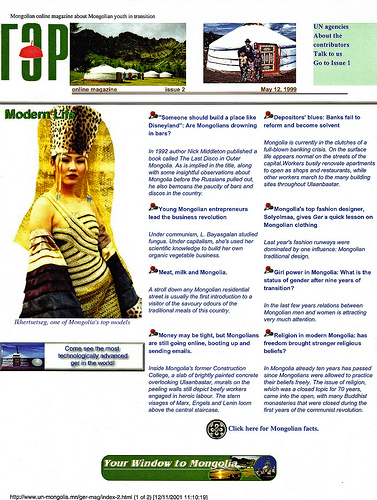
Ger interviewed S. Ikhertsetseg, one of the twin top models of Mongolia.
When did you first appear on the fashion stage?
“When we were 15 we played piano for the state concert on International Women’s Day on March 8. The ( Best Fashion) company was in trouble and they did not have anyone to wear some leather fashions for the show in the concert. It was fortuitous that we were asked to be the models. We kept it secret from our parents until we received a prize from Mongolia’s top fashion show, Goyol (or beauty) , in 1988. That was a year after the state concert. Being a fashion model was not considered so desirable as it is now. We were busy studying at music school and our parents did not know what we were doing.”
What do you think of today’s models?
“In the early days of fashion shows in Mongolia in the 1980s, we did not have many competitors. These days there are many beautiful Mongolian models we have to compete with, but only a few are very good. If someone is lucky, they have the potential to compete at the world level. Personally, I don’t like models who are too trained by courses.”
Do you think becoming famous is pure luck?
“Of course it is luck. But that doesn’t mean it isn’t a lot of hard work. You must send photos to agencies, and then only then, will someone see your photo – that is luck.”
What about design and fashion in Mongolia? Are Mongolians fashion sensitive?
“I can not say Mongolians are sensitive to fashion. I think our designers should work harder. Design is not a dress or a suit. It is everything, the whole cornucopia of details. I do not think we are going to compete with Europe, which has a long history of making clothing, rich in colors or designs. There is a big difference between fashion in the West and in Mongolia.”
Mongolia has a lively free press who sometimes step over the line when it comes to gossip and scandal reporting. These so-called “yellow” newspapers have damaged many people’s reputations. This had also happened to you. Some newspapers called the two of you the Barbie girls in Beijing, earning a lot of money.
“Yes, they did say those bad things. We replied to them.”
Was it before the court?
“No, that is a personal question.”
What was the result?
“The newspapers didn’t do that again.”
What do you do now?
“Both of us keep up the fashion work and also teach piano. Music is our profession and love. We founded the Association of Models of Mongolia to protect their rights and strengthen their position in the society.”
“A stroll down any Mongolian residential street is usually the first introduction to a visitor of the savoury odours of the traditional meals of this country. If you are invited into somebody’s ger (or traditional tent dwelling) or apartment, you will probably have an opportunity of tasting buuz, khuushuur and bansh.
“These Mongolian national meals are made with minced meat seasoned with garlic or onion (it can be anything from mutton to beef to camel to horse to gazelle) covered with flour and steamed in boiling water, fried in oil and boiled in water. For many visitors to the country the vast quantities of meat consumed can at first be surprising. But it is not long before a visitor finds their favourite Mongolian food, be it buuz, khuushur or a number of other treats. A Canadian living in Ulaanbaatar once told me, “the Mongolian national food contains a lot of meat, but I like the buuz.
“The meat-dependent diet arises from the need for hearty food to stave off the cold and long winters. Traditionally nomadic herders, Mongolians have for centuries been dependent on mostly animal products for their dietary staples. Now after over nine years of transition, the traditional diet has been used as a shield against hunger and for the wealthy, subject to the influence of imported foreign foods and cuisine. When the Russians pulled the plug on Mongolia’s aid in 1991, the economy went into a severe crisis. For many Mongolians it was their first experience of serious hunger. The staple traditional diet of meat, milk and flour saw many people through this crisis, when food imports from the former Soviet Union dropped off.
“Mongolians traditionally have turned to foods that are high in protein and minerals, relying less on more seasonable foods like vegetables and fruits. This means a diet heavy on meat and dairy products, the latter when sour in the summer time thought to clean the stomach. It isn’t just about meat though. Mongolians do also eat cereal, barley and natural fruits and plants native to the country.
“Out of necessity Mongolians have found creative and ingenious ways to use the milk of all five of the domestic animals in the country: sheep, cattle, goats, camels and horses. Orom is the cream that forms on top of boiled milk; aaruul are dried curds and can be seen baking in the sun on top of gers in the summer; eetsgii is the dried cheese; airag is fermented milk of mares (female horses); nermel, is the home-brewed vodka that packs a punch; tarag, is the sour yogurt; shar tos, melted butter from curds and orom, and tsagaan tos, boiled orom mixed with sometimes flour, natural fruits or eesgii. The method of drying the dairy products is common in preparing them. The Mongolians prepare enough dairy products for the long winter and spring.
“The traditions of using, producing and preparing these foods are stronger outside the main cities, where the population is more reliant on the vast herds for food. B. Baljmaa (Mongolians generally use their first names), a dietitian and nutritionist at the National Nutrition Research Centre, says there is a genetic compatability for the food.
‘Before 1992 there wasn’t much research in this area. But now we know from our research that Mongolians are better able to absorb foods with more acid. So, traditional food should be kept in the country.’
“Since 1997 Mongolians have seen a substantial increase in the variety and quantity of imported foods, many of which were only thought of as exotic 10 years ago. Since the start of 1999 the Soviet-style market stalls now compete against western-style supermarkets, with trolleys and shelves proudly saying “Made in Mongolia.” In markets like Dalai Eej, Dorvon Uul, Food Land and Mercury it is possible to buy delicious prepared and canned foods, candies, biscuits, and unknown and unused before by Mongolians, products like oranges, bananas, plums and American chickens.
“On top of the canteens and cafes serving Mongolian food, there are now many restaurants, canteens, bakeries and tea shops which serve meals from Russia, Italy, India, China, Japan, Korea, England, France, Senegal and Turkey. Most of these restaurants are located in the capital, Ulaanbaatar. Mongolians have taken to the new tastes. “I think Mongolians like roasted chicken and fish when they go to the foreign sit-down restaurants, and hot dogs and pizzas in the fast foods shops,” says I. Narantsetseg and her husband J.Battulga. Both were dining in the Seoul restaurant, and are happy they can go out for food: “it is a very good thing that there are opening a lot of restaurants where friends and family can go and enjoy food in comfort.”
“Isobe Hiroshi, manager of Seketei, a high-end Japanese restaurant, told me “only 20 per cent of our customers are Mongolians. The vast majority of our clients are foreign, especially Japanese people who are working and traveling here. I think Mongolians have still not grown used to sushi and sashimi, the raw fish prepared in our restaurant. But I hope we will welcome more and more Mongolians in the future.”
“The traditional diet in the cities is more changed, more european. And with comes its own dangers for Mongolians says the Nutrition Centre’s Baljmaa:
‘There is a big problem of importing poisonous foods and food which probably will cause the nutrition-related diseases common in more developed countries,” she continues.”While the trend around the world amongst health-conscious people is towards natural products for their food, some Mongolians use some food which can cause troubles for their health. For example, fast food made with more oil, salt and sugar are considered the biggest dangers for human health. On the plus side prices for these imported foods are higher and only the wealthiest people can afford them; the poor people can’t buy and eat it no matter how much they desire. This means their poverty is protecting their health. We should boost our efforts to raise awareness on what foods protect your health.’
“Help in improving nutrition awareness a poster portraying a ger details the food habits of Mongolians and the nutritional value of common foods.
“Now I want to present to you recipes of processing and preparing some Mongolian national products and meals:
“From ancient times, Mongolians use abundant and peculiar methods of processing meat and preparing food.. One of the more popular methods of processing the meat is to prepare borts (dried meat) for use in winter. Borts is made from the meat of cows, goats and camels. Here is a recipe for camel borts presented by Dr. Sh. Tserenpuntsag who engages in the research of the meat.
1. Separate the meat from its layer of fat, as fat will spoil in drying. 2. Cut meat into strips about 20-30 centimeters long and two to five centimeters thick. 3. Hang to dry in a well-ventilated room. 4. Leave for four to five months. 5. Cut into small strips for use in any dish you like.
“If soaked in water, the meat will expand up to two and half times in size. It should then be cooked for 18 minutes.
“The main method of cooking the meals of the Mongolians is boiling and steaming, considered the most healthy method in cooking by researchers the world over. Here is a recipe for buuz from the Nutrition Centre. It is considered one of the national meals of the Mongolians and is cooked by steaming and is a good fast food.”
“What a tremendous magazine your team has produced! It’s a terrific tour de force of what is interesting, cutting edge and relevant in the global mobile/ICT space… Really looking forward to what you produce in issues #2 and #3. This is great, engaging, relevant and topical stuff.” Rose Shuman, Founder & CEO, Open Mind and Question Box
Indian City Slum Areas Become Newly Desirable Places to LiveDevelopment Challenges: With India’s urban economy experiencing rapid growth, its slums – once seen as the most undesirable places to live in the country, if not on Earth – are attracting the attention of affluent residents and developers in India’s rapidly expanding cities. The prosperity in India’s cities has made these areas’ proximity to business and entertainment zones highly desirable. In turn, this has led to slum dwellers either upgrading their homes and in the process boosting their value, or being offered the opportunity to sell their rudimentary dwellings to real estate agents and property developers.
Virtual Supermarket Shopping Takes off in ChinaDevelopment Challenges: An ingenious use of technological innovation and savvy trend-spotting is radically transforming the way people do their grocery shopping in China. Busy urban dwellers with time-poor lifestyles can now do their grocery shopping as they pass through Shanghai’s subway system and have their weekly shopping delivered to their home.
Indian Mobile Phone Application Innovators Empower Citizens Development Challenges: With mobile phones becoming ubiquitous across the global South, the opportunity to make money – and possible fortunes – by providing ‘apps’ for these devices is now a reality.
Putting Quality and Design at the Centre of Chinese FashionDevelopment Challenges: Awareness of the sourcing of materials for fashion has been on the rise in the past decade. Concerns about how the global fashion industry functions and its impact on the environment have given rise to savvy retailers who take care over the sourcing of their materials and the working conditions of their employees.
Cheap Indian Tablet Seeks to Bridge Digital Divide Development Challenges: India has had many false starts in innovating in information technology. While the country and its talented army of software engineers have a global reputation for innovation, the fits and starts that have accompanied attempts to create new hardware and devices have drawn a range of emotions, from amusement to frustration.
Filipino Architect wants to Transform Slum with New PlanDevelopment Challenges: A clash is occurring across the global South over the future of urban planning and the ever-growing slums of the world’s megacities. This will be a decisive clash of visions: should cities flatten slums and relocate their residents, or work with slum dwellers, acknowledge the role they play in city economies and improve their lives with better dwellings?
Model City to Test the New Urbanism Concept in IndiaDevelopment Challenges: India’s phenomenal economic growth rate – forecast to be 7.9 percent this year by the Asian Development Bank, after averaging 7.7 percent per year over the past decade – has been the force behind an expanding middle class population, now estimated at 50 million people (McKinsey). Forecasts see it swelling from 5 percent of the population to 40 percent by 2025.
Anti-bribery Website in India Inspires Others Development Challenges: An Indian website tackling corruption has been so successful it has inspired a wave of followers in China. The I Paid a Bribe website – motto: “Uncover the Market Price of Corruption” – was set up by the Janaagraha Centre for Citizenship and Democracy (www.janaagraha.org), a non-profit organisation based in Bangalore, India.
Pakistan Simplifies Job-matching ServicesDevelopment Challenges: An innovative job-matching service from Pakistan is trying to bring together people who normally live separate lives. It is eliminating the middlemen who gouge both employers and employees for job-seeking fees and opening up a new world of opportunities for the poor.
Civet Cat Coffee Brews Filipino OpportunityDevelopment Challenges: In the Philippines, one animal’s call of nature has become a business opportunity.The civet cat, a member of the mongoose family, ingests the fruit of coffee plants, and expels the beans. This has created an unexpected by-product – a prized beverage for the world’s savvy coffee drinkers seeking the next taste sensation. The partially digested coffee beans are gathered from the faeces of the cat and used to make a much-coveted, smooth-flavoured cup of coffee.
Indonesia Best for EntrepreneursDevelopment Challenges: A global survey has unearthed hotspots across the global South for start-up businesses and private enterprise. It shows there are now many places in the South where people are actively encouraged to start businesses and engage in innovation and enterprise. The top place in the world for entrepreneurship, according to the survey for the British Broadcasting Corporation (BBC), is Indonesia.
The e-Reader Battle Reaches IndiaDevelopment Challenges: The rise and rise of e-books and electronic publishing has prompted the development of e-readers: handy, portable devices that try to mimic the reading experience of paper books while offering the storage and navigation capability of computers.
Indonesian Food Company Helps Itself by Making Farmers More Efficient Development Challenges: The current global economic crisis is taking place at the same time as a global food crisis. Food inflation took off at the beginning of 2011. This is having a devastating affect on countries dependent on food imports and experiencing decreasing domestic production capabilities. The least developed countries (LDCs) saw food imports rise from US $9 billion in 2002, to US $23 billion by 2008 (UNCTAD), prompting Supachai Panitchpakdi, secretary general of UNCTAD, to say “the import dependence has become quite devastating.”
Indian Toilet Pioneer Champions Good Ideas Development Challenges: Access to adequate sanitation and toilet facilities is critical to making development gains. Yet this simple fact of life often gets overlooked, especially in fast-growing cities where populations are on the rise or in transit. Out of an estimated 2.6 billion people in the world without toilets, two-thirds are in southern and eastern Asia (World Toilet Organization).
Indian ID Project is Foundation for Future Economic Progress Development Challenges: India is in the midst of the biggest national identification project in the country’s history. The aim is for every Indian to receive a voluntaryelectronic identification card containing his or her details and a unique number. Called an Aadhaar, it is a 12-digit unique number registered with the Unique Identification Authority of India (http://uidai.gov.in) (UIDAI). The project joins a growing trend across the global South to map populations in order to better achieve development goals.
Cambodian Bloggers Champion New, Open Ways Development Challenges: The Southeast Asian nation of Cambodia has had a very difficult history over the past few decades. In the 1950s and 1960s, it was seen as a glamorous and vibrant place. Dynamic, ambitious and newly independent from French colonial rule, Cambodia embarked on an extensive programme of building that is now called “New Khmer Architecture.” It is the most visible legacy of this modernizing time.
China Consumer Market: Asian Perspective HelpsDevelopment Challenges:The rise of China since 1989 has been the most remarkable development story of our times. The number of people lifted out of poverty is historically unprecedented: 65 percent of Chinese people lived below the poverty line in 1981; in 2007 it was 4 percent (World Bank).
Disaster Recovery, Ten Years After: The Gujarat, India Experience Development Challenges: In the past decade, there have been many devastating natural disasters, from Iran’s 2003 Bam earthquake and the Asian tsunami of 2004 to Hurricane Katrina in the United States in 2005 and the earthquakes in Chile and Haiti in 2010. All of these events received extensive media attention and drew a large aid response. Those who track natural disasters have noticed a serious increase in frequency over the past decade (http://www.marketoracle.co.uk/Article26290.html).
Indian Newspapers Thrive with Economy Development Challenges: The onslaught of digital media in the developed countries of the world regularly brings pronouncements of the death of the traditional newspaper. But this assumption of digital triumph misses out on the reality in countries across the global South.
China’s Booming Wine Market Can Boost SouthDevelopment Challenges: A great South-South opportunity has emerged with the recent boom in wine drinking in China and the pursuit of quality tastes. Matching high-quality wine producers from the global South – including South Africa, Chile, Morocco, and Lebanon – with China’s thirsty wine drinkers could deliver a major income boost.
Turning Animal Waste Into PaperDevelopment Challenges: Animal waste is a messy fact of daily life in rural communities across the global South. This byproduct of life has many uses – but an ingredient for making writing paper is probably not the first that springs to mind.
Creating Green Fashion in China Development Challenges:China is the world’s largest manufacturer (Euromonitor) and the largest clothing maker, producing a quarter of all textiles and clothing. It is a global fashion production hub, and many major global clothing brands have their products made there – whether they admit it or not.
Woman Restaurant Entrepreneur Embraces Brand-Driven Growth Development Challenges: The journey of Zhang Lan is the tale of an entrepreneur who exemplifies the story of globalization. She has gone from working many part-time jobs while studying overseas, to becoming one of China’s most successful food entrepreneurs.
Better by Design in ChinaDevelopment Challenges: In recent decades, China has been known more for its inexpensive manufactured goods than as a producer of high quality products. But this is changing as the country seeks to move up the economic chain.
Chinese Building Solution for Rapidly Urbanizing Global South Development Challenges:The global South is currently experiencing the biggest surge in urban population ever seen in human history. This transformation from urban to rural is happening in many different ways across the global South. Some countries have highly detailed plans and are building new cities from scratch, while other countries feel overwhelmed by their booming urban populations.
Free Magazine Boosts Income for Rickshaw Drivers Development Challenges:In the bustling, congested cities of Asia, rickshaws and auto-rickshaws are common forms of transport. Smaller, cheaper and more nimble than cars, they play a key role in the transit infrastructure, helping to get people to work and to get around.
Indian Entrepreneur Brings Dignity to Poor WomenDevelopment Challenges: Driven by the revelation that his wife was torn between spending money on milk for the children and buying commercially manufactured sanitary napkins, Indian innovator and inventor Arunachalam Muruganantham embarked on a long and intensive journey to find a solution. His achievement – a simple machine – is bringing dignity to poor women and providing them with a much-needed income source.
Indonesian Wooden Radio Succeeds with Good DesignDevelopment Challenges: One Indonesian industrial designer has pioneered an innovative business that has rejuvenated the economy of a farming village and improved the sustainability of local forests – and he’s doing it all with wood.
Gobi Desert Wine to Tackle Poverty and Boost IncomesDevelopment Challenges: In the arid Gobi desert spanning the two Asian nations of China and Mongolia is a bold attempt to make wine and reduce poverty. The environment is harsh, with temperatures swinging from sub-zero winter cold to sweltering summer heat. The desert is also home to high winds and notorious dust storms that plague China’s capital Beijing every year.
Help is at Hand for India’s Beleaguered Bus-ridersDevelopment Challenges:The website is a simple affair: a distinctive logo sits above a lean-looking booking system that allows users to enter their journey start and end destination, date and then click for available buses and prices. Its simplicity is deceptive: redBus is a smart technological solution to a very complicated problem in India: booking and buying a bus ticket. The service it offers – relief from a chaotic, frustrating and time-consuming task – is transforming the experience of travel in India.
China Looking to Lead on Robot Innovation Development Challenges: Since the 1950s, science fiction has been telling the world we will soon be living with robots. While robots have emerged, they have been mostly kept to heavy industry, where machines can perform dangerous, hot and unpleasant repetitive tasks to a high standard.
China Looking to Lead on Robot Innovation Development Challenges: Since the 1950s, science fiction has been telling the world we will soon be living with robots. While robots have emerged, they have been mostly kept to heavy industry, where machines can perform dangerous, hot and unpleasant repetitive tasks to a high standard.
Designed in China to Rival ‘Made in China’ Development Challenges: Harnessing the power of design to improve products and the way they are manufactured is a critical component of successful economic development. And the high export value of designing and making “computer equipment, office equipment, telecommunication equipment, electric circuit equipment, and valves and transistors” was flagged up as a priority for developing nations back in 2005 at a meeting looking for “New and Dynamic Sectors of World Trade” (UNCTAD).
Vietnam Launches Low-cost, High-Quality Video GameDevelopment Challenges: The creative economy offers huge opportunities to the countries of the global South. With the proliferation of new technologies – mobile phones, digital devices, personal computers with cheap or free software, the Internet – the tools to hand for creative people are immense. This begins to level the playing field and allows hardworking and talented people in poor countries to start to compete directly with those in wealthy countries.
Tackling China’s Air Pollution Crisis: An Innovative SolutionDevelopment Challenges: China reached an undesired landmark in 2013. While the country’s impressive economic growth has amazed the world, it has come at a price: pollution. China recorded record levels of smog in 2013, with some cities suffering air pollution many times above what is acceptable for human health.
China Pushing Frontiers of Medical ResearchDevelopment Challenges: Cutting-edge medical research in China is promising to boost human health and development. Futuristic science is being conducted on a large scale and it is hoped this will increase the pace of discovery.
China Sets Sights on Dominating Global Smartphone MarketDevelopment Challenges: The rise of smartphones – mobile phones capable of Internet access and able to run ‘apps’ or applications – is the latest wave of the global connectivity revolution. Mobile phones rapidly made their way around the world to become almost ubiquitous – the most successful take-up of a piece of communications technology in history – and now smartphones are set to do the same. The number of mobile phone subscriptions in the world surpassed 6 billion in 2012 (out of a population of 7 billion) and, according to the International Telecommunications Union (ITU), the number of mobile phones will exceed the world’s population by 2014.
Vietnamese Google Rival Challenging Global GiantDevelopment Challenges: Information technologies are creating new business opportunities across the global South. As more and more people gain access to the Internet in one form or another, opportunities to offer them services also increase.
Indian Initiatives to Make Travel Safer for WomenDevelopment Challenges: Shocking assaults on women traveling in India have galvanized innovators to find solutions. One solution that is proving successful is to establish specialist taxi services for women. As a happy additional benefit, these taxi innovators are transforming the taxi experience, introducing more ethical practices such as honest fares, professional and safe driving habits and clean, hygienic and comfortable taxis.
Boosting Tourism in India with Surfing CultureDevelopment Challenges: Tourism has experienced decades of growth and diversification and is now considered one of the fastest-growing economic sectors in the world. According to the UNWTO – the United Nations World Tourism Organization – modern tourism is “a key driver for socio-economic progress.”
Bangladesh Coffin-Maker Offers an Ethical EndingDevelopment Challenges: Few people want to think about death, and many are ill-prepared when it happens to a loved one or friend. But it will happen to us all – and growing ethical and environmental concerns are reshaping the way many deal with the inevitable event. More and more people are seeking a lower-cost option for being disposed of that also does not harm the environment.
Thai Organic Supermarkets Seek to Improve HealthDevelopment Challenges: A Thai business is working hard to expand access to organic food in the country. It sees this as part of a wider campaign to improve health in the country – and its success has caught the attention of the government, which wants to turn Thailand into a global health destination.
Indian Business Model Makes Green Energy Affordable Development Challenges: The technology already exists to provide renewable energy and electricity to all the world’s poor. The trick is finding a way to pay for it and to make it sustainable. Many innovators are experimenting with business models to reach the so-called Bottom of the Pyramid (BOP) cohort, and the 1.2 billion poorest people in the world who do not have access to electricity (World Bank) (http://tinyurl.com/n9p3f5x). A further 2.8 billion have to rely on wood or other biomass materials to cook and heat their homes.
China’s Outsourced Airliner Development ModelDevelopment Challenges: Many emerging-market countries in the global South have built up substantial foreign currency reserves. Much of this has been a response to past foreign currency crises, particularly the Asian Crisis in the late 1990s (http://en.wikipedia.org/wiki/1997_Asian_financial_crisis).
Asian Factories Starting to go GreenDevelopment Challenges: Media headlines have recently highlighted the growing air pollution crisis in Asia’s expanding cities. This is caused by a mix of factors – the growing number of vehicles, coal-powered factories, people burning dirty fuels to heat their homes, and poor enforcement of standards – and has severe consequences for human health. If it’s not tackled, more and more countries will see large rises in respiratory problems, cancers and early deaths from pollution-caused illnesses (http://www.nrdc.org/air/).
Popular Chinese Social Media Chase New MarketsDevelopment Challenges: China has a vast and growing market for the Internet and mobile devices. Over the past decade that market has been largely confined to China – most businesses have had enough domestic demand and opportunities inside the country to keep them busy.
India 2.0: Can the Country Make the Move to the Next Level?Development Challenges: With the global economic crisis threatening to cause turmoil in the emerging markets of the global South, it is becoming clear that what worked for the past two decades may not work for the next two.
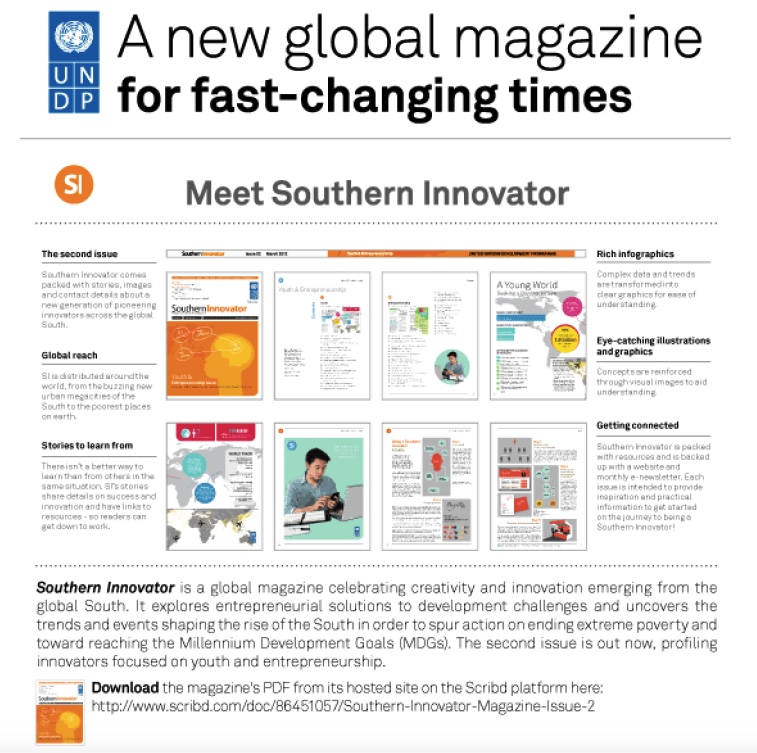
Development Challenges, South-South Solutions was launched as an e-newsletter in 2006 by UNDP’s South-South Cooperation Unit (now the United Nations Office for South-South Cooperation) based in New York, USA. It led on profiling the rise of the global South as an economic powerhouse and was one of the first regular publications to champion the global South’s innovators, entrepreneurs, and pioneers. It tracked the key trends that are now so profoundly reshaping how development is seen and done. This includes the rapid take-up of mobile phones and information technology in the global South (as profiled in the first issue of magazine Southern Innovator), the move to becoming a majority urban world, a growing global innovator culture, and the plethora of solutions being developed in the global South to tackle its problems and improve living conditions and boost human development. The success of the e-newsletter led to the launch of the magazine Southern Innovator.






 David South Consulting

You must be logged in to post a comment.