Categories
Archive Development Challenges, South-South Solutions Newsletters

A New African Beer Helps Smallholder Farmers

By David SouthDevelopment Challenges, South-South Solutions

SOUTH-SOUTH CASE STUDY

Africa’s growth in the past decade has held steady despite the trauma of the global economic crisis and the tumult of the “Arab Spring” in several countries of North Africa. African economies are growing because of a number of resilient trends. These include growing regional trade links, greater investment in infrastructure and the remarkable rise of China to become Africa’s number one trade partner, pushing the United States to second place (Technology + Policy). This has given birth to a growing consumer marketplace and consumer class – some 300 million people earning about US $200 a month (Africa Rising).

The continent as a whole now stands as the 10th largest economy in the world.

How will Africans spend this new money in their pockets (or more than likely, on their mobile phones)? They could go for the big, famous global brands that they see advertised in magazines or on television. Or they could also spend it on local products and services that seem just as enticing and life-improving. Creating local African products and services with strong brands will have an important knock-on effect of creating new wealth and jobs within Africa.

One new product being introduced to the West African country of Ghana’s thirsty beer drinkers is the Eagle beer brand. But this is not just any beer made from the traditional ingredients of water, hops, malted barley and yeast (http://en.wikipedia.org/wiki/Beer) – it is brewed from the root vegetable cassava.

A staple of many African diets, cassava (http://en.wikipedia.org/wiki/Cassava) is a starchy, tuberous root vegetable and a common crop across the continent.

It is believed that 70 per cent of Ghana’s farms are just 3 hectares in size or smaller. They grow many things, but cassava is the most common crop.

Cassava soon spoils once it has been harvested and needs to be consumed quickly. Currently, too much of it goes to waste. In Ghana, according to The Guardian, there is an annual surplus of some 40 per cent of cassava produced.

The Accra Brewery Limited (ABL) (http://www.sabmiller.com/index.asp?pageid=1156) decided to find a way to put the cassava from smallholder farms to good use and stop the waste. The brewery had observed the success of parent company SABMiller (http://www.sabmiller.com/index.asp?pageid=27) elsewhere in Africa, in turning cassava and the grain sorghum from smallholder farmers into beer. Farmers had directly benefited from the purchase of their surplus product.

Eagle brand cassava beer is creating opportunities for business, consumers and smallholder farmers in Ghana. According to The Guardian, the company hopes to source cassava from 1,500 smallholders.

By having a guaranteed purchase from the brewery on a regular basis, farmers are able to move beyond subsistence agriculture and turn themselves into functioning businesses.

The spare income from selling the cassava also can be used to improve a farmer’s household access to healthcare and education.

The Accra Brewery provides advice on agricultural techniques and growing a diverse range of crops, to ensure farmers are not dependent on a monocrop harvest. It also offers advice on business and developing commercial relationships.

The Eagle brand cassava beer will be sold at a 30 per cent discount to low-income drinkers in order to lure them away from illicit and informal alcohol drinks of dubious quality.

Professor Ethan Kapstein of business school INSEAD found that ABL and its water business Voltic (GH) Ltd. was a creator and supporter of high-quality jobs in Ghana and supported 17,600 jobs throughout the Ghanaian economy.

Adjoba Kyiamah (http://www.sabmiller.com/index.asp?pageid=1766&blogid=172), corporate and legal affairs director at Accra Brewery, told The Guardian she believes Eagle brand beer will help create even more jobs, boost government revenues and expand consumer choice.

This is an innovative first, as cassava beer had never been made before in Ghana on a commercial scale. This had not been possible in the past because of the challenge of collecting fresh cassava from farms widely spread out over a large territory. As well as spoiling quickly, Cassava is heavy, being mostly made up of water, and is difficult to transport over large distances.

“Part of our strategy across Africa is to make high quality beer which is affordable for low-income consumers while simultaneously creating opportunities for smallholder farmers in our markets. The launch of Eagle in Ghana ticks both these boxes,” said Mark Bowman, Managing Director of SABMiller Africa.

“Eagle is aimed at attracting low-income consumers away from illicit alcohol. This is a virtuous circle: smallholder cassava farmers have a guaranteed market for their crop, which is then used to make consistently high quality, affordable beer for consumers; and the government realises increased revenues as people trade up into formal, taxable alcohol consumption.”

ABL is using a mobile processing unit developed by DADTCO (Dutch Agricultural Development and Trading Company) Cassava Processing Ghana Ltd. It is designed to process the cassava on site, preserving the integrity of the starch.

Eagle is sold in 375 millilitre bottles at a price 70 per cent lower than that charged for other lager beers. The use of local ingredients, and a reduced excise tax awarded to the brand because is it is boosting local agriculture, allows for the lower price.

Production of cassava beer got its start first in Mozambique, with the launch of the Impala brand (http://www.sabmiller.com/index.asp?pageid=149&newsid=1748), the first commercial-scale cassava-based clear beer, in October 2011.

Published: April 2013

Resources

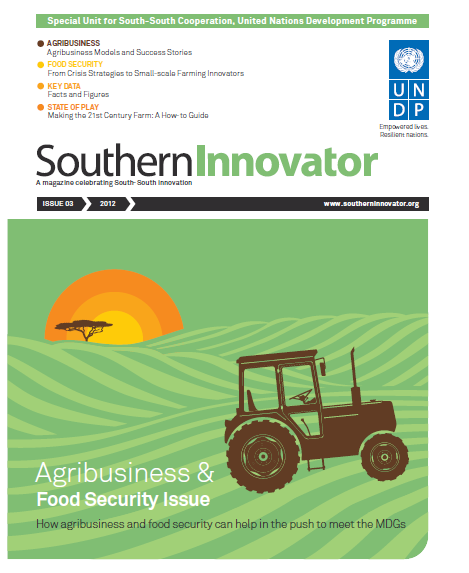
1) Southern Innovator Magazine Issue 3: Agribusiness and Food Security. Packed with information, insights and business models to turn smallholder farmers into agribusinesses. Website: http://www.scribd.com/doc/106055665/Southern-Innovator-Magazine-Issue-3-Agribusiness-and-Food-Security

2) Cassava can become Africa’s new cash crop: Cassava is abundant in sub-Saharan Africa, and could be an ideal crop to improve food security for millions of people. Website: http://www.guardian.co.uk/global-development-professionals-network/2013/mar/28/cassava-food-security-sub-saharan-africa

3) Cassava recipes from the BBC. Website: http://www.bbc.co.uk/food/cassava

Southern Innovator logo

London Edit

31 July 2013

Development Challenges, South-South Solutions was launched as an e-newsletter in 2006 by UNDP’s South-South Cooperation Unit (now the United Nations Office for South-South Cooperation) based in New York, USA. It led on profiling the rise of the global South as an economic powerhouse and was one of the first regular publications to champion the global South’s innovators, entrepreneurs, and pioneers. It tracked the key trends that are now so profoundly reshaping how development is seen and done. This includes the rapid take-up of mobile phones and information technology in the global South (as profiled in the first issue of magazine Southern Innovator), the move to becoming a majority urban world, a growing global innovator culture, and the plethora of solutions being developed in the global South to tackle its problems and improve living conditions and boost human development. The success of the e-newsletter led to the launch of the magazine Southern Innovator. 

Creative Commons License

This work is licensed under a
Creative Commons Attribution-Noncommercial-No Derivative Works 3.0 License.

ORCID iD: https://orcid.org/0000-0001-5311-1052.

© David South Consulting 2022

Categories
Archive Development Challenges, South-South Solutions Newsletters

Preserving Beekeeping Livelihoods in Morocco

By David SouthDevelopment Challenges, South-South Solutions

SOUTH-SOUTH CASE STUDY

The clever combining of tourism and long-standing beekeeping skills has revived a local craft and is also helping to preserve the ecology of Morocco.

Beekeeping, or apiculture (http://en.wikipedia.org/wiki/Beekeeping), has two clear benefits. Bee products, including honey, beeswax, propolis, pollen and royal jelly can be a valuable source of income. The other benefit is the critical role bees play in the ecology by pollinating flowers and plants as they go about their daily business.

Bees are at risk around the world, as reports of the dying-off of bees from colony collapse disorder (http://en.wikipedia.org/wiki/Colony_collapse_disorder) raise concerns about the impact on the earth’s ecology and plant life should bees disappear.

North Africa and the Middle East are considered the cradle of beekeeping, with records showing beekeeping going back to 2400 BC in Egypt. According to “A review of beekeeping in Arab countries” by Moustafa H. Hussein, “The total number of honey bee colonies in Arab countries is approximately 42 million, the total number of beekeepers is 321,700”.

In the paper “The Future of Bees and Honey Production in Arab Countries” by Moustafa A. EL-Shehawy, Egypt has the largest number of bee colonies in Arab countries (48 per cent), with Algeria in second place and Morocco with 9 per cent of the bee colonies.

Support for beekeeping comes from the Arab Beekeepers Union (http://abu.saudibi.com/index.php?page_id=115), which was established in 1994 with the aim to improve “the beekeeping profession all over the Arab World”, according to its website, and the Arab Apicultural Congress, first launched in 1996.

Beekeeping has significant potential for further development, many argue, and can be a great source of income and sustainable livelihoods for communities with a long history of beekeeping.

In Morocco, one solution to preserve beekeeping as a skill and source of income is to turn beekeeping into a tourist destination and event, which has the dual aim of boosting a local food product and reviving a traditional craft and skill.

The Berber heartland of the Agadir region is an area with a reputation for beauty, filled with waterfalls and mountains – and plentiful flowers, which attract bees. As a result, the area is home to the proud local specialty of honey, as well as for its argan nuts and oil, almonds, palm, juniper and olive production.

Now a “Honey Road” route for tourists, combined with community honey festivals, is helping preserve local skills and give a boost to this long-standing economic activity.

Beekeeping is a centuries old skill for the Berber people of North Africa. Berbers (http://en.wikipedia.org/wiki/Berber_people) are spread out across North Africa and were traditionally nomadic herders. Most now live in Morocco and Algeria, but Berbers can also be found in Tunisia, Libya, Mauritania, Mali and Niger.

Starting at the beginning of May, a honey festival takes place in the Moroccan village of Imouzzer des Ida Outanane (http://en.wikipedia.org/wiki/Imouzzer_Ida_Ou_Tanane), 60 kilometres from Agadir.

The honey festival brings together the region’s beekeepers. Tourists can sample honey and prizes are offered based on the quality of the product. It is part of the “Honey Road” route that tourists are encouraged to journey along.
The villagers share responsibility for the care of the bees. Demonstrations take place showing the basics of honey production and the keeping of queen bees.

A few kilometres away on the Honey Road is the village of Izourki Oufella, which produces honey perfumed with thyme and lavender.

The Honey Road runs a triangular pattern south and west of Marrakech between Argana, Oued Tinkert, Asif Tamraght, Agadir and Imouzzer. Argana is reputed to have the “largest and oldest collective beehive in the world” (http://www.morocco.com/blog/tantalizing-tastes-of-the-honey-festival).

Abdelhakim Sabri, owner of Auberge Zolado (aubergezolado.com) – a hilltop hotel with a restaurant and spa – is located in Agadir on the Honey Road.

Sabri works to preserve local culture. “Rural beekeepers struggle, so we’re introducing visitors to apiculturists like Ahmed – and Morocco’s finest honey,” he told High Life magazine.

Ahmed is a Berber beekeeper. He builds cylindrical hives for the bees by rolling sheets of woven reed and then caking them in earth. When the earth has dried, the bees quickly make it their home.

The region’s honey is prized for its distinctive flavour, infused with the aroma of herbs such as thyme, or flowers such as lavender, orange blossom or cactus. A mixture is made of honey, argan oil and almonds and is usually given to couples on their honeymoon.

“Different flowers bloom during different periods, so honey changes through the year,” said Sabri.

It sounds like the Honey Road is worth regular visits to sample the honey as it changes with the seasons!

Published: April 2013

Resources

1) A documentary on the Honey Route from Morocco’s travel promotion agency. Website: http://www.visitmorocco.com/index.php/eng/content/view/full/3975

2) Apinews: Latest apiculture news. Website: http://www.apinews.com/en/

3) Saudi Beekeeping Industry: An association to coordinate efforts to promote and support apiculture. Website: http://www.saudibi.com/?page_id=115
4) Laboratory of Apiculture and Social Insects (LASI): The Laboratory of Apiculture and Social Insects (LASI) at the University of Sussex is the largest research group in the UK studying honey bees and other social insects. Website: http://www.sussex.ac.uk/lasi/

5) Apimondia 2013: This year’s International Apicultural Congress will take place in Kiev, Ukraine from 29 September to 4 October 2013. Website: http://apimondia2013.org.ua/en/

6) International Bee Research Association: Founded in 1949, the International Bee Research Association (IBRA) is a not for profit organisation. It collects, collates and disseminates information on all species of bees.  It is a publishing house, producing a varied and extensive selection of bee publications. Website: http://www.ibra.org.uk/

Southern Innovator logo

London Edit

31 July 2013

Development Challenges, South-South Solutions was launched as an e-newsletter in 2006 by UNDP’s South-South Cooperation Unit (now the United Nations Office for South-South Cooperation) based in New York, USA. It led on profiling the rise of the global South as an economic powerhouse and was one of the first regular publications to champion the global South’s innovators, entrepreneurs, and pioneers. It tracked the key trends that are now so profoundly reshaping how development is seen and done. This includes the rapid take-up of mobile phones and information technology in the global South (as profiled in the first issue of magazine Southern Innovator), the move to becoming a majority urban world, a growing global innovator culture, and the plethora of solutions being developed in the global South to tackle its problems and improve living conditions and boost human development. The success of the e-newsletter led to the launch of the magazine Southern Innovator. 

Creative Commons License

This work is licensed under a
Creative Commons Attribution-Noncommercial-No Derivative Works 3.0 License.

ORCID iD: https://orcid.org/0000-0001-5311-1052.

© David South Consulting 2022

Categories
Archive Development Challenges, South-South Solutions Newsletters

Boosting Tourism in India with Surfing Culture

By David SouthDevelopment Challenges, South-South Solutions

SOUTH-SOUTH CASE STUDY

Tourism has experienced decades of growth and diversification and is now considered one of the fastest-growing economic sectors in the world. According to the UNWTO – the United Nations World Tourism Organization – modern tourism is “a key driver for socio-economic progress.”

The scale of global tourism means it rivals other sectors, such as oil exports, food products and automobiles in terms of economic clout. With such an important role to play in global commerce, it has become a top income source for developing countries in the global South.

International tourist arrivals grew by 4 per cent in 2012, reaching a record 1.035 billion worldwide (UNWTO). Emerging economies led the growth in tourism, with Asia and the Pacific showing the strongest gains. Tourism outpaced growth in the wider world economy in 2012, contributing US $2.1 trillion to global GDP and supporting 101 million jobs (WTTC).

“2012 saw continued economic volatility around the globe, particularly in the Eurozone. Yet international tourism managed to stay on course” said UNWTO Secretary-General Taleb Rifai. “The sector has shown its capacity to adjust to the changing market conditions and, although at a slightly more modest rate, is expected to continue expanding in 2013. Tourism is thus one of the pillars that should be supported by governments around the world as part of the solution to stimulating economic growth.”

One country that has found tourism becoming a key contributor to its national income is India. The country’s travel and tourism industry is now three times larger than its automotive manufacturing industry, and generates more jobs than chemical manufacturing, communications and the mining sector combined (World Travel and Tourism Council).

Indian Tourism Minister Subodh Kant Sahai called for the sector to create 25 million new jobs over the next five years and it is hoping to grow the market by 12 per cent by 2016 (The Economic Times).

Travel and tourism now contributes 6.7 billion rupees (US $124 million) – or 6.4 per cent – of the country’s total GDP (gross domestic product). The sector supports 39 million jobs directly and indirectly.

But competition for global tourist dollars is fierce. As more flight routes open up – Africa for example, is seeing new airlines and routes emerge every year – a person looking for somewhere to holiday has an ever-growing range of options to choose from. Will it be Africa this year, or shall we go to Asia?
One way to attract tourists and gain an extra edge in the global travel marketplace is to show imagination and innovation. Being different and novel can be the clincher for a tourist, especially one who is widely travelled and is searching for new experiences.

In Southern India, the state of Kerala is well known for its ayurvedic medicine (http://en.wikipedia.org/wiki/Ayurveda) and food tradition going back centuries, combined with its laid-back beach culture. It is a heady combination that successfully attracts many people, who come to relax and boost their health.
Now, Kerala is offering a new dimension to this experience: surfing. Surfing is a water sport involving a person riding ocean waves (https://en.wikipedia.org/wiki/Surfing), usually on a long board. India has enormous and mostly untapped potential as a surfing destination, with its hot weather and 7,000 kilometres of coastline.

Soul and Surf (http://soulandsurf.com) in Golden Beach, Varkala is within walking distance of the Varkala Cliff tourist area and an hour away from the closest major airport, Trivandrum International Airport.

The founders of Soul and Surf, Ed and Sofie Templeton, were captivated by “surfing warm, empty waves, eating wonderful fresh, cheap seafood, practicing yoga and receiving ayurvedic treatments”, according to their website.

“Enchanted by India’s magical, spiritual atmosphere, the warmth of the local people and the raw natural beauty of the area,” they set up a combined surfing and yoga retreat in 2010.

They have become part of a growing surfing scene in Kerala, and an increasing awareness in the country that its long ocean coastline is perfect for water sports.

As surfing grows in India, the owners wanted to create a business that supported the local area, particularly coastal fishing communities surrounding Varkala.

They have also expanded to run a luxury surf and yoga retreat in Sri Lanka and guided trips to the Andaman Islands.

Soul and Surf was inspired by the Surfing India Surf Ashram (surfingindia.net), a 12-hour trip up the coast from Surf and Soul in Karnataka.

Their so-called “Surfing Swamis” have discovered the best places to surf in India and are spirited champions of the whole surfing lifestyle. A swami (http://en.wikipedia.org/wiki/Swami) is a Hindu male religious teacher.
Surfing India promotes adventure sport in India and was started in 2004. At the time, surfing in India had a very low profile. Surfing India offers a sophisticated experience to travellers, including Wi-Fi Internet access, vegetarian food and all the equipment required.

All the staff are volunteers and work for room and board. Profits are plowed back into keeping the surf ashram going and helping its activities, which include adventure tours, a surf camp, surf school, yoga retreat, bodyboarding, snorkelling and wakeboarding.

The Surfing Swamis Foundation is a non-profit organization whose goal is to “teach surfing and environmental awareness to children, orphans, and handicapped persons of any age or gender.”

It also sponsors the All India Surf Team for boys and girls across India.

Published: April 2013

Resources

1) India Surf Festival: Taking place at the beginning of the year. Website: http://www.surfingindia.net/random-stuff/india-surf-festival-2013

2) A guide to the best places to surf in India. Website:http://www.surfingindia.net/india-surf-spots

3) Surfing Federation of India. Website:http://www.surfingfederationofindia.org/

4) United Nations World Tourism Organization: The World Tourism Organization (UNWTO) is the United Nations agency responsible for the promotion of responsible, sustainable and universally accessible tourism. Website: unwto.org

Southern Innovator logo

London Edit

31 July 2013

https://davidsouthconsulting.org/2022/10/20/african-tourism-leads-the-world-and-brings-new-opportunities/

https://davidsouthconsulting.org/2022/10/20/africas-tourism-sector-can-learn-from-asian-experience/

https://davidsouthconsulting.org/2022/09/27/caribbean-island-st-kitts-goes-green-for-tourism/

https://davidsouthconsulting.org/2022/11/20/ecotourism-to-heal-the-scars-of-the-past/

https://davidsouthconsulting.org/2022/11/23/kenyan-safari-begins-minutes-from-airport/

https://davidsouthconsulting.org/2022/10/10/a-solution-to-stop-garbage-destroying-tourism/

Creative Commons License

This work is licensed under a
Creative Commons Attribution-Noncommercial-No Derivative Works 3.0 License.

ORCID iD: https://orcid.org/0000-0001-5311-1052.

© David South Consulting 2023