Categories
Archive Development Challenges, South-South Solutions Newsletters Southern Innovator magazine

Kenyan Farmer Uses Internet to Boost Potato Farm

By David SouthDevelopment Challenges, South-South Solutions

SOUTH-SOUTH CASE STUDY

The rise of social networking websites (http://en.wikipedia.org/wiki/List_of_social_networking_websites) during the past few years has swept across the internet. The popular Facebook (www.facebook.com) site alone has over 350 million users worldwide. In Africa, there are more than 67 million people with access to the internet – just over 6 percent of the population (http://www.internetworldstats.com/stats1.htm). And this phenomenon has even begun to penetrate and influence life in poor places with weak internet infrastructure. A farmer in Kenya, Zack Matere, has boosted his potato crop by turning to Facebook for help.

On his farm in Seregeya near Eldoret, Kenya, Matere used the internet to find a cure for his ailing potato crop.

“I cycled 10 kilometres to the local cyber café, Googled (www.google.com) ‘potato disease,’ he told the BBC, “and discovered that ants were eating the potato stems.

“I checked again and found that one of the solutions was to sprinkle wood ash on the crop.”

Matere also used the internet to find a buyer for his rescued crop, and has been able to triple the price he gets for tree seedlings he sells.

Zack believes he is a bit of pioneer: “I think I am the only farmer in the area who uses the internet.”

He uses his mobile phone to access the internet and it costs him about US 0.66 cents a day to do it.

This is a lot of money for small-scale farmers so Zack has a plan to tackle the cost. He will share the information he uncovers on the internet with other farmers in the community by posting it on local community notice boards.

He has noticed some important realities about how people he knows interact with the mobile web. He has found most people do much more with the Net than surfing the mobile web alone at home.

“The internet is quite an individual pursuit. But a notice board is more of a group thing.

“So if I post an item on a notice board on potato disease, for example, the community can read it, talk together and come to a decision.”

One example of the kind of intelligence Matere is able to glean from the internet is reports of cartels deceiving farmers by buying potatoes in over-large 130 kg bags instead of 110 kg bags. Matere takes this information and translates it into Swahili and posts it on community notice boards.

Matere also has to fend off other people looking to use his community’s water supply, which he has done by photographing interlopers with his mobile phone and then posting the photographs on Facebook.

“When they came before, I took photos of what they were doing, posted them on my Facebook page and was able to get assistance,” he said.

“I got in touch with Forest Action Network (http://www.fankenya.org/) and they came back to me quickly saying they would help me protect the catchment area.”

He has also discovered there are more profitable ways to make money for farmers.

“There is a lot of money in tree seedlings or bee hives. So if we can get these young people to use the land in an environmentally (friendly) way, they can get even more money than through farming.”

“I have 400 Facebook friends and I think some of them can buy the honey.”

Matere is philosophical about the future: “I am now seeing the practicality of the internet here in rural Kenya. The problem is I am the only one. That is why the notice board is important. All we need is a bit of relevant information to help us.”

“Once it is made simpler and is more in the local language with more local content, people are going to access the internet here,” he predicts.

Published: April 2010

Resources

1) A blog with news and tips on how to use the social networking tools for business opportunities. Website:http://www.socialnetworking-weblog.com/

2) Four stories on how social networking radically improved business prospects for some people. Website:http://www.bnet.com/2403-13070_23-219914.html

3) A Business Week article on the good and bad of social networking for business. Website:http://www.businessweek.com/smallbiz/content/aug2008/sb2008086_346094.htm

4) Txteagle: A service in Kenya that is paying people to do tasks and translations with their mobile phones. Website:http://txteagle.com/index.html

https://davidsouthconsulting.org/2022/10/26/africa-to-get-own-internet-domain/

https://davidsouthconsulting.org/2022/10/04/the-brck-kenyan-developed-solution-to-boost-internet-access/

https://davidsouthconsulting.org/2020/12/04/data-surge-across-global-south-promises-to-re-shape-the-internet/

https://davidsouthconsulting.org/2022/05/16/high-impact-communications-in-a-major-crisis-undp-mongolia-1997-1999-18-february-2016/

https://davidsouthconsulting.org/2022/06/10/illiterate-get-internet-at-touch-of-a-button/

https://davidsouthconsulting.org/2021/01/24/record-breaking-wireless-internet-to-help-rural-areas/

https://davidsouthconsulting.org/2021/05/14/un-ukraine-web-development-experience-2000/

https://davidsouthconsulting.org/2022/11/18/web-2-0-networking-to-eradicate-poverty/

https://davidsouthconsulting.org/2022/06/16/web-2-0-to-the-rescue-using-web-and-text-to-beat-shortages-in-africa/

https://davidsouthconsulting.org/2022/10/10/wireless-internet-culture-helping-zimbabwe-economy-recover/

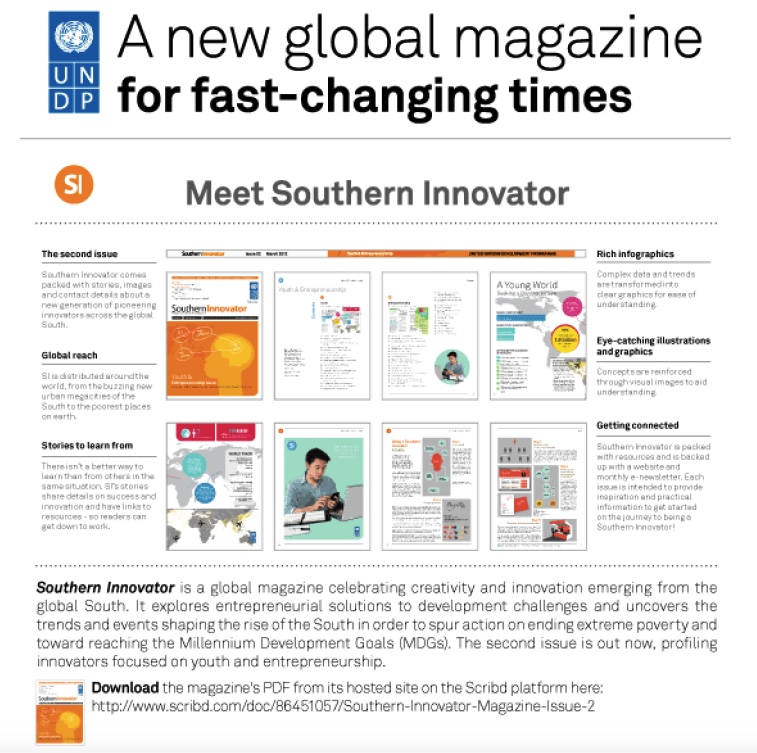
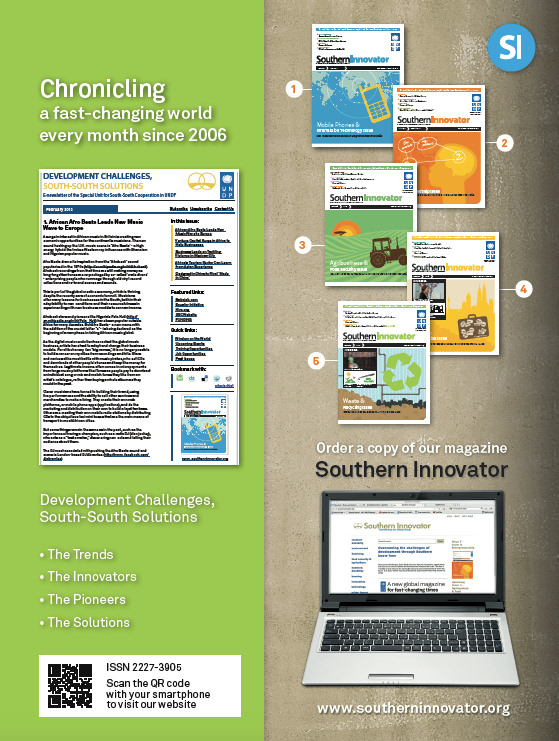
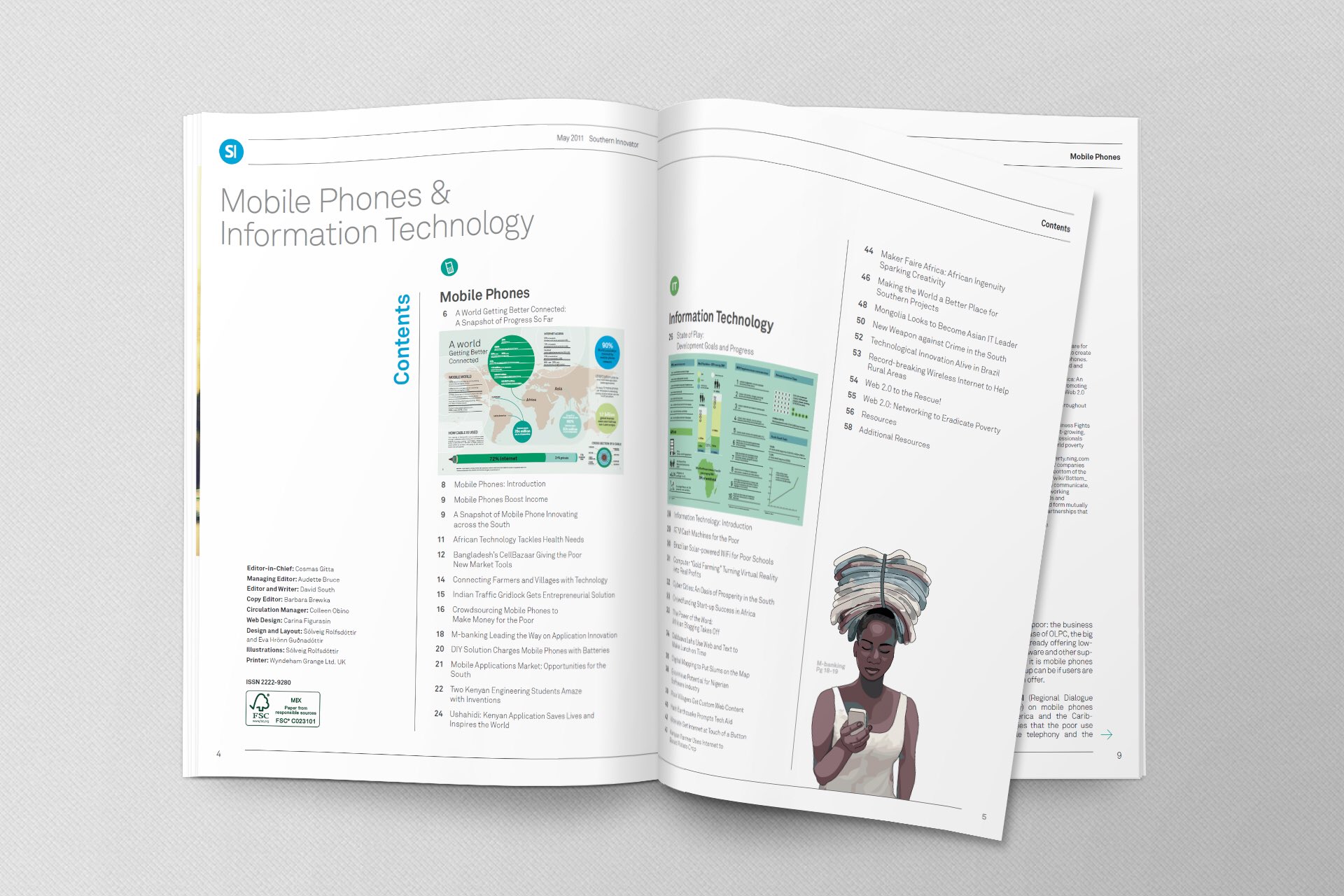
Development Challenges, South-South Solutions was launched as an e-newsletter in 2006 by UNDP’s South-South Cooperation Unit (now the United Nations Office for South-South Cooperation) based in New York, USA. It led on profiling the rise of the global South as an economic powerhouse and was one of the first regular publications to champion the global South’s innovators, entrepreneurs, and pioneers. It tracked the key trends that are now so profoundly reshaping how development is seen and done. This includes the rapid take-up of mobile phones and information technology in the global South (as profiled in the first issue of magazine Southern Innovator), the move to becoming a majority urban world, a growing global innovator culture, and the plethora of solutions being developed in the global South to tackle its problems and improve living conditions and boost human development. The success of the e-newsletter led to the launch of the magazine Southern Innovator.
https://davidsouthconsulting.org/2021/03/05/southern-innovator-issue-1/

Creative Commons License

This work is licensed under a
Creative Commons Attribution-Noncommercial-No Derivative Works 3.0 License.

ORCID iD: https://orcid.org/0000-0001-5311-1052.

© David South Consulting 2023

Categories
Archive Development Challenges, South-South Solutions Newsletters Southern Innovator magazine

Electric Bicycles Become Urban Transport Success

By David SouthDevelopment Challenges, South-South Solutions

SOUTH-SOUTH CASE STUDY

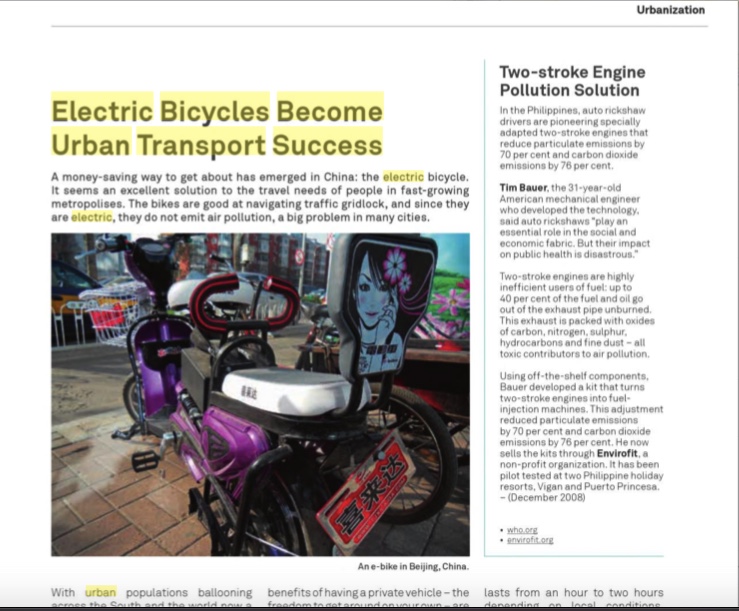
A money-saving way to get about has emerged in China: the electric bicycle. It seems an excellent solution to the travel needs of people in fast-growing metropolises. The bikes are good at navigating traffic gridlock, and since they are electric they do not emit air pollution, a big problem in many cities.

With urban populations ballooning across the South – and the world now a majority urban place – the challenge of moving people around economically and cleanly is a big issue. While turning to cars seems an appealing option for people who have raised their incomes, the resulting traffic jams and pollution are a major drawback. Gridlock (http://en.wikipedia.org/wiki/Gridlock) is a daily reality in cities across Asia and Africa.

The success of e-bikes in China is striking: It is estimated there are four times more electric bikes than cars in the country, 120 million in all. According to the Electric Bikes website (www.electricbikee.com), the number of electric bicycles produced each year has grown from 200,000 eight years ago to 22 million in 2008. It is estimated to be a US $11 billion a year business: a true Southern success story that is going around the world.

A typical electric bicycle has a rechargeable power pack, with a battery that takes up to four hours to charge and lasts from an hour to two hours depending on local conditions, like hills. The batteries can range from heavy lead acid models (around only 100 charges) to nickel metal to lightweight, long-lasting lithium batteries. The batteries range from 12 volts to 36 volts. How long a battery lasts depends on its energy retention ability, road and temperature conditions and the rider’s weight.

And while some cities are turning to encouraging more peddle power with human-powered bicycles, this is an unappealing option in hot or humid climates. Who wants to turn up at work hot and sweaty?

In China, a highly competitive market of manufacturers has sprung up in the last 10 years to provide e-bikes for every taste and need.

China has a long tradition as a cycling nation: in the 1980s, four out of five commuters used bicycles. But that changed dramatically as people bought cars with their rising incomes.

In the capital, Beijing, rapid economic development and rising incomes have led to serious traffic congestion. There are over 4 million cars on Beijing’s roads. The pollution in the city is very bad and has led to various campaigns to ban high-polluting vehicles.

The ensuing traffic gridlock means the benefits of having a private vehicle – the freedom to get around on your own – are eroded as a driver wastes time in long commutes. So, many have turned to the nimble electric bicycles.

One resident, David Dai, told the BBC “It takes only 10 minutes to ride my electric bike from home to work.”

“If I took the bus, I’d have to spend time waiting for it, and then I could be trapped in a traffic jam. It could take me half an hour to make the same journey.”

Competition is fierce in the electric bike market, with shops sometimes sitting side-by-side.

A manager of a Beijing electric bicycle store, Zhang Zhiyong, puts the success down to this: “Beijing is not like other smaller cities – it’s big. If people ride their bicycles to work, they get really tired. If they drive to work, the roads are often congested,” he told the BBC.

“But an electric bike is environmentally friendly and convenient. Promoting the use of these bikes would benefit us all.”

And the price is a definite incentive: just 2,680 yuan (US $390), while cars sell for thousands of dollars.

The electric bicycles are so successful they are now growing faster than cars in a country that has become the fastest growing car market in the world.

Some believe the bikes are just a stop gap before people get enough money to buy automobiles. But the bigger trend of growing urban populations and the ensuing traffic jams will ensure they remain a practical option to get around the gridlock.

Published: April 2010

Resources

1) Electric Bike Website: Home to news and links to manufacturers. Also lots of resources on how to convert peddle bikes into electric bikes. Website:http://www.electricbikee.com/

2) The Luyuan Electric Vehicle Company of Jinhua City in China has been making the bikes for 10 years. They come fully equipped with lights, baskets, fenders and in many colours. Website: http://en.luyuan.cn/?gclid=CJXu_tr576ACFclr4wodG1GsGQ

3) Empowered Ebikes: An online retailer of e-bikes specializing in urban commuters. Website:http://www.empoweredebikes.com/index.php

4) Made-in-China.com: A large list of e-bike manufacturers in China and how to contact the dealers and manufacturers. Website: http://www.made-in-china.com/products-search/hot-china-products/E-bike.html

5) Pedego: An American company making high-end e-bikes. Website: http://www.pedegoelectricbikes.com/index.php

Development Challenges, South-South Solutions was launched as an e-newsletter in 2006 by UNDP’s South-South Cooperation Unit (now the United Nations Office for South-South Cooperation) based in New York, USA. It led on profiling the rise of the global South as an economic powerhouse and was one of the first regular publications to champion the global South’s innovators, entrepreneurs, and pioneers. It tracked the key trends that are now so profoundly reshaping how development is seen and done. This includes the rapid take-up of mobile phones and information technology in the global South (as profiled in the first issue of magazine Southern Innovator), the move to becoming a majority urban world, a growing global innovator culture, and the plethora of solutions being developed in the global South to tackle its problems and improve living conditions and boost human development. The success of the e-newsletter led to the launch of the magazine Southern Innovator. 
Creative Commons License

This work is licensed under a
Creative Commons Attribution-Noncommercial-No Derivative Works 3.0 License.

ORCID iD: https://orcid.org/0000-0001-5311-1052.

© David South Consulting 2023

Categories
Archive Development Challenges, South-South Solutions Newsletters

Iranian Savings Funds to Tackle Loan Drought

By David SouthDevelopment Challenges, South-South Solutions

SOUTH-SOUTH CASE STUDY

For entrepreneurs around the world, acquiring finance to start or expand a small business has become harder and harder as the global financial crisis has bitten hard. Across the globe, people with good ideas or successful businesses that need funds to expand are finding the door closed by traditional banks.

As banks and governments have focused on reducing debt and building up cash reserves, it is small businesses and small-scale entrepreneurs – often without business or family connections – who suffer the most. Opportunities are being missed to create new jobs and enterprises and lift poor communities out of poverty.

In that climate, the search is on for alternative ways to build up wealth. In Iran, a new phenomenon has arisen to address the lack of bank loans for small businesses brought about by the economic crisis. Iran is suffering under international sanctions as well as outstanding bank loans exceeding US $45 billion, according to the Financial Times.

The domestic banking crisis this has provoked has resulted in a tightening of credit for loans.

But in response, middle class Iranians are forming their own savings clubs to help each other with loans.

The savings clubs work like this: each member buys a share in the club costing around US $2 per day (around US $620 over 10 months). Each share makes the saver eligible for one loan during the year. For example in a club of 30 Tehran taxi drivers, every month four members of the club receive US $600 each in loans. The fund lasts 10 months and each member is guaranteed one loan per share.

“It is a savings fund and doesn’t have the uncertainty of the banking system, which might or might not give you a loan,” club member Ahmad told the Financial Times newspaper. As one of the drivers, he has four shares and is eligible for four loans.

“My mother is also saving money in a fund of housewives among our female relatives.”

The fund is managed by the head of the taxi agency and a driver who is a retired teacher. Both are trusted. “The retired teacher receives the money every day and puts a check mark by the names of those who pay. He is trusted by the head of the taxi agency, while other drivers respect him as an educated, honest man.”

Savings clubs are also good for the local economy, helping people to be able to buy goods on loans they would never be able to purchase otherwise. Another driver used the fund to “buy the things we cannot afford under normal conditions, like a washing machine, for instance, for which we have zero chance to get bank loans.”

Overdue loans by Iran’s banks grew by 66 percent from last year according to Asghar Abolhassani, the deputy economy minister.

The Financial Times reported that an estimated 25 percent of bank loans are outstanding, making Iran’s banking system technically bankrupt. International sanctions are also blocking the country’s banks from accessing global financial markets for support.

“Stagnation has gripped many parts of the economy,” said Hamid Tehranfar, the central bank’s director-general for banking supervision.

Turning to savings clubs can be an excellent alternative saving and loans model, but it requires very specific trust guarantees in place to ensure the holder of the funds doesn’t just take the money. For those who can’t find somebody local they trust, there are a number of online social lending and fundraising alternatives for raising funds and borrowing money. These include Kiva (www.kiva.org), which connects poor people looking for loans with people around the world willing to lend.

As the crisis continues and banks and governments hoard wealth for their own needs to pay down debt, alternative sources of loans will become ever more important for the poor.

Published: April 2010

Resources

1) Zopa: “Where people meet to lend and borrow money.” Website: www.zopa.com

2) Kiva: Kiva’s mission is to connect people, through lending, for the sake of alleviating poverty. Website: www.kiva.org

3) Betterplace: Started in 2007, Betterplace is an online marketplace for projects to raise funds. It is free, and it passes on 100 percent of the money raised on the platform to the projects. Website: www.betterplace.org

4) Kickstarter: Kickstarter is a funding platform for artists, designers, filmmakers, musicians, journalists, inventors, and explorers. Website: http://www.kickstarter.com/

Development Challenges, South-South Solutions was launched as an e-newsletter in 2006 by UNDP’s South-South Cooperation Unit (now the United Nations Office for South-South Cooperation) based in New York, USA. It led on profiling the rise of the global South as an economic powerhouse and was one of the first regular publications to champion the global South’s innovators, entrepreneurs, and pioneers. It tracked the key trends that are now so profoundly reshaping how development is seen and done. This includes the rapid take-up of mobile phones and information technology in the global South (as profiled in the first issue of magazine Southern Innovator), the move to becoming a majority urban world, a growing global innovator culture, and the plethora of solutions being developed in the global South to tackle its problems and improve living conditions and boost human development. The success of the e-newsletter led to the launch of the magazine Southern Innovator. 

Creative Commons License

This work is licensed under a
Creative Commons Attribution-Noncommercial-No Derivative Works 3.0 License.

ORCID iD: https://orcid.org/0000-0001-5311-1052.

© David South Consulting 2023
Categories
Archive Development Challenges, South-South Solutions Newsletters

West African Chocolate Success Story

By David SouthDevelopment Challenges, South-South Solutions

SOUTH-SOUTH CASE STUDY

A Ghanaian chocolate company has become a big success in the United Kingdom and shown how it is possible to develop and market a high-quality product grown in West Africa. While the chocolate bars are manufactured in the Netherlands, the cooperative that owns the company initiated the push into producing a mass-market chocolate brand – and shares in the profits.

The Divine chocolate brand is available in shops and supermarkets across Britain and is the product of the Kuapa Kokoo (http://www.kuapakokoo.com/) cocoa farmers cooperative. The Divine brand was launched in the U.K. in 1998 as the first Fairtrade (http://www.fairtrade.org.uk) chocolate bar aimed at the mass market. Previously, most Fairtrade chocolate was made for high-end customers.

Apart from the chocolate bars, the co-op also sells its cocoa butter to The Body Shop (http://www.thebodyshop.co.uk/_en/_gb/index.aspx), a chain of natural beauty retailers.

In 1997, at the co-op’s annual general meeting, members decided to create a mass-market chocolate bar of their own. Ambitiously, they did not want to just be a small, niche-market chocolate bar. They wanted to take on the big brands. They set up The Day Chocolate Company in 1998 and received support from a collection of international charities, aid agencies and businesses.

The Chocolate Company is structured to have two members of the co-op on its board of directors, with one out of four yearly board meetings held in Ghana. As shareholders, the farmers also receive a share of the profits of chocolate sales. Britain’s chocolate market is worth £4 billion a year (US $6 billion) and the country has hundreds of chocolate brands, making competition for customers fierce. The Divine range of chocolate has been designed to match U.K. market tastes.

Ghana has an excellent reputation for the quality of its cocoa beans and has been growing cocoa since it was first brought to the country from Equatorial Guinea in 1878 by Tetteh Quarshie (http://www.ghanaweb.com/GhanaHomePage/people/pop-up.php?ID=128).

Kuapa Kokoo’s success story has its origins in responding to the structural adjustment programmes (http://en.wikipedia.org/wiki/Structural_adjustment) which started liberalizing Ghana’s cocoa market in 1993.

The lock the government had on selling cocoa to the Cocoa Marketing Company had been lifted. Now the opportunity was there for others to sell to the Marketing Company and some farmers decided to form a cooperative, Kuapa Kokoo – “the best of the best”. They wanted to get a better price for the cocoa and to improve working conditions and lives of the pickers.

The cooperative does all the processing of the cocoa and delivers it to market. One of the great advantages for the farmers is the honest weighing of the beans – something previous buying agents would cheat doing. By creating a more efficient and fair process, greater savings are made on the price paid for the beans and this is passed on to the co-op’s members.

The farmers are also trained to do tasks like weighing and bagging the cocoa, removing the need for outside help. Every year the farmers receive cash bonuses based on the co-op’s profits and any efficiencies made.

With this success, Kuapa Kokoo grew and now has more than 40,000 members spread over 1,300 villages.

The co-op offers various services to the farmers including a credit union to help with finances. There are also 33 Research and Development Officers employed by the co-op to oversee training and election.

The number of women farmers has grown over the years, from 13 percent to 30 percent.

Extra income-generating skills are encouraged for the women farmers as well. One project is to make soap from the potash produced from burnt cocoa husks. Women have also been given machines to crack palm kernels for cooking oil.

Comfort Kumeah, a 62-year-old co-op farmer, lives in the village of Mim in the Ashanti region. A former teacher for 39 years, she inherited 20 acres of land from her husband’s family.

“Each farmer has a passbook to record weight and payment. In the whole of Ghana, only Kuapa Kokoo … is certified Fairtrade,” she told the Sunday Times.

“I was voted chair of the farmers’ trust and national secretary for the union; once a year I attend a conference to vote on how the Fairtrade premium is spent. Last year we bought a palm-nut crusher and we sell the red oil on the market.”

“Before, I was always cheated. Purchasing clerks would come and weigh the beans and you never knew if their scales were correct, as no one checked them. Some embezzled the money instead of paying it to the farmers.”

“Owning this company has given cocoa farmers a voice for the first time.”

Kuapa Kokoo sells around 1,000 tonnes of cocoa every year to the European Fairtrade market (http://www.etfam.com/index2.php). This has many advantages for sellers if they meet certain conditions. These conditions include health and safety requirements and democratic decision making. If they are met, the producers receive a guaranteed price for their goods and long-term trading contracts. This means a stable price despite market fluctuations. With a stable price, it is easier to plan and save money.

Ghanaian cocoa has a good international reputation and trades at a higher price because of this. Cocoa once made up 66 percent of Ghana’s foreign exchange, but is now down to 35-40 percent as the economy has diversified into areas like information technology.

Cocoa is usually grown on small family farms in Ghana. Farmers also grow crops like plantain to provide food for the family. Around 1.6 million people are involved in growing cocoa and its business in Ghana. Cocoa trees grow to 15 metres in height and take three to four years to start producing a crop. An entire year’s worth of a tree’s crop can make three large chocolate bars.

A tree can produce two crops a year. Each cocoa pod produces around 40 seeds.

“A cocoa farmer’s life is hard,” admits Comfort. “In the lean season, we have no income. Also, cocoa is controlled by climate. Drought followed by too much rain causes fungus and rot, and then every farmer is poor.”

“I have saved money for my children’s education but my own needs are few: clothes, soap and toothpaste. Generally, you know, women are strong. Last year more women than men were voted onto the Kuapa Kokoo national executive and now hold some of the most senior positions.”

Learn more about cocoa trading and Africa’s role here (content provided by commodity.com): Cocoa’s Future as Commodity: What If Africa Can’t Keep Up the Supply? – Where’s Cocoa From and How Much Does It Contribute to the World’s Economy?

Cocoa has many health benefits. From the British Journal of Clinical Pharmacology: The neuroprotective effects of cocoa flavanol and its influence on cognitive performance

“In summary, the flavonoids contained in cocoa and chocolate appear able to improve various types of cognitive and visual tasks, possibly as the result of more efficient perfusion of blood to different neural tissues, clearly both forebrain and more posterior cortex and possibly also influence retinal blood flow and visual function.”

Published: April 2010

Resources

1) Divine’s online shop. Website: www.divinechocolateshop.com

2) An online shop with various Fairtrade chocolate brands for sale. Website: http://www.simplyfair.co.uk/acatalog/Chocolate.html?icid=J158-11634392-071H&gclid=CMOlycDN8KACFUkrDgodjXDsEg

3) How to make chocolate bars from the bean to bar. Website: http://www.wikihow.com/Make-Chocolate

4) Home Chocolate Factory: A website selling the moulds and other accessories for making chocolate products in small factories or at home. Website: http://www.homechocolatefactory.com/

https://davidsouthconsulting.org/2022/10/17/connoisseur-chocolate-from-the-south-gets-a-higher-price/

https://davidsouthconsulting.org/2022/11/01/indonesian-food-company-helps-itself-by-making-farmers-more-efficient/

Development Challenges, South-South Solutions was launched as an e-newsletter in 2006 by UNDP’s South-South Cooperation Unit (now the United Nations Office for South-South Cooperation) based in New York, USA. It led on profiling the rise of the global South as an economic powerhouse and was one of the first regular publications to champion the global South’s innovators, entrepreneurs, and pioneers. It tracked the key trends that are now so profoundly reshaping how development is seen and done. This includes the rapid take-up of mobile phones and information technology in the global South (as profiled in the first issue of magazine Southern Innovator), the move to becoming a majority urban world, a growing global innovator culture, and the plethora of solutions being developed in the global South to tackle its problems and improve living conditions and boost human development. The success of the e-newsletter led to the launch of the magazine Southern Innovator. 

https://davidsouthconsulting.org/2021/03/05/southern-innovator-issue-3/

Creative Commons License

This work is licensed under a
Creative Commons Attribution-Noncommercial-No Derivative Works 3.0 License.

ORCID iD: https://orcid.org/0000-0001-5311-1052.

© David South Consulting 2023