Categories
Archive Development Challenges, South-South Solutions Newsletters

Disabled Congolese Musicians Become World Hit

By David SouthDevelopment Challenges, South-South Solutions

SOUTH-SOUTH CASE STUDY

A group of Congolese musicians is using music to overcome obstacles – both economic and social – that come with being disabled in a poor country. Called Staff Benda Bilili, they are on course to be a global sensation and are looking forward to their first European tour. A remarkable achievement for anyone from a war-torn country, let alone for musicians who live as paraplegics in the slums of the Democratic Republic of Congo’s capital, Kinshasa (http://en.wikipedia.org/wiki/Kinshasa).

The South’s disabled are a large population and often suffer more than even the poorest residents. It is estimated that there are 500 million disabled people in the world, with mental, physical or sensory impairment. As many as 80 percent of all disabled people live in isolated rural areas in developing countries, and in some countries more than 20 percent of the population is classed as disabled (UN).

Obstacles are everywhere for the disabled and just being able to economically survive, let alone thrive, can be a superhuman struggle. There are many physical and social barriers in most countries which thwart full participation, and millions of children and adults live lives of segregation and degradation.

The four songwriters and musicians of Staff Benda Bilili use homemade wheelchairs to get around Kinshasa. The ‘wheelchairs’ resemble bicycles, tricycles and motorbikes, and are a testament to the resourcefulness of the band’s members. They sing about contemporary problems, like the importance of polio vaccinations – several of the band members are confined to wheelchairs because of polio (http://www.polioeradication.org/).

When performing, they are joined by a young group of acoustic rhythm musicians to complete their act.

One of the musicians, Roger Landu, just 17, plays a one-string lute called the satonge. He built it from old milk powder tin cans, a discarded fish basket and a single electrical wire. He builds the instruments for sale as well, charging US $20 for each one.

Benda Bilili means “look beyond appearances” in Lingala, a Bantu language spoken in Kinshasa.

Lounging after a recent performance on his hand-built moped wheelchair, Coco Ngambali, the group’s primary songwriter, told The Independent: “We see ourselves as journalists. We’re the real journalists because we’re not afraid of anyone. We communicate messages to mothers, to those who sleep on the streets on cardboard boxes, to the shégués (the disabled homeless).”

The band has a scrappy, street-wise persona. Being disabled, the members have had to fiercely protect their own security and economic position in society. Life on the streets for the band members, who were homeless – living near the city’s zoo – when they started, involved violent attacks and frequent attempts by thieves to rob them of the few possessions they have.

Polio victims were often abandoned by their parents and left on the streets to survive in Congo. It is a double pain: the disabled are seen as possessing demonic powers and are feared by able-bodied people. With this outsider status, the disabled have developed highly creative ways to survive, working as traders on the streets.

Staunchly self-reliant, the band members built up their musical careers with no help from others and have only just recently garnered attention from European world music fans. Prior to their recent success, they would have to busk on the street near the zoo – or even across the street from the United Nations office in Kinshasa – to make money for food.

None of the band members have formal musical training and they have learned what they know by training their ears to the sound of musical notes. Their songs can be decorated with the sounds of animals commonly heard, such as chirping frogs, or just the street noise around the zoo (http://www.youtube.com/watch?v=JtVZhaZp6Ng).

The powerful web video service You Tube has driven awareness of the band, as hundreds of thousands of people have viewed their videos online. Their debut album is called Très Très Fort (Very, Very Strong) and is available from  Crammed Discs (http://www.crammed.be/news/index.htm). A feature film about Staff Benda Bilili is about to be completed by film producers Renaud Barrett and Florent de la Tullaye.

Another band with disabled members that is garnering success is Liyana (http://www.youtube.com/watch?v=GLayxPj8OpI) from Zimbabwe. Despite the obstacles of hyperinflation, cholera, hunger and poverty in the country, the band recently completed a US tour. Their song ‘Never Give Up’ says it all: after being rejected from the African Idol television talent contest because of their wheelchairs, they didn’t let it stop them from going on to do a US tour.

Published: April 2009

Resources

https://davidsouthconsulting.org/2022/10/02/african-afro-beats-leads-new-music-wave-to-europe/

https://davidsouthconsulting.org/2022/11/17/cashing-in-on-music-in-brazil/

https://davidsouthconsulting.org/2021/11/09/mauritanian-music-shop-shares-songs-and-friendship/

https://davidsouthconsulting.org/2020/12/17/mongolias-musical-entrepreneurs-led-way-out-of-crisis-2018/

https://davidsouthconsulting.org/2023/02/07/mongolian-rock-and-pop-book-mongolia-sings-its-own-song/

https://davidsouthconsulting.org/2021/11/09/ring-tones-and-mobile-phone-downloads-are-generating-income-for-local-musicians-in-africa/

https://davidsouthconsulting.org/2021/11/09/taxis-promote-african-music-beats/

Development Challenges, South-South Solutions was launched as an e-newsletter in 2006 by UNDP’s South-South Cooperation Unit (now the United Nations Office for South-South Cooperation) based in New York, USA. It led on profiling the rise of the global South as an economic powerhouse and was one of the first regular publications to champion the global South’s innovators, entrepreneurs, and pioneers. It tracked the key trends that are now so profoundly reshaping how development is seen and done. This includes the rapid take-up of mobile phones and information technology in the global South (as profiled in the first issue of magazine Southern Innovator), the move to becoming a majority urban world, a growing global innovator culture, and the plethora of solutions being developed in the global South to tackle its problems and improve living conditions and boost human development. The success of the e-newsletter led to the launch of the magazine Southern Innovator.

https://davidsouthconsulting.org/2022/11/01/southern-innovator-magazine-2010-2014/

Creative Commons License

This work is licensed under a
Creative Commons Attribution-Noncommercial-No Derivative Works 3.0 License.

ORCID iD: https://orcid.org/0000-0001-5311-1052.

© David South Consulting 2022
Categories
Archive Development Challenges, South-South Solutions Newsletters Southern Innovator magazine

Rainforest Gum Gets Global Market

By David SouthDevelopment Challenges, South-South Solutions

SOUTH-SOUTH CASE STUDY

Mexico is home to the second largest rainforest in the Americas after the Amazon jungle. But the country’s forests face serious threats from logging, cattle ranching and agriculture. As much as 80 percent of Mexico’s original forests have already been lost.

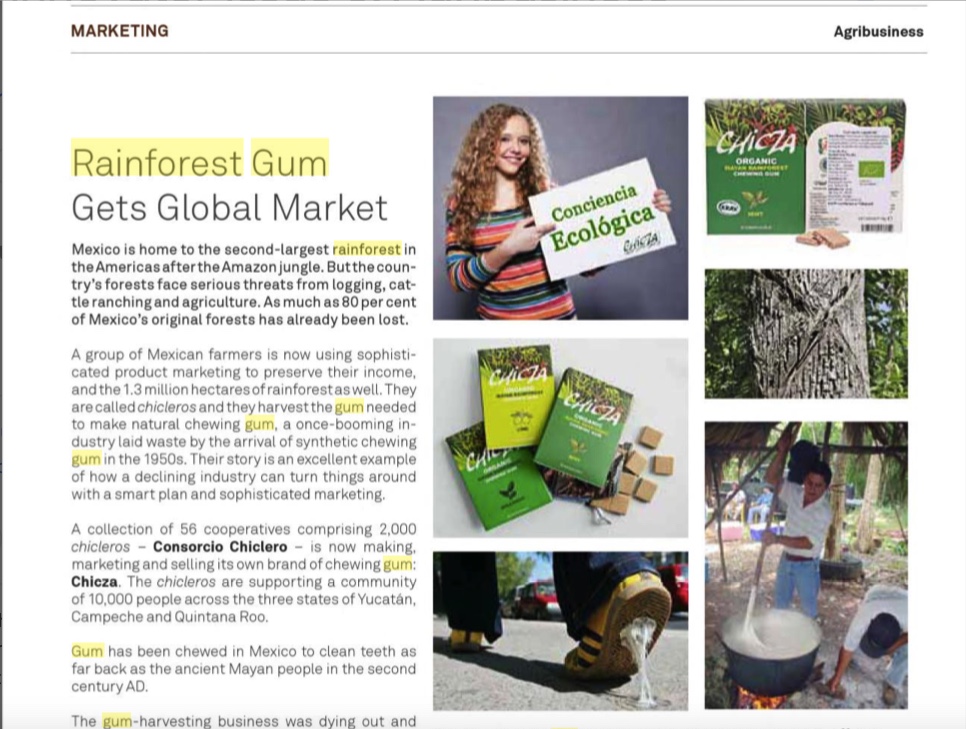
A group of Mexican farmers is now using sophisticated product marketing to preserve their income, and the 1.3 million hectares of rainforest as well. They are called chicleros and they harvest the gum needed to make natural chewing gum, a once-booming industry laid waste by the arrival of synthetic chewing gum in the 1950s. Their story is an excellent example of how a declining industry can turn things around with a smart plan and sophisticated marketing.

A collection of 56 cooperatives comprising 2,000 chicleros – called Consorcio Chiclero – is now making, marketing and selling its own brand of chewing gum: Chicza (http://www.chicza.com/index.php). The chicleros are supporting a community of 10,000 people across the three states of Yucatán, Campeche and Quintana Roo.

Gum has been chewed in Mexico to clean teeth as far back as the ancient Mayan people in the second century AD.

The gum harvesting business was dying out and young people, put off by the low pay, were leaving for jobs elsewhere. The adminstrators of the chiclero co-operative created Chicza Rainforest Gum brand to save the industry. They made a deal with Britain’s Waitrose supermarket chain, which specializes in fair trade products, and the gum is being launched in 100 stores.

The brightly coloured packages of chewing gum are now being sold as organic and a way to preserve the forest. Frustrated by the decades of decline and attendant poverty and community decay, the chicleros decided to take matters into their own hands. Five years ago they decided to avoid the middlemen who would buy their raw gum products, and instead manufacture and market the chewing gum themselves. And it is paying off: by adding value to the raw product, each farmer’s income has grown six times higher than he would earn as a mere provider of raw material.

The gum comes in three flavours: wild mint, heirloom lime and spearmint. Future flavours will blend tropical fruits, herbs and spices.

The Consorcio Chiclero coordinates the production, the logistics, the trade and the finances for the manufacture of gum from the chicozapote tree (Manilkara zapota).

Certified organic, the Chicza gum is completely natural and free of synthetic ingredients and also biodegrades when it is discarded – a boon to city governments who hate the mess and cost of traditional gum left on sidewalks.

The farmers work in the rainforest at the southern end of Mexico’s Yucatan peninsula (http://en.wikipedia.org/wiki/Yucat%C3%A1n_Peninsula), bordering Guatemala and Belize. It is a place with one of the most bio diverse ecosystems in the world, and an environment the farmers are in harmony with. The chicle gum (http://en.wikipedia.org/wiki/Chicle) is harvested from chicozapote trees – some living for more than 300 years – by hacking z-shaped cuts into the bark of the 100 foot trees. The harmless cuts zig zag down the tree and a bucket is placed at the bottom to collect the dripping sap.

Once collected, the sap is boiled, dried and made into a sticky paste, which is then kneaded and shaped into bricks called marquetas. Each marqueta is carefully marked by its maker. Since the sustainable management of their rainforests is certified by FSC (Forest Stewardship Council) (http://www.fsc.org/), these marks contain relevant information that tells the name of the chiclero who harvested it, and the exact location of the harvested tree in the rainforest. Few products offer such perfect traceability.

“I started following my dad around the rainforest when I was 10 and working when I was 12,” farmer Porfirio Banos told The Guardian newspaper. “I am a chiclero to my core.”

Working in a remote area of rainforest jungle with just spider monkeys for company, the chicleros are paid by the amount of chicle harvested

“We don’t kill the trees like farmers do when they clear land to grow corn or graze cattle,” says Roberto Aguilar, 60. “We leave a wound, it’s true, but eight years after it is healed and producing chicle again.”

The chicleros face two main risks while doing the job: falling from the trees if their rope gives out; and being bitten by poisonous snakes.

Chicle was once the basis of all commercial chewing gum. Beginning in New York 141 years ago, it was the only source for chewing gum until the 1950s, when synthetic substitutes destroyed the industry.

It was the economic desperation of a Mexican general, Antonio Lopez de Santa Anna, living in exile in the United States in 1869, that gave birth to gum-chewing as a global practice. Working with a local inventor, Thomas Adams, he tried to use the chicle to make a rubber substitute. But when this failed, Adams added sugar and flavouring, making chewing gum.

Apart from being a great chew, the natural gum’s unique selling point is saving money: local governments tight for cash are looking for other ways to deal with the menace of chewing gum on pavements. A small fortune is spent every year trying to keep streets clean of gum. The British alone spend over UK £150 million every year trying to clean their streets of chewing gum.

And despite the global recession, the chicleros are optimistic they can do well: during the Great Depression of the 1930s, chewing gum was an affordable treat and sold well.

Published: April 2009

Resources

https://davidsouthconsulting.org/2022/11/10/acai-berry-brazils-boon/

https://davidsouthconsulting.org/2022/11/10/brazilian-restaurant-serves-amazonian-treats/

https://davidsouthconsulting.org/2022/10/17/connoisseur-chocolate-from-the-south-gets-a-higher-price/

https://davidsouthconsulting.org/2022/11/01/indonesian-food-company-helps-itself-by-making-farmers-more-efficient/

https://davidsouthconsulting.org/2022/10/24/latin-american-food-renaissance-excites-diners/

https://davidsouthconsulting.org/2022/10/31/rainforest-rubbers-save-lives/

https://davidsouthconsulting.org/2022/11/10/saving-the-amazon-forest-while-making-a-living/

https://davidsouthconsulting.org/2022/10/17/west-african-chocolate-success-story/

Development Challenges, South-South Solutions was launched as an e-newsletter in 2006 by UNDP’s South-South Cooperation Unit (now the United Nations Office for South-South Cooperation) based in New York, USA. It led on profiling the rise of the global South as an economic powerhouse and was one of the first regular publications to champion the global South’s innovators, entrepreneurs, and pioneers. It tracked the key trends that are now so profoundly reshaping how development is seen and done. This includes the rapid take-up of mobile phones and information technology in the global South (as profiled in the first issue of magazine Southern Innovator), the move to becoming a majority urban world, a growing global innovator culture, and the plethora of solutions being developed in the global South to tackle its problems and improve living conditions and boost human development. The success of the e-newsletter led to the launch of the magazine Southern Innovator. 

https://davidsouthconsulting.org/2021/03/05/southern-innovator-issue-3/

Creative Commons License

This work is licensed under a
Creative Commons Attribution-Noncommercial-No Derivative Works 3.0 License.

ORCID iD: https://orcid.org/0000-0001-5311-1052.

© David South Consulting 2022