Categories
Archive Development Challenges, South-South Solutions Newsletters

Kiva: New Gateway of Loans for the Poor

By David SouthDevelopment Challenges, South-South Solutions

SOUTH-SOUTH CASE STUDY

The rise of social networking websites has created new opportunities for the poor to gain access to much needed credit. Kiva.org is pioneering a new way for entrepreneurs in the South to obtain for their businesses unsecured, no-interest financing from lenders worldwide. By just a click of the mouse a person anywhere in the world can lend as little as US $25 or more to aspiring entrepreneurs in developing countries.

Kiva, which means “agreement” or “unity” in Swahili, was founded by Matthew and Jessica Flannery after time spent in East Africa. They built upon the idea of Nobel Peace Prize Winner, Mohammud Yunus’ Grameen Bank but took it a step further by tapping into the resources of the web. It works by allowing potential lenders to search for an entrepreneur via the website. Each entrepreneur’s business idea is explained, a photo of the entrepreneur is posted and the amount of the loan they require and how much they have raised so far are clearly displayed. It is then a simple matter of the lenders using their credit cards to make a loan online. Kiva then transfers all the funds to their local partners (microfinance institutions) which, in turn, disburse the loans to each business. All entrepreneurs are screened for their trustworthiness and the viability of their business. Loans are usually between 6 to 12 months and lenders receive regular email journal updates from the business they sponsor. Gradually, the loan is paid back and the lender is returned the full value of the loan.

The process is so simple that one may ask, “Does this really work?” Take the story of Nicholas Kristof, columnist for the New York Times who recently accounted his experience with Kiva.org in his New York Times Op-Ed piece, “You, Too, Can Be a Banker to the Poor”. Through Kiva.org he chose two entrepreneurs, a baker and an owner of a TV repair shop in Afghanistan and lent them US $25 each instantly making himself a business partner with total strangers. He recently visited Afghanistan to see their progress and found two thriving businesses. Mr. Abdul Satar, the baker, borrowed a total of US $425 from a variety of lenders, Nicholas being one of them, and was able to open a second bakery with four employees. Mr. Abdul Saboor who runs a small TV repair shop now has a second shop with two new employees.

By harnessing a user friendly website to make instant cash loans, Kiva has come up with one of the simplest and most direct ways to help poor entrepreneurs who need start up capital. It was first tried out in Uganda about a year ago where partnerships were forged with local microfinance institutions that examined and evaluated each business before they were posted on the website. It has now attracted close to 18,000 lenders contributing an average of US $82.

“I believe the real solutions to poverty alleviation hinge on bringing capitalism and business to areas where there wasn’t business or where it wasn’t efficient,” co-founder Matthew Flannery told the New York Times. “This doesn’t have to be charity. You can partner with someone who’s halfway around the world.”

Published: April 2007

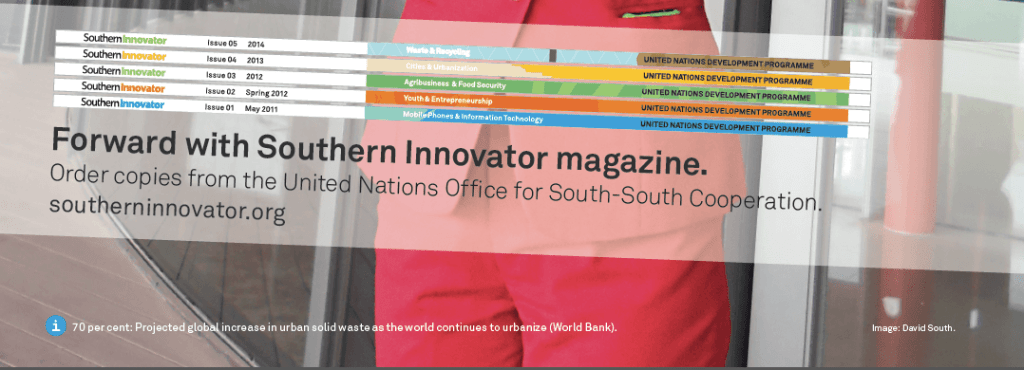
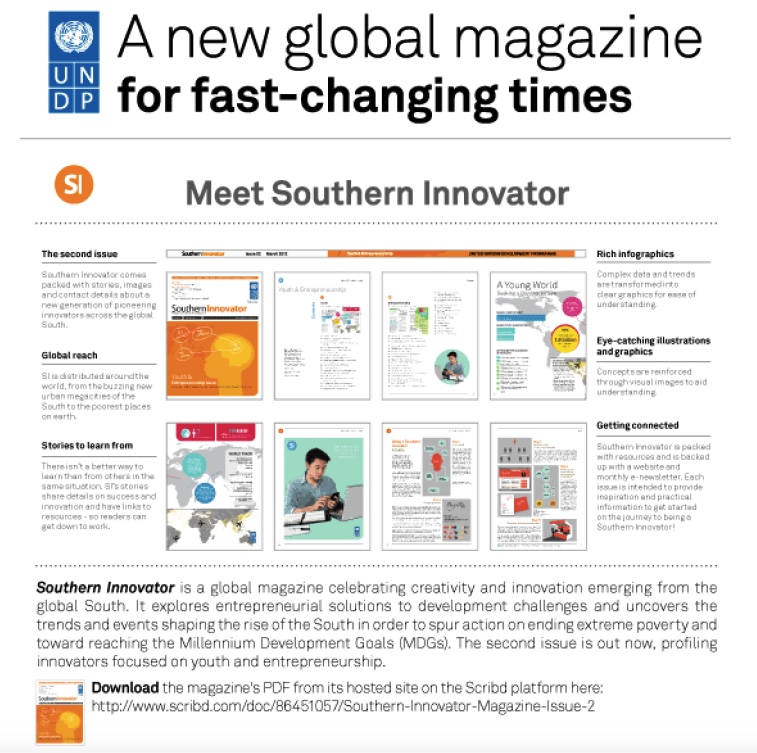
Development Challenges, South-South Solutions was launched as an e-newsletter in 2006 by UNDP’s South-South Cooperation Unit (now the United Nations Office for South-South Cooperation) based in New York, USA. It led on profiling the rise of the global South as an economic powerhouse and was one of the first regular publications to champion the global South’s innovators, entrepreneurs, and pioneers. It tracked the key trends that are now so profoundly reshaping how development is seen and done. This includes the rapid take-up of mobile phones and information technology in the global South (as profiled in the first issue of magazine Southern Innovator), the move to becoming a majority urban world, a growing global innovator culture, and the plethora of solutions being developed in the global South to tackle its problems and improve living conditions and boost human development. The success of the e-newsletter led to the launch of the magazine Southern Innovator.
Creative Commons License

This work is licensed under a
Creative Commons Attribution-Noncommercial-No Derivative Works 3.0 License.

ORCID iD: https://orcid.org/0000-0001-5311-1052.

© David South Consulting 2022

Categories
Archive Development Challenges, South-South Solutions Newsletters Southern Innovator magazine

Creative and Inventive Ways to Aid the Global Poor

By David SouthDevelopment Challenges, South-South Solutions

SOUTH-SOUTH CASE STUDY

As the saying goes, “necessity is the mother of invention”. Poverty can be a major spur to invention, and invention a route out of poverty – but only if the poor in the developing world can get the recognition, capital and support for navigating the legal and bureaucratic hurdles that will inevitably stand in their way. Thankfully many new initiatives acknowledge this.

Contrary to popular perception, the poor do have buying power, as has been documented by Massachusetts Institute of Technology (MIT) professors Abhijit Banerjee and Esther Duflo in their paper “The Economic Lives of the Poor”. Surveying 13 countries, they found those living on less than a dollar a day, the very poor, actually spent 1/3 of their household income on things other than food, including tobacco, alcohol, weddings, funerals, religious festivals, radios and TVs. The researchers also found that the poor increasingly used their spending power to seek out private sector options when the public sector failed to provide adequate services. As awareness of global poverty has grown in the past decade, a new wave of scientists, inventors and entrepreneurs has started to apply their considerable brain power to tackling the everyday problems of the poor.

Afrigadget, a website celebrating African ingenuity and inventions, serves as a goldmine for small-scale entrepreneurs looking for inspiration. All the inventions on the website share something in common: they are grassroots, homemade and handmade solutions to everyday problems of the poor. Examples of inventions profiled on the website include multi-machines, basically a 3-in-1 machine used as a metal lathe, mill and drill press, all built by hand from old car engine parts; a US $100 bicycle motor that gets 50 kilometres per liter made in Kisumu, Kenya; hand-made African wire toys; do-it-yourself telephone handsets which are then used to run roadside phone booths as a small business; and Malawian homemade windmills used to generate electricity for both home use and as a business to recharge mobile phone and radio batteries.

Another African invention tackles the urgent need for inexpensive or free common toilets that are self-financing. In the Kibera slum of Nairobi, Kenya, where 60 percent of the city’s inhabitants live, the lack of decent toilet facilities has led to the widespread use of so-called “flying toilets”, plastic bags filled with excrement and then flung as far away as possible. The resulting build-up turns the streets into a foul-smelling sludge in the rainy season and causes disease outbreaks like diarrhoea and typhoid fever. Up to now, conventional attempts to provide communal toilets have failed to resolve the problem, because they charge too much to use. But an innovative solution has been developed: bio-latrines that capture the methane gas produced by the toilets for sale as gas for cooking, heating and lighting, and the sludge for fertilizer. A joint initiative between a Kenyan company, Globology Limited, and the NGOs Umande Trustand Ushirika Roho Safi Laini Saba, it is partly funded by the Swedish International Development Agency (SIDA). The toilets are used by 500 people a day and are self-financing from the profits made by the sale of the gas and fertilizer.

In India, social entrepreneurs have stepped in to help the rural poor navigate the Indian government bureaucracy. Drishtee, an internet service provider – offers a fast-track to government services used by the poor in rural villages through its e-government services information kiosk. Using a franchise model, it has branches spread out through 160 locations in the country and serves 1.5 million people. Drishtee’s niche is that it saves the poor the exhausting and draining time and long travel normally required to access any government services. Drishtee’s “ask a government employee” service brings government to the poorest people.

Operating out of New Zealand and South Africa, Ecologics is an engineering company focused on developing appropriate technologies for sustainable livelihoods in developing countries. All their inventions are built around the principles of low maintenance and costs, and ease of use. Its African operations are based in South Africa and run under the Black Economic Empowerment (BEE) scheme. It builds step powered pumps, the Step Action Water Pump which works just like a gym step exercise machine and is a highly efficient way to power the pump – for small scale mining and agricultural irrigation. The pumps can deliver 5,000 to 6,000 litres of water per hour, weigh just 11 kilograms, and have been field tested in Fiji, Lesotho and South Africa.

Published: April 2007

Resources

  • NextBillion.net: Hosted by the World Resources Institute, it identifies sustainable business models that address the needs of the world’s poorest citizens.
  • A paper on social lending via the web: PDF version
  • African Inventors Museum: The International African Inventors Museum promotes positive images and self-esteem in children and adults and teaches people of all nationalities about the contributions that Africans throughout the world have given to society.
  • AU-WIPO Prize: The AU-WIPO is an initiative of the Africa Union Commission and the World Intellectual Property Organization. It is a leading continental award in Africa honoring the scientists and technologists whose efforts are towards addressing critical problems in Africa and the attainment of the Millennium Development Goals.
United Nations e-newsletter Development Challenges, South-South Solutions visited the Berlin, Germany headquarters of start-up betterplace.org in 2009. It was the dawn of the Berlin digital tech boom.

Development Challenges, South-South Solutions was launched as an e-newsletter in 2006 by UNDP’s South-South Cooperation Unit (now the United Nations Office for South-South Cooperation) based in New York, USA. It led on profiling the rise of the global South as an economic powerhouse and was one of the first regular publications to champion the global South’s innovators, entrepreneurs, and pioneers. It tracked the key trends that are now so profoundly reshaping how development is seen and done. This includes the rapid take-up of mobile phones and information technology in the global South (as profiled in the first issue of magazine Southern Innovator), the move to becoming a majority urban world, a growing global innovator culture, and the plethora of solutions being developed in the global South to tackle its problems and improve living conditions and boost human development. The success of the e-newsletter led to the launch of the magazine Southern Innovator. 

Creative Commons License

This work is licensed under a
Creative Commons Attribution-Noncommercial-No Derivative Works 3.0 License.

ORCID iD: https://orcid.org/0000-0001-5311-1052.

© David South Consulting 2023

Categories
Archive Blogroll Development Challenges, South-South Solutions Newsletters Southern Innovator magazine

Innovation from the Global South

By David SouthDevelopment Challenges, South-South Solutions

SOUTH-SOUTH CASE STUDY

 A major study has documented a rising tide of scientific innovation coming from Asia’s fast-developing countries, especially India and China. Conducted over 18 months by UK-based think tank Demos, it challenges the conventional wisdom that scientific ideas come from the top universities and research laboratories of large companies based in Europe or the US. It found ideas emerging in unexpected places, flowing around the world conveyed by a mobile diaspora of knowledge workers from the South.

China has seen its spending on research and development jump by 20 percent each year since 1999. India is now producing 260,000 engineers a year and its number of engineering colleges is due to double to 1,000 by 2010. Research and development in India has grown by threefold over the past decade. There is now a global flow of research and development money to the new knowledge centres of Shanghai, Beijing, Hyderabad and Bangalore.

The study found the greater political and economic emphasis being placed on science and technology was paying dividends. These emerging science powers are now investing heavily in research to become world leaders in information technology, biotechnology and nanotechnology within the next ten to fifteen years. This is also producing a flood of scientific papers from China and India to the world’s prestigious scientific journals.

For India, its knowledge-based industries by the end of this year will be a US $57 billion export industry, accounting for 4 million jobs and 7 percent of Indian GDP. Interestingly, the study also found a new wave of change is underway. Where once it was mostly low-wage manufacturing and call centre jobs that were going to China and India, a new wave of research and development jobs is now moving there. Drawn in by technology clusters in Shanghai and Bangalore, “Microsoft began to realize we can’t find all the talented people in the US. Nowhere in this universe has a higher concentration of IQ power (than India),” said Harry Shun, head of Microsoft’s research in Asia.

Published: April 2007

Resources

  • The Atlas of Ideas is an 18-month study of science and innovation in China, India and South Korea, with a special focus on new opportunities for collaboration with Europe. It is a comprehensive account of the rising tide of Asian innovation. It pinpoints where Asian innovation is coming from and explains where it’s headed. Special reports on China, India and Korea, introducing innovation policy and trends in these countries can be downloaded for free here.
  • Entrepreneurship Development Institute of India
  • Innovation China: A website linking all stories on the fast-breaking world of Chinese innovation.

https://davidsouthconsulting.org/2022/10/05/african-innovation-eco-system-taking-shape/

https://davidsouthconsulting.org/2021/07/18/case-study-7-unossc-undp-2007-2016/

https://davidsouthconsulting.org/2020/04/25/china-looking-to-lead-on-robot-innovation/

https://davidsouthconsulting.org/2021/01/05/development-challenges-south-south-solutions-newsletter/

https://davidsouthconsulting.org/2022/10/24/flurry-of-anti-poverty-innovations/

https://davidsouthconsulting.org/2021/03/24/frugal-innovation-trend-meets-global-souths-innovation-culture/

https://davidsouthconsulting.org/2022/11/16/housing-innovation-in-souths-urban-areas/

https://davidsouthconsulting.org/2017/10/18/innovation-agenda-and-timeline-2007-2015/

https://davidsouthconsulting.org/2022/11/11/innovation-cairos-green-technology-pioneers/

https://davidsouthconsulting.org/2020/12/14/innovation-in-growing-cities-to-prevent-social-exclusion/

https://davidsouthconsulting.org/2022/04/28/innovation-in-the-slums-can-bring-peace-and-prosperity/

https://davidsouthconsulting.org/2021/03/04/innovation-villages-tackling-mdgs/

https://davidsouthconsulting.org/2021/10/22/innovations-in-green-economy-top-three-agenda/

https://davidsouthconsulting.org/2016/04/14/southern-innovator-and-the-growing-global-innovation-culture-14-april-2016/

https://davidsouthconsulting.org/2022/11/01/southern-innovator-magazine-2010-2014/

Development Challenges, South-South Solutions was launched as an e-newsletter in 2006 by UNDP’s South-South Cooperation Unit (now the United Nations Office for South-South Cooperation) based in New York, USA. It led on profiling the rise of the global South as an economic powerhouse and was one of the first regular publications to champion the global South’s innovators, entrepreneurs, and pioneers. It tracked the key trends that are now so profoundly reshaping how development is seen and done. This includes the rapid take-up of mobile phones and information technology in the global South (as profiled in the first issue of magazine Southern Innovator), the move to becoming a majority urban world, a growing global innovator culture, and the plethora of solutions being developed in the global South to tackle its problems and improve living conditions and boost human development. The success of the e-newsletter led to the launch of the magazine Southern Innovator.

Creative Commons License
This work is licensed under a
Creative Commons Attribution-Noncommercial-No Derivative Works 3.0 License.

ORCID iD: https://orcid.org/0000-0001-5311-1052.

© David South Consulting 2023