Categories
Archive Development Challenges, South-South Solutions Newsletters

African Innovators Celebrated in Prize

By David SouthDevelopment Challenges, South-South Solutions

SOUTH-SOUTH CASE STUDY

Innovation is increasingly being recognized as the key to tackling long-standing development problems in Africa, as well as across the developing and developed world. While it is easy to draw up a list of challenges facing the global South, it takes a special person to see not problems but solutions.

Innovation tends to mean fresh thinking brought to bear to old problems, or completely radical new technologies, insights and ways of doing things that are transformative.

The Oslo Manual for measuring innovation (http://www.oecd.org/innovation/inno/oslomanualguidelinesforcollectingandinterpretinginnovationdata3rdedition.htm) has defined four types of innovation: product innovation, process innovation, marketing innovation and organizational innovation (OECD).

Product innovation is a good or service that is new or significantly improved. This includes significant improvements in technical specifications, components and materials, software in the product, user friendliness or other functional characteristics. Process innovation is a new or significantly improved production or delivery method. This includes significant changes in techniques, equipment and/or software. Marketing innovation is defined as a new marketing method involving significant changes in product design or packaging, product placement, product promotion or pricing. And finally, organizational innovation is a new organizational method in business practices, workplace organization or external relations.

How quickly these can be brought to the marketplace, and the level of innovation in society, will be critical to a country’s success in the coming decade, according to the Organization for Economic Cooperation and Development (OECD). Importantly, innovation is being seen as the big driver of economic progress and well-being and the best way to deal with the plethora of challenges facing human health and the environment.

As an example, in the past decade, communications innovation has given more and more of the world’s population access to mobile phones and the Internet. This has led to the success of many new companies, from the search engine giant Google to multiple software innovations such as Kenya’s M-Pesa mobile phone banking application (http://www.safaricom.co.ke/personal/m-pesa/m-pesa-services-tariffs/relax-you-have-got-m-pesa), to small and innovative companies spreading the innovation bug such as Pico Crickets (http://www.picocricket.com/) or the Raspberry Pi (http://www.raspberrypi.org/).

As the OECD has said, “Not only has innovation moved to centre stage in economic policymaking, but there is a realization that a coordinated, coherent, ‘whole of government’ approach is required.

“Even countries that have generally refrained from active industrial policy in recent years now seek new ways to improve the environment for innovation in order to boost productivity and growth. Today, innovation performance is a crucial determinant of competitiveness and national progress.”

In the past, African innovators mostly went unacknowledged, unsupported and unrecognized. But this is changing, as new resources come online to support, finance, encourage and champion African innovators. Until very recently, people outside the continent heard little positive news about what was happening there. But the African innovator story is an inspiration to people around the world.

The Innovation Prize for Africa (http://innovationprizeforafrica.org), begun in 2011, awards US $100,000 for the top innovation that matches its criteria of marketability, originality, scalability, social impact and business potential.

The prize aims to encourage people to come up with practical solutions to the continent’s long-standing problems. This year’s prize received 900 applications from 45 countries.

The 2013 prize went to the South Africa-based AgriProtein (http://www.agriprotein.com) team for an innovation that uses waste and fly larvae to produce animal feed. The solution collects biodegradable waste and then feeds it to flies. The larvae the flies produce are then ground into a protein which is used as a feed for animals. Not only does this approach improve the nutritional quality of the feed, it also lowers the cost for African processors and farmers.

This year’s finalists offer a mixed bag of innovations, including creative ways to find new energy sources, improving access to clean water and preventing diseases.

Joining a clutch of other South African finalists, Dr. Dudley Jackson has created the SavvyLoo, a waterless toilet for use in rural areas and makeshift settlements. It separates the waste into liquids and solids to reduce the risk of disease, odour, and harm to the environment and eases waste removal.

Another South African, Professor Eugene Cloete, is the inventor of the TBag Water Filter that cleverly uses material recovered from tea bags to filter polluted water until it is completely safe to drink.

When it comes to the thorny issue of finding new energy sources for an energy-hungry continent, the prize unearthed some interesting solutions. One is Justus Nwaoga, a Nigerian finalist, who developed a way to turn a common weed into a source of renewable solar energy.

Nwaoga, a researcher from the Department of Pharmaceutical and Medicinal Chemistry at the University of Nigeria Nsukka (http://unn.edu.ng/), found the common tropical weed Mimosa pudica (http://en.wikipedia.org/wiki/Mimosa_pudica) surprisingly provides a way to tap into the sun’s energy.

The weed has leaves which fold in on themselves when touched, but spring quickly back into their normal form when exposed to daylight. The plant opens up in the morning and closes in the evening – an indicator of how sensitive it is to sunlight.

Nwaoga began to experiment with the plant, subjecting it to artificial light at night to see if the leaves would open up again. But they didn’t. He came to the conclusion there were properties in the leaves that only responded to natural, solar light. He further concluded it had something to do with electrical transmission in the leaves. He isolated the element that was making the leaves respond to solar light, finding it more sensitive than the silicon solar cell used in solar panels.

Other innovators recognized by the prize include a Tunisian research and development startup called Saphon Energy (http://www.saphonenergy.com/), which makes bladeless wind turbines, and Muna Majoud Mahoamed Ahmed from Sudan, who has created the Agroforestry Model Farm in Khartoum.

“We see a strong trend emerging of innovations that have significant social impact for Africa,” Dr.Francois Bonnici, director of the Bertha Centre for Social Innovation at the University of Cape Town’s Graduate School of Business, told Ventures Africa.

The call for applications for the 2014 Prize will be announced in July 2013.

Published: June 2013

Resources

1) Innovation Prize for Africa: Innovation Prize for Africa (IPA) is a joint initiative of the United Nations Economic Commission for Africa (ECA) and the African Innovation Foundation (AIF) started in 2011. Website: http://innovationprizeforafrica.org

2) Appfrica: Accelerating the Growth of Africa’s Tech Sector: Appfrica has launched “The Cheetah Code”, an ongoing web series documenting the African tech and creative space. The series is a collection of mini-documentaries chronicling Africa’s young entrepreneurs, creative class, and emerging technology sector. The goal is to record high-quality video content that is entertaining, educational, and inspirational all at once. You can find all of this content and more at tv.cheetahcode.com. Website: http://blog.appfrica.com/2013/05/12/a-web-series-about-africas-entrepreneurs-creatives-and-technologists/?utm_medium=twitter&utm_source=twitterfeed

3) Innovation and Growth: Rationale for an Innovation Strategy: Publisher: OECD. Website: http://www.oecd.org/science/inno/39374789.pdf

4) Reverse Innovation: Ideas from the Global South. Website: http://urbantimes.co/2012/09/reverse-innovation-ideas-from-the-global-south/

5) African Innovator Magazine: Technology insights for Africa’s decision makers. Website: http://www.africaninnovatormagazine.com/

Southern Innovator logo

London Edit

31 July 2013

Development Challenges, South-South Solutions was launched as an e-newsletter in 2006 by UNDP’s South-South Cooperation Unit (now the United Nations Office for South-South Cooperation) based in New York, USA. It led on profiling the rise of the global South as an economic powerhouse and was one of the first regular publications to champion the global South’s innovators, entrepreneurs, and pioneers. It tracked the key trends that are now so profoundly reshaping how development is seen and done. This includes the rapid take-up of mobile phones and information technology in the global South (as profiled in the first issue of magazine Southern Innovator), the move to becoming a majority urban world, a growing global innovator culture, and the plethora of solutions being developed in the global South to tackle its problems and improve living conditions and boost human development. The success of the e-newsletter led to the launch of the magazine Southern Innovator. 
Creative Commons License

This work is licensed under a
Creative Commons Attribution-Noncommercial-No Derivative Works 3.0 License.

ORCID iD: https://orcid.org/0000-0001-5311-1052.

© David South Consulting 2023

Categories
Archive Development Challenges, South-South Solutions Newsletters

Innovative Mobile Phone Applications Storm South

By David SouthDevelopment Challenges, South-South Solutions

SOUTH-SOUTH CASE STUDY

The pace of change in information technology in the South is impressive, and nowhere has it been more rapid than in the take-up of mobile phones. In the past three years China has become the world’s largest exporter of information and communications technology (ICT), and home to the same number of mobile-phone users (500 million) as the whole of Europe. According to India’s telecoms regulator, half of all urban dwellers now have mobile- or fixed-telephone subscriptions and the number is growing by eight million a month. In Tanzania, mobile phone use grew by 1,600 percent between 2002 and 2008. In Nigeria it grew by almost 7,000 percent over six years, from 5 percent of the population 140 million in 2002, to a predicted 34.3 percent by the first quarter of this year.

But it is the Philippines that has become a global leader in mobile phone commerce. A whole panoply of banking tasks can now be done by mobile phone: transferring funds from one person to another, making small purchases, or paying fees.

“The most significant lesson learned so far,” said Shawn Mendes, lead author on a report titled The Innovative Use of Mobile Applications in the Philippines Lessons for Africa. “Is that m-Banking, rather than more altruistic applications such as m-Health and m-Education, has delivered the greatest benefits to people in developing countries.”

Access to basic banking services is vital for the world’s poor: The Consultative Group to Assist the Poor (CGAP) found that over 3 billion poor people lack access to even the most minimal banking services to manage their lives.

But mobile phones have come to the rescue as the fastest growing consumer product in history. Portio Research estimates that between 2007 and 2012 the number of mobile subscribers will grow by another 1.8 billion, mostly in emerging economies like India and China.

The Philippines is not alone in introducing so-called m-Banking (mobile phone banking) Africa’s leaders include the Democratic Republic of the Congo (CelPay), Kenya (M-PESA), South Africa (MTN MobileBanking and WIZZIT) and Zambia (CelPay).

“Safari-Com’s M-Pesa in Kenya has grown rapidly from start-up in early 2007 to well over 1 million accounts today,” said Mendes, the report author. “In May of this year Vodacom launched M-Pesa in Tanzania for their 4 million subscribers in that country. I expect very rapid growth of this service in Tanzania where less than 10 per cent of the adult population have conventional bank accounts. There are numerous other examples such as CelPay in Zambia and the Congo but I have been watching the success of M-Pesa in East Africa most closely.”

But the Philippines has taken m-Banking the furthest, with two great models for other countries: G-Cash and Smart Money. And the country has shown that it is possible to make these services attractive to the poor, not just the wealthy.

A combination of a good regulatory environment and an atmosphere of innovation brought mobile phone costs down, and made this possible. The mobile phone innovations were also successful because they mimicked existing consumer habits of the poor, piggy-backing on the extensive retail network of small village shops or “sari sari” stores. Poor Filipinos usually buy “tingi” or “sachets” of products like shampoo, fish sauce or soap. And it is in these shops that credit top-up centres were set up and prepaid phone cards sold.

Cleverly, mobile phone operators in the Philippines at first offered free SMS (short message service) text messaging. This was key to how m-Banking took off. As Smart Money’s Napoleon Nazareno said: “there must be an existing SMS habit.”

This should bode well for Africa, where an SMS habit has taken hold because it is so much cheaper than voice calls. Another important habit was prepayment. People learned how to use prepay cards, call numbers and how to enter codes into phones to purchase credits. They learned how to check their credit balance and to electronically load credit on to their phone. This habit made m-Commerce much easier and fuelled its growth.

In South Africa, m-Banking services are revolutionizing daily life. Hair salon owner Andile Mbatha in Soweto used to have to travel for two hours by minibus to a bank to send money to his relatives. But by setting up a bank account with a service called Wizzit, he no longer needs to keep stacks of cash in his salon (and risk robbery), can send money to his sister in Cape Town by phone, and receive payment for hair cuts by phone from his customers. “This has taken out a lot of stress,” said Mr Mbatha.

For Southern entrepreneurs looking to get the most from mobile phones, another recent development will help. Mobile phone companies are following developments with computers and turning away from using only proprietary software, to allowing open source software. Over the next six months, this will mean small-scale entrepreneurs can get in on making applications for mobile phones on a massive scale. Two software companies are now involved: Symbian, which provides the operating system for most of the new generation mobile phones with web access, and Google’s Android open source operating system for mobiles. In Sub-Saharan Africa and East Africa, these applications will help to bypass the lack of internet bandwidth.

In India, poor rural farmers are using mobile phone text messaging to get an advantage over the commodity markets. With so-called “agflation” and “rising prices for food ” it is crucial farmers keep on top of fluctuating commodity prices. Over 250 million Indians rely on farming for survival. But the pressure on farmers is severe and suicide rates are high.

Banana farmer Kapil Jachak is using a text messaging service to get the latest on the weather and daily market prices. The service, Reuters Market Light, costs a dollar a month. It’s a for-profit business venture by the global business news service, but helps farmers make money too. It already has 15,000 customers signed up.

This market knowledge gives the farmers a huge advantage when they compete with the traders in the wholesale markets of the city of Pune. “By getting the weather reports we can see exactly how much water our banana plants need,” said Kapil to the BBC. “I keep my cost down, and get the best crop I can.”

“This has increased my profit. I don’t have to make some headache, and go to any market, any shopkeepers, and wholesalers. I can do my marketing easily and get more and more money.” The service has already armed him with the knowledge to fight off banana stem weevils when they were attacking crops. The text recommended a pesticide.

Published: July 2008

Resources

Development Challenges, South-South Solutions was launched as an e-newsletter in 2006 by UNDP’s South-South Cooperation Unit (now the United Nations Office for South-South Cooperation) based in New York, USA. It led on profiling the rise of the global South as an economic powerhouse and was one of the first regular publications to champion the global South’s innovators, entrepreneurs, and pioneers. It tracked the key trends that are now so profoundly reshaping how development is seen and done. This includes the rapid take-up of mobile phones and information technology in the global South (as profiled in the first issue of magazine Southern Innovator), the move to becoming a majority urban world, a growing global innovator culture, and the plethora of solutions being developed in the global South to tackle its problems and improve living conditions and boost human development. The success of the e-newsletter led to the launch of the magazine Southern Innovator. 

Creative Commons License

This work is licensed under a
Creative Commons Attribution-Noncommercial-No Derivative Works 3.0 License.

ORCID iD: https://orcid.org/0000-0001-5311-1052.

© David South Consulting 2022

Categories
Archive Development Challenges, South-South Solutions Newsletters

New Apps Make Driving and Travelling in Egypt Easier, Safer

By David SouthDevelopment Challenges, South-South Solutions

SOUTH-SOUTH CASE STUDY

Mobile phones are ubiquitous across the global South. They have spawned whole new business opportunities and changed the way people solve problems and find solutions.

Sub-Saharan Africa is now home to approximately 650 million mobile phone subscribers, more than the United States and the European Union (World Bank).  A recent World Bank report estimated mobile phones led directly to the creation of 5 million jobs in Africa in 2012, contributing to seven per cent of Africa’s gross domestic product (GDP).

Mobile phones have also led to contests and challenges, set up to spark further innovation in this area and spur the development of so-called “apps”, or applications, to run on these electronic devices.

These prizes encourage and reward useful innovation that directly tackles the problems and challenges of the South.

In Cairo, Egypt – a city notorious for some of the worst traffic congestion in the world – many have been trying to find smart solutions to the gridlock. The World Bank says in its Cairo Traffic Congestion Study that the annual cost of congestion in Cairo is estimated at up to US $8 billion. This is four per cent of Egypt’s gross domestic product (GDP) – four times the impact on national GDP experienced by other comparable large cities. The study found that at least 1,000 Cairo residents die each year in traffic-related accidents, more than half of them pedestrians. And rapid growth in the city is making it ever-harder to get on top of the problem.

Rising traffic congestion is a problem around the world. In the United States, traffic jumped 236 per cent as the population grew by 20 per cent between 1982 and 2001 (IBM).

The IBM Commuter Pain Study conducted in 2011, ranking the emotional and economic toll of commuting in 20 international cities, found that the commute in Beijing is four times more painful than the commute in Los Angeles or New York, and seven times more painful than the commute in Stockholm.

Commuter pain leads to productivity loss as people lose time stuck in traffic and fuel is wasted as engines idle in traffic jams – not to mention damage to the environment from the increased pollution.

According to the World Business Council for Sustainable Development, 95 per cent of congestion growth in the coming years will be in developing countries. Even in developed countries like the United States, in 2000, the average driver experienced 27 hours of delays (up seven hours from 1980) (MIT Press). This ballooned to 136 hours in Los Angeles.

Developing countries are seeing vehicle numbers rise by between 10 and 30 per cent per year (World Bank). In economic hotspots, growth is even faster.

The Cairo Transport App Challenge (https://www.facebook.com/CairoTransportAppChallenge) is a contest aimed at taming the city’s traffic chaos. It is hosted by the Technology Innovation Entrepreneurship Center (TIEC) (http://www.tiec.gov.eg/en-us/Pages/default.aspx) and is organized by the World Bank in collaboration with others.

The contest’s press release says it aims to connect transport and urban development experts with volunteer technology communities to build “applications to address pressing transport challenges in Cairo through leveraging the new information and communication technologies (ICT) – such as mobile phones, smartphones and GPS-enabled devices – as well as the talent of Egyptian software developers and innovators.”

The first winner of the US $3,000 in prize money is a mobile phone app that helps drivers get help on the road and with car maintenance.

Users can use the Belya app to find the best routes, and to get help if their vehicle breaks down. The app is essentially a portable virtual car mechanic. It uses Global Positioning System (GPS) technology to locate service centres, which are then contacted when somebody needs help. The app gives details to the repair shop on what is wrong, the date and time.

“It is also linked to the General Traffic Administration, to provide quick and regular updates of the traffic situation,” according to a statement from Egypt’s Ministry of Communications and Information Technology, which awarded the prize.

The content’s second prize was won by E-mokhalfa (http://www.emokhalfa.com/emokhalfa/),which helps communities create safer roads by using peer pressure to make drivers behave better. Third place went to the app called “Where is my bus?” (https://twitter.com/AutobeesyFeen). It helps passengers find bus stations, routes, journey times and all mass transport options on their mobile phones.

Published: February 2013

Resources

1) A guide to making mobile phone apps: Here are some resources to building your own phone app online or through a provider. Website:http://www.brandignity.com/2011/03/building-mobile-iphone-phone-app-onlin/

2) Android: Android is the world’s most popular mobile platform. Website: android.com

3) Arab Republic of Egypt, Ministry of Communications and Information Technology. Website: http://www.mcit.gov.eg/

4) IBM Smart Traffic: IBM Intelligent Transportation, a compliment to the Intelligent Operations Center for Smarter Cities, enables advanced analysis of the many factors that make up traffic flow, and gives planners and responders a comprehensive look at the state of their city’s roadways on ground level. Website:http://www.ibm.com/smarterplanet/eg/en/traffic_congestion/ideas/index.html

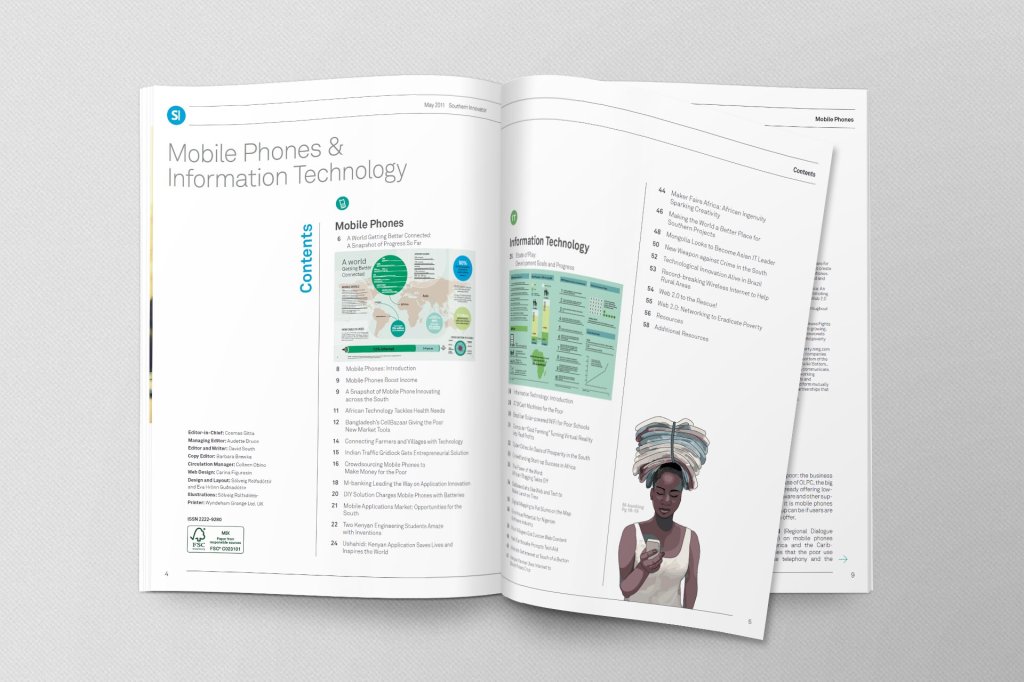
5) Southern Innovator Magazine Issue 1: Mobile Phones and Information Technology. Website:http://www.scribd.com/doc/95410448/Southern-Innovator-Magazine-Issue-1-Mobile-Phones-and-Information-Technology

Southern Innovator logo

London Edit

31 July 2013

Development Challenges, South-South Solutions was launched as an e-newsletter in 2006 by UNDP’s South-South Cooperation Unit (now the United Nations Office for South-South Cooperation) based in New York, USA. It led on profiling the rise of the global South as an economic powerhouse and was one of the first regular publications to champion the global South’s innovators, entrepreneurs, and pioneers. It tracked the key trends that are now so profoundly reshaping how development is seen and done. This includes the rapid take-up of mobile phones and information technology in the global South (as profiled in the first issue of magazine Southern Innovator), the move to becoming a majority urban world, a growing global innovator culture, and the plethora of solutions being developed in the global South to tackle its problems and improve living conditions and boost human development. The success of the e-newsletter led to the launch of the magazine Southern Innovator. 

Creative Commons License

This work is licensed under a
Creative Commons Attribution-Noncommercial-No Derivative Works 3.0 License.

ORCID iD: https://orcid.org/0000-0001-5311-1052.

© David South Consulting 2023