Categories
Archive Development Challenges, South-South Solutions Newsletters Southern Innovator magazine

Brazilian Restaurant Serves Amazonian Treats

By David SouthDevelopment Challenges, South-South Solutions

SOUTH-SOUTH CASE STUDY

The vast Amazon rainforest has inspired a cuisine pioneer in Brazil. Combining the sensual pleasures of fine dining and the joy of tasting new flavours with a pursuit of sustainable and profitable local farming, a chef is inventing a new Brazilian cuisine and showing the way to create sustainable incomes.

The kitchens of chef Alex Atala are as much a laboratory of food experimentation as a place to cook meals. He applies French and Italian cooking styles to traditional Brazilian dishes and ingredients. Since opening his restaurant D.O.M in 1999 in Sao Paulo, Atala has relentlessly pursued – through adventurous journeys around Brazil and into the Amazon rainforest – new flavours, foods and cuisines native to the country. When he started out, he was surprised to discover the lack of knowledge about native Brazilian ingredients, both within the country and outside. He has turned himself into a champion for local communities, helping them turn local foods into sources of income.

Brazil, home to the largest portion of the Amazon rainforest, is hoping to become the world’s biggest food producer – it is currently second after the United States – addressing a major global problem and providing income for Brazil’s farmers.

The challenge is to increase food production – providing income for Brazil’s farmers and helping address a major global problem – without destroying the Amazon’s complex ecosystem.

Amazonia, the region that takes in the mighty Amazon River and the vast Amazon rainforest, is home to the most diverse range of plant and animal species in the world (http://en.wikipedia.org/wiki/Amazon_Rainforest).
Brazil is currently debating legislation to ease restrictions on how small farmers can use land in the Amazon rainforest. It would loosen regulations on farming near river banks and hilltops. Many working in Brazil’s agricultural industry believe the country is not living up to its potential. They say Brazil could surpass the United States as an agricultural producer if allowed to use all its arable land.

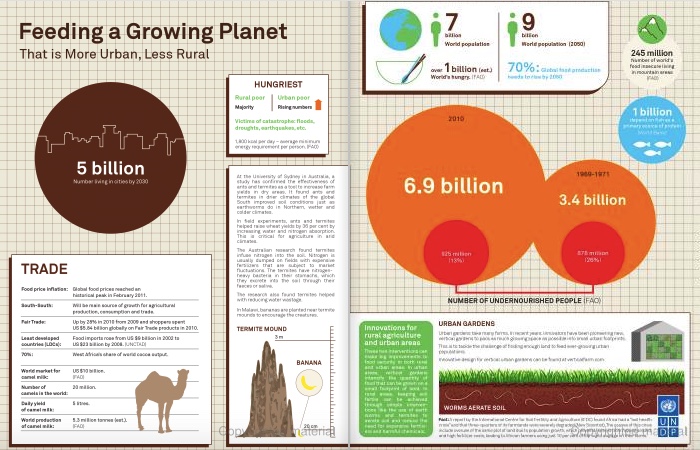
This is a crucial debate not only for the future of the environment, but also for humanity. World demand for food keeps rising as populations increase and living standards rise in many countries, such as China. Another trend at work is increasing global urbanization, where more people are leaving agriculture as a business to live in cities and peri-urban areas to pursue a better quality of life. These growing megacities will need vast amounts of food to feed their populations.

Brazil has, in recent years, increased the amount of territory designated as a protected area in the Amazon forest.

The National Institute for Space Research in Brazil (http://www.inpe.br/ingles/index.php) has satellite photographs showing deforestation in the Amazon at its slowest pace for two decades. But more recent reports show deforestation accelerating again in 2011.

Sao Paulo’s D.O.M. Restaurante (http://www.domrestaurante.com.br) – the name is an acronym for the Latin phrase “God, the best and greatest” – has used the rainforest’s rich harvest of foods to create an award-winning destination restaurant that prioritises sustainable sources. It was ranked seventh in this year’s S. Pellegrino World’s 50 Best Restaurants list.

Atala says on his website he “is bringing a new sustainable Brazilian cuisine to the world’s attention.” His motto is “It is necessary to cook and eat as a citizen.”

The restaurant celebrates small-scale producers when sourcing food products (http://www.domrestaurante.com.br/#/en-us/menu/ingredientes).  One pioneering food producer Atala works with is DRO Ervas e Flores (herbs and flowers) (http://www.droervaseflores.com). Located in the city of Cequilho, it grows edible herbs and flowers for restaurants. The flowers cultivated by DRO serve mainly to decorate plates, but can also be eaten. At the company farm, the flowers produced include violas, begonias, borago, monks cress, chrysanthemums, pumpkin flowers, coriander flowers, sweet alyssum, mini roses, basil flowers, roses, rockets and violets.

One notable success has been the Amazonian root priprioca. Once it was used only for cosmetics, but Atala has turned it into an essence for cooking. He has conducted original research into uses for the root, which is produced by small communities in the Amazon.

Other Brazilian foods he champions include black rice, an unusual variety sought after for its health benefits. It has 30 percent more fibre and 20 percent more protein than white rice, and less fat and calories than brown rice. The black rice used at D.O.M is produced in the Paraiba Valley in Sao Paulo state by Chicao Ruzene (http://www.arrozpreto.com.br), who researches new varieties on the rice farm.

Jambu, a herb from the Amazon, gives an electrical sensation when it is chewed. Tucupi, a yellowish liquid from pressed wild manioc tuber, is used to season typical Amazonian dishes made with fish, fowl and ducks.

Already well known in his native Brazil, Atala has become the country’s first internationally known celebrity chef and standard-bearer for the “New Brazilian Gastronomy.”

His origins are inspiring: a former DJ and punk, he sold his records and went on a trip backpacking in Europe when he was 18. He made a living as a painter and dishwasher until a friend convinced him to go to catering school. Upon graduation, he worked in some of the top restaurants in Italy and France. This apprenticeship left Atala skilled in the techniques of French cuisine – considered one of the most disciplined and methodical in the world – and he returned in 1994 to Brazil.

The restaurant has ultra-modern design and the sleek kitchen is home to a collection of Amazonian art. Atala acts as an ambassador for the country’s cuisine and flavours to the world. He opened a second restaurant in 2009, Dalva e Dito (http://www.dalvaedito.com.br), which celebrates home cooking by mothers and grandmothers and features only local produce.

Atala’s inclusion of ‘wild’ ingredients has inspired other chefs. His expeditions into the Amazon continue to discover and study the biodiversity of the rainforest and the culinary culture of its inhabitants.

His long-term agenda is to boost local farmers and food production and to increase the availability of ‘wild’ foods in the nation’s supermarkets. If he gets his way, people around the world will be eating the Brazilian way.

“French, Italian, Spanish and Japanese chefs, for example, have their own cuisine and give value to their terroir (local) produce,” Atala explained his passion to The World’s 50 Best Restaurants. “We have to do the same in Brazil! Our ingredients are exotic now, but can become popular in the near future.”

Published: June 2011

Resources

1) Brazilian Exporters and Importers website. Website:http://www.brazilianexportersandimporters.com/index.aspx

2) Por uma Gastronomia Brasileira by Alex Atala – ISBN 8586518352 Website:http://www.submarino.com.br/produto/1/220365/por+uma+gastronomia+brasileira

3) Winner of a UN Habitat award, the Brazilian farmer’s cooperative Cooperhaf: Cooperativa de Habitacao dos Agricultores Familiares has put together what it calls a “social technology” combining housing and farm diversification to support family farmers. Website:http://www.cooperhaf.org.br

4) Eat Smart in Brazil: How to Decipher the Menu, Know the Market Foods and Embark on a Tasting Adventure by Joan Peterson, Publisher: Ginko Press. Website:http://www.ginkgopress.com/
https://davidsouthconsulting.org/2022/11/21/agribusiness-food-security/

https://davidsouthconsulting.org/2021/01/26/aid-organization-gives-overseas-hungry-diet-food-diet-giant-slim-fast-gets-tax-write-off-for-donating-products/

https://davidsouthconsulting.org/2022/09/27/avoiding-wasting-food-and-human-potential-with-icts/

https://davidsouthconsulting.org/2022/08/14/brazil-preserves-family-farms-keeping-food-local/

https://davidsouthconsulting.org/2022/10/05/cool-food-for-the-poor/

https://davidsouthconsulting.org/2021/03/04/food-diplomacy-next-front-for-souths-nations/

https://davidsouthconsulting.org/2022/11/11/havanas-restaurant-boom-augers-in-new-age-of-entrepreneurs/

https://davidsouthconsulting.org/2022/11/01/indonesian-food-company-helps-itself-by-making-farmers-more-efficient/

https://davidsouthconsulting.org/2022/05/04/insects-can-help-in-food-crisis/

https://davidsouthconsulting.org/2022/11/21/latin-america/

https://davidsouthconsulting.org/2022/10/24/latin-american-food-renaissance-excites-diners/

https://davidsouthconsulting.org/2022/11/17/sos-shops-keep-food-affordable-for-poor-unemployed/

https://davidsouthconsulting.org/2021/03/05/southern-innovator-issue-3/

https://davidsouthconsulting.org/2022/10/14/staple-foods-are-becoming-more-secure-in-the-south/

https://davidsouthconsulting.org/2021/03/20/texting-for-cheaper-marketplace-food-with-sokotext/

https://davidsouthconsulting.org/2022/11/11/urban-farming-to-tackle-global-food-crisis/

https://davidsouthconsulting.org/2022/11/11/woman-restaurant-entrepreneur-embraces-brand-driven-growth/

Development Challenges, South-South Solutions was launched as an e-newsletter in 2006 by UNDP’s South-South Cooperation Unit (now the United Nations Office for South-South Cooperation) based in New York, USA. It led on profiling the rise of the global South as an economic powerhouse and was one of the first regular publications to champion the global South’s innovators, entrepreneurs, and pioneers. It tracked the key trends that are now so profoundly reshaping how development is seen and done. This includes the rapid take-up of mobile phones and information technology in the global South (as profiled in the first issue of magazine Southern Innovator), the move to becoming a majority urban world, a growing global innovator culture, and the plethora of solutions being developed in the global South to tackle its problems and improve living conditions and boost human development. The success of the e-newsletter led to the launch of the magazine Southern Innovator. 

Creative Commons License

This work is licensed under a
Creative Commons Attribution-Noncommercial-No Derivative Works 3.0 License.

ORCID iD: https://orcid.org/0000-0001-5311-1052.

© David South Consulting 2023
Categories
Archive Development Challenges, South-South Solutions Newsletters

Açaí Berry Brazil’s Boon

By David SouthDevelopment Challenges, South-South Solutions

SOUTH-SOUTH CASE STUDY

A formerly obscure berry from the Amazon rainforest in Brazil has become a global marketing success. The açaí berry – a dark, small fruit similar in appearance to blueberries – has surged in popularity around the world and brought newfound prosperity to poor communities.

The açaí berry (http://en.wikipedia.org/wiki/Açaí_Palm) has seen its popularity take off because of its purported antioxidant properties (http://en.wikipedia.org/wiki/Antioxidants). It is marketed as a way to reduce cancer and heart disease, although hype has sometimes portrayed the benefits to be higher than scientific studies have found. But whatever the truth of the berry’s overall health-giving properties, it has become an economic success story in Brazil.

A rapid success story – açaí was first exported from Brazil after 2000 – the berry is now sought by health-conscious consumers and the diet industry for its antioxidant properties and slimming effects.

Harvesting the berries is providing poor communities with an alternative source of income in the Amazon rainforest (http://en.wikipedia.org/wiki/Amazon_Rainforest). And the successful marketing and selling of the berries offers a good example to others trying to improve profits for agricultural products from the South.

Prior to its global popularity, a bowl of açaí berries was a staple for poor families in some parts of Brazil. The pulp is traditionally eaten as a side dish. It is a common sight in Brazil to see street vendors or shops selling crushed açaí pulp. Trendier places in Rio de Janerio sell sweetened açaí berry smoothies. In Belem, the capital of Para State, two ice cream chains sell açaí flavoured ice cream. A white and purple swirl of açaí and tapioca is a common favourite. Other treats include açaí candy and açaí tarts in bakeries.

Some claim the taste of the berry when sweetened is earthy, while left in a natural state it is more grassy. The berry grows wild on palm trees lining rivers or on farms.

Orisvaldo Ferreira de Souza is an açaí farmer on the island of Itanduba, an hour by boat from the town of Cametá, population 117,000. Açaí harvesting has become the main livelihood for many families in the area. Orisvaldo harvests açaí from 8,000 palm trees on a 14 hectare farm.

“Two or three years ago, we had a lot of trouble selling the product,” he told the New York Times. “We had to bring it to town, and sometimes we came back without selling it.”

But times have changed and the buyers now come to the farmers.
“Just yesterday, six buyers came by,” he said. “We sold 10 baskets each to two of them.”

At the CAMTA cooperative (http://www.camta.com.br/companyE.htm) in Tomé-Açu, a town with a population of 40,000, the berry is a significant source of income. The co-op’s director, Ivan Saiki, notes the boost to local incomes: “Before the boom, the harvest came and the açaí was worth practically nothing. Before, nobody had television, nobody had a motorized canoe. Now many have their own electricity at home. It’s greatly improved the life of the river communities.”

The co-op has a fruit pulp processing factory to improve the profits for the farmers and, by controlling quality, raise the reputation for their products. In order to avoid over-dependence on one commodity, the co-op members grow many other fruits as well, including papaya, mango, lemons, and local favourites abrico, uxi and bacuri.

Another initiative is Sambazon (Sustainable Management of the Brazilian Amazon) (www.sambazon.com). This small company, founded in 2000, combines business with a partnership to ensure local communities benefit from the berry’s success story. Sambazon buys the berries from over 10,000 people in the Amazon and is certified organic (http://www.organicfarmers.org.uk). Through its SAP (Sustainable Amazon Partnership), over 1,100 local family farmers are able to harvest açaí berries as an alternative income source to logging, cattle ranching and monoculture plantations – all of which are threats to the Amazon rainforest. The company sells a range of products, from sorbet to supplements to juices and energy drinks. It also uses athletes to promote the products and encourage a healthy lifestyle.

Other companies like Açaí Roots (www.acairoots.com) – founded by three Brazilians in Rio de Janerio – also associate the product with an overall healthy lifestyle. It sells drinks, smoothies, energy shots and liquid concentrate. Founded in 2005, it is selling the concept of the healthy Brazilian lifestyle and proudly claims its founders “were born and raised on açaí.”

Published: May 2010

Resources

1) Just Food is a web portal packed with the latest news on the global food industry and packed with events and special briefings to fill entrepreneurs in on the difficult issues and constantly shifting market demands. Website: www.just-food.com

2) International Cooperative Agricultural Organisation: The ICAO is the democratic organisation representing agricultural co-operatives and farmers worldwide. Website: http://www.agricoop.org

3) Waitrose Supermarket: It regularly sources fair trade and organic food products from the global South. Website: http://www.waitrose.com/index.aspx

4) Food Safety – From the Farm to the Fork is the European Commission’s guidelines on food safety and how to prepare food for import into the European Community. Website: http://ec.europa.eu/food/international/trade index_en.htm

5) An article about research into the berry. Website: http://www.sciencedaily.com/releases/2008/10/081006112053.htm

Development Challenges, South-South Solutions was launched as an e-newsletter in 2006 by UNDP’s South-South Cooperation Unit (now the United Nations Office for South-South Cooperation) based in New York, USA. It led on profiling the rise of the global South as an economic powerhouse and was one of the first regular publications to champion the global South’s innovators, entrepreneurs, and pioneers. It tracked the key trends that are now so profoundly reshaping how development is seen and done. This includes the rapid take-up of mobile phones and information technology in the global South (as profiled in the first issue of magazine Southern Innovator), the move to becoming a majority urban world, a growing global innovator culture, and the plethora of solutions being developed in the global South to tackle its problems and improve living conditions and boost human development. The success of the e-newsletter led to the launch of the magazine Southern Innovator. 

Creative Commons License

This work is licensed under a
Creative Commons Attribution-Noncommercial-No Derivative Works 3.0 License.

ORCID iD: https://orcid.org/0000-0001-5311-1052.

© David South Consulting 2023

Categories
Archive Development Challenges, South-South Solutions Newsletters

Saving the Amazon Forest While Making a Living

By David SouthDevelopment Challenges, South-South Solutions

SOUTH-SOUTH CASE STUDY

The vast Amazon rainforest straddles Brazil (over half is there), and stretches over many countries, including Peru, Ecuador and Bolivia. It holds more than 2,500 tree species and 30 per cent of all known plant species – 30,000 in all. It contains the world’s largest tropical forest national park, Brazil’s Tumucumaque Mountains National Park(http://www.amazon-rainforest.org/places-of-interest.html). Over 25 per cent of drugs sold in pharmacies contain rainforest ingredients, and the rainforest acts as the Earth’s lungs, absorbing carbon dioxide, and emitting oxygen.

Logging in the forest is widespread and highly wasteful – 356,000 square kilometres of rainforest have been deforested (WWF). In the past 50 years, Ecuadorhas lost over 50 per cent of its tropical rainforest.

More than 26 million people live in the forest, with 11 million on the Brazilian side. While the Amazon’s indigenous people have little ecological impact, it is people drawn in to logging and farming who do most of the damage. Slash and burn techniques are common.

Preserving this critical natural environment while providing jobs for the local inhabitants is a challenge being taken up by a clutch of entrepreneurs. This new wave of entrepreneurs seeks to run businesses that respect the environment and provide a good living to those they employ.

The global garment industry is one of the most lucrative in the world (in 2000 consumers spent over US $1 trillion on buying clothes). Most of the manufacturing takes place in the poorest places on earth, and the garment and fashion industries contribute to vast quantities of pollution in these countries, either by using toxic chemicals and pesticides, by polluting and depleting water supplies, or through inefficient processes, transport and waste.

Brazilian enterprise Treetap (http://www.treetap.com.br/) (formally AmazonLife) is seeking to change the fashion industry by selling sustainable materials to top designers. Their patented rubberized natural latex is sold under the brand name Treetap. It is made from natural rubber native to the region, and it uses a fair trade system to ensure its suppliers receive a living wage. The company itself uses the substance to produce its own handbags and purses.

By promoting the sustainable use of a rainforest resource and focusing on social as well as financial returns, the company is proving the value of a “triple-bottom line” approach to business – where social and environmental concern is just as important as profit.

The company has placed the preservation of the Amazon rainforest at the centre of its business plan. Tribal communities in the Amazon depend on rubber tree tapping for their livelihoods, and Treetap works with the Rubber Tappers Association (http://www.brazilmax.com/news2.cfm/tborigem/pl_amazon/id/10) to save 900,000 hectares of forest from exploitation.

Over 45 families are supported, and they are paid eight times the market rate for their rubber. Its Rio de Janeiro factory supplies several European fashion designers with their faux-leather fabric to make clothes, backpacks, upscale furniture and handbags.

“Europe is our main market,” said Treetap Project Coordinator and designer Maria Beatriz Saldanha, “We are developing relationships in France, Italy, Germany and The Netherlands.”

High profile French fashion house Hermes Sellier has been using this rubber since 1998 for handbags. Italian furniture company Moroso uses it to upholster chairs. “They (fashion designers) love it. The material is shiny and supple and has the fair fashion appeal.”

Treetap has now moved into making bike courier bags for the world’s largest bicycle company, Giant, selling over 10,000 bags.

Saldanha’s partner, Joao Augusto Fortes, first came upon the idea of using natural rubber when the pair opened a store in Rio in the 1990s.

Wild rubber is favoured because it does not kill the trees and provides jobs for the tappers. The increase in synthetic rubber made from oil-based products has driven down the price for natural rubber, and led to people clearing forests to make way for more profitable products like timber and cattle.

After nasty battles in the 1980s to protect the rubber tappers’ way of life, the Brazilian government began to take action. It has now set aside protected forests for the tappers so they can still make a living.

Saldanha hunted around for products for her EcoMercado store. She came across the rubber tappers of the state of Amazonas, who were using the natural rubber to make their traditional rubber sacks.

“We had the idea, so we met with rubber tappers and ordered laminates from them,” said Saldanha. “We then used the rubber to make a small quantity of bags, briefcases and other products.”

Things did not go swimmingly at the beginning. The first run of 500 bags sold out quickly, but “Two months later all of the bags we had just sold melted,” said Saldanha. “We hadn’t figured out that the rubber needed to be vulcanized.”

Back at the drawing board, they adapted the vulcanizing process used by big factories to a small-scale process that the rubber tappers could do. And then they patented it. The company now sells 30,000 sheets of wild rubber a year.

Another Brazilian company, Hering Instruments, is using sustainability as a marketing boost for its musical instruments. When legendary musician and current Brazilian minister of culture, Gilberto Gil, (http://en.wikipedia.org/wiki/Gilberto_Gil) played a guitar made from Hering Instruments’ parts, there was pride: “Yes, that was a good moment for us,” said Alberto Bertolazzi, CEO of Hering Instruments. Gil’s guitar was one of the first to be made of Hering crafted parts, all sourced from high-quality woods from the Amazon forests.

They are now being sold by the world’s largest guitar and bass companies. Certified by the Forest Stewardship Council, the wood is harvested from 1.8 million hectares of managed forest in the state of Acre.

Trees are chosen for harvesting based on their age, location and how many have been cut down.

It is targeting the US $30 billion/year global market for musical instruments. The clever marketing has used celebrity musicians and a series of “Amazonas” guitars decorated by well-known painters like Gustavo Rosa and Antonio Peticov.

At Florestas (www.ikove.com) (www.florestas.com), owner Fernando Lima is producing all-natural Amazonian personal care products sourced from across the Amazon. Florestas has successfully partnered with Brazilian university labs to study indigenous Amazonian therapeutics, like Babacu oil, Acerola fruit, and Acai berries. Rain forest plants are rich in nutrients, vitamins and anti-oxidants – all highly coveted by health consumers around the world.

Certified as organic and ecologically sustainable by the French Ecocert group, all goods are purchased from Amazon cooperatives, thus enabling indigenous people to avoid cutting down forests to make a living. Brazilian nuts are purchased directly from the harvesters, avoiding middlemen and increasing the amount Florestas pays local families.

The company uses a range of methods to sell its products: e-commerce, catalogues, stores, including in Japan, France and the US.

An innovative enterprise with another university connection is Ouro Verde Amazonia. Founded in 2002 by University of Sao Paulo Professor Luiz Fernando Laranja da Fonseca, and his wife, Ana Luisa, when they moved to the southern rural region of the Amazon.

The couple has single handily revitalised the declining Brazil nut industry in Mato Grosso, while protecting the ecosystem and generating income for farmers. Ouro Verde, or green gold, enables farmers to avoid having to work in the logging industry. They make nut-based cooking oils, butters and granulated powders. Rich in omega-3, it is marketed as a healthy alternative to conventional cooking oils for the health conscious consumer. At present it is sold in 100 stores in Brazil, but wants to go global.

Published: November 2007

Resources

  • Amazon Watch is a non-profit organization that works with indigenous and environmental organizations in the Amazon Basin to defend the environment and advance indigenous peoples’ rights in the face of large-scale industrial development.”
  • Design that Matters: Timothy Prestero, CEO (Cambridge, MA): Design that Matters (DtM) was founded to help social enterprises in developing countries scale up enterprises more quickly by providing them access to better products designed specifically for their business needs.
  • World of Good: Priya Haji, Co-founder and CEO (Emeryville, CA): World of Good seeks to lift thousands of women in the developing world out of poverty. It creates opportunities for hundreds of artisan cooperatives around the world by serving as a bridge to the U.S. retail market and providing access to fair wages, safe working conditions and long-term economic sustainability.

Development Challenges, South-South Solutions was launched as an e-newsletter in 2006 by UNDP’s South-South Cooperation Unit (now the United Nations Office for South-South Cooperation) based in New York, USA. It led on profiling the rise of the global South as an economic powerhouse and was one of the first regular publications to champion the global South’s innovators, entrepreneurs, and pioneers. It tracked the key trends that are now so profoundly reshaping how development is seen and done. This includes the rapid take-up of mobile phones and information technology in the global South (as profiled in the first issue of magazine Southern Innovator), the move to becoming a majority urban world, a growing global innovator culture, and the plethora of solutions being developed in the global South to tackle its problems and improve living conditions and boost human development. The success of the e-newsletter led to the launch of the magazine Southern Innovator. 

Creative Commons License

This work is licensed under a
Creative Commons Attribution-Noncommercial-No Derivative Works 3.0 License.

ORCID iD: https://orcid.org/0000-0001-5311-1052.

© David South Consulting 2022

Categories
Archive Development Challenges, South-South Solutions Newsletters Southern Innovator magazine

Brazilian Design For New Urban, Middle-Class World

By David SouthDevelopment Challenges, South-South Solutions

SOUTH-SOUTH CASE STUDY

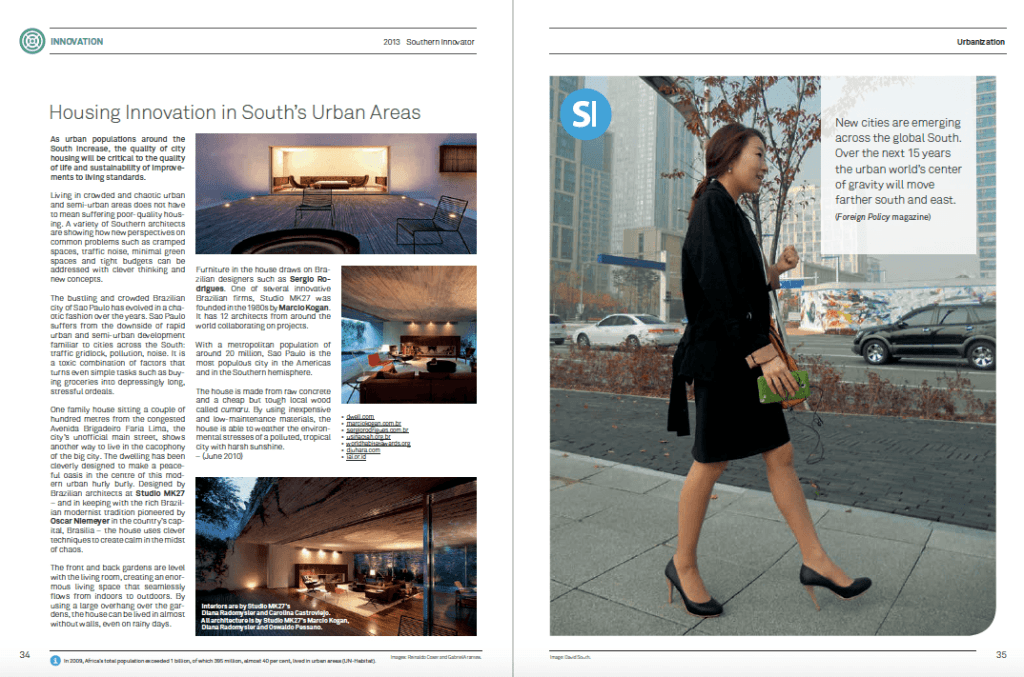
Countries across the global South are experiencing rapid urbanization as people move to cities for better economic opportunities — and this massive social change is creating new business opportunities. Those who recognize how fundamentally people’s lifestyles are changing will be those who will benefit from this big shift in populations.

Finding ways to live well in urban areas will be critical to determining whether this move repeats past urban failures — from the favelas of Brazil to the slums of India — or introduces a new way of living that is exciting and colorful. Design and designers will be critical to this change.

One young design company in Brazil, Sao Paulo-based furniture studio NUUN  (nuun.nu), is attempting to resolve a dilemma common across the rapidly urbanizing global South: How to create a design aesthetic that fits with the new way of living and being?

The company consists of designer and founder João Eulálio Kaarah and architects Renato Périgo and Carolina Sverner.

Périgo specializes in furniture and interior design, while Carolina Sverner worked with respected Japanese architect, Shigeru Ban (shigerubanarchitects.com), who is well known for designing buildings and houses made from paper and for creating easy-to-build homes for people after a disaster has struck (http://www.ted.com/talks/shigeru_ban_emergency_shelters_made_from_paper).

A collaboration among upcoming artists, designers and architects, NUUN tries to infuse its designs with a sense of “brazilianness”. Brazilianness is a modern aesthetic, made for modern lifestyles in the new urban landscape, that draws on aspects of Brazil’s culture and environment.

The young studio’s first collection of furniture offers simplicity. Called Eos, it tries to blend urban cosmopolitanism with raw nature. Brazil is known for its jam-packed urban cities as well as its vast expanse of Amazon rainforest. In practice, NUUN’s look is a mix of contrasts redolent of what used to be called brutalism: concrete mixed with glass, steel, wood and semi-precious gems. NUUN takes inspiration from NASA’s Earth Observation System (EOS): the collection vibes off of space satellites, antennae and the dry soil of the backwoods. NUUN says that “despite its Martian features, [the collection] is as Brazilian as it comes”. There is the modular Panorama sofa (http://nuun.nu/products/panorama) in five colors, capable of being re-shaped to fit a variety of living arrangements. A glass-topped coffee table with a concrete base and a side table with a carbon steel metallic structure to complement the sofa.

Elsewhere in the world of Brazilian design, footwear brand Grendene S.A. (http://ri.grendene.com.br/EN/Company/Profile) has become one of the world’s largest producers of footwear and made one of its founders a billionaire. And Grendene has boosted its international success by turning to another Brazilian success: supermodel Gisele Bündchen (giselebündchen.com.br).

Grendene began in 1971 and owns various successful shoe brands, including Melissa (melissa.com.br/en/), Grendha, Ilhabela, Zaxy, Cartago, Ipanema, Pega Forte, Grendene Kids and Grendene Baby.

It has six industrial zones with 13 footwear factories and can produce 240 million pairs of shoes a year. It undertakes all areas of production— from making its own moulds for the shoes to creating PVC (polyvinyl chloride) (http://en.wikipedia.org/wiki/Polyvinyl_chloride) – and handles its own distribution.

While Grendene is already a well-known shoe brand in Brazil, it wanted to expand its presence overseas to increase profits. Named after the two brothers who founded the company, Alexandre Grendene Bartelle and Pedro Grendene Bartelle, Grendene started working with supermodel Gisele Bündchen in 2002 to help her launch her own line of affordable flip-flops, iPanema (ipanemaflipflops.co.uk). The brightly colored sandals with elaborate patterns became an instant success.

But do celebrity endorsements really work? In the case of Bündchen and Grendene, the answer is yes. According to Forbes, 25 million pairs of the flip-flops and sandals are sold every year, accounting for 60 per cent of Grendene’s annual exports of about US $250 million.

Brazil was able to produce 864 million pairs of shoes in 2012, up 5.5 per cent from 2011.

Of these, 113 million pairs were exported to the United States, Argentina and France.

Brazil, like many other countries, has had to work out how it could compete with cheaper shoe imports from China. The strategy it chose was to target the growing number of middle-class people both in Brazil and elsewhere, as well as the high end of the market.

In 1979, Grendene created the Melissa brand, which has now become a coveted style leader. It collaborates with top design names such as Karl Lagerfeld and architect Zaha Hadid.

Making a partnership with Bündchen is part of the company’s strategy to reach higher-income buyers.

And it is working: Grendene increased its export revenue by 50 per cent in 2013.

Co-founder Alexandre Grendene Bartelle became a billionaire according to Forbes World’s Billionaires list and is worth US $1.4 billion. He owns 41 per cent of Grendene S.A. and close to 40 per cent of the Dell Anno brand.

This is a critical lesson for manufacturers in the global South. Grendene had achieved strong market dominance at home, and was already benefiting from growing wealth among Brazil’s middle classes. But it was the overseas market that had the potential to clinch even more profits for the company.

Bündchen’s high brand profile has enabled the company to compete head-to-head with the well-known Brazilian flip-flop brand, Havaianas (havaianas-store.com).

Another modern design leader owned by Grendene, Dell Anno (lojasdellanno.com.br), is a maker of modernist cabinets and furniture.

Dell Anno only use wood from renewable forest sources, to protect and preserve the Amazon and other native forests. Dell Anno tries to recycle as much as possible: up to 80 per cent of the water used in manufacturing is recycled, and byproducts from the production process such as a sawdust, wood, plastic and cardboard are also reused.

Dell Anno makes a full range of furniture for kitchens, bedrooms, closets, home theatres, home offices, service areas, restrooms and commercial environments. Dell Anno uses research and development to study trends and advise customers on the best options. The brand offers its staff training to help standardize customer service, and also has an excellent blog covering developments in modern design around the world (http://www.lojasdellanno.com.br/blog/).

Published: May 2014

Development Challenges, South-South Solutions was launched as an e-newsletter in 2006 by UNDP’s South-South Cooperation Unit (now the United Nations Office for South-South Cooperation) based in New York, USA. It led on profiling the rise of the global South as an economic powerhouse and was one of the first regular publications to champion the global South’s innovators, entrepreneurs, and pioneers. It tracked the key trends that are now so profoundly reshaping how development is seen and done. This includes the rapid take-up of mobile phones and information technology in the global South (as profiled in the first issue of magazine Southern Innovator), the move to becoming a majority urban world, a growing global innovator culture, and the plethora of solutions being developed in the global South to tackle its problems and improve living conditions and boost human development. The success of the e-newsletter led to the launch of the magazine Southern Innovator.  

Follow @SouthSouth1

Google Books: https://books.google.co.uk/books?id=NhQ9BQAAQBAJ&dq=development+challenges+may+2014&source=gbs_navlinks_s

Slideshare: http://www.slideshare.net/DavidSouth1/may-2014-development-challenges

Southern Innovator Issue 1: https://books.google.co.uk/books?id=Q1O54YSE2BgC&dq=southern+innovator&source=gbs_navlinks_s

Southern Innovator Issue 2: https://books.google.co.uk/books?id=Ty0N969dcssC&dq=southern+innovator&source=gbs_navlinks_s

Southern Innovator Issue 3: https://books.google.co.uk/books?id=AQNt4YmhZagC&dq=southern+innovator&source=gbs_navlinks_s

Southern Innovator Issue 4: https://books.google.co.uk/books?id=9T_n2tA7l4EC&dq=southern+innovator&source=gbs_navlinks_s

Southern Innovator Issue 5: https://books.google.co.uk/books?id=6ILdAgAAQBAJ&dq=southern+innovator&source=gbs_navlinks_s

Creative Commons License
This work is licensed under a
Creative Commons Attribution-Noncommercial-No Derivative Works 3.0 License.

ORCID iD: https://orcid.org/0000-0001-5311-1052.

© David South Consulting 2023