Categories
Archive Development Challenges, South-South Solutions Newsletters

Shopping and Flying in Africa’s Boom Towns

By David SouthDevelopment Challenges, South-South Solutions

SOUTH-SOUTH CASE STUDY

As economies across Africa grow, the continent still has a long way to go to create infrastructure to match people’s rising expectations of what a modern, prosperous life looks like.

Africa’s current economic growth has mainly been driven by commodities and oil and gas exports. Critics say this boom has failed to bring tangible benefits to many of Africa’s poor, who feel left out of the prosperity.

Trade has been flourishing not only because of exports to traditional markets in Europe and North America but also because of explosive growth in trade and investment between China and Africa.

Two trends now underway are set to transform people’s wealth and living standards despite the many obstacles caused by the inequalities of current economic growth. The first is the rise and rise of retail shopping options

looking to meet a strong appetite for consumer goods. And the second is the expansion of flying options on a continent notorious for its poor air links. Increasing investment in retail and flight networks will be a source of jobs, careers and wealth for the coming decade.

The aviation sector supports 6.7 million jobs on the continent, according to TradeMark Southern Africa (http://www.trademarksa.org), and makes a US $67.8 billion contribution to Africa’s gross domestic product (GDP).

But the woeful state of Africa’s air networks means that it is often cheaper for people to fly to other parts of Africa via European airports. And Africa has a long way to go to match air safety standards found elsewhere: there was one accident for every 305,000 flights involving Western-built jets in Africa last year (IATA) – nine times the global average.

But Africa is now receiving the attention of the global airline industry. The Abuja Declaration (http://nigerianaviationnews.blogspot.co.uk/2012/07/aviation-safety-in-africa-abuja.html) aims to bring the African accident rate in line with the global average by 2015. And it is hoped the added competition and introduction of more global players will also raise standards and make flying in Africa safer, more convenient and cheaper.

The experience of Europe and North America shows that increased air traffic brings a boost to economic growth.

With more frequent, safer and more reliable air routes, business people will be able to move around and strike deals, tourists can get around and traders can cross borders without the hassle of navigating poor road networks.

Airlines are lining up to compete on improving air links in Africa to capitalize on rising incomes and economic dynamism.

The competition to serve the air passengers has heated up with the announcement of numerous new airlines, as well as well-established global carriers making plans to expand routes across Africa. Kenya Airways (http://www.kenya-airways.com/) has pledged to reach all of Africa’s countries by 2017 while also launching its own budget airline called Jambo Jet (http://www.ventures-africa.com/2012/06/kenya-airways-tolaunch-low-cost-airline-as-it-prepares-for-competition/).

State-owned South African Airways (SAA) (http://www.flysaa.com/gb/en/) is also starting to expand its network to include every capital city in Africa. SAA will start by adding flights to Ivory Coast and the Democratic Republic of Congo, making it able to serve 26 African destinations. In the short term, it is doing this by halting flights between Cape Town and London, leaving that route to Virgin Atlantic and British Airways.

Operating out of bases in Kenya, Tanzania, Ghana and Angola, a new African discount airline, FastJet (http://www.fastjet.com/) – with EasyJet (http://www.easyjet.com/en) founder Stelios Haji-Ioannou as its backer – is taking over Fly540 (http://www.fly540.com/) and adding 15 leased Airbus aircraft. It will launch flights to Ghana, Kenya, Tanzania and Angola. According to Kenya’s Nation newspaper, the plan is to replicate the success of EasyJet connecting Europe and North Africa with cheap flights in sub-Saharan Africa.

Analysts believe the entry of an aggressive and experienced player like Haji-Ioannou will shake up competition within African aviation.

Other global players lining up to expand in Africa include Emirates, Etihad, Qatar Airways, Turkish Airlines and Korea Air, which has already started flying between South Korea and Kenya’s capital, Nairobi. This is being seen as a boost to the trade in electronics goods between the two countries.

The added excitement in the African air industry has also prompted Air Uganda (http://www.air-uganda.com/) and RwandaAir (http://www.rwandair.com/) to increase their destinations. Qatar Airways (http://www.qatarairways.com/uk/en/homepage.page) will start flying in November 2012 to Maputo, Mozambique three times a week, increasing to 20 the number of destinations the airline serves, according to the Nation.

And while Emirates has a 41 per cent share of the African market, African player Ethiopian Airlines (http://www.flyethiopian.com/en/default.aspx) ambitiously wants to become Africa’s largest airline by 2025.

For shoppers, West Africa is experiencing a boom in new retail spaces being developed, according to a report from Euromonitor International (http://www.euromonitor.com) (http://www.howwemadeitinafrica.com/ghana-%E2%80%93-africas-new-retail-hotspot/18544/). The advantages of creating and developing modern retail spaces are numerous: hygienic shopping environments with greater safety and security attract multinational and global brands, which tend to create lots of long-term jobs.

Euromonitor International has identified Ghana as the next hotspot for retailers. The country is seen to have the right business environment in place that is attractive to foreign investors. It also has the right mix of political stability, cultural tolerance and rising prosperity.

The country is now being seen as the gateway to West Africa’s market of 250 million consumers. Ghana is able to leverage its position as a gateway into landlocked nations and on its strong ties with English-speaking powerhouses like Britain and the United States.

On top of these strategic advantages, the country has focused on upgrading retail spaces in the capital, Accra. The Accra Mall (http://www.accramall.com/), opened in 2007, is considered the most modern shopping mall in Ghana.

Euromonitor found Ghana’s retail industry grew by 14 per cent between 2006 and 2011.

Euromonitor found companies like multinational Unilever and PZ Cussons believed basing their operations in Ghana was a big advantage.

“The presence of such manufacturers provides a good opportunity for retailers as they can source these manufacturers’ products cheaper locally rather than importing them,” it said.

Euromonitor identified three other African countries as potential retail marketplaces. This includes Zambia, a potential agribusiness powerhouse. It is already developing a strong reputation in beef through its Zambeef (http://www.zambeefplc.com/) operation. South African companies have done well in Zambia, including Shoprite, Pick n Pay, Mr Price and the Foschini Group. Much of the action is around the capital, Lusaka.

Rwanda is known for its ease of doing business and there is activity going on in residential areas, roads, hotels, offices and retail spaces. The capital, Kigali, has a new modern, shopping mall, The Union Trade Centre, with a 24-hour store.

Angola has been benefiting from peace since the end of its civil war in 2002. Foreign companies have been attracted to Angola from South Africa, Portugal and Brazil. The Belas Shopping Mall (http://belasshopping.com/website/) opened in 2007 in the capital, Luanda, followed by the Ginga Shopping Mall on the city’s outskirts in 2011.

Published: August 2012

Resources

1) How we made it in Africa: A great website packed with inspirational people and stories on business success in Africa. Website: http://www.howwemadeitinafrica.com/

Development Challenges, South-South Solutions was launched as an e-newsletter in 2006 by UNDP’s South-South Cooperation Unit (now the United Nations Office for South-South Cooperation) based in New York, USA. It led on profiling the rise of the global South as an economic powerhouse and was one of the first regular publications to champion the global South’s innovators, entrepreneurs, and pioneers. It tracked the key trends that are now so profoundly reshaping how development is seen and done. This includes the rapid take-up of mobile phones and information technology in the global South (as profiled in the first issue of magazine Southern Innovator), the move to becoming a majority urban world, a growing global innovator culture, and the plethora of solutions being developed in the global South to tackle its problems and improve living conditions and boost human development. The success of the e-newsletter led to the launch of the magazine Southern Innovator. 

Creative Commons License

This work is licensed under a
Creative Commons Attribution-Noncommercial-No Derivative Works 3.0 License.

ORCID iD: https://orcid.org/0000-0001-5311-1052.

© David South Consulting 2023

Categories
Archive Blogroll Now Magazine

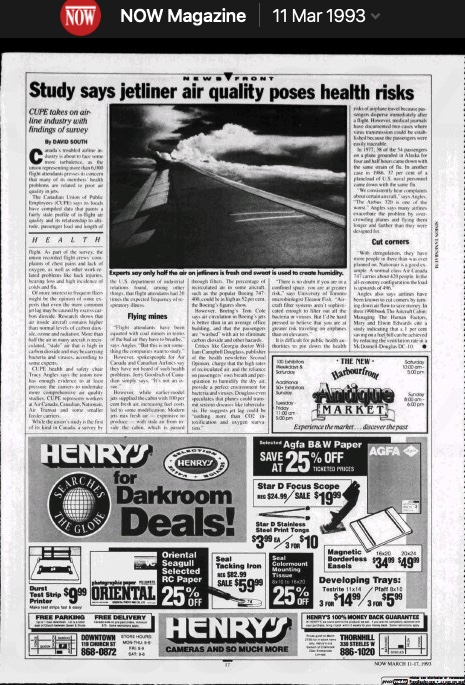
Study Says Jetliner Air Quality Poses Health Risks: CUPE Takes On Airline Industry With Findings Of Survey

By David South

Now Magazine (Toronto, Canada), March 11-17, 1993

Canada’s troubled airline industry is about to face some more turbulence, as the union representing more than 6,000 flight attendents presses its concern that many of its members’ health problems are related to poor air quality in jets.

The Canadian Union of Public Employees (CUPE) says its locals have compiled data that paints a fairly stale profile of in-flight air quality and its relationship to altitude, passenger load and length of flight. As part of the survey, the union recorded flight crews’ complaints of chest pains and lack of oxygen, as well as other work-related problems like back injuries, hearing loss and high incidence of colds and flu.

Of more interest to frequent fliers might be the opinion of some experts that even the more common jet lag may be caused by excess carbon dioxide, ozone and radiation. More than half the air in many aircraft is recirculated, “stale” air that is high in carbon dioxide and may be carrying bacteria and viruses, according to some experts.

CUPE health and safety chair Tracy Angles says the union now has enough evidence to at least pressure the carriers to undertake more comprehensive air quality studies. CUPE represents workers at Air Canada, Canadian, Nationair, Air Transat and some smaller feeder carriers.

While the union’s study is the first of its kind in Canada, a survey by the US department of industrial relations found, among other things, that flight attendents had 20 times the expected frequency of respiratory illness.

Flying mines

“Flight attendants have been equated with coal miners in terms of the bad air they have to breathe,” says Angles. “But this is not something the companies want to study.”

However, spokespeople for Air Canada and Canadian Airlines say they have not heard of such health problems. Jerry Goodrich of Canadian simply says, “It’s not an issue.”

However, while earlier-model jets supplied the cabin with 100 per cent fresh air, increasing fuel costs led to some modification. Modern jets mix fresh air – expensive to produce – with stale air from inside the cabin, which is passed through filters. The percentage of recirculated air in some aircraft, such as the popular Boeing 747-400, could be as high as 52 per cent, Boeing’s figures show.

Boeing’s Tom Cole says air circulation in Boeing’s jets is better than in an average office building, and that the passengers are “washed” with air to eliminate carbon dioxide and other hazards.

Critics like Georgia doctor William Campbell Douglass, publisher of the health newsletter Second Opinion, charge that the high rates of recirculated air, and the reliance on passengers’ own breath and perspiration to humidify the dry air, provide a perfect environment for bacteria and viruses. Douglass even speculates that planes could transmit serious diseases like tuberculosis. He suggests jet leg could be “nothing more than CO2 intoxification and oxygen starvation.”

“There is no doubt if you are in a confined space, you are at greater risk,” says University of Toronto microbiologist Eleanor Fish. “Aircraft filter systems aren’t sophisticated enough to filter out all the bacteria and viruses. But I’d be hard pressed to believe that you are at greater risk traveling on airplanes than on elevators.”

It is difficult for public health authorities to pin down the health risks of airplane travel because passengers disperse immediately after a flight. However, medical journals have documented two cases where virus transmission could be established because the passengers were easily traceable.

In 1977, 38 of the 54 passengers on a plane grounded in Alaska for a four and a half hours came down with the same strain of flu.

“We consistently hear complaints about certain aircraft,” says Angles. “The Airbus 320 is one of the worst.”

Angles says many airlines exacerbate the problem by over-crowding planes and flying them longer and farther than they were designed for.

Cut corners

“With deregulation, they have more people in there than was ever planned on. Nationair is a good example. A normal class Air Canada 747 carries about 420 people. In the all-economy configuration the load is upwards of 496.”

Angles also says airlines have been known to cut corners by turning down air flow to save money. In their 1990 book The Aircraft Cabin: Managing the Human Factors, Mary and Elwin Edwards cite a study indicating a 1 per cent saving on a fuel bill can be achieved by reducing the ventilation rate in a McDonnel-Douglas DC-10.

More resources: 

April 2021

Airqualitynews.com Terror at 20,000 feet

A new global campaign and film asks whether the air we breathe on commercial flights is as safe as we think it is.

Another issue, which frequently gets overlooked, is the quality of the air passengers breathe onboard

In February, a global campaign was launched by the Global Cabin Air QualityExecutive (GCAQE), which called for the mandatory introduction of effective filtration and warning systems, to be installed on all commercial passenger jet aircraft.

According to the GCAQE, there have been 50 recommendations and findings made by 12 air accident departments globally over the last 20 years, directly related to contaminated air exposures on passenger jet aircraft.

However, commercial aircraft continue to fly, with no contaminated air warning systems to inform passengers and crews when the air they are breathing is contaminated.”

Jetliner Cabins Are Quickly Cleared of Virus, Pentagon Says

“Particles the size of the new coronavirus are quickly purged from a commercial aircraft cabin, according to a U.S. Defense Department study touted by United Airlines Holdings Inc. in its effort to reassure wary travelers.

Filtration systems and rapid air-exchange rates mean that only about 0.003% of infected particles entered a masked passenger’s breathing zone, said the report, released Thursday.”

Aircraft Air Quality – Protecting Against Contaminants, Association of Flight Attendants

“On October 5, 2018, a 5-year FAA bill became law. Included in the bill is a study on technologies to combat contaminated bleed air. This is significant progress!”

‘Contaminated air’ on planes linked to health problems, 21 June 2017

AEROTOXIC SYNDROME: A NEW OCCUPATIONAL DISEASE?, Public Health Panorama, Volume 3, Issue 2, June 2017

Influenza Air Transmission, Influenza A (H1N1) Blog, September 28, 2009

“What does this tell us? Aerosols, very small particles of saliva containing the virus we exhale when we sneeze or even when we breathe if we have the flu, probably have an important role in the transmission of influenza. In addition to that we have public transportation, with a great number of people circulating in a place that may be closed and badly ventilated at times and we may have a notion of the importance of public campaigns that promote education and awareness of contaminated people to avoid leaving their homes when they have the flu and that they cover their mouth and nose with a disposable tissue when they sneeze and discard it right after that.”

2006

Tuberculosis and Air Travel: Guidelines for Prevention and Control

“The revised International Health Regulations, adopted in 2005, provide a legal framework for a more effective coordinated international response to emergencies caused by outbreaks of infectious diseases. A number of provisions are relevant to the detection and control of TB during air travel, strengthening the authority of WHO and of national public health authorities in this domain. Because of these important developments since the original guidelines were issued in 1998, WHO has prepared this revised version to take account of current public health risks that may arise during air travel and new approaches to international collaboration in dealing with them. The guidelines were developed with the collaboration of international experts in air travel medicine and other authorities. Implementing the recommendations will help to reduce the spread of dangerous pathogens across the globe and decrease the risk of infection among individual travellers.

An outbreak of influenza aboard a commercial airliner, American Journal of Epidemiology, Volume 110, Issue 1, July 1979

“A Jet airliner with 54 persons aboard was delayed on the ground for three hours because of engine failure during a takeoff attempt. Most passengers stayed on the airplane during the delay. Within 72 hours, 72 per cent of the passengers became III with symptoms of cough, fever, fatigue, headache, sore throat and myalgia. One passenger, the apparent Index case, was III on the airplane, and the clinical attack rate among the others varied with the amount of time spent aboard. Virus antigenlcally similar to A/Texas/1/ (H3N2) was Isolated from 8 of 31 passengers cultured, and 20 of 22 ill persons tested had serologic evidence of infection with this virus. The airplane ventilation system was inoperative during the delay and this may account for the high attack rate.”

The Airliner Cabin Environment and the Health of Passengers and Crew.

“At the end of its review of health data in the 1986 report The Airliner Cabin Environment: Air Quality and Safety, the National Research Council (NRC) committee concluded that “available information on the health of crews and passengers stems largely from ad hoc epidemiologic studies or case reports of specific health outcomes [and] conclusions that can be drawn from the available data are limited to a great extent by self-selection…and lack of exposure information” (NRC 1986). This chapter reviews data on possible health effects of exposure to aircraft cabin air that have emerged since the 1986 report and the emergence of data resources (e.g., surveillance systems) and studies that have particular relevance for the evaluation of potential health effects related to aircraft cabin air quality. Selected earlier sources are also reviewed. The decision to ban tobacco-smoking on domestic airline flights in 1987 and on flights into and out of the United States in 1999 reduces the relevance of some studies of exposures and reported signs and symptoms that clearly could have been related to the products of tobacco smoke.” 

ORCID iD: https://orcid.org/0000-0001-5311-1052.

© David South Consulting 2021