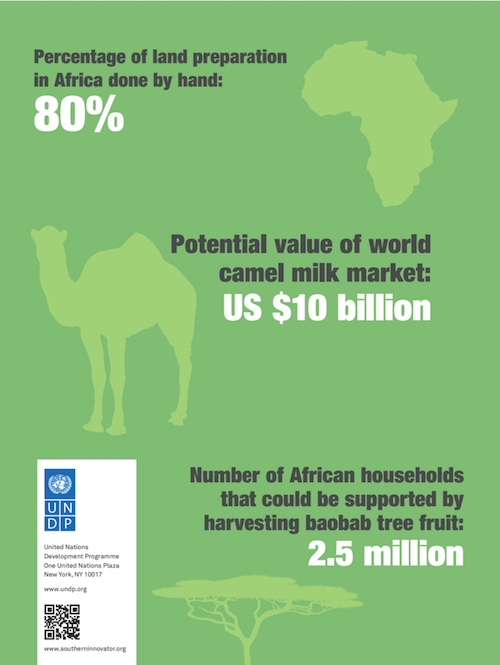
The fruit of the highly revered African baobab tree is being seen as a great new opportunity for the poor, after a recent decision by the European Commission to allow its importation. According to one study, gathering the fruit has the potential to earn an extra US $1 billion a year for Africa, and bring work and income to 2.5 million households, most of them African bush dwellers (Britain’s Natural Resources Institute).
The fruit of the African baobab tree is mostly collected in the wild from the ancient trees, which can live for 500 years, with some as old as 5,000 years. The baobob enjoys the veneration and respect traditionally accorded to age in Africa, and features in many stories and myths.
The fruit is seen as highly nutritious and a new taste option for the European market. This could be a major potential boost to Africa; the European Union is the world’s biggest trader, accounting for 20 percent of global imports and exports, and a major trading partner of most African countries. South Africa alone exports Euro 20.9 billion a year to Europe (2007).
But serious concerns have been raised about how the harvesting of the fruit will be done, and under what conditions. Getting this right is critical if the sustainability of the fruit is to be maintained, local populations are to benefit, and local use of this food source — eaten by both people and animals — does not suffer.
European food and drink companies are looking to use the fruit of the tree to flavour a large range of products, from cereal to drinks.
Baobab fruit is valued for its alleged medicinal properties in treating fevers and diarrhoea, and as a calcium supplement.
“The potential is huge … We’re quite confident that it’s going to represent significant returns for rural producers,” Dr. Lucy Welford, marketing manager of PhytoTrade Africa, a trade organisation that campaigns for the sustainable use of African natural products, told Reuters.
“I’d say it’s somewhere between grapefruit and tamarind as a kind of flavour,” said Welford, who expects baobab fruit to be used at first to flavour smoothies and cereal bars. It could also be used in juices, ice-creams and jams or bakery products.
PhytoTrade works with South African firm Afriplex, which supplies baobab fruit pulp and extracts.
A refreshing juice made from baobab fruit pulp, known as “bouye” is widely served.
“The tart flavour, the interesting vitamin and nutrition profile and the sexy story that goes with it — that it’s wild harvested from a very lovely tree — these things add value to the existing products,” said marketing economist Ben Bennet, who wrote the 2007 Natural Resources Institute’s report.
In the baobab forests around Tandene village in Senegal, local farmers said they looked forward to earning much more from the trees. Prices for a kilo of baobab fruit varied between 40 US cents and a dollar, they said.
“If people know (that European consumers will buy the product) then they’ll look after the trees better and feed them less to their animals,” said farmer Alassane Sy.
Chido Makunike, an active commentator on food and agricultural issues in Africa, raises some serious concerns about how this is handled. “Being a non-cultivated forest product, who ‘owns’ the baobab fruit? Can anybody just take a truck into the forest, collect the fruit and export it? Obviously the sudden dramatic change in the economic importance of the baobab will open up many questions that will need regulation.”
He worries the fruit will just be exported in its raw form, and processed into products in Europe – leaving Africa and Africans the ones who benefit least economically.
“Yet baobab is a dry, not-easily perishable, easy to process fruit,” he said. “It would not be difficult to have the smoothies and cereal bars that are being contemplated for its use made in Africa and exported as finished product, producing many downstream benefits and keeping more of the wealth to be generated within the continent.”
Published: October 2008
Resources
The Chamber of Commerce for Switzerland is specially targeting trade deals with Africa and its entrepreneurs. Website: www.swisscham-africa.ch
EMN Europe is a company that organises all logistics for importing goods into Europe, including making sure all legal requirements are met. Website: www.eurotradeconcept.nl
The Baobab Fruit Company Senegal has been producing organic baobab products for the nutrition and cosmetics industries. Website:http://www.baobabfruitco.com/
The Fairtrade Labelling Organization sets the standards for fair-trade and is the place to go to receive official certification. Website:www.fairtrade.org.uk
Just Food is a web portal packed with the latest news on the global food industry and packed with events and special briefings to fill entrepreneurs in on the difficult issues and constantly shifting market demands. Website: http://www.just-food.com
The global carbon credit trading schemes emanating from the Kyoto Protocol are now creating a multi-billion dollar market – the European carbon market was worth €14.6 billion in 2006 – and represents one of the fastest growing business opportunities in the world. Being green has finally come of age. Yet all the benefits of this are largely bypassing Africa despite more than 70 percent of the continent’s inhabitants earning a living off the land.
The World Agroforestry Centre – whose mission is to advance the science and practice of agroforestry to transform the lives and landscapes of the rural poor in developing countries – in partnership with Michigan State University has developed a method using satellite imagery and infrared sensing that measures carbon storage in African farmland. They have completed a pilot programme in western Kenya and are ready to encourage poor farmers to plant trees as soon as the European Union allows carbon credits under the Kyoto Protocol to be awarded for this kind of scheme. Further pilot projects will be rolled out in 2007 in partnership with CARE International and the WWF.
But European Union policies on carbon credits are holding back this significant opportunity to enhance African livelihoods. Europe’s Emissions Trading Scheme (ETS) is at present not willing to recognize the new method of verifying carbon storage in farmland. The ETS is the largest multi-country, multi-sector greenhouse gas emission trading scheme in the world. The issue of carbon storage, or carbon “sinks” as they are known, is very controversial in the world of Kyoto agreement implementation. Non-government organizations that advocate for forests and indigenous people have worked hard to exclude the use of forestry credits to offset fossil fuel burning, arguing that forestry offsets to date have been for big monoculture plantations of fast-growing eucalyptus or pine trees. It is claimed they are net carbon emitters over their lifetimes and also cause additional environmental and social problems.
But the World Agroforestry Centre’s approach is very different from a monoculture plantation. Their scheme is to help rural Africans to integrate more trees into their agricultural production systems, with benefits besides storing carbon. They argue that the right kinds of trees can increase the productivity and resilience of the land. Trees provide food, fuel, fertilizer, and medicine – medicinal trees are the main source of medication for 80 percent of Africa’s population.
Louis Verchon, the lead scientist for climate change at the World Agroforestry Centre, believes that if the EU would put in place a new scheme to credit farmers who capture carbon in their land, “millions of dollars in carbon credits could begin flowing to the world’s rural poor.” At present, Verchon says two-thirds of the carbon credit business is being captured by Asian countries who are mostly offering industrial solutions. “Africa has something to offer on this – it can’t compete with the likes of South Korea on industrial solutions, but it has plenty of land.”
In order to make the scheme work, two things will need to be improved: Africa’s institutional weakness and the paucity of qualified carbon credit verifiers. A network of verifiers would be required to inspect farm sites and make the calculations required to allocate carbon credits to poor farmers. At present, there are no qualified African-born verifiers in Africa according to Verchon.
The WAC are working with WWF and CARE to build up NGO capacity and start demonstration projects to prove it can work – two pilot projects are already up and running in Kenya. They are also automating much of the process by building a web portal.
Verchon says the WAC “are in it for the long-haul and we will see this grow over the next ten years.”
Kenya’s Greenbelt Movement: Founded by Nobel Peace Prize winner Wangari Maathai, it provides income and sustenance to millions of people in Kenya through the planting of trees.
Most people haven’t heard of Olam International, but they know the brands they work for and they more than likely eat their produce. The story of Olam (http://www.olamonline.com) – a global food supply company in ‘agri-products’ that got its start in Nigeria – shows how a Southern brand can grow and go global, and overcome the difficulties of cross-border trade.
Olam supplies well-known global food brands including Cadbury (chocolate), Nestle, Lavazza (coffee), Mars (chocolate), Tchibo and Planters (peanuts).
Olam not only survived its startup in Nigeria, it has thrived, trading around Africa and across the globe, becoming a major supplier to the world’s top food brands.
The quantity of agri-products harvested in the world is 5.2 billion metric tonnes. In that market, Olam is a significant producer of cashews, peanuts, spices, beans, coffee, cocoa, sheanuts, packaged foods, rice, wheat, barley, sugar, cotton, wood, and rubber. It is already the world’s largest supplier of cashew nuts and sesame nuts and in the top three for peanuts. Olam’s cashew business in Africa provides work for 17,000 people, 95 percent of whom are women.
Olam also uses its success to play a critical role in securing the world’s food supply and has specialized in meeting the food needs of the world’s rapidly growing population, especially in China and India. Between 2001 and 2007, annual increases in the global consumption of agricultural commodities were larger than during the 1980s and 1990s. Higher incomes are leading to higher consumption of proteins like meat. And as meat demand rises, so does the demand for grain and protein feeds to produce the meat. It takes two kilograms of grain to produce one kilogram of chicken, four kilograms of produce for one kilogram of pork, and eight kilograms of produce for one kilogram of beef.
Chris Brett, Olam’s senior vice president and head of corporate social responsibility and sustainability, said the company tries to blend business success with wider social goals.
“We are one of the few businesses investing in rural environments and am tackling the problem of urbanization,” said Brett in Olam’s London office – the company’s global headquarters is in Singapore.
In 2008, it won the World Business Development Award for its contribution to achieving the Millennium Development Goals (MDGs) (http://www.un.org/millenniumgoals/).
Olam also has been recognized for its contribution to global food security. By providing farmers with credit to help build their communities, it has also been able to revive declining rural economies and help stem the outflow of farmers to the big cities and urban slums.
“Many countries are afraid to lend to farmers,” Brett said. “We gather the farmers together in groups of 500 and Olam manages the loan while a local bank receives the money. Defaults have been low and farmers are building up a credit rating. In this way, farming becomes a business not just a subsistence existence.”
The dramatic changes taking place in African countries – especially rapid urbanization that has made the continent home to 25 of the world’s fastest growing cities (International Institute for Environment and Development) – means there is an urgent need to increase food production and stabilize rural economies to support farming.
Olam International, started in 1989 in Nigeria by its India-born CEO Sonny George Verghese has many lessons for any Southern entrepreneurs who have their sights set high.
After developing its skills in exporting cashew nutsfrom Nigeria, Olam moved into cotton, cocoa and sheanuts. From 1993 to 1995, the company explored ways of taking their skills into other countries and different products. It was a period of rapid expansion into other African countries including Benin, Togo, Ghana, Cote d’Ivoire, Burkina Faso and Senegal.
Olam now operates in 26 African countries.
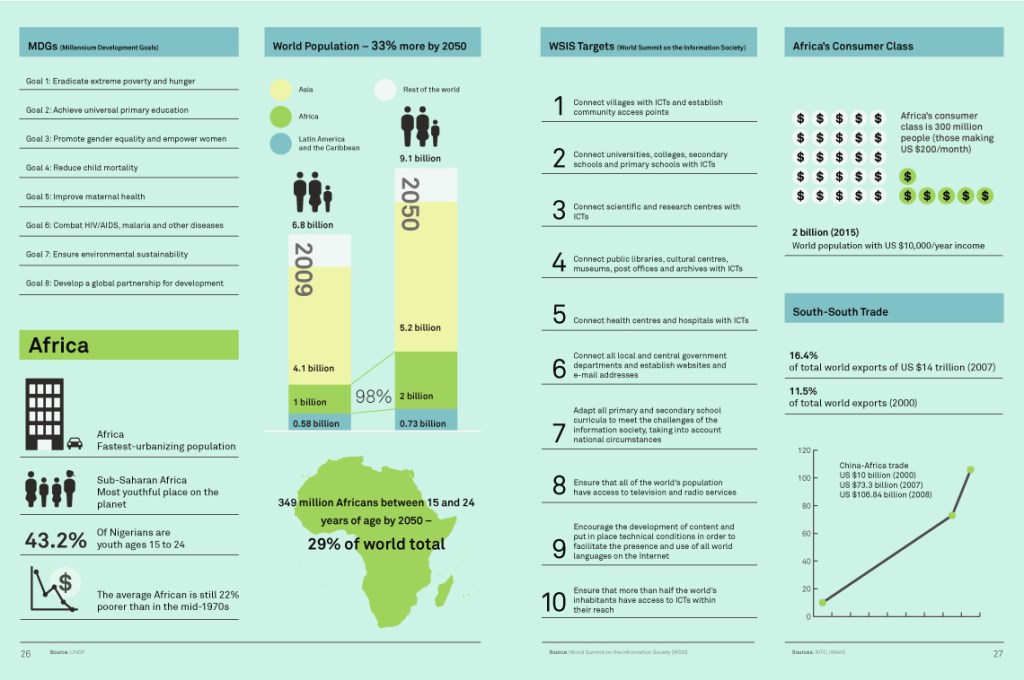
There has been a renaissance in South-South trade in recent years before the current economic crisis, growing by an average of 13 percent per year between 1995 and 2007. By 2007, South-South trade made up 20 percent of world trade.
Olam started with one product, got its supply right, and then started looking around and seeing what other products and services it could offer, applying already-tested expertise and supply skills – what the company calls the ‘Olam DNA’.
Olam claims its success has come from building strong relationships with farmers to guarantee high standards for the food products. The company does this by tightly tracking its stock and its quality. Olam then uses the information to analyze risks to the supply network. The company also keeps both warehouses and field managers close to the farmers. Olam estimates 65 percent of its profit comes from managing the journey from farmer’s field to factory gate.
Its selling point to customers is the ability to guarantee the entire journey from farmer’s field to factory gate, taking on all the risk and stress for ensuring the product is of the right standard and delivered on time.
Its niche is to provide the food products required by some of the world’s top food brands. The company has grown from just one product in Nigeria and two employees in 1989, to directly employing over 10,000 people worldwide and supplying 20 products in 60 countries, according to Brett. He says the company, which had a total 2008 turnover of US $5.75 billion, was “born out of Africa.”
Brett says the company is now “investing heavily in Africa in processing and distribution centres” – proof that a success story feeds back into more success and investment. It has been able to use its profits to go back and buy up failing businesses and former state-run enterprises, and modernize them. Olam now grows the food, processes it, and transports it to market.
Olam actively works with international donors, global NGOs like Technoserve (farmer business development), WWF (environmental impact of supply chain), and the Bill and Melinda Gates Foundation (cocoa and cashew farmers).
Olam, however, has received criticisms for its past practices. The global environmental group Greenpeace attacked its logging in the Democratic Republic of Congo (DRC) (http://www.greenpeace.org.uk/tags/olam), and the International Finance Corporation (IFC) divested its holdings from Olam for it trading illegally cut timber.
Olam and the Gates Foundation project are working with 200,000 cocoa farmers in West Africa to double their incomes. In Ghana, cocoa farming has become synonymous with poverty and perceived as an occupation of last resort. The work force is rapidly aging and the industry will die out if it doesn’t become more profitable and attractive to young people.
“We want the farmers to be profitable, the transporters to be profitable,” Brett said. “We believe a supply chain does not work if one player takes too much.”
And what advice does Olam have for budding food producers and growers? “Catchy, simple brands work. Our Mama Mia pasta caught the wave of the Abba revival.”
“Our Tasty Tom brand became very popular in Africa so we extended the brand into other products than just tomato paste. You reduce the cost of advertising by extending the brand name.”
“We feel SMEs (small, medium enterprises) growth is critical because it would give us more support. If more people invested in SMEs, we would have more people to do business with. We want to be able to make deals: they could be entrepreneurs.
“If you can add extra value it costs nothing but time.”
Brett advises budding SMEs: “It’s all about quality: trust and shared business ethics like formal contracts. When you have those, the bigger brands will give you support.”
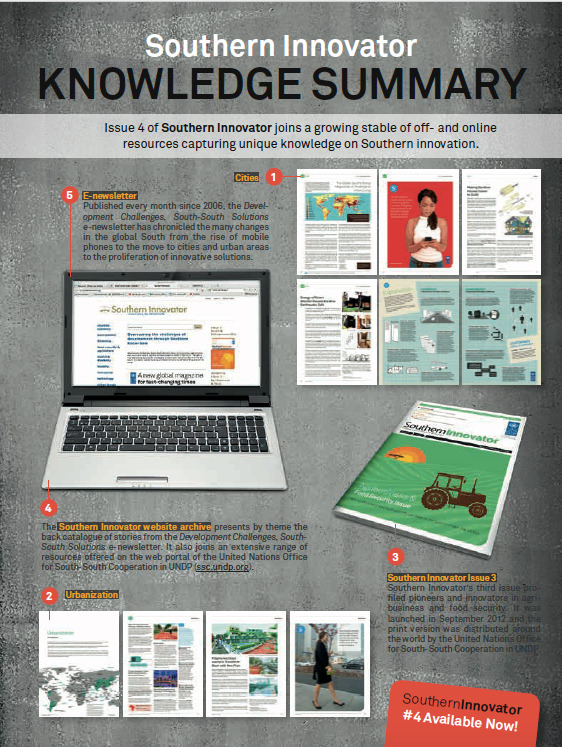
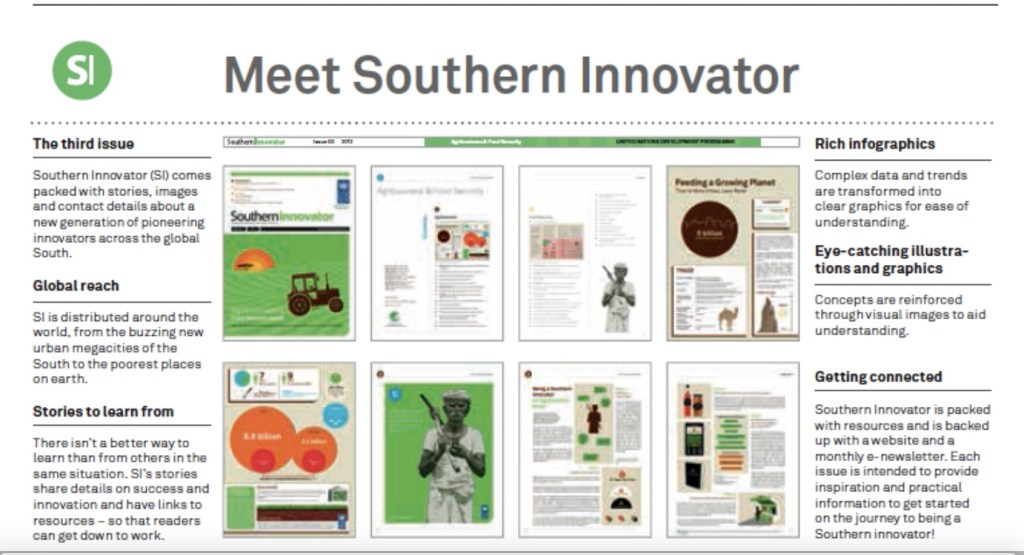
Development Challenges, South-South Solutions was launched as an e-newsletter in 2006 by UNDP’s South-South Cooperation Unit (now the United Nations Office for South-South Cooperation) based in New York, USA. It led on profiling the rise of the global South as an economic powerhouse and was one of the first regular publications to champion the global South’s innovators, entrepreneurs, and pioneers. It tracked the key trends that are now so profoundly reshaping how development is seen and done. This includes the rapid take-up of mobile phones and information technology in the global South (as profiled in the first issue of magazine Southern Innovator), the move to becoming a majority urban world, a growing global innovator culture, and the plethora of solutions being developed in the global South to tackle its problems and improve living conditions and boost human development. The success of the e-newsletter led to the launch of the magazine Southern Innovator.
Increasing the agricultural productivity of Africa is critical for the continent’s future development, and the world’s. Two-thirds of Africans derive their main income from agriculture, but the continent has the largest quantity of unproductive – or unused – potential agricultural land in the world.
This means the continent has the potential to become the world’s new breadbasket – but there is a problem. A report by the International Centre for Soil Fertility and Agriculture (IFDC) found the continent had a “soil health crisis” and that three-quarters of its farmlands were severely degraded (New Scientist). The causes of this crisis include overuse of the same plot of land due to population growth, which prevents farmers moving around, and high fertilizer costs, leading to African farmers using just 10 per cent of the world average on their farms.
But a new study shows that an existing practice by some African farmers could help solve this dilemma if it was adopted by the majority.
At the University of Sydney in Australia, a study has confirmed the effectiveness of ants and termites as a tool to increase farm yields in dry areas. It found ants and termites in drier climates of the global South improved soil conditions just as earthworms do in northern, wetter and colder climates. Both termites and ants, by burrowing their way through the soil, carve out tunnels that make it easier for plants to shoot their roots outwards in search of water.
In field experiments, ants and termites helped raise wheat yields by 36 per cent by increasing water and nitrogen absorption. This is critical for agriculture in arid climates.
While termites wreak havoc on crops such as maize (corn) and sugarcane, they are very useful for other African crops.
The Australian research found termites infuse nitrogen into the soil. Nitrogen is usually dumped on fields with expensive fertilizers that are subject to market fluctuations. The termites have nitrogen-heavy bacteria in their stomachs, which they excrete into the soil through their faeces or saliva.
The research also found termites helped with reducing water wastage.
This research reinforces what has long been known to some African farmers. Long-held farmer tradition in parts of West Africa uses termites to enhance soil by placing wood on the earth to attract them. By burying manure in holes near newly planted grains, farmers in Burkina Faso attract termites to the soil.
In Malawi, bananas are planted near termite mounds to encourage the creatures. In southern Zambia, soil from termite nests is harvested and used as top soil on agricultural land.
If more farmers adopted this practice, Africa could simultaneously address its chronic malnutrition and hunger problem and contribute to the world’s food needs. As the McKinsey Global Institute (MGI) found, “With 60 percent of the world’s uncultivated arable land and low crop yields, Africa is ripe for a ‘green revolution’ like those that transformed agriculture in Asia and Brazil.”
McKinsey estimated that Africa’s agricultural output could increase from US $280 billion a year now to US $500 billion by 2020 and as much as US $880 billion by 2030.
The UN recently declared that the world’s population has reached 7 billion. That is many mouths to feed and presents Africa with a dilemma and an opportunity.
And as urban growth accelerates across the global South – the world is now a majority urban place – there is a huge profit to be made from providing food to growing urban populations.
The time to act is now, as there have been reports from African farmers that they are seeing harvests declining by 15 to 25 per cent. And the picture gets gloomier: many farmers think their harvests will drop by half over the next five years.
Given that there are 2,600 different species of termites now recognised in the world (UNEP) and with over 660 species, found in Africa, it is by far the richest continent in termite diversity (Eggleton 2000) and they are proof that an affordable solution is close at hand to the current crisis.
Published: January 2012
Resources
1) World Vegetable Center: The World Vegetable Center is the world’s leading international non-profit research and development institute committed to alleviating poverty and malnutrition in developing countries through vegetable research and development. Website:http://www.avrdc.org
2) Songhai Centre: a Benin-based NGO that is a training, production, research, and development centre in sustainable agriculture. Website:http://www.songhai.org/english
5) African Alliance for Capital Expansion: A management consultancy focused on private sector development and agribusiness in West Africa. Website:http://www.africanace.com/v3
6) Ants and termites increase crop yield in a dry climate by Theodore A. Evans, Tracy Z. Dawes, Philip R. Ward and Nathan Lo, Nature Communications 2, Article number: 262
7) Integrating Ethno-Ecological and Scientific Knowledge of Termites for Sustainable Termite Management and Human Welfare in Africa by Gudeta W. Sileshi et al, Ecology and Society, Volume 14, Number 1. Website:http://www.ecologyandsociety.org/vol14/iss1/art48






 David South Consulting
You must be logged in to post a comment.