Categories
Archive Development Challenges, South-South Solutions Newsletters

A New African Beer Helps Smallholder Farmers

By David SouthDevelopment Challenges, South-South Solutions

SOUTH-SOUTH CASE STUDY

Africa’s growth in the past decade has held steady despite the trauma of the global economic crisis and the tumult of the “Arab Spring” in several countries of North Africa. African economies are growing because of a number of resilient trends. These include growing regional trade links, greater investment in infrastructure and the remarkable rise of China to become Africa’s number one trade partner, pushing the United States to second place (Technology + Policy). This has given birth to a growing consumer marketplace and consumer class – some 300 million people earning about US $200 a month (Africa Rising).

The continent as a whole now stands as the 10th largest economy in the world.

How will Africans spend this new money in their pockets (or more than likely, on their mobile phones)? They could go for the big, famous global brands that they see advertised in magazines or on television. Or they could also spend it on local products and services that seem just as enticing and life-improving. Creating local African products and services with strong brands will have an important knock-on effect of creating new wealth and jobs within Africa.

One new product being introduced to the West African country of Ghana’s thirsty beer drinkers is the Eagle beer brand. But this is not just any beer made from the traditional ingredients of water, hops, malted barley and yeast (http://en.wikipedia.org/wiki/Beer) – it is brewed from the root vegetable cassava.

A staple of many African diets, cassava (http://en.wikipedia.org/wiki/Cassava) is a starchy, tuberous root vegetable and a common crop across the continent.

It is believed that 70 per cent of Ghana’s farms are just 3 hectares in size or smaller. They grow many things, but cassava is the most common crop.

Cassava soon spoils once it has been harvested and needs to be consumed quickly. Currently, too much of it goes to waste. In Ghana, according to The Guardian, there is an annual surplus of some 40 per cent of cassava produced.

The Accra Brewery Limited (ABL) (http://www.sabmiller.com/index.asp?pageid=1156) decided to find a way to put the cassava from smallholder farms to good use and stop the waste. The brewery had observed the success of parent company SABMiller (http://www.sabmiller.com/index.asp?pageid=27) elsewhere in Africa, in turning cassava and the grain sorghum from smallholder farmers into beer. Farmers had directly benefited from the purchase of their surplus product.

Eagle brand cassava beer is creating opportunities for business, consumers and smallholder farmers in Ghana. According to The Guardian, the company hopes to source cassava from 1,500 smallholders.

By having a guaranteed purchase from the brewery on a regular basis, farmers are able to move beyond subsistence agriculture and turn themselves into functioning businesses.

The spare income from selling the cassava also can be used to improve a farmer’s household access to healthcare and education.

The Accra Brewery provides advice on agricultural techniques and growing a diverse range of crops, to ensure farmers are not dependent on a monocrop harvest. It also offers advice on business and developing commercial relationships.

The Eagle brand cassava beer will be sold at a 30 per cent discount to low-income drinkers in order to lure them away from illicit and informal alcohol drinks of dubious quality.

Professor Ethan Kapstein of business school INSEAD found that ABL and its water business Voltic (GH) Ltd. was a creator and supporter of high-quality jobs in Ghana and supported 17,600 jobs throughout the Ghanaian economy.

Adjoba Kyiamah (http://www.sabmiller.com/index.asp?pageid=1766&blogid=172), corporate and legal affairs director at Accra Brewery, told The Guardian she believes Eagle brand beer will help create even more jobs, boost government revenues and expand consumer choice.

This is an innovative first, as cassava beer had never been made before in Ghana on a commercial scale. This had not been possible in the past because of the challenge of collecting fresh cassava from farms widely spread out over a large territory. As well as spoiling quickly, Cassava is heavy, being mostly made up of water, and is difficult to transport over large distances.

“Part of our strategy across Africa is to make high quality beer which is affordable for low-income consumers while simultaneously creating opportunities for smallholder farmers in our markets. The launch of Eagle in Ghana ticks both these boxes,” said Mark Bowman, Managing Director of SABMiller Africa.

“Eagle is aimed at attracting low-income consumers away from illicit alcohol. This is a virtuous circle: smallholder cassava farmers have a guaranteed market for their crop, which is then used to make consistently high quality, affordable beer for consumers; and the government realises increased revenues as people trade up into formal, taxable alcohol consumption.”

ABL is using a mobile processing unit developed by DADTCO (Dutch Agricultural Development and Trading Company) Cassava Processing Ghana Ltd. It is designed to process the cassava on site, preserving the integrity of the starch.

Eagle is sold in 375 millilitre bottles at a price 70 per cent lower than that charged for other lager beers. The use of local ingredients, and a reduced excise tax awarded to the brand because is it is boosting local agriculture, allows for the lower price.

Production of cassava beer got its start first in Mozambique, with the launch of the Impala brand (http://www.sabmiller.com/index.asp?pageid=149&newsid=1748), the first commercial-scale cassava-based clear beer, in October 2011.

Published: April 2013

Resources

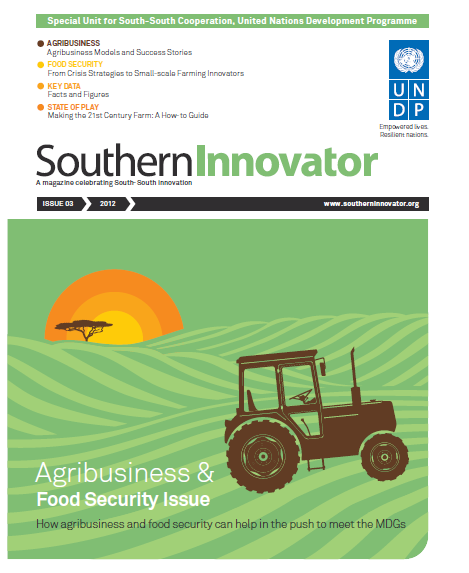
1) Southern Innovator Magazine Issue 3: Agribusiness and Food Security. Packed with information, insights and business models to turn smallholder farmers into agribusinesses. Website: http://www.scribd.com/doc/106055665/Southern-Innovator-Magazine-Issue-3-Agribusiness-and-Food-Security

2) Cassava can become Africa’s new cash crop: Cassava is abundant in sub-Saharan Africa, and could be an ideal crop to improve food security for millions of people. Website: http://www.guardian.co.uk/global-development-professionals-network/2013/mar/28/cassava-food-security-sub-saharan-africa

3) Cassava recipes from the BBC. Website: http://www.bbc.co.uk/food/cassava

Southern Innovator logo

London Edit

31 July 2013

Development Challenges, South-South Solutions was launched as an e-newsletter in 2006 by UNDP’s South-South Cooperation Unit (now the United Nations Office for South-South Cooperation) based in New York, USA. It led on profiling the rise of the global South as an economic powerhouse and was one of the first regular publications to champion the global South’s innovators, entrepreneurs, and pioneers. It tracked the key trends that are now so profoundly reshaping how development is seen and done. This includes the rapid take-up of mobile phones and information technology in the global South (as profiled in the first issue of magazine Southern Innovator), the move to becoming a majority urban world, a growing global innovator culture, and the plethora of solutions being developed in the global South to tackle its problems and improve living conditions and boost human development. The success of the e-newsletter led to the launch of the magazine Southern Innovator. 

Creative Commons License

This work is licensed under a
Creative Commons Attribution-Noncommercial-No Derivative Works 3.0 License.

ORCID iD: https://orcid.org/0000-0001-5311-1052.

© David South Consulting 2022

Categories
Archive Development Challenges, South-South Solutions Newsletters Southern Innovator magazine

New Appetite for Nutritious Traditional Vegetables

By David SouthDevelopment Challenges, South-South Solutions

SOUTH-SOUTH CASE STUDY

Throughout the history of farming, around 7,000 species of plants have been domesticated. Yet everyday diets only draw on 30 percent of these plants and even this number has been going down as more people consume mass-market foods (FAO).

One consequence has been poor nutrition resulting from the reduction in consumption of high-vitamin foods, leading to stunted mental and physical development across the global South.

Once-rich culinary traditions have wilted and left many people not knowing what to do with formerly common vegetables and fruits, even if they can actually find them in markets.

Between 94,000 and 144,000 plant species — a quarter to a half of the world’s total — could die out in the coming years, according to an estimate by Scientific American (2002). Among them are vital food crops, threatened by a world in which climate change is causing more weather turbulence and diseases and viruses can spread rapidly and destroy crops.

This scale of plant loss risks leaving the world’s food security dependent on fewer – and more vulnerable – domesticated species.

Despite being rich in vitamins, minerals and trace elements, African leafy vegetables have been overlooked in preference for cabbage, tomatoes, carrots, and other imported produce. But with rising food prices at local markets, people are looking again at these neglected African vegetables. In East Africa, this includes indigenous plants like amaranth (http://en.wikipedia.org/wiki/Amaranth), African eggplant, Ethiopian mustard, cowpea, jute mallow and spider plant.

Like tomatoes and potatoes, some of these vegetables are members of the nightshade family — but unlike those imports, they are indigenous to Africa. According to Patrick Maundu of Bioversity International (http://www.bioversityinternational.org/), African nightshades provide good levels of protein, iron, vitamin A, iodine, zinc, and selenium at seven times the amounts derived from cabbage. The high levels of vitamins and micronutrients, he says, are especially important to people at risk of malnutrition and disease, particularly HIV/AIDS.

As the cost for basic foodstuffs have shot up during the global economic crisis, growing food has become an increasingly lucrative source of income. Estimates of the number of people doing this across Africa range from hundreds of thousands to millions.

In the bid to reduce the over-dependence on imported foods, urban farming is coming to the rescue and becoming an effective survival tactic in Africa’s fast-growing cities. Thousands of urban workers in Kenya’s capital, Nairobi, are supplementing their wages by investing in farms growing food.

Eunice Wangari, a nurse in Kenya, supplements her US $350/month salary with money earned from growing food. “For too long our country has been flooded with imported food and westernized foods,” Wangari told The Guardian newspaper. “This is our time to fight back – and grow our own.”

In Kenya, this type of agriculture usually involves an urbanite taking a stake in farmland outside the city. Relatives then do the farming. Mobile phones play a key role in this approach. The urban dweller can keep in touch with the farm by phone and receive updates on progress. They use their knowledge of urban food tastes to then adjust the crops and increase profits.

An accountant, James Memusi in Nairobi, is growing mushrooms in a spare bedroom in his home and then selling them to hotels and supermarkets, according to The Guardian. Miringo Kinyanjui is selling unrefined maize and wheat. Loved for its nutritional qualities, the flour is also flavoured with amarathan, a common green vegetable in Kenya.It is a clever way to make the most of the fact that many urban dwellers have some access to land in the countryside.

Pride is also returning to the topic of food, as people re-discover traditional foods and vegetables and fruits.

In Liberia, president Ellen Johnson-Sirleaf has launched a “Back to the Soil” campaign to get urban dwellers to farm and help the country lose its dependence on foreign food imports.

Liberia is trying to reduce the importing of rice and tomatoes.

In Zambia, the embracing of traditional foods has been fuelled by recipes used by a chain of popular restaurants. This appetite has driven demand for dried pumpkins, ‘black jack’ leaves and fresh okra.

The success of this revival of traditional foods has attracted big multinationals as well. Unilever Kenya ran a campaign in 2008 called ‘taste our culture,’ promoting African herbs and spices.

Published: November 2009

Resources

1) The Global Trees Campaign, a partnership between Fauna & Flora International, Botanic Gardens Conservation International and many other organisations around the world, aims to save threatened tree species through provision of information, conservation action and support for sustainable use. Website: http://www.globaltrees.org

2) World Vegetable Center: The World Vegetable Center is the world’s leading international non-profit research and development institute committed to alleviating poverty and malnutrition in developing countries through vegetable research and development. Website: http://www.avrdc.org/

3) Sylva Professional Catering and College: A well-known Zambian food entrepreneur who runs a range of businesses, including restaurants, a cooking school and a guest house. Website: http://sadcbiz.com/countries/zambia/categories/index.htm

4) Marketing African Leafy Vegetables: Challenges and Opportunities in the Kenyan Context By Kennedy M. Shiundu and Ruth. K. Oniang. Website: http://www.ajfand.net/Issue15/PDFs/8%20Shiundu-IPGR2_8.pdf

Development Challenges, South-South Solutions was launched as an e-newsletter in 2006 by UNDP’s South-South Cooperation Unit (now the United Nations Office for South-South Cooperation) based in New York, USA. It led on profiling the rise of the global South as an economic powerhouse and was one of the first regular publications to champion the global South’s innovators, entrepreneurs, and pioneers. It tracked the key trends that are now so profoundly reshaping how development is seen and done. This includes the rapid take-up of mobile phones and information technology in the global South (as profiled in the first issue of magazine Southern Innovator), the move to becoming a majority urban world, a growing global innovator culture, and the plethora of solutions being developed in the global South to tackle its problems and improve living conditions and boost human development. The success of the e-newsletter led to the launch of the magazine Southern Innovator. 

Creative Commons License

This work is licensed under a
Creative Commons Attribution-Noncommercial-No Derivative Works 3.0 License.

ORCID iD: https://orcid.org/0000-0001-5311-1052.

© David South Consulting 2023

Categories
Archive Development Challenges, South-South Solutions Newsletters Southern Innovator magazine

Woman Wants African Farming to be Cool

By David SouthDevelopment Challenges, South-South Solutions

SOUTH-SOUTH CASE STUDY

Can farming be cool? Especially on a continent where it has long been associated with hardship and poverty, can agriculture be attractive to a young generation looking for big opportunities? A young woman in Nigeria thinks so and is on a mission to show farming is a great way to get ahead in modern Africa. And she hopes more people attracted to farming will boost the continent’s food security and reduce costly imports.

Cynthia Mosunmola Umoru’s company, Honeysuckle PTL Ventures (http://www.tootoo.com/d-c3015227-Honeysuckles_Ptl_Ventures/), is based in Lagos , the business capital of Nigeria. The West African country has become dependent on food imports, despite many attempts to modernise its agricultural sector.

The country’s heavy dependence on oil exports for its income has led to poor investment in its domestic economy. Over 80 percent of Nigeria’s university graduates struggle to find work. And it is these two problems – food security and high unemployment among the country’s young, educated and ambitious – that Umoru wants to change.

Leading by example, Umoru has set up a successful and modern agribusiness focusing on high-quality food products using modern packaging and fast delivery. She produces meat products, from seafood like shrimps and prawns to snails, beef, chicken, and birds. Her niche is to deliver the product however the customer wishes: fresh, frozen or processed. Her business has its own farms and ponds but also has developed a sophisticated network with other farmers, providing them with standard contracts and benefits. This extra capacity means she can meet the demand and handle large volume orders.

She is proudly self-taught. “I didn’t have a mentor in farming! Though I have other mentors,” Umoru told the Guardian Life Magazine. “My knowledge of agribusiness has been largely from personal education and research. The Internet has served greatly as my resource bank.”

Umoru was initially on the path to study medicine, but had that dream upset by riots in the late 1990s. She then moved on to study zoology at Lagos State University. In her final year, she became interested in agribusiness. Her company was officially registered in 2004, but she had already begun at university providing meat products to fast-food outlets in Lagos.

“It took five years to gain relevance,” she said. “My involvement in the agribusiness sector is really impacting people, particularly young people like me, who I always hear say ‘If you are involved with farming then it is probably not as bad as it seems’. Farming, before now in Nigeria, was termed business of low-lives and with the barrier to entry being so high for young people to actively participate.”

“I have successfully, in my little way, impressed on my generation that farming could be glamorous and cool enough for us to trade places with the business executive in the large conglomerate and also the bank’s middle management cadre, which is the initial attraction for most young graduate(s) in Nigeria.”

She is not shy talking about how rough it was in the beginning: “As a young entrepreneur, in my very early days, I lost a lot of the seed capital I got from financial mentors to poor and bad business decisions I took because there was no one to talk to.”

Overall in sub-Saharan Africa, the long-term prospects for agriculture are good. The Food and Agricultural Organization (FAO) found in a 2009 paper that “the sub-Saharan agricultural sector — 80 percent of which consists of smallholder farmers — grew more than 3.5 percent in 2008, well above the 2 percent rate of population growth.”

Sub-Saharan Africa’s population is predicted to grow from 770 million in 2005 to 1.5 to 2 billion in 2050 (FAO). Despite rapid migration from the countryside to cities and the growth in urban population, the absolute number of rural people is also likely to continue to increase.

Agriculture is the motor for rural development, poverty and hunger reduction in sub-Saharan Africa. The FAO paper said that agricultural growth in sub-Saharan Africa is likely to be led by domestic and intra-African demand for food commodities due to urbanization and the growing population.

African farming has been able to benefit from rising global food prices and demand. The policy environment has also become more favourable, according to the FAO. The paper found “There is a particular need for programmes and policies to increase the capacity of smallholder farmers to enter dynamic sectors of national, regional and international markets.”

African farming can see serious productivity gains if it changes and it takes on new techniques. At the moment only 3 percent of the region’s food crops are produced using irrigation, compared to more than 20 percent globally.

The irony is that Nigeria has already hatched one of the world’s most successful food companies, Olam (www.olamonline.com). A global food supply company in ‘agri-products’ that got its start in Nigeria, it shows Umoru is on to something – a Southern brand can grow and go global, and overcome the difficulties of cross-border trade in Africa.

Olam currently supplies well-known global food brands including Cadbury (chocolate), Nestle, Lavazza (coffee), Mars (chocolate), Tchibo and Planters (peanuts).

With some 218 million people in Africa — around 30 percent of the total population — estimated to be suffering from chronic hunger and malnutrition, a thriving local food sector would bring many gains.

Turning to more sophisticated business models offers solutions to chronic problems. With 80 percent of Africa’s farms less than two hectares in size – and there are 33 million of them – cereal yields have grown little and are still around 1.2 tonnes per hectare in the region, compared to an average of some 3 tonnes per hectare in the developing world as a whole. Fertilizer consumption was only 13 kg per hectare in sub-Saharan Africa in 2002, compared to 73 kg in the Middle East and North Africa and 190 kg in East Asia and the Pacific. The FAO has estimated that the potential additional land area available for cultivation in sub-Saharan Africa amounts to more than 700 million hectares – a boon to the continent’s and the world’s food needs in coming years if handled well.

And the demand is there: Between 2001 and 2007, annual increases in the global consumption of agricultural commodities were larger than during the 1980s and 1990s. The quantity of agri-products harvested in the world is 5.2 billion metric tonnes a year.

“I have been able to reach out to so many people across the nation, preaching the agribusiness development and adoption gospel,” said Umoru. “I have also worked closely with other youth agencies to empower many more young people to aspire in Nigeria.”

One such agency is the Harambe Nigeria Endeavour. Harambe Nigeria (http://www.hendeavor.org/content/bgroups/nigeria.php) is a programme designed to stimulate growth in the agricultural sector and open up opportunities for youth to become leaders and entrepreneurs in this area. And this means future young entrepreneurs going into the agricultural sector will not feel as alone as Umoru once did.

As Obinna Ukwuani, creative director of Harambe Nigeria says: “We wish to rectify the tarnished image of agriculture in Nigeria, making it a viable investment for Nigerian youth from all walks of life.”

Published: May 2010

Resources

1) World Vegetable Center: The World Vegetable Center is the world’s leading international non-profit research and development institute committed to alleviating poverty and malnutrition in developing countries through vegetable research and development. Website: http://www.avrdc.org

2) Marketing African Leafy Vegetables: Challenges and Opportunities in the Kenyan Context by Kennedy M. Shiundu and Ruth. K. Oniang. Website: http://www.ajfand.net/Issue15/PDFs/8%20Shiundu-IPGR2_8.pdf

3) 2050: Africa’s Food Challenge: Prospects good, resources abundant, policy must improve: A discussion paper from the Food and Agricultural Organization (FAO). Website: http://www.fao.org/wsfs/forum2050/wsfs-background-documents/issues-briefs/en/

4) African Alliance for Capital Expansion: A management consultancy focused on private sector development and agribusiness in West Africa. Website: http://www.africanace.com/v3

5) Branding Strategy Insider: This blog provides advice and case studies on how to build trust for your brand. Website: www.brandingstrategyinsider.com

6) Growing Inclusive Markets, a web portal from UNDP packed with case studies, heat maps and strategies on how to use markets to help the poor. Website: www.growinginclusivemarkets.org

7) Starting a SME (small, medium enterprise): This website is packed with advice and tips for starting a small business and how to grow it with limited resources. Website: http://www.smallbusiness.co.uk

8) World Business Fair: The World Business Fair is an international trade platform for global entrepreneurs and professionals. Website: http://www.worldbusinessfair.com

Development Challenges, South-South Solutions was launched as an e-newsletter in 2006 by UNDP’s South-South Cooperation Unit (now the United Nations Office for South-South Cooperation) based in New York, USA. It led on profiling the rise of the global South as an economic powerhouse and was one of the first regular publications to champion the global South’s innovators, entrepreneurs, and pioneers. It tracked the key trends that are now so profoundly reshaping how development is seen and done. This includes the rapid take-up of mobile phones and information technology in the global South (as profiled in the first issue of magazine Southern Innovator), the move to becoming a majority urban world, a growing global innovator culture, and the plethora of solutions being developed in the global South to tackle its problems and improve living conditions and boost human development. The success of the e-newsletter led to the launch of the magazine Southern Innovator. 

Creative Commons License

This work is licensed under a
Creative Commons Attribution-Noncommercial-No Derivative Works 3.0 License.

ORCID iD: https://orcid.org/0000-0001-5311-1052.

© David South Consulting 2023

Categories
Archive Development Challenges, South-South Solutions Newsletters

India’s Modernizing Food Economy Unleashing New Opportunities

By David SouthDevelopment Challenges, South-South Solutions

SOUTH-SOUTH CASE STUDY

Increasing prosperity in India is reshaping the country’s relationship to its food. A number of trends are coming together that point to significant improvements to India’s long-running problems with food supply and distribution. This matters because India, despite its two-decade economic boom – and increasing middle-class population – is still home to about 25 per cent of the world’s hungry poor, according to the World Food Programme (WFP).

According to Indian government figures, around 43 per cent of children under five are malnourished and more than half of pregnant women between 15 and 49 suffer from anaemia (http://en.wikipedia.org/wiki/Anemia), a consequence of poor diets (WFP).

Many Indians go hungry despite the fact that the country grows enough food for its entire population. The problem isn’t lack of food but a wasteful system that fails to distribute affordable food efficiently and to make participating in the food system a viable income source. Farming employs as much as 70 per cent of Indians. But many work small plots of land, are heavily in debt and earn a meagre income.

However, a number of developments are improving the efficiency of India’s food system and modernizing the way it works.

There are signs that big changes lie ahead: New restaurants exploring foreign cuisines; modern supermarkets; online food shopping services; food academies teaching new skills; food gurus proselytising for new approaches; and a thriving publishing and media sector.

They are creating new jobs, increasing price competition and encouraging more modern delivery, marketing and distribution systems.

In 2011 the introduction of global supermarkets into the Indian marketplace became a hot debate. The Indian government announced it would open the marketplace to global competition and foreign direct investment (FDI), but put the move on hold in December after an outcry by political parties and protests by small- and medium-sized retailers fearful it would harm livelihoods. The Indian supermarket sector is a market estimated to be worth US $475 (The Guardian).

One retailer that is already bringing international methods to Indian retailing is the Best Price chain of wholesale stores. Best Price is a joint venture between U.S.-based Walmart and Bharti Enterprises, one of India’s largest business groups. In 2007, Walmart India made a deal with Bharti Enterprises to set up a cash and carry business called Best Price Modern Wholesale. The first store opened in 2009, and by 2012 there were 15 outlets.

By teaming up with Walmart, Bharti Enterprises gets to learn from one of the world’s leading retailers and a pioneer in efficiencies, logistics, supply chain management and sourcing.

The stores have all the hallmarks of modern food selling – warehouses, sophisticated inventory control, hygienic conditions and connection to new information technologies (http://www.indiaretailing.com/bharti-walmart-II.asp).

Best Price Modern Wholesale employs 3,710 people, and the stores sell more than 6,000 items, a mix of food and non-food products. It claims 90 per cent of the goods and services are sourced locally.

Food is a highly volatile and politicized issue in India. High food inflation – which reached 12.21 per cent in November 2011, according to India’s Finance Minister Pranab Mukherjee – has led to political tensions. Inflation has driven up the price of staple foods, essential commodities and imported products.

At the same time, India’s commerce ministry has forecast that 10 million jobs will be created if foreign supermarkets are allowed to set up in India. Many of these jobs will be in logistics as more efficient, modern methods shake up India’s food industry. Poor logistics in the Indian food sector means that as much as 40 per cent of produced food does not reach consumers. This waste comes at a high cost in a country with 50 million malnourished children.

New jobs are already being created in the country’s restaurant industry.

While there have always been high-end restaurants in India’s cities, the gastronomic scene has received a recent boost from expatriate Indian restaurateurs returning from the competitive London, Tokyo and New York scenes, bringing skills and experience from some of the most demanding kitchens in the world.

One example is Megu, a restaurant in New Delhi’s Leela hotel(theleela.com/new-delhi-megu.html) that sells Japanese-influenced food.

Such cuisine is being called “elite Indian international gastronomy”, according to The Guardian newspaper.

“We are aiming at the affluent traveller or the ultra-rich local,” Aishwarya Nair, a senior executive at the Leela, told The Guardian. “The idea is to give people a taste of globalization. In our restaurant you don’t know you are in India. You could be in New York, Japan, anywhere.”

That appeals to many newly affluent Indians, food critic Vir Sanghvi told the newspaper.

“The food (at somewhere like Megu) doesn’t matter so much as the experience and the glamour,” Sanghvi said. “There is a lot of money outside the traditional elite now and these people are looking for ways to spend it on something that seems sophisticated.”

The new food fascination is also leading families who once would have employed a cook to watch 24-hour TV channels about food. This programming changes habits and encourages buying new foods and exploring new flavours.

Market analysts believe these trends are likely to continue. A middle class with spending power has been growing in India for almost two decades, and forecasts see the number of middle class Indians reaching 250 million by 2016.

“With bigger and better restaurants and international food brands coming in to the country, it’s only a matter of time before fine dining finds its place among a growing cosmopolitan population,” said Siddharth Mathur, manager of the independent Smoke House Room restaurant (facebook.com/SmokeHouseRoom).

Online food shopping in India is also thriving. Research by Juxt found that 65 million people use the web in India, four-fifths of whom shop online. Murali Krishnan, head of eBay India, told the BBC that the country could become one of the top 10 e-commerce hubs in the world by 2015.

Online grocery services include MyGrahak.com, which calls itself “India’s Largest Food Store” and offers home delivery of food, toiletries and pet supplies. Another is Greenytails.com, which brings together multiple food retailers into one online shopping website and is based in Bangalore and Hyderabad.

As an example of the spin-offs that can be created from rising interest in food culture, there is the story of Nita Mehta. Considered one of India’s most celebrated cookbook authors, Mehta (nitamehta.com) not only publishes recipes but also runs a chain of cooking academies.

As she tells it, her interest in cooking was always there and she started experimenting at home with new recipes for her friends and family. The response was encouraging and she started teaching people how to make ice cream in her home. Curious students flocked to her classes to learn how to make flavours like mint, chocolate chip and mocha.

Following on this success, she started teaching classes in baking, Chinese cooking and what she calls “multicuisine”.

The lessons soon turned into a cookbook, which she wrote after doing her household chores. But her battles had only begun: publishers were not interested so she self-published. She called her publishing company Snab Publishers and released her first book, “Vegetarian Wonders”. It was modestly successful but it was with her second book, “Paneer All the Way”, that things got cooking. Her publishing company has now produced 400 cook books and sold 5 million copies. She has won international awards, does TV cooking programmes, has established several cooking institutes in New Delhi and teaches classes in the U.S., Canada, Britain and other countries.

With successes like Nita Mehta, the Indian food revolution is well underway.

Published: March 2012

Resources 

1) India Retailing.com: Calling itself “a path-breaking retail information interface portal. Addressed and directed towards the retailing community across the world, the portal provides a wide-angle view and analysis of the business of retail in India”. Website: indiaretailing.com

2) Retailers Association of India (RAI): RAI is the unified voice of Indian retailers. RAI works with all the stakeholders for creating the right environment for the growth of the modern retail industry in India. Website: rai.net.in/

3) The Wal-Mart Effect: A book on how highly competitive retail supermarkets can drive down food prices and inflation. Website: http://www.amazon.co.uk/Wal-Mart-Effect-Out—town-Superstore/dp/0141019794/ref=sr_1_1?s=books&ie=UTF8&qid=1322570100&sr=1-1

4) More on India’s food situation from the World Food Programme. Website: http://www.wfp.org/countries/india

5) Report on the State of Food Insecurity in Urban India: A report from Networked Ideas. The Report reveals an alarming situation of a permanent food and nutrition emergency in urban India. Website: http://www.networkideas.org/focus/feb2012/fo28_M_S_Swaminathan.htm

Development Challenges, South-South Solutions was launched as an e-newsletter in 2006 by UNDP’s South-South Cooperation Unit (now the United Nations Office for South-South Cooperation) based in New York, USA. It led on profiling the rise of the global South as an economic powerhouse and was one of the first regular publications to champion the global South’s innovators, entrepreneurs, and pioneers. It tracked the key trends that are now so profoundly reshaping how development is seen and done. This includes the rapid take-up of mobile phones and information technology in the global South (as profiled in the first issue of magazine Southern Innovator), the move to becoming a majority urban world, a growing global innovator culture, and the plethora of solutions being developed in the global South to tackle its problems and improve living conditions and boost human development. The success of the e-newsletter led to the launch of the magazine Southern Innovator. 

Creative Commons License

This work is licensed under a
Creative Commons Attribution-Noncommercial-No Derivative Works 3.0 License.

ORCID iD: https://orcid.org/0000-0001-5311-1052.

© David South Consulting 2023