Categories
Archive Development Challenges, South-South Solutions Newsletters

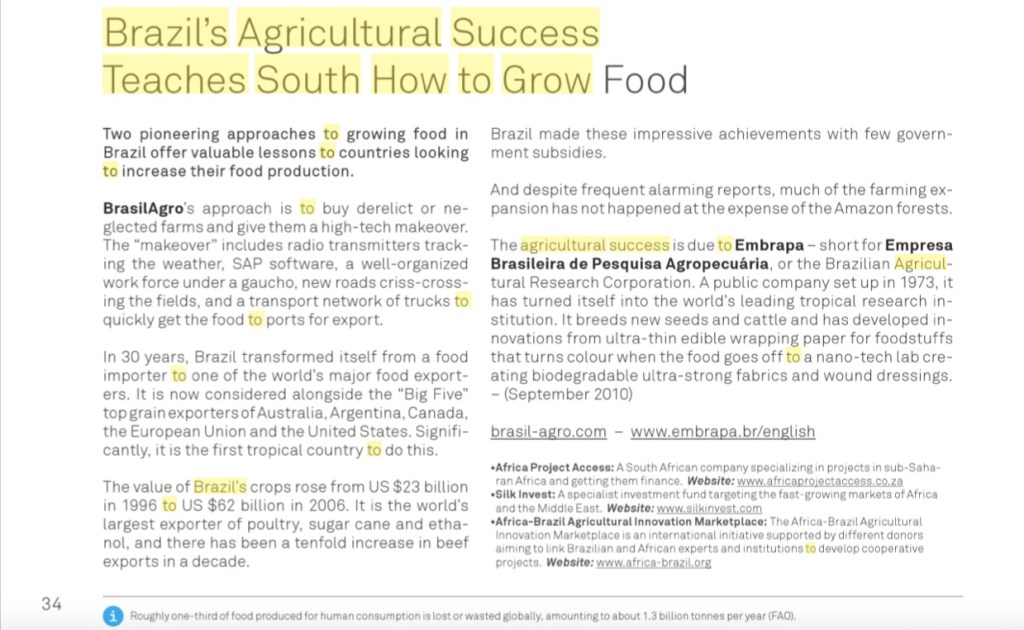
Brazil’s Agricultural Success Teaches South How to Grow

By David SouthDevelopment Challenges, South-South Solutions

SOUTH-SOUTH CASE STUDY

Inflation, environmental stresses and population and economic growth are testing the world’s food supply systems. There is a strong need to boost yields and improve the quality of food.

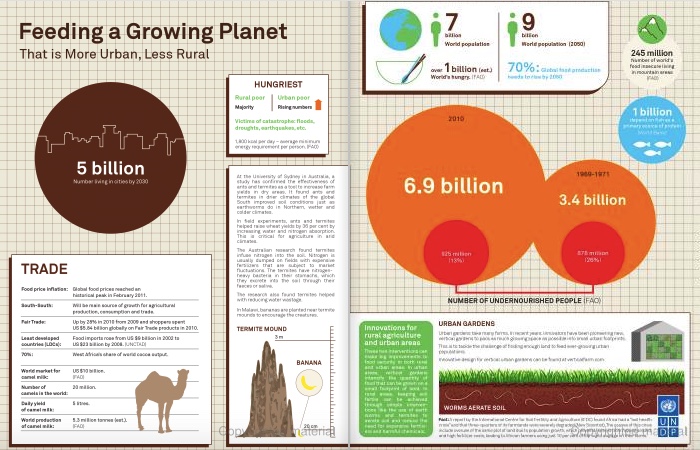
Between now and 2050 the world’s population will rise from 7 billion to 9 billion. Urban populations will probably double and incomes will rise. City dwellers tend to eat more meat and this will boost demand.

The UN’s Food and Agriculture Organization (FAO) reckons grain output will have to rise by around half but meat output will have to double by 2050 to meet demand.

Two pioneering approaches to growing food in Brazil offer valuable lessons to countries looking to increase their food production.

One is taking place in Bahia state in north-eastern Brazil. On Brazil’s cerrado (savannah) (http://en.wikipedia.org/wiki/Cerrado), enormous farms grow cotton, soybeans and maize. One of them, Jatoba farm, has 24,000 hectares of land: vastly larger than comparable farms in the United States.

On the Cremaq farm in the north of the country in Piaui state, a transformation has taken place. Once a failed cashew farm, it is now a highly modern operation. Owned by BrasilAgro, it is benefiting from clever agricultural innovation that gets results.

BrasilAgro’s approach is to buy derelict or neglected farms and give them a high-tech makeover. The ‘makeover’ includes radio transmitters tracking the weather, SAP software (http://en.wikipedia.org/wiki/SAP_AG), a well-organized work force under a gaucho (http://en.wikipedia.org/wiki/Gaucho), new roads criss-crossing the fields, and a transport network of trucks to quickly get the food to ports for export. Piaui is an isolated place with few services: it can take half a day to get to a health clinic. Dependence on state welfare payments for survival is the norm for many residents.

Brazil, over 30 years, transformed itself from a food importer to one of the world’s major food exporters. It is now considered alongside the ‘Big Five’ top grain exporters of America, Canada, Australia, Argentina and the European Union. Importantly, it is the first tropical nation to do this.

The value of Brazil’s crops rose from US $23 billion in 1996, to US $62 bn in 2006. It is the world’s largest exporter of poultry, sugar cane and ethanol, and there has been a tenfold increase in beef exports in a decade.

Brazil made these impressive achievements with few government subsidies. According to the Organization for Economic Co-operation and Development (OECD), state support accounted for just 5.7 percent of total farm income in Brazil from 2005-07. In the US it was 12 percent, while the OECD average is 26 percent and the level in the European Union is 29 percent.

And despite frequent alarming reports, much of the farming expansion has not happened at the expense of the Amazon forests.

The agricultural success is down to Embrapa (http://www.embrapa.br/english) – short for Empresa Brasileira de Pesquisa Agropecuária, or the Brazilian Agricultural Research Corporation. A public company set up in 1973, it has turned itself into the world’s leading tropical research institution. It breeds new seeds and cattle and has developed innovations from ultra-thin edible wrapping paper for foodstuffs that turns colour when the food goes off to a nano-tech lab creating biodegradable ultra-strong fabrics and wound dressings.

Its biggest achievement has been turning the vast expanses of the cerrado green for agriculture. Norman Borlaug, an American plant scientist often called the father of the Green Revolution, told the New York Times that “nobody thought these soils were ever going to be productive.” They seemed too acidic and too poor in nutrients.

Embrapa uses what its scientists call a “system approach”: all the interventions work together. Improving the soil and developing new tropical soybeans were both needed for farming the cerrado. The two together also made possible the changes in farm techniques which have boosted yields further.

Many believe this approach can be applied to Africa as well. There are several reasons to think it can. Brazilian land is like Africa’s: tropical and nutrient-poor. The big difference is that the cerrado gets a decent amount of rain and most of Africa’s savannah does not (the exception is the swathe of southern Africa between Angola and Mozambique).

Another approach that Brazil has been pioneering is making small, family farms sustainable and productive for the 21st century.

There has long been a tension between those who believe in very large farms, agribusiness and mono-crops (http://en.wikipedia.org/wiki/Mono-cropping), and those who believe in having a large number of smaller farms with a wide variety of crops and animals.

But small farms have endured. The livelihoods of more than 2 billion people depend on the 450 million smallholder farms across the world. With their families, they account for a third of the world’s population.

Family farms are critical to weathering economic crises and ensuring a steady and secure food supply. The International Fund for Agricultural Development (IFAD) (www.ifad.org)called in 2008 for small family farms to be put at the heart of the global response to high food prices and uncertain food security.

In Brazil, this call is being answered by a bold initiative to create what is termed a “social technology”, combining a house building programme with diverse family farms.

The Brazilian farmers’ cooperative Cooperhaf: Cooperativa de Habitacao dos Agricultores Familiares (http://www.cooperhaf.org.br) – a World Habitat Awards winner – combines housing and farm diversification to support family farmers.

“Family farming is very important for the country – 70 percent of food for Brazilians comes from family farming,” said Adriana Paola Paredes Penafiel, a projects adviser with the Cooperhaf. “The government wants to keep people in rural areas.”

“We see the house as the core issue,” she continued.  “The farmers can improve their productivity but the starting point is the house.”

Started in 2001 by a federation of farmers unions, the Cooperhaf works in 14 Brazilian states with family farmers. In Brazil farmers have a right to a house in the law and the cooperative was formed to make sure this happened.

“We promote diversification to make farmers less vulnerable: if they lose a crop in macro farming, they lose everything. We encourage diversification and self-consumption to guarantee the family has food everyday. We help to set up a garden.”

The concept is simple: a good quality home acts as an anchor to the family farm, making them more productive as farmers. The farmers receive up to 6,000 reais (US $2,290) for a house, and can choose designs from a portfolio of options from the Cooperhaf.

As in other countries, the Cooperhaf and other co-ops encourage markets and certification programmes to promote family farmed food and raise awareness. Penafiel says promoting the fact that the food is family farmed is critical: to the consumer it is healthier, fresher and contains fewer chemicals than imported produce.

“Most agri business is for export,” said Penafiel. “If we don’t have food in the country, food for poor communities would not be available. This enables farmers to be more autonomous, not having to buy fertilizers and equipment and take on too much debt. That approach is not sustainable as we saw with the so-called Green Revolution.”

Published: September 2010

Resources

  • Africa Project Access: A South African company specializing in projects in sub-Saharan Africa and getting them finance. Website:http://www.africaprojectaccess.co.za/
  • Silk Invest: A specialist investment fund targeting the fast-growing markets of Africa and the Middle East. Website:http://www.silkinvest.com/
  • Olam: A global food supply company in ‘agri-products’ that got its start in Nigeria  and shows how a Southern brand can grow and go global and overcome the difficulties of cross-border trade. Website: www.olamonline.com

Development Challenges, South-South Solutions was launched as an e-newsletter in 2006 by UNDP’s South-South Cooperation Unit (now the United Nations Office for South-South Cooperation) based in New York, USA. It led on profiling the rise of the global South as an economic powerhouse and was one of the first regular publications to champion the global South’s innovators, entrepreneurs, and pioneers. It tracked the key trends that are now so profoundly reshaping how development is seen and done. This includes the rapid take-up of mobile phones and information technology in the global South (as profiled in the first issue of magazine Southern Innovator), the move to becoming a majority urban world, a growing global innovator culture, and the plethora of solutions being developed in the global South to tackle its problems and improve living conditions and boost human development. The success of the e-newsletter led to the launch of the magazine Southern Innovator. 
Creative Commons License

This work is licensed under a
Creative Commons Attribution-Noncommercial-No Derivative Works 3.0 License.

ORCID iD: https://orcid.org/0000-0001-5311-1052.

© David South Consulting 2022

Categories
Archive Development Challenges, South-South Solutions Newsletters

Building an Interactive Radio Network for Farmers in Nigeria

By David SouthDevelopment Challenges, South-South Solutions

SOUTH-SOUTH CASE STUDY

As solar power technology has improved, new pioneers have emerged to exploit this innovation. Several decades ago, solar power was seen as too expensive for wide-scale roll out in poor countries and communities. But today, an army of solar technology pioneers has fanned out across the world to show the new wave of innovations and how they make solar power affordable.

More than 1.7 billion people around the world have no domestic electricity supply, of whom more than 500 million live in sub-Saharan Africa (World Bank). Without access to domestic electricity, these people need to fall back on expensive, battery-powered devices or use gas generators and lamps: a cost that eats into their income.  

More than 90 percent of Nigeria’s estimated 155 million people (US Census Bureau) live on just US $2 a day. Many of them are small farmers in remote areas. Access to information is very poor, especially critical information that can improve farming methods and boost incomes.

One of the most effective ways to communicate to a large number of people over a large territory is through radio.

A clever use of solar-powered battery radios has enabled the building of a low-cost, two-way communications network for rural farmers. The Smallholders Farmers Rural Radio (http://smallholdersfoundation.org) network broadcasts to 250,000 listeners with 10 hours of daily programming. The communications network reaches 3.5 million farmers in around 5,000 villages in Imo State (www.imostate.gov.ng), southeast Nigeria. The programming tackles issues from sustainable farming practices to HIV/AIDS and how to open a bank account . The clever part is the two-way dialogue between the listeners and the radio station. This is done through mobile radios known as AIR devices. They are small, solar-powered radios that let listeners send voice messages to the radio station. The message is stored on the radio station’s computers and later broadcast during a programme, allowing farmers to share their experiences, ask questions and receive answers in their own language.

The slim, hand-held silver-coloured radios have a small antenna and dials.

The network was created by Nnaemeka Ikegwuonu, who won a 2010 Rolex Laureate award (http://young.rolexawards.com/laureates/nnaemeka_ikegwuonu). The awards seek to foster innovation in the next generation. Launched in 2009, it looks for “visionary young men and women at a critical juncture in their careers, enabling them to implement inventive ideas that tackle the world’s most pressing issues in five areas: science and health, applied technology, exploration, the environment and cultural preservation.”  

Ikegwuonu hopes to bring the service to other parts of Nigeria.

His radio studio is the height of simplicity and sophistication: a laptop computer, a microphone, a headset and a small control board to manage the sound levels. The radio signal is broadcast through a 30-metre-high antenna.

Solar power is being creatively used in many countries to tackle energy poverty. This ranges from lamps and lights to cookers to small power packs for electronic devices, all the way to large hardware to power homes and communities.

In India, whole villages are already using solar energy and improving their standard of living. Various companies and projects are selling inexpensive solar appliances – from cooking stoves to lanterns and power generators – across the country.

A report by the International Finance Corporation called the sub-Saharan solar market the largest in the world – a market of 65 million potential customers, who could access off-grid lighting over the next five years (IFC). The report anticipated high growth rates of 40 to 50 percent for anyone entering the market, with less than one percent of the market currently being served.

With a billion Africans using just four percent of the world’s electricity (The Economist), energy poverty is already harming further economic growth and development gains. As Africa’s population is expected to double to 2 billion by 2050, the gap between people’s needs and the power available will be stark: in Nigeria, out of 79 power stations, only 17 are working (The Economist). It will take innovators like Ikegwuonu to bring hope to this situation and transform lives despite the obstacles.

Published: December 2011

Resources

1) ToughStuff has developed a modular range of affordable solar powered energy solutions to the three main power needs of poor consumers in the developing world – lighting, mobile phones and radios. Website:www.toughstuffonline.com

2) Solar Power Answers is a one-stop-shop for everything to do with solar power. It has a design manual and guides to the complex world of solar power equipment. Website:www.solar-power-answers.co.uk/index.php

3) How We Made It Africa: A website detailing success stories on businesses investing in Africa and how people are making the most of opportunities on the continent. Website:www.howwemadeitinafrica.com

4) Solar Sister: A clever way to sell solar lamps and torches using a network of women. Website: www.solarsister.org

5) D.light Design: Their lights use LEDs (light emitting diodes) (http://en.wikipedia.org/wiki/LED_lamp) and are four times brighter than a kerosene lantern according to D.Light Design. Website: www.dlightdesign.com

6) Lighting Africa: Lighting Africa, a joint IFC and World Bank program, is helping develop commercial off-grid lighting markets in Sub-Saharan Africa as part of the World Bank Group’s wider efforts to improve access to energy. Lighting Africa is mobilizing the private sector to build sustainable markets to provide safe, affordable, and modern off-grid lighting to 2.5 million people in Africaby 2012 and to 250 million people by 2030. Website: www.lightingafrica.org

7) A list of Nigerian companies selling solar-powered equipment and devices. Website: http://posharp.com/solar-energy-service-companies-in-nigeria-in-alphabetic-order_renewable.aspx?ptype=solar&btype=service&gtype=country_NG&xtype=ntype

Development Challenges, South-South Solutions was launched as an e-newsletter in 2006 by UNDP’s South-South Cooperation Unit (now the United Nations Office for South-South Cooperation) based in New York, USA. It led on profiling the rise of the global South as an economic powerhouse and was one of the first regular publications to champion the global South’s innovators, entrepreneurs, and pioneers. It tracked the key trends that are now so profoundly reshaping how development is seen and done. This includes the rapid take-up of mobile phones and information technology in the global South (as profiled in the first issue of magazine Southern Innovator), the move to becoming a majority urban world, a growing global innovator culture, and the plethora of solutions being developed in the global South to tackle its problems and improve living conditions and boost human development. The success of the e-newsletter led to the launch of the magazine Southern Innovator. 

Creative Commons License

This work is licensed under a
Creative Commons Attribution-Noncommercial-No Derivative Works 3.0 License.

ORCID iD: https://orcid.org/0000-0001-5311-1052.

© David South Consulting 2023

Categories
Archive Development Challenges, South-South Solutions Newsletters

Indonesian Food Company Helps Itself by Making Farmers More Efficient

By David SouthDevelopment Challenges, South-South Solutions

SOUTH-SOUTH CASE STUDY

The current global economic crisis is taking place at the same time as a global food crisis. Food inflation took off at the beginning of 2011. This is having a devastating affect on countries dependent on food imports and experiencing decreasing domestic production capabilities. The least developed countries (LDCs) saw food imports rise from US $9 billion in 2002, to US $23 billion by 2008 (UNCTAD), prompting Supachai Panitchpakdi, secretary general of UNCTAD, to say “the import dependence has become quite devastating.”

Garuda Food (www.garudafood.com), one of Indonesia’s leading snack food and drink manufacturers, has been boosting its own productivity by investing in improving the productivity of domestic small-scale farmers. This led to a doubling of crop purchases from peanut farmers between 2007 and 2009. By stabilising the market for peanuts and better guaranteeing income, it has attracted more people into becoming peanut farmers in the region.

This is crucial for the future of feeding the planet: we need more farmers.

Indonesia is the world’s fourth most populous country, with a population of over 238 million, spread out over a network of islands. Peanut farmers in West Nusa Tenggara (http://en.wikipedia.org/wiki/West_Nusa_Tenggara) (one of Indonesia’s poorest places) are a key part of the region’s wealth. Peanuts are the area’s third largest crop after rice, maize and soybeans, and the region supplies six percent of the country’s peanut production and 10 percent of Garuda Food’s needs.

Garuda Food says investing in farmers has raised its own productivity by a third. Turning past practices on its head, this large agri-food company is supporting small-scale farmers and helping them to boost their productivity and incomes. Conventional wisdom had been to view small-scale farmers as an inefficient hold-over from the past – the quicker they were driven out of business, the better.

The Indonesian peanut farmers were using traditional farming methods and local seeds. Knowledge of more sustainable farming methods and land management techniques was poor. The farmers were also beholden to the whims of local buyers and fluctuating market prices.

Then Garuda Food stepped in. The company’s field staff offer the farmers training, and through its subsidiary PT Bumi Mekar Tani, it spreads knowledge about new agricultural practices and provides the farmers with quality seeds and farming equipment.

The company buys crops directly from the farmers, rather than from middlemen, increasing the amount the farmer makes. A premium is also paid if the farmer achieves better quality for their crop.

“We receive substantial supply from peanut farmers in NTB (West Nusa Tenggara) and we hope the arrangement will continue,” Garuda Food’s managing director Hartono Atmadja told the Enchanting Lombok website.

Garuda Food’s initiative, with support from the World Bank’s International Finance Corporation and AusAID, through the Australia Indonesia Partnership, has raised the productivity for 8,000 small-scale farmers by 30 percent: an income boost for the farmers of 3.9 million Indonesian rupiah (US $456) per hectare annually.

Peanut farmer H. Sajidin told the IFC (International Finance Corporation): “My farm’s productivity doubled, my income improved significantly, and I can sleep peacefully at night knowing that Garuda Food will buy my crops at agreed prices.”

Raj Patel, author of Stuffed and Starved: Markets, Power and the Hidden Battle for the World Food System (http://stuffedandstarved.org/drupal/frontpage), has grappled with the conundrum of how to feed a rapidly growing planet. He finds the world is not lacking in food, but distributes its bounty very poorly and wastefully, leaving a planet where some people are literally ‘stuffed’ with too much food (the well-documented global obesity crisis) and others left to starve.

He finds the solution is often local.

“It turns out that if you’re keen to make the world’s poorest people better off, it’s smarter to invest in their farms and workplaces than to send them packing to the cities,” Patel wrote recently in Foreign Policy. “In its 2008 World Development Report, the World Bank found that, indeed, investment in peasants was among the most efficient and effective ways of raising people out of poverty and hunger.”

Patel uses the example of the southern African nation of Malawi, where “according to one estimate, the marginal cost of importing a ton of food-aid maize is $400, versus $200 a ton to import it commercially, and only $50 to source it domestically using fertilizers.”

Published: May 2011

Resources

1) Emprapa: The Brazilian Agricultural Research Corporation’s mission is to provide feasible solutions for the sustainable development of Brazilian agribusiness through knowledge and technology generation and transfer. Website: http://www.embrapa.br/english

2) Divine Chocolate: The highly successful global chocolate brand from the Kuapa Kokoo farmers’ cooperative in Ghana, West Africa. Website: http://www.divinechocolateshop.com

3) Olam: The highly successful global food product supplier brand which got its start in Nigeria, West Africa. Website: http://www.olamonline.com

4) Insects as food: Tapping the world’s vast insect population offers many ways to supplement world food sources. Website: http://ssc.undp.org/other/e-news/newsletters/april-2008/

5) Cooperhaf: The Brazilian farmers’ cooperative Cooperhaf: Cooperativa de Habitacao dos Agricultores Familiares, has put together what it calls a “social technology”, combining housing and farm diversification to support family farmers. Website: http://www.cooperhaf.org.br

Development Challenges, South-South Solutions was launched as an e-newsletter in 2006 by UNDP’s South-South Cooperation Unit (now the United Nations Office for South-South Cooperation) based in New York, USA. It led on profiling the rise of the global South as an economic powerhouse and was one of the first regular publications to champion the global South’s innovators, entrepreneurs, and pioneers. It tracked the key trends that are now so profoundly reshaping how development is seen and done. This includes the rapid take-up of mobile phones and information technology in the global South (as profiled in the first issue of magazine Southern Innovator), the move to becoming a majority urban world, a growing global innovator culture, and the plethora of solutions being developed in the global South to tackle its problems and improve living conditions and boost human development. The success of the e-newsletter led to the launch of the magazine Southern Innovator. 

Creative Commons License

This work is licensed under a
Creative Commons Attribution-Noncommercial-No Derivative Works 3.0 License.

ORCID iD: https://orcid.org/0000-0001-5311-1052.

© David South Consulting 2023

Categories
Archive Development Challenges, South-South Solutions Newsletters

New Beer Helping to Protect Elephants

By David SouthDevelopment Challenges, South-South Solutions

SOUTH-SOUTH CASE STUDY

How to match the often conflicting goals of protecting animal habitats and supporting local economies? One clever solution may draw amusement but is actually a sharp marketing strategy to get attention for a product that is helping to preserve the elephants of Thailand’s Golden Triangle (http://en.wikipedia.org/wiki/Golden_Triangle_(Southeast_Asia).

A beer flavored with a special ingredient – coffee beans that have passed through elephants – is generating profits that are plowed back into improving health services for the animals. The coffee beans excreted by elephants are roasted and turned into a high-quality coffee by a company in Thailand; this coffee is then used by a Japanese company to make a special beer brand that is getting attention and winning rave reviews.

The elephant dung coffee beans used in the beer are called Black Ivory (http://www.blackivorycoffee.com) and come from Thailand’s Golden Triangle Asian Elephant Foundation (http://www.helpingelephants.org). According to The Drinks Business, the coffee beans retail for US $100 per 35 grams.

The beans are of the Thai Arabica variety and grow at an elevation of 1,500 metres. Elephants consume the coffee cherries and excrete the beans as part of their diet. Once the elephants have excreted the beans in their faeces they are harvested, processed, sun dried and roasted.

It takes 10,000 beans to make a kilogram of roasted coffee, according to the Black Ivory website. A total of 33 kilograms of coffee cherries are consumed by the elephants to make a kilogram of the Black Ivory coffee.

Elephants in Thailand are used for various activties, from heavy work to providing rides for tourists. The riders of the elephants – called mahouts (http://en.wikipedia.org/wiki/Mahout) – and their wives also benefit from the manufacturing and sale of the coffee. The income is used to pay for health costs, school fees, food and clothing.

Additionally, 8 per cent of the proceeds from the sale of the coffee beans pays for a veterinarian to provide care to the elephants. The money is also used to pay for their medicine and the setting up of a laboratory.

Elephants are much-revered in Thailand and feature in the country’s national iconography. They are listed as Protected Animals under Thailand’s Conservation Act 1992 (FAO). Many believe they should be classified as endangered. The last survey on the population was conducted in 1991 and elephant numbers were recorded as 1,900 (FAO).

The main threat to elephants comes from humans – in the form of poaching for the animals’ ivory tusks, their abuse in begging on the streets, and the destruction of forests where the elephants live.

The natural habitat and feeding grounds for the elephants have shrunk over the past decades. It is estimated the forest area in Thailand shrank from 80 per cent to 20 per cent between 1957 and 1992. Causes include major infrastructure projects, increasing farmland and the building of large resorts, all encroaching on the elephants’ territory. Limited space means elephants increasingly come into conflict with humans and this can lead to them being poisoned or killed.

But the success of the Japanese-brewed Kono Kuro beer is creating a new funding source for helping the elephants and doing some good.

The beer is brewed by Sankt Gallen brewery (http://www.sanktgallenbrewery.com) in Kanagawa, Japan using the Black Ivory coffee beans, imparting the beer with an earthy flavour. It may sound like a gimmick, but consumers have remarked on the beer’s distinctive taste, and sales do not lie: it has been a quick success, selling out within minutes of its launch in Japan.

The beer comes in dark bottles with a sandy coloured label elegantly illustrated with pictograms showing the process of turning the beans excreted by the elephants into beer. It is a humorous visual tale that makes the label stand out from other beer brands.

Brewer Sankt Gallen calls it a “chocolate stout” because of its rich, earthy flavour (it does not contain any chocolate, however).

Although bottles of the stout sold out after going on sale on the Sankt Gallen website, the brewery has said that it has plans to put the beer on tap at its new shop, which opened in Tokyo recently.

Published: June 2013

Resources

1) Coffee Alamid: Ethically produces the coffee harvested from the droppings of civet cats in the Philippines. Website: http://www.botecentral.net/

2) Save the Elephants: A campaign to stop the poaching of elephant ivory. Website: http://www.savetheelephants.org/

3) BBC Nature: Background on elephants. Website: http://www.bbc.co.uk/nature/life/African_elephant

4) WWF: Facts and background on elephants. Website: http://worldwildlife.org/species/elephant

Southern Innovator logo

London Edit

31 July 2013

Development Challenges, South-South Solutions was launched as an e-newsletter in 2006 by UNDP’s South-South Cooperation Unit (now the United Nations Office for South-South Cooperation) based in New York, USA. It led on profiling the rise of the global South as an economic powerhouse and was one of the first regular publications to champion the global South’s innovators, entrepreneurs, and pioneers. It tracked the key trends that are now so profoundly reshaping how development is seen and done. This includes the rapid take-up of mobile phones and information technology in the global South (as profiled in the first issue of magazine Southern Innovator), the move to becoming a majority urban world, a growing global innovator culture, and the plethora of solutions being developed in the global South to tackle its problems and improve living conditions and boost human development. The success of the e-newsletter led to the launch of the magazine Southern Innovator. 

Creative Commons License

This work is licensed under a
Creative Commons Attribution-Noncommercial-No Derivative Works 3.0 License.

ORCID iD: https://orcid.org/0000-0001-5311-1052.

© David South Consulting 2023