Categories
Archive Blogroll Development Challenges, South-South Solutions Newsletters

Popular Chinese Social Media Chase New Markets

By David SouthDevelopment Challenges, South-South Solutions

SOUTH-SOUTH CASE STUDY

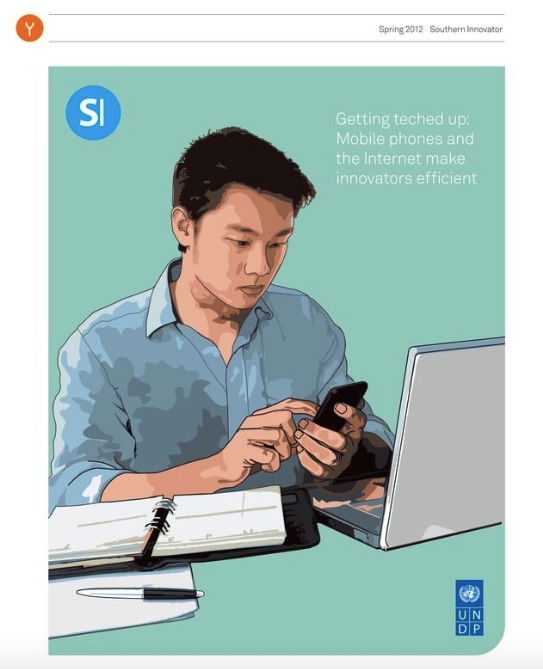
China has a vast and growing market for the Internet and mobile devices. Over the past decade that market has been largely confined to China –  most businesses have had enough domestic demand and opportunities inside the country to keep them busy.

But now companies in China’s dynamic Internet and mobile sector are seeking out new markets outside the country. Both online shopping service Alibaba (alibaba.com) and Weibo (weibo.com), the Chinese version of Twitter (twitter.com), are seeking to list on the New York Stock Exchange. The excitement this news has generated shows how many people want to get a piece of the large Chinese market for technology, social networks and online shopping. It is also sending a chill through America’s Silicon Valley – home to the country’s innovative high technology sector – that they are missing out on China’s fast-growing marketplace. Many American services are banned from operating in China. Even more worrying for Silicon Valley, these home-grown Chinese companies, with the market sewn up at home, are now set to compete globally for customers using their increasingly deep pockets.

One example is Tencent (http://www.tencent.com/en-us/index.shtml), owner of popular Chinese social messaging application (app) Weixin (weixin.qq.com), known as WeChat (wechat.com) outside China. Used on mobile phones and smartphones, Weixin has gained 300 million users in just three years, becoming the dominant social messaging service in the world’s largest smartphone market. Its has been so successful that many rivals are trying to chip away at its customer base.

Weixin, pronounced way-shin, allows smartphone users to send messages and share news, photos, videos and web links with friends. One of its selling points is its claim to not store messages on its servers.

Building on its success in social networking in China, it is looking to expand in other markets, including Southeast Asia, Europe and Latin America. It also wants to grow its offerings in online payment and e-commerce.

One factor in Weixin’s success is the ability to send messages by recording a voice message rather than just typing in characters: very useful for non-Latin script users, and especially for Chinese-language users, who use thousands of characters in everyday communication.

One ambitious forecast claims Weixin could reach 400 million users and make US $500 million revenue within a year.

Cosmetics marketer Jenny Zhao, who uses an iPhone 5, told The New York Times: “I’m probably on Weixin six hours a day. A lot of what I do revolves around it.”

“I use Weixin every day,” said Zhang Shoufeng, a food and drinks seller. “My friends are on it and my boss is on it. We are talking about where to eat, where to hang out and where to meet for company conferences. This is how we communicate.”

Analysts believe Weixin has benefitted from not having to compete with banned-in-China American company Facebook (facebook.com).

“Even if Facebook had permission, it’s probably too late,” said Wang Xiaofeng, an analyst at Forrester Research. “Weixin has all the functionality of Facebook and Twitter, and Chinese have already gotten used to it.”

Tencent is an example of a wider trend: As Chinese companies and offerings have become stronger, wealthier and more innovative, they increasingly look to build their customer base outside China.

Founded in November, 1998, Tencent, Inc. has grown into China’s largest and most used Internet service portal. Its most popular services include QQ (QQ Instant Messenger), WeChat, QQ.com, QQ Games, Qzone, 3g.QQ.com, SoSo, PaiPai and Tenpay, as well as Weixin.

The company claims to put innovation at the heart of its business, with more than half of its employees devoted to research and development. The Tencent Research Institute, established in 2007 with RMB 100 million (US $16 million), calls itself “China’s first Internet research institute, with campuses in Beijing, Shanghai, and Shenzhen.” It has patents for technologies it has developed for instant messaging, e-commerce, online payment services, search, information security, and gaming.

Tencent was driven to innovate by a fear it could quickly become irrelevant in the information technology space. Weixin is also pioneering ways to book taxis, hotels and airline flights through the service and even ways to control home appliances.

“Chinese Internet companies are no longer behind,” said William Bao Bean, a managing director at the venture capital firm SingTel Innov8 (http://innov8.singtel.com/). “Now in some areas, they’re leading the way.”

Published: April 2014

Resources

1) Weibo: Sina Weibo is a Chinese microblogging (weibo) website. Akin to a hybrid of Twitter and Facebook, it is one of the most popular sites in China, in use by well over 30 per cent of Internet users, with a market penetration similar to what Twitter has established in the USA. Website: weibo.com

2) Laiwang: A variation on the WeChat service, its biggest competitor. Website: laiwang.com

3) WhatsApp: WhatsApp Messenger is a cross-platform mobile messaging app which allows you to exchange messages without having to pay for SMS. Website: whatsapp.com

4) Southern Innovator Issue 1: Mobile Phones and Information Technology: Pioneering and innovative ways to deploy mobile phones and information technology to tackle poverty. Website: http://www.scribd.com/doc/57980406/Southern-Innovator-Magazine-Issue-1 and here: http://tinyurl.com/q6bfnpz
https://davidsouthconsulting.org/2022/10/20/china-consumer-market-asian-perspective-helps/

https://davidsouthconsulting.org/2020/12/10/china-sets-sights-on-dominating-global-smartphone-market/

https://davidsouthconsulting.org/2021/03/20/computer-gold-farming-turning-virtual-reality-into-real-profits/

https://davidsouthconsulting.org/2021/01/26/designed-in-china-to-rival-made-in-china/

https://davidsouthconsulting.org/2022/10/26/tackling-chinas-air-pollution-crisis-an-innovative-solution/

https://davidsouthconsulting.org/2020/04/17/virtual-supermarket-shopping-takes-off-in-china/

Citation

Qianyu, Ji (2014) “Exploring the Concept of QR Code and the Benefits of Using QR Code for Companies,” Lapland University of Applied Sciences, School of Business and Culture Degree Programme in Business Information Technology, 2014.

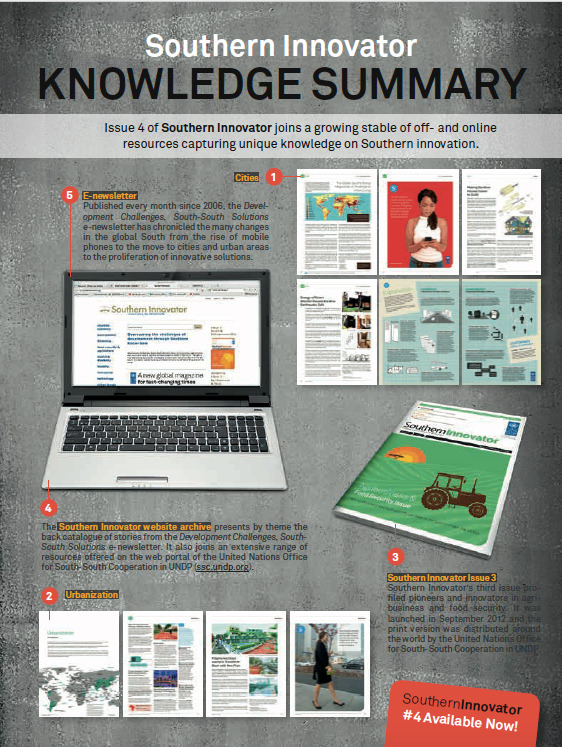
Development Challenges, South-South Solutions was launched as an e-newsletter in 2006 by UNDP’s South-South Cooperation Unit (now the United Nations Office for South-South Cooperation) based in New York, USA. It led on profiling the rise of the global South as an economic powerhouse and was one of the first regular publications to champion the global South’s innovators, entrepreneurs, and pioneers. It tracked the key trends that are now so profoundly reshaping how development is seen and done. This includes the rapid take-up of mobile phones and information technology in the global South (as profiled in the first issue of magazine Southern Innovator), the move to becoming a majority urban world, a growing global innovator culture, and the plethora of solutions being developed in the global South to tackle its problems and improve living conditions and boost human development. The success of the e-newsletter led to the launch of the magazine Southern Innovator.  

Creative Commons License

This work is licensed under a
Creative Commons Attribution-Noncommercial-No Derivative Works 3.0 License.

ORCID iD: https://orcid.org/0000-0001-5311-1052.

© David South Consulting 2025
Categories
Archive data Development Challenges, South-South Solutions Newsletters digital ID

India 2.0: Can the Country Make the Move to the Next Level?

By David SouthDevelopment Challenges, South-South Solutions

SOUTH-SOUTH CASE STUDY

With the global economic crisis threatening to cause turmoil in the emerging markets of the global South, it is becoming clear that what worked for the past two decades may not work for the next two.

For India, the legacy issues of poverty still need to be addressed, and the country’s impressive information technology (IT) industry – which has driven so much of India’s growth – will face stiff competition from other countries in the global South. Some argue that if the IT industry hopes to keep growing and contributing to India’s wealth, things will need to change.

Unlike China, where heavy investment in infrastructure and a strong link between government and the private sector has driven the impressive manufacturing boom in the country, in India the government has de-regulated and taken a back seat, leaving the private sector and entrepreneurs to drive the change and do the innovation.

Many believe various areas need urgent attention if India is to continue to enjoy good growth rates in the coming years. Areas in need of attention include infrastructure, healthcare and education (thesmartceo.in), in particular the knowledge to work in the information technology industry of the 21st century.

One of the founders of Indian outsourcing success Infosys (infosys.com), executive co-chairman Senapathy Gopalakrishnan, told Britain’s Telegraph newspaper, “So many people’s lives have been changed by IT in India.

“People from the middle class and lower middle class have become global employees and have the opportunity to work with some of the best companies in the world. But the challenge for India is that this industry can only create so many jobs. IT is not going to solve the unemployment problem in India.”

But the coming next wave of change in information technology is an opportunity to be seized to reduce unemployment if enough people are educated to handle it.

According to Gopalakrishnan: “I strongly believe, and it’s backed up by data, that there is a shortage of computer professionals everywhere in the world, including India. The application of computers is growing dramatically and will continue to grow dramatically over the next 20 to 30 years. We have to train and create the workforce necessary to grow this industry.”

Various media stories have called this next phase India 2.0. If India 1.0 was the highly successful information technology outsourcing industry developed in the late 1980s, through the 1990s and 2000s, then India 2.0 is the next wave of IT innovation being driven by Big Data, automation, robotics, smart technologies and the so-called “Internet of things.”

Big Data is defined as the large amounts of digital data continually generated by the global population. The speed and frequency with which data is produced and collected – by an increasing number of sources – is responsible for today’s data deluge (UN Global Pulse). It is estimated that available digital data will increase by 40 per cent every year. Just think of all those mobile phones people have, constantly gathering data.

Processing this data and finding innovative ways to use it will create many of the new IT jobs of the future.

“We are living in a world which is boundary-less when it comes to information, and where there is nowhere to hide,” continues Gopalakrishnan, “If you have a cellphone, somebody can find out exactly where you are. Through social networks you’re sharing everything about yourself. You are leaving trails every single moment of your life. Theoretically, in the future you’ll only have to walk through the door at Infosys and we’ll know who you are and everything about you.”

Unlike in the late 1980s, when India was the pioneer in IT outsourcing for large multinational companies and governments, competition is fierce across the global South. The mobile-phone revolution and the spread of the Internet have exponentially increased the number of well-educated people in the global South who could potentially work in IT. China, the Philippines, Kenya, Nigeria and Ghana are just some of the countries heavily involved in this area.

If India fails to meet the India 2.0 challenge, it risks seeing its successful companies and entrepreneurs leaving to work their magic elsewhere in Asia and the new frontiers of Africa, just as many of its best and brightest of the recent past became pioneers and innovators in California’s Silicon Valley.

India’s IT sector contributed 1.2 per cent to the country’s gross domestic product (GDP) in 1998; by 2012, this was 7.5 per cent (Telegraph). The IT industry employs 2.5 million people in India, and a further 6.5 million people indirectly. IT makes up 20 per cent of India’s exports and, according to the National Association of Software and Services Companies (nasscom.in), the industry has revenue of US $100 billion.

India is now the IT and outsourcing hub for more than 120 of the Fortune 500 companies in the United States.

Out of India’s 3.5 million graduates every year, 500,000 are in engineering – a large pool of educated potential IT workers. India produces the world’s third largest group of engineers and scientists, and the second largest group of doctors.

IT has become a route that catapults bright Indian youth into 21st-century businesses and science parks and to the corporations of the world.

One visible example of the prosperity brought by IT services in India is the booming technology sector based in the city of Bangalore (also called Bengaluru) (http://en.wikipedia.org/wiki/Bangalore).

Reflective of the contradictions of India, Bangalore has 10 per cent of its workforce now working in IT, but also 20 per cent of its population living in urban slums.

The nearby Electronics City (elcia.in) is considered “India’s own silicon valley and home to some of the best known global companies.”

To date, aspects of India 2.0 are already taking shape.

One company is called Crayon Data (crayondata.com). It uses Big Data and analytics to help companies better understand their customers and increase sales and deliver more personal choices.
Edubridge (http://acumen.org/investment/edubridge/) is helping to bridge the gap for rural youth with varied education backgrounds and long-term jobs. Edubridge trains youth for the real needs of employers to increase the chances they will get a job. This includes jobs in the IT business process outsourcing sector and banking and financial services.

Infosys is working on innovations for the so-called “Internet of things,” in which smart technologies connect everyday items to the grid and allow for intelligent management of resources and energy use. Infosys is developing sophisticated software using something called semantic analytics – which analyses web content (http://en.wikipedia.org/wiki/Semantic_analytics) – to sort through social media and the Internet to track customer responses to products.

Elsewhere, former Infosys Chief Executive Nanden Nilekani is involved in a Big Data innovation to address the problem of social and economic exclusion of India’s poor. Called Aadhaar (http://uidai.gov.in/), the government-run scheme is gathering biometric data on every Indian to build the world’s largest biometric database. After being enrolled and having fingerprints and iris scans taken, each individual is given a 12-digit identification number. So far 340 million people have been registered with the scheme, and it is hoped 600 million will be registered by the end of 2014.

The idea is to use a combination of access to mobile phones and these unique ID numbers to widen access to all sorts of products and services to poor Indians, including bank accounts for the millions who do not have one. Many people, lacking any identity or official acknowledgment they exist, were prevented from engaging with the formal economy and formal institutions. Being able to save money is a crucial first step for getting out of poverty and it is hoped information technology will play an important role in achieving this.

Published: March 2014

Resources

1) India 2.0 by Mick Brown. Website: http://s.telegraph.co.uk/graphics/india2.0/part-one#top

2) Electronic City Bangalore: Regional information portal for Electronic City, an industrial technology hub located in Bangalore South, India. This portal is becoming the most favourite haunt of ECitizens living and/or working in Electronic City. Website: http://www.electronic-city.in/

3) Electronics City Industries Association: Welcome to the Electronics City, India’s own silicon valley and home to some of the best known global companies. Located in Bangalore, the Electronics City was conceived way back in the mid-1970?s as an Industrial Estate exclusively for Electronics Industries. Today the industrial estate boasts is an oasis of large, medium and small industries spanning software services, hardware; high end telecommunications; manufacture of indigenous components; electronic musical instruments, just  to name a few. Website: elcia.in

4) Godrej E-City: Situated in Electronic city and connected through NICE road and the elevated expressway, Godrej E-City brings your workplace and other major conveniences within your immediate reach. Your travel times become shorter and hassle-free. You have more time for your family and yourself. It’s time to move closer to happiness. Website: https://www.godrejproperties.com/godrejecity/overview

5) Infosys: Infosys is a global leader in consulting, technology and outsourcing solutions. As a proven partner focused on building tomorrow’s enterprise, Infosys enables clients in more than 30 countries to outperform the competition and stay ahead of the innovation curve. Website: http://www.infosys.com/pages/index.aspx

6) Tech Hub Bangalore: partnering with the UK India Business Council to establish TechHub in Bangalore.TechHub is a community and workspace for technology entrepreneurs with 1000’s of members, building the most exciting startups in Europe. We have physical community spaces in London, Manchester, Bucharest, Swansea and Riga and have members from over 50 countries.The Bangalore site will be part of a wider scheme in partnership with other British firms such as Rolls Royce, ADS, Bangalore Cambridge Innovation Network, BAe and PA Consulting with the aim of forging stronger links between the UK and India. Website: http://www.techhub.com/blog/techhub-expands-to-bangalore/

https://davidsouthconsulting.org/2022/09/29/cheap-indian-tablet-seeks-to-bridge-digital-divide/

https://davidsouthconsulting.org/2022/02/17/digital-mapping-to-put-slums-on-the-map/

https://davidsouthconsulting.org/2022/10/09/entrepreneurs-use-mobiles-and-it-to-tackle-indian-traffic-gridlock/

https://davidsouthconsulting.org/2022/10/20/the-e-reader-battle-reaches-india/

https://davidsouthconsulting.org/2022/10/25/indian-city-slum-areas-become-newly-desirable-places-to-live/

https://davidsouthconsulting.org/2021/03/04/indian-id-project-is-foundation-for-future-economic-progress/

https://davidsouthconsulting.org/2022/11/01/indian-newspapers-thrive-with-economy/

https://davidsouthconsulting.org/2022/10/18/indians-fighting-inflation-with-technology/

https://davidsouthconsulting.org/2022/10/06/indian-solar-power-pack-powers-villages/

https://davidsouthconsulting.org/2021/03/31/new-weapon-against-crime-in-the-south/

Development Challenges, South-South Solutions was launched as an e-newsletter in 2006 by UNDP’s South-South Cooperation Unit (now the United Nations Office for South-South Cooperation) based in New York, USA. It led on profiling the rise of the global South as an economic powerhouse and was one of the first regular publications to champion the global South’s innovators, entrepreneurs, and pioneers. It tracked the key trends that are now so profoundly reshaping how development is seen and done. This includes the rapid take-up of mobile phones and information technology in the global South (as profiled in the first issue of magazine Southern Innovator), the move to becoming a majority urban world, a growing global innovator culture, and the plethora of solutions being developed in the global South to tackle its problems and improve living conditions and boost human development. The success of the e-newsletter led to the launch of the magazine Southern Innovator.  

https://davidsouthconsulting.org/2021/03/05/southern-innovator-issue-1/

Creative Commons License

This work is licensed under a
Creative Commons Attribution-Noncommercial-No Derivative Works 3.0 License.

ORCID iD: https://orcid.org/0000-0001-5311-1052.

© David South Consulting 2022

Categories
Archive Development Challenges, South-South Solutions Newsletters Southern Innovator magazine

Technological Innovation Alive in Brazil

By David SouthDevelopment Challenges, South-South Solutions

SOUTH-SOUTH CASE STUDY

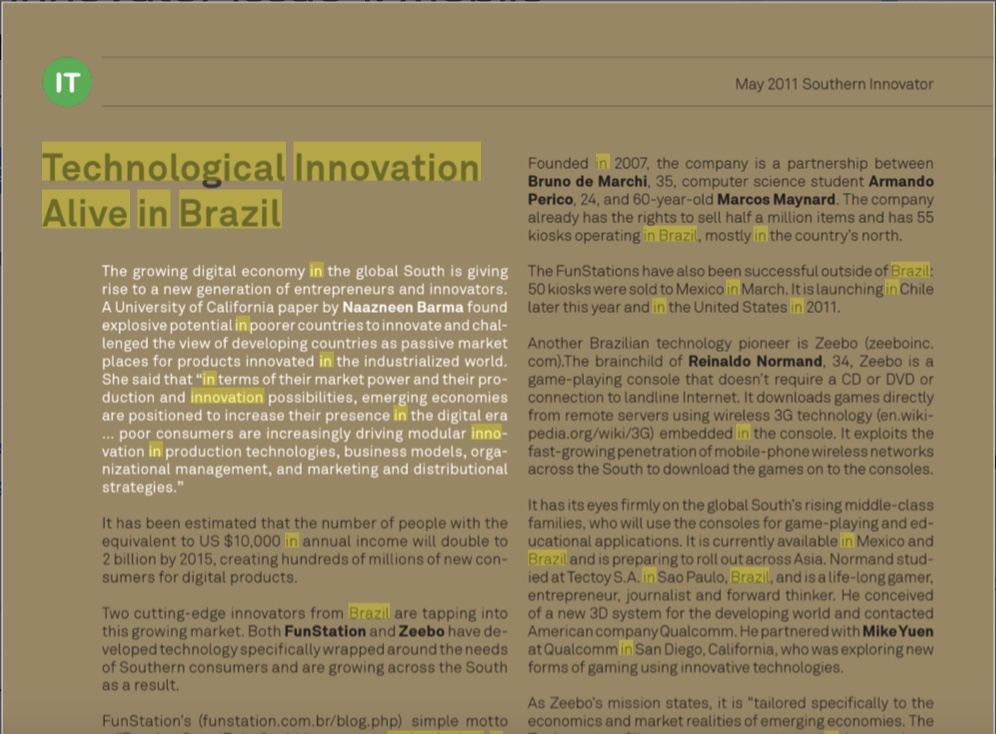
The growing digital economy in the global South is giving rise to a new generation of entrepreneurs and innovators.

A University of California paper by Naazneen Barma found explosive potential in poorer countries to innovate, and challenged the view of developing countries as passive market places for products innovated in the industrialized world. She said that “in terms of their market power and their production and innovation possibilities, emerging economies are positioned to increase their presence in the digital era … poor consumers are increasingly driving modular innovation in production technologies, business models, organizational management, and marketing and distributional strategies.”

It has been estimated that the number of people with equivalent to US $10,000 in annual income will double to 2 billion by 2015, creating hundreds of millions of new consumers for digital products.

Two cutting-edge innovators from Brazil are tapping into this growing market. Both FunStation and Zeebo have developed technology specifically wrapped around the needs of Southern consumers and are growing across the South as a result.

FunStation’s (http://www.funstation.com.br/blog.php)simple motto – “Touch – Get – Enjoy” – hides a savvy technological innovation aimed at the growing army of digital downloaders on the march across the South. Sao Paulo’s FunStation entertainment kiosk system serves up video, audiobooks, songs, and ringtones to mobile phones and MP3 (http://en.wikipedia.org/wiki/MP3) players. Customers just need to plug into one of the large futuristic white kiosks, scroll through the choices, select what they want, pay and download. By going to the kiosk, customers avoid the need to download from the internet, which can take a lot of time depending on the connection and bandwidth. The kiosk is speedy, with 14 musical tracks downloaded to a device in 10 seconds.

Apart from the convenience and speed of the kiosks, they also have other benefits: customers do not need to register with a download site like iTunes on the internet. This means they do not have to run the risks of giving away bank details or other personal information.

Customers buy something called a Funcard which is similar to a pre-pay phone plastic phone card, with a PIN number. Cards are sold with values ranging from US $2 to US $50. The user just punches the number into the kiosk to pay for the download.

The kiosks are being located in high-traffic places like festivals, airports, universities, retail shopping centres and transport systems.

Founded in 2007, the company is a partnership between Bruno de Marchi, 35, computer science student Armando Perico, 24, and 60-year-old Marcos Maynard. The company already has the rights to sell half a million items and has 55 kiosks operating in Brazil, mostly in the country’s north. “People are poorer in those places,”de Marchi told Monocle magazine. “Usually they have an MP3 player but no computer.”

The FunStations have also been successful outside of Brazil: 50 kiosks were sold to Mexico in March. It is launching in Chile later this year and in the United States in 2011. Always evolving, the business is also working with the University of Lugano in Switzerland to develop new software and keep the kiosks fresh and lively.

Another Brazilian technology pioneer is Zeebo (http://www.zeeboinc.com). The brainchild of Reinaldo Normand, 34, Zeebo is a game-playing console that doesn’t require a CD or DVD, or connection to landline internet. It downloads games directly from remote servers using wireless 3G technology (http://en.wikipedia.org/wiki/3G)embedded in the console. It exploits the fast-growing penetration of mobile phone wireless networks across the South to download the games on the consoles.

It has its eyes firmly on the global South’s rising middle-class families, who will use the consoles for game-playing and educational applications. It is currently available in Mexico and Brazil and is preparing to roll out across Asia. Normand studied at Tectoy S.A. in Sao Paulo, Brazil, and is a life-long gamer, entrepreneur, journalist and forward thinker. He conceived of a new 3D system for the developing world and contacted American company Qualcomm. He partnered with Mike Yuen at Qualcomm in San Diego, California, who was exploring new forms of gaming using innovative technologies.

As Zeebo’s mission states, it is “tailored specifically to the economics and market realities of emerging economies. The Zeebo system fills an enormous unmet need in these regions. At the same time it opens an immense new market for interactive content and products.”

Normand is ambitious and wants to reach a vast market of 340 million Chinese families. “By 2011, I want to close deals in China to manufacture televisions with this technology built in, therefore entering the homes of millions of families,” he told Monocle.

Zeebo makes some games for the console and also buys in other games from big-name game makers like Electronic Arts and Activision. The games are downloaded from the internet using a 3G mobile chip already built in to the consoles. The games are priced between US $5 and US $13.

The Zeebo system will roll out to China, the US and India in 2011, and Eastern Europe in 2012.

Published: August 2010

Resources

  • Afrinnovator: Is about telling the stories of African start-ups, African innovation, African made technology, African tech entrepreneurship and entrepreneurs. Their mission is to ‘Put Africa on the Map’ by covering these kinds of stories from all over Africa. As their website says, “if we don’t tell our own story, who will tell it for us?” Website: http://afrinnovator.com
  • AfricaUnsigned: This African alternative way of producing African music started this year. Unsigned artists record their music, funded by fans. Music fans from all over the world listen to the selection of artists, pick their favorite(s) and chip in a minimum of $1 dollar to the recording of a professional EP. The music is then distributed to the fans who backed the artist and sold on all major online stores (incl. Amazon & iTunes). Website: www.AfricaUnsigned.com
  • TechMasai: Pan-African start-up news and reviews. Website: www.techmasai.com
  • The Emerging Economies in the Digital Era: Market Places, Market Players, and Market Makers by Naazneen Barma, University of California. Website: http://tinyurl.com/3xjf2ps

https://davidsouthconsulting.org/2022/02/17/african-digital-laser-breakthrough-promises-future-innovation/

https://davidsouthconsulting.org/2022/10/05/african-innovation-eco-system-taking-shape/

https://davidsouthconsulting.org/2021/05/18/african-innovation-helps-make-banking-transactions-safer/

https://davidsouthconsulting.org/2022/11/16/brazils-agricultural-success-teaches-south-how-to-grow/

https://davidsouthconsulting.org/2022/11/10/brazilian-restaurant-serves-amazonian-treats/

https://davidsouthconsulting.org/2022/10/10/bringing-the-invention-and-innovation-mindset-to-young-kenyans/

https://davidsouthconsulting.org/2022/11/17/cashing-in-on-music-in-brazil/

https://davidsouthconsulting.org/2020/04/25/china-looking-to-lead-on-robot-innovation/

https://davidsouthconsulting.org/2022/10/24/flurry-of-anti-poverty-innovations/

https://davidsouthconsulting.org/2021/03/24/frugal-innovation-trend-meets-global-souths-innovation-culture/

https://davidsouthconsulting.org/2017/10/18/innovation-agenda-and-timeline-2007-2015/

https://davidsouthconsulting.org/2020/04/27/innovation-from-the-global-south/

https://davidsouthconsulting.org/2020/12/14/innovation-in-growing-cities-to-prevent-social-exclusion/

https://davidsouthconsulting.org/2022/11/11/innovation-cairos-green-technology-pioneers/

https://davidsouthconsulting.org/2021/03/04/innovation-villages-tackling-mdgs/

https://davidsouthconsulting.org/2021/10/22/innovations-in-green-economy-top-three-agenda/

https://davidsouthconsulting.org/2022/10/27/kenyan-mobile-phone-innovations/

https://davidsouthconsulting.org/2021/03/02/new-3d-technology-makes-innovation-breakthrough-and-puts-mind-over-matter/

https://davidsouthconsulting.org/2022/10/09/next-generation-of-innovation-for-the-grassroots/

https://davidsouthconsulting.org/2016/04/14/southern-innovator-and-the-growing-global-innovation-culture-14-april-2016/

https://davidsouthconsulting.org/2021/03/05/southern-innovator-issue-1/

Creative Commons License

This work is licensed under a
Creative Commons Attribution-Noncommercial-No Derivative Works 3.0 License.

ORCID iD: https://orcid.org/0000-0001-5311-1052.

© David South Consulting 2023

Categories
Archive Development Challenges, South-South Solutions Newsletters Southern Innovator magazine

Global South Eco-cities Show How the Future Can Be

By David SouthDevelopment Challenges, South-South Solutions

SOUTH-SOUTH CASE STUDY

The world is currently undergoing a high-stress transition on a scale not seen since the great industrial revolution that swept Europe in the 19th and 20th centuries. Today’s urban and industrial transition involves many more people and is taking place on a greater proportion of the planet. With rapid urbanization comes a demand for middle class lifestyles, with their high-energy usage and high consumption of raw materials.

This is stretching the planet’s resources to breaking point. And as many have pointed out, if the world’s population is to continue past today’s 7 billion to reach 9 billion and beyond, new ways of living are urgently required. Radical thinking will be necessary to match the contradictory goals of raising global living standards for the world’s poor with pressured resources and environmental conditions.

But there are innovative projects already under development to build a new generation of 21st-century cities that use less energy while offering their inhabitants a modern, high quality of life. Two examples are in China and the Middle East.

Both projects are seen as a way to earn income and establish viable business models to build the eco-cities of the future. Each project is seeking to develop the expertise and intellectual capacity to build functioning eco-cities elsewhere. In the case of the Masdar City project in the United Arab Emirates, international businesses are being encouraged to set up in Masdar City and to develop technologies that can be sold to other countries and cities – in short, to create a green technology hub akin to California’s hi-technology hub ‘Silicon Valley’. Masdar City is also being built in stages as investors are found to help with funding. Both projects hope to prove there is money to be made in being green and sustainable.

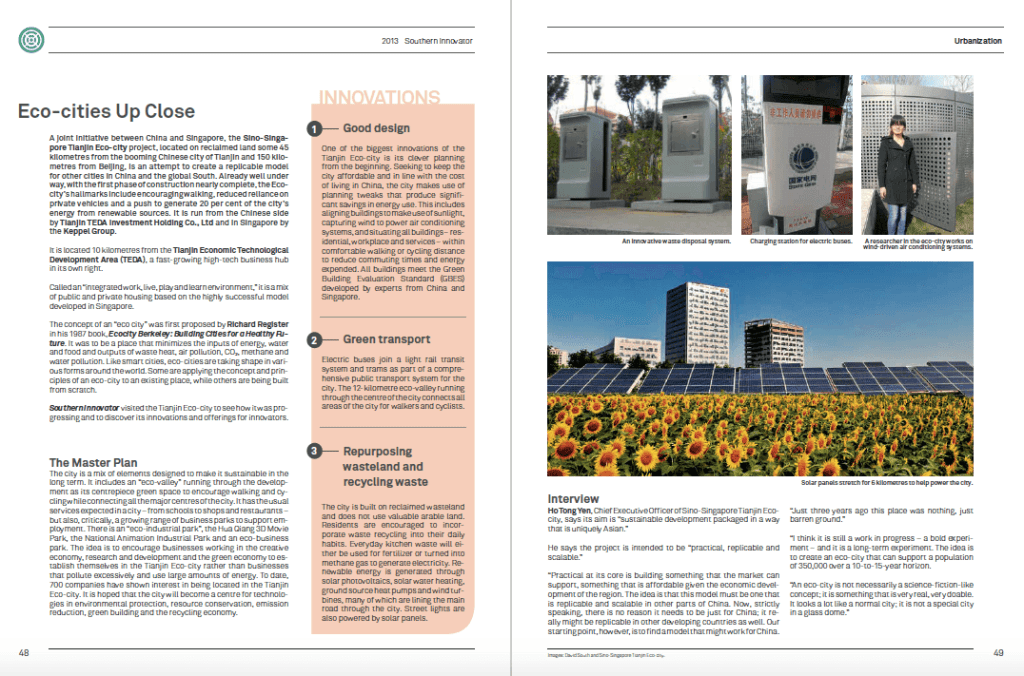
The Tianjin Eco-city (tianjinecocity.gov.sg) project is a joint venture between China and Singapore to build a 30 square kilometre city to house 350,000 residents.

Tianjin (http://en.wikipedia.org/wiki/Tianjin) is a large industrial city southeast of China’s capital, Beijing. It is a place that wears the effects of its industrial expansion on the outside. Air pollution is significant and the city has a grimy layer of soot on most outdoor infrastructure.

China has received a fair bit of criticism for its polluted cities as the country has rapidly modernized in the past two decades. This sprint to be one of the world’s top economic powers has come at a cost to the environment. In this respect, China is not unusual or alone. Industrialization can be brutal and polluting, as Europe found out during its earlier industrial revolution.

But China is recognizing this can’t go on forever and is already piloting many initiatives to forge a more sustainable future and bring development and high living standards back in line with what the environment can handle.

Sino-Singapore Tianjin Eco-city is the second large-scale collaboration between the Chinese government and Singapore. The first was the Suzhou Industrial Park (http://www.sipac.gov.cn/english/).The Tianjin project came up in 2007 as both countries contemplated the challenges of rapid urbanization and sustainable development.

The project’s vision, according to its website, is to be “a thriving city which is socially harmonious, environmentally-friendly and resource-efficient – a model for sustainable development.”

The philosophy behind the project is to find a way of living that is in harmony, with the environment, society and the economy. It is also about creating something that could be replicated elsewhere and be scaled up to a larger size.

The city is being built 40 kilometres from Tianjin centre and 150 kilometres from Beijing. It is located in the Tianjin Binhai New Area, considered one of the fastest growing places in China.

Construction is well underway and can be followed on the project’s website (http://www.tianjinecocity.gov.sg/gal.htm). It will be completed in 2020.

This year, the commercial street was completed and is ready for residents to move in.

Residents will be encouraged to avoid motorized transport and to either use public transport or people-powered transport such as bicycles and walking.

An eco-valley runs down the centre of the city and is meant to be a place for pedestrians and cyclists to enjoy.

The basic building block of the Eco-city – its version of a city block – is called the Eco Cell. Each Eco Cell measures 400 metres by 400 metres, a comfortable walking distance. Four Eco Cells make a neighbourhood. Several Eco Neighbourhoods make an Eco District and there are four Eco Districts in the Eco-city. It is a structure with two ideas in mind: to keep development always on a walkable, human scale and also to provide a formula for scaling up the size of the Eco-city as the number of residents increases.

It is a logical approach and seeks to address one of the most common problems with conventional cities: sprawling and unmanageable growth that quickly loses sight of human need.

Agreement was also reached on the standards that should be achieved for a wide variety of criteria, from air and water quality to vegetation, green building standards, and how much public space there should be per person.

An ambitious project in the United Arab Emirates is trying to become both the world’s top centre for eco cities and a living research centre for renewable energy. Masdar City (http://www.masdarcity.ae/en/)is planned to be a city for 40,000 people. It is billed as a high-density, pedestrian-friendly development where current and future renewable energy and clean technologies will be “marketed, researched, developed, tested and implemented.”

The city hopes to become home to hundreds of businesses, a research university and technology clusters.

This version of an eco-city is being built in three layers in the desert, 17 kilometres from the Emirati capital Abu Dhabi. The goal is to make a city with zero carbon emissions, powered entirely by renewable energy. It is an ambitious goal but there are examples in the world of cities that use significant renewable energy for their power, such as Reykjavik, Iceland in Northern Europe, which draws much of its energy from renewables and geothermal sources.

Masdar City is designed by world-famous British architect Norman Foster (fosterandpartners.com) and will be 6.5 square kilometres in size.

The design is highly innovative. The city will be erected on 6 metre high stilts to increase air circulation and reduce the heat coming from the desert floor. The city will be built on three levels or decks, to make a complete separation between transport and residential and public spaces.

The lowest deck will have a transportation system based on Personal Rapid Transport Pods. These look like insect eyes and are automated, controlled by touch screens, using magnetic sensors for propulsion. On top of this transport network will be the pedestrian streets, with businesses, shops and homes. No vehicles will be allowed there, and people will only be able to use bicycles or Segway (segway.com) people movers to get around. An overhead light railway system will run through the city centre, all the way to Abu Dhabi City.

“By layering the city, we can make the transport system super-efficient and the street level a much better experience,” Gerard Evenden, senior partner at Foster + Partners, told The Sunday Times. “There will be no car pollution, it will be safer and have more open spaces. Nobody has attempted anything like this.”

Masdar City is being built in stages as funding comes, with the goal of completion by 2016. It hopes to achieve its aspiration to be the most technologically advanced and environmentally friendly city in the world. As for water supplies in the desert, there is a plan: dew collected in the night and morning and a solar-powered desalination plant turning salt water into drinking water.

Electricity will come from a variety of sources. Solar panels will be on every roof and double as shade on alleyways. Non-organic waste will be recycled, while organic waste will be turned into fuel for power plants. Dirty water will be cleaned and then used to irrigate green spaces. Because of the design, the planners hope the city will just use a quarter of the energy of a conventional city.

To keep the city smart and the project on top of developments in renewable energy, the Masdar Institute of Science and Technology (http://www.masdar.ac.ae/) will specialize in renewable energy technology.

The cost for the city was pegged at US $22 billion in 2009.

The chief executive of Masdar – Abu Dhabi’s renewable-energy company – is Sultan Al Jaber. He sees the city as a beacon to show the way for the rest of the Emirate to convert from a highly inefficient consumer of energy to a pioneer in green technology.

“The problem with the renewable-energy industry is that it is too fragmented,” he told The Sunday Times. “This is where the idea for Masdar City came from. We said, ‘Let’s bring it all together within the same boundaries, like the Silicon Valley model (in California, USA).’”

The project needs to gather much of its funding as it progresses. The United Nations’ Clean Development Mechanism (http://cdm.unfccc.int/) is helping with financing. Companies can earn carbon credits if they help fund a low-carbon scheme in the global South. The sultan is ambitious and sees this as a “blueprint for the cities of the future.” It has been able to bring on board General Electric (GE) and the Massachusetts Institute of Technology (MIT) to sponsor the university.

It is possible to visit Masdar City and take a tour (http://www.masdarcity.ae/en/105/visit-masdar-city/) and it is also possible to view online what has been built so far (http://www.masdarcity.ae/en/32/built-environment/).

Published: June 2012

Resources

1) Center for Innovation, Testing and Evaluation (CITE): Located in Texas, USA, CITE is a fully functioning city with no residents to test new technologies before they are rolled out in real cities. Website: http://www.pegasusglobalholdings.com/test-center.html

2) Digital Cities of the Future: In Digital Cities, people will arrive just in time for their public transportation as exact information is provided to their device. The Citizen-Centric Cities (CCC) is a new paradigm, allowing governments and municipalities to introduce new policies. Website: http://eit.ictlabs.eu/action-lines/digital-cities-of-the-future/

3) Eco-city Administrative Committee: Website: http://www.eco-city.gov.cn/

4) Sino-Singapore Tianjin Eco-city, Investment and Development Co., Ltd. Website: tianjineco-city.com

5) ‘The Future Build’ initiative, a new green building materials portal from Masdar City. Website: thefuturebuild.com

6) UNHABITAT: The United Nations Human Settlements Programme is the UN agency mandated to promote socially and environmentally sustainable towns and cities with the goal of providing adequate shelter for all. Website: http://www.unhabitat.org

Creative Commons License

This work is licensed under a
Creative Commons Attribution-Noncommercial-No Derivative Works 3.0 License.

ORCID iD: https://orcid.org/0000-0001-5311-1052.

© David South Consulting 2022