Categories
Archive Development Challenges, South-South Solutions Newsletters

Global South’s Rising Economies Gain Investor Spotlight

By David SouthDevelopment Challenges, South-South Solutions

SOUTH-SOUTH CASE STUDY

A new book is arguing that the world’s attention should switch away from BRICS countries – Brazil, Russia, India, China and South Africa – and take another look at nations and regions elsewhere across the global South. It argues many are lodestones of future growth and prosperity in the making and will see dramatic changes over the next decade.

The story of the BRIC and BRICS countries is an impressive one. In just eight years from 2000 to 2008, the BRIC countries’ combined share of total world economic output rose from 16 to 22 per cent. This led to a 30 per cent increase in global output during the period, showing how key these countries were to global prosperity in the 2000s. BRIC countries make up nearly half the world’s population and are regional leaders. Taken together, their gross domestic products (GDPs) are not far behind the United States.

Ruchir Sharma’s Breakout Nations: In Pursuit of the Next Economic Miracles (http://www.amazon.com/Breakout-Nations-Pursuit-Economic-Miracles/dp/0393080269) argues that the BRICS are now entering a more stable growth path and thus will not see the rapid-fire expansion and quick profits investors have become used to in the past decade.

“The BRICs,” Sharma told Forbes magazine, “were last decade’s team.”

The BRIC acronym (http://en.wikipedia.org/wiki/BRIC) was coined in 2001 by Goldman Sachs managing director Jim O’Neill, in a 2001 paper titled “Building Better Global Economic BRICs” (http://www.goldmansachs.com/ourthinking/brics/building-better.html). O’Neill predicted that this handful of countries would dominate the growth and economic development story for the years 2000 to 2010. This was because they all shared a similar stage of advanced economic development.

The BRIC states first began meeting together in 2006. South Africa was added in 2010 to form the BRICS acronym.

The buzz surrounding the BRICS countries over the past decade has been justified by their impressive growth rates, declining poverty levels,modernizing economies and societies and growing middle class populations.

China alone had seen its gross domestic product grow by US $5 trillion between 2001 and 2011.

Now, Sharma argues, it is someone else’s turn.

Sharma is head of emerging markets with Morgan Stanley Investment Management in New York, and Breakout Nations looks at where the next economic surprise stories will take place.

“A breakout nation is a nation that will grow above expectations, and will grow more than nations with similar per capita income,” Sharma told Forbes. “You can’t bunch all of the emerging markets together anymore. The last decade saw these countries behaving the same economically, but I think that is behind us now. Investors today will really have to pick their spots.”

He points out that Indonesia was the best performing emerging market in 2011 and has an economy that will surpass a trillion dollars in the coming years.

He also believes Sri Lanka and Nigeria are economies to watch.

Sharma says funds flowing into emerging market stocks grew by 478 per cent from 2005 to 2010, a massive jump compared to 2000 to 2005, when they grew by 92 per cent.

As he sees it, China has now reached middle-income status and its growth rates will not be as high as they have been for the past two decades. In his research, he found that countries like Japan, South Korea and Taiwan all slowed down once their per capita income went past US $5,000.

Investors who watch the emerging markets predict the hot growth areas for the next decade will be around energy, technology, and agricultural resources.

Sharma picks out Indonesia, Turkey, the Philippines, Poland and the Czech Republic for future investment interest, but urges caution with thinking all emerging economies are on course to boom.

“You’ve got to pick your spots, rather than just assume that because you put a tag of emerging on a particular nation, it’s going to boom,” Sharma told The Globe and Mail newspaper.

To make sense of the complexity of fast-emerging economies, a flurry of new investor acronyms has popped up. One of the country clusters is called the CIVETS: Colombia, Indonesia, Vietnam, Egypt, Turkey, South Africa (http://en.wikipedia.org/wiki/CIVETS).

The MINTS (Mexico, Indonesia, Nigeria and Turkey) are also set for great growth in the next decade, many investors believe.

Then there is the N-11 or Next 11. This is the MINTS plus Bangladesh, Egypt,Iran, Pakistan, the Philippines, South Korea and Vietnam.

And after that there is VISTA (Vietnam, Indonesia, South Africa, Turkey and Argentina). While clearly the creative juices are flowing at investment houses as they come up with ever-catchier acronyms, a more serious point is being made: many countries in the global South, for the first time in history, are no longer solely dependent on the Western economic system for demand.

These countries, investors note, now have an unprecedented range of options uncoupled from the political, financial and economic legacy of Western developed nations. They say that many nations in the global South are set for a runaway investment boom because they are making changes and modernizing their economies faster than many expect.

As the BRICS economies mature and slow down and take on different priorities based around improving the quality of life of their citizens, those seeking faster profits will look elsewhere. This trend is even happening within the BRICS, as Chinese and Brazilian companies offshore work to Vietnam and Colombia.

There are many new centres of economic activity and rising prosperity across the emerging markets that often fail to gain wider attention. Few would probably know that the Northeast Asian nation of Mongolia – mired in the 1990s in the worst peacetime economic collapse in half a century (http://www.scribd.com/doc/20864541/Mongolia-Update-1998-Book) – is now the world’s fastest-growing economy (http://www.worldbank.org/en/news/2012/02/28/what-behind-mongoliaeconomic-boom) and one of the top places for mobile phone usage and penetration (http://www.businessmongolia.com/mongolia/2012/03/19/mongolia-ringing-the-changes/).

Then there is Myanmar (formerly Burma), where many are hoping recent moves toward democracy and improvements in diplomatic relations will lead to an economic boon for the region. Investors are also targeting Kazakhstan in Central Asia.

Reflecting these changing realities, Standard Bank, Africa’s largest bank, has been documenting the rising role played by the Chinese currency in international trade. A recent report forecast US $100 billion (R768 billion) in Sino-African trade would be settled in the Chinese currency, the renminbi, by 2015. This would be double the trade between China and Africa in 2010. It also found 70,000 Chinese companies are using the renminbi in international trade transactions.

Published: April 2012

Resources 

1) Beyondbrics blog: A blog by the Financial Times calling itself “The Ft’s emerging markets hub”. Website: http://blogs.ft.com/beyond-brics/

2) BRICS Summit: The Fourth BRICS Summit was hosted in New Delhi on 29 March 2012 under the overarching theme of “BRICS Partnership for Global Stability, Security and Prosperity.” The Summit has imparted further momentum to the BRICS process. Website: bricsindia.in

3) Market Oracle: A good source for updates on investor sentiment about the emerging market economies. Website: marketoracle.co.uk

4) Monocle magazine: “A briefing on global affairs, business, culture and design” often featuring trends in the emerging market countries. Website: monocle.com

5) BRICS Information Centre, University of Toronto. Website: brics.utoronto.ca

https://davidsouthconsulting.org/2022/04/15/african-youth-want-to-do-business-in-fast-growing-economy/

https://davidsouthconsulting.org/2022/03/20/global-south-eco-cities-show-how-the-future-can-be/

https://davidsouthconsulting.org/2021/07/19/global-south-trade-boosted-with-increasing-china-africa-trade-in-2013/

https://davidsouthconsulting.org/2022/10/20/global-souths-middle-class-is-increasing-prosperity/

https://davidsouthconsulting.org/2022/10/20/global-souths-rising-economies-gain-investor-spotlight-2/

https://davidsouthconsulting.org/2021/11/12/global-souths-rising-megacities-challenge-idea-of-urban-living/

https://davidsouthconsulting.org/2022/11/15/indonesian-middle-class-recycle-wealth-back-into-domestic-economy/

https://davidsouthconsulting.org/2022/10/20/trade-to-benefit-the-poor-up-in-2006-and-to-grow-in-2007/

https://davidsouthconsulting.org/2022/11/20/venezuelas-currencies-promote-cooperation-not-competition/

https://davidsouthconsulting.org/2022/10/10/wireless-internet-culture-helping-zimbabwe-economy-recover/

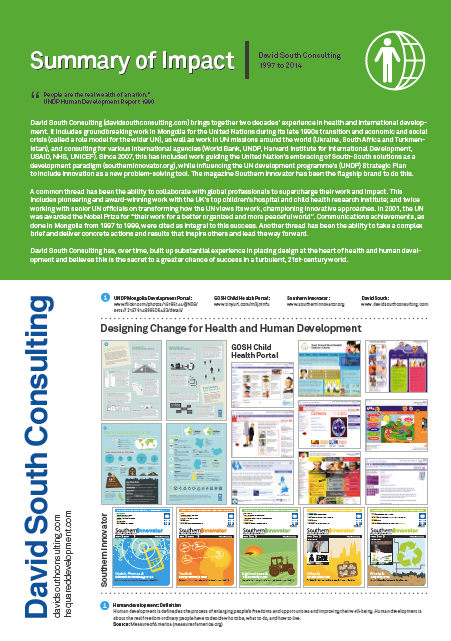
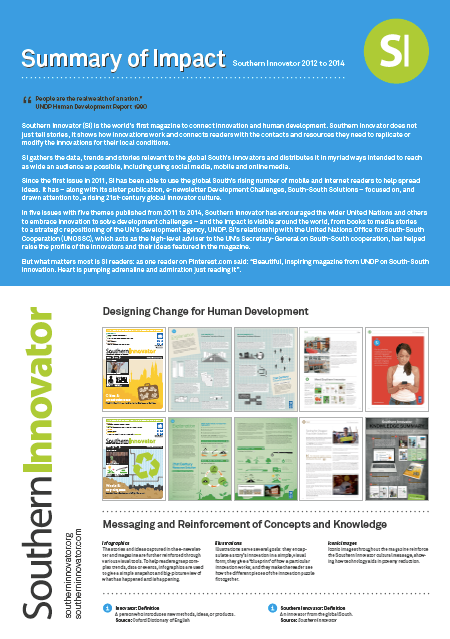
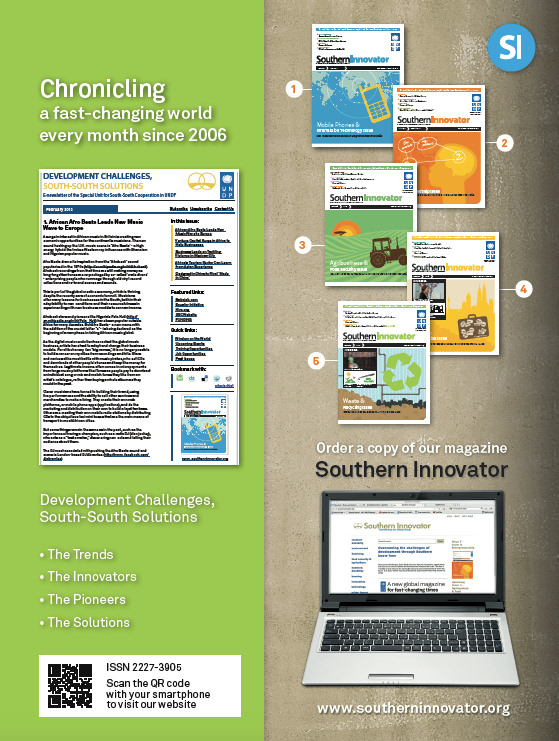
Development Challenges, South-South Solutions was launched as an e-newsletter in 2006 by UNDP’s South-South Cooperation Unit (now the United Nations Office for South-South Cooperation) based in New York, USA. It led on profiling the rise of the global South as an economic powerhouse and was one of the first regular publications to champion the global South’s innovators, entrepreneurs, and pioneers. It tracked the key trends that are now so profoundly reshaping how development is seen and done. This includes the rapid take-up of mobile phones and information technology in the global South (as profiled in the first issue of magazine Southern Innovator), the move to becoming a majority urban world, a growing global innovator culture, and the plethora of solutions being developed in the global South to tackle its problems and improve living conditions and boost human development. The success of the e-newsletter led to the launch of the magazine Southern Innovator. 

https://davidsouthconsulting.org/2021/03/05/southern-innovator-issue-2/

Creative Commons License

This work is licensed under a
Creative Commons Attribution-Noncommercial-No Derivative Works 3.0 License.

ORCID iD: https://orcid.org/0000-0001-5311-1052.

© David South Consulting 2022

Categories
Archive Development Challenges, South-South Solutions Newsletters Southern Innovator magazine

Next Generation of Innovation for the Grassroots

By David SouthDevelopment Challenges, South-South Solutions

SOUTH-SOUTH CASE STUDY

Taking inspiration from science fiction sagas like the TV show Star Trek, the next generation of innovation is already taking shape in the South. A group of innovative facilities called Fab Labs (short for Fabrication Laboratory) in Ghana, India, Kenya, South Africa and Costa Rica are applying cutting-edge technology to address the everyday needs of people.

Like the futuristic “replicator” in Star Trek, Fab Labs allow people to design and produce what they need there and then. The labs are mushrooming throughout the South as people get the innovation bug.

Originally an idea from the Massachusetts Institute of Technology’s Center for Bits and Atoms, which sponsors nine of the labs, Fab Labs let people use digital technology to build physical objects, from eyeglass frames to toys and computer parts. Fab Labs empower local invention by turning education, problem-solving and job creation into a creative process.

Started by Professor Neil Gershenfeld, Fab Labs use US $20,000 worth of computers, open source design software, laser cutters, milling machines and soldering irons, letting people harness their creativity to build things they need, including tools, replacement parts and essential products unavailable in the local market.

With minimal training, children and adults are designing and making their own toys, jewellery and even computer circuit boards with the machines. It turns people from consumers into inventors.

“Instead of bringing information technology to the masses, the Fab Labs bring information technology development to the masses,” said Gershenfeld.

In Ghana, the Takoradi Technical Institute in the southwest of the country hosts a Fab Lab, allowing a wide variety of people to use the “replicator” – from local street children to tribal chiefs – to make a wide range of products. The Ghana lab has several projects on the go, including antennae and radios for wireless internet networks and solar-powered machinery for cooking, cooling and cutting. The labs have found that the younger the users, the faster the skills are picked up.

John Silvester Boafo, principal at the Takoradi Technical Institute, is proud of what he calls a fu-fu pounder. “In a Ghanaian home, the main dish is fu-fu,” he told the BBC. “Fu-fu is made of plaintain and cassava, which are cooked. After they are cooked, they are put into a mortar and pounded by hand. People go through hard labour just to get a meal to eat. So, we thought we could fabricate this machine to alleviate the hard labour they use in pounding.”

They are also working on portable hand-held chargeable solar panels for televisions and refrigerators.

In Pabal, in the western part of Maharashtra, India, a Fab Lab was established at the Vigyan Ashram in 2002 and is now working on developing agricultural instruments. They are also testing milk for quality and safety, and tuning diesel engines to run more efficiently, especially with bio fuels. Another lab in Bithoor in the state of Uttar Pradesh (operated with the Indian Institute of Technology, Kanpur) is working on 3-D scanning and printing for rural artisans, such as producing wooden blocks used in Chikan embroidery.

In South Africa, officials are in the process of setting up four labs. The first is in the capital Pretoria, home to Africa’s first “science park”. The second is in the township of Shoshanguve, a very poor community with high unemployment.

“We have these very high-tech small start-up companies that are excited by the proximity of the lab,” said Sushil Borde, head of the government agency charged with rolling out the four labs. “The companies say, ‘We have these brilliant ideas, we have these business models, but we don’t know how to get these ideas into tangible products.”

Borde hopes the network of Fab Labs will enable South African entrepreneurs and engineers to test their ideas and “fast track the process of growth and development.”

Seventeen-year-old Kenneth Chauke has been able to build a robot in the Fab Lab in Pretoria, he told the Christian Science Monitor.

IT supervisor Nthabiseng Nkadimeng at the Fab Lab in Shoshanguve, has been encouraging South African youth to dream expansively about new technology. “We want to encourage innovation,” she told the Christian Science Monitor. “A lot of the kids, right now, they’re making toys. That’s okay, it’s a start. But eventually we want them to do things that haven’t been done before.”

“It’s the idea that if you’re somewhere in rural South Africa, and you want something for solar energy, you can go to a Fab Lab and make your own,” said Naas Zaayman, who works for the government on coordinating the Fab Lab strategy.

Published: October 2007

Resources:

  • id21 Insights: A series of articles by the UK ’s Institute of Development Studies on how to make technology and science relevant to the needs of the poor:
  • Biography: Professor Neil Gershenfeld
  • eMachineShop: This remarkable service allows budding inventors to download free design software, design their invention, and then have it made in any quantity they wish and shipped to them: Amazing!

https://davidsouthconsulting.org/2022/02/17/african-digital-laser-breakthrough-promises-future-innovation/

https://davidsouthconsulting.org/2022/10/05/african-innovation-eco-system-taking-shape/

https://davidsouthconsulting.org/2021/05/18/african-innovation-helps-make-banking-transactions-safer/

https://davidsouthconsulting.org/2022/10/10/bringing-the-invention-and-innovation-mindset-to-young-kenyans/

https://davidsouthconsulting.org/2020/04/25/china-looking-to-lead-on-robot-innovation/

https://davidsouthconsulting.org/2022/10/24/flurry-of-anti-poverty-innovations/

https://davidsouthconsulting.org/2021/03/24/frugal-innovation-trend-meets-global-souths-innovation-culture/

https://davidsouthconsulting.org/2022/10/09/grassroots-entrepreneurs-now-have-many-ways-to-fund-their-enterprises/

https://davidsouthconsulting.org/2017/10/18/innovation-agenda-and-timeline-2007-2015/

https://davidsouthconsulting.org/2022/11/11/innovation-cairos-green-technology-pioneers/

https://davidsouthconsulting.org/2020/04/27/innovation-from-the-global-south/

https://davidsouthconsulting.org/2020/12/14/innovation-in-growing-cities-to-prevent-social-exclusion/

https://davidsouthconsulting.org/2022/04/28/innovation-in-the-slums-can-bring-peace-and-prosperity/

https://davidsouthconsulting.org/2021/03/04/innovation-villages-tackling-mdgs/

https://davidsouthconsulting.org/2021/10/22/innovations-in-green-economy-top-three-agenda/

https://davidsouthconsulting.org/2022/10/27/kenyan-mobile-phone-innovations/

https://davidsouthconsulting.org/2021/03/02/new-3d-technology-makes-innovation-breakthrough-and-puts-mind-over-matter/

https://davidsouthconsulting.org/2016/04/14/southern-innovator-and-the-growing-global-innovation-culture-14-april-2016/

https://davidsouthconsulting.org/2022/04/08/technological-innovation-alive-in-brazil/

https://davidsouthconsulting.org/2022/09/26/3d-home-printing-landmark-10-houses-in-a-day/

https://davidsouthconsulting.org/2022/09/26/3d-printing-gives-boy-a-new-arm-in-sudan/

https://davidsouthconsulting.org/2021/01/02/a-undp-success-story-grassroots-environmental-campaign-mobilizes-thousands-in-mongolia-1998/

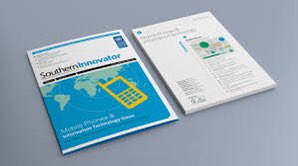
Development Challenges, South-South Solutions was launched as an e-newsletter in 2006 by UNDP’s South-South Cooperation Unit (now the United Nations Office for South-South Cooperation) based in New York, USA. It led on profiling the rise of the global South as an economic powerhouse and was one of the first regular publications to champion the global South’s innovators, entrepreneurs, and pioneers. It tracked the key trends that are now so profoundly reshaping how development is seen and done. This includes the rapid take-up of mobile phones and information technology in the global South (as profiled in the first issue of magazine Southern Innovator), the move to becoming a majority urban world, a growing global innovator culture, and the plethora of solutions being developed in the global South to tackle its problems and improve living conditions and boost human development. The success of the e-newsletter led to the launch of the magazine Southern Innovator.  
https://davidsouthconsulting.org/2021/03/05/southern-innovator-issue-1/

https://davidsouthconsulting.org/2021/03/05/southern-innovator-issue-2/

Creative Commons License

This work is licensed under a
Creative Commons Attribution-Noncommercial-No Derivative Works 3.0 License.

ORCID iD: https://orcid.org/0000-0001-5311-1052.

© David South Consulting 2023

Categories
Archive Development Challenges, South-South Solutions Newsletters Southern Innovator magazine

Global South Urbanization Does Not Have to Harm Biodiversity

By David SouthDevelopment Challenges, South-South Solutions

SOUTH-SOUTH CASE STUDY

How to balance fragile ecosystems with rapid urbanization will be the challenge for planners and governments across the global South in the coming years. The urbanization trend is clear: the world’s total urban area is expected to triple between 2000 and 2030, with urban populations set to double to around 4.9 billion in the same period (UNEP). This urban expansion will draw heavily on water and other natural resources and will consume prime agricultural land.

Global urbanization will have significant implications for biodiversity and ecosystems if current trends continue, with knock-on effects for human health and development, according to a new assessment by the United Nations Convention on Biological Diversity (CBD).

Cities and Biodiversity Outlook – the first global analysis of how projected patterns of urban land expansion will affect biodiversity and crucial ecosystems – argues that promoting low-carbon, resource-efficient urban development can counter urbanization’s adverse effects on biodiversity while improving quality of life.

“The way our cities are designed, the way people live in them and the policy decisions of local authorities, will define, to a large extent, future global sustainability,” said Braulio Dias, Executive Secretary of the CBD.

“The innovation lies not so much in developing new infrastructural technologies and approaches but to work with what we already have. The results often require fewer economic resources and are more sustainable,” he added.

The report says urban expansion is occurring fast in areas close to biodiversity ‘hotspots’ and coastal zones. And rapidly urbanizing regions, such as large and mid-size settlements in sub-Saharan Africa, India and China, often lack resources to implement sustainable urban planning.

But the study found that cities do not need to be in conflict with plant and animal species and ecosystems. They can, in fact, protect species, as is the case with Belgium, where 50 per cent of the country’s floral species are found in Brussels, or Poland, where 65 per cent of the country’s bird species occur in Warsaw.

At the Alexander von Humboldt Research Institute in Bogota, Colombia (humboldt.org.co) researchers have been thinking about how to get this balance right and make sure the growing cities of the future are not ecological disasters.

According to Juana Marino and Maria Angélica Mejia at the Institute’s Biological Resources Policy Program – which investigates “Biodiversity, Ecosystem Services and Urban-Regional Environments” – how cities grow and develop must change.

They believe cities need to take into account the resources they require to function and the impact this has on biodiversity and ecosystems.

“The more people who arrive in cities, the more they demand goods and services (in a massive way!): roads, housing, infrastructure, food, water – (creating) an impressive amount of waste, challenging traditional waste management and sanitation policies,” said Marino.

In short, “Cities enhance consumption.”

The Humboldt researchers believe common patterns can be seen across the global South, where ecosystems “surrounding urban areas are deforested and have significant levels of water and air pollution; they also become deeply transformed by informal settlements.”

This process means cities “lose their ability to be resilient, they become highly vulnerable to global change and they decrease their production of ecosystem services to maintain human well-being in cities.”

They argue that human settlements must be sustainably planned for, with ecological resilience and human well-being. If this is not done, areas suitable for agricultural production and biodiversity preservation will be harmed.

While better planning is needed there also needs to be long-term thinking.

But planning and managing are not the only things required: “it is a matter of design” if new “resilient” urban-rural landscapes are to be created.

And what can be done? They believe better analysis is required and it needs to take on social and cultural knowledge, and take in the border regions around cities, the “suburban, peri-urban and other ‘transition’ landscapes should become main actors in these relationships, not mere by-products; (they are) compromise territories between a lack of definition and low governance.”

These complex relationships with the border ecosystems of cities need to be communicated to the general public in simple, user-friendly ways so they can understand how important these areas are to the overall health of the city.

In Latin America, the cities of Curitiba (Brazil) and Bogotá and Medellin (Colombia) have made great strides in managing and planning for biodiversity and ecosystem services, they say. But it is not just as simple as recording the number of native species and the percentage of protected areas in urban places. Links need to be created between “social, scientific and political” elements to create “socio-ecological indicators” that can be developed and turned into “easy-to-adopt mechanisms” for people to use.

And they see innovation as the way to do this. Innovation is critical if cities and urban areas are to avoid widespread destruction of biodiversity as urbanization increases.

“Innovation is not just an option – it is a ‘must’,” said Marino. “Not just the technical innovation already being carried on by infrastructure, transport and building sectors that are rapidly changing their patterns based on mitigation technologies.

“Innovation is also needed in terms of biodiversity, biotechnology, information and knowledge production; appropriation, use and management. Knowledge turns into innovation when appropriated by social spheres; when it enters the social and political arenas.”

Environmental governance can be strengthened “when promoting top-down and bottom-up innovations.”

Published: December 2012

Resources

1) Environmental Public Awareness Handbook: Case Studies and Lessons Learned in Mongolia. Website: http://tinyurl.com/yhjyd7h

2) Hyderabad Case Study: During the recent UN biodiversity talks in Hyderabad, the International Union for Conservation of Nature gave journalists the opportunity to see how biodiversity can thrive in the middle of a bustling metropolis. Website: http://www.rtcc.org/hyderabad-a-showcase-of-urban-biodiversity/

3) UNEP: A Global Partnership on Cities and Biodiversity was launched by UNEP, the Secretariat of the Convention on Biological Diversity (CBD), UN-HABITAT, ICLEI, IUCN Countdown 2010, UNITAR, UNESCO and a Steering Group of Mayors from Curitiba, Montreal, Bonn, Nagoya and Johannesburg to bring together existing initiatives on cities and biodiversity. Website: http://www.unep.org/urban_environment/issues/biodiversity.asp

4) Nature in the City: Nature in the City, a project of Earth Island Institute, is San Francisco’s first organization wholly dedicated to ecological conservation, restoration and stewardship of the Franciscan bioregion. Website: http://natureinthecity.org/urbanbiodiversity.php

Development Challenges, South-South Solutions was launched as an e-newsletter in 2006 by UNDP’s South-South Cooperation Unit (now the United Nations Office for South-South Cooperation) based in New York, USA. It led on profiling the rise of the global South as an economic powerhouse and was one of the first regular publications to champion the global South’s innovators, entrepreneurs, and pioneers. It tracked the key trends that are now so profoundly reshaping how development is seen and done. This includes the rapid take-up of mobile phones and information technology in the global South (as profiled in the first issue of magazine Southern Innovator), the move to becoming a majority urban world, a growing global innovator culture, and the plethora of solutions being developed in the global South to tackle its problems and improve living conditions and boost human development. The success of the e-newsletter led to the launch of the magazine Southern Innovator.  

Creative Commons License

This work is licensed under a
Creative Commons Attribution-Noncommercial-No Derivative Works 3.0 License.

ORCID iD: https://orcid.org/0000-0001-5311-1052.

© David South Consulting 2023

Categories
Archive Development Challenges, South-South Solutions Newsletters

African Infrastructure Dreams Back on Agenda

By David SouthDevelopment Challenges, South-South Solutions

SOUTH-SOUTH CASE STUDY

Africa’s patchy infrastructure is not keeping pace with the continent’s economic growth.

Satellite photos of Africa at night show a place where light is concentrated overwhelmingly in the South – primarily South Africa – and in the North, with a sprinkling of lights on the west and east coasts (http://geology.com/articles/satellite-photo-earth-at-night.shtml).

This is just one visually arresting way to view the much larger problem of the continent lacking 21st-century infrastructure – from roads to airports to sewage and water services to harbors and rail connections. All are in desperate need of an upgrade.

The World Bank says only one in four people has access to electricity in sub-Saharan Africa. According to the International Energy Agency (IEA), the region will require more than US $300 billion in investment to achieve universal electricity access by 2030.

This lack of modern infrastructure is clashing with Africa’s impressive economic growth in recent years. The continent will be home to seven of the 10 fastest growing economies in the world by 2015, according to the IMF. Yet still too much of this is a reflection of a booming resource economy, which sounds impressive in numbers, but still leaves much of the continent’s population living in a day-to-day world of underdevelopment and poverty.

Africa desperately needs further investment in infrastructure. The good news is that a mix of positive developments is coming together to breathe life into efforts to upgrade the continent.

One is a new campaign to mobilize Africa’s wealthiest to stump up the necessary funds to conduct feasibility studies to lay the groundwork for a big boost to infrastructure spending in the coming years. Another is a flurry of new pledges from the United States to spend more in Africa to increase access to energy – a necessary precondition to improvements to living standards. China, too, is to continue to grow its already substantial investments in Africa.

For innovators, better infrastructure across Africa will make it easier to export products, connect with markets and customers and gain access to new technologies and products available to others around the world.

The Made in Africa Foundation (madeinafricafoundation.co.uk) hopes to turn to Africa’s wealthy global community to help with funding the feasibility studies required to unleash a new wave of infrastructure spending and building across the continent.

Africa takes up 30 million square kilometers (UNEP), is home to approximately 15 per cent of the world’s population and has 60 per cent of the world’s potential agricultural land. Yet, just 34 per cent of Africa can be reached by road and only 30 per cent has access to electricity. One estimate has placed the cost of meeting Africa’s power and transport needs at US $28 trillion by 2050.

That is a vast amount of money, and nobody will commit those sums unless they know that work has gone into planning for this infrastructure and that people are thinking long-term. This is where the Made in Africa Foundation wants to make a difference: it is hoping to get Africa’s wealthy to contribute US $400 million to fund feasibility studies which in turn will kick-off a US $68 billion first phase in investment into roads, railways, ports and energy.

“In 2009, there was (US) $150bn (billion) available to spend, but no bankable infrastructure projects in Africa,” that these funds could be directed towards, said the Foundation’s George Brennan. “These figures should make us angry – the problem is not the availability of funding but the fact that projects are not in a condition to be funded.”

Just as a global diaspora of Indians and Chinese have been instrumental in economic growth and development in India and China in the past two decades, so it is hoped the same formula can be applied to the equally substantial, successful and wealthy African diaspora.

“African Americans spend (US) $1 trillion every year in their economy, but what do they spend on Africa? About 0.01 percent,” said Chris Cleverly, Director of the Made in Africa Foundation. “They have the wherewithal to make profound differences – personally, and by lobbying their pension funds, investment advisers and government to invest in Africa on the basis that it provides good returns.

“It was China and India’s diasporas that developed them – it is the same with Africa’s now.”

Ozwald Boateng (http://ozwaldboateng.co.uk), the dynamic Ghanaian-descended London tailor who built his reputation on a quirky and modern take on traditional British bespoke suits, took the lead along with the Ugandan Prince Hassan Kimbugwe (http://www.cdrex.com/prince-hassan-kimbugwe/1251509.html) and former British barrister Chris Cleverly.

Boateng’s reputation and fame rose along side the buzzing British capital throughout the 2000s. But now he is reaching back to Africa to lead a campaign to substantially raise the level of investment in the continent’s creaking, antiquated or non-existent infrastructure.

He is trying to rally Africa’s wealthiest business leaders to contribute to creating a 21st-century African infrastructure of roads, railways, ports and power supplies. Made in Africa is tackling the fact many big global investors are willing to invest in Africa but find it difficult to do so. Much has to be done before an investor can come along and start, for example, building a new road network or airport. Local governments need to do the initial site survey and environmental impact studies and develop a larger vision for where they would like their country to go and how its cities are to develop.

The campaign got underway with a star-studded gala event earlier this year in Marrakech, Morocco, at the African Banker Awards (http://www.ic-events.net/awards/african_banker_awards_2013/). It also comes with a film, Our Future, Made in Africa, to help explain the campaign and the company.

Some of the people who attended included Nigerian philanthropist Tony Elumelu, Angola’s richest woman Isabel dos Santos and Sudanese telecoms mogul Mo Ibrahim.

“This is the start of fully understanding what Africa can do for itself,” said Boateng. “The Chinese managed to build a railway across China; the Japanese have the bullet train – we need to get past thinking about why it’s difficult to create the roads and railways that Africa needs and just get on with it.”

The Foundation is being supported by the African Development Bank (http://www.afdb.org/en/), a long-time supporter of African infrastructure investment through loans and technical assistance.

An additional boost to African development comes from a recent U.S. government pledge to spend US $7 billion over the next five years in Africa to improve access to energy. Energy is the needed fuel for any significant improvements to human development over the long-term.

U.S. President Barack Obama announced “Power Africa” (http://www.whitehouse.gov/the-press-office/2013/06/30/fact-sheet-power-africa) while he was in Cape Town, South Africa on his recent African tour. At the heart of Power Africa is the pledge to double access to power in Africa. According to medical journal The Lancet, 3.5 million Africans die every year due to indoor air pollution – a figure larger than those who die every year from malaria and HIV/AIDS combined. The pollution results from the fumes caused by burning fuel for cooking, warmth and light.

President Obama promised the funding to help governments in Ethiopia, Ghana, Kenya, Liberia, Nigeria and Tanzania. The funds will be used to boost access to electricity for 20 million households. Funds will also be used to help Angola and Mozambique modernize their energy export sectors.

Power Africa will act as a go-between to encourage links and deals between American energy companies and African partners.

On top of this, Power Africa is being supplemented by an additional US $10 billion in private sector contributions, including a commitment from the General Electric Company to bring 5,000 megawatts of affordable energy to Tanzania and Ghana.

In total, the US estimates it will take US $300 billion in additional funds to bring full power to sub-Saharan Africa.

For the past decade, the biggest change in Africa’s infrastructure story has come from the growing role played by China. China has become Africa’s largest single trading partner, with bilateral trade reaching US $166 billion in 2011 – a jump of 33 per cent from 2010. The total volume was valued at $198.5 billion in 2012 and is expected to surpass $380 billion by 2015.

And much, much more has been promised to come: China’s President Xi Jinping (http://en.wikipedia.org/wiki/Xi_Jinping) renewed a pledge to offer US $20 billion in loans to Africa in March 2013 (Reuters). Much of this is going to electricity-generation projects.

Published: July 2013

Resources

1) China in Africa: The Real Story is a blog tracking the relationship and digging up the real numbers on what is happening. Website: http://www.chinaafricarealstory.com/

2) The China-Africa Development Fund (CADFund) will invest US $2.4 billion in African projects, according to its President Chi Jianxin. Website: http://www.cadfund.com/en/

3) Map of Africa’s major infrastructure: The image shows how infrastructure in Africa is growing rapidly, but is still largely concentrated in coastal regions and those with large mineral deposits. This means that rural and isolated populations often do not have access to modern energy and the benefits that it can bring. Website: http://www.one.org/us/2011/05/10/map-of-africas-major-infrastructure/

4) Dead Aid by Dambisa Moyo. In the past 50 years, more than US $1 trillion in development-related aid has been transferred from rich countries to Africa. Website: http://www.dambisamoyo.com/books-and-publications/book/dead-aid

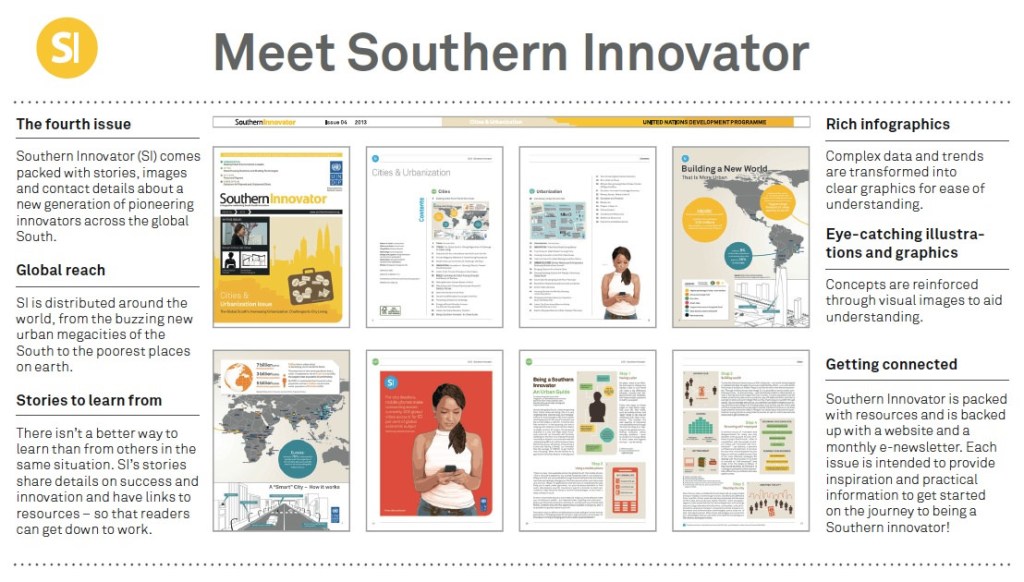
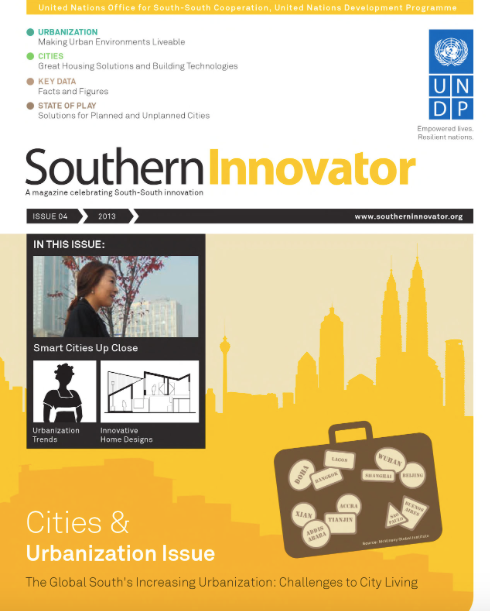
Find more in Southern Innovator Issue 4: Cities and Urbanization

https://g.co/kgs/y2K5Hy

Development Challenges, South-South Solutions was launched as an e-newsletter in 2006 by UNDP’s South-South Cooperation Unit (now the United Nations Office for South-South Cooperation) based in New York, USA. It led on profiling the rise of the global South as an economic powerhouse and was one of the first regular publications to champion the global South’s innovators, entrepreneurs, and pioneers. It tracked the key trends that are now so profoundly reshaping how development is seen and done. This includes the rapid take-up of mobile phones and information technology in the global South (as profiled in the first issue of magazine Southern Innovator), the move to becoming a majority urban world, a growing global innovator culture, and the plethora of solutions being developed in the global South to tackle its problems and improve living conditions and boost human development. The success of the e-newsletter led to the launch of the magazine Southern Innovator.  

Creative Commons License

This work is licensed under a
Creative Commons Attribution-Noncommercial-No Derivative Works 3.0 License.

ORCID iD: https://orcid.org/0000-0001-5311-1052.

© David South Consulting 2023