Categories
Archive Development Challenges, South-South Solutions Newsletters

African Infrastructure Dreams Back on Agenda

By David SouthDevelopment Challenges, South-South Solutions

SOUTH-SOUTH CASE STUDY

Africa’s patchy infrastructure is not keeping pace with the continent’s economic growth.

Satellite photos of Africa at night show a place where light is concentrated overwhelmingly in the South – primarily South Africa – and in the North, with a sprinkling of lights on the west and east coasts (http://geology.com/articles/satellite-photo-earth-at-night.shtml).

This is just one visually arresting way to view the much larger problem of the continent lacking 21st-century infrastructure – from roads to airports to sewage and water services to harbors and rail connections. All are in desperate need of an upgrade.

The World Bank says only one in four people has access to electricity in sub-Saharan Africa. According to the International Energy Agency (IEA), the region will require more than US $300 billion in investment to achieve universal electricity access by 2030.

This lack of modern infrastructure is clashing with Africa’s impressive economic growth in recent years. The continent will be home to seven of the 10 fastest growing economies in the world by 2015, according to the IMF. Yet still too much of this is a reflection of a booming resource economy, which sounds impressive in numbers, but still leaves much of the continent’s population living in a day-to-day world of underdevelopment and poverty.

Africa desperately needs further investment in infrastructure. The good news is that a mix of positive developments is coming together to breathe life into efforts to upgrade the continent.

One is a new campaign to mobilize Africa’s wealthiest to stump up the necessary funds to conduct feasibility studies to lay the groundwork for a big boost to infrastructure spending in the coming years. Another is a flurry of new pledges from the United States to spend more in Africa to increase access to energy – a necessary precondition to improvements to living standards. China, too, is to continue to grow its already substantial investments in Africa.

For innovators, better infrastructure across Africa will make it easier to export products, connect with markets and customers and gain access to new technologies and products available to others around the world.

The Made in Africa Foundation (madeinafricafoundation.co.uk) hopes to turn to Africa’s wealthy global community to help with funding the feasibility studies required to unleash a new wave of infrastructure spending and building across the continent.

Africa takes up 30 million square kilometers (UNEP), is home to approximately 15 per cent of the world’s population and has 60 per cent of the world’s potential agricultural land. Yet, just 34 per cent of Africa can be reached by road and only 30 per cent has access to electricity. One estimate has placed the cost of meeting Africa’s power and transport needs at US $28 trillion by 2050.

That is a vast amount of money, and nobody will commit those sums unless they know that work has gone into planning for this infrastructure and that people are thinking long-term. This is where the Made in Africa Foundation wants to make a difference: it is hoping to get Africa’s wealthy to contribute US $400 million to fund feasibility studies which in turn will kick-off a US $68 billion first phase in investment into roads, railways, ports and energy.

“In 2009, there was (US) $150bn (billion) available to spend, but no bankable infrastructure projects in Africa,” that these funds could be directed towards, said the Foundation’s George Brennan. “These figures should make us angry – the problem is not the availability of funding but the fact that projects are not in a condition to be funded.”

Just as a global diaspora of Indians and Chinese have been instrumental in economic growth and development in India and China in the past two decades, so it is hoped the same formula can be applied to the equally substantial, successful and wealthy African diaspora.

“African Americans spend (US) $1 trillion every year in their economy, but what do they spend on Africa? About 0.01 percent,” said Chris Cleverly, Director of the Made in Africa Foundation. “They have the wherewithal to make profound differences – personally, and by lobbying their pension funds, investment advisers and government to invest in Africa on the basis that it provides good returns.

“It was China and India’s diasporas that developed them – it is the same with Africa’s now.”

Ozwald Boateng (http://ozwaldboateng.co.uk), the dynamic Ghanaian-descended London tailor who built his reputation on a quirky and modern take on traditional British bespoke suits, took the lead along with the Ugandan Prince Hassan Kimbugwe (http://www.cdrex.com/prince-hassan-kimbugwe/1251509.html) and former British barrister Chris Cleverly.

Boateng’s reputation and fame rose along side the buzzing British capital throughout the 2000s. But now he is reaching back to Africa to lead a campaign to substantially raise the level of investment in the continent’s creaking, antiquated or non-existent infrastructure.

He is trying to rally Africa’s wealthiest business leaders to contribute to creating a 21st-century African infrastructure of roads, railways, ports and power supplies. Made in Africa is tackling the fact many big global investors are willing to invest in Africa but find it difficult to do so. Much has to be done before an investor can come along and start, for example, building a new road network or airport. Local governments need to do the initial site survey and environmental impact studies and develop a larger vision for where they would like their country to go and how its cities are to develop.

The campaign got underway with a star-studded gala event earlier this year in Marrakech, Morocco, at the African Banker Awards (http://www.ic-events.net/awards/african_banker_awards_2013/). It also comes with a film, Our Future, Made in Africa, to help explain the campaign and the company.

Some of the people who attended included Nigerian philanthropist Tony Elumelu, Angola’s richest woman Isabel dos Santos and Sudanese telecoms mogul Mo Ibrahim.

“This is the start of fully understanding what Africa can do for itself,” said Boateng. “The Chinese managed to build a railway across China; the Japanese have the bullet train – we need to get past thinking about why it’s difficult to create the roads and railways that Africa needs and just get on with it.”

The Foundation is being supported by the African Development Bank (http://www.afdb.org/en/), a long-time supporter of African infrastructure investment through loans and technical assistance.

An additional boost to African development comes from a recent U.S. government pledge to spend US $7 billion over the next five years in Africa to improve access to energy. Energy is the needed fuel for any significant improvements to human development over the long-term.

U.S. President Barack Obama announced “Power Africa” (http://www.whitehouse.gov/the-press-office/2013/06/30/fact-sheet-power-africa) while he was in Cape Town, South Africa on his recent African tour. At the heart of Power Africa is the pledge to double access to power in Africa. According to medical journal The Lancet, 3.5 million Africans die every year due to indoor air pollution – a figure larger than those who die every year from malaria and HIV/AIDS combined. The pollution results from the fumes caused by burning fuel for cooking, warmth and light.

President Obama promised the funding to help governments in Ethiopia, Ghana, Kenya, Liberia, Nigeria and Tanzania. The funds will be used to boost access to electricity for 20 million households. Funds will also be used to help Angola and Mozambique modernize their energy export sectors.

Power Africa will act as a go-between to encourage links and deals between American energy companies and African partners.

On top of this, Power Africa is being supplemented by an additional US $10 billion in private sector contributions, including a commitment from the General Electric Company to bring 5,000 megawatts of affordable energy to Tanzania and Ghana.

In total, the US estimates it will take US $300 billion in additional funds to bring full power to sub-Saharan Africa.

For the past decade, the biggest change in Africa’s infrastructure story has come from the growing role played by China. China has become Africa’s largest single trading partner, with bilateral trade reaching US $166 billion in 2011 – a jump of 33 per cent from 2010. The total volume was valued at $198.5 billion in 2012 and is expected to surpass $380 billion by 2015.

And much, much more has been promised to come: China’s President Xi Jinping (http://en.wikipedia.org/wiki/Xi_Jinping) renewed a pledge to offer US $20 billion in loans to Africa in March 2013 (Reuters). Much of this is going to electricity-generation projects.

Published: July 2013

Resources

1) China in Africa: The Real Story is a blog tracking the relationship and digging up the real numbers on what is happening. Website: http://www.chinaafricarealstory.com/

2) The China-Africa Development Fund (CADFund) will invest US $2.4 billion in African projects, according to its President Chi Jianxin. Website: http://www.cadfund.com/en/

3) Map of Africa’s major infrastructure: The image shows how infrastructure in Africa is growing rapidly, but is still largely concentrated in coastal regions and those with large mineral deposits. This means that rural and isolated populations often do not have access to modern energy and the benefits that it can bring. Website: http://www.one.org/us/2011/05/10/map-of-africas-major-infrastructure/

4) Dead Aid by Dambisa Moyo. In the past 50 years, more than US $1 trillion in development-related aid has been transferred from rich countries to Africa. Website: http://www.dambisamoyo.com/books-and-publications/book/dead-aid

Find more in Southern Innovator Issue 4: Cities and Urbanization
https://g.co/kgs/y2K5Hy

Development Challenges, South-South Solutions was launched as an e-newsletter in 2006 by UNDP’s South-South Cooperation Unit (now the United Nations Office for South-South Cooperation) based in New York, USA. It led on profiling the rise of the global South as an economic powerhouse and was one of the first regular publications to champion the global South’s innovators, entrepreneurs, and pioneers. It tracked the key trends that are now so profoundly reshaping how development is seen and done. This includes the rapid take-up of mobile phones and information technology in the global South (as profiled in the first issue of magazine Southern Innovator), the move to becoming a majority urban world, a growing global innovator culture, and the plethora of solutions being developed in the global South to tackle its problems and improve living conditions and boost human development. The success of the e-newsletter led to the launch of the magazine Southern Innovator.  

Creative Commons License

This work is licensed under a
Creative Commons Attribution-Noncommercial-No Derivative Works 3.0 License.

ORCID iD: https://orcid.org/0000-0001-5311-1052.

© David South Consulting 2023

Categories
Archive Development Challenges, South-South Solutions Newsletters

An Innovator’s ‘Big Chicken Agenda’ for Africa

By David SouthDevelopment Challenges, South-South Solutions

SOUTH-SOUTH CASE STUDY

Increasing the quantity and quality of food in Africa will be critical to improving the continent’s human development. And a key element in giving Africa a more secure food supply will be boosting science and knowledge on the continent and making sure it is focused on Africa’s needs and situation.

One pioneering scientist is looking to the humble chicken to tackle two big problems in Africa: food security and household incomes. By pumping up the weight and productivity of African chickens, she hopes to eradicate hunger and boost household incomes.

Kenyan scientist Sheila Ommeh (http://www.awardfellowships.org/participants/success-stories/108-sheilaommeh.html ) is showing how local knowledge can give farmers the edge when it comes to improving Africa’s animal stock. An animal geneticist, she is trying to create a disease-resistant African chicken that can also produce plenty of eggs.

Her pioneering work is about trailblazing “a big chicken agenda in Africa,” she explained to TrustLaw, a global hub for free legal assistance and information on good governance and women’s rights.  She grew up in an area – Mount Elgon in western Kenya – where raising chickens was the primary source of both income and food. Her family raised chickens and the income from this helped to pay for her schooling.

Raising chickens is common in rural Kenya, and many of the people doing it are women.

Based on her experience, she saw how virulent diseases kill chicken flocks and destroy family incomes and disrupt lives – diseases like Newcastle (http://www.avianbiotech.com/diseases/newcastle.htm) and Gumboro (gumboro.com).

She works at the International Livestock Research Institute (ilri.org) based in Nairobi, Kenya. The ILRI “works at the crossroads of livestock and poverty, bringing high-quality science and capacity-building to bear on poverty reduction and sustainable development” and conducts research in Africa, South and Southeast Asia and China.

“I’m really passionate about giving back to the community an improved chicken that will really help their lives,” she explains.

Another project she is working on is the development of a drought-tolerant chicken. This chicken could prove very helpful in parts of Africa suffering from drought and hunger, like in the Horn of Africa.

Women are considered to be the majority producers of food in Africa yet just one in four people working in agricultural research in Africa is a woman, according to TrustLaw.

Ommeh has a PhD in chicken genetics and is a staunch believer in seeking out solutions to Africa’s problems within Africa: “In my view = it’s about time Africa looked for solutions in Africa for Africa,” she told a group of British Members of Parliament.

She will continue her research by looking at native African chickens. She is worried indigenous African chickens are being wiped out by cross-breeding and the introduction into the continent of exotic breeds, which are making African chickens more susceptible to viruses.

Her goal is to produce a disease-resistant breed of chicken weighing four kilograms and laying 250 eggs a year. This would be a big increase on current average weights, and a trebling of the yield.

“Definitely the incomes of these households will increase and that will (create) a rippling effect that will trickle up … And we hope that in 10 to 15 years the poverty issue in Africa will not be so serious,” Ommeh said.

“Chicken is a small livestock but I believe it has the capacity to have a big impact.”

For female scientists working in agriculture, African Women in Agricultural Research and Development (AWARD) (http://awardfellowships.org/) is seeking researchers looking to boost their technical and leadership skills. It is hoped that supporting more women researchers will have the effect of turning research priorities towards the needs of smallholder farmers, who make up the majority of  farmers in Africa.

Published: May 2012

Resources

1) Artificial chicken: The contest to create artificial chicken meat offers a US $1 million prize. Website: http://www.guardian.co.uk/science/2012/jan/21/artificial-chicken-food-prize

2) Poultry Hub: “Poultry Hub can help you learn more about the amazing world of poultry and your place in it. Poultry is one of the world’s most technically advanced agricultural industries, offering rewarding career paths to talented young people in hundreds of countries.” The Hub includes the excellent “anatomy of the chicken” learning resource. Website: http://www.poultryhub.org/organisations/rural-industries-research-anddevelopment-corporation-rirdc-chicken-meat-program/

3) Poultry Research Centre: From the University of Alberta, the website offers resources and contacts on poultry sciences. Website: http://www.poultryresearchcentre.com/

4) Chickens: Basic information on chickens and their origins. Website: http://www.encyclopedia.com/topic/Chicken.aspx

https://davidsouthconsulting.org/2022/11/21/africa/

https://davidsouthconsulting.org/2022/11/21/agribusiness-food-security/

https://davidsouthconsulting.org/2022/09/27/avoiding-wasting-food-and-human-potential-with-icts/

https://davidsouthconsulting.org/2022/08/14/brazil-preserves-family-farms-keeping-food-local/

https://davidsouthconsulting.org/2022/10/10/cheap-farming-kit-hopes-to-help-more-become-farmers/

https://davidsouthconsulting.org/2020/04/25/china-pushing-frontiers-of-medical-research/

https://davidsouthconsulting.org/2021/03/08/the-dawn-of-the-genetics-revolution-2001-2003/

https://davidsouthconsulting.org/2021/03/04/food-diplomacy-next-front-for-souths-nations/

https://davidsouthconsulting.org/2022/02/10/food-inflation-ways-to-fight-it/

https://davidsouthconsulting.org/2022/10/14/indias-modernizing-food-economy-unleashing-new-opportunities/

https://davidsouthconsulting.org/2022/11/01/indonesian-food-company-helps-itself-by-making-farmers-more-efficient/

https://davidsouthconsulting.org/2022/05/04/insects-can-help-in-food-crisis/

https://davidsouthconsulting.org/2022/10/14/staple-foods-are-becoming-more-secure-in-the-south/

https://davidsouthconsulting.org/2021/03/20/texting-for-cheaper-marketplace-food-with-sokotext/

https://davidsouthconsulting.org/2022/11/11/urban-farming-to-tackle-global-food-crisis/

https://davidsouthconsulting.org/2022/10/10/us-1-trillion-opportunity-for-africas-agribusinesses-says-report/

https://davidsouthconsulting.org/2022/10/18/woman-wants-african-farming-to-be-cool/

Development Challenges, South-South Solutions was launched as an e-newsletter in 2006 by UNDP’s South-South Cooperation Unit (now the United Nations Office for South-South Cooperation) based in New York, USA. It led on profiling the rise of the global South as an economic powerhouse and was one of the first regular publications to champion the global South’s innovators, entrepreneurs, and pioneers. It tracked the key trends that are now so profoundly reshaping how development is seen and done. This includes the rapid take-up of mobile phones and information technology in the global South (as profiled in the first issue of magazine Southern Innovator), the move to becoming a majority urban world, a growing global innovator culture, and the plethora of solutions being developed in the global South to tackle its problems and improve living conditions and boost human development. The success of the e-newsletter led to the launch of the magazine Southern Innovator.

https://davidsouthconsulting.org/2021/03/05/southern-innovator-issue-1/

Creative Commons License

This work is licensed under a
Creative Commons Attribution-Noncommercial-No Derivative Works 3.0 License.

ORCID iD: https://orcid.org/0000-0001-5311-1052.

© David South Consulting 2021

Categories
Archive Blogroll Southern Innovator magazine United Nations Office for South-South Cooperation

Southern Innovator in Southasiadisasters.net

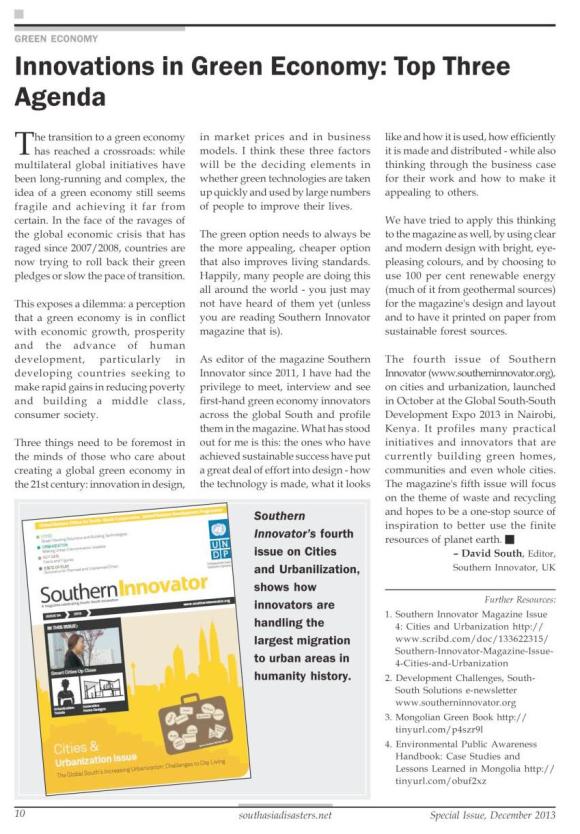
Innovations in Green Economy: Top Three Agenda

c22e6-innovations20in20green20economy20top20three20agenda20december202013

By David South

southasiadiasters.net December 2013

The transition to a green economy has reached a crossroads: while multilateral global initiatives have been long-running and complex, the idea of a green economy still seems fragile and achieving it far from certain. In the face of the ravages of the global economic crisis that has raged since 2007/2008, countries are now trying to roll back their green pledges or slow the pace of transition. 

This exposes a dilemma: a perception that a green economy is in conflict with economic growth, prosperity and the advance of human development, particularly in developing countries seeking to make rapid gains in reducing poverty and building a middle class, consumer society. 

Three things need to be foremost in the minds of those who care about creating a global green economy in the 21st century: innovation in design, in market prices and in business models. I think these three factors will be the deciding elements in whether green technologies are taken up quickly and used by large numbers of people to improve their lives. 

The green option needs to always be the more appealing, cheaper option that also improves living standards. Happily, many people are doing this all around the world – you just may not have heard of them yet (unless you are reading Southern Innovator magazine that is). 

As editor of the magazine Southern Innovator since 2011, I have had the privilege to meet, interview and see first-hand green economy innovators across the global South and profile them in the magazine. What has stood out for me is this: the ones who have achieved sustainable success have put a great deal of effort into design – how the technology is made, what it looks like and how it is used, how efficiently it is made and distributed – while also thinking through the business case for their work and how to make it appealing to others. 

We have tried to apply this thinking to the magazine as well, by using clear and modern design with bright, eye-pleasing colours, and by choosing to use 100 per cent renewable energy (much of it from geothermal sources) for the magazine’s design and layout and to have it printed on paper from sustainable forest sources. 

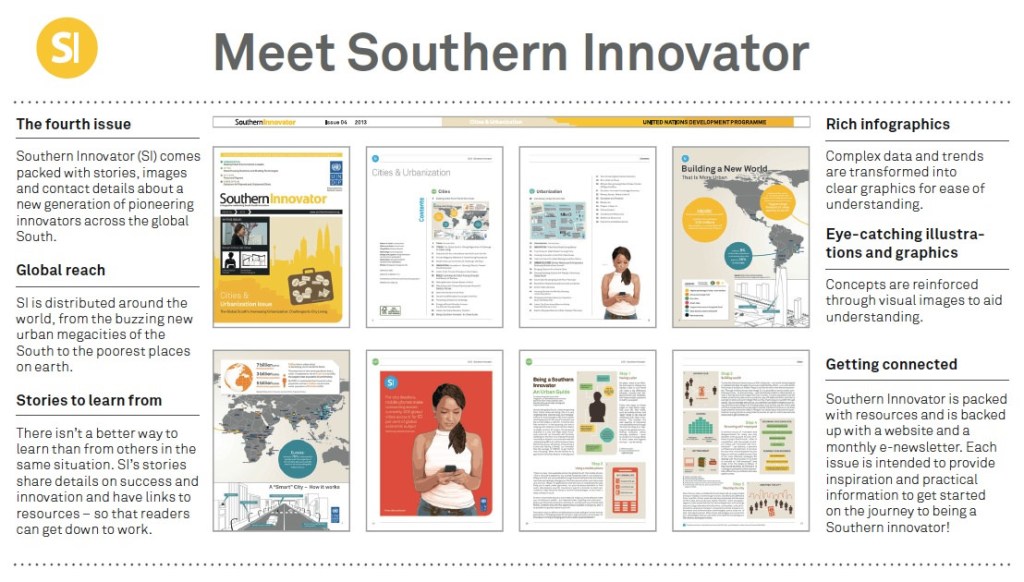
The fourth issue of Southern Innovator (www.southerninnovator.org), on cities and urbanization, launched in October at the Global South-South Development Expo 2013 in Nairobi, Kenya. It profiles many practical initiatives and innovators that are currently building green homes, communities and even whole cities. The magazine’s fifth issue will focus on the theme of waste and recycling and hopes to be a one-stop source of inspiration to better use the finite resources of planet earth.

David South, Editor, Southern Innovator
United Nations Office for South-South Cooperation (UNOSSC)

https://www.preventionweb.net/publication/climate-smart-disaster-risk-management-action

South-South Cooperation for Cities in Asia

South-South Cooperation for Cities July 2014

Published: July 2014

Publisher: Southasiadisasters.net

Issue No. 114, July 2014

Theme: Towards Urban Resilience

The coming wave of technological innovations aimed at global South cities will dominate civic debates whether people wish it to or not. Already, futuristic, 21st-century cities are being built around Asia from scratch. I had the privilege of visiting a couple of them in 2012 while researching the fourth issue of our magazine, Southern Innovator (  h t t p : / / w w w . s c r i b d . c o m / SouthernInnovator). Each city had a different focus for its construction – one was seeking to be an “eco-city” and the other one called itself a “smart city,” focused on becoming a regional business and technology hub. Both aimed to use the latest information technologies to make the way Asian cities operate on a day-to-day basis smarter – and greener.

Large information technology companies – including India’s Infosys (infosys.com) – have their sights set on selling all sorts of technological solutions to common problems of urban living. This aspiring revolution is built on two foundations: One is the Internet of Things – in which everyday objects are connected to the
Internet via microchips. The other is Big Data, the vast quantities of data being generated by all the mobile phones and other electronic devices people use these days.

Much of this new technology will be manufactured in Asia, and not just that – it will also be developed and designed in Asia, often to meet the challenges of urban Asia.

By their nature, cities are fluid places. People come and go for work and pleasure, and successful cities are magnets for people of all backgrounds seeking new opportunities. This fluidity puts stress on cities and leads to the constant complaints familiar to any urban dweller – inadequate transport, traffic jams, air pollution, poor housing, and a high cost of living.

If handled well and with imagination, new information technologies can ensure Asian cities do more than pay lip service to aspirations to improve human development. They can make cities resilient places – able to bounce back from disasters, whether man made or natural.

During the late 1990s, I saw first-hand the pressures placed on one Asian city, Mongolia’s capital, Ulaanbaatar. The country endured the worst peacetime economic collapse since World War II while confronting the wrenching social and economic stresses of switching from a command economy during Communism to a free-market democracy. The city’s population grew quickly as rural economies collapsed and poverty shot upwards. I can only imagine now how the response could have been different with the technologies available today.

In 2010, I interviewed one of the editors of the Cities for All book, Charlotte Mathivet (http://globalurbanist.com/2010/08/24/cities-for-all-shows-how-the-worldspoor-are-building-ties-across-theglobal-
south), and she stressed the importance of South-South cooperation to ensuring cities are good places to live for everyone.

“A lot of social initiatives based on the right to the city are coming from these ‘new cities of the South,’” Mathivet said. “The book highlights original social initiatives: protests and organizing of the urban poor, such as the pavement dwellers’ movements in Mumbai where people with nothing, living on the pavements of a very big city, organise themselves to struggle for their collective rights, just as the park dwellers did in Osaka.”

Recently, an Indian restaurant uploaded to the Internet a video of what it claimed to be the first drone delivering a pizza in an Indian city. While this may or may not be a practical solution to traffic congestion, the subsequent negative fallout – angry police and public officials – from this use of new technology highlights the promise
and perils of innovating in the real world of Asian cities (http:/
/www.bbc.co.uk/news/
b l o g s – n e w s – f r o m –
elsewhere-27537120).

Micro electronics are becoming cheaper and more powerful by the month. Small businesses armed with a only laptop computer, access to the Internet and/or mobile phone networks, and cloud computing services, can offer very powerful business and public services solutions. And sharing solutions across the global South via information technologies has never been easier.

The U.S. Pentagon published various reports and studies in the 2000s forecasting a dark future for cities in the global South. As author Mike Davis revealed in his seminal work, Planet of Slums (http://www.amazon.com/exec/obido/ASIN/1844670228/nationbooks08), the Pentagon saw the developing world’s cities as the “battlespace of the twenty-first century.” It imagined sprawling, crime ridden cities full of poverty and slums and needing tiny drones and robots darting back and forth, keeping an eye on everything and suppressing unrest. This threat-based view of future cities is one to be avoided. It is possible, through the right application of quick solutions to the challenges that arise as cities grow, to turn to cooperation across the cities of the global South to avoid this pessimistic fate.


David South, Editor,
United Nations Office for
South-South Cooperation

(UNOSSC), UK

https://reliefweb.int/report/india/southasiadisastersnet-issue-no114-july-2014-towards-urban-resilience

Lima To Delhi: What Can Be Learned On Urban Resilience?

Published: March 2015

Publisher: Southasiadisasters.net

Issue No. 128, March 2015

Theme: Challenges of Urban Resilience in India

Fast-growing cities and urban areas in the global South can be vulnerable because they lack the web of structures and institutions that enable more long-established cities to mitigate risks and, when a disaster does strike, to bounce back quickly. But thanks to many new technologies, and some smart new thinking, it is possible to bring resilience to even the poorest and most deprived urban communities.

The essence of resilience is to build into plans and daily activities a
community’s ability to weather any disaster, small or large. All cities, rich or poor, can experience a disaster of some sort, be it weather, civil unrest, war, earthquakes, shortages, or economic, financial and health crises. New technologies make it possible for all cities, no matter how poor and overcrowded, to build in urban resilience. The ubiquity of mobile phones introduces a powerful city and urban planning tool. Mapping chaotic and unplanned areas is already underway in many cities of the global South (in Brazil and Kenya for example (http://tinyurl.com/qgba8kb).

Impressively, innovators in the South are using affordable microelectronics in the form of mobile phones and laptops to gather data and map it. This computing capability was once the sole domain of big information technology companies such as IBM. Now, a single laptop computer combined with a smartphone equipped with the right software can manage a large urban area, a task that once required rooms full of computers. The data can then be used to manage growth today and re-build after a disaster. Any excuse not to be resilient has been wiped out with this technological leap.

But how to deal with the common reality of feeling overwhelmed by the many obstacles to rational planning and building for urban growth in the South? Innovators have stepped in to take matters into their own hands with simple construction technologies as the solution. One example is the Moladi system of recycled plastic moulds (moladi.net). Anybody can master this simple building technique, as the mortar-filled moulds are designed to fit easily together to construct an earthquake-resistant, beautiful home.

This approach has the advantage of bypassing the failings of authorities to enforce building codes and standards in poor, urban communities, creating safer places to live and preventing the growth of unregulated shanty towns at risk to fire and earthquakes.

Others have found social ways to organize people, even in the most desperate of conditions, providing services and laying down the groundwork for an upgrading of an urban area to improve living conditions and long-term opportunities. The concept of ‘cities for all’ has inspired many to re-energize civic organizations and networking in poor areas to ensure they are not left out of economic growth. In Colombia, a famous example of this is the escalator in the city of Medellin, which connects a hillside slum to the centre of the city, opening up economic opportunities to all (http://tinyurl.com/nm47d3u).

Still more exciting, new technologies are in the works to simplify construction of major infrastructure and new buildings. A future city will be able to gather extensive data on an expanding urban area, make detailed development plans with architects and engineers, and then have robots and 3D fabricating machines quickly lay down infrastructure and erect buildings. Sounds far-fetched?
Well, in China one company recently used a 3D machine to make 10 houses in a single day (http://www.yhbm.com/index.aspx).

An infographic from Southern Innovator’s fourth issue (http://
tinyurl.com/m9vfwur) shows 10 ways any urban area – either planned or unplanned – can build in resilience. All are proven approaches from cities in the global South.

Southern Innovator’s upcoming sixth issue will explore the interplay
of science, technology and innovation in the global South and how people are making the most of 21st century advances to increase wealth and improve human development. Hopefully, all of this innovation will lead to more resilient cities in the future!


David South,
Editor, Southern Innovator, UNOSSC

https://www.preventionweb.net/publication/challenges-urban-resilience-india

This work is licensed under a Creative Commons Attribution 4.0 International License.

ORCID iD: https://orcid.org/0000-0001-5311-1052.

© David South Consulting 2021