Categories
Archive Development Challenges, South-South Solutions Newsletters

African Ingenuity Attracting Interest

By David SouthDevelopment Challenges, South-South Solutions

SOUTH-SOUTH CASE STUDY

The tide of science and innovation from the South is grabbing the world’s attention. While the big giants of India, China and Brazil are well-established hubs of invention, it is the once-overlooked continent of Africa that is generating current excitement. The atmosphere can be equated to the flush of innovation in the late 19th and early 20th centuries, as inventors tackled the budding new technologies of the combustion engine, flight, electricity and radio waves. These days, it’s the challenges of development, rapid urbanization and finding ways to ‘hack’ (http://en.wikipedia.org/wiki/Hack_%28technology%29), like adapting existing  technology such as mobile phones or bicycles to new purposes.

That previous period of invention had a spirit of pioneering and making-do, of dreams and adaptability triumphing over poverty, and it laid the path for many new companies to sprout up and create wealth and jobs for millions. At this August’s Maker Faire Africa gathering (http://makerfaireafrica.com/) in Accra, Ghana, African pioneers in grassroots innovation offered inspiring inventions.

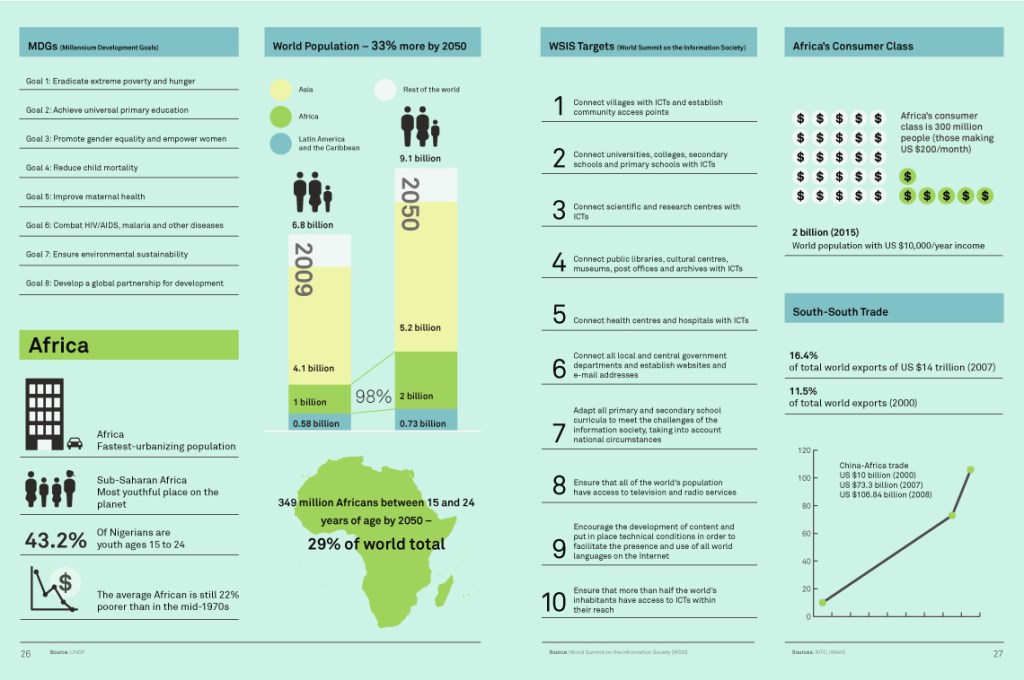
The rapid changes happening in African countries – especially the tilt to having a larger urban population than a rural one – means there is an urgent need to boost incomes.

Handled right, these grassroots inventors could grow to become part of the already expanding South-South trade, which grew by an average of 13 percent per year between 1995 and 2007, to make up 20 percent of world trade.

Inspired by the US magazine Make (http://makezine.com/) – a do-it-yourself technology magazine written by makers of computers, electronics and robotics – the first Maker Faire gathering was held in 2006 in the San Francisco area of the United States.

The African Maker Faire modelled itself on this approach and has tapped into Africa’s well-entrenched do-it-yourself development culture. It went looking for more inventors like those celebrated on the website AfriGadget (http://www.afrigadget.com/), with its projects that solve “everyday problems with African ingenuity.” The Faire works with the participants to share their ideas and to find ways to make money from their ideas.

The Faire in Accra ran in parallel with the International Development Design Summit (http://2009.iddsummit.org/),which came to Ghana from its home at the Massachusetts Institute of Technology (http://web.mit.edu/) in the United States. Its aim was to bring technology closer to “potential end users of the projects.”

“It is part of the revolution in design that aims to create equity in the distribution of research and development resources by focusing on the needs of the world’s poor,” organizers said.

This spirit of African invention is about breaking the perception that invention is a purely Northern phenomenon that requires complex and expensive materials. African ingenuity is about taking whatever is available and tackling common problems. It is an empowering approach that celebrates local initiative and seeks to find ways to turn these inventions into sustainable incomes.

“What’s different about African mechanics and gadgets is that it’s generally made with much fewer, and more basic, materials,” said Afrigadget founder Erik Hersman. “Where you might find a story on how to make hi-tech robots at home in Make, its counterpart in Africa might be how to create a bicycle out of wood. No less ingenuity needed, but far more useful for an African’s everyday life.”

The African Maker Faire featured a wide range of solutions, from a low-power radio station to a bicycle-powered saw and a simple corn planter.

Shamsudeen Napara, from northern Ghana, brought a US $10 corn planter that looks like a pill dispenser to help speed up crop planting. He also has invented a cheap shea nut (http://en.wikipedia.org/wiki/Shea_butter) roaster. These inventions are cooked up in his metal fabrication shop which builds tools for agricultural use. Shea nut processing is a lucrative task for women in Northern Ghana. Napara’s roaster costs US $40 and reduces the energy and time to process the nuts. He has also made a soap cutter using piano wires and guitar screws.

Bernard Kiwia, a bicycle mechanic from Arusha, Tanzania, is a pioneer working with windmills, water pumps, mobile phone chargers and pedal-powered hacksaws – all made from old bike parts.

Hayford Bempong, David Celestin and Michael Amankwanor from Accra Polytechnic (http://www.accrapolytechnic.edu.gh/), built a low-power radio station. Made from scrap electronic parts and an antenna from copper pipe, the radio was put straight to use to broadcast announcements at the event over a range of a few thousand metres.

Suprio Das, Killian Deku, Laura Stupin and Bernard Kiwia brought a method to produce chlorine from salt water and other common materials. It can then be used to purify water. Their method can clean vast quantities of water using no moving parts (avoiding breakdowns). It does this by dripping chlorine into the water until a level has been reached, and then the purified water is released. By using a 5 litre bag of chlorine, and a US $3 valve, 100,000 litres of water can be purified.

Electricity was also being made using low-cost batteries from aluminum cans and plastic water bottles. Applying salt water as an electrolyte (http://en.wikipedia.org/wiki/Electrolyte),electricity is created by the oxidation of the aluminum can – a cheaper approach and less toxic than commercial batteries.

A group called Afrobotics (http://www.afrobotics.com) gave a presentation to encourage more African students to go into engineering, science and technology. Afrobotics is set up as a competition to “fuel engineering, science, innovation, and entrepreneurship on the African continent, utilizing robotics.” They have some excellent videos of African robots in action: http://www.afrobotics.com/videos.

Published: October 2009

Resources

1) Fab Labs: Like the futuristic “replicator” in the TV show Star Trek, Fab Labs allow people to design and produce what they need there and then. The labs are mushrooming throughout the South as people get the innovation bug. The Fab Lab program is part of the MIT’s Center for Bits and Atoms (CBA) which broadly explores how the content of information relates to its physical representation. Website: http://fab.cba.mit.edu/

2) id21 Insights: A series of articles by the UK ’s Institute of Development Studies on how to make technology and science relevant to the needs of the poor. Website: http://www.id21.org/insights/insights68/art00.html

3) eMachineShop: This remarkable service allows budding inventors to download free design software, design their invention, and then have it made in any quantity they wish and shipped to them: Amazing! Website: http://www.emachineshop.com/

4) The red dot logo stands for belonging to the best in design and business. The red dot is an internationally recognised quality label for excellent design that is aimed at all those who would like to improve their business activities with the help of design. Website: www.red-dot.de

5) Institute for the Future: It identifies emerging trends that will transform global society and the global marketplace. It provides insight into business strategy, design process, innovation, and social dilemmas. Its website helps budding inventors to identify new areas of invention.Website: http://www.iftf.org/

Development Challenges, South-South Solutions was launched as an e-newsletter in 2006 by UNDP’s South-South Cooperation Unit (now the United Nations Office for South-South Cooperation) based in New York, USA. It led on profiling the rise of the global South as an economic powerhouse and was one of the first regular publications to champion the global South’s innovators, entrepreneurs, and pioneers. It tracked the key trends that are now so profoundly reshaping how development is seen and done. This includes the rapid take-up of mobile phones and information technology in the global South (as profiled in the first issue of magazine Southern Innovator), the move to becoming a majority urban world, a growing global innovator culture, and the plethora of solutions being developed in the global South to tackle its problems and improve living conditions and boost human development. The success of the e-newsletter led to the launch of the magazine Southern Innovator. 

Creative Commons License

This work is licensed under a
Creative Commons Attribution-Noncommercial-No Derivative Works 3.0 License.

ORCID iD: https://orcid.org/0000-0001-5311-1052.

© David South Consulting 2023

Categories
Archive Development Challenges, South-South Solutions Newsletters Southern Innovator magazine

African Technology Tackles Health Needs

By David SouthDevelopment Challenges, South-South Solutions

SOUTH-SOUTH CASE STUDY

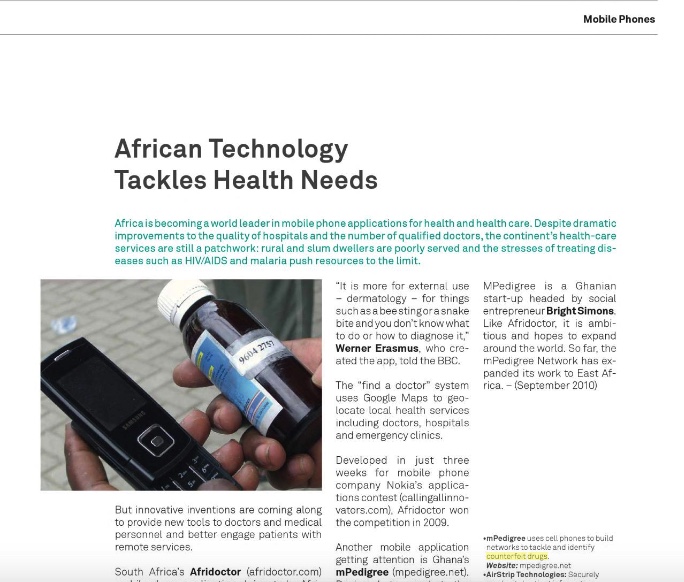
Africa is becoming a world leader in mobile phone applications for health and healthcare. Despite dramatic improvements to the quality of hospitals and the number of qualified doctors, the continent’s healthcare services are still a patchwork, with rural and slum dwellers poorly served and the stresses of treating patients with contagious diseases like HIV/AIDS and malaria pushing resources to the limit.

But innovative inventions are coming along to provide new tools to doctors and medical personnel and to better engage patients with remote services.

South Africa’s Afridoctor (http://twitter.com/afridoctor) mobile phone application claims to be Africa’s first personal mobile health clinic. It lets patients use its “SnapDiagnosis” system to submit photos of their ailments and in turn receive advice from a panel of medical professionals, or use the mapping feature to find doctors, clinics and health industry-related services nearby.

Afridoctor was conceived to fill the gap across Africa for basic health information that is reliable and trustworthy.

There is an emergency feature to notify next of kin during a medical emergency and provide a location. Other features include symptom checkers, first-aid information, health calculators and quizzes.

Expert feedback comes within 48 hours after submission of a request.

A winner of a Nokia competition, Afridoctor was developed by the labs of media company 24.com (http://20fourlabs.com) of Cape Town, South Africa.

“It is more for external use – like dermatology – for things like a bee sting or a snake bite and you don’t know what to do or how to diagnose it,” Werner Erasmus, who created the app, told the BBC.

The “find a doctor” system uses Google Maps to geo-locate local health services including doctors, hospitals and emergency clinics.

The distress feature enables users to contact a family member or friend at the touch of a button. It does this by storing the mobile phone number of a selected relative. When the distress button is pressed, they are notified of the phone’s location.

Developed in just three weeks, to enter mobile phone company Nokia’s contest (http://www.callingallinnovators.com) for mobile phone applications, Afridoctor went on to win the competition in 2009. It is now being expanded to be usable on most, if not all, smart phones.

As in the rest of Africa, mobile phone use in South Africa has dramatically increased in the past 10 years. It is estimated that over 70 percent of South Africans now have access to one.

Another application getting attention is Ghana’s mPedigree (http://mpedigree.net). Designed to combat the damage done by counterfeit drugs in Africa and across the South, mPedigree works by letting a person send a text message by mobile phone to the mPedigree service to check a drug’s authenticity. A message comes back confirming whether the medicine is authentic or not.

The World Health Organization (WHO) has estimated that 25 percent of medicines sold around the developing world are counterfeit. Some contain no active ingredients, and others are even harmful.

MPedigree is a Ghanian start-up headed by social entrepreneur Bright Simons (http://www.worldpress.org/freelancers/index.cfm/hurl/page=freelancerDetails/id=7). Like Afridoctor, it is ambitious and hopes to expand around the world. So far, the mPedigree Network has expanded its work to East Africa.

Published: September 2010

Resources

Development Challenges, South-South Solutions was launched as an e-newsletter in 2006 by UNDP’s South-South Cooperation Unit (now the United Nations Office for South-South Cooperation) based in New York, USA. It led on profiling the rise of the global South as an economic powerhouse and was one of the first regular publications to champion the global South’s innovators, entrepreneurs, and pioneers. It tracked the key trends that are now so profoundly reshaping how development is seen and done. This includes the rapid take-up of mobile phones and information technology in the global South (as profiled in the first issue of magazine Southern Innovator), the move to becoming a majority urban world, a growing global innovator culture, and the plethora of solutions being developed in the global South to tackle its problems and improve living conditions and boost human development. The success of the e-newsletter led to the launch of the magazine Southern Innovator.  

Creative Commons License

This work is licensed under a
Creative Commons Attribution-Noncommercial-No Derivative Works 3.0 License.

ORCID iD: https://orcid.org/0000-0001-5311-1052.

© David South Consulting 2023

Categories
Archive Development Challenges, South-South Solutions Newsletters

African Digital Laser Breakthrough Promises Future Innovation

By David SouthDevelopment Challenges, South-South Solutions

SOUTH-SOUTH CASE STUDY

For decades many African countries have experienced low investment in research and development (R&D) and scientific innovation. One of the few nations to benefit from a sophisticated university network and research and development sector was South Africa. It still ranks top on the continent for funding R&D and its high number of scientific journals.

And it seems this support has paid off in a recent innovation. The world’s first digital laser designed and built in Africa has been developed by a team of physicists at the University of KwaZulu–Natal in South Africa (http://www.ukzn.ac.za/), as reported in the MIT Technology Review (http://www.technologyreview.com/).

This innovation joins a positive trend in Africa, where support to science, technology and R&D is rising – albeit from a very low base. In 2010 UNESCO – the United Nations Educational, Scientific and Cultural Organization – found Africa was reversing decades of neglect in research and development. African countries were increasing investment in science and technology after realizing it will accelerate their connection with the global economy and help create better-quality jobs to tackle poverty. The UNESCO Science Report found Burkina Faso, Kenya, Nigeria and South Africa had adopted laws to support biotechnology research, for example.

Since 2005, six new science academies have been established in Mauritius, Morocco, Mozambique, Sudan, Tanzania and Zimbabwe. This compares to nine established between 1902 and 2004.

The proportion of GDP (gross domestic product) devoted to R&D averages 0.3 per cent in Africa, according to UNESCO.

South Africa continues to lead in R&D spending, raising its investment from 0.73 per cent of GDP in 2001 to 0.94 per cent in 2006. The country is home to 46 per cent of Africa’s scientific publications compared to 11.4 per cent in Nigeria and 6.6 per cent in Kenya (UNESCO).

Experts say the digital laser developed in South Africa is a breakthrough that will open up ever-further innovations and business opportunities.

So, what is a digital laser and what is the innovation? A laser is short form for Light Amplification by Stimulated Emission of Radiation. It is a device that produces a concentrated light source. Unlike conventional light sources that emit a diffused, multispectral light, lasers allow for a monochromatic light beam to be concentrated on a small area. This can be used to cut an object precisely, or beamed over long distances without losing its strength.

Lasers can create immense light, heat and power at close range and are regularly used in surgery and medical diagnosis.

Conventional lasers require external devices to alter and bend the laser light beam. The digital laser allows the shape of the beam to be digitally altered internally at the touch of a computer keyboard and gives greater immediate control. This means a plethora of new shapes can be formed with the laser beam, and this can have many practical applications.

The digital laser augers in a new age of creativity with lasers and more spontaneity in how they are used. Rather than having to place a lens or mirror at the front of the casing to shape the laser beam, this innovation makes it possible to create any shape desired digitally by a computer. The research team has been able to create various complex shapes for the laser beams in experiments. One mooted use is to apply laser beams to manipulate microscopic objects – similar to the tractor beams seen in science fiction films such as “Star Trek”.

Few of us spend much time thinking about lasers, yet they are ubiquitous in the modern world and are found in many electronic products (https://en.wikipedia.org/wiki/List_of_laser_applications). They play a critical part in the modern world’s economy. Some common applications for lasers include laser light shows at music concerts, bar code readers at the grocery store, or laser pointers used during public presentations. Dentists also use them to speed the hardening of fillings.

Not to exploit lasers as a technology in the modern world is equivalent to bypassing the silicon micro-chip that sits inside personal computers, electronic devices and mobile phones.

Published: May 2013

Resources

1) Digital laser: The research paper submitted by the team explaining the innovation. Website: http://arxiv.org/abs/1301.4760

2) 3D Laser Hologram Kit: Now you can make your own holograms at home with the help of this innovative kit. Website: http://www.scientificsonline.com/hologram-kit.html

3) Hands-On Science Kits and Demos. Website: http://ice.chem.wisc.edu/Catalog/SciKits.html

4) Home kit for making a Laser Theatre. Website: http://www.scientificsonline.com/laser-theater.html

5) Little Bits: littleBits is an open source library of electronic modules that snap together with magnets for prototyping, learning and fun. Website: http://littlebits.cc/

6) Consolidated Plan of Action for Africa’s Science and Technology adopted by African Minsters of Science and Technology in 2005. Website: http://www.nepad.org/humancapitaldevelopment/news/1581/advancing-science-and-technology-africa

Southern Innovator logo

London Edit

31 July 2013

Like science and technology stories from the global South? Here are some more from the archive:

China Sets Sights on Dominating Global Smartphone Market

China Pushing Frontiers of Medical Research

China Looking to Lead on Robot Innovation

Follow @SouthSouth1

Slideshare: http://www.slideshare.net/DavidSouth1/development-challengessouthsouthsolutionsnovember2010issue

Southern Innovator Issue 1: https://books.google.co.uk/books?id=Q1O54YSE2BgC&dq=southern+innovator&source=gbs_navlinks_s

Southern Innovator Issue 2: https://books.google.co.uk/books?id=Ty0N969dcssC&dq=southern+innovator&source=gbs_navlinks_s

Southern Innovator Issue 3: https://books.google.co.uk/books?id=AQNt4YmhZagC&dq=southern+innovator&source=gbs_navlinks_s

Southern Innovator Issue 4: https://books.google.co.uk/books?id=9T_n2tA7l4EC&dq=southern+innovator&source=gbs_navlinks_s

Southern Innovator Issue 5: https://books.google.co.uk/books?id=6ILdAgAAQBAJ&dq=southern+innovator&source=gbs_navlinks_s

Creative Commons License

This work is licensed under a
Creative Commons Attribution-Noncommercial-No Derivative Works 3.0 License.

ORCID iD: https://orcid.org/0000-0001-5311-1052.

© David South Consulting 2023

Categories
Archive

Profile of African Innovators Continues to Rise

By David South, Development Challenges, South-South Solutions

SOUTH-SOUTH CASE STUDY

A mix of developments is proving that African innovators no longer need to see themselves as lone operators working in isolation. Awareness of the continent’s talent has never been higher and is grabbing attention from the world’s media. In turn, more and more resources are being made available – from funding opportunities to get-togethers where innovators can meet like-minded people, to ego-boosting praise that helps raise profiles and attract investors.

This summer saw the launch of a new publication called African Innovator Magazine (africaninnovatormagazine.com). It is a good example of how perceptions have switched to recognizing that the continent is awash with innovators who have a lot to say.

Billing itself as “Technology insights for Africa’s decision makers,” African Innovator interviews business leaders on the continent about how they are driving innovation within their organizations.

Launched at a dinner on July 31 in Johannesburg, South Africa (http://www.flickr.com/photos/innovationdinner/sets/72157630881776882/), the quarterly magazine – with its glossy production values, high-quality photographs and design – is a reflection of how far the information technology business has come in Africa. The first issue asks “What is Innovation?” and features a broad range of African technology innovators, from Nigerian tablet personal computer maker Saheed Adepoju (http://enciphergroup.com/about/) to one of the world’s best-known technology innovators, South African-born Elon Musk (http://elonmusk.com/).

Publisher Abby Wakama told IT News Africa that the magazine would initially be distributed in South Africa, with plans to expand into Kenya and Nigeria.

“Our aim is to grow the reader base and branch out into new regions,” Wakama said. “The vision is to be the premier voice of Africa’s larger ICT community, covering issues that impact on commerce, trade, industry and the lives of everybody who uses IT.

“Readers do have a choice of publications that talk about ICT that cover technology and products. But there are very few that have an inside track into innovation in Africa. There are not many publications that discuss how technology is making an impact in the lives of Africans.”

For innovators strapped for cash to take their ideas forward, there are several new Africa-based funding sources to turn to.

In East Africa, the Rwanda Innovation Endowment Fund (RIEF) (http://www.mineduc.gov.rw/spip.php?article21) is a collaboration between the Government of Rwanda and the United Nations. The Fund aims to promote research and development (R&D) of “innovative market-oriented products and processes in priority areas of the economy” to increase the country’s wealth and economic competiveness.

For Africans as a whole, there is The Innovation Prize for Africa (IPA) (http://innovationprizeforafrica.org), an initiative of the United Nations Economic Commission for Africa (ECA) and the African Innovation Foundation (AIF) (africaninnovation.org). The prize hopes to place African innovators and entrepreneurs at the heart of the development agenda. It will be awarded to innovators who develop new products, increase efficiency or find ways to do things better and save money in Africa.

Africa Review, published by the Nation Media Group in Kenya, is “a digital news platform” providing “smart insights on African news and to examine important social and political trends in the continent.” It recently came up with a list of 20 East African “bold young innovators to watch”.

The 20 were selected because all of them are working on mobile phone applications and are creating “life-changing mobile apps in health care, education, finance and agriculture.”

They include:

  • Jamila Abass from Kenya, the founder and chief executive officer (CEO) for M-Farm (http://mfarm.co.ke/about), which is helping farmers get real-time retail prices for their products.
  • Tanzania’s Erric Mutta, founder and CEO of Problem Solved Ltd, set up the MiniShop mobile phone application for small businesses to make accounting and inventory control easier and more transparent – in turn making it easier to access credit.
  • Jessie Gakwandi Benimana runs Rwandan company Sail Ltd (http://sailltd.com/) and the Get-It application (http://www.youtube.com/watch?v=vU8SCfyzf9Q), which helps people to find restaurants in the capital Kigali.
  • Everyone knows Africans like to tell stories, and Victor Miclovich from Uganda is helping them to do this online. His StorySpaces (storyspaces.net) website “builds on the age-old African tradition of storytelling” for the digital age.
  • Tanzania’s Eric Lwambura is using technology to save lives during pregnancy. He is founder of Crystal Interactive Systems (CIS) (http://www.crystal-int.com/), which has developed a mobile phone-based application to assist doctors to detect problems during labour. It is designed for health centres that can’t afford more expensive and sophisticated equipment.
  • Kariuki Gathitu from Kenya who founded Zege Technologies (http://zegetech.com/home/), is working on innovative ways to transfer money. His latest development is M-Payer, helping small businesses manage their payments.

Read more about the East African technology innovators here: http://www.africareview.com/Special+Reports/-/979182/1513900/-/xpmsurz/-/index.html

Resources

1) Southern Innovator: Browse the back issues of Southern Innovator magazine. Website: http://www.scribd.com/SouthernInnovator

2) Innovative Africa: The New Face of Africa: Essays on the Rise of Africa’s Innovation Age by Will Mutua and Mbwana Ally, Publisher: Afrinnovator.  Website:http://book.afrinnovator.com/

3) The Coming Prosperity by Philip Auerswald, Publisher: Oxford University Press.  Website: http://auerswald.org/

Creative Commons License

This work is licensed under a
Creative Commons Attribution-Noncommercial-No Derivative Works 3.0 License.

ORCID iD: https://orcid.org/0000-0001-5311-1052.

© David South Consulting 2022