Categories
Archive Development Challenges, South-South Solutions Newsletters

New African Film Proving Power of Creative Economy

By David SouthDevelopment Challenges, South-South Solutions

SOUTH-SOUTH CASE STUDY

A new movie is generating excitement around life in the war-torn, chaotic and impoverished Democratic Republic of the Congo(http://en.wikipedia.org/wiki/Democratic_Republic_of_the_Congo – the central African nation – and proving how versatile and resilient a creative economy can be in a crisis.

Viva Riva! (http://www.vivarivamovie.com) is set in the capital, Kinshasa, and gives a raw portrayal of sex, violence and gangsters in the city. The film has already won a fistful of awards, and will now be released in 18 African countries.

Written and directed by Djo Tunda Wa Munga, it is being hailed as the first feature-length film to be made in the Democratic Republic of Congo in 25 years. The industry was shut down by long-serving dictator and President Mobutu Sese Seko, who was overthrown in 1997 in the First Congo War by Laurent-Désiré Kabila, who was supported by the governments of Rwanda, Burundi and Uganda.

Africa has a rich film history but its movies have struggled to reach commercial audiences – both on the continent and around the world – outside of showcases at film festivals. Without access to a wide audience, filmmakers are not able to make the sort of profits possible for films with a wide commercial distribution. It has also been hard to compete with the big budgets and the big publicity machines of traditional film centres like Hollywood or Europe. But it looks like Viva Riva! could change that situation.

Indigenous African filmmaking took off as countries became independent of their colonial European rulers in the 1960s and 1970s. One example is the Senegalese film comedy Xala (http://www.imdb.com/title/tt0073915/), directed by Ousmane Sembéne, and considered a classic. Previous portrayals of Africa have mostly been viewed through the cinematic lens of Europeans.

As the second largest country in Africa, the Congo has an estimated population of over 71 million (2011 estimate), with Kinshasa home to more than 8 million people (CIA – The World Factbook). It has suffered badly from war and chaos and has some of the world’s worst statistics for rape and sexual violence brought about by these conditions. The so-called Second Congo War began in 1998 and is considered the world’s deadliest conflict since the Second World War.

As a result, the world’s biggest United Nations peacekeeping mission is in the country in an attempt to stabilise the situation. (http://www.un.org/en/peacekeeping/missions/monuc/).

Filmmaking forms part of the creative economy, a vital and growing sector in many countries. As the Creative Economy Report 2010 states: “A new development paradigm is emerging that links the economy and culture, embracing economic, cultural, technological and social aspects of development at both the macro and micro levels. Central to the new paradigm is the fact that creativity, knowledge and access to information are increasingly recognized as powerful engines driving economic growth and promoting development in a globalizing world.”

For example,Nigeria’s US $2.75 billion annual film industry is the third largest in the world, following the U.S. and India. Nigeria’s ‘Nollywood’ produces more than 1,000 films a year, creating thousands of jobs, and is the country’s second most important industry after oil. In recognition of its importance, the country’s government has invested in the industry, reforming policies and providing training to promote film production and distribution.

The Creative Economy Report 2010 has highlighted a few key trends for the global South. It found that creative industry products, especially domestically consumed ones like videos, music, video games and TV programmes, are weathering the global economic crisis well. It also found the creative economy can help boost economies and bring countries out of recession if the right government policies are in place.

The exporting of creative goods and services continues to grow, doubling from 2002 to 2008. This represented a 14 percent per year growth rate. The global South’s exporting of creative goods reached a high of US $176 billion by 2008 and represented 43 percent of the world’s total creative industries trade.

The majority of the world’s mobile phones are now in developing countries, representing a vast, new platform for distributing, sharing and selling cultural products and services. Broadband Internet is also being rolled out to more countries and represents an enormous emerging opportunity waiting for enterprising people to seize.

The report also found more and more cities across the global South are placing creative economies at the centre of their urban development, emphasising culture and creative activities.

For Viva Riva!, the next stop is Africa-wide release in Botswana, Burkina Faso, Kenya, Lesotho, South Africa, Swaziland and Uganda. The film’s producers have their sights set on even more countries in central and West Africa.

“We want to show that you can release African films acrossAfrica,” co-producer Steven Markovitz told The Guardian. “As far as we can tell, it’s unprecedented. No one has tried to do an Africa-wide release in so many countries.”

There is more at stake with the film than just Congolese pride: it is about proving an African film can successfully take on the slick and well-funded film distribution machines deployed byAmerica’s Hollywood and European film distributers.

With the African middle class growing and a burgeoning African consumer class now clearly identified, many see this as the right time to make African film pay.

“African cinemas have been dominated by Hollywood and European cultural programmes catering to the intellectual elite, not tapping into a growing middle class who are interested in seeing films about themselves and their neighbours,” Markovitz told The Guardian.

“There is an audience, a real market for African films. They have disposable income and they want to be entertained. We hope that this will create a pipeline for further African titles on the continent.”

Viva Riva! is in French and Lingala (http://en.wikipedia.org/wiki/Lingala_language). The story revolves around a hustler who makes quick cash stealing oil and celebrates by going on a hedonistic romp through Kinshasa’s night clubs.

The film had its international debut at the 2010 Toronto International Film Festival and won the 2011 MTV Movie award for best African film.

Markovitz is from South African film production company Big World Cinema (http://www.bigworld.co.za). The producers hope the film will appeal to both French speakers and English speakers.

“There are distribution challenges in Africa but we thought this one presents an opportunity to make it happen,” he said. “Some African films have felt like homework but this is an entertaining action film and we think it can cross language barriers. We have to try things out.”

Critics have said good things about the film. The Nigerian actor and director Akin Omotoso told The Guardian: “I loved Viva Riva! Absolute breath of fresh air, an adrenalin rush from top to bottom, a great gangster flick.”

The film is unique as an African production that has “captured not just international attention but the continent’s attention”, he added.

“I think it stands a good chance; as we know, it’s up to the audience but either way it has made history.”

Published: November 2011

Resources

1) UNCTAD Global Database on the Creative Economy. Website:http://unctadstat.unctad.org/ReportFolders/reportFolders.aspx?sCS_referer=&sCS_ChosenLang=en

2) Creative Economy Report 2010: Creative Economy: A Feasible Development Option. Website:http://www.unctad.org/Templates/WebFlyer.asp?intItemID=5763&lang=1

4) Dictionary of African Filmmakers from Indiana University Press. Website:http://www.iupress.indiana.edu/product_info.php?products_id=76770

6) The Filmmakers Guide to South Africa is the most recognised, established and representative brand marketing the South African film industry locally and internationally. Website: http://www.filmmakersguide.co.za

7) Youth Filmmakers Africa: An initiative in Kenya to inspire the next generation of filmmakers. Website:http://www.indiegogo.com/Youth-Filmmakers-Africa

Other Film Stories

Angolan Film Grabs Attention at Film Festival

Bolivian Film School’s Film Scene Paying Off

Local Animation: A Way Out of Poverty

New Cuban Film Seeks to Revive Sector

Nollywood: Booming Nigerian Film Industry

Riverwood: Kenyan Super-fast, Super-cheap Filmmaking

Creative Commons License

This work is licensed under a
Creative Commons Attribution-Noncommercial-No Derivative Works 3.0 License.

ORCID iD: https://orcid.org/0000-0001-5311-1052.

© David South Consulting 2023
Categories
Archive Blogroll Development Challenges, South-South Solutions Newsletters

Riverwood: Kenyan Super-fast, Super-cheap Filmmaking

By David SouthDevelopment Challenges, South-South Solutions

SOUTH-SOUTH CASE STUDY

The African film-making success story of Nigeria’s Nollywood has been joined by another fast-rising star: Kenya’s Riverwood. Both are beneficiaries of the digital revolution in filmmaking over the last decade, and both are using low-cost digital filmmaking and editing to tell local stories — in the process making money and creating thousands of jobs.

The power of creative industries to create jobs and wealth has been a focus of UNESCO, through its Global Alliance for Cultural Diversity. UNESCO has been in the forefront in helping African countries re-shape their policies to take cultural industries into consideration. The promotion of cultural industries also has been incorporated into the New Partnership for Africa’s Development (NEPAD).

What is particularly attractive about this phenomenon for the poor in the South is its rough-and-ready approach to filmmaking: combining low-cost digital cameras and film editing software on personal computers, with small budgets and fast turn-around times. Films are made on location using local people. These factors make getting into filmmaking accessible and within reach of more people.

Riverwood is named after River Road, a bustling creative and business hub in Nairobi. Riverwood operates at a furious pace, with 20 to 30 films made every week. It adds up to 1,000 films a year selling 500,000 copies at 200 Kenyan shillings (US $2.60) a piece: 1 billion shillings (US $13 million) in the past two years.

The whole industry is totally self-sufficient, and is following the well-trodden path laid down by Hollywood and India’s Bollywood.

One of Kenya’s woman directors is leading the renaissance in filmmaking. “Movies are very important because I think they are the most important art in Kenya – in Africa,” said Wanjiru Kinyanjui in the film, “Riverwood, the Blooming of a Film Industry,” by the World Intellectual Property Organization (www.wipo.org). “Basically, because Africans have an oral tradition, and a visual one, there is a huge market for local films.”

Riverwood films share a common characteristic of on-the-spot sets and a resourceful and cheap approach.

“They are shot in two, three days and edited in a week,” she continued. “They are selling because people can identify with them. The films being in Riverwood are basically the lives of people, reflecting the Kenyan way of life and entertaining Kenyans. “

And it is a new form of employment for many people:  “When I am making a movie, I need people: you employ very many people. And you also employ yourself. It is a real way of getting rid of poverty. Because all this talent, which is untapped, could be working.”

And as Riverwood rising star director John E. Maina puts it: “Hollywood is the model for any society that wants to develop.”

While still in its infancy compared to Nigeria’s Nollywood, Riverwood is already pioneering ways to protect the creative rights of filmmakers and build a financially-sustainable industry. Inspired by Hollywood’s ownership of creative material, Kenyan filmmakers have come up with some ingenious solutions. Each production company has a rubber stamp and signs on the sleeve of the DVD (digital video disc) – even if it is 1,000 copies.

If a director finds a pirated copy, and even if pirates have forged the rubber stamp, the signature will look like a forgery.

“It is based on a business model,” said director John E. Maina. ”It is commercial. So it is self-sustaining. This is how Bollywood is growing, this is how Nollywood is growing, this is how Hollywood developed.”

As pioneers in copyright protection, Riverwood directors strongly believe they are an important part of the country’s development.

“When you pirate a product, and the resources are not channelled back to the person who created that product, he is losing out on creating a new product for you tomorrow,” said Maina. “So you are the loser: tomorrow you will not have another product.

“Riverwood, Nollywood, Hollywood, are the model for any society that wants to develop. No society will develop without an audiovisual industry. And I think the way to protect an audiovisual industry is through strong copyright laws,” he said.

“If you go to most of the cafes and the pubs in Kenya, people only turn to TV at 7 o’clock, watch the news, after the news is over, they tell the management to put for them the local DVDs from Riverwood. Because they see themselves, they identify with those images. They don’t identify with the foreign American films, the soaps from South America.<

“The audiovisual industry is a mirror. If you don’t have a mirror to see yourself, you don’t know who you are. If you don’t have that mirror to see yourself, you are lost.”

Published: November 2008

Resources

  • The global charity Camfed (dedicated to eradicating poverty in Africa through the education of girls and empowerment of women) has projects to teach women filmmaking skills. Website: http://uk.camfed.org
  • Festival Panafricain du Cinéma et de la Television de Ouagadoogou 2009: Africa’s biggest film festival. Website: http://www.fespaco.bf/
  • Naijarules: Billing itself as the “largest online community of lovers and critics of Nollywood”, an excellent way to connect with all the players in the business.Website: http://www.naijarules.com/vb/index.php
  • A film by the World Intellectual Property Organization about the Riverwood phenomenon and an introduction to its up-and-coming directors. Website: http://uk.youtube.com/watch?v=OwSu5kcUErE

Citations

Cited in The Liverpool Companion to World Science Fiction Film by Sonja Fritzsche (2014).

Accentuating the positive: Building capacity for creative industries into the development agenda for global intellectual property law by Sean A. Pager, Michigan State University College of Law, American University International Law Review, 2012

Cinema as cultural discourse: A study of cultural symbols in selected contemporary Gikuyu comedies by Stanley Mbugua Njoroge, School of Creative and Performing Arts, Film and Media Studies, Kenyatta University, 2019

Other Film Stories

https://davidsouthconsulting.org/2022/03/30/angolan-film-grabs-attention-at-film-festival/

https://davidsouthconsulting.org/2022/04/01/bolivian-film-schools-film-scene-paying-off/

https://davidsouthconsulting.org/2022/10/21/local-animation-a-way-out-of-poverty/

https://davidsouthconsulting.org/2021/02/04/new-cuban-film-seeks-to-revive-sector/

https://davidsouthconsulting.org/2020/11/30/nollywood-booming-nigerian-film-industry/

Creative Commons License

This work is licensed under a
Creative Commons Attribution-Noncommercial-No Derivative Works 3.0 License.

ORCID iD: https://orcid.org/0000-0001-5311-1052.

© David South Consulting 2023

Categories
Archive Development Challenges, South-South Solutions Newsletters

African Digital Laser Breakthrough Promises Future Innovation

By David SouthDevelopment Challenges, South-South Solutions

SOUTH-SOUTH CASE STUDY

For decades many African countries have experienced low investment in research and development (R&D) and scientific innovation. One of the few nations to benefit from a sophisticated university network and research and development sector was South Africa. It still ranks top on the continent for funding R&D and its high number of scientific journals.

And it seems this support has paid off in a recent innovation. The world’s first digital laser designed and built in Africa has been developed by a team of physicists at the University of KwaZulu–Natal in South Africa (http://www.ukzn.ac.za/), as reported in the MIT Technology Review (http://www.technologyreview.com/).

This innovation joins a positive trend in Africa, where support to science, technology and R&D is rising – albeit from a very low base. In 2010 UNESCO – the United Nations Educational, Scientific and Cultural Organization – found Africa was reversing decades of neglect in research and development. African countries were increasing investment in science and technology after realizing it will accelerate their connection with the global economy and help create better-quality jobs to tackle poverty. The UNESCO Science Report found Burkina Faso, Kenya, Nigeria and South Africa had adopted laws to support biotechnology research, for example.

Since 2005, six new science academies have been established in Mauritius, Morocco, Mozambique, Sudan, Tanzania and Zimbabwe. This compares to nine established between 1902 and 2004.

The proportion of GDP (gross domestic product) devoted to R&D averages 0.3 per cent in Africa, according to UNESCO.

South Africa continues to lead in R&D spending, raising its investment from 0.73 per cent of GDP in 2001 to 0.94 per cent in 2006. The country is home to 46 per cent of Africa’s scientific publications compared to 11.4 per cent in Nigeria and 6.6 per cent in Kenya (UNESCO).

Experts say the digital laser developed in South Africa is a breakthrough that will open up ever-further innovations and business opportunities.

So, what is a digital laser and what is the innovation? A laser is short form for Light Amplification by Stimulated Emission of Radiation. It is a device that produces a concentrated light source. Unlike conventional light sources that emit a diffused, multispectral light, lasers allow for a monochromatic light beam to be concentrated on a small area. This can be used to cut an object precisely, or beamed over long distances without losing its strength.

Lasers can create immense light, heat and power at close range and are regularly used in surgery and medical diagnosis.

Conventional lasers require external devices to alter and bend the laser light beam. The digital laser allows the shape of the beam to be digitally altered internally at the touch of a computer keyboard and gives greater immediate control. This means a plethora of new shapes can be formed with the laser beam, and this can have many practical applications.

The digital laser augers in a new age of creativity with lasers and more spontaneity in how they are used. Rather than having to place a lens or mirror at the front of the casing to shape the laser beam, this innovation makes it possible to create any shape desired digitally by a computer. The research team has been able to create various complex shapes for the laser beams in experiments. One mooted use is to apply laser beams to manipulate microscopic objects – similar to the tractor beams seen in science fiction films such as “Star Trek”.

Few of us spend much time thinking about lasers, yet they are ubiquitous in the modern world and are found in many electronic products (https://en.wikipedia.org/wiki/List_of_laser_applications). They play a critical part in the modern world’s economy. Some common applications for lasers include laser light shows at music concerts, bar code readers at the grocery store, or laser pointers used during public presentations. Dentists also use them to speed the hardening of fillings.

Not to exploit lasers as a technology in the modern world is equivalent to bypassing the silicon micro-chip that sits inside personal computers, electronic devices and mobile phones.

Published: May 2013

Resources

1) Digital laser: The research paper submitted by the team explaining the innovation. Website: http://arxiv.org/abs/1301.4760

2) 3D Laser Hologram Kit: Now you can make your own holograms at home with the help of this innovative kit. Website: http://www.scientificsonline.com/hologram-kit.html

3) Hands-On Science Kits and Demos. Website: http://ice.chem.wisc.edu/Catalog/SciKits.html

4) Home kit for making a Laser Theatre. Website: http://www.scientificsonline.com/laser-theater.html

5) Little Bits: littleBits is an open source library of electronic modules that snap together with magnets for prototyping, learning and fun. Website: http://littlebits.cc/

6) Consolidated Plan of Action for Africa’s Science and Technology adopted by African Minsters of Science and Technology in 2005. Website: http://www.nepad.org/humancapitaldevelopment/news/1581/advancing-science-and-technology-africa

Southern Innovator logo

London Edit

31 July 2013

Like science and technology stories from the global South? Here are some more from the archive:

China Sets Sights on Dominating Global Smartphone Market

China Pushing Frontiers of Medical Research

China Looking to Lead on Robot Innovation

Follow @SouthSouth1

Slideshare: http://www.slideshare.net/DavidSouth1/development-challengessouthsouthsolutionsnovember2010issue

Southern Innovator Issue 1: https://books.google.co.uk/books?id=Q1O54YSE2BgC&dq=southern+innovator&source=gbs_navlinks_s

Southern Innovator Issue 2: https://books.google.co.uk/books?id=Ty0N969dcssC&dq=southern+innovator&source=gbs_navlinks_s

Southern Innovator Issue 3: https://books.google.co.uk/books?id=AQNt4YmhZagC&dq=southern+innovator&source=gbs_navlinks_s

Southern Innovator Issue 4: https://books.google.co.uk/books?id=9T_n2tA7l4EC&dq=southern+innovator&source=gbs_navlinks_s

Southern Innovator Issue 5: https://books.google.co.uk/books?id=6ILdAgAAQBAJ&dq=southern+innovator&source=gbs_navlinks_s

Creative Commons License

This work is licensed under a
Creative Commons Attribution-Noncommercial-No Derivative Works 3.0 License.

ORCID iD: https://orcid.org/0000-0001-5311-1052.

© David South Consulting 2023
Categories
Archive Development Challenges, South-South Solutions Newsletters Southern Innovator magazine

African Megacity Makeovers Tackle Rising Populations

By David SouthDevelopment Challenges, South-South Solutions

SOUTH-SOUTH CASE STUDY

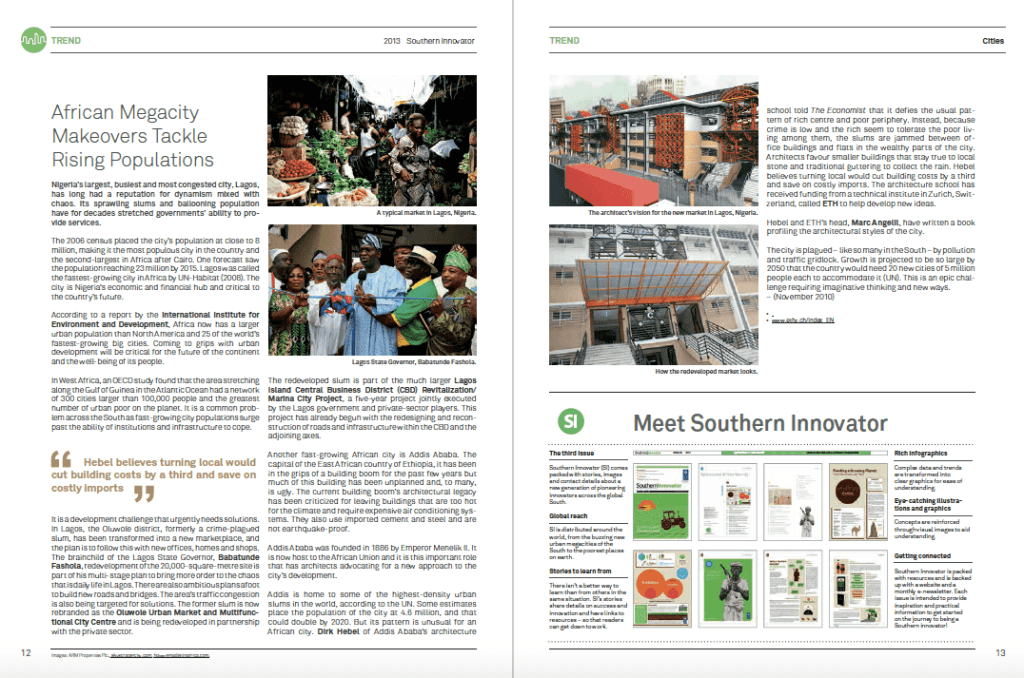
Nigeria’s largest, busiest and most congested city, Lagos, has long had a reputation for dynamism mixed with chaos. Its sprawling slums and ballooning population have for decades stretched governments’ ability to provide services.

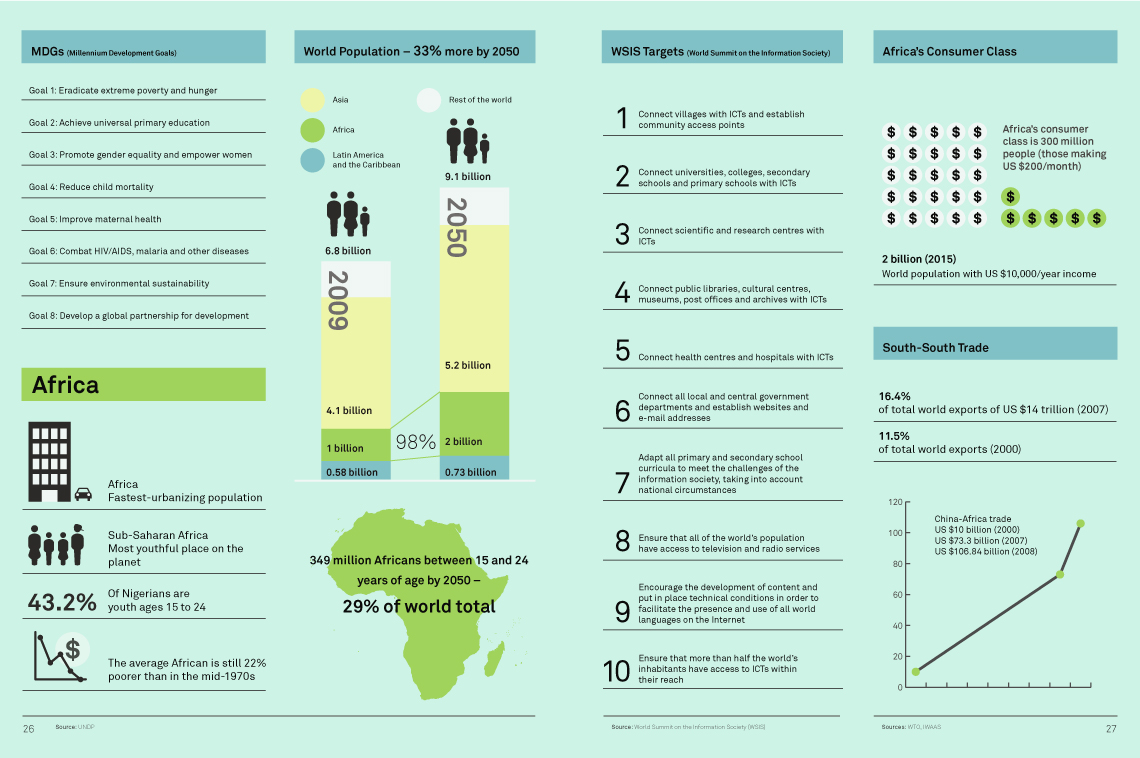
The 2006 census placed the city’s population at close to 8 million, making it the most populous city in the country and the second largest in Africa after Cairo. One forecast saw the population reaching 23 million by 2015. It was called the fastest growing city in Africa by UNHABITAT (2008). The city is Nigeria’s economic and financial hub and critical to the country’s future.

According to a report by the International Institute for Environment and Development, Africa now has a larger urban population than North America and 25 of the world’s fastest growing big cities. Getting to grips with urban development will be critical for the future of the continent and the wellbeing of its people.

In West Africa, an OECD study found the area stretching along the Gulf of Guinea in the Atlantic Ocean had a network of 300 cities larger than 100,000 people and the biggest collection of urban poverty on the planet.

It is a common problem across the South as fast-growing city populations surge past the ability of institutions and infrastructure to cope.

By 2025, Asia could have 10 or more cities with populations larger than 20 million (Far Eastern Economic Review).

It is a development challenge that urgently needs solutions.

In Lagos, the Oluwole district – formerly a crime-plagued slum – has been transformed into a new marketplace, and the plan is to follow this with new offices, homes and shops. The brainchild of the Lagos state governor Babatunde Fashola (http://en.wikipedia.org/wiki/Babatunde_Fashola), redevelopment of the 20,000 square metre site is part of his multi-stage plan to bring more order to the chaos that is daily life in Lagos. There are also ambitious plans afoot to build new roads and bridges. The area’s traffic congestion is also being targeted for solutions. The former slum is now re-branded as the Oluwole Urban Market and Multifunctional City Centre (http://tinyurl.com/2wmrscq) and is being re-developed in partnership with the private sector.

The re-developed slum is part of the much-larger Lagos Island Central Business District (CBD) Revitalisation/Marina City Project, a five-year project, jointly executed by the Lagos government and private sector players. This project has already begun with the redesigning and reconstruction of roads and infrastructure within the CBD and the adjoining axes.

Another fast-growing African city is Addis Ababa. The capital of the East African nation of Ethiopia, it has been in the grip of a building boom for the past few years. But much of this building has been unplanned and, to many, is ugly. The current building boom’s architectural legacy has been criticized for leaving buildings that are too hot for the climate and require expensive air conditioning systems. They also use imported cement and steel and are not earthquake-proof.

Addis Ababa (http://en.wikipedia.org/wiki/Addis_Ababa) was founded in 1886 by Emperor Menelik II. It is now host to the African Union (http://www.africa-union.org/) and it is this important role that has architects advocating for a new approach to the city’s development.

Addis is home to some of the highest density urban slums in the world, according to the UN. Some estimates place the population at of the city at 4.6 million people and that it could double by 2020. But its pattern is unusual for an African city. Dirk Hebel of Addis Ababa’s architecture school  (http://www.eiabc.edu.et/managing-board/scientific-director.html) told The Economist it defies the usual pattern of rich centre and poor periphery. Instead, because crime is low and the rich seem to tolerate the poor living among them, the slums are jammed between office buildings and flats in the wealthy parts of the city.

Architects favour smaller buildings that stay true to local stone and traditional guttering to collect the rain. Hebel believes turning local would cut building costs by a third and save on costly imports.

The architecture school has received funding from a technical institute in Zurich, Switzerland called ETH (http://www.ethz.ch/index_EN) to help develop new ideas.

Hebel and ETH’s head, Marc Angelil, have written a book profiling the architectural styles of the city. The city has gone through various phases: during its Marxist period (1974-1991) government buildings mimicked the Soviet Union. During the Italian fascist occupation (1935-1941) they followed the styles favoured by Italian dictator Benito Mussolini. Political problems aside, the architects believe the Italians brought good planning, allowing streets to radiate out from landmark buildings.

The city is plagued – like so many in the South – by pollution and traffic gridlock. Growth is on projection to be so large by 2050, the country would need 20 new cities of 5 million people each to accommodate it (UN). This is an epic challenge requiring imaginative thinking and new ways.

Published: November 2010

https://davidsouthconsulting.org/2022/10/17/ambitious-schemes-hope-to-advance-economic-development/

https://davidsouthconsulting.org/2020/04/22/artists-fear-indifference-from-megacity/

https://davidsouthconsulting.org/2020/12/04/big-data-can-transform-the-global-souths-growing-cities/

https://davidsouthconsulting.org/2022/10/19/chinese-building-solution-for-rapidly-urbanizing-global-south/

https://davidsouthconsulting.org/2021/10/21/cities-for-all-shows-how-the-worlds-poor-are-building-ties-across-the-global-south/

https://davidsouthconsulting.org/2020/12/11/cyber-cities-an-oasis-of-prosperity-in-the-south/

https://davidsouthconsulting.org/2021/11/04/filipino-architect-wants-to-transform-slum-with-new-plan/

https://davidsouthconsulting.org/2022/03/20/global-south-eco-cities-show-how-the-future-can-be/

https://davidsouthconsulting.org/2021/11/12/global-souths-rising-megacities-challenge-idea-of-urban-living/

https://davidsouthconsulting.org/2022/09/28/model-cities-across-the-south-challenge-old-ways/

https://davidsouthconsulting.org/2022/10/10/more-futuristic-african-cities-in-the-works/

https://davidsouthconsulting.org/2021/11/12/new-cities-offering-solutions-for-growing-urban-populations/

https://davidsouthconsulting.org/2017/11/08/smart-cities-up-close-2013/

https://davidsouthconsulting.org/2021/10/22/south-south-cooperation-for-cities-in-asia/

https://davidsouthconsulting.org/2020/04/22/will-the-megacity-mean-mega-privatization/

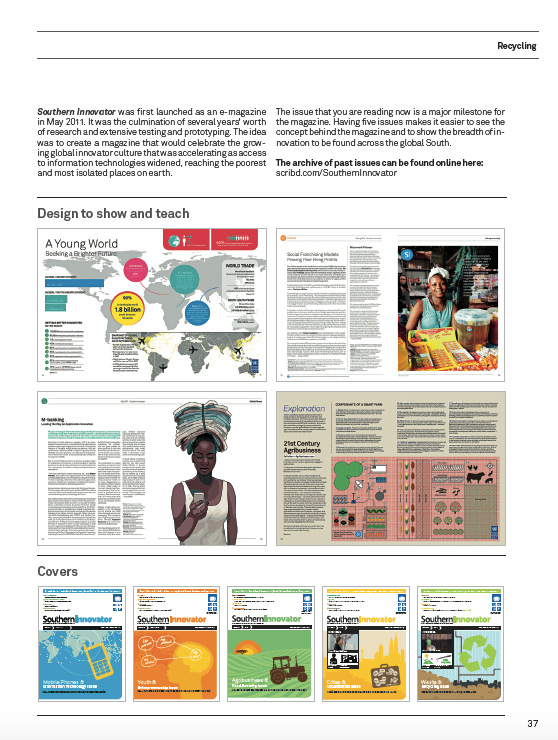
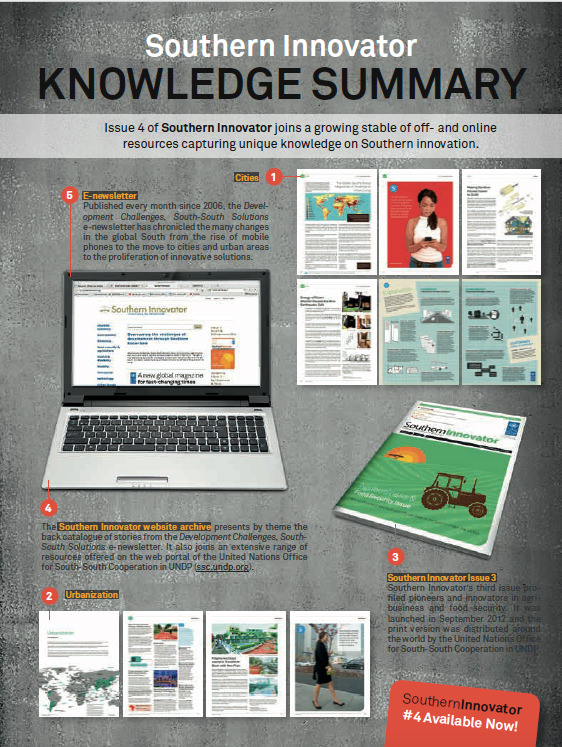
Development Challenges, South-South Solutions was launched as an e-newsletter in 2006 by UNDP’s South-South Cooperation Unit (now the United Nations Office for South-South Cooperation) based in New York, USA. It led on profiling the rise of the global South as an economic powerhouse and was one of the first regular publications to champion the global South’s innovators, entrepreneurs, and pioneers. It tracked the key trends that are now so profoundly reshaping how development is seen and done. This includes the rapid take-up of mobile phones and information technology in the global South (as profiled in the first issue of magazine Southern Innovator), the move to becoming a majority urban world, a growing global innovator culture, and the plethora of solutions being developed in the global South to tackle its problems and improve living conditions and boost human development. The success of the e-newsletter led to the launch of the magazine Southern Innovator.  

Follow @SouthSouth1

Slideshare: http://www.slideshare.net/DavidSouth1/development-challengessouthsouthsolutionsnovember2010issue

Southern Innovator Issue 1: https://books.google.co.uk/books?id=Q1O54YSE2BgC&dq=southern+innovator&source=gbs_navlinks_s

Southern Innovator Issue 2: https://books.google.co.uk/books?id=Ty0N969dcssC&dq=southern+innovator&source=gbs_navlinks_s

Southern Innovator Issue 3: https://books.google.co.uk/books?id=AQNt4YmhZagC&dq=southern+innovator&source=gbs_navlinks_s

Southern Innovator Issue 4: https://books.google.co.uk/books?id=9T_n2tA7l4EC&dq=southern+innovator&source=gbs_navlinks_s

Southern Innovator Issue 5: https://books.google.co.uk/books?id=6ILdAgAAQBAJ&dq=southern+innovator&source=gbs_navlinks_s

https://davidsouthconsulting.org/2021/03/05/southern-innovator-issue-4/

Creative Commons License
This work is licensed under a
Creative Commons Attribution-Noncommercial-No Derivative Works 3.0 License.

ORCID iD: https://orcid.org/0000-0001-5311-1052.

© David South Consulting 2022