Categories
Archive Development Challenges, South-South Solutions Newsletters

Ugandan Project Pioneers Transparent Development

By David SouthDevelopment Challenges, South-South Solutions

SOUTH-SOUTH CASE STUDY

A pioneering experiment in the community of Katine (www.guardian.co.uk/katine) in the East African nation of Uganda recently came to its official end. A unique three-year project to try and transform the development outcomes of this rural community, it pioneered a new model of communicating aid and development. Unusual transparency was used to show how things work – or don’t – in development. The budgets, the reports and the evaluations are all available on the website. Britain’s Guardian newspaper regularly covered the work, and two Ugandan journalists embedded in the community gave regular updates as well.

A rich resource of web content was built up over the three years. People were able to post their comments and criticisms on the website for all to see. Members of the community logged onto the website as well and gave their on-the-ground views. Development workers had to explain what they were doing and why.

Anthropologist Ben Jones wrote in The Guardian that Katine is “remarkable: for the first time, the complex reality of doing a development project has been brought to a wider audience.”

Katine is a rural community of villages and home to 29,000 people. The Katine development project set out to focus on five aspects of deprivation: health, education, water and sanitation, livelihoods and governance.

It was launched in 2007, when The Guardian urged its readers to donate to support the project. The British bank Barclays pledged to match the donations up to £1 million (US$1,619,229). The NGO Farm-Africa (http://www.farmafrica.org.uk/) provided expertise on agriculture and the project partnered with Amref (http://uk.amref.org/), a leading African health NGO.

Journalists, academics, development experts and NGOs tracked progress on the web and shared this with the general public.

The records show that the project spent a total of US $3.72 million between 2007 and 2010. Administration in various forms used US $968,166 while, US $501,935 was spent on health projects, US $650,866 on education and US $577,997 on water and sanitation.

Accomplishments included a boost to safe water coverage from 42 percent to 69.6 percent, and the distribution of 7,000 malaria nets. A co-operative was set up to help sell surplus agricultural products from farmers and teach new skills to grow disease-resistant cassava. A culture of saving and investing was also introduced with the establishment of 150 village savings and loans associations. They charged a start up membership fee of 12 US cents. Villagers used small loans to start small businesses or to buy medicine. In one year, a total of £22, 482 (US $36,401) was banked.

Along the three-year journey, tempers flared over the cost of a school’s classrooms, and people vented their feelings regularly on the project website.

Beyond the donated inputs to the community, the issue of sustainability has taken more hard work. The community needed a better organizing structure and committees were established: village health teams, parent-teacher associations, water source committees, farmers’ groups, parent-teacher associations, and village savings associations.

It wasn’t just a legacy of poverty the community had to contend with: residents also were overcoming the disruption and trauma of decades of violence and instability. The Lord’s Resistance Army had terrorised the population in 2003, for example.

With the relationship with The Guardian ending, Amref will continue to work for another year to strengthen the community structures to lock in the sustainability of the achievements.

This experience is an interesting one that could be copied across the South, with people sharing their recent experiences of development and how they overcame poverty.

Published: November 2010

https://davidsouthconsulting.org/2022/11/21/africa/

https://davidsouthconsulting.org/2022/10/14/anti-bribery-website-in-india-inspires-others/

https://davidsouthconsulting.org/2021/03/04/innovation-villages-tackling-mdgs/

https://davidsouthconsulting.org/2021/04/08/making-the-world-a-better-place-for-southern-projects/

https://davidsouthconsulting.org/2021/03/31/new-weapon-against-crime-in-the-south/

https://davidsouthconsulting.org/2022/11/23/publications/

https://davidsouthconsulting.org/2021/02/22/team-southern-innovator-phase-1-development-2010-2015/

https://davidsouthconsulting.org/2021/09/16/ugandan-fish-sausages-transform-female-fortunes/

https://davidsouthconsulting.org/2022/06/16/women-mastering-trade-rules/

Development Challenges, South-South Solutions was launched as an e-newsletter in 2006 by UNDP’s South-South Cooperation Unit (now the United Nations Office for South-South Cooperation) based in New York, USA. It led on profiling the rise of the global South as an economic powerhouse and was one of the first regular publications to champion the global South’s innovators, entrepreneurs, and pioneers. It tracked the key trends that are now so profoundly reshaping how development is seen and done. This includes the rapid take-up of mobile phones and information technology in the global South (as profiled in the first issue of magazine Southern Innovator), the move to becoming a majority urban world, a growing global innovator culture, and the plethora of solutions being developed in the global South to tackle its problems and improve living conditions and boost human development. The success of the e-newsletter led to the launch of the magazine Southern Innovator.  

Follow @SouthSouth1

Slideshare: http://www.slideshare.net/DavidSouth1/development-challengessouthsouthsolutionsnovember2010issue

Southern Innovator Issue 1: https://books.google.co.uk/books?id=Q1O54YSE2BgC&dq=southern+innovator&source=gbs_navlinks_s

Southern Innovator Issue 2: https://books.google.co.uk/books?id=Ty0N969dcssC&dq=southern+innovator&source=gbs_navlinks_s

Southern Innovator Issue 3: https://books.google.co.uk/books?id=AQNt4YmhZagC&dq=southern+innovator&source=gbs_navlinks_s

Southern Innovator Issue 4: https://books.google.co.uk/books?id=9T_n2tA7l4EC&dq=southern+innovator&source=gbs_navlinks_s

Southern Innovator Issue 5: https://books.google.co.uk/books?id=6ILdAgAAQBAJ&dq=southern+innovator&source=gbs_navlinks_s

https://davidsouthconsulting.org/2021/03/05/southern-innovator-issue-2/

Creative Commons License
This work is licensed under a
Creative Commons Attribution-Noncommercial-No Derivative Works 3.0 License.

ORCID iD: https://orcid.org/0000-0001-5311-1052.

© David South Consulting 2023

Categories
Archive Blogroll data digital ID Now Magazine

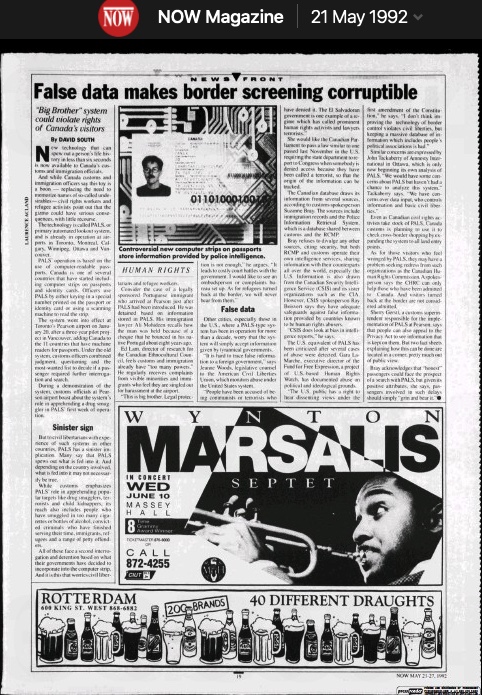
False Data Makes Border Screening Corruptible

“Big Brother” system could violate rights of Canada’s visitors

By David South

Now Magazine (Toronto, Canada), May 21-27, 1992

New technology that can spew out a person’s life history in less than six seconds is now available to Canada’s customs and immigration officials.

And while Canada customs and immigration officers say this toy is a boon – replacing the need to memorize names of so-called undesirables – civil rights workers and refugee activists point out that the gizmo could have serious consequences, with little recourse.

The technology is called PALS, or primary automated look out system, and is already in operation at airports in Toronto, Montreal, Calgary, Winnipeg, Ottawa and Vancouver.

PALS’ operation is based on the use of computer-readable passports. Canada is one of several countries that have started including computer strips on passports and identity cards. Officers use PALS by either keying in a special number printed on the passport or identity card or using a scanning machine to read the strip.

The system went into effect at Toronto’s Pearson airport on January 20, after a three-year pilot project in Vancouver, adding Canada to the 11 countries that have machine readers for passports. Under the old system, customs officers combined judgement, questioning and the most-wanted list to decide if a passenger required further interrogation and search.

During a demonstration of the system, customs officials at Pearson airport boast about the system’s role in apprehending a drug smuggler in PALS’ first week of operation.

Sinister sign

But to civil libertarians with experience of such systems in other countries, PALS hasa sinister implication. Many say that PALS spews out what is fed into it. And depending on the country involved, what is fed into it may not necessarily be true.

While customs emphasizes PALS’ role in apprehending popular targets like drug smugglers, terrorists and child kidnappers, its reach also includes people who have smuggled in too many cigarettes or bottles of alcohol, convicted criminals who have finished serving their time, immigrants, refugees and a range of petty offenders.

All of these face a second interrogation and detention based on what their governments have decided to incorporate into the computer strip. And it is this that worries civil libertarians and refugee workers.

Consider the case of a legally sponsored Portuguese immigrant who arrived at Pearson just after PALS had been introduced. He was detained based on information stored in PALS. His immigration lawyer Ali Mohideen recalls how the man was held because of a cheque that he bounced in his native Portugal about eight years ago.

Ed Lam, director of research for the Canadian Ethnocultural Council, feels customs and immigration already have “too many powers.” He regularly receives complaints from visible minorities and immigrants who feel they are singled out for harassment at the airport.

“This is big brother. Legal protection is not enough,” he argues. “It leads to costly court battles with the government. I would like to see an ombudsperson or complaints bureau set up. As for refugees turned back at the border, we will never hear from them.”

False data

Other critics, especially those in the US, where a PALS-type system has been in operation for more than a decade, worry that the system will simply accept information given by tyrannical governments.

“It is hard to trace false information to a foreign government,” says Jeanne Woods, legislative counsel to the American Civil Liberties Union, which monitors abuse under the United States system.

“People have been accused of being communists or terrorists who have denied it. The El Salvadoran government is one example of a regime which has called prominent human rights activists and lawyers terrorists.”

She would like the Canadian Parliament to pass a law similar to one passed last November in the US requiring the state department to report to Congress when somebody is denied access because they have been called a terrorist, so that the origin of the information can be tracked.

“People have been accused of being communists or terrorists who have denied it. The El Salvadoran government is one example of a regime which has called prominent human rights activists and lawyers terrorists.”

The Canadian database draws its information from several sources, according to customs spokesperson Suzanne Bray. The sources include immigration records and the Police Information Retrieval System, which is a database shared between customs and the RCMP.

Bray refuses to divulge any other sources, citing security, but both RCMP and customs operate their own intelligence services, sharing information with their counterparts all over the world, especially the US. Information is also drawn from the Canadian Security Intelligence Service (CSIS) and its sister organizations such as the CIA. However, CSIS spokesperson Ray Boisvert says they have adequate safeguards against false information provided by countries known to be human rights abusers.

“CSIS does look at bias in intelligence reports,” he says.

The US equivalent of PALS has been criticized after several cases of abuse were detected. Gara LaMarche, executive director of the Fund for Free Expression, a project of US-based Human Rights Watch, has documented abuse on political and ideological grounds.

“The US public has a right to hear dissenting views under the first amendment of the Constitution,” he says. “I don’t think improving the technology of border control violates civil liberties, but keeping a massive database of information which includes people’s political associations is bad.”

Similar concerns are expressed by John Tackaberry of Amnesty International in Ottawa, which is only now beginning its own analysis of PALS. “We have concerns over data input, who controls information and basic civil liberties.”

Even as Canadian civil rights activists take stock of PALS, Canada customs is planning to use it to check cross-border shopping by expanding the system to all land entry points.

As for those visitors who feel wronged by PALS, they may have a problem seeking redress from such organizations as the Canadian Human Rights Commission. A spokesperson says the CHRC can only help those who have been admitted to Canada. And visitors turned back at the border are not considered admitted.

Sherry Gerstl, a customs superintendent responsible for the implementation of PALS at Pearson, says that people can also appeal to the Privacy Act to see information that is kept on them. But two fact sheets explaining how this can be done are located in a corner, pretty much out of public view.

Bray acknowledges that “honest” passengers could face the prospect of a search with PALS, but given its positive attributes, she says, passengers involved in such delays should simply “grin and bear it.”

Facial recognition AI software triangulates facial features to produce a recognition match.
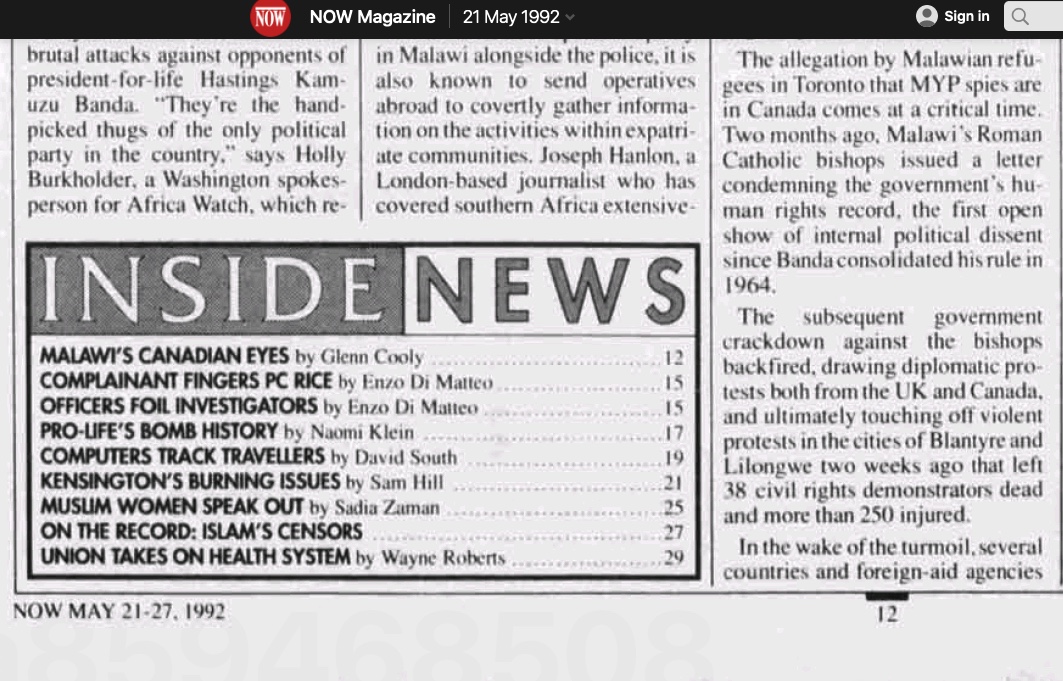
“Computers Track Travellers” by David South. Now Magazine published investigative journalism from David South, Naomi Klein and others in the early 1990s.

More on biometrics:

https://davidsouthconsulting.org/2022/02/09/african-health-data-revolution/

https://davidsouthconsulting.org/2020/12/04/big-data-can-transform-the-global-souths-growing-cities/

https://davidsouthconsulting.org/2020/12/04/data-surge-across-global-south-promises-to-re-shape-the-internet/

https://davidsouthconsulting.org/2021/03/04/indian-id-project-is-foundation-for-future-economic-progress/

https://davidsouthconsulting.org/2021/03/31/new-weapon-against-crime-in-the-south/

Creative Commons License

This work is licensed under a
Creative Commons Attribution-Noncommercial-No Derivative Works 3.0 License.

 ORCID iD: https://orcid.org/0000-0001-5311-1052.

© David South Consulting 2023

Categories
Annex Gleaner Archive Blogroll

Safety At Stake

By David South

Annex Gleaner (Toronto, Canada), February 1997

Toronto’s innovative crime-fighting and crime-prevention experiments face elimination if and when the city is swallowed up by the monolithic megacity. And the Annex’s status as one of Toronto’s safest neighbourhoods could be destroyed by the resulting tax increases.

Since the late 1980s, thinking about crime in Toronto has focused on public safety rather than just cops in cars. Taking what can be called a holistic approach, the city has poured millions into public health programs, street lighting, safety audits and social services, and it has led the region in putting cops back on foot patrol.

Carolyn Whitzman, coordinator of the Safe City Committee – founded in 1989 and a symbol of that attitude change – worries many of the services will find their funds cut or their street-level approach altered.

“I don’t know if people in Toronto realize how privileged they are,” she says. “All these programs have led us to be one of the safest cities in the world. There is nothing like the Safe City Committee in surrounding municipalities. There is nothing like it at Metro – though they do fund safety initiatives.”

The Safe City Committee was the first of its kind in North America and subsequently has been copied by other cities. Initiatives funded by the committee include pamphlets on ending sibling violence, self-defense tips for volunteer workers, a youth drop-in centre at Dufferin Mall an community safety audits.

Whitzman also worries the new meagcity will follow the advice of government consultants KPMG, who recommended replacing some police duties with volunteer labour.

“They recommended store fronts (community police booths) and reporting of accidents be run by volunteers. What if you want a police officer?”

Whitzman also doesn’t like plans to encourage police to spend more time in their cars filing reports on laptop computers. She would rather see them out on the beat.

She also fears school safety programs, like extra lighting, will be jettisoned as school boards chase savings. This also applies to the TTC and public housing. (Whitzman says some housing projects have already cut security due to provincial funding reductions.)

Another factor could jeopardize the Annex’s status as one of the safest neighbourhoods in the city. Higher taxes may chase out homeowners, and the Annex many once again become a haven for transient populations living in rooming houses, as it was in the 1960s and 1970s.

According to Joe Page, a crime analyst at 52 Division for the past quarter century, the Annex had the dubious reputation in the late 1970s of being the busiest neighbourhood in Toronto for police.

It’s a different story today. For example, in the portion of the Annex between Avenue Road and Spadina Road from Dupont south to Bloor, there was one murder in 1995 and none in 1996, and major assaults were down from nine in 1995 to five in 1996. There was one murder in the Little Italy area west of Bathurst in 1996.

If there is a good side to rising crime rates in the surrounding municipalities, it’s that councillors there can no longer ignore public safety issues. This could mean greater sympathy for Toronto’s plight from once-smug suburban councillors.

Whitzman sees hypocrisy in the attitudes of many of the satellite cities. “Scarborough has a bad reputation and other municipalities are not immune to safety issues.”

Other stories from the Annex Gleaner

An Abuse of Privilege?

https://davidsouthconsulting.org/2021/08/31/an-abuse-of-privilege/

Artists Fear Indifference from Megacity 

https://davidsouthconsulting.org/2020/04/22/artists-fear-indifference-from-megacity/

https://davidsouthconsulting.org/2021/06/14/case-study-1-investigative-journalism-1991-1997-2/

Will the Megacity Mean Mega-Privatization? 

https://davidsouthconsulting.org/2020/04/22/will-the-megacity-mean-mega-privatization/

https://davidsouthconsulting.org/2022/02/09/african-megacity-makeovers-tackle-rising-populations/

https://davidsouthconsulting.org/2021/10/21/cities-for-all-shows-how-the-worlds-poor-are-building-ties-across-the-global-south/

https://davidsouthconsulting.org/2022/10/17/east-africa-to-get-its-first-dedicated-technology-city/

https://davidsouthconsulting.org/2017/11/08/eco-cities-up-close-2013/

https://davidsouthconsulting.org/2022/03/20/global-south-eco-cities-show-how-the-future-can-be/

https://davidsouthconsulting.org/2021/11/12/global-souths-rising-megacities-challenge-idea-of-urban-living/

https://davidsouthconsulting.org/2022/03/29/model-city-to-test-the-new-urbanism-concept-in-india/

https://davidsouthconsulting.org/2021/11/12/new-cities-offering-solutions-for-growing-urban-populations/

https://davidsouthconsulting.org/2017/11/08/smart-cities-up-close-2013/

https://davidsouthconsulting.org/2021/03/12/southern-innovator-magazine/

Creative Commons License

This work is licensed under a
Creative Commons Attribution-Noncommercial-No Derivative Works 3.0 License.

ORCID iD: https://orcid.org/0000-0001-5311-1052.

© David South Consulting 2023