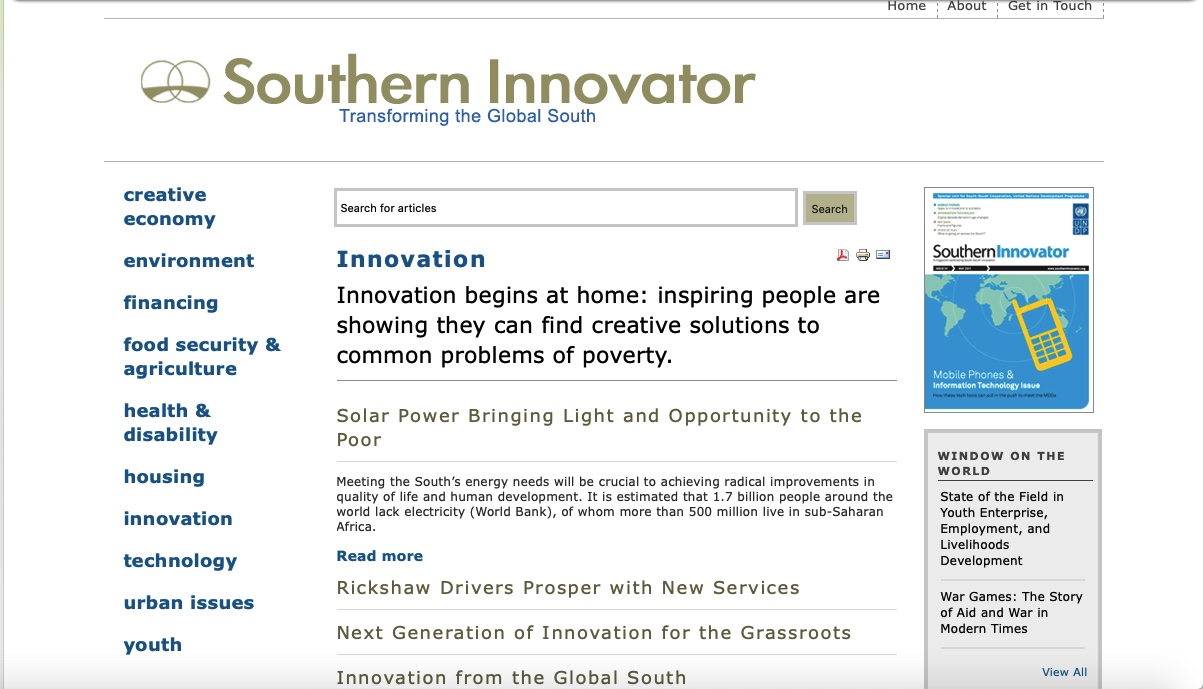
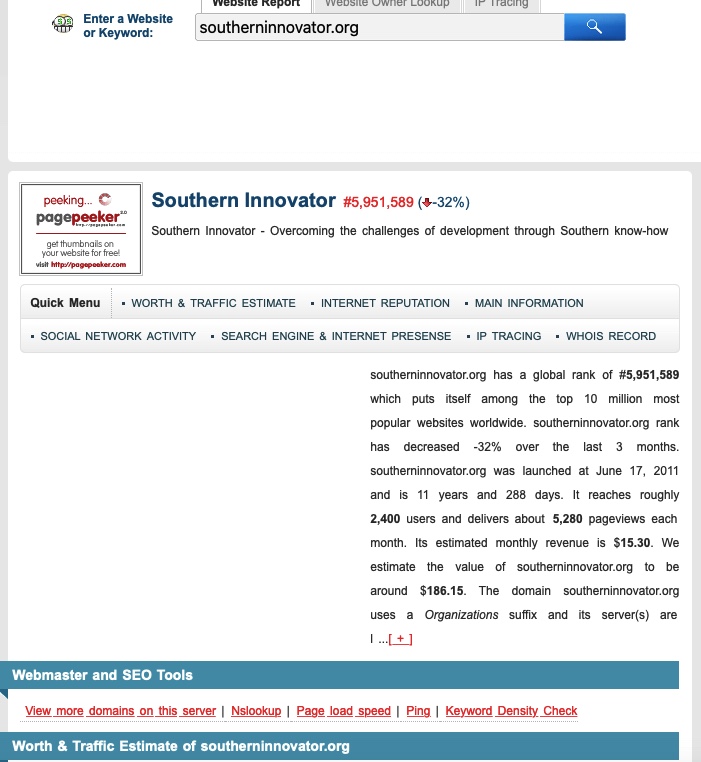
The original southerninnovator.org website launched in 2011, in tandem with the first issue of Southern Innovator Magazine, and ranked midway in the top 10 million most popular websites in the world. Its content has been cited in books, scholarship and strategic plans.
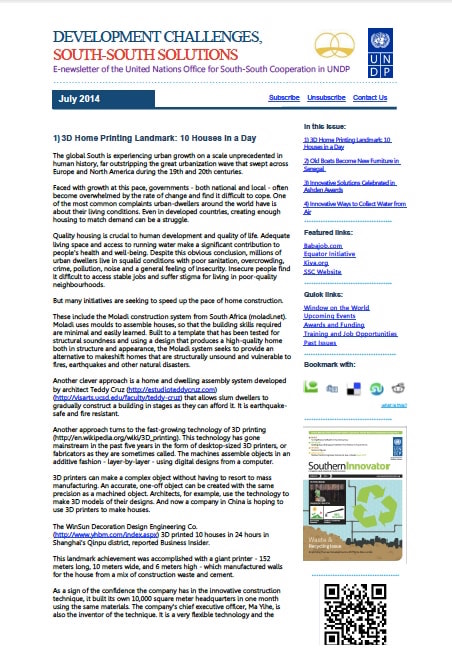
Development Challenges, South-South Solutions is the monthly e-newsletter for the United Nations Office for South-South Cooperation in UNDP (formerly the United Nations Development Programme’s South-South Cooperation Unit). I research and write all stories (since January 2007). You can view the original website here. The stories are in English, French and Spanish.
The original WordPress website for Development Challenges, South-South Solutions (southsouthnews.wordpress.com). It was launched in 2006 and eventually became southerninnovator.org in 2011. The magazine Southern Innovator was also launched in New York in 2011.
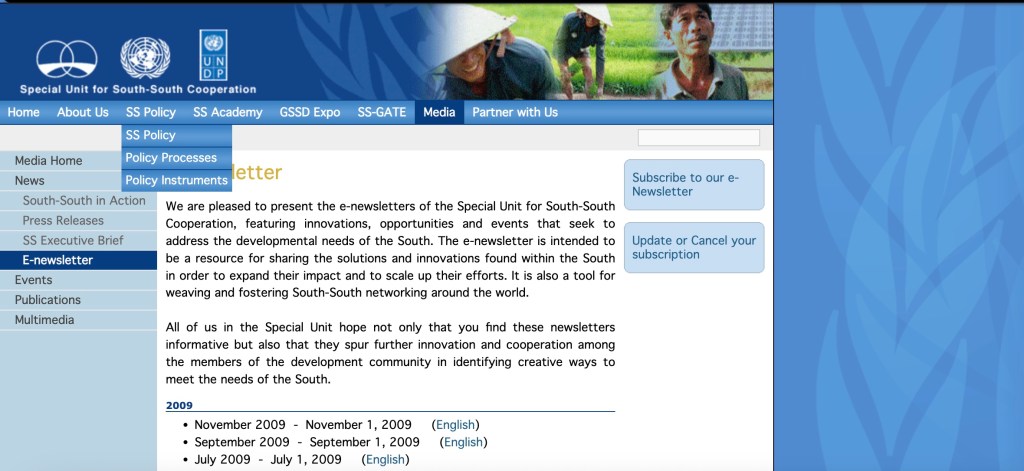
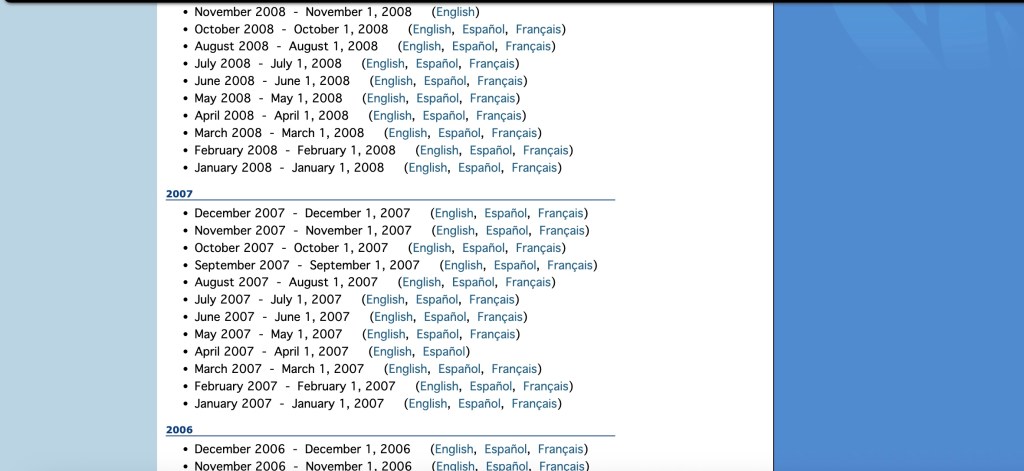
The newsletter archive on the website for UNDP’s Special Unit for South-South Cooperation circa 2011 (including issues in English, French and Spanish). 2011 was an important year as the e-newsletter Development Challenges, South-South Solutions scaled into a dedicated web archive, http://southerninnovator.org, a sister magazine, Southern Innovator (https://unsouthsouth.org/2014/12/25/southern-innovator-magazine/), and pollinated its content across multiple platforms, capitalising on the platform and social media explosion of the time.
Here is a good background article on the rise of South-South cooperation, how it is altering global trade and power relationships, and what the future holds: South-South Cooperation Defies the North. And here is some historical background from Wikipedia: South-South Cooperation.
Development Challenges, South-South Solutions reaches a global audience of influential decision-makers on the frontlines of international development in the South. More than 2,000 subscribers read the newsletter every month (academic institutions, UN agencies, private sector companies, UNDP Country Offices, financial institutions including the IMF and World Bank, inter-governmental organisations, UNDP knowledge networks around the world, and all South-South focal points in West Africa).
Remember to think of Development Challenges, South-South Solutions when you have a Southern innovation to share with the world. You can read our archive of stories online here: http://ssc.undp.org/index.php?id=66
From Special Unit for South-South Cooperation: 2008 Reflections: “As part of the strategy to foster South‐South cooperation within and across regions, the Division has continued to invigorate and re‐enforce a South‐South cooperation focal point system. These efforts included the publication and distribution of a monthly e‐newsletter, Development Challenges: South-South Solutions, which presents a briefing for South‐South focal points, Southern academics and development professionals on practical solutions to development challenges found throughout the South. Over the course of 2008, twelve e‐newsletters were released via e‐mail and published on the website of the Special Unit.”
What are people saying about Development Challenges, South-South Solutions? Read some comments here.
Contact me by email about the newsletter here: developmentchallenges@googlemail.com.
Contact me by email about the new global magazine Southern Innovator here: southerninnovator@yahoo.co.uk
July 2014 issue of Development Challenges, South-South Solutions: The last issue is available online for download. Support the e-newsletter for 2017: we are seeking additional funding so we can improve the reader experience and frequency of the e-newsletter. Since first launching in 2006, we often heard from readers how they valued the stories in the e-newsletter and how it has helped in raising the profile of innovators across the global South (“Congratulations on another great newsletter that’s packed with fascinating information! I really enjoy getting it each month.”). Additional resources would enable us to improve the way readers can access and receive the e-newsletter, enable the e-newsletter’s contributors to travel and report on developments, and allow us to offer daily and weekly updates and a wider range of resources online and on mobile platforms. Additional funds help in maintaining the quality of the e-newsletter, something that has been appreciated by readers (“Great economic and business reporting! Very helpful for us.” Africa Renewal). It will also allow the e-newsletter to spin-off quality resources for innovators, such as the influential magazine Southern Innovator. Contact the United Nations Office for South-South Cooperation if you wish to support the e-newsletter for 2017: UNOSSC.
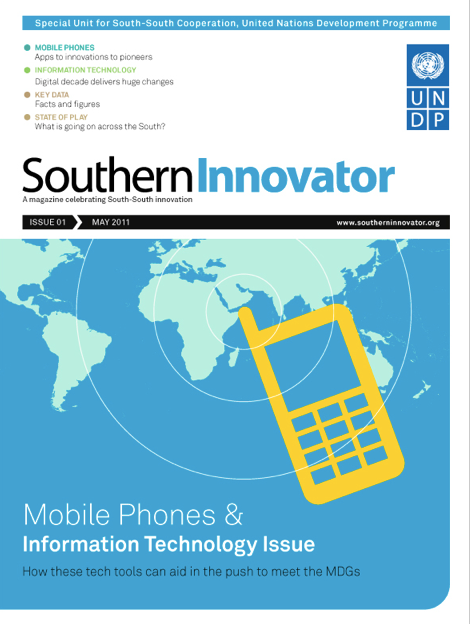
“What a tremendous magazine your team has produced! It’s a terrific tour de force of what is interesting, cutting edge and relevant in the global mobile/ICT space… This is great, engaging, relevant and topical stuff.” Rose Shuman, Founder & CEO, Open Mind and Question Box, Santa Monica, CA, U.S.A.
“Great economic and business reporting! Very helpful for us.” Africa Renewal, Africa Section, Strategic Communications Division, United Nations Department of Public Information
“The reviewer observed that, although the Policy and UN Coordination Unit had produced all of the reports requested by intergovernmental bodies, especially for the High-level Committee, it had not been able to produce many of the publications (evidence-based analytical reports) that had previously been within its purview. Such publications included Southern Innovator magazine and the monthly e-newsletter “Development Challenges, South-South Solutions”. In the case of Southern Innovator, one issue (No. 5 on waste and recycling) was published during the four-year period of the framework but did not have wide online distribution, and issue No. 6 was awaiting funds for publication. The e-newsletter was last issued in July 2014 even though the reviewer found it a good way to communicate with focal points at the national and inter-agency levels. In fact, the shortage of funds for those knowledge products was the main reason that they had ceased being produced during the evaluation period.” Final evaluation of the performance of the United Nations Office for South-South Cooperation under its strategic framework, 2014-2017, in light of the adoption of the 2030 Agenda for Sustainable Development
The coming years will see a major new force dominating development: Big Data. The term refers to the vast quantities of digital data being generated as a result of the proliferation of mobile phones, the Internet and social media across the global South – a so-called ‘data deluge’ (UN Global Pulse). It is an historically unprecedented surge in data, much of it coming from some of the poorest places on the planet and being gathered in real time.
Big Data will have a profound impact on how the cities of the future develop, and will re-shape the way the challenges and problems of human development are handled.
Estimates by Cisco (cisco.com) foresee 10 billion mobile Internet-enabled devices around the world by 2016. With the world population topping 7.3 billion by then, that will work out to 1.4 devices per person.
Some estimates say 90 per cent of the digital data ever generated in the world has been produced in the past two years. It is also estimated that available digital data will increase by 40 per cent every year (UN Global Pulse). This digital transformation is being accompanied by another trend: the largest migration in human history from rural to semi-urban and urban areas.
This presents an unprecedented opportunity to make this rapid urbanization and social change smarter and more responsive to human needs, and to avoid the failures of the past, from over-crowding to crime, disease, pollution, unemployment and poverty. Some believe data collection can radically alter development by flagging up problems quickly, giving cities the chance to respond and correct negative trends before they get out of control. In short, to build in resilience by way of digital technology.
The latest region to see rapid industrialization and urbanization has been Asia – in particular China, a country that since the 1980s has simultaneously lifted the largest number of people in world history out of poverty and undertaken the biggest migration ever from rural to urban areas.
And now Africa is beginning to follow in Asia’s wake.
Unlike previous waves of industrialization and urbanization, Africa’s transformation is occurring in the age of the mobile phone, the Internet, personal computers and miniature electronic devices capable of more computing power than the computers used during the Apollo space programme (http://www.nasa.gov/audience/foreducators/diypodcast/rocket-evolution-index-diy.html). This changes the game significantly.
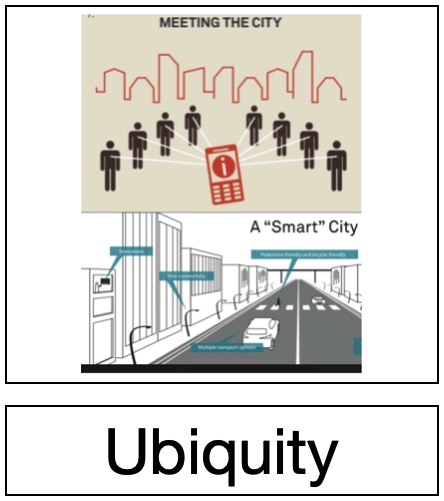
This 21st-century approach to urban growth is at its most sophisticated, and utopian, in so-called “smart cities.” These are built-from-scratch cities that use the “Internet of Things”, where everything, from lamp posts to garbage bins to roads are embedded with microchips and radio frequency transmitters (RFID chips) (http://en.wikipedia.org/wiki/Radio-frequency_identification) to communicate data in real time. By analyzing this data, cities can be responsive to human needs and mitigate problems – improving waste collection and traffic management, reducing crime and pollution. Services can be customized to residents’ needs and liberate them to spend more time on things that matter such as their own health, family, work and hobbies. Examples of these cities include Tianjin Eco-city (tianjinecocity.gov.sg) in China, Masdar (masdar.ae) in Abu Dhabi in the United Arab Emirates and Songdo International Business District (songdo.com) in the Republic of Korea.
These experimental smart cities are springing up in the East, and it will be the East – as well as Africa – that will see most of the action going forward. As the global management consulting firm McKinsey noted in its report Urban World: Mapping the Economic Power of Cities: “Over the next 15 years, the center of gravity of the urban world will move south and, even more decisively, east.”
Cities in the global South will be generating the new prosperity of the 21st century. And it is widely accepted that people living in cities have the potential to become very efficient economically while rapidly driving prosperity higher.
The McKinsey report says that “by 2025, developing-region cities of the City 600 (a list gathered by McKinsey) will be home to an estimated 235 million middle-class households earning more than (US) $20,000 a year at purchasing power parity (PPP).
“Emerging-market mega-and middleweight cities together – 423 of them are included in the City 600 – are likely to contribute more than 45 percent of global growth from 2007 to 2025 (http://www.mckinsey.com/insights/urbanization/urban_world).”
The world’s future prosperity is going to be found in the urban, the digitally connected, and the middle class.
Tracking all this digital change is the UN Global Pulse. UN Global Pulse (unglobalpulse.org) was started by Secretary-General Ban Ki-moon in 2009 with a mandate to study these changes and build expertise in applying Big Data to global development. UN Global Pulse functions as a network of innovation labs where research on Big Data for development is conceived and coordinated. It partners with experts from UN agencies, governments, academia, and the private sector to research, develop, and mainstream approaches for applying real-time digital data to 21st-century development challenges.
Unlike major technological trends of the past, this one is not restricted to the industrialized, developed world. Through the spread of mobile phone technology, billions of people are now using a device that constantly collects digital data, even in the poorest places on earth.
From an international development perspective, Big Data has five characteristics, according to UN Global Pulse: it is digitally generated, passively produced by people interacting with digital services, automatically collected, can be geographically or temporally traced and can be continuously analyzed in real time.
Sources of Big Data include chatter from social networks, web server logs, traffic flow sensors, satellite imagery, telemetry from vehicles and financial market data.
The key to using Big Data is combining datasets and then contrasting them in lots of different ways and doing it very quickly. The purpose? Better decision-making, based on an understanding of what is really happening on the ground.
This data exceeds the capability of existing database software. It is either too much, or comes in too quickly, or can’t be handled using current software technology. Tackling this problem is creating a whole new wave of opportunities for those working in information technology.
As technology and processing power continue to improve, the cost of wrestling with this data and putting it to use is coming down.
The data can be analyzed for patterns and hidden information that before would have been too difficult to gather. This approach has been used by big companies such as WalMart (walmart.com), but it has cost them a large amount of money and time.
Pioneers in Big Data include search engine Google, email and search provider Yahoo, online shopping service Amazon and social media service Facebook. Many supermarkets use Big Data to analyze the way customers behave when they are shopping, combining it with their social and geographical data.
But new developments in hardware, cloud architecture, and open-source software mean Big Data processing is more accessible, including for small start-ups, who can just rent the capacity required on a cloud-based service (http://en.wikipedia.org/wiki/Cloud_computing).
In the past, governments and planners had a ready excuse as to why they could not keep on top of ballooning urban populations and the chaos they brought. They could just throw up their hands and say “We do not know who these people are or what to do about them!”
This excuse does not work in the age of the mobile phone. It is now relatively easy to deploy the power of the networked computing inside mobile phones to map urban slums and identify the needs of the people there. Parse that data, and you have an accurate account of what is happening in the slum – all in real-time.
Making sense of all this information is creating its own new industries as innovators, entrepreneurs and companies step forward to chart this brave new world.
Historically, significant improvements in human development have occurred only after large-scale gathering of data and information on the actual living conditions of the population. For example, prototypes of today’s infographics (http://en.wikipedia.org/wiki/Infographic) – informative visual representations of complex data – were created during the great attempts at tackling poverty and disease in Europe in the 19th century. Today’s masters of this technique include the Swedish doctor, academic and statistician Hans Rosling (gapminder.org), whose dynamic infographics are renowned for changing people’s perceptions of global problems.
UN Global Pulse notes “much of the data used to track progress toward the Millennium Development Goals (MDGs) dates back to 2008 or earlier and doesn’t take into account the more recent economic crisis.
“While this may feed a perception that there is a scarcity of information about the wellbeing of populations, the opposite is in fact true. Thanks to the digital revolution, there is an ocean of data, being continuously generated in both developed and developing nations, that did not exist even a few years ago.”
UN Global Pulse believes Big Data can be used to protect social development gains when crises strike. Rather than undoing decades of good development work and human development achievements, Big Data can help to create agile responses to crisis as it happens.
UN Global Pulse believes the same data, tools and analytics used by business can be turned to help the public sector understand “where people are losing the fight against hunger, poverty and disease, and to plan or evaluate a response.”
Published: June 2014
Resources
1) Big Data: The Next Frontier for Innovation, Competition, and Productivity, Publisher: McKinsey Global Institute. Website: mckinsey.com
2) United Nations Global Pulse: Global Pulse is an innovation initiative launched by the Executive Office of the United Nations Secretary-General, in response to the need for more timely information to track and monitor the impacts of global and local socio-economic crises. The Global Pulse initiative is exploring how new, digital data sources and real-time analytics technologies can help policymakers understand human well-being and emerging vulnerabilities in real-time, in order to better protect populations from shocks. Website: http://www.unglobalpulse.org/
11) Hadoop: Is open source software for handling of large data sets across clusters of computers using simple programming models. Website: http://hadoop.apache.org/
12) Pivotal: Pivotal develops software applications for big data. A testimonial on the Pivotal website sums it up: “With the ability to load a day’s worth of data for a million meters in under fifty (50) seconds, we are able to keep up with the tremendous amount of data generated and start experimenting with many useful smart grid analytics.” Website: gopivotal.com
13) TotallyDot: A way to centralize all the social media people use into a single page. Website: totallydot.com
Development Challenges, South-South Solutions was launched as an e-newsletter in 2006 by UNDP’s South-South Cooperation Unit (now the United Nations Office for South-South Cooperation) based in New York, USA. It led on profiling the rise of the global South as an economic powerhouse and was one of the first regular publications to champion the global South’s innovators, entrepreneurs, and pioneers. It tracked the key trends that are now so profoundly reshaping how development is seen and done. This includes the rapid take-up of mobile phones and information technology in the global South (as profiled in the first issue of magazine Southern Innovator), the move to becoming a majority urban world, a growing global innovator culture, and the plethora of solutions being developed in the global South to tackle its problems and improve living conditions and boost human development. The success of the e-newsletter led to the launch of the magazine Southern Innovator.
Many emerging-market countries in the global South have built up substantial foreign currency reserves. Much of this has been a response to past foreign currency crises, particularly the Asian Crisis in the late 1990s (http://en.wikipedia.org/wiki/1997_Asian_financial_crisis).
But what to do with this often vast wealth? How should it be used to improve economies, human development and people’s lives?
China — whose foreign currency reserves reportedly total US $3.7 trillion — is showing one approach, using the wealth to build industrial capability in sectors traditionally associated with more developed countries, such as aircraft manufacturing.
China is seeking to build a commercial airliner able to compete with the sector’s longstanding giants, Boeing and Airbus. To ensure it can do it to the highest global standards, it is outsourcing much of the parts manufacturing to the best around the world, while keeping the overall design and assembly in China.
Comac, or Commercial Aircraft Corporation of China, Ltd. (http://english.comac.cc/products/ca/pi/), is located outside Shanghai, China’s rapidly growing global business hub. The modern Comac factory is working on building China’s first commercial airliner, the C919. It is also making a smaller jet, the ARJ21.
Comac calls the outsourcing method an “airframer supplier” model. Suppliers provide the components, and Comac designs and assembles the plane.
Countries making the parts include the United States, France, Ireland, the United Kingdom, Austria, Switzerland and Japan.
Comac’s dream is to graduate to the top tier of global aircraft manufacturers alongside Boeing and Airbus, which together account for 70 per cent of the global commercial airliner market (Fortune).
At present, this is just an aspiration, with a detailed life-sized plastic model of the C919 – right down to the intricacies of the cockpit instrument panels — all there is to show for the project.
Founded in 2008, Comac ambitiously aims to be making and selling commercial airliners within a decade. State-owned Comac is an amalgamation of various aviation companies, as previous efforts to make a commercial airliner in China had failed. China has invested US $3 billion in the venture.
The name, C919, breaks down as C for China, 9 because it sounds similar to the Chinese word for forever, and 19 because it will carry 190 passengers.
The idea is to target the city-to-city aircraft market which is dominated by Boeing’s 737 and Airbus’s A320.
China saw huge aviation growth in the first decade of the 21st century, and is expecting that trend to continue. The country is on track to surpass the United States for airline-passenger traffic by 2032 and is already the world’s second largest market (Fortune).
To feed this fast-growing market, China will need an estimated 5,580 new planes by 2032, costing US $780 billion in today’s prices (Boeing).
China has decided, rather than committing this vast investment to purchasing all the aircraft from overseas manufacturers, to instead use this wealth to build a competitive aircraft manufacturing industry to rival the big leaders. This would create jobs in the country and create a multiplier effect as airline industry investment helps the domestic economy.
China already has years of experience manufacturing aircraft parts for foreign companies. Comac makes the tail section of Boeing’s 737, as well as manufacturing cargo door frames for the Airbus’ A320.
The C919 is similar in some ways to the Airbus A320. They have similar dimensions and are made from similar materials. Comac has hired over 100 foreign experts to help with the project, to ensure quality control meets global standards.
By trying to compete with the world’s best, China is entering a very competitive and complex marketplace. The complexity of modern aircraft (an average of 4 million parts in a typical commercial airliner) means there is no room for mistakes or cutting corners. And this is where China has to change its reputation. The country has experienced several high-profile manufacturing failures due to corner-cutting and corruption. These have included tainted milk products, poorly constructed buildings that collapsed, and high-speed train crashes.
The C919 is an opportunity to show high standards and high quality can be the norm in Chinese manufacturing.
In the 1970s, China designed and built the Y-10 (http://en.wikipedia.org/wiki/Shanghai_Y-10) in Shanghai, modeled on Boeing’s 707. But it was a failed programme, shut down after the plane flew once.
Those behind the new plane acknowledge that this is a learning experience for China: “Comac must learn how to walk first before running,” Comac chairman Jin Zhuanglong told Fortune magazine.
“I’ve always maintained the point that we won’t be a big challenge for Airbus or Boeing in the short term,” said Jin, who used to work in China’s satellite and spacecraft industry. “But in terms of some single product, we might be competitive.”
There’s no doubt that China needs planes. China will have constructed 80 new airports between 2011 and 2015 (China Daily). It has already received 1,000 Airbus planes for domestic carriers, quickly bringing fleets to international standards.
State-owned airlines, including China Air, China Southern and China Eastern, dominate 80 per cent of flights. All stand to be a ready market for the C919, which will sell for around US $75 million – US $10 million less than the next generation Boeing 737 and the Airbus A320 (Fortune).
Ireland-based budget airline Ryanair is considering being the first Western airline to purchase the C919.
Ryanair CEO Michael O’Leary is confident people will fly on a Chinese-made plane: “Ninety-nine percent of my passengers don’t know what kind of aircraft they are getting on,” O’Leary told Fortune. “You trust the Chinese to make computers and medical devices, and the question is, Would you get on a Chinese aircraft? Of course!”
Brazil has shown it is possible. The Embraer (embraer.com) aircraft company, based in São José dos Campos, is now a US $6 billion a year success story that has won the public’s trust.
Comac’s C919 project is a risk, but the rewards could be enormous.
Development Challenges, South-South Solutions was launched as an e-newsletter in 2006 by UNDP’s South-South Cooperation Unit (now the United Nations Office for South-South Cooperation) based in New York, USA. It led on profiling the rise of the global South as an economic powerhouse and was one of the first regular publications to champion the global South’s innovators, entrepreneurs, and pioneers. It tracked the key trends that are now so profoundly reshaping how development is seen and done. This includes the rapid take-up of mobile phones and information technology in the global South (as profiled in the first issue of magazine Southern Innovator), the move to becoming a majority urban world, a growing global innovator culture, and the plethora of solutions being developed in the global South to tackle its problems and improve living conditions and boost human development. The success of the e-newsletter led to the launch of the magazine Southern Innovator.
We were able to identify numerous trends that were at the time being overlooked or under-reported; trends that could radically re-shape international development. This included the rapid rise ofmobile phonesin the global South and their powerful impact on economic development, the rush to cities and urban areas that was turning the world into a majority urban place, and the shift to greater South-South trade, investment and contact. Whereas the past involved people always looking North for inspiration, capital and business and trade relationships, this was shifting to South-South arrangements. And there were plenty of inspirational, modern, 21st century examples of economic, social and human development achievements across the global South to report on. By consistently tracking and chronicling a quiet revolution underway in the global South, the e-newsletter was able to draw attention to a rising 21st-century global innovator culture being shaped by the use of mobile phones and information technologies. Few at the time had grasped how much this was going to reshape the international development paradigm.
To start, the e-newsletterDevelopment Challenges, South-South Solutions(begun in 2006), was used to gather together as many stories, data, trends, and contacts as possible and get this message to as wide a group as possible. Luckily, this coincided with the very moment whole swathes of the global South were coming online, either through connecting with mobile phones or through the Internet. Quickly, it became clear there was not a lack of inspiring stories and innovations and solutions to share, but a lack of resources to communicate them. One solution was to utilise a new publishing tool that emerged in 2007: crowd-powered news services. It became a great way to bypass the stranglehold on news and information held by traditional media. Read more on this here:http://www.scribd.com/doc/251968773/Southern-Innovator-Summary-of-Impact-2011-to-2012
In particular, the e-newsletter caught the eye of those looking for inspiration in the wake of the 2007/2008 global economic crisis:
“Great economic and business reporting! Very helpful for us.” Africa Renewal, Africa Section, Strategic Communications Division, United Nations Department of Public Information
“I just went over your June newsletter. It’s very well done and far reaching. Congratulations!” Violette Ruppanner, Director, 3D -> Trade – Human Rights – Equitable Economy, Geneva, Switzerland
“Just to let you know I enjoyed the newsletter a lot – it was interesting to learn about things going on that I would never otherwise find out about, and also the listing of future conferences and events proved very useful.” Ian Sanderson, Deloitte, Geneva, Switzerland
“Congratulations on another great newsletter that’s packed with fascinating information! I really enjoy getting it each month.” Whitney Harrelson, Making Cents, Washington D.C.
2008: Development work begins on the concept for a book on innovation in the global South. Attend an Africa trade-focused meeting in Switzerland just as the global crisis breaks. Witness attendees dash from the event as they get frantic calls from London and New York. Undertake Cuba study tour with the BSHF.
2009: The book concept becomes a magazine. Attend the UN Conference on the Social and Political Dimensions of the Global Crisis: Implications for Developing Countries in Geneva, Switzerland.
2010: Begin working with graphic designer and illustrator Solveig Rolfsdottir and graphic designer Eva Hronn Gudnadottir in Reykjavik, Iceland on the initial concepts for what would become Southern Innovator. The working title for the new magazine is Creative Sparks.
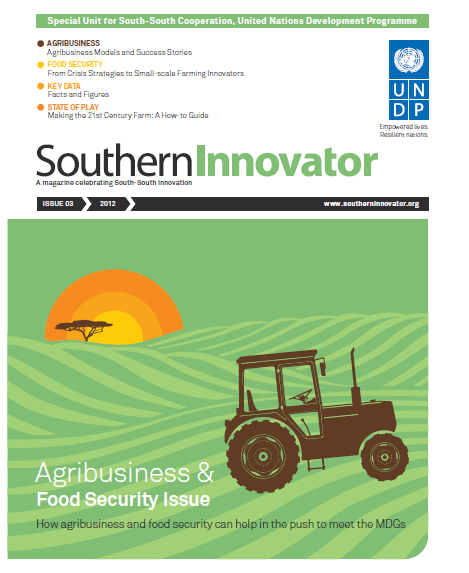
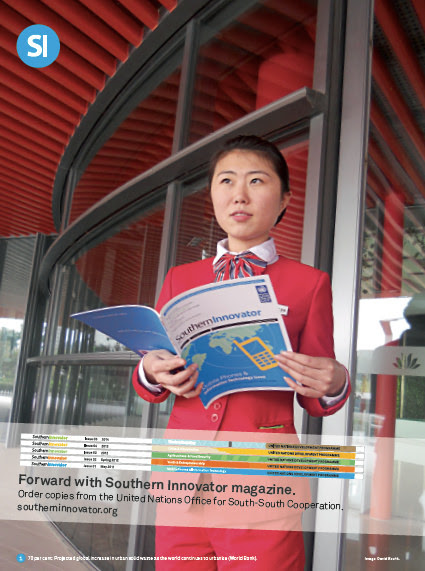
2014: The fifth issue ofSouthern Innovatoris launched at the Global South-South Development Expo (GSSD Expo) in Washington, D.C.. Southern Innovator has always tried to inspire others to take action and this has turned out to be the case.
“Beautiful, inspiring magazine from UNDP on South-South innovation. Heart is pumping adrenaline and admiration just reading it”
Once blazing a lonely trail, there are now many places to find stories on global South innovation (The Guardian, SciDev, Devex, Business Fights Poverty, Zunia etc.). Mainstream media have also woken up to the energy and change sweeping across the global South, disrupting its regular diet of negative news stories focused around war, disasters and failure (unfortunately, still the majority of what most people see on their TV).
“I liked your latest Southern innovator! Always inspiring.”
“Btw, I really enjoyed reading them, impressive work & a great resource. Looking forward to Issue 6. My best wishes to you & your team at SI.”
“The magazine looks fantastic, great content and a beautiful design!”
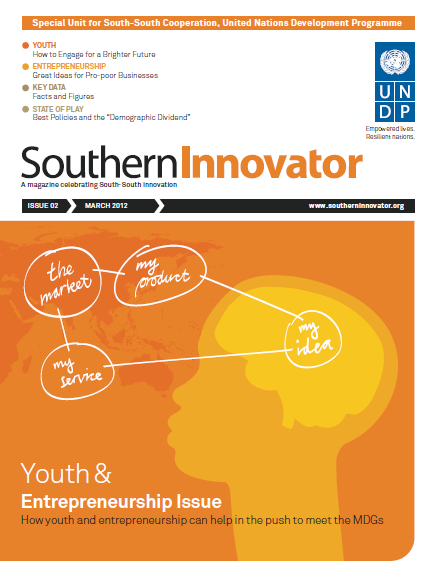
Most importantly, it is the young who have told us they ‘get’ Southern Innovator. It portrays a world they know – comfortable with new technologies, looking to solve problems, open to doing things in new ways. And it is that audience that excites us the most: the youth of the global South (Africa’s young population will be a huge contributor to the world’s working-age workforce by 2050): they are shaping the new world we live in and seeking a role in it.
On Twitter, comments included: From @CapacityPlus Nice job RT @ActevisCGroup: RT @UNDP: Great looking informative @SouthSouth1 mag on South-South Innovation; @UNDP Great looking informative @SouthSouth1 mag on South-South Innovation; @JeannineLemaire Graphically beautiful & informative @UNDP Southern Innovator mag on South-South Innov.
The phases of this project have been compiled in two e-books and published online here:
2015: In September 2015 (http://www.bbc.co.uk/news/world-asia-china-34372188), China’s President Xi Jinping announced China would spend US $2 billion on South-South cooperation initiatives. This has been called “a ‘game changer’ in international relations”(http://www.ipsnews.net/2015/11/opinion-chinas-new-south-south-funds-a-global-game-changer/).President Xi also said of South-South cooperation, it is: “a great pioneering measure uniting the developing nations together for self-improvement, is featured by equality, mutual trust, mutual benefit, win-win result, solidarity and mutual assistance and can help developing nations pave a new path for development and prosperity.”
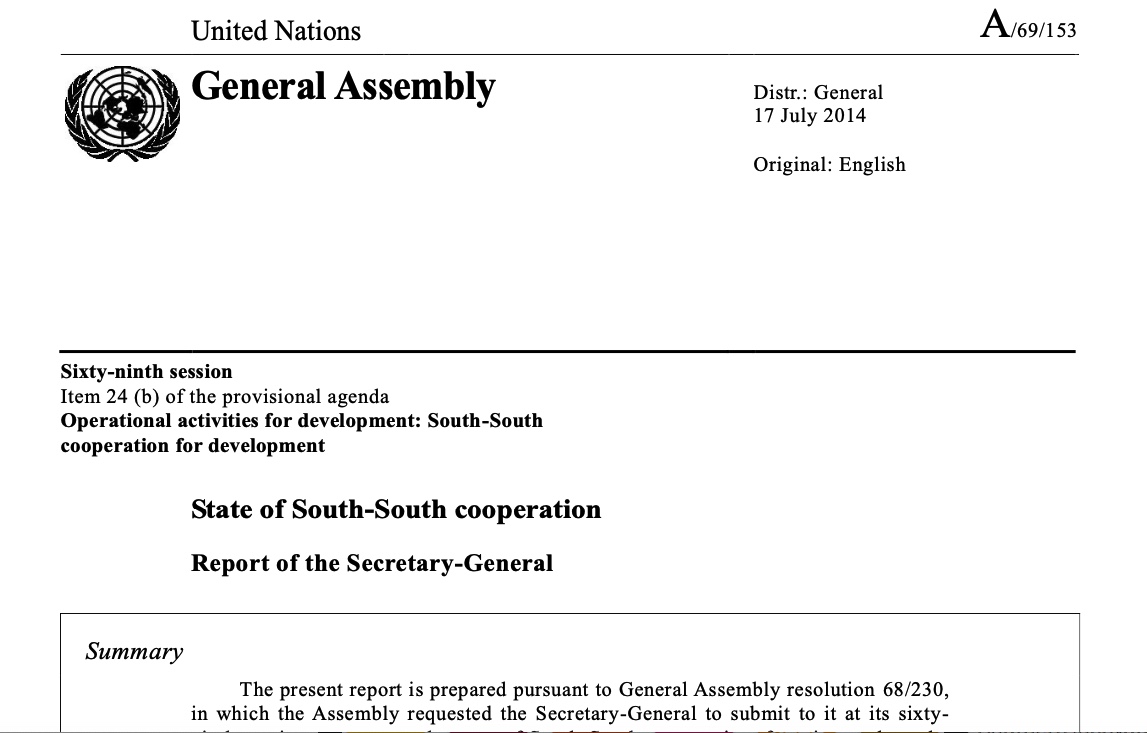
The Southern origins of sustainable development goals: Ideas, actors, aspirations by Sakiko Fukuda-Parr and Bhumika Muchhala (SDG Resource Centre).United Nations General Assembly: Sixty-ninth session, Item 24 (b) of the provisional agenda, Operational activities for development: South-South cooperation for development, 17 July 2014.The research informing Southern Innovator Magazine played a part in the formulation of the UN’s post-2015 development agenda, including the Sustainable Development Goals (SDGs).


















 David South Consulting
You must be logged in to post a comment.