Categories
Archive Development Challenges, South-South Solutions Newsletters

Global South Trade Boosted with Increasing China-Africa Trade in 2013

By David SouthDevelopment Challenges, South-South Solutions

SOUTH-SOUTH CASE STUDY

It was announced in January 2014 that China has surpassed the United States to become the world’s number one trading nation, as measured by the total value of exports and imports. This new economic behemoth also continued to grow its trade relationships with Africa.

US exports and imports of goods totaled US $3.82 trillion in 2013, according to the U.S. Commerce Department. China’s annual trade in goods passed US $4 trillion for the first time in 2013 (Guardian).

Zheng Yuesheng, a spokesman for China’s customs administration, told The Guardian that becoming the world’s number one trading nation was “a landmark milestone for our nation’s foreign trade development.”

Significantly for Africa, 2012 was also a record year for China-Africa trade, which reached 5 per cent of China’s total foreign trade and made up 16 per cent of all of Africa’s international trade, according to a new report from South Africa.

Consultancy Africa Intelligence (consultancyafrica.com), a South African-based organization with more than 200 consultants focused on “expert research and analysis on Africa” highlights the achievements of this strong trade relationship – and also some of its threats and weaknesses – in its report.

Trade between China and Africa has surged during the decade since China joined the World Trade Organization (WTO) (wto.org) in 2001, rising from around US $10 billion in 2000 to US $198.49 billion in 2012, according to China’s Ministry of Commerce. Ambitiously, it could reach US $300 billion by 2015, announced Cheng Zhigang, secretary-general of the China-Africa Industrial Cooperation and Development Forum (www.zfhz.org) (China Daily).

China’s trade and poverty reduction.

The World Bank reported South-South trade now surpasses South-North trade, meaning exports from developing countries to other developing countries exceed exports to wealthy developed countries. South-South trade experienced rapid growth in the 2000s, accounting for 32 per cent of world trade by 2011 (World Bank).

South-South trade and investment between Africa and lower-income and middle-income developing countries rose from 5 per cent in the 1990s to almost 25 per cent in 2010 (Consultancy Africa Intelligence). Before the 1990s, over 90 per cent of trade for Africa was with high-income or developed countries.

China is attractive as a trade partner for many reasons. One of them is the strong admiration for its success in lifting millions out of poverty through an aggressive growth strategy and rapid urbanization with big investments in education, science, technology, infrastructure – modern airports, ports, roads and rail – and research and development.

Since 1978, it is believed China has lifted 500 million people out of poverty, out of a population of 1.3 billion people (World Bank). Incomes have doubled every 10 years with average GDP growth of 10 per cent a year, meaning the country has almost reached all the Millennium Development Goals.

Building a trade relationship with China has led to Zambia’s copper mines running again, Gabon’s oil fields being re-explored, and Sudan becoming a major oil exporter to China. Angola, Democratic Republic of Congo (DRC), Equatorial Guinea, Republic of Congo and South Africa are all benefiting from exporting commodities to China.

The relationship has not been entirely beneficial, according to the Consultancy Africa Intelligence report. Some African industries, such as textiles, have suffered from competition with cheaper Chinese imports, leading to factory closures and job loses.

Non-commodity exports from Africa to China amounted to just 10 per cent of the trade total. Many of the contracts signed for projects also go to Chinese companies, the report found.

Renewed concern has also emerged over rising debt levels in Africa.

In summary, the report finds a growing trade relationship with China has brought to Africa commodity booms, growing GDP (gross domestic product), and lots of foreign investment. On the negative side of the ledger, there have been job loses due to cheaper imports, rising personal and government debt levels and an over-dependence on minerals for economic growth.

Across Africa, new infrastructure has emerged where it probably would not have come about under the continuing debt burdens from the 1970s and 1980s. The continent has received a shot of energy, but it remains to be seen whether governments can sustain this  economic jolt and make the wise choices that create African jobs and build liveable cities for the 21st century.

Published: March 2014

Resources

1) Global South-South Development Expo: The Global South-South Development Expo (GSSD Expo) is the only Expo solely from the South and for the South. It showcases successful Southern-grown development solutions (SDSs) addressing the need to meet the Millennium Development Goals (MDGs). Website: southsouthexpo.org

2) World Trade Organization (WTO): There are a number of ways of looking at the World Trade Organization. It is an organization for trade opening. It is a forum for governments to negotiate trade agreements. It is a place for them to settle trade disputes. It operates a system of trade rules. Essentially, the WTO is a place where member governments try to sort out the trade problems they face with each other. Website: http://www.wto.org

3) Djibouti Free Zone: Djibouti Free Zone was created with one primary goal in mind – to bring about a sea-change in the way Africa thinks and does business. No red tape, ruthless efficiency and genuinely exhaustive services – in essence, it offers the ideal conditions for trade and commerce to flourish. Website: djiboutifz.com/

4) Forum on China-Africa Cooperation: Keep up with the busy diplomatic and trade contacts between China and African countries. Website: http://www.focac.org/eng/

5) China-Africa Cooperation Net: China-Africa Industrial Forum (CAIF) is the collective dialogue and cooperation mechanism that was set up by both China and friendly African countries in the year 2000. Website: http://www.zfhz.org/html/en_gywm.html

China has been a member of the WTO (World Trade Organization) since 11 December 2001. The World Trade Organization deals with the global rules of trade between nations. Its main function is to ensure that trade flows as smoothly, predictably and freely as possible. 

https://davidsouthconsulting.org/2022/06/02/afghanistans-juicy-solution-to-drug-trade/

https://davidsouthconsulting.org/2022/11/02/african-online-supermarket-set-to-boost-trade/

https://davidsouthconsulting.org/2022/10/26/african-trade-hub-in-china-brings-mutual-profits-2/

https://davidsouthconsulting.org/2022/11/21/chinese-trade-in-angola-helps-recovery/

https://davidsouthconsulting.org/2022/04/12/djibouti-re-shapes-itself-as-african-trade-hub/

https://davidsouthconsulting.org/2022/10/26/perfume-of-peace-helps-farmers-switch-from-drug-trade/

https://davidsouthconsulting.org/2021/07/19/south-south-trade-helping-countries-during-economic-crisis/

https://davidsouthconsulting.org/2021/03/05/southern-innovator-issue-2/

https://davidsouthconsulting.org/2022/11/01/southern-innovator-magazine-2010-2014/

https://davidsouthconsulting.org/2022/10/20/trade-to-benefit-the-poor-up-in-2006-and-to-grow-in-2007/

https://davidsouthconsulting.org/2020/12/30/unrisd-blog/

https://davidsouthconsulting.org/2022/10/05/women-empowered-by-fair-trade-manufacturer/

https://davidsouthconsulting.org/2022/06/16/women-mastering-trade-rules/

Creative Commons License

This work is licensed under a Creative Commons Attribution 4.0 International License.

ORCID iD: https://orcid.org/0000-0001-5311-1052.

© David South Consulting 2023

Categories
Archive Development Challenges, South-South Solutions Newsletters

South-South Trade Helping Countries During Economic Crisis

By David SouthDevelopment Challenges, South-South Solutions

SOUTH-SOUTH CASE STUDY

Weathering the global economic crisis is testing the stability of countries across the global South. But many countries are finding South-South trade and catering to their domestic middle classes can lift incomes and maintain growth rates despite the global turmoil.

A decade of boom in global markets as they became more integrated has brought rising incomes and created growing economies in the so-called emerging markets of the global South. Finance and investment from developed countries flowed into the global South and helped bolster growing economies, boosting incomes and bringing millions of people into the middle classes. But since the start of the global economic crisis in 2008, more and more countries in the global South have experienced turmoil, chaos and crisis.

The export-driven model that had served many Asian countries well – creating products for developed Western markets – is being tested by high unemployment in developed economies and declining purchasing power for the Western middle classes. Two trends that have grown in the past 10 years may offer a solution to this economic crisis. One is to build on the growth in South-South trade, and the other is to tap the growing middle classes of the global South by expanding the products and services available to them and further improving their quality of life.

It is well established that one of the key elements to securing sustainable prosperity is a thriving middle class. Middle classes in many countries in the global South are still classified as vulnerable – at risk of returning to poverty if the economy experiences a short-term crisis. Their resilience to an economic downturn needs to be strengthened, and this can be done by improving the quality of products and services available to them.

Building this market can also strengthen domestic job growth and help reduce a country’s dependence on imports.

One country facing up to this challenge is Indonesia. The New York Times recently reported that ports in Indonesia and other resource-exporting countries are quiet, as China’s demand for resources slows.

But while export markets are experiencing a slowdown, investment is going into Indonesia’s agricultural food-processing industry. Agricultural multinational Cargill (cargill.com) is building a cocoa-bean processing plant in the country, and the PT. Suprama (suprama.co.id/en/) instant-noodle factory is running at full capacity to meet the needs of the country’s growing middle class.

Many countries have experienced significant inflows of investment money as a result of stimulus measures led by the United States Federal Reserve (http://www.federalreserve.gov/faqs/about_12594.htm) to counter the economic contraction caused by the global economic crisis. This money, however, is uncertain and can just as easily disappear as it leaves to chase the next opportunity. Wise countries take measures to avoid being dependent on this fickle and fast investment funding.

Unlike in the Asian Crisis of 1997-1998 (http://en.wikipedia.org/wiki/1997_Asian_financial_crisis), many emerging-market countries now have large foreign currency reserves and robust stock markets. They have also built up their middle classes and increased consumption. Trade links with other countries in the global South have grown enormously since the late 1990s. For example, the trade between China and Africa, as announced by Chinese President Xi Jinping (http://en.wikipedia.org/wiki/Xi_Jinping) in early 2014, has surpassed US $200 billion for the first time, turning China into Africa’s largest trading partner

The relationship between trade and poverty reduction, the case of China.

Despite a raging global crisis, in many emerging economies domestic spending is holding up and, in some cases, has never been stronger.

China now plays a key role in maintaining global economic demand. According to the global bank HSBC, Chinese growth adds “twice as many dollars to annual global demand as growth in the United States economy and far more than the economies of the European Union.”

An article in The New York Times (http://www.nytimes.com/2014/02/13/business/emerging-markets-in-asia-in-a-delicate-limbo.html?_r=0) suggested that global South countries can benefit from these trends by becoming an alternative to China’s “own increasingly high-cost producers of coal, aluminum, and other minerals” – as well as of clothing, shoes and electronics.

China is also in the process of altering its economy, from being the low-wage workshop of the world to an increasingly high-tech, high-value economy with growing science, technology and innovation sectors buoyed by heavy investment in research and development, for example China’s Xi’an Hi-tech Industries Development Zone (xdz.com). As China changes, other countries can step in and replace the industries that no longer find China an affordable place to manufacture their goods.

As an example, the Indonesian vice minister of trade, Bayu Krisnamurthi, announced that the Foxconn Technology Group of Taiwan (foxconn.com), which makes components and assembles devices for the popular Apple (apple.com) computer brand, is looking to set up a large factory in Indonesia.

“The other brands will come in their footsteps,” Krisnamurthi told The New York Times.

Other countries are bucking the crisis trend and using greater freedom to boost economic growth.

Cuba has been able to bounce back with free-market reforms. The Caribbean island has had its ups and downs economically since its revolution in the late 1950s. After the revolution, the country had several decades of impressive human development gains and built up enviable education and health care systems. But with the collapse of the Soviet Union in the early 1990s, the country lost its trade relationships and subsidies and was pitched into a major economic crisis.

During the Cold War, the USSR hoovered up almost all of Cuba’s exports of sugar, nickel and citrus fruit, and sold Cuba two-thirds of its food and 98 per cent of its fuel.

What was termed the “special period” after the collapse of the Soviet Union saw petrol become scarce. Many had to turn to cycling and walking to get around. Factories closed and food production declined.

One estimate by Hal Klepak of the Royal Military College of Canada, reported in The Observer newspaper, found the economy collapsed by 50 per cent in the five years to 1993.

Since then, Cuba has endured significant austerity and has struggled to regain its trade relationships and restore economic growth. Tourism has played a key role in keeping the country going.

And since 2008, various economic reforms have started to shift the economy away from over-dependence on the state and towards a more mixed market model.

Its capital, Havana, is a UNESCO world heritage site and is a popular tourist destination with one of the best-preserved former Spanish colonial architecture in the Caribbean.

When President Raul Castro took over from his brother Fidel, he began to slowly experiment with reforms to test how much market freedom could boost the economy and increase incomes. This has included allowing paladares, or privately-run restaurants, which are now flourishing and benefiting from the steady flow of tourists to the island.

The state now allows people to set up as independent traders in 200 occupations. Some have established entertainment businesses such as paint balling, others are running bars, or bookshops. It is now possible to easily change money in Havana and to find accommodation in private homes. Cash machines are spreading throughout the capital and more and more businesses will accept credit cards.

Registered businesspeople rose from 157,000 in October 2011 to more than 442,000 in 2013.

By being flexible, it is possible to discover new ways to grow economies and increase incomes, even in hard times. And increasing South-South trade is the way to go.

Published: June 2014

Resources

1) The China Africa Project: The China Africa Project is a multimedia resource dedicated to exploring every aspect of China’s growing engagement with Africa. Website: chinaafricaproject.com

2) China’s trade and investment in Africa: Resources to contribute to more informed investment and trade policies and decision making in sectors and locations where China is emerging as a major player. Website: http://www.cifor.org/china-africa/home.html

Made-in-China.com: With the continuous and explosive growth of Chinese exports, trade and the number of internet users, Focus Technology launched its online trade platform, Made-in-China.com. Made-in-China.com provides the most complete, accurate and up-to-date information on Chinese products and Chinese suppliers available anywhere on the web. Nowadays, Made-in-China.com is a world-leading B2B portal, specializing in bridging the gap between global buyers and quality Chinese suppliers. Website: made-in-china.com

4) Southern Innovator Issue 2: Youth and Entrepreneurship: Called “Graphically beautiful & informative”, Issue 2 features entrepreneurial solutions for escaping poverty relevant to youth. Website: http://books.google.co.uk/books?id=Ty0N969dcssC&dq=southern+innovator+issue+2&source=gbs_navlinks_s

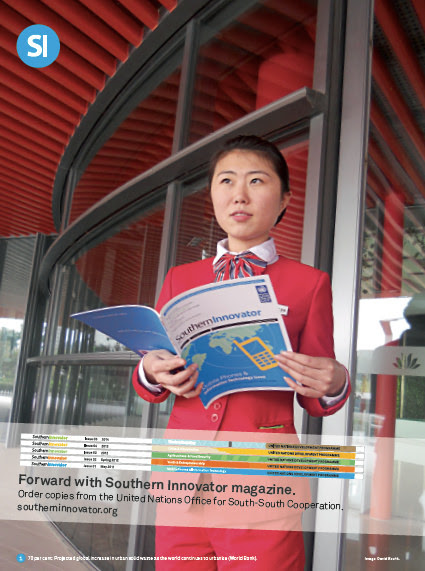
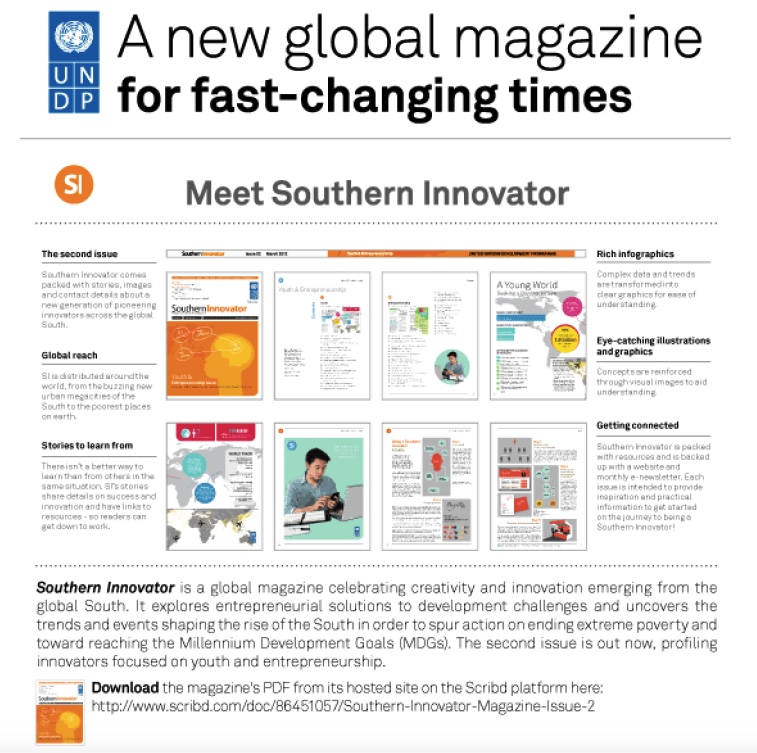
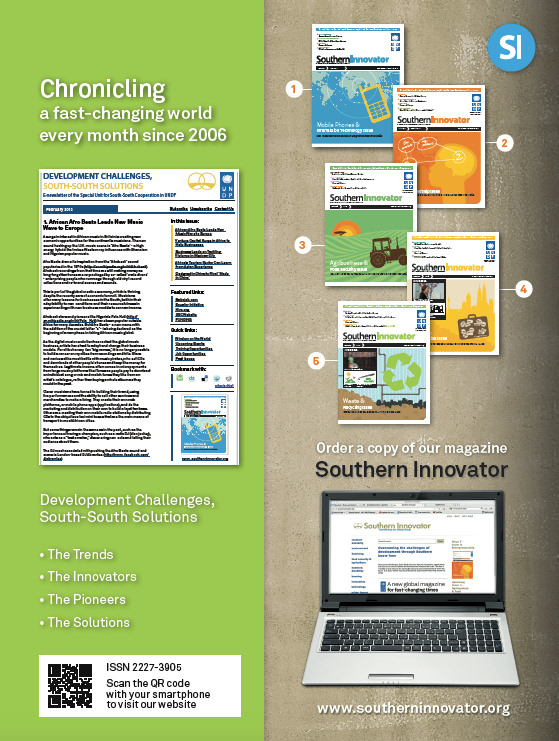
Development Challenges, South-South Solutions was launched as an e-newsletter in 2006 by UNDP’s South-South Cooperation Unit (now the United Nations Office for South-South Cooperation) based in New York, USA. It led on profiling the rise of the global South as an economic powerhouse and was one of the first regular publications to champion the global South’s innovators, entrepreneurs, and pioneers. It tracked the key trends that are now so profoundly reshaping how development is seen and done. This includes the rapid take-up of mobile phones and information technology in the global South (as profiled in the first issue of magazine Southern Innovator), the move to becoming a majority urban world, a growing global innovator culture, and the plethora of solutions being developed in the global South to tackle its problems and improve living conditions and boost human development. The success of the e-newsletter led to the launch of the magazine Southern Innovator.  

Follow @SouthSouth1

Google Books: https://books.google.co.uk/books?id=m5GYBgAAQBAJ&dq=development+challenges+may+2012&source=gbs_navlinks_s

Slideshare: http://www.slideshare.net/DavidSouth1/development-challengessouthsouthsolutionsmay2012issue

Southern Innovator Issue 1: https://books.google.co.uk/books?id=Q1O54YSE2BgC&dq=southern+innovator&source=gbs_navlinks_s

Southern Innovator Issue 2: https://books.google.co.uk/books?id=Ty0N969dcssC&dq=southern+innovator&source=gbs_navlinks_s

Southern Innovator Issue 3: https://books.google.co.uk/books?id=AQNt4YmhZagC&dq=southern+innovator&source=gbs_navlinks_s

Southern Innovator Issue 4: https://books.google.co.uk/books?id=9T_n2tA7l4EC&dq=southern+innovator&source=gbs_navlinks_s

Southern Innovator Issue 5: https://books.google.co.uk/books?id=6ILdAgAAQBAJ&dq=southern+innovator&source=gbs_navlinks_s

China has been a member of the WTO (World Trade Organization) since 11 December 2001.
Creative Commons License

This work is licensed under a
Creative Commons Attribution-Noncommercial-No Derivative Works 3.0 License.

ORCID iD: https://orcid.org/0000-0001-5311-1052.

© David South Consulting 2023
Categories
Archive Blogroll Southern Innovator magazine United Nations Office for South-South Cooperation

Southern Innovator in Southasiadisasters.net

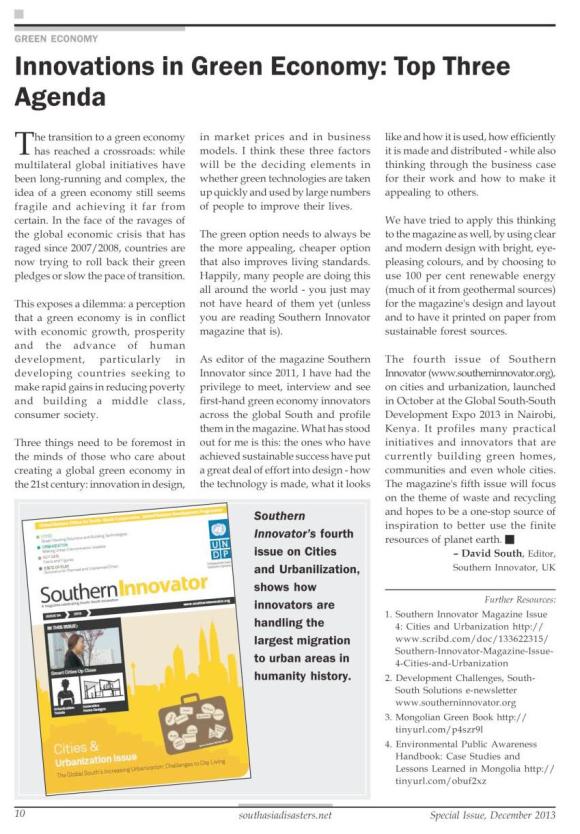
Innovations in Green Economy: Top Three Agenda

c22e6-innovations20in20green20economy20top20three20agenda20december202013

By David South

southasiadiasters.net December 2013

The transition to a green economy has reached a crossroads: while multilateral global initiatives have been long-running and complex, the idea of a green economy still seems fragile and achieving it far from certain. In the face of the ravages of the global economic crisis that has raged since 2007/2008, countries are now trying to roll back their green pledges or slow the pace of transition. 

This exposes a dilemma: a perception that a green economy is in conflict with economic growth, prosperity and the advance of human development, particularly in developing countries seeking to make rapid gains in reducing poverty and building a middle class, consumer society. 

Three things need to be foremost in the minds of those who care about creating a global green economy in the 21st century: innovation in design, in market prices and in business models. I think these three factors will be the deciding elements in whether green technologies are taken up quickly and used by large numbers of people to improve their lives. 

The green option needs to always be the more appealing, cheaper option that also improves living standards. Happily, many people are doing this all around the world – you just may not have heard of them yet (unless you are reading Southern Innovator magazine that is). 

As editor of the magazine Southern Innovator since 2011, I have had the privilege to meet, interview and see first-hand green economy innovators across the global South and profile them in the magazine. What has stood out for me is this: the ones who have achieved sustainable success have put a great deal of effort into design – how the technology is made, what it looks like and how it is used, how efficiently it is made and distributed – while also thinking through the business case for their work and how to make it appealing to others. 

We have tried to apply this thinking to the magazine as well, by using clear and modern design with bright, eye-pleasing colours, and by choosing to use 100 per cent renewable energy (much of it from geothermal sources) for the magazine’s design and layout and to have it printed on paper from sustainable forest sources. 

The fourth issue of Southern Innovator (www.southerninnovator.org), on cities and urbanization, launched in October at the Global South-South Development Expo 2013 in Nairobi, Kenya. It profiles many practical initiatives and innovators that are currently building green homes, communities and even whole cities. The magazine’s fifth issue will focus on the theme of waste and recycling and hopes to be a one-stop source of inspiration to better use the finite resources of planet earth.

David South, Editor, Southern Innovator
United Nations Office for South-South Cooperation (UNOSSC)

https://www.preventionweb.net/publication/climate-smart-disaster-risk-management-action

South-South Cooperation for Cities in Asia

South-South Cooperation for Cities July 2014

Published: July 2014

Publisher: Southasiadisasters.net

Issue No. 114, July 2014

Theme: Towards Urban Resilience

The coming wave of technological innovations aimed at global South cities will dominate civic debates whether people wish it to or not. Already, futuristic, 21st-century cities are being built around Asia from scratch. I had the privilege of visiting a couple of them in 2012 while researching the fourth issue of our magazine, Southern Innovator (  h t t p : / / w w w . s c r i b d . c o m / SouthernInnovator). Each city had a different focus for its construction – one was seeking to be an “eco-city” and the other one called itself a “smart city,” focused on becoming a regional business and technology hub. Both aimed to use the latest information technologies to make the way Asian cities operate on a day-to-day basis smarter – and greener.

Large information technology companies – including India’s Infosys (infosys.com) – have their sights set on selling all sorts of technological solutions to common problems of urban living. This aspiring revolution is built on two foundations: One is the Internet of Things – in which everyday objects are connected to the
Internet via microchips. The other is Big Data, the vast quantities of data being generated by all the mobile phones and other electronic devices people use these days.

Much of this new technology will be manufactured in Asia, and not just that – it will also be developed and designed in Asia, often to meet the challenges of urban Asia.

By their nature, cities are fluid places. People come and go for work and pleasure, and successful cities are magnets for people of all backgrounds seeking new opportunities. This fluidity puts stress on cities and leads to the constant complaints familiar to any urban dweller – inadequate transport, traffic jams, air pollution, poor housing, and a high cost of living.

If handled well and with imagination, new information technologies can ensure Asian cities do more than pay lip service to aspirations to improve human development. They can make cities resilient places – able to bounce back from disasters, whether man made or natural.

During the late 1990s, I saw first-hand the pressures placed on one Asian city, Mongolia’s capital, Ulaanbaatar. The country endured the worst peacetime economic collapse since World War II while confronting the wrenching social and economic stresses of switching from a command economy during Communism to a free-market democracy. The city’s population grew quickly as rural economies collapsed and poverty shot upwards. I can only imagine now how the response could have been different with the technologies available today.

In 2010, I interviewed one of the editors of the Cities for All book, Charlotte Mathivet (http://globalurbanist.com/2010/08/24/cities-for-all-shows-how-the-worldspoor-are-building-ties-across-theglobal-
south), and she stressed the importance of South-South cooperation to ensuring cities are good places to live for everyone.

“A lot of social initiatives based on the right to the city are coming from these ‘new cities of the South,’” Mathivet said. “The book highlights original social initiatives: protests and organizing of the urban poor, such as the pavement dwellers’ movements in Mumbai where people with nothing, living on the pavements of a very big city, organise themselves to struggle for their collective rights, just as the park dwellers did in Osaka.”

Recently, an Indian restaurant uploaded to the Internet a video of what it claimed to be the first drone delivering a pizza in an Indian city. While this may or may not be a practical solution to traffic congestion, the subsequent negative fallout – angry police and public officials – from this use of new technology highlights the promise
and perils of innovating in the real world of Asian cities (http:/
/www.bbc.co.uk/news/
b l o g s – n e w s – f r o m –
elsewhere-27537120).

Micro electronics are becoming cheaper and more powerful by the month. Small businesses armed with a only laptop computer, access to the Internet and/or mobile phone networks, and cloud computing services, can offer very powerful business and public services solutions. And sharing solutions across the global South via information technologies has never been easier.

The U.S. Pentagon published various reports and studies in the 2000s forecasting a dark future for cities in the global South. As author Mike Davis revealed in his seminal work, Planet of Slums (http://www.amazon.com/exec/obido/ASIN/1844670228/nationbooks08), the Pentagon saw the developing world’s cities as the “battlespace of the twenty-first century.” It imagined sprawling, crime ridden cities full of poverty and slums and needing tiny drones and robots darting back and forth, keeping an eye on everything and suppressing unrest. This threat-based view of future cities is one to be avoided. It is possible, through the right application of quick solutions to the challenges that arise as cities grow, to turn to cooperation across the cities of the global South to avoid this pessimistic fate.


David South, Editor,
United Nations Office for
South-South Cooperation

(UNOSSC), UK

https://reliefweb.int/report/india/southasiadisastersnet-issue-no114-july-2014-towards-urban-resilience

Lima To Delhi: What Can Be Learned On Urban Resilience?

Published: March 2015

Publisher: Southasiadisasters.net

Issue No. 128, March 2015

Theme: Challenges of Urban Resilience in India

Fast-growing cities and urban areas in the global South can be vulnerable because they lack the web of structures and institutions that enable more long-established cities to mitigate risks and, when a disaster does strike, to bounce back quickly. But thanks to many new technologies, and some smart new thinking, it is possible to bring resilience to even the poorest and most deprived urban communities.

The essence of resilience is to build into plans and daily activities a
community’s ability to weather any disaster, small or large. All cities, rich or poor, can experience a disaster of some sort, be it weather, civil unrest, war, earthquakes, shortages, or economic, financial and health crises. New technologies make it possible for all cities, no matter how poor and overcrowded, to build in urban resilience. The ubiquity of mobile phones introduces a powerful city and urban planning tool. Mapping chaotic and unplanned areas is already underway in many cities of the global South (in Brazil and Kenya for example (http://tinyurl.com/qgba8kb).

Impressively, innovators in the South are using affordable microelectronics in the form of mobile phones and laptops to gather data and map it. This computing capability was once the sole domain of big information technology companies such as IBM. Now, a single laptop computer combined with a smartphone equipped with the right software can manage a large urban area, a task that once required rooms full of computers. The data can then be used to manage growth today and re-build after a disaster. Any excuse not to be resilient has been wiped out with this technological leap.

But how to deal with the common reality of feeling overwhelmed by the many obstacles to rational planning and building for urban growth in the South? Innovators have stepped in to take matters into their own hands with simple construction technologies as the solution. One example is the Moladi system of recycled plastic moulds (moladi.net). Anybody can master this simple building technique, as the mortar-filled moulds are designed to fit easily together to construct an earthquake-resistant, beautiful home.

This approach has the advantage of bypassing the failings of authorities to enforce building codes and standards in poor, urban communities, creating safer places to live and preventing the growth of unregulated shanty towns at risk to fire and earthquakes.

Others have found social ways to organize people, even in the most desperate of conditions, providing services and laying down the groundwork for an upgrading of an urban area to improve living conditions and long-term opportunities. The concept of ‘cities for all’ has inspired many to re-energize civic organizations and networking in poor areas to ensure they are not left out of economic growth. In Colombia, a famous example of this is the escalator in the city of Medellin, which connects a hillside slum to the centre of the city, opening up economic opportunities to all (http://tinyurl.com/nm47d3u).

Still more exciting, new technologies are in the works to simplify construction of major infrastructure and new buildings. A future city will be able to gather extensive data on an expanding urban area, make detailed development plans with architects and engineers, and then have robots and 3D fabricating machines quickly lay down infrastructure and erect buildings. Sounds far-fetched?
Well, in China one company recently used a 3D machine to make 10 houses in a single day (http://www.yhbm.com/index.aspx).

An infographic from Southern Innovator’s fourth issue (http://
tinyurl.com/m9vfwur) shows 10 ways any urban area – either planned or unplanned – can build in resilience. All are proven approaches from cities in the global South.

Southern Innovator’s upcoming sixth issue will explore the interplay
of science, technology and innovation in the global South and how people are making the most of 21st century advances to increase wealth and improve human development. Hopefully, all of this innovation will lead to more resilient cities in the future!


David South,
Editor, Southern Innovator, UNOSSC

https://www.preventionweb.net/publication/challenges-urban-resilience-india

This work is licensed under a Creative Commons Attribution 4.0 International License.

ORCID iD: https://orcid.org/0000-0001-5311-1052.

© David South Consulting 2021

Categories
Archive Blogroll Development Challenges, South-South Solutions Newsletters

Cheap Paper Microscope to Boost Fight Against Diseases

By David SouthDevelopment Challenges, South-South Solutions

SOUTH-SOUTH CASE STUDY

To tackle diseases in the developing world, the most important first step is diagnosis. Without effective diagnosis, it is difficult to go to the next steps of either treatment or cure. While much attention is given to the high costs involved in treating and curing ailments, screening for diagnosis is also expensive, especially if it involves lots of people. Anything that can reduce the cost of diagnosis will free up resources to expand the number of people who can be checked, and help eradicate contagious diseases.

One innovation is an inexpensive microscope that could allow diagnosing diseases such as malaria to be done on a much larger scale. Called the Foldscope (foldscope.com), it is made from paper, comes in a variety of bright colors and resembles the cardboard, three-dimensional cut-and-keep models regularly found in children’s books and magazines.

Foldscope’s designs are developed on a computer and then printed. Foldscopes are made from thick paper, glue, a switch, a battery and a light-emitting diode (LED) (http://en.wikipedia.org/wiki/Light-emitting_diode).

Inspired by the ancient Japanese paper-folding craft of Origami (http://en.wikipedia.org/wiki/Origami), Foldscope’s makers at the Prakash Lab at Stanford University (http://www.stanford.edu/~manup/) are trying to create “scientific tools that can scale up to match problems in global health and science education”, according to their website.

The Foldscope can be put together in less than 10 minutes (http://www.youtube.com/watch?v=rphTSmb-Ux4) using a pair of scissors, packing tape and tweezers.

Once assembled, a user places a standard glass microscope slide in the Foldscope, turns on the LED light and uses their thumbs to guide the lens to view the slide.

Each Foldscope can magnify up to 2000 times with a sub-micron resolution of 800 nm. The battery can last up to 50 hours on a single button-cell battery and requires no further external power. Its makers claim it can survive being stepped on or dropped from a three-storey building.
It can perform a wide variety of microscopy techniques.

Its makers hope to manufacture billions of Foldscopes a year by exploiting the cheapness of the material and the simplicity of construction.

A beta test called “Ten Thousand Microscopes” will enlist 10,000 people to test the Foldscope in the field. Participants will contribute to helping write a field manual for the Foldscope prior to mass manufacturing. The Foldscope costs just US $0.50 to make for the basic model and US $1 for a higher-magnification version.

Field tests are taking place in the United States, Uganda and India.

Foldscope is designed to be used where more sophisticated lab analysis is not possible or affordable. It can also be an educational tool to give students experience in hands-on microscopy, or build awareness in the general population of how infectious diseases are spread by unseen lifeforms.

Foldscope’s makers hope their creation will help diagnose common but devastating diseases including Plasmodium falciparum (malaria), Trypanosome cruzi (Chagas disease), Giradia lamblia (giardiasis), Leishmania donovani (leishmaniasis), Dirofilaria immitis (filariasis), Human Sickle Cell (sickle-cell anaemia), E. Coli and Bacillus and Pine strobilus.

The quantity of people that need to be checked for diseases is vast and means, in countries where incomes and resources are low, it just isn’t possible to undertake diagnostic services using conventional methods.

“There is definitely a huge gap between where we are and where we want to be,” Stanford School of Medicine Assistant Professor for Bioengineering Manu Prakash explained on the university’s website.

“When you do get it (malaria), there is this simple-minded thing ‘forget diagnostics, let’s just get that tablet’ – and that’s what happens in most of the world. But the problem is there is many different strains, there are many different medications, you could potentially make the problem even worse by not realizing that you have malaria. And at the same time, the people who get a severe case – they are not detected at all.

“What is that one thing that you could almost distribute for free that starts to match the specificity of what detection requires? For malaria, the standard is to be able to image, and sit on a microscope and essentially go through slides.

“What we found as a challenge, if you truly want to scale, you should be really testing more than a billion people every year: that’s a billion tests a year. Any platform that you can imagine needs to scale to those numbers to make an impact.

“One of these things that have been shown over and over again – if you can put (in place) an infrastructure to fight malaria that is scalable and sustainable, then you get retraction of malaria in different regions.”

Published: April 2014

Resources

1) World Health Organization: Facts on malaria from the WHO. Website: http://www.who.int/topics/malaria/en/

2) WHO: Ten Facts on Malaria: About 3.4 billion people – half of the world’s population – are at risk of malaria. In 2012, there were about 207 million malaria cases (with an uncertainty range of 135 million to 287 million) and an estimated 627,000 malaria deaths (with an uncertainty range of 473,000 to 789,000). Website: http://www.who.int/features/factfiles/malaria/en/

3) Instructables: How to build a US $10 stand to turn a smartphone into a digital microsope. Website: http://www.instructables.com/id/10-Smartphone-to-digital-microscope-conversion/

4) Microscope adapter app for smartphones:  iPhone, Android, Blackberry or any Smartphone, with an attachment and an app, can be turned into a microscope. Website: http://internetmedicine.com/iphone-microscope/

5) Stanford University: Stanford University, located between San Francisco and San Jose in the heart of California’s Silicon Valley, is one of the world’s leading teaching and research universities. Website: stanford.edu

6) MaRS: Located in Toronto, Canada, MaRS is where science, technology and social entrepreneurs get the help they need. Where all kinds of people meet to spark new ideas. And where a global reputation for innovation is being earned, one success story at a time. Website: marsdd.com

7) Universal smartphone to microscope and telescope adapter/mount: The SkyLight is a universal smartphone-to-microscope adapter. Website: http://www.amazon.com/Universal-Smart-Microscope-Telescope-Adapter/dp/B00GF3Q3CK

Development Challenges, South-South Solutions was launched as an e-newsletter in 2006 by UNDP’s South-South Cooperation Unit (now the United Nations Office for South-South Cooperation) based in New York, USA. It led on profiling the rise of the global South as an economic powerhouse and was one of the first regular publications to champion the global South’s innovators, entrepreneurs, and pioneers. It tracked the key trends that are now so profoundly reshaping how development is seen and done. This includes the rapid take-up of mobile phones and information technology in the global South (as profiled in the first issue of magazine Southern Innovator), the move to becoming a majority urban world, a growing global innovator culture, and the plethora of solutions being developed in the global South to tackle its problems and improve living conditions and boost human development. The success of the e-newsletter led to the launch of the magazine Southern Innovator.

Creative Commons License

This work is licensed under a
Creative Commons Attribution-Noncommercial-No Derivative Works 3.0 License.

ORCID iD: https://orcid.org/0000-0001-5311-1052.

© David South Consulting 2022