Categories
Archive Development Challenges, South-South Solutions Newsletters

Asian Factories Starting to go Green

By David SouthDevelopment Challenges, South-South Solutions

SOUTH-SOUTH CASE STUDY

Media headlines have recently highlighted the growing air pollution crisis in Asia’s expanding cities. This is caused by a mix of factors – the growing number of vehicles, coal-powered factories, people burning dirty fuels to heat their homes, and poor enforcement of standards – and has severe consequences for human health. If it’s not tackled, more and more countries will see large rises in respiratory problems, cancers and early deaths from pollution-caused illnesses (http://www.nrdc.org/air/).

The World Health Organization (WHO) says air pollution is the world’s largest environmental health risk, killing 7 million people every year. Asia has the largest number of air pollution deaths in the world, with 3.3 million deaths linked to indoor air pollution and 2.6 million deaths related to outdoor air pollution (Clean Air Asia).

While most of the Asian countries where this is a problem are also aggressively growing their economies in order to get richer and raise living standards, there is a rising awareness of the need to balance a modern, industrial economy with human health and the environment.

One solution is to adopt green and sustainable building standards when constructing new factories. This is more than just a public relations exercise: the energy savings possible from building smart pay off in the long run. And green factories not only pollute less, they save lives and the environment.

Asia plays a critical role in producing the world’s consumer products, from the small and simple to the highly complex components used in 21st-century computing technologies.

Intel (intel.com), the manufacturer of electronic devices and the computer chips that go inside them, is trying to lead the way. It has built a US $1 billion manufacturing plant 16 kilometers outside Ho Chi Minh City, Vietnam, and it is designed to exceed Vietnamese environmental and sustainability guidelines and laws.

Opened in 2010, it boasts the country’s largest solar power system. It is also currently working on a water reclamation system to reduce water consumption at the plant by 68 per cent, according to The New York Times. It is hoping to receive certification from the US Green Building Council (usgbc.org).

It is all part of a wider trend that is starting to reverse the damaging, short-termist approach of the past. More and more Western multinationals and their Asian suppliers are building environmentally sound factories in the developing world.

According to the US Green Building Council, around 300 manufacturing facilities in Asia are either certified or are awaiting Leadership in Energy and Environmental Design (LEED) certification. The LEED certification recognizes the building has met certain standards in becoming a ‘green’ building.

Going green is more and more part of corporate policy for companies that want to avoid the bad publicity of disasters such as the garment factory collapse that killed 1,135 people in Bangladesh in April 2013.

But it is not just driven by a desire to avoid bad publicity: large corporations that build factories in the global South are also realizing there are big financial savings to be made.

Intel has been able to reduce its global energy costs by US $111 million since 2008. It did this by investing US $59 million in 1,500 projects to boost sustainability across its facilities worldwide. The projects have reduced carbon dioxide emissions equivalent to the amount produced by 126,000 American households per year.

Intel’s solar array in Vietnam, which cost US $1.1 million, offsets the equivalent of 500 pollution-belching motorbikes every day.

How effective are LEED-certified buildings? The New York Times reported that a 2011 survey compared a typical shoe factory with a LEED factory run by the American sport shoe maker Nike. It found the LEED factory used 18 per cent less electricity and fuel and 53 per cent less water.

And this trend is creating a new economy unto itself. As an example, a new marketplace for industrial efficiency upgrading is developing in India. Power outages are frequent in India, so finding a way to save electricity and alternatives to dependence on the national power grid is attractive to any economic enterprise.

Prashant Kapoor, principal industry specialist for green buildings at the International Finance Corporation (IFC), believes demand for upgrades is strong enough that various companies can specialize in this field and profit from it.

And things are also happening in the notoriously smog-choked cities of China. By the end of 2012, China had certified eight factories and 742 buildings as LEED, according to the China buildings programme at the Energy Foundation (ef.org) in San Francisco.

Damien Duhamel of Solidiance (solidiance.com), a firm that advises businesses on how to grow in Asia, believes avoiding risk caused by environmental accidents or scandals is heightened by the growing presence of social media, which amplifies negative publicity.

“The next battle will be here” for higher corporate environmental standards, Duhamel believes. “This is why some smart companies – Intel, for example – took the steps of being proactive.”

Published: April 2014

Resources

1) Leadership in Energy and Environmental Design (LEED): LEED, or Leadership in Energy & Environmental Design, is a green building certification program that recognizes best-in-class building strategies and practices. Website: http://www.usgbc.org/leed

2) US Green Building Council (USGBC): Its mission is to transform the way buildings and communities are designed, built and operated, enabling an environmentally and socially responsible, healthy, and prosperous environment that improves the quality of life. Website: http://www.usgbc.org/

3) Dwell: Dwell magazine is focused on demonstrating that modern design can be both functional and comfortable. Website: dwell.com

4) Inhabitat: Design for a Better World: Inhabitat.com is a weblog devoted to the future of design, tracking the innovations in technology, practices and materials that are pushing architecture and home design towards a smarter and more sustainable future. Website: inhabitat.com

5) Solidiance: Singapore-based consulting firm specializing in Asia’s green-building sector. Website: solidiance.com

6) Clean Air Asia: Clean Air Asia was established in 2001 as the premier air quality network for Asia by the Asian Development Bank, World Bank, and USAID. Its mission is to promote better air quality and livable cities by translating knowledge to policies and actions that reduce air pollution and greenhouse gas emissions from transport, energy and other sectors. Website: cleanairinitiative.org

7) Southern Innovator Issue 4: Cities and Urbanization: This issue is packed with ideas on to how make cities and urban environments greener and reduce air pollution. Website: http://www.scribd.com/doc/133622315/Southern-Innovator-Magazine-Issue-4-Cities-and-Urbanization and here: http://tinyurl.com/oc2mqgm

8) Better Air Quality Conference 2014 and 8th Regional Environmentally Sustainable Transport Forum in Asia:  From 19 to 21 November 2014 in Colombo, Sri Lanka, BAQ is the leading event on air quality in Asia, covering the key sectors of transport, energy, industry and climate change, with a particular emphasis on government policies and measures. Website: http://cleanairinitiative.org/portal/node/12274

9) Tianjin Eco-city: The Sino-Singapore Tianjin Eco-city’s vision is to be a thriving city which is socially harmonious, environmentally-friendly and resource-efficient. Website: tianjinecocity.gov.sg

10) Songdo: Songdo International Business District (IBD) officially opened on August 7, 2009 as a designated Free Economic Zone and the first new sustainable city in the world designed to be an international business district. Website: songdo.com

https://davidsouthconsulting.org/2022/09/27/caribbean-island-st-kitts-goes-green-for-tourism/

https://davidsouthconsulting.org/2021/01/25/creating-green-fashion-in-china/

https://davidsouthconsulting.org/2021/02/01/ethiopia-and-djibouti-join-push-to-tap-geothermal-sources-for-green-energy/

https://davidsouthconsulting.org/2023/02/03/environmental-public-awareness-handbook-case-studies-and-lessons-learned-in-mongolia/

https://davidsouthconsulting.org/2021/08/29/indian-business-model-makes-green-energy-affordable/

https://davidsouthconsulting.org/2022/11/11/innovation-cairos-green-technology-pioneers/

https://davidsouthconsulting.org/2021/10/22/innovations-in-green-economy-top-three-agenda/

https://davidsouthconsulting.org/2021/08/07/mongolian-green-book/

https://davidsouthconsulting.org/2022/04/14/prisons-with-green-solutions/

https://davidsouthconsulting.org/2021/02/04/us-450-million-pledged-for-green-economy-investments-at-kenyan-gssd-expo/

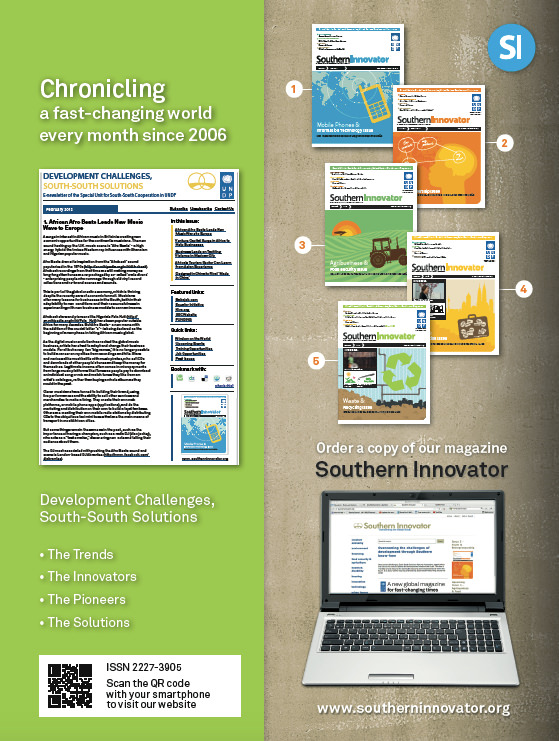
Development Challenges, South-South Solutions was launched as an e-newsletter in 2006 by UNDP’s South-South Cooperation Unit (now the United Nations Office for South-South Cooperation) based in New York, USA. It led on profiling the rise of the global South as an economic powerhouse and was one of the first regular publications to champion the global South’s innovators, entrepreneurs, and pioneers. It tracked the key trends that are now so profoundly reshaping how development is seen and done. This includes the rapid take-up of mobile phones and information technology in the global South (as profiled in the first issue of magazine Southern Innovator), the move to becoming a majority urban world, a growing global innovator culture, and the plethora of solutions being developed in the global South to tackle its problems and improve living conditions and boost human development. The success of the e-newsletter led to the launch of the magazine Southern Innovator.  

Creative Commons License

This work is licensed under a
Creative Commons Attribution-Noncommercial-No Derivative Works 3.0 License

ORCID iD: https://orcid.org/0000-0001-5311-1052.

© David South Consulting 2022

Categories
Archive Development Challenges, South-South Solutions Newsletters

Caribbean Island St. Kitts Goes Green for Tourism

By David SouthDevelopment Challenges, South-South Solutions

SOUTH-SOUTH CASE STUDY

Going green may sound like the right thing to do but it can also be associated with being a costly burden and boring. But, as one island nation is proving, being green is a great selling point for attracting tourists and investors – especially in a world where many places are grappling with pollution and resource depletion.

St. Kitts, an island located between the Caribbean Sea and the Atlantic Ocean, is part of the Federation of Saint Kitts and Nevis and has a population of around 35,000 (stkittstourism.kn).

The country shut down its main source of income, the sugar industry, in 2005. Facing dropping profits, it decided the industry was not worth supporting anymore.

But what would be the replacement source of income and employment? St. Kitts has turned to tourism for the answer. While many other Caribbean islands have long drawn on tourism – along with banking and finance, in some cases – in order to diversify economies away from dependence on agriculture, St. Kitts had not developed this sector. As a latecomer, St. Kitts needed to think about how it could do things differently and stand out from the crowd.

St. Kitts decided to become a regional champion for green tourism and green energy, and to lure tourists to the island by championing its green credentials.

The launch in 2013 of a Euro 1.8 million (US $2.48 million) one-megawatt solar energy farm nearby the Robert L. Bradshaw International Airport (http://www.stkittstourism.kn/explore-st-kitts-getting-here-airport.php) – enough to power a few hundred houses – showed St. Kitts was getting serious about going green (http://www.cuopm.com/?m=201302&paged=13).

Joining the new solar farm, an all-green resort is hoping to further boost St. Kitts’ green credentials. The ambitious Kittitian Hill (kittitianhill.com) resort stretches across 162 hectares and includes four hotels, an organic farm and multiple restaurants. In the pipeline is a plan to open film production and editing facilities to lure movie-makers looking for a green film-making studio.

Kittitian Hill is the brainchild of property developer Val Kempadoo (http://www.linkedin.com/pub/valmiki-kempadoo/8/53a/339), who is trying to set a precedent for sustainable resorts in the Caribbean. It is being developed with a mix of foreign experts and local contractors.

The resort boasts organic food fresh from tropical farms and an on-site tropical forest, described as an “edible landscape” offering a bounty of fresh fruit and vegetables. Around the resort, “Pick Me” signs encourage visitors to pick ripe fruit and sit down and make a meal of it.

The grounds include rare and heirloom fruit trees, and the resort hopes to create a reserve to protect endangered species. To spread the green message, the plants and seeds are shared locally with farmers and others. It is part of a strategy to encourage farmers to produce organic food, avoiding pesticides and chemicals, and to farm animals ethically.

The resort’s green ethos even extends to its 18-hole golf course. Golf courses are notorious water-wasters, but this one has a smart water management system, using organic crops and fruit trees to help keep the soil moist, interweaving a farm throughout the golf course. Caddies will guide golfers to the ripest fruits while they putt their way around the course.

“My vision is to bring together community and culture, along with mindful conservation of natural resources,” said Kempadoo. “This means we can offer our guests an unforgettable experience, while bringing lasting, life-changing benefits to the local people and economy.”

As an added sweetener to get investment coming in, St. Kitts and Nevis offers citizenship to investors in the country. In return, investors can travel visa-free to 120 countries – something that has appealed to investors from around the global South.

“It is important for St. Kitts to be selective and careful about development and focus on high-end rather than high-volume tourism,” Kempadoo told Monocle magazine. “The best asset of this island is its natural beauty, and we want to preserve it.”

Published: June 2014

Resources

1) The International Ecotourism Society: The International Ecotourism Society (TIES) is a 501(c)(3) nonprofit organization dedicated to promoting ecotourism. Website: https://www.ecotourism.org/what-is-ecotourism

2) Top Five Eco Resorts of Mexico: Website: http://www.ecotourismtrips.org/topics/show/3809

3) 3 Rivers Dominica Eco Lodge: “An award-winning range of comfortable and charming self-contained cottages, nature, adventure and community-based ecotourism activities, restaurant, rivers and relaxation”. Website: http://www.3riversdominica.com/

4) Jungle Bay Resort and Spa: Award-winning Jungle Bay was built and is operated in alignment with international Geotourism and Ecotourism guidelines. As an alternative to traditional Caribbean tourism, the focus is on enjoyable nature-based activities and wellness of guests with quality service, guided by the principles as set by both National Geographic’s Center for Sustainable Destinations and The International Ecotourism Society (TIES). Website: junglebaydominica.com

https://davidsouthconsulting.org/2022/10/20/african-tourism-leads-the-world-and-brings-new-opportunities/

https://davidsouthconsulting.org/2022/09/28/asian-factories-starting-to-go-green/

https://davidsouthconsulting.org/2022/02/07/boosting-tourism-in-india-with-surfing-culture/

https://davidsouthconsulting.org/2021/01/25/creating-green-fashion-in-china/

https://davidsouthconsulting.org/2022/11/20/ecotourism-to-heal-the-scars-of-the-past/

https://davidsouthconsulting.org/2023/02/03/environmental-public-awareness-handbook-case-studies-and-lessons-learned-in-mongolia/

https://davidsouthconsulting.org/2021/02/01/ethiopia-and-djibouti-join-push-to-tap-geothermal-sources-for-green-energy/

https://davidsouthconsulting.org/2022/11/11/innovation-cairos-green-technology-pioneers/

https://davidsouthconsulting.org/2021/10/22/innovations-in-green-economy-top-three-agenda/

https://davidsouthconsulting.org/2022/10/10/a-solution-to-stop-garbage-destroying-tourism/

https://davidsouthconsulting.org/2021/03/05/southern-innovator-issue-5/

https://davidsouthconsulting.org/2021/02/04/us-450-million-pledged-for-green-economy-investments-at-kenyan-gssd-expo/

Development Challenges, South-South Solutions was launched as an e-newsletter in 2006 by UNDP’s South-South Cooperation Unit (now the United Nations Office for South-South Cooperation) based in New York, USA. It led on profiling the rise of the global South as an economic powerhouse and was one of the first regular publications to champion the global South’s innovators, entrepreneurs, and pioneers. It tracked the key trends that are now so profoundly reshaping how development is seen and done. This includes the rapid take-up of mobile phones and information technology in the global South (as profiled in the first issue of magazine Southern Innovator), the move to becoming a majority urban world, a growing global innovator culture, and the plethora of solutions being developed in the global South to tackle its problems and improve living conditions and boost human development. The success of the e-newsletter led to the launch of the magazine Southern Innovator.  

Creative Commons License

This work is licensed under a
Creative Commons Attribution-Noncommercial-No Derivative Works 3.0 License

ORCID iD: https://orcid.org/0000-0001-5311-1052.

© David South Consulting 2023

Categories
Archive data Development Challenges, South-South Solutions Newsletters digital ID

India 2.0: Can the Country Make the Move to the Next Level?

By David SouthDevelopment Challenges, South-South Solutions

SOUTH-SOUTH CASE STUDY

With the global economic crisis threatening to cause turmoil in the emerging markets of the global South, it is becoming clear that what worked for the past two decades may not work for the next two.

For India, the legacy issues of poverty still need to be addressed, and the country’s impressive information technology (IT) industry – which has driven so much of India’s growth – will face stiff competition from other countries in the global South. Some argue that if the IT industry hopes to keep growing and contributing to India’s wealth, things will need to change.

Unlike China, where heavy investment in infrastructure and a strong link between government and the private sector has driven the impressive manufacturing boom in the country, in India the government has de-regulated and taken a back seat, leaving the private sector and entrepreneurs to drive the change and do the innovation.

Many believe various areas need urgent attention if India is to continue to enjoy good growth rates in the coming years. Areas in need of attention include infrastructure, healthcare and education (thesmartceo.in), in particular the knowledge to work in the information technology industry of the 21st century.

One of the founders of Indian outsourcing success Infosys (infosys.com), executive co-chairman Senapathy Gopalakrishnan, told Britain’s Telegraph newspaper, “So many people’s lives have been changed by IT in India.

“People from the middle class and lower middle class have become global employees and have the opportunity to work with some of the best companies in the world. But the challenge for India is that this industry can only create so many jobs. IT is not going to solve the unemployment problem in India.”

But the coming next wave of change in information technology is an opportunity to be seized to reduce unemployment if enough people are educated to handle it.

According to Gopalakrishnan: “I strongly believe, and it’s backed up by data, that there is a shortage of computer professionals everywhere in the world, including India. The application of computers is growing dramatically and will continue to grow dramatically over the next 20 to 30 years. We have to train and create the workforce necessary to grow this industry.”

Various media stories have called this next phase India 2.0. If India 1.0 was the highly successful information technology outsourcing industry developed in the late 1980s, through the 1990s and 2000s, then India 2.0 is the next wave of IT innovation being driven by Big Data, automation, robotics, smart technologies and the so-called “Internet of things.”

Big Data is defined as the large amounts of digital data continually generated by the global population. The speed and frequency with which data is produced and collected – by an increasing number of sources – is responsible for today’s data deluge (UN Global Pulse). It is estimated that available digital data will increase by 40 per cent every year. Just think of all those mobile phones people have, constantly gathering data.

Processing this data and finding innovative ways to use it will create many of the new IT jobs of the future.

“We are living in a world which is boundary-less when it comes to information, and where there is nowhere to hide,” continues Gopalakrishnan, “If you have a cellphone, somebody can find out exactly where you are. Through social networks you’re sharing everything about yourself. You are leaving trails every single moment of your life. Theoretically, in the future you’ll only have to walk through the door at Infosys and we’ll know who you are and everything about you.”

Unlike in the late 1980s, when India was the pioneer in IT outsourcing for large multinational companies and governments, competition is fierce across the global South. The mobile-phone revolution and the spread of the Internet have exponentially increased the number of well-educated people in the global South who could potentially work in IT. China, the Philippines, Kenya, Nigeria and Ghana are just some of the countries heavily involved in this area.

If India fails to meet the India 2.0 challenge, it risks seeing its successful companies and entrepreneurs leaving to work their magic elsewhere in Asia and the new frontiers of Africa, just as many of its best and brightest of the recent past became pioneers and innovators in California’s Silicon Valley.

India’s IT sector contributed 1.2 per cent to the country’s gross domestic product (GDP) in 1998; by 2012, this was 7.5 per cent (Telegraph). The IT industry employs 2.5 million people in India, and a further 6.5 million people indirectly. IT makes up 20 per cent of India’s exports and, according to the National Association of Software and Services Companies (nasscom.in), the industry has revenue of US $100 billion.

India is now the IT and outsourcing hub for more than 120 of the Fortune 500 companies in the United States.

Out of India’s 3.5 million graduates every year, 500,000 are in engineering – a large pool of educated potential IT workers. India produces the world’s third largest group of engineers and scientists, and the second largest group of doctors.

IT has become a route that catapults bright Indian youth into 21st-century businesses and science parks and to the corporations of the world.

One visible example of the prosperity brought by IT services in India is the booming technology sector based in the city of Bangalore (also called Bengaluru) (http://en.wikipedia.org/wiki/Bangalore).

Reflective of the contradictions of India, Bangalore has 10 per cent of its workforce now working in IT, but also 20 per cent of its population living in urban slums.

The nearby Electronics City (elcia.in) is considered “India’s own silicon valley and home to some of the best known global companies.”

To date, aspects of India 2.0 are already taking shape.

One company is called Crayon Data (crayondata.com). It uses Big Data and analytics to help companies better understand their customers and increase sales and deliver more personal choices.
Edubridge (http://acumen.org/investment/edubridge/) is helping to bridge the gap for rural youth with varied education backgrounds and long-term jobs. Edubridge trains youth for the real needs of employers to increase the chances they will get a job. This includes jobs in the IT business process outsourcing sector and banking and financial services.

Infosys is working on innovations for the so-called “Internet of things,” in which smart technologies connect everyday items to the grid and allow for intelligent management of resources and energy use. Infosys is developing sophisticated software using something called semantic analytics – which analyses web content (http://en.wikipedia.org/wiki/Semantic_analytics) – to sort through social media and the Internet to track customer responses to products.

Elsewhere, former Infosys Chief Executive Nanden Nilekani is involved in a Big Data innovation to address the problem of social and economic exclusion of India’s poor. Called Aadhaar (http://uidai.gov.in/), the government-run scheme is gathering biometric data on every Indian to build the world’s largest biometric database. After being enrolled and having fingerprints and iris scans taken, each individual is given a 12-digit identification number. So far 340 million people have been registered with the scheme, and it is hoped 600 million will be registered by the end of 2014.

The idea is to use a combination of access to mobile phones and these unique ID numbers to widen access to all sorts of products and services to poor Indians, including bank accounts for the millions who do not have one. Many people, lacking any identity or official acknowledgment they exist, were prevented from engaging with the formal economy and formal institutions. Being able to save money is a crucial first step for getting out of poverty and it is hoped information technology will play an important role in achieving this.

Published: March 2014

Resources

1) India 2.0 by Mick Brown. Website: http://s.telegraph.co.uk/graphics/india2.0/part-one#top

2) Electronic City Bangalore: Regional information portal for Electronic City, an industrial technology hub located in Bangalore South, India. This portal is becoming the most favourite haunt of ECitizens living and/or working in Electronic City. Website: http://www.electronic-city.in/

3) Electronics City Industries Association: Welcome to the Electronics City, India’s own silicon valley and home to some of the best known global companies. Located in Bangalore, the Electronics City was conceived way back in the mid-1970?s as an Industrial Estate exclusively for Electronics Industries. Today the industrial estate boasts is an oasis of large, medium and small industries spanning software services, hardware; high end telecommunications; manufacture of indigenous components; electronic musical instruments, just  to name a few. Website: elcia.in

4) Godrej E-City: Situated in Electronic city and connected through NICE road and the elevated expressway, Godrej E-City brings your workplace and other major conveniences within your immediate reach. Your travel times become shorter and hassle-free. You have more time for your family and yourself. It’s time to move closer to happiness. Website: https://www.godrejproperties.com/godrejecity/overview

5) Infosys: Infosys is a global leader in consulting, technology and outsourcing solutions. As a proven partner focused on building tomorrow’s enterprise, Infosys enables clients in more than 30 countries to outperform the competition and stay ahead of the innovation curve. Website: http://www.infosys.com/pages/index.aspx

6) Tech Hub Bangalore: partnering with the UK India Business Council to establish TechHub in Bangalore.TechHub is a community and workspace for technology entrepreneurs with 1000’s of members, building the most exciting startups in Europe. We have physical community spaces in London, Manchester, Bucharest, Swansea and Riga and have members from over 50 countries.The Bangalore site will be part of a wider scheme in partnership with other British firms such as Rolls Royce, ADS, Bangalore Cambridge Innovation Network, BAe and PA Consulting with the aim of forging stronger links between the UK and India. Website: http://www.techhub.com/blog/techhub-expands-to-bangalore/

https://davidsouthconsulting.org/2022/09/29/cheap-indian-tablet-seeks-to-bridge-digital-divide/

https://davidsouthconsulting.org/2022/02/17/digital-mapping-to-put-slums-on-the-map/

https://davidsouthconsulting.org/2022/10/09/entrepreneurs-use-mobiles-and-it-to-tackle-indian-traffic-gridlock/

https://davidsouthconsulting.org/2022/10/20/the-e-reader-battle-reaches-india/

https://davidsouthconsulting.org/2022/10/25/indian-city-slum-areas-become-newly-desirable-places-to-live/

https://davidsouthconsulting.org/2021/03/04/indian-id-project-is-foundation-for-future-economic-progress/

https://davidsouthconsulting.org/2022/11/01/indian-newspapers-thrive-with-economy/

https://davidsouthconsulting.org/2022/10/18/indians-fighting-inflation-with-technology/

https://davidsouthconsulting.org/2022/10/06/indian-solar-power-pack-powers-villages/

https://davidsouthconsulting.org/2021/03/31/new-weapon-against-crime-in-the-south/

Development Challenges, South-South Solutions was launched as an e-newsletter in 2006 by UNDP’s South-South Cooperation Unit (now the United Nations Office for South-South Cooperation) based in New York, USA. It led on profiling the rise of the global South as an economic powerhouse and was one of the first regular publications to champion the global South’s innovators, entrepreneurs, and pioneers. It tracked the key trends that are now so profoundly reshaping how development is seen and done. This includes the rapid take-up of mobile phones and information technology in the global South (as profiled in the first issue of magazine Southern Innovator), the move to becoming a majority urban world, a growing global innovator culture, and the plethora of solutions being developed in the global South to tackle its problems and improve living conditions and boost human development. The success of the e-newsletter led to the launch of the magazine Southern Innovator.  

https://davidsouthconsulting.org/2021/03/05/southern-innovator-issue-1/

Creative Commons License

This work is licensed under a
Creative Commons Attribution-Noncommercial-No Derivative Works 3.0 License.

ORCID iD: https://orcid.org/0000-0001-5311-1052.

© David South Consulting 2022
Categories
Archive Development Challenges, South-South Solutions Newsletters

3D Printing Gives Boy a New Arm in Sudan

By David SouthDevelopment Challenges, South-South Solutions

SOUTH-SOUTH CASE STUDY

3D printing is rapidly going mainstream and is now starting to make a big impact in health care. One innovative solution is using the technology to manufacture artificial arms for amputees harmed by war in Africa.

While large-scale manufacturers use the machines to fabricate products and parts, from aircraft components to furniture, it is the smaller-scale use of 3D printing machines that has been getting many working in development excited.

3D printing (http://en.wikipedia.org/wiki/3D_printing) usually involves a desktop-sized fabrication machine that builds a three-dimensional object following instructions from a digital computer file. It is an additive process, in which material is laid down in successive layers to create an object. The technology has been around since the 1980s but only became affordable for the general public in the past five years. Typically, 3D printers are used to make prototypes — for example architectural models or machine parts — or to manufacture one-off objects without the need to turn to mass production methods. But the technology is evolving quickly and, according to The Guardian, “20% of the output of 3D printers is now final products rather than prototypes.”

For international development, 3D printing offers the potential to close the gap between what is available in developed and developing countries. Just as the Internet has closed the knowledge gap, and enabled people around the world to access news and knowledge at the same time, so 3D printing could make it possible for technological innovations to be available everywhere. Just upload the digital plans for an object, and people can download them and print the item, wherever they are.

Some of the more enthusiastic proponents of 3D manufacturing see it as a game-changer in access to technology. They argue it could eliminate material want and place the power of manufacturing in the hands of billions, in the same way the rapid proliferation of mobile phones and the Internet transformed access to information. That is the dreamers’ dream, but it is closer than many think.

The conflict in the new nation of South Sudan, which separated from the Republic of the Sudan in 2011, continues and involves UN peacekeeping forces (http://unmiss.unmissions.org). The violence has killed over 10,000 (International Crisis Group) and injured many more, ruining lives through lost limbs and capabilities. One young boy, Daniel Omar, 16, lost both his hands while trying to use a tree trunk to shield himself from an exploding bomb. Losing his hands was devastating enough, but he was also so depressed at not being of full use to his family that he wished he had died that day.

He is not alone in being harmed by the conflict. In total, an estimated 50,000 people in South Sudan are physically disabled, according to the International Committee of the Red Cross (ICRC).
Prosthetic limbs are very expensive and so far are not a priority for medical services in the country. Saving lives is the priority, with rehabilitation an expensive luxury.

This is where Not Impossible Labs (notimpossiblelabs.com), based in Los Angeles, California, came in. The non-profit startup founded by Mick Ebeling specializes in “crowd-sourcing to crowd-solve previously insurmountable healthcare issues.” The solutions are then made public on the Internet and explained in online media to help innovators either replicate the solutions or be inspired to come up with their own ideas.

The lab’s ingenious solutions include BrainWriter – a way to draw using brainwaves and a computer mouse that can allow disabled artists to carry on creating. Not Impossible Labs also developed a high-tech cane for the blind that draws on sonar technology and a laser to navigate the terrain and foresee upcoming obstacles.

Emotionally touched after learning about Daniel’s plight, Ebeling decided to act.
“I’ve got three little boys,” Ebeling told The Guardian newspaper. “It was hard for me to read a story about a young boy who had lost his arms.”

Project Daniel (http://www.notimpossiblelabs.com/#!project-daniel/c1imu) set out to manufacture artificial hands for Daniel without him having to leave his country and his family. Daniel was living between the Yida refugee camp in South Sudan and his home in the Nuba Mountains.

A team from Not Impossible Labs set up the 3D printing lab in the Nuba Mountains and trained and supervised the local team to print two prosthetic arms. The design for the arm was done in the U.S. at its headquarters in Venice, California and is available for free and is open source (http://en.wikipedia.org/wiki/Open_source). A “dream team of innovators” were assembled – including the South African inventor of the Robohand (http://www.robohand.net/), an Australian MIT (Massachusetts Institute of Technology) neuroscientist and a 3D printing company owner from Northern California – to crowd-solve the challenge of making a 3D-printable prostheses. A precision engineering company, Precipart (precipart.com/home), and Intel were also drafted in to support the project.

Not Impossible believe the spirit behind the project will be globally transformative.

“We are on the precipice of a can do maker community that is reaching critical mass,” said Elliot V. Kotek, Not Impossible’s content chief and co-founder. “There is no shortage of knowledge, and we are linking the brightest technical minds and creative problem-solvers around the globe. Project Daniel is just the tip of the proverbial iceberg.”

Daniel’s new artificial arm and hand took a 3D printer several days to make and cost around US $100.

In November 2013, Ebeling travelled to South Sudan with all the equipment required to “print” Daniel a new arm: 3D printers, spools of plastic and cables.

The plastic arm printed by the 3D printer works by allowing the wearer to flex what remains of their arm to pull various cables that act as ligaments, like in a real limb. When the user flexes and bends, the cables pull back and in turn make the fingers close and open.

It is not a solution for every amputee. “With the technology we currently have it’s hard to help people with no arm left,” said Kotek. “There needs to be at least a little bit of a stump.”

Shy at first, once Daniel saw the arm, he was transformed. “It was a pretty amazing thing to see this boy come out of his shell,” said Ebeling. “Getting Daniel to feed himself was a highlight that was right up there with watching my kids being born.”

Even more impressive has been the quick adoption of the technology by the local doctor, Dr. Tom Catena, who performs all the amputations in the area.

With two 3D printing machines left behind by Ebeling, Dr. Catena has been able to print a prosthetic arm a week.

The machines mostly work at night when it is cool. The printer parts are then assembled by eight local people trained to operate the machines and build the arms.

But how do they ensure, over time, this 21st-century technology doesn’t just fall into disrepair and neglect as has been seen time and again with other attempts at technology transfer? Weekly phone calls are made to check on the project and the plastic used to make the arms is sent directly from Not Impossible Labs.

And then there is community buy-in.

“At first these kids wanted arms that matched their skin tone, because they didn’t want to stand out,” said Kotek.

But in time the youths have been decorating the arms in many colors and customizing them. And the arms have been given a name: the Daniel Arm.

Published: May 2014

Resources

1) The pioneer behind developing 3D technology has been the Massachusetts Institute of Technology’s Fab Labs based in the United States. It has been running experimental “Fab Labs” across the global South for the past few years, experimenting with ways to apply this technology to the challenges of development and to use this technology to turn people on to the power of technology to solve problems. These experiments have explored how a 3D printer could print everything a small community could require but would otherwise be expensive or difficult to purchase through normal markets. Fab Lab is the educational outreach component of MIT’s Center for Bits and Atoms (CBA), an extension of its research into digital fabrication and computation. Website: http://fab.cba.mit.edu/

2) 3D Systems: 3D Systems envisions a future in which 3D printing will return humanity to a heritage of personalized, localized craftsmanship and improve quality of life. A new industrial revolution changing the human experience from health care to entertainment. Website: 3dsystems.com

3) MakerBot: MakerBot makes a range of 3D printers for consumers. Website: makerbot.com

4) Stratasys: Stratasys manufactures 3D printing equipment and materials that create physical objects directly from digital data. Its systems range from affordable desktop 3D printers to large, advanced 3D production systems, making 3D printing more accessible than ever. Website: http://www.stratasys.com/

5)  3D Printing and Technology Fund: The Fund seeks long term capital appreciation through focused investment in global 3D printing and technology companies. Website: http://www.3dpfund.com/

6) Digital Revolution: An Immersive Exhibition of Art, Design, Film, Music and Video Games: Running from July to September 2014 at the Barbican Centre in London, UK. Website: https://www.barbican.org.uk/bie/upcoming-digital-revolution

https://davidsouthconsulting.org/2021/03/02/new-3d-technology-makes-innovation-breakthrough-and-puts-mind-over-matter/

https://davidsouthconsulting.org/2022/09/26/3d-home-printing-landmark-10-houses-in-a-day/

Creative Commons License

This work is licensed under a
Creative Commons Attribution-Noncommercial-No Derivative Works 3.0 License.

ORCID iD: https://orcid.org/0000-0001-5311-1052.

© David South Consulting 2023