Across the South, cities are expanding and urban populations growing at a phenomenal rate — the cities of Africa and Asia are growing by a million people a week. Megacities and sprawling slums will be the hallmarks of this majority urban world. In sub-Saharan Africa, 72 percent of the population already lives in slum conditions.
How people will be housed is an urgent problem. There are many ways to build a dwelling, from scavenged materials, to labour-intensive and expensive custom-built construction, yet affordable and safe construction techniques for the poor are sorely needed.
The danger of building unsafe housing can be seen in the recent devastating earthquake in Haiti, where many buildings collapsed, killing an estimated 212,000 people. If the rapid growth in urban populations is to be safe and sustainable, then new dwellings will need to be built that meet high standards of durability.
In South Africa, one company believes it has the right technology for an age of rapid urban population growth and the need for quick and safe housing construction.
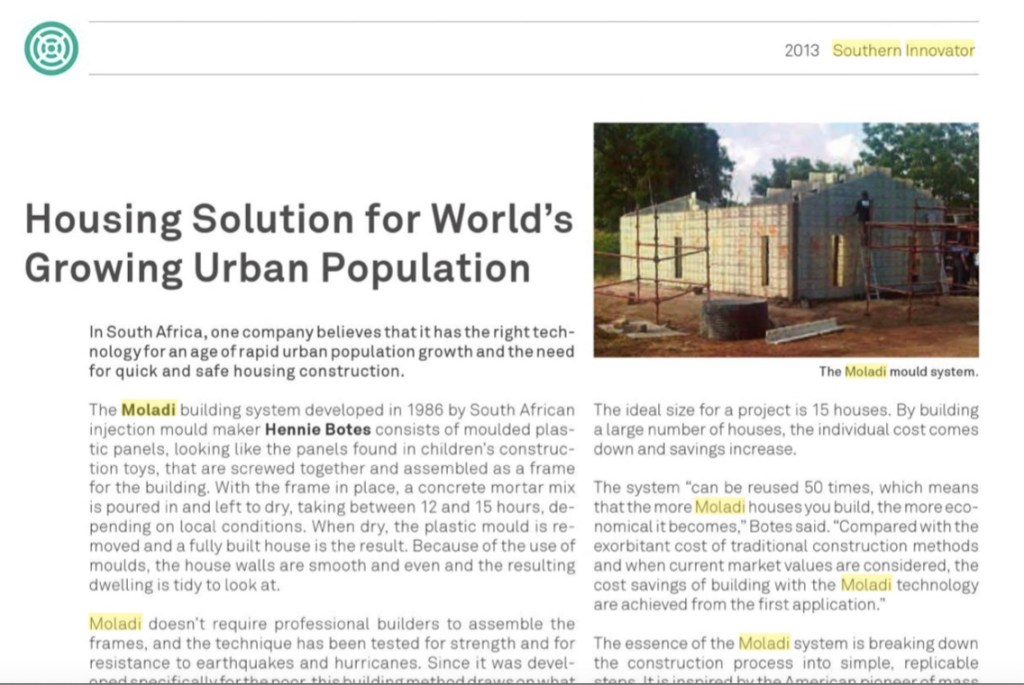
The Moladi building system (http://moladi.com/) (http://www.moladi.net/default.aspx?AspxAutoDetectCookieSupport=1) developed in 1986 by South African injection mold maker Hennie Botes consists of molded plastic panels, looking like the panels found in children’s construction toys that are screwed together and assembled as a frame for the building. With the frame in place, a concrete mortar mix is poured in and left to dry: depending on local conditions, taking between 12 and 15 hours. When dry, the plastic mold is removed and a fully built house is the result. Because of the use of molds, the home’s walls are smooth and even and the resulting home is tidy to look at.
Moladi doesn’t require professional builders to assemble the frames, and the technique has been tested for strength and for resistance to earthquakes and hurricanes. Since it was developed specifically for the poor, this building method draws on what is called ‘sweat equity’: often the only asset a poor person has to contribute to the cost of building a home is their free labour.
Because the dimensions of the home have already been established when the plastic frames were molded, common on-site mistakes are avoided.
Moladi benefits from South Africa’s Black Economic Empowerment programme (http://www.southafrica.info/business/trends/empowerment/bee.htm) and is certified for its quality with the South African Bureau of Standards (SABS) (https://www.sabs.co.za/). Moladi contractors and developers are working in 15 countries and the technique is distributed in a further seven countries.
The Moladi construction technique was born of frustration with the traditional approach of laying one brick on top of another. This traditional construction method, dating back thousands of years, just doesn’t match the needs of our times. It is slow and requires highly skilled bricklayers to be done right. Across the developing world, it is possible to see poorly constructed brick dwellings – often built unevenly with poor quality mortar holding the bricks together – that are unsafe in an earthquake.
Training in the Moladi technique takes from one to two weeks for unskilled workers depending on the size of the home. Moladi provides handbooks and all the necessary resources to complete the project. Each project has its own custom-built plastic frames made based on the home’s design.
“There is no flat fee for on-site training; the client is only responsible for covering the travel and living expenses for the Moladi representative or training foreman,” said Hennie Botes.
The ideal size for a project is 15 homes. By building a large number of homes, the individual cost comes down and savings increase.
The system “can be reused 50 times, which means that the more Moladi houses you build, the more economical it becomes,” Botes said. “Compared with the exorbitant cost of traditional construction methods and when current market values are considered, the cost savings of building with the Moladi technology are achieved from the first application.”
As the world’s cities grow, and slums become larger and more prevalent, the urgent need for affordable and decent housing will go hand-in-hand with a need for jobs — particularly jobs for unskilled workers. There just won’t be enough skilled workers to go around to build the homes. Even in developed countries, this has become a problem.
“The recent earthquake disaster in Haiti could benefit from the Moladi system,” Botes said. “Job creation for Haitians is desperately needed and Moladi can immediately facilitate an income for family groups, as over 95 percent of the construction team consists of unskilled labourers. There is no requirement for heavy machinery, or even electricity, and remote areas can be easily accessed; Moladi also allows for the utilisation of building rubble resulting from the earthquake in the construction of new buildings.”
The essence of the Moladi system is breaking down the construction process into simple, replicable steps. It is inspired by the American pioneer of mass production, car maker Henry Ford (http://en.wikipedia.org/wiki/Henry_Ford), who achieved efficiency and low costs in production by simplifying production into standardized and modulated steps.
“The Moladi construction process should be viewed as a workflow process similar to that of a vehicle assembly line,” Botes said. “Through the simplification, standardization, modularization, and industrialization of the construction process, efficiency and cost savings are achieved and maintained by managing the continuous flow process on site.
“Contractors must make sure that they have planned their project roll-out and budget well and have clearly defined goals as to what they want to achieve. It is very important to have all team players and professionals on the same page with regards to their roles and responsibilities.”
In the beginning, Botes encountered resistance to his innovative production methods. “I was highly motivated and really believed in my idea, but when I presented it to investors, they’d shoot holes in it. … It’s been a 22-year journey, but I always kept the goal in mind. Moses spent 40 years in the desert … I’m quite happy my desert experience was only 20-odd years, though,” he told Men’s Health magazine.
South Africa is facing a population growth rate of 1.73 percent a year (UNICEF). It also has 61 percent of the urban population trying to live on four percent of the land, according to Botes. This urban population grows at 2.7 percent a year, yet existing housing needs are not being met. There is already a backlog of 2.2 million homes needed to be built, and this grows by 180,000 every year, according to the Banking Association of South Africa (http://www.banking.org.za/default.aspx).
“Even though the need for housing has always been a fundamental requirement to sustain one’s health and welfare, the advances in this area have been seriously lacking,” said Botes. “The brick and mortar method of construction was recorded as early as 1458 B.C, which means that very little has changed in terms of building structures over a period of almost 3.5 millennia.
“We cannot expect to resolve the housing crisis in our age with a technique developed for the requirements of society 3468 years ago.”
With the success of the Moladi building system, Hennie is working on “producing windows, doors, toilet seats, window frames, sinks and washbasins. If I can include these as part of my product, I’ll reduce the total unit cost of the house.”
Published: February 2010
Resources
1) Cradle to Cradle: Remaking the Way We Make Things: This radical concept is about how products, can be used, recycled, and used again without losing any material quality—in cradle to cradle cycles. Website:http://www.mcdonough.com/cradle_to_cradle.htm
2) Builders Without Borders: Is an international network of ecological builders who advocate the use of straw, earth and other local, affordable materials in construction. Website:http://builderswithoutborders.org/
3) World Hands Project: An NGO specialising in simple building techniques for the poor. Website:http://www.worldhandsproject.org
4) CIDEM and Ecosur specialise in building low-cost community housing using eco-materials. They have projects around the world and are based in Cuba. Website:http://www.ecosur.org
5) The Rural Development Institute focuses on land rights for the poor and has a series of articles on China’s land reforms. Website: http://www.rdiland.org
6) More Urban, Less Poor: The first textbook to explore urban development and management and challenge the notion unplanned shanty towns without basic services are the inevitable consequence of urbanization. Website:http://www.earthscan.co.uk/
7) Building and Social Housing Foundation: The Building and Social Housing Foundation (BSHF) is an independent research organisation that promotes sustainable development and innovation in housing through collaborative research and knowledge transfer. Website: http://www.bshf.org/
The fourth issue of Southern Innovator has launched online and in print. Order copies now for distribution. Email: southerninnovator@yahoo.co.uk.
December
Baker Cookstoves – Designing for the African Customer Development Challenges: An innovative social enterprise is using design to create an energy-efficient cookstove for Kenya. By turning to an experienced Swedish architecture and design firm, the people behind the Baker cookstove wanted to make sure the stove’s design was as efficient as possible and relevant to the customers’ needs, while also making sure it is visually appealing and something a person would proudly want in their home.
Texting for Cheaper Marketplace Food with SokoText Development Challenges: An international group of graduate-social entrepreneurs from the London School of Economics (LSE) is pioneering a way to reduce food prices in Kenya using mobile phones.
Ethiopia and Djibouti Join Push to Tap Geothermal Sources for Green EnergyDevelopment Challenges:Ethiopia and Djibouti are the latest global South countries to make a significant commitment to developing geothermal energy – a green energy source that draws on the heat below the earth’s surface (http://en.wikipedia.org/wiki/Geothermal_energy) – to meet future development goals.
Tackling China’s Air Pollution Crisis: An Innovative SolutionDevelopment Challenges: China reached an undesired landmark in 2013. While the country’s impressive economic growth has amazed the world, it has come at a price: pollution. China recorded record levels of smog in 2013, with some cities suffering air pollution many times above what is acceptable for human health.
November
Ghana Wants to Tap Global Trendy Party Scene Development Challenges: Tourism is big business – and one of the most resilient parts of the global economy. Despite the international economic crisis that has wreaked havoc and increased unemployment and poverty in many countries since 2007, tourism is still going strong.
China Pushing Frontiers of Medical ResearchDevelopment Challenges: Cutting-edge medical research in China is promising to boost human health and development. Futuristic science is being conducted on a large scale and it is hoped this will increase the pace of discovery.
Latin American Food Renaissance Excites Diners Development Challenges: Food is essential for a good life and plays a critical part in overall human health and development. The better the quality of food available to the population, the better each individual’s overall health will be, and this will have a direct impact on mental and physical performance (http://www.sciencedirect.com/science/article/pii/S2213453012000055).
Perfume of Peace Helps Farmers Switch From Drug Trade Development Challenges: A tragedy in a time of war has led to a social enterprise that is creating jobs – and making the world smell a little better, too.
US $450 Million Pledged for Green Economy Investments at Kenyan ExpoDevelopment Challenges: Innovators working in the global green economy could benefit from over US $450 million in investment recently pledged at the UN’s Global South-South Development Expo held in Nairobi, Kenya.
October
African Fashion’s Growing Global Marketplace Profile Development Challenges: Tales of African global fashion successes have multiplied in the last few years. African fashion is seeing its profile rise as more and more shows and festivals boost awareness of the continent’s designs, designers and models. In turn, African fashion and design is being taken more seriously as an income and job generator, and as a sector able to weather the ups and downs of the global economy: people always need to wear clothes.
Cuban Entrepreneurs Embracing Changes to Economy Development Challenges: The Caribbean island of Cuba has gone its own way economically and socially since its revolution in 1959. The country has seen significant gains in its human development in the decades since, and can boast impressive education levels and good public health care.
Radical Drone Solution to Woeful Infrastructure in Poor CountriesDevelopment Challenges: Drones – unpiloted aircraft, formally called Unmanned Aerial Vehicles (UAV) or Unmanned Aircraft Systems (UAS) – have long been used for military purposes. The U.S. military claims to have 7,500 drones – a massive growth from just 50 a decade ago – and has used them for surveillance and combat in conflicts from Afghanistan to Iraq.
Pioneering African Airlines Help to Expand Routes Development Challenges: The last decade has seen a revolution in African air travel. The number of air routes has grown and this has paralleled the economic growth across the continent. As demand has been strong for Africa’s resources, it has also fueled a consumer boom that is benefiting an increasing number of people.
September
Affordable Space Programmes Becoming Part of South’s DevelopmentDevelopment Challenges: Space: the final frontier. At least that was how heading off into the stars was portrayed in cult television and film series Star Trek. While many countries are working to raise living standards and eradicate poverty on earth, some are also looking to space for solutions to earth-bound problems.
Solar Bottle Bulbs Light Up Dark HomesDevelopment Challenges: Finding ways to generate low-cost or free light has captured the imagination of innovators across the global South. The desire for light is strong: Light gives an immediate boost to income-making opportunities and quality of life when the sun goes down or in dark homes with few windows.
China Sets Sights on Dominating Global Smartphone MarketDevelopment Challenges: The rise of smartphones – mobile phones capable of Internet access and able to run ‘apps’ or applications – is the latest wave of the global connectivity revolution. Mobile phones rapidly made their way around the world to become almost ubiquitous – the most successful take-up of a piece of communications technology in history – and now smartphones are set to do the same. The number of mobile phone subscriptions in the world surpassed 6 billion in 2012 (out of a population of 7 billion) and, according to the International Telecommunications Union (ITU), the number of mobile phones will exceed the world’s population by 2014.
Poorest Countries Being Harmed by Euro Currency Crisis Development Challenges: The ongoing economic crisis in Europe is forecast to harm the economies of the world’s poorest countries if it continues, according to a study by the United Kingdom’s Overseas Development Institute (ODI) (odi.org.uk).
August
Solar-Powered Mobile Clinics to Boost Rural Healthcare in AfricaDevelopment Challenges: Around the world, innovative thinking is finding new ways of using solar power technology to bring electricity to underserved areas of the global South. Innovators are experimenting with new technologies, new business models and new ways to finance getting solar power into the hands of the poor.
Vietnamese Google Rival Challenging Global Giant Development Challenges: Information technologies are creating new business opportunities across the global South. As more and more people gain access to the Internet in one form or another, opportunities to offer them services also increase.
More Futuristic African Cities in the WorksDevelopment Challenges: It has been well documented that China is undergoing the largest migration in human history from rural areas to cities. But this urbanization trend is occurring across the global South, including in Africa, as well. According to the UN, more than half the world’s population already lives in cities, and 70 per cent will live in urban areas by 2050. Most of the world’s population growth is concentrated in urban areas in the global South.
Story cited in Beyond Gated Communitiesby Samer Bagaeen and Ola Uduku, Taylor & Francis, ISBN 9781317659051, 2015
Haitian Coffee Becoming a Hit with American ConnoisseursDevelopment Challenges: The Caribbean country of Haiti has had to deal with the twin challenges of recovering from a devastating earthquake in 2010 while also pulling itself out of the economic and social chaos that has resulted in its status as the poorest place in the Western hemisphere.
New 3D Technology Makes Innovation Breakthrough and Puts Mind over MatterDevelopment Challenges:Revolutions in technology are placing more and more power into the hands of the individual, and 3D printing and fabrication machines are opening a whole new chapter. These devices come in many forms, but they all do one thing: they can manufacture pretty well any three-dimensional object on the spot, from digital plans. These machines come in many sizes, from factory scale to smaller, home versions which are no bigger than personal computer printers, such as the well-known MakerBot Replicator 2 (makerbot.com).
July
African Infrastructure Dreams Back on Agenda Development Challenges: Africa’s patchy infrastructure is not keeping pace with the continent’s economic growth. Satellite photos of Africa at night show a place where light is concentrated overwhelmingly in the South – primarily South Africa – and in the North, with a sprinkling of lights on the west and east coasts (http://geology.com/articles/satellite-photo-earth-at-night.shtml).
Mobile Phone Microscopes to Revolutionize Health DiagnosticsDevelopment Challenges: Mobile phone usage has increased hugely across the global South in the past five years. In Africa, the number of mobile phone subscribers reached 545 million in 2013, while there are 3.5 billion mobile phone users in Asia and the Pacific (ITU). Some 93 million people in Africa and 895 million in Asia and the Pacific have mobile phone Internet access (ITU).
Small Fish Farming Opportunity Can Wipe Out MalnutritionDevelopment Challenges: Pioneering work to boost diets across the global South is turning to the smallest of fish. While small in size, tiny fish are packed with nutrition when eaten whole, as they are in many cultures. Often these fish come packed with vitamin A, iron, zinc, calcium, protein and essential fats – all necessary elements to eradicate malnutrition and hidden hunger, especially among women and children.
Burgeoning African E-commerce Industry Full of OpportunityDevelopment Challenges: Africa has seen huge change since 2000 in the way people access information and do business electronically. The most championed accomplishment has been the widespread take-up of mobile phones. This has given birth to countless entrepreneurs and innovators who are using phones to help people, do business and sell goods and services.
Staple Foods Are Becoming More Secure in the South Development Challenges: Finding ways to ensure food security in countries experiencing profound economic and social change and stress is critical to achievement of development goals. Food security is crucial to ensuring economic development is sustainable, and it is vital to long-term human health. Just one bout of famine can damage a generation of youth, stunting brain development and leaving bodies smaller and weaker than they should be.
June
African Innovators Celebrated in PrizeDevelopment Challenges: Innovation is increasingly being recognized as the key to tackling long-standing development problems in Africa, as well as across the developing and developed world. While it is easy to draw up a list of challenges facing the global South, it takes a special person to see not problems but solutions.
New Beer Helping to Protect ElephantsDevelopment Challenges: How to match the often conflicting goals of protecting animal habitats and supporting local economies? One clever solution may draw amusement but is actually a sharp marketing strategy to get attention for a product that is helping to preserve the elephants of Thailand’s Golden Triangle (http://en.wikipedia.org/wiki/Golden_Triangle_(Southeast_Asia).
Solar Solution to Lack of Electricity in AfricaDevelopment Challenges: Electricity is critical to improving human development and living standards. Yet, for many in the global South, electricity is either non-existent or its provision is patchy, erratic, unreliable or expensive.
Time-Tested Iranian Solutions to Cool and Refrigerate Development Challenges: Keeping food cool is critical for human health. No matter what the climate, a cool environment will prolong food preservation, stave off spoilage and lower the risk of food poisoning. This is crucial for the poor because it means they can reduce food waste and avoid illnesses caused by food poisoning. Diarrhea is a common problem when people do not have access to refrigeration for their food.
May
US $1 Trillion Opportunity for Africa’s Agribusinesses Says ReportDevelopment Challenges: As the world’s population continues to grow – surpassing 9 billion people by 2050, the United Nations estimates – and more and more people move to urban areas, producing enough food to feed this population will be one of the biggest economic challenges and opportunities in the global South.
Ambitious Schemes Hope to Advance Economic DevelopmentDevelopment Challenges: Sometimes it takes a bold, fresh start to speed up economic and human development goals. Taking a large-scale approach has been used around the world, either establishing new trade zones or even a new city.
Indian Initiatives to Make Travel Safer for Women Development Challenges: Shocking assaults on women traveling in India have galvanized innovators to find solutions. One solution that is proving successful is to establish specialist taxi services for women. As a happy additional benefit, these taxi innovators are transforming the taxi experience, introducing more ethical practices such as honest fares, professional and safe driving habits and clean, hygienic and comfortable taxis.
Kenya Reaches Mobile Phone Banking Landmark Development Challenges: Financial transactions and banking with mobile phones have been a Kenyan success story.
April
Online Education Could Boost African Development Development Challenges: Education is recognized as a major catalyst for human development. During a high-level meeting on the Millennium Development Goals (MDGs) (http://www.undp.org/content/undp/en/home/mdgoverview.html) in 2010, UNESCO – the United Nations Educational, Scientific and Cultural Organization – pointed out the necessity of making rapid gains in education if all the MDGs are to be achieved. The goals deadline is 2015 – just two years away.
African Digital Laser Breakthrough Promises Future InnovationDevelopment Challenges: For decades many African countries have experienced low investment in research and development (R&D) and scientific innovation. One of the few nations to benefit from a sophisticated university network and research and development sector was South Africa. It still ranks top on the continent for funding R&D and its high number of scientific journals.
Preserving Beekeeping Livelihoods in Morocco Development Challenges: The clever combining of tourism and long-standing beekeeping skills has revived a local craft and is also helping to preserve the ecology of Morocco. Beekeeping, or apiculture (http://en.wikipedia.org/wiki/Beekeeping), has two clear benefits. Bee products, including honey, beeswax, propolis, pollen and royal jelly can be a valuable source of income. The other benefit is the critical role bees play in the ecology by pollinating flowers and plants as they go about their daily business.
A New African Beer Helps Smallholder Farmers. Development Challenges: Africa’s growth in the past decade has held steady despite the trauma of the global economic crisis and the tumult of the “Arab Spring” in several countries of North Africa. African economies are growing because of a number of resilient trends. These include growing regional trade links, greater investment in infrastructure and the remarkable rise of China to become Africa’s number one trade partner, pushing the United States to second place (Technology + Policy). This has given birth to a growing consumer marketplace and consumer class – some 300 million people earning about US $200 a month (Africa Rising).
Boosting Tourism in India with Surfing Culture Development Challenges: Tourism has experienced decades of growth and diversification and is now considered one of the fastest-growing economic sectors in the world. According to the UNWTO – the United Nations World Tourism Organization – modern tourism is “a key driver for socio-economic progress.”
March
Made-in-Africa Fashion Brand Pioneers Aim for Global SuccessDevelopment Challenges: African fashion brands have not always been the first place fashionistas turned to when shopping for new clothes or shoes in developed economies. While Africa has long been a source of inspiration in contemporary and traditional fashion, the continent has had a weak reputation for manufacturing and selling mass market global fashion brands.
Kenyan Book Company Brings Online Sales to East Africa Development Challenges: The Internet has revolutionized retail sales in many developed countries – and nowhere more so than for booksellers. The ability to offer an almost unlimited supply of books through a website is revolutionizing the way people shop and giving life to books long out of print or by unknown authors.
African Innovation Helps Make Banking Transactions SaferDevelopment Challenges: As economies grow in Africa, more and more people are conducting their financial transactions electronically. This can be either through mobile phones and digital devices, or through the hole-in-the-wall of the automatic teller machine, or ATM.
New Apps Make Driving and Travelling in Egypt Easier, SaferDevelopment Challenges: Mobile phones are ubiquitous across the global South. They have spawned whole new business opportunities and changed the way people solve problems and find solutions.
Bangladesh Coffin-Maker Offers an Ethical Ending Development Challenges: Few people want to think about death, and many are ill-prepared when it happens to a loved one or friend. But it will happen to us all – and growing ethical and environmental concerns are reshaping the way many deal with the inevitable event. More and more people are seeking a lower-cost option for being disposed of that also does not harm the environment.
February
Thai Organic Supermarkets Seek to Improve HealthDevelopment Challenges: A Thai business is working hard to expand access to organic food in the country. It sees this as part of a wider campaign to improve health in the country – and its success has caught the attention of the government, which wants to turn Thailand into a global health destination.
Global South Experiencing Transportation Revolution Development Challenges: Away from the news headlines, a quiet revolution has been taking place in public transportation across the global South. As cities have expanded and grown, they have also been putting in place public transport systems to help people get around and get to work.
Global South’s Middle Class is Increasing Prosperity Development Challenges: The global middle class is on the rise – and this is creating both challenges and opportunities. As poverty rates have come down across the global South, many countries have seen a rise in the proportion of their population categorized as “middle class”. Globally, being middle class is defined as a person able to consume between US $4 a day and US $13 a day (ILO).
Angolan Film Grabs Attention at Film Festival Development Challenges: The power of the creative economy to transform lives, livelihoods – and perceptions – should never be underestimated. Creativity can transform the image of places and situations often seen in a negative light. A film from Angola is shining a light on the country’s music scene and showing the vitality of the nation in the wake of a long-running civil war.
Development Challenges, South-South Solutions was launched as an e-newsletter in 2006 by UNDP’s South-South Cooperation Unit (now the United Nations Office for South-South Cooperation) based in New York, USA. It led on profiling the rise of the global South as an economic powerhouse and was one of the first regular publications to champion the global South’s innovators, entrepreneurs, and pioneers. It tracked the key trends that are now so profoundly reshaping how development is seen and done. This includes the rapid take-up of mobile phones and information technology in the global South (as profiled in the first issue of magazine Southern Innovator), the move to becoming a majority urban world, a growing global innovator culture, and the plethora of solutions being developed in the global South to tackle its problems and improve living conditions and boost human development. The success of the e-newsletter led to the launch of the magazine Southern Innovator.
Pioneering work to boost diets across the global South is turning to the smallest of fish. While small in size, tiny fish are packed with nutrition when eaten whole, as they are in many cultures. Often these fish come packed with vitamin A, iron, zinc, calcium, protein and essential fats – all necessary elements to eradicate malnutrition and hidden hunger, especially among women and children.
It is estimated that 684,000 child deaths worldwide could be prevented by increasing access to vitamin A and zinc (WFP).
Iron deficiency is the most prevalent form of malnutrition worldwide, affecting an estimated 2 billion people. Iron deficiency is impairing the mental development of 40 to 60 per cent of children in developing countries (UNICEF). The World Health Organization says that eradicating iron deficiency can improve national productivity levels by as much as 20 percent.
Vitamin A deficiency affects approximately 25 per cent of the developing world’s pre-schoolers. It is associated with blindness, susceptibility to disease and higher mortality rates, and leads to the death of approximately 1 to 3 million children each year (UN).
This devastating evidence shows the need to find effective food solutions to eradicate these nutrient deficiencies. Access to affordable nutrient-rich food is also key to social and political stability. Already, there is serious unrest in many countries around the world because of food-price inflation.
Finding ways to boost nutritional health that are sustainable, low-cost and do not require substantial use of resources will have the best success in the poorest areas.
A number of studies suggest one solution may be eating more small fish. In many countries, these species are eaten as part of the diet, but often not in large enough quantities to address hunger and malnutrition. Small fish species are a remarkable food source because they are usually eaten whole, bringing greater nutritional benefits.
A study conducted between 2010 and 2013 in Bangladesh and Cambodia by Dr. Shakuntala Haraksingh Thilsted, Senior Nutrition Adviser to WorldFish (worldfishcenter.org), found that the eating of small fish in both countries gave a significant boost to daily diets and massively improved nutrition and health. The project, called Linking Fisheries and Nutrition: Promoting Innovative Fish Production Technologies in Ponds and Wetlands with Nutrient-dense Small Fish Species, was supported by the International Fund for Agricultural Development.
People in both countries still currently suffer from undernutrition and micronutrient deficiencies.
In rural areas of Bangladesh and Cambodia it found 50 to 80 per cent of total fish consumed were small fish. The quantities consumed during each meal were small but they occurred in diets frequently. Typically, they were eaten whole, with the head, viscera (internal organs) and bones consumed. This meant consuming small fish packed a punch, giving the eater a dose of calcium, vitamin A, iron and zinc.
More specifically, the study found the iron-rich Mekong flying barb (Esomus longimanus) (http://www.iucnredlist.org/details/169546/0) – eaten as part of a meal of rice and sour soup with its head intact in Cambodia – could provide 45 per cent of the daily iron requirement for a woman.
Malnutrition is also a serious problem in Bangladesh. Half the population lives below the poverty line and diets are poor in delivering necessary vitamins and minerals. This is damaging to peoples’ physical and mental health.
The study found existing fish aquaculture methods in Bangladesh were inefficient. But new technologies provide an opportunity to increase the quantity of fish harvested and increase household incomes. By using highly efficient low-risk polyculture systems – basically combining small, nutrient-dense fish with high-value fish such as carp or freshwater prawn – it is possible to significantly increase the quantity of fish produced.
Another one of the new techniques includes increasing pond depth, which conserves broodfish (http://en.wikipedia.org/wiki/Broodstock). Broodfish are the mature fish used for the production of eggs or sperm and are also called spawners.
The study estimated a production of 10 kilograms per pond per year of fish spread across the 4 million small ponds in Bangladesh has the potential to meet the recommended dietary intake for 6 million children in the country.
The work in Bangladesh to boost the production of small fish has inspired similar initiatives in Sunderbans, West Bengal, India and in Terai, Nepal. Initiatives in Cambodia and Kenya have also developed meals for young children by combining powdered rice or maize with small fish.
And in Africa, some are calling for more use of aquaculture as an alternative to dwindling fish sources. For sub-Saharan Africans, fish can make up 22 per cent of the protein in their diet.
As populations on the continent quickly rise, marine fisheries are beginning to be over-exploited. The Food and Agriculture Organization of the United Nations and WorldFish are calling for an aquaculture revolution on the continent to move away from the old approach of just using ponds located on farms. To make a real impact, both organizations argue, there needs to be a partnership between smallholder farmers and others to build a commercial fish farming sector.
“Per capita fish supplies in Africa are dwindling,” Malcolm Beveridge, director for aquaculture at WorldFish, one of the 15 CGIAR research centers (Consultative Group on International Agricultural Research) (http://www.cgiar.org/cgiar-consortium/research-centers/), that generate and disseminate knowledge, technologies, and policies for agricultural development. “In Malawi, they fell from 10 kilograms to 6 kilograms per person between 1986 and 2006. Aquaculture has the potential to increase supplies of this affordable nutritious food for poor and vulnerable consumers,” he told The Guardian.
Published: July 2013
Resources
1) Scaling Up Nutrition: Scaling Up Nutrition, or SUN, is a unique movement founded on the principle that all people have a right to food and good nutrition. It unites people – from governments, civil society, the United Nations, donors, businesses and researchers – in a collective effort to improve nutrition. Website: http://scalingupnutrition.org/
2) The WorldFish Center: WorldFish, a member of the CGIAR Consortium, is an international, non-profit research organization dedicated to reducing poverty and hunger by improving fisheries and aquaculture. Website: http://www.worldfishcenter.org/
3) Bangladesh Shrimp and Fish Foundation: Bangladesh Shrimp and Fish Foundation (BSFF) is a non-profit private research and advocacy organization created through a USAID project. Website: http://www.shrimpfoundation.org/
4) Aquaculture for the Poor in Cambodia – Lessons Learned: The project was implemented by the WorldFish Center with financial support from the Ministry of Foreign Affairs (Government of Japan). Website: http://www.worldfishcenter.org/resource_centre/WF_2769.pdf
5) Global Aquatics: The website design is a bit dated but it is packed with the basics on aquaculture. Website: http://growfish.com/
Development Challenges, South-South Solutions was launched as an e-newsletter in 2006 by UNDP’s South-South Cooperation Unit (now the United Nations Office for South-South Cooperation) based in New York, USA. It led on profiling the rise of the global South as an economic powerhouse and was one of the first regular publications to champion the global South’s innovators, entrepreneurs, and pioneers. It tracked the key trends that are now so profoundly reshaping how development is seen and done. This includes the rapid take-up of mobile phones and information technology in the global South (as profiled in the first issue of magazine Southern Innovator), the move to becoming a majority urban world, a growing global innovator culture, and the plethora of solutions being developed in the global South to tackle its problems and improve living conditions and boost human development. The success of the e-newsletter led to the launch of the magazine Southern Innovator.
It was announced in January 2014 that China has surpassed the United States to become the world’s number one trading nation, as measured by the total value of exports and imports. This new economic behemoth also continued to grow its trade relationships with Africa.
US exports and imports of goods totaled US $3.82 trillion in 2013, according to the U.S. Commerce Department. China’s annual trade in goods passed US $4 trillion for the first time in 2013 (Guardian).
Zheng Yuesheng, a spokesman for China’s customs administration, told The Guardian that becoming the world’s number one trading nation was “a landmark milestone for our nation’s foreign trade development.”
Significantly for Africa, 2012 was also a record year for China-Africa trade, which reached 5 per cent of China’s total foreign trade and made up 16 per cent of all of Africa’s international trade, according to a new report from South Africa.
Consultancy Africa Intelligence (consultancyafrica.com), a South African-based organization with more than 200 consultants focused on “expert research and analysis on Africa” highlights the achievements of this strong trade relationship – and also some of its threats and weaknesses – in its report.
Trade between China and Africa has surged during the decade since China joined the World Trade Organization (WTO) (wto.org) in 2001, rising from around US $10 billion in 2000 to US $198.49 billion in 2012, according to China’s Ministry of Commerce. Ambitiously, it could reach US $300 billion by 2015, announced Cheng Zhigang, secretary-general of the China-Africa Industrial Cooperation and Development Forum (www.zfhz.org) (China Daily).
China’s trade and poverty reduction.
The World Bank reported South-South trade now surpasses South-North trade, meaning exports from developing countries to other developing countries exceed exports to wealthy developed countries. South-South trade experienced rapid growth in the 2000s, accounting for 32 per cent of world trade by 2011 (World Bank).
South-South trade and investment between Africa and lower-income and middle-income developing countries rose from 5 per cent in the 1990s to almost 25 per cent in 2010 (Consultancy Africa Intelligence). Before the 1990s, over 90 per cent of trade for Africa was with high-income or developed countries.
China is attractive as a trade partner for many reasons. One of them is the strong admiration for its success in lifting millions out of poverty through an aggressive growth strategy and rapid urbanization with big investments in education, science, technology, infrastructure – modern airports, ports, roads and rail – and research and development.
Since 1978, it is believed China has lifted 500 million people out of poverty, out of a population of 1.3 billion people (World Bank). Incomes have doubled every 10 years with average GDP growth of 10 per cent a year, meaning the country has almost reached all the Millennium Development Goals.
Building a trade relationship with China has led to Zambia’s copper mines running again, Gabon’s oil fields being re-explored, and Sudan becoming a major oil exporter to China. Angola, Democratic Republic of Congo (DRC), Equatorial Guinea, Republic of Congo and South Africa are all benefiting from exporting commodities to China.
The relationship has not been entirely beneficial, according to the Consultancy Africa Intelligence report. Some African industries, such as textiles, have suffered from competition with cheaper Chinese imports, leading to factory closures and job loses.
Non-commodity exports from Africa to China amounted to just 10 per cent of the trade total. Many of the contracts signed for projects also go to Chinese companies, the report found.
Renewed concern has also emerged over rising debt levels in Africa.
In summary, the report finds a growing trade relationship with China has brought to Africa commodity booms, growing GDP (gross domestic product), and lots of foreign investment. On the negative side of the ledger, there have been job loses due to cheaper imports, rising personal and government debt levels and an over-dependence on minerals for economic growth.
Across Africa, new infrastructure has emerged where it probably would not have come about under the continuing debt burdens from the 1970s and 1980s. The continent has received a shot of energy, but it remains to be seen whether governments can sustain this economic jolt and make the wise choices that create African jobs and build liveable cities for the 21st century.
Published: March 2014
Resources
1) Global South-South Development Expo: The Global South-South Development Expo (GSSD Expo) is the only Expo solely from the South and for the South. It showcases successful Southern-grown development solutions (SDSs) addressing the need to meet the Millennium Development Goals (MDGs). Website: southsouthexpo.org
2) World Trade Organization (WTO): There are a number of ways of looking at the World Trade Organization. It is an organization for trade opening. It is a forum for governments to negotiate trade agreements. It is a place for them to settle trade disputes. It operates a system of trade rules. Essentially, the WTO is a place where member governments try to sort out the trade problems they face with each other. Website: http://www.wto.org
3) Djibouti Free Zone: Djibouti Free Zone was created with one primary goal in mind – to bring about a sea-change in the way Africa thinks and does business. No red tape, ruthless efficiency and genuinely exhaustive services – in essence, it offers the ideal conditions for trade and commerce to flourish. Website: djiboutifz.com/
4) Forum on China-Africa Cooperation: Keep up with the busy diplomatic and trade contacts between China and African countries. Website: http://www.focac.org/eng/
5) China-Africa Cooperation Net: China-Africa Industrial Forum (CAIF) is the collective dialogue and cooperation mechanism that was set up by both China and friendly African countries in the year 2000. Website: http://www.zfhz.org/html/en_gywm.html
China has been a member of the WTO (World Trade Organization) since 11 December 2001. The World Trade Organization deals with the global rules of trade between nations. Its main function is to ensure that trade flows as smoothly, predictably and freely as possible.









 David South Consulting


You must be logged in to post a comment.