Tag: 2013

  • Solar Solution to Lack of Electricity in Africa

    Solar Solution to Lack of Electricity in Africa

    By David SouthDevelopment Challenges, South-South Solutions

    SOUTH-SOUTH CASE STUDY

    Electricity is critical to improving human development and living standards. Yet, for many in the global South, electricity is either non-existent or its provision is patchy, erratic, unreliable or expensive.

    Just as Africa has been able to jump a generation ahead when it comes to communications through the mass adoption of mobile phones – a much cheaper option than trying to provide telephone wires and cables across the continent – so it could also bypass the burdensome costs of providing electricity mains to everyone by turning to smaller electricity generation technologies such as solar power. This is called “off-grid” electricity.

    The UN has set the goal of universal access to modern energy services by 2030. A report issued in April 2010 by United Nations Secretary-General Ban Ki-moon’s Advisory Group on Energy and Climate Change (AGECC) calls for expanding energy access to more than 2 billion people (http://www.unido.org/fileadmin/user_media/Publications/download/AGECCsummaryreport.pdf).

    The report found that a lack of access to modern energy services represents a significant barrier to development. Some 1.6 billion people still lack access to electricity.

    A reliable, affordable energy supply, the report says, is the key to economic growth and the achievement of the anti-poverty targets contained in the Millennium Development Goals.

    When a person has electricity and the lighting it powers, it is possible to do business and study late into the night. Electric lighting also makes streets and living areas safer. Electricity can power a plethora of labour-saving and life-enhancing consumer goods: televisions, refrigerators, vacuum cleaners, air conditioners and fans, washing machines, clothes dryers, computers. And electricity recharges that most essential item, the mobile phone, on which millions rely to do their daily business.

    After witnessing the struggle African health clinics have to access electricity, a Nairobi, Kenya-based company has developed a simple solution to ensure a steady supply of solar electricity. One Degree Solar’s (http://onedegreesolar.com/) founder, Gaurav Manchanda, developed and sells the BrightBox solar-charging system for lights, mobile phones, tablet computers and radios.

    He first gained experience working in the West African nation of Liberia with the Clinton Health Access Initiative (http://www.clintonfoundation.org/main/our-work/by-initiative/clinton-health-access-initiative/about.html). Working at the country’s Ministry of Health, he found most health clinics operated without electricity.

    He identified solar power as the only viable energy source. Trying to deliver fuel to power generators by the road network had two impediments: the diesel fuel was expensive and the road conditions were poor.

    After seeing that large solar-power systems required significant maintenance and upkeep, he started to explore the possibility of low-cost, and simple-to-use solar electricity products that would be useful to community healthcare workers.

    This became the beginning of One Degree Solar and its mission.

    The company’s main product is the BrightBox, a cleverly designed solar charger. A bright orange box with a folding, aluminum handle at the top for easy carrying, it switches on and off simply with a bright red button. It has a waterproof solar panel. The BrightBox has USB (universal service bus) (http://en.wikipedia.org/wiki/Universal_Serial_Bus) ports so that mobile phones and radios can be plugged in. It is also possible to plug in four lights at once with the four outports on the side of the box.

    It meets the standards set by the Lighting Africa initiative (http://lightingafrica.org/specs/one-degree-brightbox-2-.html) of the International Finance Corporation and the World Bank.

    One Degree Solar claim it is possible to set up a BrightBox in 10 minutes. When the indicator light has turned green, the box is fully charged and capable of providing 40 hours of light.

    A full charge can power two light bulbs for 20 hours. Manchanda told How We Made It In Africa (http://www.howwemadeitinafrica.com/) that he has sold 4,000 units of the BrightBox since its launch in October 2012.

    According to The Nation, the BrightBox is currently retailing in Kenya for Kenyan shillings 7,000 (US $82).

    One Degree Solar’s product range is sold to local resellers and distributors. The products are designed to be repaired using locally sourced parts and can be fixed by local electricians.

    Most of the sales so far have been in Kenya but the firm has also sold units to other countries.

    Testimonials on the BrightBox website tell of the transformation to people’s lives the clean energy source makes: “BrightBox has helped us in so many ways! We used to spend 800 Shillings (US $9.50) a month for two paraffin lanterns. The fumes smelled and always made us feel sick.”

    Manchanda is a strong believer in Africa’s potential and its future and dismisses those who are negative about the continent.

    “That was not a holistic assessment, but rather, an unnecessary and damaging generalization,” he told How We Made It In Africa. “Fortunately, most news outlets in Africa are now available online and offer a wider range of perspectives. The middle class is booming in certain countries. We have seen the success of mobile phones in enabling people to access other services. I think hope and progress come with innovation. Technology access has helped create entirely new markets and reach populations that otherwise could have taken decades to service with traditional approaches.

    “India was in a similar space 15 years ago before the Internet boom, and today parts of Nairobi (Kenya) are just like Delhi (India): people have a cell phone or two, there are large shopping malls, a booming middle class, and new construction everywhere.”

    Published: June 2013

    Resources

    Global Off-Grid Lighting Association: Global Off-Grid Lighting Association (GOGLA) has been established to act as the industry advocate with a focus on small and medium enterprises. It is a neutral, independent, not-for-profit association created to promote lighting solutions that benefit society and businesses in developing and emerging markets. GOGLA will support industry in the market penetration of clean, quality alternative lighting systems. Website: http://globaloff-gridlightingassociation.org/

    Solar Sister: Solar Sister eradicates energy poverty by empowering women with economic opportunity. Website: http://www.solarsister.org/

    Solarpod: Sunbird Solar/Thousand Suns manufactures, sources and distributes the portable solar generator range. Website: http://www.thousandsuns.com/

    4) Little Sun: An attractive, high-quality solar-powered lamp in the shape of a hand-sized sun developed by artist Olafur Eliasson and engineer Frederik Ottesen. Website: http://www.littlesun.com/

    Southern Innovator logo

    London Edit

    31 July 2013

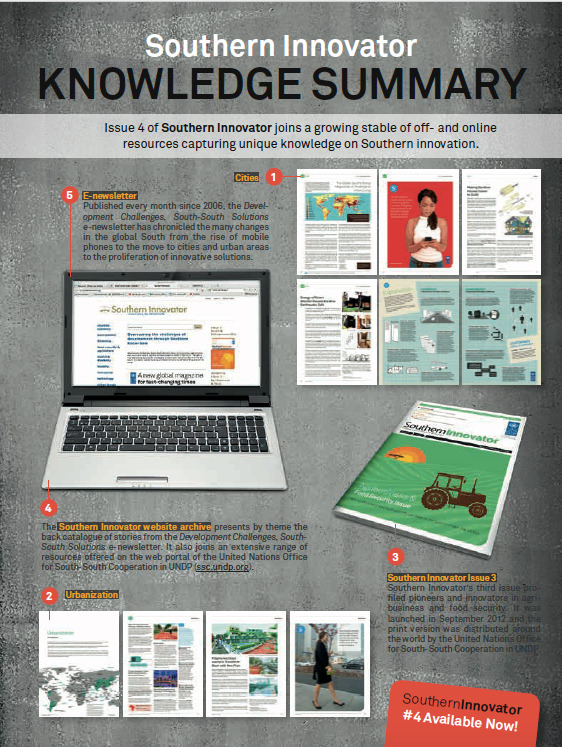
    Development Challenges, South-South Solutions was launched as an e-newsletter in 2006 by UNDP’s South-South Cooperation Unit (now the United Nations Office for South-South Cooperation) based in New York, USA. It led on profiling the rise of the global South as an economic powerhouse and was one of the first regular publications to champion the global South’s innovators, entrepreneurs, and pioneers. It tracked the key trends that are now so profoundly reshaping how development is seen and done. This includes the rapid take-up of mobile phones and information technology in the global South (as profiled in the first issue of magazine Southern Innovator), the move to becoming a majority urban world, a growing global innovator culture, and the plethora of solutions being developed in the global South to tackle its problems and improve living conditions and boost human development. The success of the e-newsletter led to the launch of the magazine Southern Innovator.

    Creative Commons License

    This work is licensed under a
    Creative Commons Attribution-Noncommercial-No Derivative Works 3.0 License.

    ORCID iD: https://orcid.org/0000-0001-5311-1052.

    © David South Consulting 2023

  • Poorest Countries Being Harmed by Euro Currency Crisis

    Poorest Countries Being Harmed by Euro Currency Crisis

    By David SouthDevelopment Challenges, South-South Solutions

    SOUTH-SOUTH CASE STUDY

    The ongoing economic crisis in Europe is forecast to harm the economies of the world’s poorest countries if it continues, according to a study by the United Kingdom’s Overseas Development Institute (ODI) (odi.org.uk).

    As an example, Kenya’s shilling currency has weakened and increased the cost of imports, leading to a surge in inflation, while the number of European tourists has declined, according to Business Daily.

    Raging since 2009 (http://www.bbc.co.uk/news/business-13856580), the eurozone crisis has seen several European countries struggling to pay debts built up during the boom years, and this has threatened the currency compact among countries that use the euro single currency (http://www.ecb.europa.eu/euro/html/index.en.html). Several countries have introduced harsh austerity measures to try and rein in the debts and stabilize economies while keeping countries within the eurozone.

    This has had the consequence of dramatically raising unemployment levels, reducing consumption of goods and services and increasing poverty rates in many European countries. Some governments have responded by reducing the amount of legal labour migration allowed into their countries.

    The study estimates that the euro crisis could amount to a loss of US $238 billion for poorer countries from 2012 to 2013 as aid, trade, investment and remittance payments sent home to relatives and friends are damaged by the crisis.

    This would particularly harm export-dependent, emerging-market countries. The study found demand was weakening for products from low and low-to-middle income countries. This would in turn harm growth in these countries. Growth in the past decade has helped many countries lift millions of people out of poverty and enabled the growth of new middle classes, who in turn use their rising incomes to purchase consumer goods and invest.

    The crisis will cause developing countries’ currencies to drop in value if they are pegged to the euro, and for countries to be economically harmed because of austerity policies in European countries, said the study’s author, Dr. Isabella Massa.

    “The EU remains the largest single export market for poorer countries, although it is the emerging BRIC economies which are their main source of imports.”

    The European Union (EU) (http://europa.eu/index_en.htm) is the biggest market in the world and the largest importer of goods from developing countries. The ODI report found a 1 per cent drop in global export demand has the knock-on affect of reducing growth in poor countries by 0.5 per cent. The countries most at risk from the crisis are Mozambique, Kenya, Niger, Cameroon, Cape Verde and Paraguay.

    For example, 17 per cent of Ivory Coast’s exports go to the EU. Mozambique sends 14 per cent of its exports to the EU and Nigeria sends 10 per cent.

    Tajikistan in Central Asia was the most highly dependent economy on remittance payments from its workers living outside the country to prop up its GDP (gross domestic product). Remittance payments from Tajik citizens outside the country made up 40 per cent of GDP.

    Liberia and the Democratic Republic of Congo were both heavily dependent on foreign direct investment (FDI) from Europe in 2010.

    Many countries have also grown used to strong demand for their resources in recent years as China has rapidly developed and urbanized, sucking in more and more resources from around the world, including sub-Saharan Africa.

    “Poor countries are vulnerable to the euro crisis not only because of their exposure (due to dependence on trade flows, remittances, private capital flows and aid) but also because of their weaker resilience compared to 2007, before the onset of the global financial crisis,” said Massa.

    “The ability of developing countries to respond to the shock waves emanating from the euro area crisis is likely to be constrained if international finance dries up and global conditions deteriorate sharply.

    “The escalation of the euro crisis and the fact that growth rates in emerging BRIC economies, which have been the engine of the global recovery after the 2008-9 financial crisis, are now slowing down make the current situation really worrying for developing countries.”

    Despite the gloom, there are many positive and powerful antidotes to this economic crisis, including rising South-South trade and innovation, which shows it is possible to reduce dependency on wealthy-developed countries alone for economic prosperity.

    Published: September 2013

    Resources

    1) UNRISD: United Nations Research Institute for Social Development: The United Nations Research Institute for Social Development (UNRISD) is an autonomous research institute within the UN system that undertakes multidisciplinary research and policy analysis on the social dimensions of contemporary development issues. Website: unrisd.org/

    2) The Global Urbanist: News and analysis of cities around the world: planning, governance, economy, communities, environment, international. Website: globalurbanist.com

    3) OECD: The global economic crisis is entering a new phase amid signs of a return to positive growth in many countries. But unemployment is likely to remain high and much still needs to be done to underpin a durable recovery. This website will track the recovery. Website: http://www.oecd.org/general/tacklingthecrisisastrategicresponse.htm

    4) African Union: This vision of a new,  forward looking, dynamic and integrated Africa will be fully realized through relentless struggle on several fronts and as a long-term endeavor. The African Union has shifted focus from supporting liberation movements in the erstwhile African territories under colonialism and apartheid, as envisaged by the OAU since 1963 and the Constitutive Act, to an organization spear-heading Africa’s development and integration. Website: http://www.au.int/en/

    5) Youth-Inclusive Financial Services (YFS-Link) Program website: The first space for financial services providers (FSPs) and youth-service organizations (YSOs) to gather, learn and share about youth-inclusive financial services. Website: http://www.makingcents.com/ourWork/yfsLink.php

    6) Triple Crisis Blog: Global Perspectives on Finance, Development and Environment: Website: http://triplecrisis.com/

    7) African Economic Outlook: A unique online tool that puts rigorous economic data, information and research on Africa at your fingertips. A few clicks gives access to comprehensive analyses of African economies, placed in their social and political contexts. This is the only place where African countries are examined through a common analytical framework, allowing you to compare economic prospects at the regional, sub-regional and country levels. Website: africaneconomicoutlook.org/en

    Creative Commons License

    This work is licensed under a
    Creative Commons Attribution-Noncommercial-No Derivative Works 3.0 License.

    ORCID iD: https://orcid.org/0000-0001-5311-1052.

    © David South Consulting 2023


  • Kenyan Book Company Brings Online Sales to East Africa

    Kenyan Book Company Brings Online Sales to East Africa

    By David SouthDevelopment Challenges, South-South Solutions

    SOUTH-SOUTH CASE STUDY

    The Internet has revolutionized retail sales in many developed countries – and nowhere more so than for booksellers. The ability to offer an almost unlimited supply of books through a website is revolutionizing the way people shop and giving life to books long out of print or by unknown authors.

    Kenya has recently gained a reputation for doing things differently in Africa and making great strides when it comes to using information technologies. And the next development in this story is the launch of a Kenyan online book shop modelled on the successful U.S. online bookseller Amazon (amazon.com).

    A book boom is well underway across the global South. Literary festivals continue to expand, from Colombia in South America to India to Nigeria in West Africa, and so do sales of books, newspapers and magazines. While the publishing industries in developed countries despair at the impact of digital media on their profits, in the global South, rising prosperity and literacy are fuelling greater interest in reading and a growing print publishing industry. For example, India is experiencing 15-per-cent-a-year growth for its publishing industry, which is valued at nearly US $2 billion (Frankfurt Book Fair).

    Kenya’s Text Book Centre (TCB) (textbookcentre.com), considered one of the country’s most reputable booksellers, has launched its own online book selling portal and its “eBook web store”. It is targeting readers across East Africa and sells books in 14 categories. Being Kenyan, it is taking an innovative approach that recognizes the large numbers of people who are doing all their transactions over mobile phones. The book portal allows customers to make purchases with their mobile phones using mobile money. This system uses the Kopo Kopo (kopokopo.com) software platform, which allows small and medium sized businesses to accept mobile phone payments.

    Kopo Kopo was first developed in Sierra Leone in 2011, before being further prototyped in Kenya. Kopo Kopo wanted to develop an effective mobile platform to help small and medium sized businesses to better interact with their customers. The Kopo Kopo service was officially launched in February 2012 and is partnered with Safaricom, using its M-PESA Buy Goods service. It is being currently used by hundreds of businesses, from “salons to restaurants to office supply stores”, according to Kopo Kopo’s website.

    As an added benefit, the Kenyan online book platform is joined by a new marketplace for thousands of African ebooks. This part of the service is called eKitabu (ekitabu.com).

    EKitabu will be a big boost to the continent’s authors and also open up new opportunities for budding authors who previously would have struggled to get published and distribute their work. If the ebook web store follows the dynamic of online booksellers in more developed markets, then this ability to gain exposure for author’s work and find an audience could also attract bigger publishers and spark interest in international book deals for formerly obscure writers.

    The Text Book Centre was founded in 1964 by two Indian business partners in Kenya, Mr. SV Shah and Mr. MJ Rughani, and is now considered the leading bookstore in Kenya, specializing in leisure and educational books, according to its website.

    Headquartered in Nairobi’s central business district, it focuses on providing books for the educational sector and strives to be “East Africa’s leading leisure and educational bookstore and office support resource centre”. It also supplies to customers in Uganda, Sudan, Somalia, Malawi, Zanzibar and Tanzania.

    Published: March 2013

    Resources

    1) Tara Books: Based in Chennai, India, the book publisher is a co-operative and has published 200,000 hand-made books since its founding in 1994. Website: http://www.tarabooks.com/

    2) Pathlight: A Beijing, China-based literary magazine with new writing and poetry. Website: http://paper-republic.org/pubs/pathlight/

    3) “Indian readers keep publishing industry on growth track”. Website: http://hcilondon.in/headlines_1686.html

    4) African Publishers Network (APNET): APNET’s vision is the transformation of African peoples through books. APNET’s mission is to strengthen African publishing through networking, training, trade promotion, Intellectual Property (IP) and advocacy, in partnership with other stakeholders, to fully meet Africa’s need for quality, relevant books. Website: http://www.african-publishers.net/

    Southern Innovator logo

    London Edit

    31 July 2013

    Creative Commons License

    This work is licensed under a
    Creative Commons Attribution-Noncommercial-No Derivative Works 3.0 License.

    ORCID iD: https://orcid.org/0000-0001-5311-1052.

    © David South Consulting 2023

  • Solar Bottle Bulbs Light Up Dark Homes

    Solar Bottle Bulbs Light Up Dark Homes

    By David SouthDevelopment Challenges, South-South Solutions

    SOUTH-SOUTH CASE STUDY

    Finding ways to generate low-cost or free light has captured the imagination of innovators across the global South. The desire for light is strong: Light gives an immediate boost to income-making opportunities and quality of life when the sun goes down or in dark homes with few windows.

    More than 1.7 billion people around the world have no domestic electricity supply, of whom more than 500 million live in sub-Saharan Africa (World Bank). Without a source of electricity, it is difficult to use conventional technology to switch the lights on.

    While it is possible to run lights using batteries or diesel generators, these are expensive options that are not possible for many poor people. The more of a slim income that is spent on light, heat or cooking fuel, the less there is left for better-quality food, clothing, transport or education and skills development.

    Low-cost light is great, but free light is even better – and one Brazilian solution is offering this.

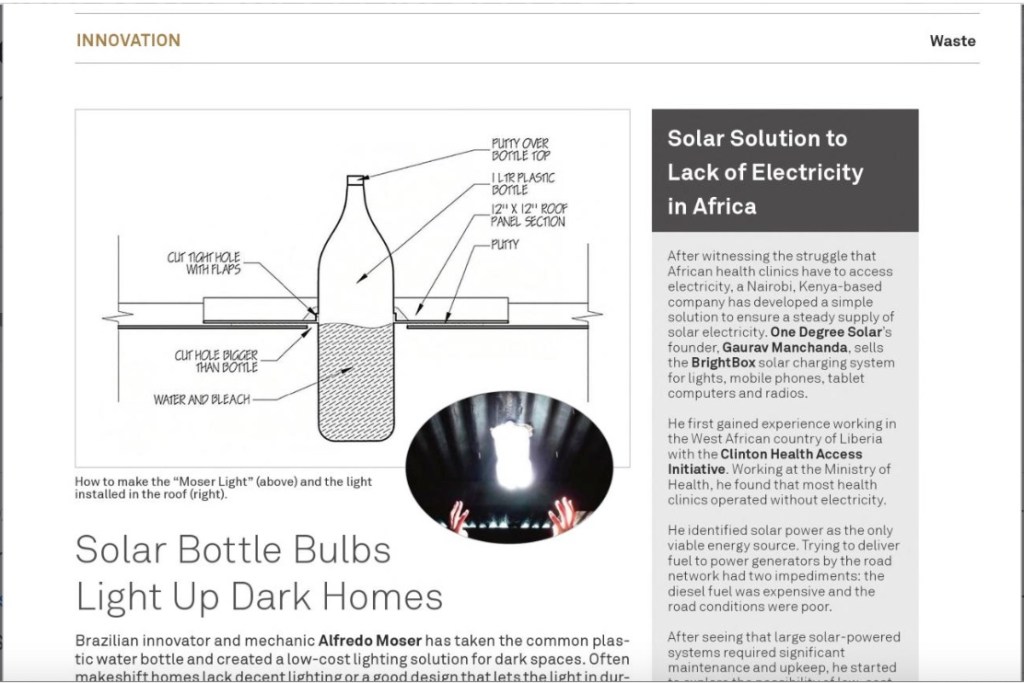
    Brazilian innovator and mechanic Alfredo Moser has taken the common plastic water bottle and created a low-cost lighting solution for dark spaces. Often makeshift homes lack decent lighting or a good design that lets the light in during the day. This means it may be a bright, sunny day outside, but inside the home or workplace, it is very dark and reading or working is difficult.

    Moser came upon the idea during regular blackouts in his home city of Uberaba (http://www.uberaba.mg.gov.br/portal/principal) in southern Brazil during 2002. During the blackouts, only factories were able to get electricity, leaving the rest of the population in the dark.

    The “Moser Light” involves taking plastic bottles, which are usually just thrown away or recycled, and filling them with water and bleach to draw on a basic physical phenomenon: the refraction of sunlight when it passes through a water-based medium.

    It is a simple idea: Holes are drilled in the ceiling of a room and the bottles placed in the holes. The liquid-filled bottle amplifies the existing sunlight (or even moonlight) and projects it into the dark room. This turns the plastic bottle into a very bright lightbulb that does not require any electricity.

    Moser uses a solution of two capfuls of bleach added to the water to prevent anything growing in the water such as algae because of the exposure to sunlight.

    “The cleaner the bottle, the better,” he said.

    Polyester resin is used to seal the hole around the plastic bottle and make it watertight from rain.

    Moser claims his bottle innovation can produce between 40 and 60 watts of light.

    Moser uses recycled plastic bottles, so the carbon footprint is minimal compared to the manufacture of one incandescent bulb, which takes 0.45 kilograms of CO2 (UN). Running a 50 Watt incandescent light bulb for 14 hours a day for a year, around the same light as produced by the bottle bulb, produces a carbon footprint of nearly 200 kilograms of CO2.

    “There was one man who installed the lights and within a month he had saved enough to pay for the essential things for his child, who was about to be born. Can you imagine?” Moser told the BBC.

    The plan is to try and get as many as a million homes fitted with the lighting system by the end of 2013.

    In many poor areas, it is common to live in makeshift or rudimentary dwellings. These are often built to crude designs and, in order to keep costs down and boost security, will have few or no windows. These dwellings will consequently be very dark inside, even on the brightest days. This leaves people having to turn to a source of artificial light if they want to do something indoors like read or work. And this costs money. Be it electricity from a mains, or battery-powered lamps or gas-powered lanterns, the cost will eat into a person’s tight income. This is where Moser’s simple solution saves the day and saves pennies: it is free light once the bottle lamp system is installed.

    Placing the bottle lights in the ceiling transforms the ceiling into something akin to the night sky, with many points of light shining down into the room like stars. It also means the occupant of the room does not just have to strain to see with the use of a single light but now has many lights illuminating the room from all angles.

    “It’s a divine light,” Moser told the BBC World Service. “God gave the sun to everyone, and light is for everyone. Whoever wants it saves money. You can’t get an electric shock from it, and it doesn’t cost a penny.”

    It has not been a road to riches for Moser. He has made some money installing the system in a local supermarket and nearby homes, and he has inspired a charity to install the lighting system and to train people to do the installation and make an income from it.

    The MyShelter Foundation in the Philippines was inspired by Moser’s invention and has installed the system in some 140,000 homes there, the BBC reported.

    “We want him to know that there are a great number of people who admire what he is doing,” MyShelter Executive Director Illac Angelo Diaz said of Moser.

    Using bottle bulbs instead of electricity or generators means families can save US $6 per month, according to Diaz (CNN). The Philippines is reported to have the most expensive electricity in Asia and slum homes usually do not have electricity.

    It is estimated 15 other countries also have homes using the Moser system. The MyShelter Foundation believes 1 million homes worldwide have used the Moser system as of 2013.

    Liter of Light (http://aliteroflight.org), run by the MyShelter Foundation, offers instructions on how to install the lighting system on its website.

    Published: September 2013

    Resources

    1) D-Lab: MIT: Development through Dialogue, Design and Dissemination: D-Lab is building a global network of innovators to design and disseminate technologies that meaningfully improve the lives of people living in poverty. The program’s mission is pursued through interdisciplinary courses, technology development, and community initiatives, all of which emphasize experiential learning, real-world projects, community-led development, and scalability. Website: http://d-lab.mit.edu/

    2) d.light Solar: d.light is a for-profit social enterprise whose purpose is to create new freedoms for customers without access to reliable power so they can enjoy a brighter future. d.light design manufacture and distribute solar light and power products throughout the developing world. Website: http://www.dlightdesign.com/

    3) Liter of Light:  It brings the eco-friendly bottle light to communities living without electricity. Website: http://aliteroflight.org

    4) Solar Sister: Solar Sister eradicates energy poverty by empowering women with economic opportunity.  They combine the breakthrough potential of solar technology with a deliberately woman-centered direct sales network to bring light, hope and opportunity to even the most remote communities in rural Africa. Website: http://www.solarsister.org/

    Creative Commons License

    This work is licensed under a
    Creative Commons Attribution-Noncommercial-No Derivative Works 3.0 License.

    ORCID iD: https://orcid.org/0000-0001-5311-1052.

    © David South Consulting 2023