Tag: 2013

  • Ambitious Schemes Hope to Advance Economic Development

    Ambitious Schemes Hope to Advance Economic Development

    By David SouthDevelopment Challenges, South-South Solutions

    SOUTH-SOUTH CASE STUDY

    Sometimes it takes a bold, fresh start to speed up economic and human development goals. Taking a large-scale approach has been used around the world, either establishing new trade zones or even a new city.

    Two recent examples in Nigeria and Afghanistan are attempting to speed economic development in their respective countries, with both receiving help from experienced Asian practitioners of rapid economic development.

    The role models for this approach are the so-called “Asian Tigers”: they include Taiwan, Hong Kong, Singapore and South Korea. They are admired because each country rose from extreme poverty to become some of the Earth’s richest nations. Importantly, what they did stands as proof that extreme poverty can be escaped from; people can become much wealthier in just a decade or two.

    The pioneer of using trade zones to speed development is the Asian city state of Singapore (http://www.gov.sg/government/web/content/govsg/classic/home)..Fifty years ago it was one of Asia’s poorest countries. With its port (http://www.mpa.gov.sg/) it had a way to turn things around but it also realized in the early 1960s it could not just compete by having cheap labour, something that was plentiful across the developing world (http://www.mti.gov.sg/MTIInsights/Pages/Economic-History-and-Milestones.aspx). It needed unique technical skills that could not be found elsewhere.

    The country was unable to create products and services that it could export and compete in global markets because of a lack of skills, the Government determined. Authorities employed a mix of measures to make the country attractive to foreign companies to boost skills. These included fair enforcement of local laws, tax incentives and upgraded infrastructure, much of it paid for with an infrastructure tax, rather than borrowing. With the influx of new thinking and high-quality skills, new technologies and new ways of doing things, in time, a culture of innovation became hardwired into the way things were done in Singapore.

    Beginning in 1961 with the Jurong Industrial Estate (http://infopedia.nl.sg/articles/SIP_246_2004-12-16.html), the Singapore government set aside land to develop the economy by attracting international businesses and boosting its existing port facilities. It also established the Economic Development Board (EDB) in 1961 and the Singapore Tourism Promotion Board (STPB) in 1964.

    By creating favorable conditions for international businesses to come in and operate, Singapore quickly developed to become one of Asia’s wealthiest trading and manufacturing centres.

    This is a strategy China successfully implemented in the 1980s and 1990s and in turn generated the largest and quickest population shift out of poverty in human history, turning the country into an economic powerhouse.

    The secrets to making this strategy work include understanding what modern infrastructure requirements are necessary for international businesses. These days, this means speedy and generous bandwidth for the Internet, modern airports, roads, security, and quality housing and food.

    One of the biggest contemporary challenges is competition. Whereas Singapore was a pioneer in its day, now, many countries across the global South are pursuing this strategy to spur growth. An international company has many options to consider, and will more than likely gravitate towards the country that makes the best offer with the least risk.

    Trade zones are places ripe with opportunity for innovators. New places tend to be seeking the latest in information and communication technologies, the latest in transportation options, modern housing and office facilities. All of these changes require innovators with fresh thinking to make them work. It is also often easier to introduce new ways of doing things to places that are not coping with legacy infrastructure and old habits and ways.

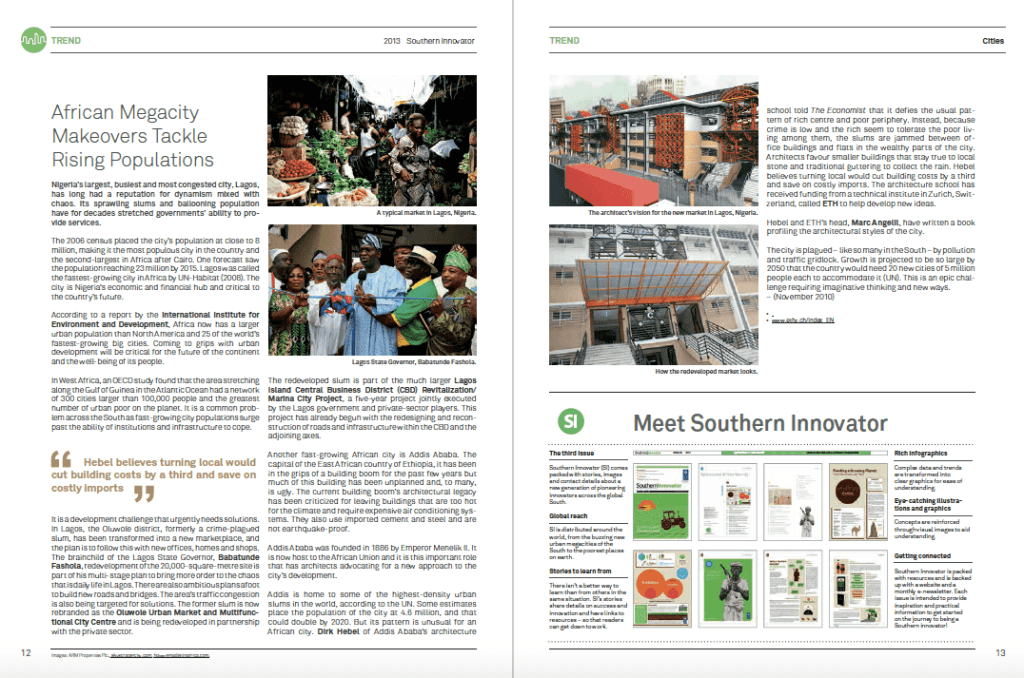
    Billing itself as a “new model city,” the Lekki Free Zone Lagos, Nigeria (lekkizone.com) in West Africa is trying to bring a fresh start to the city and the region. It is a joint partnership between investors from China and Nigeria.

    Its goal is to better connect regional markets to the global economy. The free trade zone hopes to remove barriers to growth and to attract international investment, becoming the top destination for inward investment in Africa. The project is being run by the Lagos State Government but funded with private capital investment.

    Nigeria has been looking into Free Zones since 1982, as it sought additional ways to earn income apart from oil exports. The Export Processing Zone Act 63 was passed in 1992 and the Calabar Export Processing Zone was eventually set up in 1999 (http://www.nepza.gov.ng/index.php?option=com_content&task=view&id=18&Itemid=34). Since then, a slew of Free Zones have been set up, or are in the works.

    The Lekki Free Zone is envisioned as a high-tech zone that will eventually lead to the creation of 2 million jobs. The Zone’s investors are targeting businesses working in oil and gas, petrochemicals, electronics, light and heavy equipment, machinery and automobiles, pharmaceuticals, textiles, shopping and banking and financial services.

    Lagos State is home to 21 million people, and the current city of Lagos is on course to become the third-largest megacity in the world. Officials claim the area has an economic growth rate of 16.8 per cent per year.

    The 16,500 hectare Lekki Free Zone, to the southeast of the city, is divided into two parts: an industrial zone and a residential zone. The residential zone will include apartments and villas, shopping malls and plazas, hospitals and clinics, schools and research and development centres and a hotel, tour and recreational centres, golf courses, gyms and water sports facilities.

    Located on the southern coast of Nigeria with connections to the Atlantic Ocean and the Gulf of Guinea, the Lekki Free Zone says it will give companies access to the largest consumer market in Africa, with a potential reach of 500 million people.

    The companies will also be able to draw on Nigeria’s natural resources, including oil, natural gas, timber, rubber, cocoa, Arabic gum and sesame seeds as examples.

    Another new beginning is being sought in war-torn Afghanistan, which is working on building a new city close to the capital, Kabul.

    Kabul New City started construction in 2013 and is planned to be a city of canals, parks and villas. It will be home to 1.5 million people, cost US $33 billion and take 15 years to complete. It is being partly funded by Japan.

    It is a very ambitious scheme for a country that has been mired in conflict for decades. It is hoped the initial seed capital invested by Japan will attract other investors to fully fund the project. Japan got the project going with a commitment to contribute US $106 million between 2009 and 2015.

    The site of Kabul New City is 19 kilometres from the existing Kabul, near the Bagram airbase used by NATO forces in the country.

    Foreign military forces are looking to leave Afghanistan in 2014 and the new city offers a fresh start for the country after years of conflict.

    Located in an area surrounded by the Marko mountains, it is in “one of the safest areas of Afghanistan,” Abdul Habib Zadran, Chief Financial Officer of the Dehsabz-Barikab City Development Authority (http://www.dcda.gov.af/), the agency in charge of the project, told The Sunday Times.

    The project could be a significant leap ahead in modernization from the current conditions in Kabul, where the streets are in poor condition and buildings in disrepair. Kabul was originally built for 800,000 people, according to The Sunday Times, but now has over 4 million residents. Projections forecast the city growing to 6.5 million people by 2025. Kabul will experience extreme pressure to handle this growing population and find the resources to serve it.

    The homes would receive electricity from solar panels and renewable energy sources. Kabul New City will need to tackle the problem of access to enough water to service the growing new city’s population. Plans are afoot to provide water from rivers north of the city.

    The master plan for the new city has been designed by Zahra Breshna (breshna-consulting.com), an Afghan-German company which has also built the new Kabul Bank headquarters. The company calls the project “a new beginning for Kabul.”

    Published: May 2013

    Resources

    1) Tianjin Eco-city: The Sino-Singapore Tianjin Eco-city’s vision is to be a thriving city which is socially harmonious, environmentally-friendly and resource-efficient. Website: tianjinecocity.gov.sg/

    2) Songdo International Business District: Songdo International Business District (IBD) is home to the UN’s Green Climate Fund and is a smart city located in the Republic of Korea built to the highest green building standards. Website: songdo.com/

    3) Singapore: An island and islets in the heart of Southeast Asia, between Malaysia and Indonesia. Website: http://app.www.sg/

    4) Djibouti Free Zone: Djibouti Free Zone was created with one primary goal in mind – to bring about a sea-change in the way Africa thinks and does business. No red tape, ruthless efficiency and genuinely exhaustive services – in essence, we offer the ideal conditions for trade and commerce to flourish in. Website: djiboutifz.com/

    5) Cisco Smart + Connected Cities: Cisco Smart+Connected Communities solutions use intelligent networking capabilities to bring together people, services, community assets, and information to help community leaders address these world challenges. Website: http://www.cisco.com/web/strategy/smart_connected_communities.html

    6) IBM Smarter Cities: Smarter cities drive sustainable economic growth and prosperity for their citizens. Their leaders have the tools to analyze data for better decisions, anticipate problems to resolve them proactively and coordinate resources to operate effectively. Website:http://www.ibm.com/smarterplanet/us/en/smarter_cities/overview/

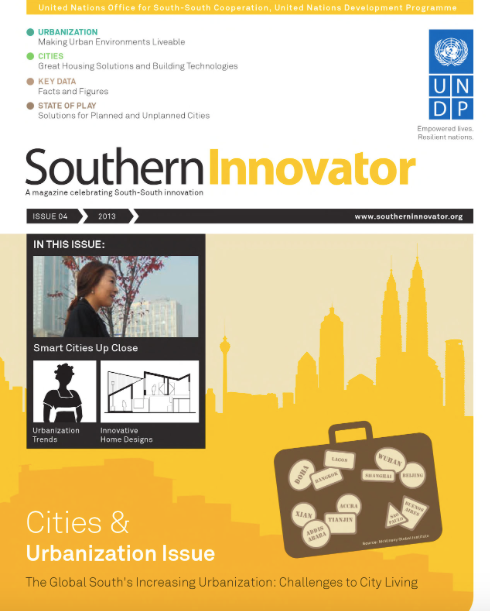
    7) Southern Innovator Magazine Issue 4: Cities and Urbanization. Website: http://www.scribd.com/doc/133622315/Southern-Innovator-Magazine-Issue-4-Cities-and-Urbanization

    Southern Innovator logo

    London Edit

    31 July 2013

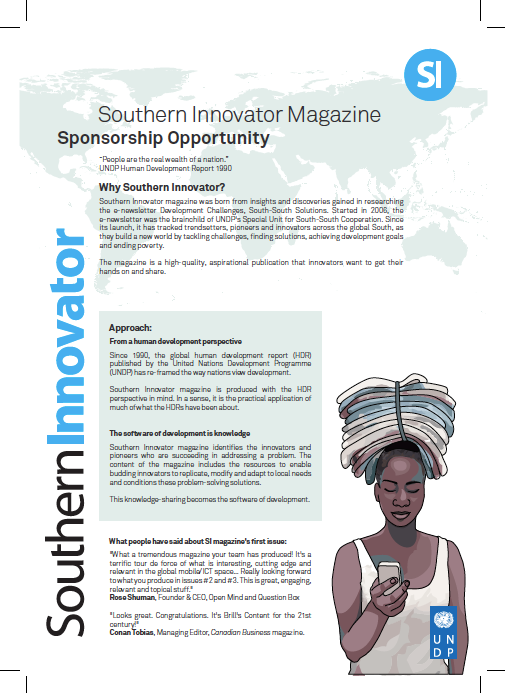
    Development Challenges, South-South Solutions was launched as an e-newsletter in 2006 by UNDP’s South-South Cooperation Unit (now the United Nations Office for South-South Cooperation) based in New York, USA. It led on profiling the rise of the global South as an economic powerhouse and was one of the first regular publications to champion the global South’s innovators, entrepreneurs, and pioneers. It tracked the key trends that are now so profoundly reshaping how development is seen and done. This includes the rapid take-up of mobile phones and information technology in the global South (as profiled in the first issue of magazine Southern Innovator), the move to becoming a majority urban world, a growing global innovator culture, and the plethora of solutions being developed in the global South to tackle its problems and improve living conditions and boost human development. The success of the e-newsletter led to the launch of the magazine Southern Innovator. 

    Creative Commons License

    This work is licensed under a
    Creative Commons Attribution-Noncommercial-No Derivative Works 3.0 License.

    ORCID iD: https://orcid.org/0000-0001-5311-1052.

    © David South Consulting 2023

  • Pioneering African Airlines Help to Expand Routes

    Pioneering African Airlines Help to Expand Routes

    By David SouthDevelopment Challenges, South-South Solutions

    SOUTH-SOUTH CASE STUDY

    The last decade has seen a revolution in African air travel. The number of air routes has grown and this has paralleled the economic growth across the continent. As demand has been strong for Africa’s resources, it has also fueled a consumer boom that is benefiting an increasing number of people.

    More and more people can afford to fly and flights are taking Africans to cities across Africa and out of Africa to visit cities around the world. These flights also bring in a growing number of tourists and business people.

    As growth continues despite the many obstacles and challenges, and as urbanization rolls onwards, new routes have sprung up linking the continent’s cities to each other and to the world. National and local airlines have evolved to meet growing demand for flights, with the big global airlines moving in to compete.

    Africa’s airlines, tourism and airport authorities gathered in early 2013 to discuss how better to link the continent up by air, and the fruits of this collaboration are coming to light.

    A recent new entrant is Fastjet (http://www.fastjet.com/us/). Bringing the highly competitive budget airline model to Africa that has proven so successful in Europe, it is owned by Britain’s Easyjet and has its hub in Dar es Salaam, Tanzania. It will offer low-cost flights to South Africa, Zambia, and Rwanda in autumn 2013 and, ambitiously, hopes to become “Africa’s first pan-continental low-cost airline” (BBC). It has 10 aircraft.

    If people book early, they can snag a one-way flight between Johannesburg and Dar es Salaam for just US $100.
    Fastjet is also creating a low-cost airline in Nigeria in partnership with Nigeria’s Red 1 Airways (red1air.com).

    One airline also expanding its routes is Daallo Airlines (daallo.com) from the small nation of Djibouti (http://en.wikipedia.org/wiki/Djibouti) in the northeast Horn of Africa.

    Its website shows straight away how the airline is able to help link up cities normally left out of global air routes. Flights can be booked for journeys between Djibouti and Somalia, a country only now beginning to recover from decades of civil war and anarchy. Daallo also flies to Nairobi, Kenya, the East African hub for international agencies and corporations, to Dubai in the United Arab Emirates, to Jeddah in Saudi Arabia and Hargeisa, capital of the autonomous region of Somaliland (http://somalilandgov.com/).

    It also offers weekly cargo flights to these destinations. Daallo has a Boeing 777 and an Antanov AN-12.

    Djibouti is tiny but well positioned as a transport and shipping hub. It has invested heavily recently in its port facilities and benefits from good security, with a large U.S. base located in the country, Camp Lemonnier (http://www.cnic.navy.mil/regions/cnreurafswa/installations/camp_lemonnier_djibouti.html), home to Combined Joint Task Force – Horn of Africa.

    Further improving flight access in Africa, in August 2013, South Africa saw a new low-cost airline enter the marketplace. Safair (safair.co.za) is operating 10 daily flights between Johannesburg and Cape Town using Boeing 737-400s.

    Ethiopian Airlines (http://www.flyethiopian.com/en/default.aspx) has also started a strategic partnership with Malawi Airlines as part of its Ethiopian Vision 2025. This will make the capital of Malawi, Lilongwe, Ethiopian Airlines’ third hub on the African continent. It has its main hub in Addis Ababa, Ethiopia and its West African hub in the Togo capital Lomé.

    Published: October 2013

    LINKS:

    1) Routes Online: The Routes business is focused entirely on aviation route development and the company’s portfolio includes events, media and online businesses. The company organizes and operates world-renowned airline and airport networking events through its regional and World Route Development Forums. They are held in key markets throughout the year in Asia, Africa, Europe, the Americas and the CIS. Website: http://www.routesonline.com/

    2) IATA: The International Air Transport Association (IATA) is the trade association for the world’s airlines, representing some 240 airlines or 84 per cent of total air traffic. IATA support many areas of aviation activity and help formulate industry policy on critical aviation issues. Website: http://www.iata.org/Pages/default.aspx

    3) Airlines International magazine: Airlines International is IATA’s flagship magazine, available in print, on tablets and online. Website: http://www.iata.org/publications/airlines-international/Pages/index.aspx

    4) African Airlines Association: “To be the leader and catalyst for the growth of a globally competitive and integrated African airline industry”. Website: afraa.org

    Development Challenges, South-South Solutions was launched as an e-newsletter in 2006 by UNDP’s South-South Cooperation Unit (now the United Nations Office for South-South Cooperation) based in New York, USA. It led on profiling the rise of the global South as an economic powerhouse and was one of the first regular publications to champion the global South’s innovators, entrepreneurs, and pioneers. It tracked the key trends that are now so profoundly reshaping how development is seen and done. This includes the rapid take-up of mobile phones and information technology in the global South (as profiled in the first issue of magazine Southern Innovator), the move to becoming a majority urban world, a growing global innovator culture, and the plethora of solutions being developed in the global South to tackle its problems and improve living conditions and boost human development. The success of the e-newsletter led to the launch of the magazine Southern Innovator. 
    Creative Commons License

    This work is licensed under a
    Creative Commons Attribution-Noncommercial-No Derivative Works 3.0 License.

    ORCID iD: https://orcid.org/0000-0001-5311-1052.

    © David South Consulting 2023

  • Staple Foods Are Becoming More Secure in the South

    Staple Foods Are Becoming More Secure in the South

    By David SouthDevelopment Challenges, South-South Solutions

    SOUTH-SOUTH CASE STUDY

    Finding ways to ensure food security in countries experiencing profound economic and social change and stress is critical to achievement of development goals.

    Food security is crucial to ensuring economic development is sustainable, and it is vital to long-term human health. Just one bout of famine can damage a generation of youth, stunting brain development and leaving bodies smaller and weaker than they should be.

    Thankfully, many innovators are working on this problem and are making significant progress. A report from the Asian Development Bank, The Quiet Revolution in Staple Food Value Chains (http://www.adb.org/publications/quiet-revolution-staple-food-value-chains), found improvements to security of rice and potatoes – common staple foods in many countries. It said the so-called value chains – the various activities a company does to deliver a product or service to the marketplace (http://en.wikipedia.org/wiki/Value_chain) – for potatoes and rice have seen significant improvements in Bangladesh, China and India.

    This is important because improvements in access to staple foods will mean better food security and less threat of extreme hunger events. This matters because it just takes one extreme hunger event and a generation is scarred for life.

    The human brain is a heavy user of energy: it uses between 20 and 30 per cent of a person’s energy intake. Failure to consume enough calories means brain functioning begins to  be altered (brain-guide.org).

    Hunger and starvation slow a person’s mental responsiveness. Low energy intake from minimal diets leads to apathy, sadness and depression. Fetuses and infants are especially sensitive to brain damage caused by malnutrition. A malnourished child can suffer life-long low intelligence and cognitive defects.

    More than 70 per cent of the world’s 146 million underweight children aged five and under live in just 10 countries, with more than 50 per cent located in South Asia alone (UNICEF). A quarter of all children – roughly 146 million – in developing countries are underweight, and it is estimated that 684,000 child deaths worldwide could be prevented by increasing access to vitamin A and zinc (WFP).

    Undernutrition contributes to 53 per cent of the 9.7 million deaths of children under five each year in developing countries (UNICEF).

    Food insecurity also shows on the faces of people who experience it. This extreme stress scars people and harms their prospects in the labour market and their ability to improve their incomes.

    Why is access to staple foods improving? It seems, according to the report, to result from innovations such as rapid modernization, with the increasing roll out of supermarkets, the use of cold storage facilities and large rice mills. It also cites the impact of small farmers taking on modern technologies, such as mechanized farming, and making the most of soil by using fertilizers and efficient techniques.

    Supermarkets by their nature encourage highly sophisticated supply lines to ensure a steady stream of fresh produce coming in from farms to urban areas. Because of the variety and vast range of produce on offer, they require finely-tuned organizing models and information technologies. In short, they radically alter the way people buy their food, and what people will expect from food providers.

    By negotiating deals with farmers, supermarkets create stability, as well as low and competitive prices. They allow for better traceability for food and give consumers more confidence in what they are purchasing. They use cold storage, which means food lasts longer and there is less waste than if food is left to spoil in a marketplace without refrigeration – a revolutionary change in hot countries.

    The downside with supermarkets, as has been the case in some countries, is they can quickly dominate the marketplace and push out all other competitors with their economies of scale. When this happens, farmers can also find themselves with little bargaining power again and be hostage to the price the supermarket tells them to sell their product at.

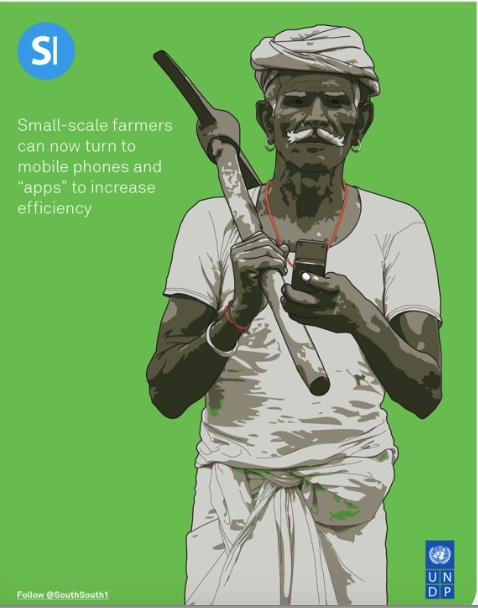
    Another critical improvement is the rapid spread of mobile phones. Armed with a mobile phone, small-scale farmers are able to access critical knowledge and information. This means they can make better decisions and quickly adjust what they are doing when mistakes are made.

    The survey found that India is a country where the food-supply game has changed dramatically. In the past, traders would advance cash to farmers in the form of loans. But since the use of mobile phones has increased, the balance of power has shifted: farmers now have many other options to finance their operations than turning to middlemen and traders. This means they are no longer as easily manipulated by the traders and can negotiate better prices. Also, better roads, combined with greater competition to provide services to farmers, are improving farming of staple foods in general.

    Among potato farmers in rural areas, 73 to 97 per cent have mobile phones and use them to organize deals with traders or receive market information. The take-up of mobile phones was also a recent development for the farmers: most had acquired a mobile phone in the last four years.

    It is clear this quiet revolution in food security for staples is a result of greater use of innovative technology and taking on of new techniques.

    Published: July 2013

    Resources

    1) How to start a supermarket in Lagos, Nigeria: A supermarket is one of the most lucrative businesses that can thrive anywhere in the world. Website: http://www.ackcity.net/supermarket-startup-in-lagos

    2) Write a supermarket business plan: Templates for writing professional business plans. Website: http://planmagic.com/business_plan/supermarket_business_plan.html

    3) How to get your product into a supermarket: Use this mindmap to remind you what you should be doing at every stage of the process. Website: http://www.smarta.com/advice/suppliers-and-trade/logistics-management/mindmap-how-to-get-your-product-into-a-supermarket/

    4) The hidden tricks behind making a successful supermarket: Website: http://www.independent.co.uk/news/business/news/the-secrets-of-our-supermarkets-8228864.html

    Development Challenges, South-South Solutions was launched as an e-newsletter in 2006 by UNDP’s South-South Cooperation Unit (now the United Nations Office for South-South Cooperation) based in New York, USA. It led on profiling the rise of the global South as an economic powerhouse and was one of the first regular publications to champion the global South’s innovators, entrepreneurs, and pioneers. It tracked the key trends that are now so profoundly reshaping how development is seen and done. This includes the rapid take-up of mobile phones and information technology in the global South (as profiled in the first issue of magazine Southern Innovator), the move to becoming a majority urban world, a growing global innovator culture, and the plethora of solutions being developed in the global South to tackle its problems and improve living conditions and boost human development. The success of the e-newsletter led to the launch of the magazine Southern Innovator. 
    Creative Commons License

    This work is licensed under a
    Creative Commons Attribution-Noncommercial-No Derivative Works 3.0 License.

    ORCID iD: https://orcid.org/0000-0001-5311-1052.

    © David South Consulting 2023

  • Rickshaw Drivers Prosper with New Services

    Rickshaw Drivers Prosper with New Services

    By David SouthDevelopment Challenges, South-South Solutions

    SOUTH-SOUTH CASE STUDY

    The rickshaw is the world’s oldest form of wheeled transportation and forms a significant part of India’s transport infrastructure. In large cities across Asia, 1 million three-wheeled auto-rickshaws form an important means of daily transportation and a vital source of income for their drivers. There are 8 million cycle rickshaws on the streets of India, the government says. They perform many tasks: as taxis, as couriers, as goods movers. And the Indian government promotes cycle rickshaws as a non-polluting alternative.

    But rickshaw drivers in India struggle with a bad image despite being a critical component of the transport infrastructure. They work 12 to 18 hour days, are paid poorly, and are subject to frequent abuse from passengers and other drivers in the crowded and stressful streets.

    Many of the men working as rickshaw drivers have left behind families in villages. Because their main home is elsewhere, many just eat, sleep and live next to the roadside.

    An innovative company is taking this important service into the 21st century, and in turn boosting income and benefits for the drivers and restoring their dignity. Based in Delhi, Sammaan (www.sammaan.org), meaning dignity, has developed a sophisticated business model that offers a wide range of services to rickshaw passengers – drinks for sale, mobile phone chargers, courier collections, music, magazines/newspapers, first aid and outdoor advertising and marketing – along with professional treatment of the drivers, providing them with a uniform, identity card, bank accounts, profit sharing and insurance. The drivers pay a small maintenance fee of 10 rupees a day (US 20 cents) for renting the rickshaws. It is common in the rickshaw industry in India for drivers to rent their vehicles on a daily basis – 95 percent do so.

    Drivers get the full fare from a ride, while they share the profits from the sales of goods with Sammaan (http://uk.youtube.com/watch?v=yUuP16fyTjM).

    Sammaan’s founder, 27-year-old Irfan Alam, from the Indian state of Bihar, had the inspiration for his business idea when he was thirsty and riding in a rickshaw. He knew the rickshaw driver made very little money after he paid his rent for the rickshaw. And so he thought about how drivers could increase their income. Why couldn’t they sell drinks, or newspapers or mobile phone cards, he thought?

    As well, since they travel more than 6 miles a day on average, why not deliver things and host advertisements on the rickshaws?

    Sammaan’s idea is to fully modernize the rickshaw business: an important goal considering it makes up 30 percent of urban transport in India. By turning rickshaws into mobile advertising and marketing vehicles, income is substantially increased, while offering services builds loyalty from passengers.

    In order to improve the quality of life for drivers, Sammaan also offers free evening classes for the drivers and their children.

    Sammaan’s rickshaws are custom designed to allow for ample space to display the paid-for advertisements. This has proved a highly competitive way to do outdoor advertisements: it is 90 percent cheaper than advertising billboards and other campaigns. The fact the rickshaws go everywhere – from urban back streets to rural areas – makes it an effective way to reach all corners of India.

    The rickshaws for the passengers are no more expensive than rickshaws with no services. And passengers are even covered by insurance if there is an accident.

    Sammaan currently has hundreds of rickshaws running in Noida, Ghaziabad , Patna , Agra , Meerut , Gurgaon and Chandigarh .

    The company also is planning to offer phone services in the rickshaws and the ability to pay utility bills while riding inside.

    “We are also in advanced talks with Zandu Pharmaceuticals, Coca Cola and Dabur, and are hopeful of getting advertising contracts from them,” Alam told The Economist magazine. Sammaan expects to make Rs 10,000 to 15,000 (US $204 to US $307) a year from a single rickshaw.
    Alam is part of a new breed in India: he is not from an established business family, but is nonetheless well educated. Many educated Indians are turning to entrepreneurship instead of becoming a corporate drone in a big company. This is being called a revolution in middle-class aspirations.

    India has long-standing entrepreneurial traditions: merchant community the Marwari baniyas (http://en.wikipedia.org/wiki/Marwaris) are famed for their business acumen. But the new entrepreneurs have different aspirations and inspirations. They look to technology pioneers like Infosys (http://www.infosys.com/) and hire people based on merit and professionalism, not family connections.

    The hot areas for this new breed of entrepreneur are technology, entertainment, human resources and education.

    Alam’s rickshaws are made out of fiberglass for tourist towns with paved roads, and a rugged version out of iron for places with poor road conditions.

    Another initiative to modernize the rickshaw business has come from India’s Centre for Scientific and Industrial Research (CSIR) (http://www.csir.res.in/), which has developed a state-of-the-art, solar powered version of the humble cycle-rickshaw.

    The “soleckshaw” is a motorized cycle rickshaw that can be pedalled normally or run on a 36-volt solar battery.

    The makeover includes FM radios and power points for charging mobile phones during rides.

    The “soleckshaw,” which has a top speed of 15 kilometres (9.3 miles) per hour, has a sturdier frame and foam seats for up to three people.

    The fully-charged solar battery will power the rickshaw for 50 to 70 kilometres (30 to 42 miles). Used batteries can be deposited at a centralized solar-powered charging station and replaced for a nominal fee.

    Published: January 2009

    Resources

    • India’s National Entrepreneurship Network (NEN) promotes the spirit of enterprise on the country’s campuses and has a contest to pick the top 30 Indian hot start-ups. Website: http://www.nenonline.org/
    • Indian venture capital firm Helion Ventures invests in start-ups. Website: www.helionvc.com
    • TATA NEN Hottest Startups — India’s first ever people’s choice awards. Hottest Startups will identify, showcase and support the highest-potential young companies in India. Websitehttp://www.hotteststartups.in/http://www.hotteststartups.in/shortlistedStartupsHome.do?        method=fetch&businessFn=shortlistedStartupsHome
    • Tukshop is a website selling auto rickshaws and tuk-tuks. Website: http://www.tukshop.biz/
    • A wide range of auto rickshaws for sale. Website: http://www.auto-rickshaw.com/
    • The Hybrid Tuk Tuk Battle is a competition to come up with less polluting auto rickshaws, clean up the air in Asian cities, and improve the economic conditions for auto rickshaw drivers. Website: http://hybridtuktuk.com/

    Citations:

    As cited in A Sociological Approach to Health Determinants by Toni Schofield (2015).

    https://davidsouthconsulting.org/2022/11/21/asia/

    https://davidsouthconsulting.org/2022/09/29/cheap-indian-tablet-seeks-to-bridge-digital-divide/

    https://davidsouthconsulting.org/2022/02/17/digital-mapping-to-put-slums-on-the-map/

    https://davidsouthconsulting.org/2022/10/20/the-e-reader-battle-reaches-india/

    https://davidsouthconsulting.org/2022/10/09/entrepreneurs-use-mobiles-and-it-to-tackle-indian-traffic-gridlock/

    https://davidsouthconsulting.org/2022/10/12/free-magazine-boosts-income-for-rickshaw-drivers/

    https://davidsouthconsulting.org/2022/06/10/illiterate-get-internet-at-touch-of-a-button/

    https://davidsouthconsulting.org/2022/09/27/india-2-0-can-the-country-make-the-move-to-the-next-level/

    https://davidsouthconsulting.org/2022/10/25/indian-city-slum-areas-become-newly-desirable-places-to-live/

    https://davidsouthconsulting.org/2021/03/04/indian-id-project-is-foundation-for-future-economic-progress/

    https://davidsouthconsulting.org/2022/06/15/indian-mobile-phone-application-innovators-empower-citizens/

    https://davidsouthconsulting.org/2022/11/01/indian-newspapers-thrive-with-economy/

    https://davidsouthconsulting.org/2022/10/06/indian-solar-power-pack-powers-villages/

    https://davidsouthconsulting.org/2022/10/18/indians-fighting-inflation-with-technology/

    https://davidsouthconsulting.org/2022/06/10/info-ladies-and-question-boxes-reaching-out-to-the-poor/

    https://davidsouthconsulting.org/2022/03/29/model-city-to-test-the-new-urbanism-concept-in-india/

    https://davidsouthconsulting.org/2022/10/09/a-new-mobile-phone-aimed-at-the-poor/

    https://davidsouthconsulting.org/2021/03/31/new-weapon-against-crime-in-the-south/

    Development Challenges, South-South Solutions was launched as an e-newsletter in 2006 by UNDP’s South-South Cooperation Unit (now the United Nations Office for South-South Cooperation) based in New York, USA. It led on profiling the rise of the global South as an economic powerhouse and was one of the first regular publications to champion the global South’s innovators, entrepreneurs, and pioneers. It tracked the key trends that are now so profoundly reshaping how development is seen and done. This includes the rapid take-up of mobile phones and information technology in the global South (as profiled in the first issue of magazine Southern Innovator), the move to becoming a majority urban world, a growing global innovator culture, and the plethora of solutions being developed in the global South to tackle its problems and improve living conditions and boost human development. The success of the e-newsletter led to the launch of the magazine Southern Innovator. 
    Creative Commons License

    This work is licensed under a
    Creative Commons Attribution-Noncommercial-No Derivative Works 3.0 License.

    ORCID iD: https://orcid.org/0000-0001-5311-1052.

    © David South Consulting 2023