Tag: 2013

  • Global South’s Middle Class is Increasing Prosperity

    Global South’s Middle Class is Increasing Prosperity

    By David SouthDevelopment Challenges, South-South Solutions

    SOUTH-SOUTH CASE STUDY

    The global middle class is on the rise – and this is creating both challenges and opportunities. As poverty rates have come down across the global South, many countries have seen a rise in the proportion of their population categorized as “middle class”. Globally, being middle class is defined as a person able to consume between US $4 a day and US $13 a day (ILO).

    According to the Organization for Economic Cooperation and Development (OECD), most of this growth will be in Asia and the region will soon make up 66 per cent of the world’s middle class. Historical experience shows that members of the middle class quickly become absorbed in spending their accumulated capital on housing, equipment, industry and business, health and education. In countries with a growing middle class, policy makers need to show a strong interest in creating stable economic conditions to encourage this expanding consumption and domestic demand, the OECD advises.

    Growth of the world’s middle class took off after 2001, with an additional 400 million workers joining this group. The McKinsey group of consultants found the total number reached 2 billion in a dozen “emerging nations” in 2010, collectively spending US $6.9 trillion every year (McKinsey).

    Forecasters predict a further increase in the middle class across the global South will bring with it a surge in consumption (a combination of spending and demand). Areas being highlighted by various studies and reports include China’s small and mid-size cities, other areas of East Asia and Africa.

    Middle class spending in these dozen emerging nations could reach US $20 trillion during the next decade – twice the amount of consumption occurring in the United States right now (McKinsey).

    The result is a re-shaping of populations, with growing numbers of people now neither rich nor desperately poor, but landing in the middle of the income distribution.

    And local competitors in the global South are fighting hard for these consumers on their own turf.

    The Hangzhou Wahaha (http://en.wahaha.com.cn/) beverage maker in China has been able to compete against multinationals such as Coca-Cola and PepsiCo, according to McKinsey. It has turned itself into a US $5.2 billion business using a multi-pronged strategy: targeting rural areas, catering to local needs, keeping costs low and positioning itself as the patriotic choice.

    And this change is also occurring in Africa, where a growing middle class is fuelling sales of refrigerators, television sets, mobile phones, motors and automobiles across the continent, according to the OECD. In Ghana, for example, car and motorcycle ownership has risen by 81 per cent since 2006.

    According to the African Development Bank (AfDB), Africa’s middle class has reached 34 per cent of the population, or 350 million people. In 1980, it was 126 million people, or 27 per cent of the population.

    Countries with the largest middle classes in Africa include Tunisia and Morocco, while Liberia and Burundi have the smallest number of people in the middle class.

    The economic growth that is fuelling this middle-class surge is coming from a combination of increasing investment in the services sector, the tapping of the natural resource sector and better economic policies in the past two decades. Africa’s middle class is driving growth in the private sector and boosting demand for goods and services, most often also provided by the private sector.

    “The liberalization of African economies has resulted in improved efficiencies and led to a rapid growth in the service sector, which has spurred the growth of the middle class,” Lawrence Bategeka, a principal researcher at the Uganda-based Economic Policy Research Centre, told The East African newspaper.

    How important the middle class is to increasing consumption levels can be seen in the cases of Brazil and South Korea.

    According to the OECD, both countries had similar income levels and growth rates in the 1960s. But by the 1980s, high income inequality in Brazil capped the middle class at 29 per cent of the population. In South Korea in the 1980s, the middle class population reached 53 per cent. This larger middle class population enabled South Korea to switch from an export-driven growth strategy to domestic consumption.

    While Brazil wasn’t able to do this at the time, it has since made impressive gains in reducing poverty – from 40 per cent of the population in 2001 to 25 per cent in 2009. This has seen the middle class grow to 52 per cent of the population and boosted domestic consumption.

    While a rising middle class in the global South is good news for improving human development and living standards, the OECD found much of the new middle class was vulnerable and could easily slip out of that category. They also often lacked enough income to purchase more expensive durable goods such as automobiles (OECD Yearbook 2012).

    The success of this fragile but growing middle class will be key to how well the global economy fares in the coming years.

    A new report by the UN’s International Labour Organization (ILO) argues that the global South’s growing middle classes are just the thing to spur growth across the wider world economy.

    “Over time, this emerging middle-class could give a much needed push to more balanced global growth by boosting consumption, particularly in poorer parts of the developing world,” said Steven Kapsos, one of the authors of the report.

    In Indonesia, an example of the economic impact of the middle class trend in action can be seen in the surging life insurance business.

    Association of Indonesian Life Insurance Companies (AAJI) chairman Hendrisman Rahim believes the growing middle class are potential customers for the country’s thriving life insurance industry.

“They are the ones who have the need to be insured and can afford to purchase a policy. Extremely rich people are financially capable [of buying], but may not have the need. Extremely poor people have the need, but require financial assistance to be insured,” he said to the Jakarta Post.

    As the Indonesian middle class increases, the life insurance industry is expecting to see revenue rise by 30 per cent in 2013.

    Published: February 2013

    Resources

    1) The $10 Trillion Dollar Prize by Michael J. Silverstein. Website: amazon.com

    2) The Middle of the Pyramid: Dynamics of the Middle Class in Africa. Website: http://www.afdb.org/en/blogs/afdb-championing-inclusive-growth-across-africa/post/the-african-consumer-market-8901/

    3) McKinsey Quarterly: Capturing the world’s emerging middle class. Website:http://www.mckinseyquarterly.com/Capturing_the_worlds_emerging_middle_class_2639

    4) OECD Observer: An emerging middle class by Mario Pezzini. Website:http://www.oecdobserver.org/news/fullstory.php/aid/3681/An_emerging_middle_class.html

    Southern Innovator logo

    London Edit

    31 July 2013

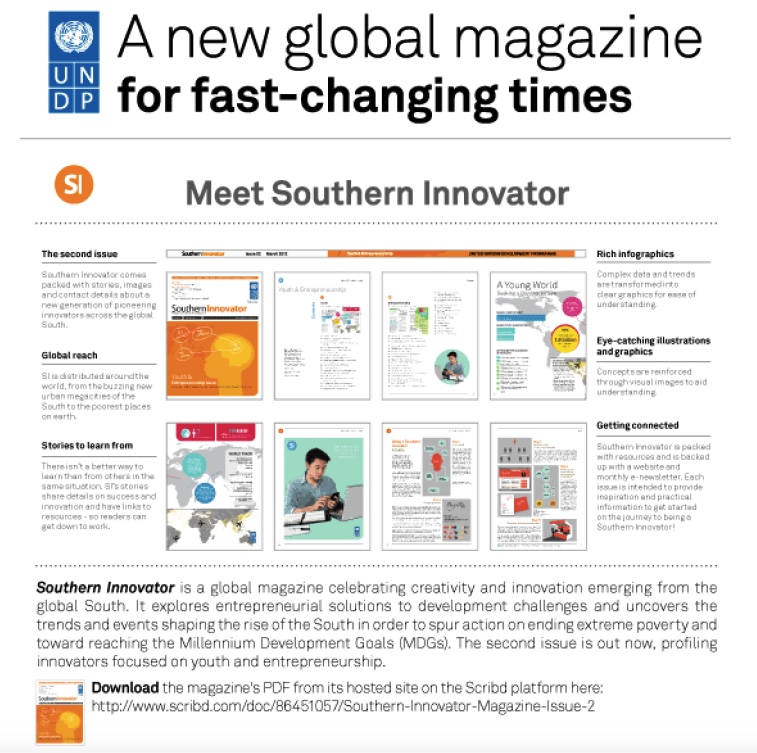
    Development Challenges, South-South Solutions was launched as an e-newsletter in 2006 by UNDP’s South-South Cooperation Unit (now the United Nations Office for South-South Cooperation) based in New York, USA. It led on profiling the rise of the global South as an economic powerhouse and was one of the first regular publications to champion the global South’s innovators, entrepreneurs, and pioneers. It tracked the key trends that are now so profoundly reshaping how development is seen and done. This includes the rapid take-up of mobile phones and information technology in the global South (as profiled in the first issue of magazine Southern Innovator), the move to becoming a majority urban world, a growing global innovator culture, and the plethora of solutions being developed in the global South to tackle its problems and improve living conditions and boost human development. The success of the e-newsletter led to the launch of the magazine Southern Innovator. 

    Creative Commons License

    This work is licensed under a
    Creative Commons Attribution-Noncommercial-No Derivative Works 3.0 License.

    ORCID iD: https://orcid.org/0000-0001-5311-1052.

    © David South Consulting 2023

  • Ghana Wants to Tap Global Trendy Party Scene

    Ghana Wants to Tap Global Trendy Party Scene

    By David SouthDevelopment Challenges, South-South Solutions

    SOUTH-SOUTH CASE STUDY

    Tourism is big business – and one of the most resilient parts of the global economy. Despite the international economic crisis that has wreaked havoc and increased unemployment and poverty in many countries since 2007, tourism is still going strong.

    The UN’s World Tourism Organization (UNWTO) (http://www2.unwto.org/) found international tourist arrivals grew by 5 per cent during the first half of 2013 from the same period in 2012, reaching 500 million arrivals.

    “The fact that international tourism grew above expectations confirms that traveling is now part of consumer patterns for an increasing number of people in both emerging and advanced economies,” said UNWTO Secretary-General Taleb Rifai. “This underlines the need to rightly place tourism as one of the key pillars of socio-economic development, being a leading contributor to economic growth, exports and jobs.”

    One successful way to lure tourists, especially young tourists, is to nurture hubs of culture, outdoor activities, music and fashion around a holiday destination – generally one involving sun and sand. Such “party scenes” can be found in hotspots as far afield as Florida, the Spanish island of Ibiza and Koh Samui (http://www.kohsamui.com/) in Thailand. While at times annoying to local people, these groups of young tourists do bring significant wealth to smaller towns and seaside communities.

    And now there are some in Africa who want to replicate this successful business formula in beach communities.

    The Ghanaian fishing village of Kokrobrite (http://en.wikipedia.org/wiki/Kokrobite), located west of the capital, Accra, has become a nascent hub for a dance music scene and beach parties.

    “We are organizing an all-day-long beach party with DJs, food and partying, inspired by the kind of summer jams that are held in Miami,” Basil Anthony, Chief Executive of Silky Entertainment (http://www.silkyentertainment.com/), told The Guardian newspaper. Silky Entertainment is organizer of Ghana Summer Beach Rave 2013.

    “We are expecting partygoers in the thousands, and double the number we had last year. It’s going to be big.”

    Other popular events include Tidal Rave (http://www.youtube.com/watch?v=8f5Wy3g9Y7w), aimed at university students, and an upmarket champagne party at Bella Roma beach which attracts expats and wealthy Ghanaians.

    While these events have been very popular locally, ambitious entertainment entrepreneurs want to take the parties to the next level and make them truly global events, attracting tourists from around the world.

    “The next Ibiza will be in Africa. It has already started,” said Andrew Tumi, also known as Won, a singer from the group Supafly.

    “We are trying to recreate the good things about going to Ibiza, the music and the vibes. But more and more we are creating our own sound here, an Afro-house, reggae, African mashup… It’s really blending the African rhythm into a house scene.”

    Dance music is hot right now, and is being refreshed with new trends in Afro-house and Afro-pop from across the continent. This in turn is creating a demand for parties to celebrate and enjoy the music.

    The economic impact is considerable as the parties inspire other businesses to feed off the good vibrations. DJ MoBlack, who works in a nightclub in Accra, told The Guardian, “It’s not just the music, it’s a whole scene that’s on the rise – goods, fashion, jewelry – there is a style revolution happening around it. It’s a unique African vibe, but something that people everywhere can relate to.”

    The impact on the tourism sector is already quantifiable. Tourist visits to Ghana grew from 400,000 a year in 2005 to 1 million in 2011.

    Ben Ohene-Aryeh at the Ghana Tourism Authority (http://www.ghana.travel/) is optimistic bigger things are to come: “[The scene] is catching on well with the youth and now we hope that it will be done on a massive scale,” he said.

    There is, however, a downside to this strategy: drug use is on the increase. According to the West Africa Commission on Drugs (wacommissionondrugs.org), marijuana use is on the rise as well as harder drugs such as cocaine.

    It’s clear there are pitfalls to the youth-tourism strategy, but these can be managed with the right strategy – and the economic opportunities for small communities are substantial.

    Published: November 2013

    Resources

    1) Information on drug tourism from DARA Thailand: DARA is Asia’s first and leading international destination for drug and alcohol rehabilitation. Website: http://alcoholrehab.com/alcohol-rehab/drug-tourism/

    2) 3rd UNWTO International Conference on Tourism and the Media: How new media is shaping the news: With the rise of the new media, both the media landscape and the way stories are being told are changing. Millions of consumers now have the possibility to directly engage in the editorial process due to faster than ever evolving technology. More recently, mobile technology and a myriad of applications for smart phone devices are increasingly influencing communication flows. Website: http://www2.unwto.org/en/event/3rd-unwto-international-conference-tourism-and-media-how-new-media-shaping-news

    3) The UNWTO World Tourism Barometer: A regular publication of the Tourism Trends and Marketing Strategies Programme of UNWTO aimed at monitoring the short-term evolution of tourism and providing the sector with relevant and timely information. Website: http://mkt.unwto.org/en/barometer

    Tourism Investment and Business Forum for Africa: INVESTOUR is an annual tourism business and knowledge exchange platform in which representatives of African tourism and potential Spanish and Portuguese investors/partners meet to discuss about business and cooperation opportunities. Website: http://africa.unwto.org/en/event/v-tourism-investment-and-business-forum-africa-investour-edition-2014-madrid-spain

    Development Challenges, South-South Solutions was launched as an e-newsletter in 2006 by UNDP’s South-South Cooperation Unit (now the United Nations Office for South-South Cooperation) based in New York, USA. It led on profiling the rise of the global South as an economic powerhouse and was one of the first regular publications to champion the global South’s innovators, entrepreneurs, and pioneers. It tracked the key trends that are now so profoundly reshaping how development is seen and done. This includes the rapid take-up of mobile phones and information technology in the global South (as profiled in the first issue of magazine Southern Innovator), the move to becoming a majority urban world, a growing global innovator culture, and the plethora of solutions being developed in the global South to tackle its problems and improve living conditions and boost human development. The success of the e-newsletter led to the launch of the magazine Southern Innovator. 
    Creative Commons License

    This work is licensed under a
    Creative Commons Attribution-Noncommercial-No Derivative Works 3.0 License.

    ORCID iD: https://orcid.org/0000-0001-5311-1052.

    © David South Consulting 2023

  • Bangladesh Coffin-Maker Offers an Ethical Ending

    Bangladesh Coffin-Maker Offers an Ethical Ending

    By David SouthDevelopment Challenges, South-South Solutions

    SOUTH-SOUTH CASE STUDY

    Few people want to think about death, and many are ill-prepared when it happens to a loved one or friend. But it will happen to us all – and growing ethical and environmental concerns are reshaping the way many deal with the inevitable event. More and more people are seeking a lower-cost option for being disposed of that also does not harm the environment.

    There are many ideas out there, but one that is getting attention is using sustainably sourced and fairly traded coffins as a way of reducing carbon emissions resulting from a person’s death.

    Bangladeshi pioneers Oasis Coffins (oasiscoffins.com) are crafting ecologically sound, Fair Trade coffins and generating jobs and income for an impoverished region of the country. The coffins are made from locally grown bamboo, seagrass and willow and are a clever piece of design.

    Bamboo is as strong as steel and yet flexible, and the coffins made from it look like typical burial boxes – but can be folded back into their footprint to be stored flat. This is a great space-saving innovation and makes it easier to store the coffins and also to ship them to overseas markets. This clever design is reducing the amount of energy used.

    Oasis has a manufacturing workshop employing 70 people in the Nilphamari district of Bangladesh (http://en.wikipedia.org/wiki/Nilphamari_District), about 400 kilometres north from the capital, Dhaka. The region is poor, but large quantities of bamboo grow in the area.

    It is a region where employment is seasonal and erratic, making family life chaotic as parents constantly search for stable work.
    Oasis Coffins is located in the Uttara Export Processing Zone (http://www.epzbangladesh.org.bd/bepza.php?id=EPZ-U), run under the authority of the Bangladesh Export Processing Zones Authority (BEPZA), a government agency that aims to “promote, attract and facilitate foreign investment in the Export Processing Zones.”  Its sales office is based in Birmingham in the United Kingdom.

    The company began in 2006 with the idea of creating high-quality products using local materials while creating good quality jobs to achieve a double impact: changed lives and a protected environment. The hope is to create a business model that can be replicated elsewhere.

    The company is structured to include both its product development and manufacturing in rural Bangladesh. It took its time conducting market research and product development to make sure it had a product people were willing to buy.

    “We make beautiful, high quality products in an environment that gives people reliable employment and good working conditions,” said managing director David How on the company’s website. “Our products are in demand from people who are becoming increasingly conscious of their impact on the environment and others.

    “It is encouraging to know that in bereavement, we can give life into people and a community in Bangladesh. We want people to know where their products are coming from, and to know that what they buy can benefit people elsewhere.”

    According to its website, Oasis Coffins abides by the standards prescribed by the World Fair Trade Organization (wfto.com) and the European Fair Trade Association (http://www.european-fair-trade-association.org/) and is also a member of ECOTA (ecotaftf.org). The ECOTA Fair Trade Forum started in 1990 and is a networking and coordinating body for small and medium sized Fair Trade Enterprises of Bangladesh.

    Employees are divided equally between women and men, and many have never been to school. They are paid 30 per cent more than the recommended rate for garment workers in Bangladesh.

    Oasis Coffins know by name the farmers who provide the bamboo and all of it is harvested within 20 kilometres of the manufacturing workshop. Oasis Coffins also takes pride in the construction of the workshop, which features plenty of natural light, good ventilation and easy access in and out. A comfortable workshop is important for the health and happiness of manufacturing workers.

    Employees receive a pension scheme, paid holidays, sick leave and a lump-sum payment if they leave. There is also a doctor available during working hours for free medical advice.

    To help upgrade the skills of the workers, there are lunchtime literacy classes, and employees are also taught how to manufacture products to a high global standard.

    The Oasis coffins are benefiting from the growing marketplace for green funerals in Europe and North America.

    In Britain, ecological funerals are on the rise as people seek an affordable and environmentally sound way to be dispatched.
    The UK’s Co-operative Funeral Care, part of the Co-operative Group, is selling the Bangladeshi coffins at more than 900 of its funeral homes in the United Kingdom as part of its ethical strategy.

    Providing funeral services can be an effective income generator. In Ghana, craftsmen have developed a global reputation for their quirky coffin designs celebrating the lives of the deceased. Ghana is also pioneering the selling of funeral insurance through mobile phones. Bereavement services are among the many basic needs of all communities, no matter where they are located. Just as people will always be born and get sick, they will also eventually die. Providing services that offer dignity to the families and the deceased can be a boost to local economies.

    Published: March 2013

    Resources

    1) Ghana coffin pioneer: Paa Joe’s sculpted coffins blur the line between art and craft. Each work is carefully constructed to reflect the ambition or the trade of the person for whom it was made. Website:http://www.jackbellgallery.com/artists/35-Paa-Joe/overview/

    2) African funeral insurance providers: “Stanbic Bank launches FuneralPlan insurance product”. Website:http://www.modernghana.com/news/427917/1/stanbic-bank-launches-funeralplan-insurance-produc.html

    3) Southern Innovator Magazine Issue 2: Youth and Entrepreneurship. Website:http://www.scribd.com/doc/106055335/Southern-Innovator-Magazine-Issue-2-Youth-and-Entrepreneurship

    Ghanaian Coffins Prove Design and Craftsmanship Boost Incomes

    Southern Innovator logo

    London Edit

    31 July 2013

    Development Challenges, South-South Solutions was launched as an e-newsletter in 2006 by UNDP’s South-South Cooperation Unit (now the United Nations Office for South-South Cooperation) based in New York, USA. It led on profiling the rise of the global South as an economic powerhouse and was one of the first regular publications to champion the global South’s innovators, entrepreneurs, and pioneers. It tracked the key trends that are now so profoundly reshaping how development is seen and done. This includes the rapid take-up of mobile phones and information technology in the global South (as profiled in the first issue of magazine Southern Innovator), the move to becoming a majority urban world, a growing global innovator culture, and the plethora of solutions being developed in the global South to tackle its problems and improve living conditions and boost human development. The success of the e-newsletter led to the launch of the magazine Southern Innovator. 

    Creative Commons License

    This work is licensed under a
    Creative Commons Attribution-Noncommercial-No Derivative Works 3.0 License.

    ORCID iD: https://orcid.org/0000-0001-5311-1052.

    © David South Consulting 2023

  • Indian Initiatives to Make Travel Safer for Women

    Indian Initiatives to Make Travel Safer for Women

    By David SouthDevelopment Challenges, South-South Solutions

    SOUTH-SOUTH CASE STUDY

    Shocking assaults on women traveling in India have galvanized innovators to find solutions. One solution that is proving successful is to establish specialist taxi services for women. As a happy additional benefit, these taxi innovators are transforming the taxi experience, introducing more ethical practices such as honest fares, professional and safe driving habits and clean, hygienic and comfortable taxis.

    With sexual harassment levels high and several shocking assaults and rapes of women in Indian cities grabbing global media attention, Indian women are now being offered a variety of women-driver-only taxi services to ensure they get to work and home again safely.

    As well as offering their passengers security, these companies are also redefining the taxi experience with innovation. As travelers know, the taxi experience in many cities can be frustrating, fraught with scams, rip-offs, disputes over fares, unhygienic taxi interiors and poor driving skills. These pioneering women-only taxi companies are trying to show there is another way: that taxis can be clean, meters honest and driving safe and sound.

    Security for women has come into the media spotlight in India after a series of high-profile attacks and sexual assaults. The country is undergoing major economic and social change as it modernizes and urbanizes. Women are seeing their incomes and their role in the economy increase.

    This brings both opportunities and risks. Women who would have only lived and worked in a small geographical area, and generally associated only with their family or a small village, are now mobile and in contact with the busy urban environments of megacities awash with strangers.

    One woman is raped every 20 minutes in India, according to the National Crime Records Bureau. But police estimate only four out of 10 rapes are reported, largely due to victims’ fear of being shamed by their families and communities. At the beginning of March 2013, a campaign to raise awareness on women’s safety was launched in Delhi to chime with International Women’s Day. The UN also confirmed in March 2013 a global strategy to combat violence against women (http://www.un.org/womenwatch/daw/csw/57sess.htm).

    One champion of safer transport for women in India is Revathi Roy, a rally car driver and entrepreneur. She started a women-only taxi company in Mumbai called Forsche in 2007 out of raw economic need, and to solve a problem.

    “I am a very fussy passenger and I would get upset that the seat was not comfortable, or the driver was driving too rashly for my liking,” Roy told BBC News.

    “I would also find it irritating that some drivers would stare at me from their rear-view mirror and one day, I just decided I had had enough.”

    Forsche – pronounced “for she” – a play on the German car maker Porsche’s name – was one of the pioneers in bringing all-women taxi services to India. Their drivers’ uniform came in pink and purple with a purple scarf worn around the neck.

    However, Roy parted ways with her previous business partner and set up Viira Cabs (viiracabs.com/) in 2011. Viira means ‘courageous woman’ according to Roy.

    Roy hopes passengers from young girls to senior citizens will feel safer and more confident knowing a woman is the driver.

    “The attitude of Indian mothers is changing,” she said. “Now they know their daughters go out and drink. They realize they may as well keep them safe by putting them in the hands of a woman who at all times is playing the role of a mother or a sister.  A man can’t be a woman. And just because a woman is sitting at the wheel she doesn’t become a man.”

    The company has 20 taxis and 25 drivers. It uses a fleet of Maruti Eecos (http://marutisuzukieeco.in/), a mini van made by Suzuki capable of carrying four adult passengers and their luggage. Viira also seeks to improve driving standards on Mumbai’s roads by setting a good example with safe, defensive driving techniques.

    A pioneer of female taxi drivers in India, Roy is now the Mentor and Chief Driving Officer for Viira Cabs. According to the company’s website, she is looking to train thousands of women to be able to make their livelihood as a taxi driver.

    “Driving is still very male dominated and in Mumbai where most people travel by public transport, there are very few women with driving licenses,” she explained.

    “Viira is a very powerful platform for poor, urban women who are now able to earn up to Rs 12,000 a month (US $222),” Roy told CNN.

    Viira’s drivers wear a professional uniform of a peaked cap, white short sleeved shirt with blue trim, and a plastic identification badge on a blue lanyard. This makes it clear from the start to passengers who is driving them.

    The service runs 24 hours a day, seven day a week, and journeys are dispatched from the company’s call centre. To keep the service safe as can be, all vehicles are monitored by GPS (global positioning system) and a panic alert system. The drivers receive self-defence and defensive-driving training so they can elude any dangers while on the road. They also know how to handle roadside emergencies and are backed up by 24/7 support from the call centre.

    The taxis follow the standard charges set down by the Mumbai region. By using mini-vans, passengers are able to enjoy a comfortable and roomy ride in air conditioned comfort – a big plus in a hot country. The vans run on CNG (compressed natural gas) (http://en.wikipedia.org/wiki/Compressed_natural_gas), reducing pollution.

    To add even more value to the journey experience, the taxis feature live television and Internet web surfing using something called Tabbie TM (Tablet in a Cab), a 10-inch-wide computer tablet.

    In addition to the taxi service, the Viira Motor Training School offers driver training to women with low incomes. Its 12-week program covers all the main areas of taxi-driving skills – driving theory, mechanics, customer service, health and safety and self-defence – but also goes to the next level and gives the students training on a vehicle-driving simulator donated by the Suzuki company.

    Roy said she hopes to expand the business from Mumbai to smaller urban areas “where Indian women are most starved of opportunities.”

    Long-term, she wants to become “India’s premier chauffeur and fleet service.”

    Roy’s success with these companies led to the founding of the social enterprise Sakh Consulting Wings (http://sakhaconsultingwings.com/about-us.php) to support establishing similar services in other Indian cities.

    Sakha Consulting Wings is partnered with the Azad Foundation to promote taxi driving as a viable career for women from poor backgrounds.

    Super Cabz in Delhi (http://www.supercabz.com/women-friendly-cab-service-delhi-ncr.php) is another service aimed at women. It has innovations such as panic buttons in the back seats of the cabs and mobilizers to allow the central call centre to shut the cab’s engine down in an emergency. There is also a GPS monitoring and tracking system to keep tabs on the cabs as they go about the city.

    Published: May 2013

    Resources

    1) South Africa’s Cabs for Women. Website: cabsforwomen.co.za/

    2) India Taxi Auto Fare: “A unique service that calculates your taxi fare and auto fares; before you start your travel! You also get an exact, to the scale Google Map that shows your route. Further, you can also change the default route to avoid traffic, plan for some shopping on the way or just pick up your date!” Website: http://www.taxiautofare.com/Default.aspx

    3) Merar: Merar was launched with the idea to create the best platform for investment providers and seekers from emerging markets. It has grown to become one of the largest online meeting places bringing together investors, entrepreneurs and investment intermediaries globally. Website: merar.com/

    4) Lavasa Womens Drive: Helps champion skilled women drivers in India. Website: http://www.lavasawomensdrive.com/selectcity1.html

    5) PeopleNet TABLET™: A powerful in-cab personal computer with a touch screen, stylus and screen keyboard. Website: peoplenetonline.com/tablet

    https://davidsouthconsulting.org/2022/11/22/bio-ethanol-from-sturdy-and-once-unwanted-indian-plant/

    https://davidsouthconsulting.org/2022/09/29/cheap-indian-tablet-seeks-to-bridge-digital-divide/

    https://davidsouthconsulting.org/2022/10/09/entrepreneurs-use-mobiles-and-it-to-tackle-indian-traffic-gridlock/

    https://davidsouthconsulting.org/2021/08/29/indian-business-model-makes-green-energy-affordable/

    https://davidsouthconsulting.org/2022/10/25/indian-city-slum-areas-become-newly-desirable-places-to-live/

    https://davidsouthconsulting.org/2021/08/28/indian-entrepreneur-brings-dignity-to-poor-women/

    https://davidsouthconsulting.org/2021/03/04/indian-id-project-is-foundation-for-future-economic-progress/

    https://davidsouthconsulting.org/2022/06/15/indian-mobile-phone-application-innovators-empower-citizens/

    https://davidsouthconsulting.org/2022/11/01/indian-newspapers-thrive-with-economy/

    https://davidsouthconsulting.org/2022/10/06/indian-solar-economy-brings-new-vocation-for-women/

    https://davidsouthconsulting.org/2022/10/06/indian-solar-power-pack-powers-villages/

    https://davidsouthconsulting.org/2022/10/25/indian-toilet-pioneer-champions-good-ideas/

    https://davidsouthconsulting.org/2022/10/18/indians-fighting-inflation-with-technology/

    https://davidsouthconsulting.org/2020/12/04/model-indian-villages-to-keep-rural-relevant/

    Southern Innovator logo

    London Edit

    31 July 2013

    Development Challenges, South-South Solutions was launched as an e-newsletter in 2006 by UNDP’s South-South Cooperation Unit (now the United Nations Office for South-South Cooperation) based in New York, USA. It led on profiling the rise of the global South as an economic powerhouse and was one of the first regular publications to champion the global South’s innovators, entrepreneurs, and pioneers. It tracked the key trends that are now so profoundly reshaping how development is seen and done. This includes the rapid take-up of mobile phones and information technology in the global South (as profiled in the first issue of magazine Southern Innovator), the move to becoming a majority urban world, a growing global innovator culture, and the plethora of solutions being developed in the global South to tackle its problems and improve living conditions and boost human development. The success of the e-newsletter led to the launch of the magazine Southern Innovator. 

    https://davidsouthconsulting.org/2021/03/05/southern-innovator-issue-1/

    Creative Commons License

    This work is licensed under a
    Creative Commons Attribution-Noncommercial-No Derivative Works 3.0 License.

    ORCID iD: https://orcid.org/0000-0001-5311-1052.

    © David South Consulting 2023