Tag: 2012

  • African Innovation Eco-system Taking Shape

    African Innovation Eco-system Taking Shape

    By David SouthDevelopment Challenges, South-South Solutions

    SOUTH-SOUTH CASE STUDY

    How to increase the rate of innovation in Africa? And specifically, innovation that actually improves people’s lives and reduces poverty. It is a hard question to answer, but some are putting in place the building blocks of a 21st century innovation culture by riding the information technology revolution as it rolls across Africa.

    The transformative story of mobile phones in Africa has captured the attention of the world. Technologies like mobile phone payment systems developed in Africa are now being rolled out around the globe.

    But there is more to come as undersea cables increase the communications links between African nations and the rest of the world. New undersea cables including TEAMs, Seacom and Eastern Africa Submarine Cable System (EASSy) (eassy.org) are vastly increasing the continent’s Internet capacity and bandwidth (http://en.wikipedia.org/wiki/Bandwidth_%28computing%29).

    These communications links will revolutionize the type and scale of innovation that can happen in Africa.

    As websites like AfriGadget (afrigadget.com) amply prove, there is already an entrenched do-it-yourself innovation culture hard-wired into daily life on the continent. While impressively resourceful and able to make the most of often very little, this innovation culture is often confined to a narrow geographical area. And this is the difference the new information technologies will make: They will allow this energetic and resourceful innovators’ culture to develop businesses and business models that can reach beyond narrow geographical parameters.

    New technologies will also accelerate the spread of new ideas and solutions.

    Across the continent, ways and means are being stitched together that enable people to transcend borders and old divisions and obstacles to connect with like-minded collaborators, seek out funding and take ideas from dreams to schemes and eventually to continent- and world-straddling levels.

    According to the Deloitte 2011 East Africa Private Equity Confidence Survey: Promising 2012, “Many investors see East Africa’s strong growth potential as a driver of better investment performance than in South Africa: This is a huge shift in private equity attitudes toward Africa, which have been historically focused on South Africa. East African investment potential is seen as roughly on par with West Africa, where similar growth dynamics are at play.”

    Identifying the elements that are making this innovation culture flourish came under analysis in a recent post on the Afrinnovator website (afrinnovator.com). Afrinnovator is dedicated to “telling the stories of African startups, African innovation, African made technology, African tech entrepreneurship and entrepreneurs.”

    While it is well known that new infrastructure, better governance, new policies, and new services like mobile phones and mobile money have made a big difference in shifting perceptions of Africa from despair to optimism, Afrinnovator found there were other key ingredients to this innovation renaissance.

    Afrinnovator argues there are four elements that have come together to change circumstances for innovators on the continent: education, mentoring and incubators, funding, and showcase events.

    Afrinnovator found education was critical to the quality of emerging technological innovations. Information and communication technology (ICT) education has moved from just computer science courses to a vast array of options, from bachelors degrees to masters programmes.

    For mentoring and incubators, Afrinnovator found hubs and incubators are providing places for young educated people to go to and get down to work.

    Examples include iHub (http://ihub.co.ke/pages/home.php), mLab East Africa (http://mlab.co.ke/pages/home.php), ccHub (Co-Creation Hub Nigeria) (http://cchubnigeria.com/about-cchub/), Lusaka, Zambia’s Bongohive (bongohive.com), iLab Africa (http://ilabafrica.ac.ke/) NaiLab (http://nailab.co.ke/) iBid Labs (http://ibidlabs.com/) and Uganda’s HiveColab (http://hivecolab.org/), among others. These places offer like-minded fellowship and access to mentors to take them on the journey from “idea to viable profitable business.”

    According to Business Daily Africa, “There are more than 3,000 software developers who have come up with both mobile and personal computer-based software applications that are changing lives across the continent.”

    A transformation in funding access has seen a renaissance in new thinking that is transforming tech start-ups into viable businesses. Kenya has the Kenya ICT Board (http://www.ict.go.ke/) and it awards US $50,000 through its Tandaa grant programme (https://sites.google.com/a/ict.go.ke/tandaa/).

    Because of this enthusiastic local support, the World Bank is now committing a US $55 million grant targeting Kenya’s technology innovators to be distributed through the Kenya ICT Board.

    East Africa also saw 16 new investor funds launch in 2011 alone. They include early-stage investor funds like eVentures Fund Africa (eVA) (http://www.eva-fund.com/), which calls itself “the first venture capital firm investing in African SME’s active in digital media.” Another is Kenya-based 88mph (http://www.humanipo.com/88mph), with its “focus on startups targeting the East African mobile and web market.”

    In Kenya, the World Bank money will be used to help technology developers bring to market simple solutions in health and education.

    According to the World Bank (http://tinyurl.com/cm3g2rf), “Kenya has put in place the second-fastest broadband on the continent (after Ghana), which has reduced the wholesale internet capacity prices by over 90% and increased internet penetration from 3% to 37% of the population in the past decade. Today, about 90% of Kenyan adults have or have the use of a mobile phone.”

    And the final game-changer, according to Afrinnovator, is “showcase events.”

    These events give investors and potential partners the opportunity to meet start-ups and explore their new ideas.

    Examples include DEMO (http://www.demo.com/ehome/index.php?eventid=29414&amp😉 – which connects the idea people with the money people – and Pivot East in East Africa (http://pivoteast.com/). Pivot East provides 25 technology entrepreneurs with the opportunity to make a pitch in front of investors. DEMO is working with USAID, Microsoft, Nokia and others to launch DEMO Africa in Nairobi, Kenya from 21 to 22 October 2012.

    Afrinnovator concludes: “This is the last virgin tech landscape left on the planet. The best time to become a player in the African technology innovation ecosystem is now.”

    Published: July 2012

    Resources

    1) Read more about Africa’s evolving innovation system. Website: http://afrinnovator.com/blog/2012/06/13/the-innovation-ecosystem-in-eastafrica/

    2) Southern Innovator: Youth and Entrepreneurship Issue. Website: http://www.scribd.com/doc/86451057/Southern-Innovator-Magazine-Issue-2

    3) Southern Innovator: Mobile Phones and Information Technology Issue. Website: http://www.scribd.com/doc/57980406/Southern-Innovator-

    Magazine-Issue-1

    4) Notes from ‘Understanding Broadband Demand in Africa: Internet Going Mobile’. Website: http://www.oafrica.com/mobile/notes-from-understanding-broadband-demandin-africa-internet-going-mobile/

    5) Deloitte Private Equity Survey 2012. Website: deloitte.com
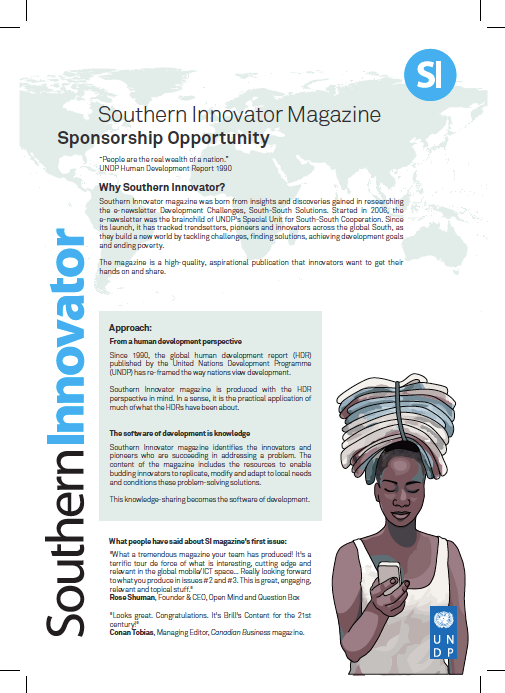
    Development Challenges, South-South Solutions was launched as an e-newsletter in 2006 by UNDP’s South-South Cooperation Unit (now the United Nations Office for South-South Cooperation) based in New York, USA. It led on profiling the rise of the global South as an economic powerhouse and was one of the first regular publications to champion the global South’s innovators, entrepreneurs, and pioneers. It tracked the key trends that are now so profoundly reshaping how development is seen and done. This includes the rapid take-up of mobile phones and information technology in the global South (as profiled in the first issue of magazine Southern Innovator), the move to becoming a majority urban world, a growing global innovator culture, and the plethora of solutions being developed in the global South to tackle its problems and improve living conditions and boost human development. The success of the e-newsletter led to the launch of the magazine Southern Innovator.  

    Creative Commons License

    This work is licensed under a
    Creative Commons Attribution-Noncommercial-No Derivative Works 3.0 License.

    ORCID iD: https://orcid.org/0000-0001-5311-1052.

    © David South Consulting 2023

  • African Afro Beats Leads New Music Wave to Europe

    African Afro Beats Leads New Music Wave to Europe

    By David SouthDevelopment Challenges, South-South Solutions

    SOUTH-SOUTH CASE STUDY

    A surge in interest in African music in Britain is creating new economic opportunities for the continent’s musicians. The new sound heating up the U.K. music scene is “Afro Beats” – a high energy hybrid that mixes Western rap influences with Ghanaian and Nigerian popular music.

    Afro Beats draws its inspiration from the “Afrobeat” sound popularized in the 1970s (http://en.wikipedia.org/wiki/Afrobeat).Afrobeat recordings from that time are still making money as long-forgotten tunes are re-packaged by so-called ‘crate divers’ – enterprising people who rummage through old vinyl record collections and re-brand scenes and sounds.

    This is part of the global creative economy, which is thriving despite the recent years of economic turmoil. Musicians offer many lessons for businesses in the South, both in their adaptability to new conditions and their resourcefulness in experimenting with new business models to earn an income.

    Afrobeat stars and pioneers like Nigeria’s Fela Kuti (http://en.wikipedia.org/wiki/Fela_Kuti) have been popular outside Africa for many decades. But Afro Beats – a new name with the addition of the crucial letter “s” – is being declared as the beginning of a new phase in taking African music global.

    As the digital music revolution has rocked the global music business, artists have had to adapt and change their business models. For all but a very few “big names,” it is no longer possible to build a career on royalties from recordings and hits. Stars and novices alike must battle with music pirates, who sell CDs and downloads of other people’s tunes and keep the money for themselves. Legitimate income often comes in micropayments from large music platforms like iTunes as people pay to download an individual song or mix and match tunes they like from an artist’s catalogue, rather than buying a whole album as they would in the past.

    Clever musicians have turned to building their brand, using live performances and the ability to sell other services and merchandise to make a living. They create their own web platforms, or mobile phone apps (applications), and do the marketing and distribution on their own to build a loyal fan base. Others are creating their own mobile radio stations by distributing CDs to the ubiquitous taxi mini buses that are the main means of transport in most African cities.

    But some things remain the same as in the past, such as the importance of having a champion, such as a radio DJ (disc jockey), who acts as a “taste maker,” discovering new acts and telling their audience about them.

    The DJ most associated with pushing the Afro Beats sound and scene is London-based DJ Abrantee (http://www.facebook.com/djabrantee).

    “I’ve been playing this music to three or four thousand people at African events in the U.K. for years,” DJ Abrantee told The Guardian. “For years we’ve had amazing hiplife, highlife, Nigerbeats, juju music, and I thought: you know what, let’s put it all back together as one thing again, and call it Afro Beats, as an umbrella term. Afrobeat, the 60s music, was more instrumental – this Afro Beats sound is different, it’s inter-twined with things like hip-hop and funky house, and there’s more of a young feel to it.”

    Abrantee (abrantee.com) promotes Afro Beats in the United Kingdom in myriad ways: he broadcasts six days a week on a radio station, including an Afro Beats-themed show on Saturdays. He travels around to DJ and takes Ghanaian and Nigerian tunes with him. He says Africa is so musically vibrant, he can’t keep up with it all.

    “This is specifically the western African sound: there are a lot of shared ideas between these two neighbouring countries,” he explained to The Guardian. “I see Afro Beats as music which makes the heart beat. And it’s funky, and hyped, and energetic and young.”

    Afro Beats has also been able to reach a young audience. “It’s striking how young they are – when I do these Afro Beats events there’s thousands of people, and they’re all youngsters, really.”

    One of the Afro Beats stars is D’Banj (mohitsrecords.com/d-banj) – a Nigerian rap star – who has been receiving attention for his song Oliver Twist.

    The Afro Beats sound is also provoking a new interest in all things African amongst youth with African parents. This is a big change from when American “cool” set the trends. As DJ Abrantee notes, “the parents are really pleased, and proud, that their kids are all of a sudden embracing their culture. It didn’t used to be cool, but now they’re going through their parents’ record collections going, ‘Have you got this old song by Daddy Lumba?’.”

    Some of the Afro Beats leaders include Sarkodie’s ‘U Go Kill Me’, Ice Prince’s ‘Oleku’, Atumpan’s ‘The Thing’, Castro ftAsamoah Gyan’s ‘African Girls’.

    Afro Beat’s popularity in Britain has led to African artists collaborating with musicians in the UK. Afro Beats musician Sarkodie has collaborated with London-based artists Donaeo and Sway.  DJ Abrantee sees this trend continuing and expanding. “You’re going to see more U.K. artists doing Afro Beats collaborations now,” he said.

    Other Nigerian artists who have benefited from the increasing awareness are Wiz Kid, 2Face Idibia and P-Square (mypsquare.com).

    Abrantee believes Ghana and Nigeria are having a big impact on the global music scene.

    “The floodgates have opened. Music is always evolving, and everyone’s always looking for the next drug. Funky house has died out, grime is still there but it’s gone back underground, electro-pop’s got U.K. urban music in the charts, but that’ll die out, it’s got a short shelf-life. … and people are finally noticing I’m getting 3,000 people coming out to dance to Afro Beats.”

    British-Ghanaian hip-hop performer Sway sees connections between Afrobeat and Afro Beats.

    “Fela Kuti is obviously a massive legend in the game, and what he was doing is not too different to what D’Banj is doing now – taking western influences and adding them to African culture, and coming up with something new, that appeals to everyone,” he said.

    And technology is seen as the binding element that is connecting African music and musicians to other scenes.

    “African music in Africa is evolving in relation to what’s going on abroad too,” said Sway. “Via the Internet they’re picking up certain trends much quicker: so for example you have Auto-Tune and western styles of singing cropping up on all these Afro Beats tracks.”

    And Sway believes the quality of production of African music has improved: “There’s been a serious change in the music coming out of Africa lately.

    “The sound is heavier and clearer, the videos are better, there’s been a positive growth in the African music scene. It was just a matter of time before people paid attention.

    “When you’ve got African swag and African traditions combined with up-to-date western styles, and singing in English, well – you’ve got a winning formula on your hands.”

    Published: February 2012

    Resources  

    1) Mongolian Rock Pop book: In the Mongolian language, this UNDP book details how pop musicians led on business innovation during the turbulent transition years of the 1990s. Website: http://www.scribd.com/doc/23917535/Mongolian-Rock-and-Pop-Book

    2) Afrobeat: An interactive exploration of Afrobeat and its participants from National Geographic. Website: http://worldmusic.nationalgeographic.com/view/page.basic/genre/content.genre/afrobeat_686/en_US

    3) DJ Abrantee: More from the champion of the Afro Beats scene. Website: http://www.abrantee.com

    https://davidsouthconsulting.org/2022/11/21/africa/

    https://davidsouthconsulting.org/2022/11/19/african-culture-as-big-business/

    https://davidsouthconsulting.org/2022/11/17/african-ingenuity-attracting-interest/

    https://davidsouthconsulting.org/2022/10/26/africas-consumer-market-in-spotlight-for-2011/

    https://davidsouthconsulting.org/2021/03/12/afro-coffee-blending-good-design-and-coffee/

    https://davidsouthconsulting.org/2021/01/05/afropolitan-african-fashion-scene-bursting-with-energy/

    https://davidsouthconsulting.org/2022/11/17/cashing-in-on-music-in-brazil/

    https://davidsouthconsulting.org/2022/12/18/disabled-congolese-musicians-become-world-hit/

    https://davidsouthconsulting.org/2022/10/20/ghana-wants-to-tap-global-trendy-party-scene/

    https://davidsouthconsulting.org/2022/10/24/made-in-africa-fashion-brand-pioneers-aim-for-global-success/

    https://davidsouthconsulting.org/2021/11/09/mauritanian-music-shop-shares-songs-and-friendship/

    https://davidsouthconsulting.org/2023/02/07/mongolian-rock-and-pop-book-mongolia-sings-its-own-song/

    https://davidsouthconsulting.org/2020/12/17/mongolias-musical-entrepreneurs-led-way-out-of-crisis-2018/

    https://davidsouthconsulting.org/2021/11/09/ring-tones-and-mobile-phone-downloads-are-generating-income-for-local-musicians-in-africa/

    https://davidsouthconsulting.org/2022/06/25/shoes-with-sole-ethiopian-web-success-story/

    https://davidsouthconsulting.org/2021/03/05/southern-innovator-issue-2/

    https://davidsouthconsulting.org/2021/11/09/taxis-promote-african-music-beats/

    https://davidsouthconsulting.org/2022/04/15/youth-surge-in-the-south-a-great-business-opportunity/

    Development Challenges, South-South Solutions was launched as an e-newsletter in 2006 by UNDP’s South-South Cooperation Unit (now the United Nations Office for South-South Cooperation) based in New York, USA. It led on profiling the rise of the global South as an economic powerhouse and was one of the first regular publications to champion the global South’s innovators, entrepreneurs, and pioneers. It tracked the key trends that are now so profoundly reshaping how development is seen and done. This includes the rapid take-up of mobile phones and information technology in the global South (as profiled in the first issue of magazine Southern Innovator), the move to becoming a majority urban world, a growing global innovator culture, and the plethora of solutions being developed in the global South to tackle its problems and improve living conditions and boost human development. The success of the e-newsletter led to the launch of the magazine Southern Innovator.  

    Creative Commons License

    This work is licensed under a
    Creative Commons Attribution-Noncommercial-No Derivative Works 3.0 License.

    ORCID iD: https://orcid.org/0000-0001-5311-1052.

    © David South Consulting 2023

  • Design Collaborations Revitalize Traditional Craft Techniques

    Design Collaborations Revitalize Traditional Craft Techniques

    By David SouthDevelopment Challenges, South-South Solutions

    SOUTH-SOUTH CASE STUDY

    Keeping alive traditional craft techniques and methods in the age of globalization is a tricky balance to get right. As countries seek to increase living standards and income, traditional craft-making methods are often jettisoned in favour of attracting manufacturing and other high-value activities – meaning rich and potentially lucrative skills can be lost.

    One promising new initiative is bringing craftspeople in the global South together with established and well-known designers in The Netherlands to create the market incentives to continue using traditional techniques. It is establishing a brand and a business model to sell unique and original craft products into the European marketplace. By doing this, it hopes to open up new markets in Europe – and in time, the rest of the world – for craft makers from the global South so they can continue to earn an income using their traditional skills and techniques.

    The brand is called Imperfect Design (http://www.imperfectdesign.nl/) and was founded in 2011 by Monique Thoonen, formerly the managing director of Dutch Design in Development (ddid.nl) – a matchmaker between Dutch designers, producers in developing countries and European importers. Imperfect Design takes the idea a step further: It is a brand dedicated to creating high-value, well-designed craft products for the European marketplace.

    The idea began to percolate in Thoonen’s mind in 2010. She received a good response from some of the Dutch designers she approached – who were keen to work with craft workers in developing countries – and this gave her the confidence to launch Imperfect Design.

    “We saw that many designers were very interested to work with craftsmen/small workshops in developing countries,” she explained, reflecting on her previous experience working with Dutch Design in Development. “The designers and the crafters learned a lot about the inspiring cooperation and it resulted often in good quality products/collections. However, it was hard to find good sales channels for the products. In 2010 the idea came about to set up an own brand.”

    Thoonen was seeking a business model that could be sustainable and rewarding for all the participants along the value chain (http://en.wikipedia.org/wiki/Value_chain).

    “The cooperation is inspiring for Dutch designers,” Thoonen said. “The craftsmen will learn a lot about product development during the project and will earn money from the orders. The idea is to build up long-term relations with producers in three countries in three continents – each continent one country.”

    For Thoonen, the business model approach is at the core of Imperfect Design.

    “The idea of my business model is not doing good. It must be a profitable business model, otherwise it can’t be sustainable. Making it profitable is a big challenge and also forces us to keep the commercial aspect every day in mind.”

    The criteria for selecting the designers includes a resourcefulness and creativity that can shape a high-quality craft product with the resources and tools at hand for the collaborating craft workers in the developing country. It is also crucial they understand how to shape the craft product into a high-value item that can command a high price back in Europe.

    According to Thoonen, “the products must be differentiated from the market, otherwise it can be copied easily by large producers in China. It is really important to create new things, as the prices are in general higher than from mass production, so the consumer must understand why the price is higher.”

    So far, Imperfect Design has begun working with craftspeople in Vietnam and Guatemala, and it is currently selecting a country in Africa. Craft workers can contact Imperfect Design about collaborating but the number of people it can work with is limited at this stage. Imperfect Design places emphasis in taking the time to build sustainable relationships.

    A common criticism of craft products sold in many markets is their sameness and sometimes poor and inconsistent production quality. Trying to enter an overseas market and understand what consumers want or desire is a very difficult thing for a craft worker to get right. This is where the experience and knowledge of a designer can make a big difference. Designers can help to hone the craft product, improve the production methods and position the product in the overseas marketplace.

    “The workshops have fantastic qualities and materials to work with,” says Thoonen. “When you combine that with the strength of our Dutch designers, you can create products which are commercial, of high quality, and beautiful.”

    One of the first collaborations to bear fruit is between Dutch designer Arian Brekveld (arianbrekveld.com) and craft workers in Vietnam. The collaborations have resulted in lacquer tables, trays and candlesticks, ceramic vases, iPad bags and throw cushions – all made using techniques and materials unique to Vietnam.

    Imperfect Design allows the designers to select which country they would like to work with. Brekveld’s previous experience travelling widely in Asia tipped his interest towards a country in that continent. He appreciated the friendly and welcoming contacts he had made in Vietnam, who showed a strong interest in collaborating.

    Brekveld wanted to bring a “designer’s eye” to the possibilities in Vietnam. He asked: “How could they make the crafts more beautiful and customized for the market in Europe?”

    He found Vietnam was not just an interesting place to work, but also a country undergoing significant change. As a result, he found it critical to go and see what was happening in the country and to see first-hand the working conditions in the workshops.

    This was a contrast to many of the design briefs he normally undertakes in Europe, where there often isn’t the intimacy of working directly with the craft workers in their workshops.

    The time spent in Vietnam was intense and involved visiting multiple workshops to see which would be the best partner.

    “We visited four or five lacquer companies to see what their skills were, looking for possibilities,” he said. “It is very special to see by yourself, to really to take a look by yourself, to see what companies do.”

    Brekveld was surprised to see that concepts that had been discussed and explored earlier in the day would be presented to him as completed works by the end of the day. The quick work pace and precision really impressed the designer, and the project took months to complete in comparison to the years required by some projects he works on in Europe.

    A group of women from the ethnic Catu (http://en.wikipedia.org/wiki/Co_Tu_people) community in central Vietnam weaved the fabrics for the iPad bags and cushions. It was very valuable to work with them in person because he could see what they were – and weren’t – capable of. The fabrics are made into iPad bags and cushions in the capital Hanoi by disabled craftsmen.

    Brekveld said visiting the remote workshop saved a lot of time and frustration.

    “It was a big difference compared to sitting behind a desk and sending designs. You really see all the possibilities that are there.”

    Brekveld is seeking to design products that do not fit in with a clichéd idea of what comes from a developing country.

    “If you look you can see the imperfections but they are not obvious. These designs would not necessarily sell in their own country. We try to design products showing the skills they have, using their techniques – not using patterns they would use for themselves. We look at their process and say ‘you can make that and that’. On the other hand, we don’t want to tell them to do something completely different. We look at the technique – a combination of European design language with their abilities.”

    But what about quality control? Brekveld says that is an issue he looks at right from the beginning of the design process. “I am a maker, try to make myself – try to think about it before hand.”

    He is ambitious for the collaboration to flourish.

    “We hope these relations are long-term relations,” he said. “We hope to expand the collection.”

    He will present the collections during Dutch Design Week at the end of October 2012 in Eindhoven (ddw.nl).

    For Thoonen, success will bring many benefits. “If we manage to sell the collection well in the market, then we can give more orders,” Thoonen said. “In short: it will create work, but also development in quality and design.”

    Published: September 2012

    Resources

    1) An online film showing Arian Brekveld’s trip to Vietnam and the craft collaborations. Website: http://imperfectdesign.nl/index.php?route=product/category&path=72_91

    2) Dutch Design in Development: DDiD is the agency for eco design, sustainable production and fair trade. They work with Dutch importers and designers and connect them to local producers in developing countries and emerging markets. Together products are made that are both profitable and socially and environmentally sustainableWebsite: http://www.ddid.nl/english/

    3) Dutch Design Week: Groundbreaking ideas, mind-blowing experiments and extraordinary forms of collaboration – that’s what it’s all about during DDW. With the boundless creativity of hundreds of renowned designers and young talents, each year the leading event offers a unique look into the future of design (Eindhoven, The Netherlands: 20-28 October 2012). Website: http://www.ddw.nl/

    Creative Commons License

    This work is licensed under a
    Creative Commons Attribution-Noncommercial-No Derivative Works 3.0 License.

    ORCID iD: https://orcid.org/0000-0001-5311-1052.

    © David South Consulting 2023

  • African Fuel Pioneer Uses Crisis to Innovate

    African Fuel Pioneer Uses Crisis to Innovate

    By David SouthDevelopment Challenges, South-South Solutions

    SOUTH-SOUTH CASE STUDY

    Crisis, as the old saying goes, is also a window of opportunity. And there is one African entrepreneur who knows this better than most. Daniel Mugenga has been on a journey of innovation that has led him to become a pioneer in the emerging new field of algae technologies. The story of how he got there is a testament to the power of using business to both solve problems and make profits.

    Kenyan entrepreneur Daniel Mugenga has found a solution to the problem of high fuel costs for the transport sector in his country. He has been making money from turning waste cooking oil and inedible vegetable oil into biodiesel (http://en.wikipedia.org/wiki/Biodiesel). He then discovered that he could boost his production of biodiesel by using marine algae as a source for oil.

    According to the body that represents the algae fuel industry, Oilgae (oilgae.com), algae are “plant-like organisms that are usually photosynthetic and aquatic, but do not have true roots, stems, leaves, vascular tissue and have simple reproductive structures. They are distributed worldwide in the sea, in freshwater and in wastewater. Most are microscopic, but some are quite large, e.g. some marine seaweeds that can exceed 50 m in length.”

    The U.S. Department of Energy has been investigating algae as a fuel source since 1978, and it is being investigated as a potentially transformative fuel source around the world. His business, Pure Fuels Ltd. (http://www.purefuels.co.ke/), is currently seeking venture capital funding for expansion and innovation. Pure Fuels is “a commercial producer of biodiesel and also manufactures biodiesel processors, which we sell to budding entrepreneurs,” says Mugenga.

    The Pure Fuels website educates readers on biodiesel as well as offering opportunities for investors and news updates. Pure Fuels was registered as a business in Kenya in 2010.

    The business was born out of crisis: in 2008 there were frequent fuel shortages in Kenya and prices were volatile. That was bad news for Daniel Mugenga’s job, working for a transport company with a fleet of trucks. Rising or volatile fuel prices can destroy businesses in areas like trucking, where the biggest expense is fuel.

    Mugenga began to do research into fuel alternatives in the crisis and came upon biodiesel. He then set about training in how to produce biodiesel. A period of testing, trials and research ensued between 2008 and 2010, which enabled Pure Fuels to build confidence they had something that was high  quality. The company started producing 120,000 litres of biodiesel in 2010 and increased production to 360,000 litres in 2011 and 700,000 so far in 2012. In 2011, Pure Fuels had revenue of US $230,000 from selling biodiesel.

    “We started off using jatropha oil, but when its price went up it was no longer profitable,” Mugenga told the VC4Africa website blog. “Having invested in the machinery, we switched to the next quickest alternative which is used cooking oil. We source it from several of the tourist hotels along the Kenyan coast.”

    Turning to cooking oil for biodiesel at first was a good idea. The company was able to get enough waste cooking oil from Kenya hotels and tourist resorts to meet demand. But as demand rose, the thorny problem of Kenya’s tourism business being seasonal arose.

    “For about five months of the year, many hotels in Mombasa temporarily shut down or operate at lower capacity. Of course this is affecting the amount of waste cooking oil,” Mugenga said. This is where algae (http://en.wikipedia.org/wiki/Algae) comes in.

    Pure Fuels found a biotechnologist in Kenya to help develop a solution using algae as a source for fuel. While the company is keeping details of its innovation secret, it is currently hunting for investors to help increase the quantity of biodiesel it can make – and in turn, revenues.

    Investor funds would be used to import non-edible vegetable oil and also to continue the company’s work on extracting oil from marine algae.

    Pure Fuels make a bold statement on algae fuel development: it “may actually be Kenya’s next cash crop.”

    Pure Fuels sells several products: there is the biodiesel itself, as well as a processing machine called the GXP-200, which can turn customers into biodiesel manufacturers themselves. The company also builds large, industrial-scale processors that can produce between 1,000 litres and 5,000 litres a day.

    Pure Fuels currently sells fuel to truck, bus and tuk-tuk companies, and also operates biofuel stations.

    The firm has patented its biodiesel and makes all its fuel go through seven quality checks for purity. An in-house laboratory ensures adherence to international standards, and the company is certified by the Kenya Bureau of Standards (http://www.kebs.org/).

    Mugenga is a passionate advocate of biodiesel’s advantages: he believes it is cheaper, and better for engines and for the environment. He admits it does have a disadvantage: it gels below 13 degrees Celsius and must be mixed 50-50 with conventional diesel to stay fluid.

    Pure Fuels encourages others to use biofuels for business, throwing in a home training kit with the biodiesel processors it manufactures and sells, complete with DVDs, manuals and a business plan. The GXP-200 biodiesel processor was developed after years of experience, and Pure Fuels hopes it will be bought by people who then set up businesses – especially youth, women and the disabled. As a further incentive, Pure Fuels promises to buy the biodiesel produced. The GXP-200 was recently awarded “Most Innovative Product 2012” at a small and medium business entrepreneurs event in Nairobi.

    In Israel, there are a number of pioneers working on further developing algae as a biofuel source too. Isaac Berzin of Seambiotic (seambiotic.com) sees algae as a good source for biofuel because it does not compete with food crops like other biofuel sources (sugar, potatoes, corn etc.). Algae is among a group of so-called second-generation biofuels that includes jatropha, wood and castor plants.

    The disadvantage of plant-based fuel sources is they need arable land and water. This seriously holds back their ability to meet the world’s demand for fuel since they would just take up too much land and water. Algae takes up less space and produces a higher yield per acre than conventional crops.

    Seambiotic makes marine microalgae using the CO2 from electric power plant flue gas. It pioneered making large quantities of fuel algae in the United States, creating the first gallons of bio-diesel and bio-ethanol from marine microalgae.

    Seambiotic is also working on a US $10 million commercial microalgae farm in China, partnering with China Guodian (http://www.cgdc.com.cn/), one of the country’s largest power companies. Another Israeli company in this field is UniVerve (http://www.univervebiofuel.com/). Its CEO, Ohad Zuckerman, runs the10-person company in Tel Aviv, Israel. It is developing a new biofuel from a special strain of algae that can grow quickly in a wider range of temperatures.

    Published: July 2012

    Resources

    1) A website with all the details on biodiesel and how to make it. Website: http://www.biodiesel.org/

    2) How to make your own biodiesel. Website: http://journeytoforever.org/biodiesel_make.html

    3) Oilgae is the global information support resource for the algae fuels industry. Website: http://www.oilgae.com/

    4) Algae as a superfood and cancer-fighter: Chlorella. Website: http://en.wikipedia.org/wiki/Chlorella

    Creative Commons License

    This work is licensed under a
    Creative Commons Attribution-Noncommercial-No Derivative Works 3.0 License.

    ORCID iD: https://orcid.org/0000-0001-5311-1052.

    © David South Consulting 2023