Tag: 2012

  • Havana’s Restaurant Boom Augers in New Age of Entrepreneurs

    Havana’s Restaurant Boom Augers in New Age of Entrepreneurs

    By David SouthDevelopment Challenges, South-South Solutions

    SOUTH-SOUTH CASE STUDY

    Cuba, the Caribbean island nation known for its 1959 revolution and its tourism industry, is undergoing a shift in its economic strategy. The country has had heavy state control of its industries and business activities since the country adopted the official policy of state socialism and joined the Communist economic sphere headed by the Soviet Union.

    When the Soviet Union fell apart in 1991, Cuba was pitched into an economic crisis as it lost access to preferential trade subsidies. This period is known as the ‘Special Period’ (http://en.wikipedia.org/wiki/Special_Period) and was marked by a severe reduction in access to fuel as supplies and subsidies from the Soviet Union disappeared. Some of the iconic images of the time include people abandoning their cars and turning to bicycles to get around, or using make-shift truck-buses packed with workers. Exports collapsed and slashed the size of the economy by a third.

    Fast-forward to today, and tourism is booming. A record 2.7 million tourists went to Cuba in 2011, earning the country US $2.3 billion. And it is catering to this tourism market that probably offers the best near-term opportunities. With wages still just 50 per cent of what they were in 1989 many are taking up this new opportunity to become entrepreneurs.

    To become an entrepreneur, Cubans need to apply for a pink identification card with their name and photo and the words “Autorizacion Para Ejercer el Trabajo por Cuenta Propria.” This gives authority “to work for your own account.” With the card, a person can start a business, hire staff and pay them what they like.

    Cuba’s economy has been through many phases since the revolution, swinging between loosening up the ability of people to establish private businesses – and pulling back, restricting private enterprise. But since 2008, there has been a significant shift to encouraging greater private enterprise, entrepreneurship and the ownership of private property – once banned – to stimulate the economy.

    “This is the most important thing to happen in Cuba since the revolution in 1959,” Juan Triana, senior fellow at the Centre for the Study of the Cuban Economy at Havana University, told The Sunday Times Magazine.

    One visible sign of this change is the flourishing of what is called locally ‘paladar’ (http://en.wikipedia.org/wiki/Paladar), or privately run restaurants.

    Paladares are usually located in a person’s home and staffed by family members. Their customers are a mix of tourists, expatriates living in Cuba, and Cubans with a high enough income to be able to afford restaurant meals.

    The cost of a meal in these restaurants can run from US $40 to US $60 for two people.

    Stocking the kitchen is not easy. Cuba experiences food shortages and there is still rationing for many. Basics like eggs can be hard to find. As for exotic, imported ingredients, many chefs rely on visitors to stock their larders.

    Cuba will have to re-build its food sector to make this a lasting improvement.

    The agriculture sector has declined and, where Cuba once provided a third of the world’s sugar harvest, the country now has to import half of its food supply. Measures are in the works to change this, with smallholder farmers now able to own 165 acres of land and sell their produce to private customers and hotels.

    One restaurant owner, Héctor Higuera Martinez, told The New York Times:“You dream up a recipe that you’d like to make but then you can’t find the ingredients.

    “One day you go out to get salt and there’s no salt. And I mean no salt,Anywhere.”

    Martinez trained with a well-known Cuban chef and did a stint in Paris before returning to Havana. He has turned a 19th-century mansion into the restaurant Le Chansonnier (http://www.cubajunky. com/havana/restaurant_le_chansonnier.html) and decorated the walls with the work of local artists.

    Martinez sees the paladares as a turning point in changing Cuba’s reputation for having boring food. “I believe we can play an important role in revolutionizing Cuban cuisine.”

    Cuba is making the difficult shift from having an economy where 80 per cent of activity is in the state sector, to a mixed model balanced between private and public ownership.

    Havana’s historic district offers tourists renovated colonial architecture mixed with shops, restaurants and bars. As a tourist strolls from the renovated district, they quickly come across the rest of Havana, which has beautiful buildings from the colonial period, 1950s American-influenced architecture with its fading retro signage, and more utilitarian Soviet-era architecture.

    While charming and home to most of the city’s residents, much of it is rundown and crowded and in need of investment and renovation.

    But things are changing fast. Oyaki Curbelo and Cedric Fernando use spices brought in by visitors for Bollywood, their restaurant in the Nuevo Vedado area (http://cubantripadvisor.com/destinations/havana-cityoutskirts/bollywood-paladar/). It has a small menu of Indian and Sri Lankan dishes, including shrimp curry with ginger and tamarind. The restaurant sources its curry leaves from a tree located in the Sri Lankan Embassy.

    Another restaurant, Atelier (http://www.cubaabsolutely.com/articles/travel/article_travel.php?landa=70),located in a mansion in the Vedado neighbourhood, serves European Continental food and has a roof terrace letting diners enjoy the a view of the Havana skyline.

    The restaurant Doña Eutimia (https://www.facebook.com/paladardona.eutimia) serves up Cuban favourites off the Cathedral Square. Specialties include a dish made of shredded beef with garlic, tomato, oregano and bay leaves.

    At Vistamer (http://www.stay.com/havana/restaurant/4249/paladar-vistamar/),diners can enjoy garlic-laden lobster tails and lemon meringue pie. At the paladar Café Laurent (http://www.cubaabsolutely.com/articles/travel/article_travel.php?landa=71), the menu includes meatballs with sesame seeds and mustard in red-wine and tarragon sauce, according to The New York Times.

    Habana Chef in the Vedado district (http://cubantripadvisor.com/destinations/havana-city-outskirts/habana-chefpaladar/) was started by Joel Begue and chef Ivan Rodriguez. Begue gained his experience in the state restaurant sector and took the opportunity to get a licence when the government offered them in 2011. He borrowed US $25,000 to start the restaurant and has been able to pay back half so far. His current success is prompting him to look into opening a second restaurant in the capital.

    An enthusiastic Andrew Macdonald, who is looking for investment opportunities for a half a billion dollar fund held by the Escencia Anglo-Cuban firm, told The Sunday Times magazine, “Cuba is the top emerging tourism market in the Caribbean by a mile, and it’s in the top five emerging markets globally.”

    Published: May 2012

    Resources

    1) Advice on starting a restaurant and links to additional resources. Website: runarestaurant.co.uk

    2) How to start a restaurant: From Entrepreneur magazine, a guide to the planning required to start a successful restaurant. Website: http://www.entrepreneur.com/article/73384

    3) AlaMesa: A directory of restaurants in Cuba. Website: alamesacuba.com

    4) Southern Innovator: Youth and Entrepreneurship Issue: The new global magazine is launching its second issue and is packed with innovative entrepreneurs and youth using business to tackle poverty. Website: http://www.scribd.com/doc/86451057/Southern-Innovator-Magazine-Issue-2

    https://davidsouthconsulting.org/2022/11/10/brazilian-restaurant-serves-amazonian-treats/

    https://davidsouthconsulting.org/2022/11/19/cooking-up-a-recipe-to-end-poverty/

    https://davidsouthconsulting.org/2022/10/24/latin-american-food-renaissance-excites-diners/

    https://davidsouthconsulting.org/2022/11/11/woman-restaurant-entrepreneur-embraces-brand-driven-growth/

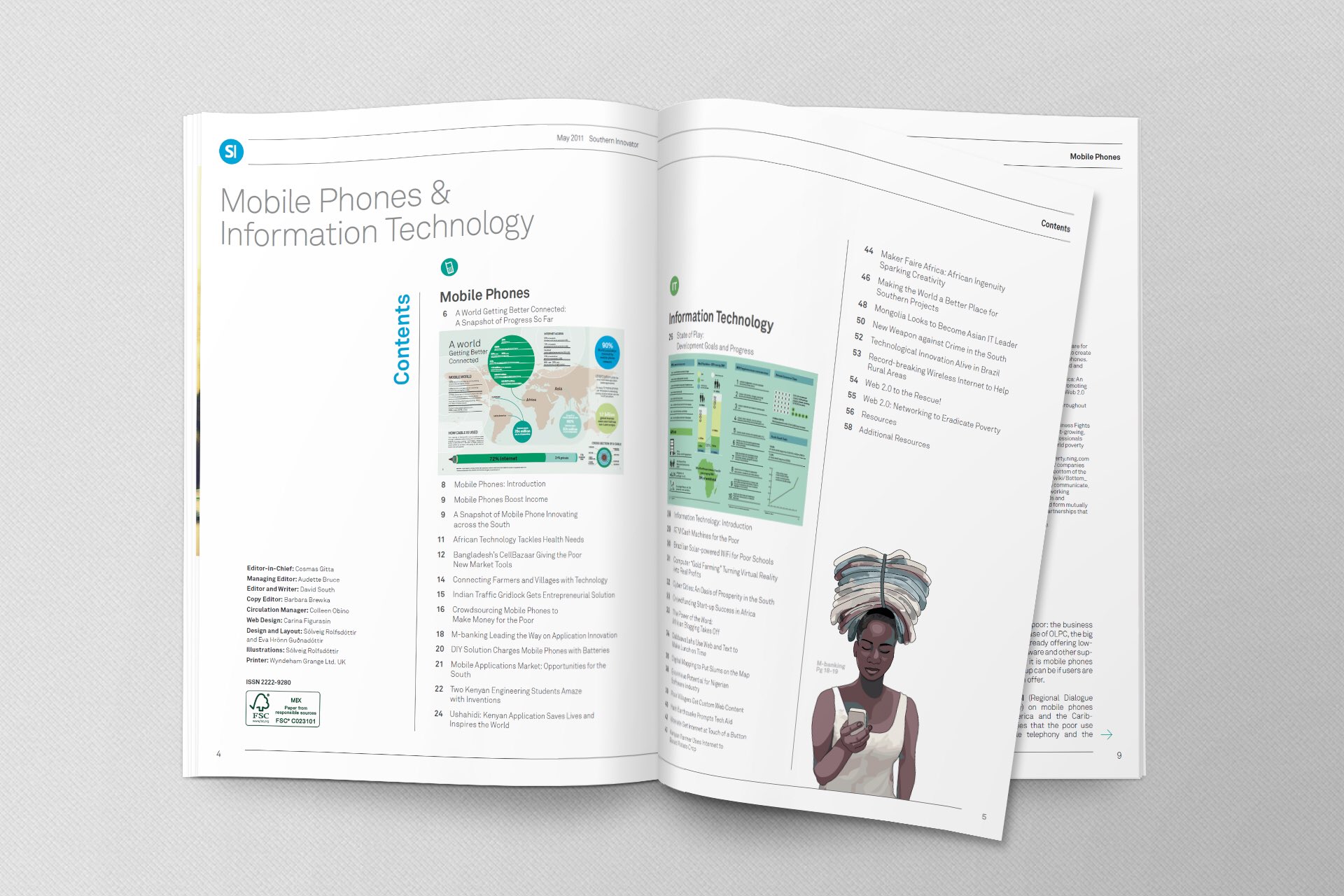
    Development Challenges, South-South Solutions was launched as an e-newsletter in 2006 by UNDP’s South-South Cooperation Unit (now the United Nations Office for South-South Cooperation) based in New York, USA. It led on profiling the rise of the global South as an economic powerhouse and was one of the first regular publications to champion the global South’s innovators, entrepreneurs, and pioneers. It tracked the key trends that are now so profoundly reshaping how development is seen and done. This includes the rapid take-up of mobile phones and information technology in the global South (as profiled in the first issue of magazine Southern Innovator), the move to becoming a majority urban world, a growing global innovator culture, and the plethora of solutions being developed in the global South to tackle its problems and improve living conditions and boost human development. The success of the e-newsletter led to the launch of the magazine Southern Innovator. 

    https://davidsouthconsulting.org/2021/03/05/southern-innovator-issue-3/

    Creative Commons License

    This work is licensed under a
    Creative Commons Attribution-Noncommercial-No Derivative Works 3.0 License.

    ORCID iD: https://orcid.org/0000-0001-5311-1052.

    © David South Consulting 2023

  • New Journal Celebrates Vibrancy of Modern Africa

    New Journal Celebrates Vibrancy of Modern Africa

    By David SouthDevelopment Challenges, South-South Solutions

    SOUTH-SOUTH CASE STUDY

    Africa has seen huge changes to its communications and media in the past five years. The rise and rise of mobile phones, the expansion of the Internet and the explosion in African blogging and social media, on top of flourishing print and broadcast media, all bring an increasing range of options for telling African stories and increasing dialogue.

    With all this new media creating new communications channels – and all the turmoil and change affecting millions as economies and countries change – people need the ability to make sense of it all. One magazine is trying to play that role.

    An entrepreneur and multimedia innovator has created a unique publication that is capturing the spirit, ideas and stories of modern Africa. It is a high-quality product, has gathered together talented writers and photographers and is gaining a growing global audience. Chimurenga Magazine (http://www.chimurenga.co.za/) based in Cape Town, South Africa, calls itself a “pan African publication of writing, art and politics.” Named for the Zimbabwean Shona word for “revolutionary struggle,” it is published three times a year. Editor Ntone Edjabe is from Cameroon and came to Cape Town in the 1990s after the end of South Africa’s racist Apartheid regime.

    With more than 100 contributors, the magazine offers insight into contemporary Africa, what occupies people’s thoughts and how their lives are actually lived.

    It is involved in a wide range of other activities, including co-curating a Global South Dialogue Series. And its readership is truly diverse.

    “We have readers who are long-term prisoners at Pretoria Central Prison, who have subscriptions that they get to us in coins, and readers who are successful businessmen,” Edjabe said to The Financial Times Magazine.

    Chimurenga is out to challenge perceptions of Africa. Practicing the art of long-form journalism more associated with established high-end publications like The New Yorker (newyorker.com), the magazine sets out to challenge perceptions about Africa.

    “Discourse on Africa is geared towards simplicity,” Edjabe told CNN. “Everything must be simple – ‘he’s a poor black man, he’s a victim’ – like there has to be a simple story, in a way this is what signifies Africa and global consciousness.

    “The moment you bring a degree of complexity to it, it kind of throws people off, they just don’t know where to look anymore. It’s like, ‘what’s going on?’ So Chimurenga in a way does not try to maintain the superficiality of this narrative – we engage with life, we try to present life as complex as it really is.”

    Stories in the journal include Billy Kahora writing on the decay of a neighbourhood in Nairobi, Kenya, Michael Abrahams writing about his time in the Cape Town mental hospital after a suicide attempt, and Sean O’Toole following a Zimbabwean immigrant on his journey into South Africa.

    The magazine’s website carries back issues of the journal, along with a shop selling magazines, books and t-shirts and the “Chimurenga Library,” an archive of pan-African, independent periodicals. There’s also live online streaming of music – “from ancient techno to future roots” – through the Pan African Space Station radio station, there is a biennial publication of urban life it calls “Africa-style,” and the writings of 14 African writers who visited 14 African cities to check-up on life in urban areas.

    As an example of the creativity of Chimurenga’s talent, a special issue of the magazine tried to better understand the impact of violence in South Africa in May 2008 that led to the deaths of 62 people. It did this by creating a fictitious newspaper called The Chimurenga Chronic (http://www.chimurenga.co.za/chimurenga-magazine/current-issue) set during the violence.

    The writers are a mix of Anglophones and Francophones, all based in Africa. Common subjects focus on the world of lower-middle class Africa. Examples of past issues show the variety of its content: Conversations With Poets Who Refuse To Speak, Futbol, Politricks & Ostentatious Cripples, Conversations in Luanda and Other Graphic Stories, *We’re all Nigerian!

    Well-travelled editor Edjabe has studied and lived in Lagos, Nigeria and Johannesburg, South Africa. He has worked as a disc jockey, music writer and basketball coach. He launched Chimurenga in 2002. He told The Financial Times Magazine “I printed 1,000 copies, which I carried around in my bag. I sold it mainly to friends.”

    It was supposed to be a one-off publication but became a journal, initially written mostly by his friends.

    “I found out later that this is how most journals actually begin,” he said. “At the time I thought it was unique.”

    He aspired to get Africans writing about the Africa they saw and lived in. The challenge was changing the dynamic he found of writers only considering something worth writing about if it had been featured in non-African media.

    Edjabe had already made his mark with an innovative initiative to show the diversity of what Africa has to offer. Three years after arriving in South Africa he started the Pan African Market (PAM) in Cape Town. An African cultural centre, it began as a craft market with various traders able to run their individual businesses and leasing stall space from the market. PAM became very successful because it brought together Africans from across the continent and offered a vibrant mix of artists, small businesses and food. It now has 33 stores and stalls from 14 countries of Africa. Shoppers can find arts and crafts, hair dressing, tailoring, holistic healing and catering.

    Hard copies of Chimurenga are distributed around Africa and sent to Europe, the United States and India.

    “There’s a feeling about writing something, sharing something that is beautiful and truthful from one’s perspective,” Edjabe told CNN.

    Published: June 2012

    Resources

    1) How to Start a Magazine: Simple online advice on starting and running a magazine. Website: http://www.ehow.com/how_16579_start-magazine.html

    2) Venture Capital for Africa: VC4Africa is the largest online community of investors, angels and entrepreneurs working to build businesses on the continent. Website: http://vc4africa.biz/landing/?redir_to=%2F

    https://davidsouthconsulting.org/2022/10/21/african-media-changing-to-reach-growing-middle-class/

    https://davidsouthconsulting.org/2021/01/05/development-challenges-south-south-solutions-newsletter/

    https://davidsouthconsulting.org/2021/07/14/freedom-of-expression-introducing-investigative-journalism-to-local-media-in-mongolia-1999-25-january-2016/

    https://davidsouthconsulting.org/2021/05/25/ger-mongolias-first-web-magazine-and-a-pioneering-web-project-for-the-united-nations-12-january-2016/

    https://davidsouthconsulting.org/2022/11/01/indian-newspapers-thrive-with-economy/

    https://davidsouthconsulting.org/2022/10/04/popular-chinese-social-media-chase-new-markets/

    https://davidsouthconsulting.org/2022/11/01/southern-innovator-magazine-2010-2014/

    Development Challenges, South-South Solutions was launched as an e-newsletter in 2006 by UNDP’s South-South Cooperation Unit (now the United Nations Office for South-South Cooperation) based in New York, USA. It led on profiling the rise of the global South as an economic powerhouse and was one of the first regular publications to champion the global South’s innovators, entrepreneurs, and pioneers. It tracked the key trends that are now so profoundly reshaping how development is seen and done. This includes the rapid take-up of mobile phones and information technology in the global South (as profiled in the first issue of magazine Southern Innovator), the move to becoming a majority urban world, a growing global innovator culture, and the plethora of solutions being developed in the global South to tackle its problems and improve living conditions and boost human development. The success of the e-newsletter led to the launch of the magazine Southern Innovator. 

    https://davidsouthconsulting.org/2021/03/05/southern-innovator-issue-1/

    Creative Commons License

    This work is licensed under a
    Creative Commons Attribution-Noncommercial-No Derivative Works 3.0 License.

    ORCID iD: https://orcid.org/0000-0001-5311-1052.

    © David South Consulting 2022

  • New Kenyan Services to Innovate Mobile Health and Farming

    New Kenyan Services to Innovate Mobile Health and Farming

    By David SouthDevelopment Challenges, South-South Solutions

    SOUTH-SOUTH CASE STUDY

    Kenya is home to a vibrant innovation culture centred around mobile phones. While not all the services launched will be successful, the flurry of start-ups shows the country has the right combination of technical skills, bright ideas and cash to make a go of new services.

    With the number of mobile phone users leaping 28 per cent in 2011, to reach 25 million subscribers out of a population of 39 million (Reuters), the country has a large market for mobile phone-based services. Kenya also has 10 million people with access to the Internet, up from 4 million in 2009.

    Two issues critical to the well-being of Kenyans – health services and farming – are being tackled by new mobile phone services. One is a service being run and marketed by a major player in the market, and the other, by a small start-up.

    Statistics indicate that in Kenya, one doctor attends to over 10,000 patients. The World Health Organization recommends a ratio of 1:600. There are just over 7,500 licensed medical facilities in the country.

    Safaricom, Kenya’s largest telecoms operator, is trying to take the pressure off overstretched medical and health systems with a new mobile health service. Its 24-hour health advice and referral service is called ‘Daktari 1525’ and lets people call and speak with a doctor or an expert to get advice on any health issue. The number 1525 refers to the dialling code which links users directly to the Safaricom call centre. Daktari 1525 is available to the 18 million Safaricom subscribers.

    Safaricom has partnered with ‘Call-a-Doc’ to launch the tool. The new service hopes to relieve outpatient departments in government hospitals and health facilities with its advice and referrals. The Daktari 1525 service does not prescribe a treatment to the callers, avoiding the legal risks of remote diagnosis.

    It also offers home remedies and health tips on healthy lifestyles. In an emergency, users can also dial Daktari 1525 if there is Safaricom network coverage.

    The partnership is divided between Safaricom and Call-a-Doc. Safaricom handles all the mobile phone network infrastructure, the call centre facility and the marketing of the service. Call-a-Doc takes care of recruiting doctors.

    But how does the service use the doctors’ time well? The shifts are designed to surge the number of doctors to 15 during peak times, falling to as few as four doctors during off-peak times. The doctors work on a part-time basis and there are currently 50 employed by the service.

    Not everyone is convinced the service will work.

    “It is a good attempt to venture into the field; however we would like to caution the practitioners involved that they must remain ethical and must at all times uphold professional confidentiality,” Medical Practitioners and Dentist Board Chief Executive Officer Daniel Yumbya told Capital News.

    Another new service based in the capital, Nairobi, is trying to shake up the world of farming. Its new mobile phone service, “MFarm: connecting farmers” (http://mfarm.co.ke/) calls itself “a transparency tool for Kenyan farmers”.

    It bills itself as a “factory of ideas” looking to find “creative agribusiness solutions.” The service is a paid-for web platform that helps farmers keep track of prices in the capital, Nairobi, and claims to have signed up 3,000 farmers in the first year of operations.

    The service offers crop prices by sending a text to the numbers 3535 if the user gives the crop location required. As an example, the user texts “price crop location” “price maize Nairobi”. Users can also sell their crops, or buy farm supplies.

    It also allows farmers to group sell their crops by getting together with other small-scale farmers. This is a crucial service because it allows the smaller farmer to sell into the wholesale markets where prices are better. Farmers can also group buy, benefiting from lower prices by buying bulk from suppliers. It cleverly offers several ‘plans’ to suit budgets. There is an ‘Eco Plan’ at the low end, a mid-range ‘Pro Plan’, and a bells-and-whistles option, ‘Biz Plan’.

    The service also benefits from its connections with iHub Nairobi (http://ihub.co.ke/pages/home.php), the buzzing “open space for technologists, investors, tech companies and hackers in Nairobi.” It provides a strong support network to turn to when problems arise.

    It seems as if it would be a mistake to enter the African market with any new tech solution without first checking out the scene in Nairobi.

    Published: January 2012

    Resources

    1) iHub Nairobi: Nairobi’s Innovation Hub for the technology community is an open space for the technologists, investors, tech companies and hackers in the area. The space has a focus on young entrepreneurs, web and mobile phone programmers, designers and researchers. Website: http://ihub.co.ke/pages/home.php

    2) EPROM: Entrepreneurial Programming and Research on Mobiles aims to foster mobile phone-related research and entrepreneurship. Website: http://www.media.mit.edu/ventures/EPROM

    Development Challenges, South-South Solutions was launched as an e-newsletter in 2006 by UNDP’s South-South Cooperation Unit (now the United Nations Office for South-South Cooperation) based in New York, USA. It led on profiling the rise of the global South as an economic powerhouse and was one of the first regular publications to champion the global South’s innovators, entrepreneurs, and pioneers. It tracked the key trends that are now so profoundly reshaping how development is seen and done. This includes the rapid take-up of mobile phones and information technology in the global South (as profiled in the first issue of magazine Southern Innovator), the move to becoming a majority urban world, a growing global innovator culture, and the plethora of solutions being developed in the global South to tackle its problems and improve living conditions and boost human development. The success of the e-newsletter led to the launch of the magazine Southern Innovator. 

    Creative Commons License

    This work is licensed under a
    Creative Commons Attribution-Noncommercial-No Derivative Works 3.0 License.

    ORCID iD: https://orcid.org/0000-0001-5311-1052.

    © David South Consulting 2023
  • Africa to Get Own Internet Domain

    Africa to Get Own Internet Domain

    By David SouthDevelopment Challenges, South-South Solutions

    SOUTH-SOUTH CASE STUDY

    Africa is in the midst of an Internet revolution that is set only to accelerate. The continent is one of the last places to experience the information technology revolution that has swept the world in the past two decades.

    Africa has been at a disadvantage for several reasons, the most basic of which has been the lack of bandwidth capacity available from the undersea cables that connect other continents to the Internet. A map showing the world’s undersea cable links says it all: the majority of traffic goes between Europe and the United States (http://www.telegeography.com/telecom-resources/telegeography-infographics/submarine-cable-map/).

    But this is changing: a glance at recent developments with the launching of the Seacom, EASSy, MainOne and other cables shows a continent getting better connected by the year (http://manypossibilities.net/african-undersea-cables/).

    With seven out of the 10 fastest-growing economies in the world between 2011 and 2015 projected to be in sub-Saharan Africa, the conditions are ripe to grow African Internet businesses. For example, Ghana, with its booming information technology sector, boasted 13 percent economic growth last year, among the fastest in the world.

    In eight of the past 10 years, sub-Saharan Africa has grown faster than Asia (The Globe and Mail).

    While Africa has come late to the Internet party, the continent can benefit from two decades of experience elsewhere to avoid making the mistakes others have. Africa can upload tried and tested Internet platforms and can also create new, Africa-specific platforms that tackle the continent’s own needs and challenges.

    One of the ways to make the most of the opportunities presented by the Internet is to have an Africa-specific Internet domain name. A domain name (http://en.wikipedia.org/wiki/Domain_name) is the suffix placed after the period in Internet URL (uniform resource locator) (http://en.wikipedia.org/wiki/Uniform_resource_locator) addresses. Common ones familiar to most people who use the Internet include .com (for commercial websites), .org (for non-profit websites and organizations), .co.uk (for British businesses) or .ca (for Canadian organizations).

    The dot Africa (.africa) domain name will be available in the next 15 months according to the Internet Corporation for Assigned Names and Numbers (ICANN) (http://www.icann.org/). It is currently reviewing 500 African organizations that have expressed interest in managing the domain name registrations, and will choose one at the beginning of 2013.

    Countries such as Kenya and South Africa – two places in Africa with booming information technology sectors – are hoping to make the most of the new dot Africa domain name.

    The idea is to use the dot Africa domain name to build a stronger brand for the continent’s Internet that will be bigger than the individual country domain names. Sophia Bekele, executive director of DotConnectAfrica, told CNN the suffixes for individual African countries had proven unpopular during the decade since their introduction.

    Her organization found that 80 per cent of African domain name registrants had opted for “.com” or “.org” suffixes, which were price competitive, reliable to register and had wide recognition.

    The country-level domain names suffered from being “usually owned by governments, and governments are typically not very good at marketing,” she told CNN.

    Bekele’s research found young developers involved in creating local content felt a stronger affinity with the “.africa” suffix than to the “.com” domains. And the new suffix will let companies unify their presence across the continent under a single online brand.

    A major benefit of the “.africa” domain will be that proceeds from African domain registrations remain on the continent, rather than flowing offshore. DotConnectAfrica says it plans to reinvest surpluses into developing the African Internet sector.

    The African Union Commission (http://www.au.int/en/commission) is also looking to register the .afrique (French language websites) and .afriqia (Arabic language websites).

    The AUC’s head of information society, Moctar Yedaly, told CNN the commission’s vision for the .africa domain is not just commercial.

    “It may well be a very good business in terms of money generating. If it may generate some revenue we can use for the development of ICT in Africa, then that is all very good, but that’s not my primary goal,” he told CNN. “My primary goal is to ensure the identity of Africa, the image, the culture are well-maintained.”

    Published: October 2012

    Resources

    1) The Wikipedia page on the .africa initiative. Website: http://en.wikipedia.org/wiki/.africa

    2) ICANN: To reach another person on the Internet you have to type an address into your computer — a name or a number. That address must be unique so computers know where to find each other. ICANN coordinates these unique identifiers across the world.  Website: http://www.icann.org/

    3) DotConnectAfrica, a non-profit organization registered in Mauritius, is one of the is trying win the right to manage the dot africa name space for businesses and individuals across the continent. Website: http://www.dotconnectafrica.org/

    4) Dot.Africa: Dot.Africa is specialised in realising internet access for international organisations with sites in Africa. Website: http://www.dotafrica.com/about/index.html 

    https://davidsouthconsulting.org/2022/11/21/africa/

    https://davidsouthconsulting.org/2022/11/11/african-breakthroughs-to-make-life-better/

    https://davidsouthconsulting.org/2022/11/19/african-culture-as-big-business/

    https://davidsouthconsulting.org/2022/10/26/arab-world-domain-name-opportunity-huge-economic-help/

    https://davidsouthconsulting.org/2022/10/04/the-brck-kenyan-developed-solution-to-boost-internet-access/

    https://davidsouthconsulting.org/2022/11/23/kenyan-farmer-uses-internet-to-boost-potato-farm/

    https://davidsouthconsulting.org/2022/10/17/mapping-to-protect-kenyas-environment-the-emazingira-solution/

    https://davidsouthconsulting.org/2020/11/30/nollywood-booming-nigerian-film-industry/

    https://davidsouthconsulting.org/2021/03/09/the-power-of-the-word-african-blogging-and-books/

    https://davidsouthconsulting.org/2022/03/30/riverwood-kenyan-super-fast-super-cheap-filmmaking/

    https://davidsouthconsulting.org/2022/10/10/wireless-internet-culture-helping-zimbabwe-economy-recover/

    Development Challenges, South-South Solutions was launched as an e-newsletter in 2006 by UNDP’s South-South Cooperation Unit (now the United Nations Office for South-South Cooperation) based in New York, USA. It led on profiling the rise of the global South as an economic powerhouse and was one of the first regular publications to champion the global South’s innovators, entrepreneurs, and pioneers. It tracked the key trends that are now so profoundly reshaping how development is seen and done. This includes the rapid take-up of mobile phones and information technology in the global South (as profiled in the first issue of magazine Southern Innovator), the move to becoming a majority urban world, a growing global innovator culture, and the plethora of solutions being developed in the global South to tackle its problems and improve living conditions and boost human development. The success of the e-newsletter led to the launch of the magazine Southern Innovator. 

    Creative Commons License

    This work is licensed under a
    Creative Commons Attribution-Noncommercial-No Derivative Works 3.0 License.

    ORCID iD: https://orcid.org/0000-0001-5311-1052.

    © David South Consulting 2023