Tag: 2011

  • Solar Sisters Doing it for Themselves: Tackling African Light Famine

    Solar Sisters Doing it for Themselves: Tackling African Light Famine

    By David SouthDevelopment Challenges, South-South Solutions

    SOUTH-SOUTH CASE STUDY

    A social enterprise is seeking to capture the power of the sun to bring light and economic opportunity to women in Africa. Using a direct-marketing distribution system, it sells solar lamps and lanterns to some of Africa’s remotest communities. Solar Sister (www.solarsister.org), launched in Uganda in 2010, is hoping to do for power generation what mobile phones have done for communication in Africa: make a technological leap to a model of grassroots power generation, rather than waiting for large-scale power schemes to eventually reach the poor and rural.

    More than 1.7 billion people around the world have no domestic electricity supply, of which more than 500 million live in sub-Saharan Africa (World Bank).

    Solar power is being creatively used in many countries to tackle energy poverty and give women, in particular, viable sources of income. In India, whole villages are already using solar energy and improving their standard of living. Various companies and projects are selling inexpensive solar appliances – from cooking stoves to lanterns and power generators – across the country.

    A billion Africans use just four percent of the world’s electricity (The Economist). Energy poverty is already harming further economic growth and development gains. With Africa’s population expected to double to 2 billion by 2050, the gap between people’s needs and the power available is stark: in Nigeria, out of 79 power stations, only 17 are working (The Economist).

    A report by the International Finance Corporation called the sub-Saharan solar market the largest in the world – a market of 65 million would-be customers, who could access off-grid lighting over the next five years (IFC). The report anticipated high growth rates of 40 to 50 percent for anyone entering the market, with less than one percent of the market currently being served.

    Being able to see at night unleashes a vast range of possibilities, such as being able to work or study later. But for the very poor, lighting is often the most expensive household expense.

    As Solar Sister founder Katherine Lucey points out, households “rely on kerosene lanterns and candles for light. They spend up to 40 percent of their family income on energy that is inefficient, insufficient and hazardous. Widespread use of kerosene has an adverse impact on local air quality as well as on global climate change.

    “Poor lighting, smoke and rudimentary lanterns are responsible for a large number of infections and burn injuries. Within the household, women are responsible for kerosene purchases and use – in order for new clean energy technology to be adopted at the household level, women have to ‘buy in’ to the technology.”

    And this is the challenge: to find an affordable – and sustainable – way to bring electricity and energy to people living in remote and rural areas. These are places that face stark options: to remain off-grid and energy poor, or to abandon their communities and join the many millions across the global South on the march to urban and semi-urban areas in search of income and opportunity.

    Lucey says that could be “a recipe for disaster”.

    “In a country like Uganda, with a population of 32 million people, it is not possible to have them all move to Kampala to access electricity,” she said. “It would overburden already stretched infrastructure and services and disrupt the social and economic structures of an entire population. In the end, it can challenge the stability of entire nations.”

    The Solar Sister direct-marketing model works like this: micro-investment capital of US $500 is invested in one Solar Sister Entrepreneur and she receives a ‘business in a bag’: a start-up kit of inventory, training and marketing resources. As her own boss, she has a strong incentive to succeed. She uses the money to purchase a consignment of lamps or lanterns, which she then sells, encouraging people to replace kerosene lamps with solar lamps: healthier, safer and better for the environment. She is encouraged to use her existing networks of family, friends and neighbours to reach rural and hard-to-reach customers.

    The Solar Sister, after succeeding in selling the first consignment of lamps, then receives training in marketing and inventory and business skills. She can then move on to be a team leader and recruit other Solar Sisters. She earns a commission from the lamp sales, which help to improve her ability to pay for healthcare, education and food for her family. She then repays the cash for the lamps and the cycle starts all over again with a new consignment.

    The model will sound familiar to many: it is what has built successful marketing machines like the famous all-women’s make-up and beauty products seller Avon (www.avon.com). Or the other famous direct marketing behemoth, Amway (www.amway.co.uk).

    The Solar Sister model is heavily dependent on the success of word-of-mouth to grow:

    “What we have found is that the women are the best distribution system for bringing new technology to rural households since they sell through their trusted networks of family, friends and neighbours,” Lucey said. “They use the lamps themselves, and then talk passionately about the benefits: the better light, the money they save by not having to buy kerosene, the amount of time their children are able to study, the cleaner air and safer environment for their kids.”

    According to Lucey, the business model “brings solar technology right to the women’s doorstep. The Solar Sister business model developed as a grass-roots solution to the gender-based technology gap. Women make up 70 percent of the rural poor, but are often left out ‘in the dark’ when it comes to technology solutions.”

    It is still early days for Solar Sister, which has been in operation for just over a year and now has 107 Solar Sister Entrepreneurs working in 10 teams reaching 34 communities in three countries – Uganda, Rwanda and Sudan. Lucey says the goal is to build a network of 1,500 female entrepreneurs in Africa over the next two years, benefiting over 1 million people.

    Apart from the business model and the new technology, there is a radical concept at the heart of Solar Sister: to replicate for electricity generation the distributed and rapid growth that has been seen with mobile phones. In just five years, the availability of mobile phones in Africa increased by 550 percent.

    “Distributed energy, such as solar, puts the investment in energy generation rather than transmission, and breaks the problem into smaller, achievable, components that do not have to wait for political processes for implementation,” explains Lucey. “It allows for the possibility that people can solve their own problems rather than wait for government or NGOs to come solve their energy problems for them. Distributed solar has the potential to leap-frog the 20th century grid-based solution, much like mobile phones have done in the telecom industry.”

    One of the solar lanterns for sale is manufactured by D.Light Design. Their newest lantern model is called Kiran (http://www.dlightdesign.com/products_kiran_global.php). It sells for US $10 and provides up to eight hours of light on a full battery, its manufacturers say. D.Light Design calls it the “$10 Kerosene Killer” because it believes it has the right mix of price and technology to trump the need to use kerosene lanterns. The lantern gives off a white light powerful enough so people can read, study or do domestic tasks. A solar panel sits on top of the lantern, which is shaped like a drinking thermos with a large carry handle on top.

    Other solar lamps/lanterns have been burdened by cost, ranging in price from US $15 to US $30: a prohibitive price for many poor people.

    The ubiquity of mobile phone payments in Africa has made it much easier to transfer funds back and forth between the entrepreneurs and Solar Sister. And since its launch, Solar Sister has learned how to change and adapt to local conditions.

    “These women are the experts in their local communities of what works and what doesn’t,” Lucey said. “Solar Sister Voila (http://www.solarsister.org/voila-uganda) decided to visit the roadside market stalls at night when shopkeepers were burning kerosene lamps for light. She got their instant attention with the high brightness of her solar powered lamps.

    “Solar Sister’s mission is to bring more and more women from the veils of smoke, darkness and anonymity to the forefront of a clean energy revolution.”

    Published: April 2011

    Resources

    1) D.light Design: Their lights use LEDs (light emitting diodes) (http://en.wikipedia.org/wiki/LED_lamp) and are four times brighter than a kerosene lantern according to D.Light Design. Website: www.dlightdesign.com

    2) Lighting Africa: Lighting Africa, a joint IFC and World Bank program, is helping develop commercial off-grid lighting markets in Sub-Saharan Africa as part of the World Bank Group’s wider efforts to improve access to energy. Lighting Africa is mobilizing the private sector to build sustainable markets to provide safe, affordable, and modern off-grid lighting to 2.5 million people in Africa by 2012 and to 250 million people by 2030. Website: www.lightingafrica.org

    3) Solar Lighting for the Base of the Pyramid – Overview of an Emerging Market, a report by the International Finance Corporation finding Africa will be the world’s largest market for solar portable lights by 2015. The report addresses market trends and statistics at a global level with more detailed analysis for the African market. Website: www.lightingafrica.org/market-intelligence/market-trends-assessment.html

    4) How We Made It Africa: A website detailing success stories on businesses investing in Africa and how people are making the most of opportunities on the continent. Website: www.howwemadeitinafrica.com

    5) Barefoot College: The College is training women to be solar engineers, developing both useful skills and a new income source. So far, Barefoot College itself has solar electrified some 350 villages across India and dozens more in sub-Saharan Africa and even war-torn Afghanistan. Website: www.barefootcollege.org

    6) Solar Power Answers is a one-stop-shop for everything to do with solar power. It has a design manual and guides to the complex world of solar power equipment. Website: www.solar-power-answers.co.uk/index.php

    7) Sun King solar lantern: The lantern provides 16 hours of light for a day’s charge. Website: www.greenlightplanet.com/ourusers.html

    8) ToughStuff has developed a modular range of affordable solar powered energy solutions to the three main power needs of poor consumers in the developing world – lighting, mobile phones and radios. Website: www.toughstuffonline.com

    Development Challenges, South-South Solutions was launched as an e-newsletter in 2006 by UNDP’s South-South Cooperation Unit (now the United Nations Office for South-South Cooperation) based in New York, USA. It led on profiling the rise of the global South as an economic powerhouse and was one of the first regular publications to champion the global South’s innovators, entrepreneurs, and pioneers. It tracked the key trends that are now so profoundly reshaping how development is seen and done. This includes the rapid take-up of mobile phones and information technology in the global South (as profiled in the first issue of magazine Southern Innovator), the move to becoming a majority urban world, a growing global innovator culture, and the plethora of solutions being developed in the global South to tackle its problems and improve living conditions and boost human development. The success of the e-newsletter led to the launch of the magazine Southern Innovator.  
    Creative Commons License

    This work is licensed under a
    Creative Commons Attribution-Noncommercial-No Derivative Works 3.0 License.

    ORCID iD: https://orcid.org/0000-0001-5311-1052.

    © David South Consulting 2023

  • China’s Booming Wine Market Can Boost South

    China’s Booming Wine Market Can Boost South

    By David SouthDevelopment Challenges, South-South Solutions

    SOUTH-SOUTH CASE STUDY

    A great South-South opportunity has emerged with the recent boom in wine drinking in China and the pursuit of quality tastes. Matching high-quality wine producers from the global South – including South Africa, Chile, Morocco, and Lebanon – with China’s thirsty wine drinkers could deliver a major income boost.

    In the past year China has become the world’s fastest-growing wine market with newly wealthy seeking sophisticated tastes and young working women seeking the health benefits of wine (http://www.healthtree.com/articles/red-wine/). Yearly wine consumption in China is expected to increase by 20 percent to 126.4 million cases by 2014, a fact that is grabbing the attention of old and new-world wine producers.

    Women are driving China’s growing market for wine, which is perceived as a symbol of affluence, a benefit to health – in moderation – and good for the skin. A new report from the International Wine and Spirit Research (IWSR) group says wine consumption in China and Hong Kong jumped 100 per cent between 2005 and 2009, from 46.9 million to 95.9 million cases.

    Import taxes have been reduced as China entered the World Trade Organization (WTO), and this has prompted foreign wine brands to lunge into the market.

    The government is trying to get people to switch away from high-strength alcoholic drinks by increasing the tax on them.

    Awareness and experience varies widely amongst the winemakers of the global South. Some countries, such as South Africa, Chile and Argentina, have long-standing international reputations for producing quality wine, and use sophisticated branding and marketing campaigns to connect with their customers. But other countries, including Lebanon, Tunisia and Zimbabwe, have lower profiles and do not pack the same brand punch. But all these countries help show the role viticulture can play in economic development. By tapping into this Chinese wine drinking boom, they could reap rich rewards.

    In Lebanon, viticulture – the harvesting of grapes for wine (http://en.wikipedia.org/wiki/Viticulture) – has prospered despite the country’s wars and instability.

    Lebanon has a long and illustrious history of winemaking stretching back 5,000 years. The modern Lebanese wine industry dates itself from 1857, when Jesuit monks at Ksara in the Bekaa Valley began importing vines from Algeria. After World War I, when the French took control of Lebanon, its vineyards expanded to satisfy France’s thirsty imperial troops.

    Then Lebanon was hit by the brutal civil war of the 70s and 80s. And things have remained unstable and uncertain since.

    But despite this, well established businesses like Ksara (http://www.ksara.com.lb/), Kefraya (http://www.chateaukefraya.com/) and Musar (http://www.chateaumusar.com.lb/english/cave.aspx), and small boutique producers, thrive.

    Massaya (http://www.massaya.com/old/wine.htm) is one of Lebanon’s most dynamic and successful wineries, owned by brothers Sami and Ramzi Ghosn. Both are Christians like many of the Lebanese winemakers. They have been able to succeed in an area fraught with tension from past conflicts.

    Another winery is using the business to revive a community and restore old skills. In the hills east of Beirut, the BBC found Naji Boutros – who used to be an investment banker in London – and his wife Jill. Boutros started Chateau Belle-Vue in Bhamdoun (http://www.chateaubelle-vue.com/), in the village where he grew up. As well as producing wine, the Chateau finances community projects and a library.

    The two kings in the global South of wine exports are South Africa and Chile. Both countries have very strong brand awareness in export markets and both have triumphed after years of boycotts due to the political situations in the respective countries (Chile’s military dictatorship and South Africa’s Apartheid regime).

    Wine-making is one of South Africa’s oldest industries and plays a key part in the economy (http://www.wine.co.za/), with exports growing from less than 50 million litres in 1994 to more than 400 million litres in 2008 – year-on-year growth of 17 percent.

    Since the end of the racist Apartheid regime (http://en.wikipedia.org/wiki/South_Africa_under_apartheid) in the mid-1990s, various government and industry initiatives have begun to reverse the iniquities of the country’s wine-making industry. South Africa has been pioneering switching black Africans on to the pleasures and profits of wine making and drinking.

    Like Argentina, Chile (http://www.winesofchile.org/) has a strategic plan for its wine industry by 2020. It hopes to be “the Number One producer of sustainable and diverse premium wines from the New World by the year 2020.”

    Chile – recovering from the severe earthquake on February 27, 2010 – uses a sophisticated marketing strategy to promote its wines, including websites, social networking media and events and tastings. Since 2007, it has unified its marketing efforts under one umbrella organization, the Vinos de Chile, and it also offers wine tourism to further develop a close relationship with drinkers, The Wines of Chile Experience (http://www.chilewinetourism.com/), launched in 2010.

    Chile’s neighbour Argentina (http://www.winesofargentina.org/) is the world’s fifth largest producer of wine,

    The country has seen its domestic consumption of wine shrink as tastes changed, and has also experienced very extreme economic fluctuations. It has had to raise its game in order to earn income from exporting. This has been a spur to the wine industry and it has seen growth since 1996.

    Wine growing has a long history in Argentina, going back to its Spanish colonial foundations in the 1500s. Argentineans drank large quantities of wine domestically in the 1970s but this tailed off in the later decades.

    That had been balanced by a great export success with wines from the malbec grape. The flavour of this wine and its brand image has proven to be a weighty ambassador for Argentinean wines in general. By keeping a competitive price, Argentinean wine has flourished during the global economic crisis as people have moved to less expensive brands. The country cleverly has a wine marketing strategy based on Australia’s experience. This is an ambitious plan with the goal of capturing 10 percent of the global wine market share by 2020.

    Argentina also aggressively pursues new markets by visiting them regularly and doing wine promotions and tastings with potential customers. It also brings people to the country to visit the wineries and experience Argentinean culture and food.

    In North Africa, Algeria, Tunisia and Morocco have a long history cultivating wine and have been winning awards since the 1859 Fall Exposition in Paris. Over the years quality control was an issue as political and economic factors disrupted access to global markets. But in the last few years governments have been working to support the industry and regain its past reputation.

    Winemaking in North Africa goes back to the Romans and the Phoenicians. Despite Islam prohibiting the consumption of alcohol, the industry has survived. The industry is currently being re-organized to make the most of a free trade agreement with the European Union.

    Tunisia has a long, rich winemaking heritage known the world over. About half of Tunisia’s vineyards are dedicated to producing grapes for wine production rather than for sale as table grapes.

    Over the last 20 years, Les Vignerons de Carthage, a cooperative of 10 cellars located in the Cap Bon region of Northern Tunisia, have been working under the leadership of Belgacem D’Khili, a Bordeaux trained oenologist to improve and maintain wine quality.

    They have kept the old vines, persevered with hand-harvesting and traditional techniques, but have modernised the cellar equipment, the storage and overall approach to hygiene.

    North African wines are being collectively marketed by resellers like Cotes d’Afrique (http://www.cotes-d-afrique.co.uk/tunisianwine/history.aspx).

    Morocco, too, has become a respected wine maker and has a robust domestic wine-drinking market. Morocco’s oldest winery, Celliers de Meknes (http://www.lescelliersdemeknes.net/), told the Global Post how it handles the delicacies of wine-making in a majority Muslim country.

    “We are tolerated,” said Jean-Pierre Dehut, the export manager for Celliers de Meknes. “But the tolerance requires that we stay within certain boundaries.”

    Celliers de Meknes sells some 30 million bottles of wine per year — 25 million in Morocco.

    A little-known wine producer, Zimbabwe has been producing wines since the early 1950s and commercially since 1965, according to Zimbabwe Tourism. Production peaked in the 1980s and later suffered from an export ban. Despite the country’s economic and political problems, the wine industry has grown. New techniques, equipment and grape varietals have been introduced and winemakers have been trained in Germany, Australia and South Africa. Regular visits from outside consultants have helped with raising standards.

    Apart from economic problems the industry struggled with viruses and climate. But since the 1990s the industry has started to win international wine competitions

    One of the successful wineries is Mukuyu Winery (http://www.africanbeersandwine.com/pages/wine.html), which produces an average of 1.5 million litres per year from 100 hectares under vines. Over the past 13 years, Mukuyu wines have won Silver and Bronze medals at the International Wine and Spirit Competition in London, and regional wine tasting competitions in South Africa.

    Published: January 2011

    Resources

    1) China Wines Information Website: A website with the latest news and events on China’s fast-growing wine market. Website: http://www.wines-info.com/en/index.aspx

    2) Interwine China 2011: The 6th China (Guangzhou) International Wine and Spirits Exhibition and World Famous Wine Expo, May 25th to 27th, 2011. Website: http://www.interwine.org/interwine/pages/2010/index.interwine

    3) Shenzhen International Wine Hub: Shenzhen International Wine Hub is located in downtown Longgang, and is designed to provide an unprecedented one-stop platform for all wine-related business, integrating product exhibition, wine trading, wine information and statistics publishing, wine knowledge training, quality examination and evaluation, wine culture showcasing as well as food and recreation. Website: http://www.szwinehub.com/en/

    4) Zimbabwe Tourism: Website: http://www.zimbabwetourism.net/index.php?option=com_content&view=article&id=119&Itemid=144

    5) Soweto Wine Festival: Website: http://www.sowetowinefestival.co.za/About.htm

    Development Challenges, South-South Solutions was launched as an e-newsletter in 2006 by UNDP’s South-South Cooperation Unit (now the United Nations Office for South-South Cooperation) based in New York, USA. It led on profiling the rise of the global South as an economic powerhouse and was one of the first regular publications to champion the global South’s innovators, entrepreneurs, and pioneers. It tracked the key trends that are now so profoundly reshaping how development is seen and done. This includes the rapid take-up of mobile phones and information technology in the global South (as profiled in the first issue of magazine Southern Innovator), the move to becoming a majority urban world, a growing global innovator culture, and the plethora of solutions being developed in the global South to tackle its problems and improve living conditions and boost human development. The success of the e-newsletter led to the launch of the magazine Southern Innovator.  

    Creative Commons License

    This work is licensed under a
    Creative Commons Attribution-Noncommercial-No Derivative Works 3.0 License.

    ORCID iD: https://orcid.org/0000-0001-5311-1052.

    © David South Consulting 2023

  • Chilean Eco-Buildings Pioneering Construction Methods

    Chilean Eco-Buildings Pioneering Construction Methods

    By David SouthDevelopment Challenges, South-South Solutions

    SOUTH-SOUTH CASE STUDY

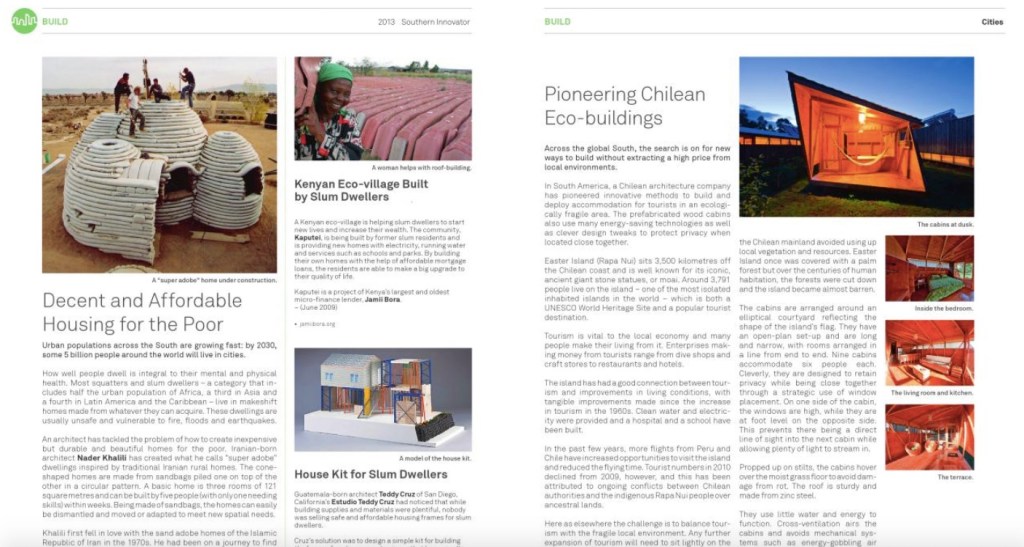
    Across the global South, the search is on for new ways to build without extracting a high price from local environments.

    More and more people are recognizing the advantages of energy-saving methods like prefabrication. Prefab building techniques involve assembling a structure from pre-assembled parts or modules made in a factory, or transporting a completed, factory-made structure to a site (http://en.wikipedia.org/wiki/Prefabricated_building). Pre-fabrication has many advantages, especially now that information technologies bring precision to the building process. Prefabrication means the construction process can be tightly controlled, helping to avoid waste, time delays, weather problems, or any of the other idiosyncrasies of a building site. It can also allow large numbers of dwellings to be built quickly by maximizing skills and efficiencies in an assembly-line model of production.

    In South America, a Chilean architecture company has pioneered innovative methods to build and deploy accommodation for tourists in an ecologically fragile area. The prefabricated wood cabins also use many emerging saving technologies and clever design tweaks to protect privacy when located close together.

    Easter Island (Rapa Nui) (http://en.wikipedia.org/wiki/Easter_Island) sits 3,500 kilometers off the Chilean coast and is well known for its iconic, giant head ancient stone statues, or moai (http://en.wikipedia.org/wiki/Moai). Around 3,791 people live on the island – one of the most isolated inhabited islands in the world – which is both a UNESCO World Heritage Site and a popular tourist destination.

    Tourism is vital to the local economy and many people make their living from it. Enterprises making money from tourists range from dive shops and craft stores to restaurants and hotels.

    The island has had a good connection between tourism and improvements in living conditions, with tangible improvements made since the increase in tourism in the 1960s. Clean water and electricity were provided and a hospital and a school built.

    In the past few years, more flights from Peru and Chile have increased opportunities to visit the island and lowered flight times. The island’s only airport is being expanded to further increase the capacity of flights, a project due to be completed by 2015.

    But tourist numbers in 2010 declined from 2009 and this has been attributed to ongoing conflicts between Chilean authorities and the indigenous Rapa Nui people over ancestral lands.

    Here as elsewhere, the challenge is to balance tourism with the fragile local environment. Any further expansion of tourism will need to sit lightly on the land and respect the rights of the Rapa Nui people.

    The brief for the Morerava eco cabins (http://www.morerava.com/) was to provide environmentally sensitive accommodation that uses few local resources. Built by Santiago-based Chilean architects AATA Associate Architects (http://aata.cl/), the cabins were prefabricated in a factory and shipped to the island during 2010.

    The architects specialize in industrial, commercial, educational and institutional, residential and interior design. They pay attention to environmental conditions and the use of resources.

    The cabins are arranged around an elliptical courtyard reflecting the shape of the island’s flag design. They have an open-plan set-up and are long and skinny, with rooms arranged in a line from end to end. Nine cabins accommodate six people each. Cleverly, they are designed to retain privacy while being close together. Privacy is maintained through a strategic use of window placement. On one side of the cabin, the windows are high, while they are low at foot level on the opposite side. This prevents there being a direct sight line into the next cabin, while allowing plenty of light to stream in.

    Having the cabins built on the Chilean mainland avoided using up local vegetation and resources. Easter Island once was covered with a palm forest. But over the centuries of human habitation, the forests were cut down and the island became almost barren.

    Propped up on stilts, the cabins hover over the moist grass floor to avoid damage from rot. The roof is sturdy and made from zinc steel.

    They use little water and energy to function. Cross-ventilation airs the cabins and avoids mechanical systems like energy-gobbling air conditioners. Electricity on the island is generated from expensive petrol, so any means to avoid using it means a big savings.

    With a mild climate, the cabins do not need insulation.

    Water is captured from rainfall on the roof and is then drained into a storage tank below the cabins (http://en.wikipedia.org/wiki/Rainwater_harvesting), and hot water is provided by solar heaters placed on the rooftops. This system circulates the hot water without electricity by using a technology called thermosiphon (http://en.wikipedia.org/wiki/Thermosiphon) which exploits the natural phenomenon of heated water being less dense and rising while cooler water flows downward through the force of gravity.

    At the other end of the construction spectrum, one of the most notoriously energy-wasting of structures – an office building – has been given a green makeover. Another Chilean pioneer in green architecture is the Santiago headquarters of Empresas Transoceanica (http://www.transoceanica.cl/), a private investment company in real estate, hotels and tourism, agro-industry and logistics. Its new campus HQ – part park, part office building – maximizes light through the building’s long and bulbous shape.

    Designed to reduce energy demand while improving work spaces, it favours natural light while avoiding excess heat build up through wooden slats outside the building.

    Geothermal energy comes from a well 75 metres below ground. This provides water cooled at 12 degrees Celsius, to cool the building. The building has been built following the strict environmental guidelines laid down in the LEED guidelines (Leadership in Energy & Environmental Design (LEED) – an internationally recognized green building certification system (http://en.wikipedia.org/wiki/Leadership_in_Energy_and_Environmental_Design).

    Extensive planning and design work went into making sure the building’s structure, orientation, lighting, insulation and landscaping reduced energy use and need for energy-intensive mechanical solutions. Skylights bring natural light into the building’s public spaces. There are three stories above ground and two stories below providing underground parking.

    The landscaped park around the building is actually the roof for the underground parking garage. The whole edifice creates a seamless connection between the building and the greenery and water features surrounding it.

    Published: February 2011

    Resources

    1) Series of photographs and architectural renderings of the Transoceanica headquarters. Website: http://www.plataformaarquitectura.cl/2010/10/28/edificio-transoceanica-arquitectos-2/

    2) World Hands Project: An NGO specialising in simple building techniques for the poor. Website: www.worldhandsproject.org

    3)  Builders Without Borders: Is an international network of ecological builders who advocate the use of straw, earth and other local, affordable materials in construction. Website: http://builderswithoutborders.org/

    4) An inspiring collection of prefabrication buildings and the techniques used to make them. Website: http://inhabitat.com/architecture/prefab-housing/

    5)  Tiny House Design Blog: The blog is full of ideas and plans for making small homes cheaply. Website: http://www.tinyhousedesign.com/

    6)  Building and Social Housing Foundation: The Building and Social Housing Foundation (BSHF) is an independent research organisation that promotes sustainable development and innovation in housing through collaborative research and knowledge transfer. Website: http://www.bshf.org/

    Development Challenges, South-South Solutions was launched as an e-newsletter in 2006 by UNDP’s South-South Cooperation Unit (now the United Nations Office for South-South Cooperation) based in New York, USA. It led on profiling the rise of the global South as an economic powerhouse and was one of the first regular publications to champion the global South’s innovators, entrepreneurs, and pioneers. It tracked the key trends that are now so profoundly reshaping how development is seen and done. This includes the rapid take-up of mobile phones and information technology in the global South (as profiled in the first issue of magazine Southern Innovator), the move to becoming a majority urban world, a growing global innovator culture, and the plethora of solutions being developed in the global South to tackle its problems and improve living conditions and boost human development. The success of the e-newsletter led to the launch of the magazine Southern Innovator.  

    Creative Commons License

    This work is licensed under a
    Creative Commons Attribution-Noncommercial-No Derivative Works 3.0 License.

    ORCID iD: https://orcid.org/0000-0001-5311-1052.

    © David South Consulting 2023

  • Cheap Indian Tablet Seeks to Bridge Digital Divide

    Cheap Indian Tablet Seeks to Bridge Digital Divide

    By David SouthDevelopment Challenges, South-South Solutions

    SOUTH-SOUTH CASE STUDY

    India has had many false starts in innovating in information technology. While the country and its talented army of software engineers have a global reputation for innovation, the fits and starts that have accompanied attempts to create new hardware and devices have drawn a range of emotions, from amusement to frustration.

    India faces an urgent problem: the country is falling behind others in the global South in access to the Internet. Based on 2009 data, there are 5.1 Internet users for every 100 Indians. This compares poorly with Brazil at 39.2 per 100 and China at 28.5.

    The challenge is to find inexpensive devices that allow people to access the Internet through mobile phone networks. With 37 percent of India’s 1.21 billion people living below the official poverty line – and some estimates placing the number at up to 77 percent – cheap devices are urgently needed to reach the poor. A study developed by the Oxford Poverty and Human Development Initiative (OPHI),  found eight Indian states account for more poor people than the 26 poorest African countries combined. The Indian states had 421 million “poor” people, compared to 410 million poor in the poorest African countries, it concluded.

    The World Bank recently criticised India for lacklustre results in addressing poverty levels.

    Five years ago, the Indian government launched a competitive search for an inexpensive device for the masses. The government has been supporting the development of these devices through its National Mission on Education through Information and Communication Technology (Sakshat) (http://www.sakshat.ac.in). It aims to link 25,000 colleges and 400 universities in India in an e-learning program.

    The motivation behind these attempts is a good one: to try and find an affordable device to bridge the digital divide (http://en.wikipedia.org/wiki/Digital_divide) and reach the majority of the population living on less than US $2 a day.

    But the search has had mixed results.

    Low points included a failed attempt to make a rival to the One Laptop Per Child (http://www.onelaptop.org) computer from MIT (Massachusetts Institute for Technology) with an Indian version selling for US $10. What was offered instead in 2009 was a device with no screen or keyboard, requiring an additional laptop and paper to access its stored files. It was also made in Taiwan, rather than India.

    Another first stab at making a US $35 tablet computer was launched in 2010 with much fanfare, but by January 2011 the Indian government had dropped manufacturers HCL Technologies for failing to honour its 600 million rupee (US $13 million) contract.

    What these first steps show is the complexity of hardware development and how challenging it is to get the user experience right for customers while keeping the price affordable.

    But India recently relaunched what it is calling the world’s cheapest tablet computer, selling for US $35. It is called Aakash (http://www.akashslate.com) (http://www.aakashcomputer.co.in), meaning “sky” in the Sanskrit language, and is being sold as an e-learning tool to bridge the digital divide in the country.

    The utility of tablets (http://en.wikipedia.org/wiki/Tablet_personal_computer) and e-readers (http://en.wikipedia.org/wiki/Comparison_of_e-book_readers) for people in the global South is clear: they can enable people to bypass the lack of local library facilities to store vast personal archives of books. This is a powerful educational tool: imagine a village doctor with easy access to thousands of medical texts and papers, or a child preparing for university exams no longer having to worry they can find study texts. It also is a cost-effective way to publish in many local languages and break the stranglehold English-language publishing has had on delivering e-books.

    Aakash will be sold for US $35 to educational institutions and marketed for private sale for US $61 under the UbiSlate brand name (http://www.ubisurfer.com). It is also hoped the tablet can be sold in the UK and the USA.

    Jointly developed by engineers in India, Canada and the UK, it will be assembled at DataWind’s manufacturing plant in Hyderabad, India (http://datawind.com/products.html). Datawind also makes other low-cost, portable devices like the PocketSurfer3 (http://www.pocketsurfer.co.uk).

    The project is run by two Indian-born Canadians, DataWind chief executive officer Suneet Singh Tuli and his brother Raja Singh Tuli.

    Based in Montreal, Canada, DataWind bills itself as “a leading developer of wireless web access products and services.”

    Suneet Singh Tuli wants to sell 1 million tablets a month. The first 100,000 tablets are being bought by the Indian government and then sold to university students.

    The Aakash uses the Google Android operating system (http://www.android.com) and has a WiFi capability, 17.78 centimetre wide screen, two USB ports (http://en.wikipedia.org/wiki/USB) and battery that can last three hours. It can stream high-definition videos, read e-books and run Microsoft Windows Office applications.

    The components in the device are a mix, including parts DataWind has designed itself to save costs.

    “This is not a one-time opportunity,” Suneet Singh Tuli told the Toronto Star newspaper. “There are 2½ to 3 million students entering university every year, as well as 80 million students in Grades 9 to 12, and the government is very serious about making mobile products available to this age group.

    “I could tell you a romantic story about two Indian brothers who arrive in Montreal to get a great Canadian education, become citizens, and then go back to India to bring Internet to the masses,” says Tuli.

    “But the reality is, this is all about profit – my investors and board wouldn’t want it any other way.”

    To compare, the Amazon Kindle Fire device (http://www.amazon.com/Kindle-Fire-Color/dp/B0051VVOB2), which launched recently, sells for US $199 and has fewer features.

    “The rich have access to the digital world; the poor and ordinary have been excluded. Aakash will end that digital divide,” Kapil Sibal, India’s education minister told the Financial Times.

    India’s initiatives are heating up competition with the One Laptop Per Child project set up by MIT professor Nicholas Negroponte (http://one.laptop.org). The colourful OLPC laptop sells for around US $200, and 2 million have been distributed to Latin America, Africa elsewhere.

    While many companies and entrepreneurs are developing products for the poor and the bottom of the pyramid (BOP) markets, it is still a difficult thing to get right. A big issue is aspiration: consumers are still attracted to products they perceive as aspirational and quality, despite a higher price.

    “(Aakash) might suffer the Nano syndrome,” Shashi Bhusan, technology analyst at brokerage Prabhudas Lilladher, told the Financial Times, referring to the cheap made-in-India car that failed to catch on (http://tatanano.inservices.tatamotors.com/tatamotors). “It is always difficult to predict the market’s reaction to a product, but what we have learnt from the Nano is that people don’t want to buy the ‘car-like’ product, they want the real thing … I feel the same will probably happen with this ‘laptop-like’ product.”

    And others strongly disagree that gadgets can transcend the deep-seated social problems that need radical change.

    “It is charity of a very superficial nature,” said George Mathew, director of Delhi’s Institute of Social Sciences. “It has nothing to do with the structure and permanency of our society and our system – you have to work for systemic change.”

    Earlier this year an Indian company produced a rival to Amazon’s Kindle (http://www.amazon.co.uk/Kindle-Store/b?ie=UTF8&node=341677031). The Wink (http://www.thewinkstore.com/ereader/index) is designed to accommodate 15 common Indian languages, comes in an eye-catching design and is complemented by a sleek website stuffed with e-books ready for download. The entire package is very well-thought-out and marketed.

    The Wink was developed and built by EC Media International and retails, according to its website, for Rs 8,999 (US $200). It looks similar to the Kindle, but where the Kindle is grey the Wink is white. This Indian rival has some impressive capabilities: it can not only support 15 Indian languages, it can also access an online library of more than 200,000 book titles. They range from arts and entertainment to biography, newspapers and science topics. There is also a large archive of free books for download.

    But it has come in for criticism for its price, which some say is far too high for the Indian market.

    As has been shown by the information technology experience in other countries, it is constant innovation and trial and error which will eventually create successes. But with persistence, this is one space to keep watching.

    Published: October 2011

    Resources

    1) How to build your own personal computer: This guide helps to demystify computing hardware and shows how to build a computer at home. Website: http://www.buildeasypc.com/

    2) Hardware design and architecture: An archive of free e-books on all aspects of computer hardware and architecture design. An outstanding resource to get anyone started in computer engineering. Website: http://www.e-booksdirectory.com/listing.php?category=38

    3) Jonathan Ive is the man behind the highly successful and user-friendly modern design that has turned the Apple computer brand into such a global success story. He provides tips on how to design usable computer hardware and shares the secrets of his success. Website: http://www.wired.com/culture/design/news/2003/06/59381

    Development Challenges, South-South Solutions was launched as an e-newsletter in 2006 by UNDP’s South-South Cooperation Unit (now the United Nations Office for South-South Cooperation) based in New York, USA. It led on profiling the rise of the global South as an economic powerhouse and was one of the first regular publications to champion the global South’s innovators, entrepreneurs, and pioneers. It tracked the key trends that are now so profoundly reshaping how development is seen and done. This includes the rapid take-up of mobile phones and information technology in the global South (as profiled in the first issue of magazine Southern Innovator), the move to becoming a majority urban world, a growing global innovator culture, and the plethora of solutions being developed in the global South to tackle its problems and improve living conditions and boost human development. The success of the e-newsletter led to the launch of the magazine Southern Innovator.  

    Creative Commons License

    This work is licensed under a
    Creative Commons Attribution-Noncommercial-No Derivative Works 3.0 License

    ORCID iD: https://orcid.org/0000-0001-5311-1052.

    © David South Consulting 2023