Tag: 2011

  • South Africa Innovates Healthcare with Prepay Phone Vouchers

    South Africa Innovates Healthcare with Prepay Phone Vouchers

    By David SouthDevelopment Challenges, South-South Solutions

    SOUTH-SOUTH CASE STUDY

    Pioneers in Africa are experimenting with new ways to fund the delivery of healthcare that is affordable and sustainable and not dependent on foreign aid and donations. A South African company is prototyping the selling of pre-payment healthcare services through mobile phones with a range of vouchers that can be bought and downloaded at the tap of a keypad. They are priced at between US $12 and US $49 and cover medical and dental check-ups, tests, treatments, chronic care and medicines. They are flexible and can also be sent to friends and family who need help.

    In South Africa, poverty is still widespread. The majority black population has a median income of US $2,000 a year (New Internationalist) and many still live in crowded townships and poor rural communities. Poverty has also increased for many white Afrikaner South Africans (http://en.wikipedia.org/wiki/Afrikaner). A study by the Standard Bank of South Africa found the number of whites earning less than US $80 a month grew from 2000 to 2004 by more than 50 per cent. In the government capital of Pretoria, 50 Afrikaner squatter camps have emerged in recent years. For many, affordable healthcare is a critical issue.

    The story of healthcare in Africa is not a linear one of constant progress. The continent as whole achieved its lowest child mortality rates in the 1970s. But after that, the quality of healthcare declined as a result of various factors including economic crises and the HIV/AIDS crisis – both of which overwhelmed public systems. In sub-Saharan Africa, health systems reached rock bottom in the late 1990s.

    “Few people could afford annual check-ups, medicines or user fees at hospitals,” wrote Dr. Ebrahim Malick Samba in the paper “African health care systems: what went wrong?” for News Medical (www.news-medical.net). “One result was the resurgence of infectious diseases such as malaria, tuberculosis and cholera.

    “Prior to the 1980s, the district hospitals, community health centres and other outreach health posts provided medical services and essential drugs free of charge. With reforms, user fees and cost recovery were introduced, and the sale of drugs was liberalized.

    “Many governments discontinued budget support to the health sector which paralysed the public health system. There was no money for medical equipment and maintenance; salaries and working conditions declined.”

    Things have been steadily improving from this low base through the 2000s, the result of increased aid funding for public health systems and greater national investments in staff, facilities and equipment. There is still a long way to go, but Africa is becoming a world leader in developing and deploying mobile phone applications for health and healthcare.

    Despite dramatic improvements to the quality of hospitals and the number of qualified doctors, the continent’s healthcare services are still a patchwork, with rural and slum dwellers poorly served and the stresses of treating patients with contagious diseases like HIV/AIDS and malaria pushing resources to the limit.

    Research has shown it is better and fairer to develop pre-payment mechanisms for healthcare than to just hit patients with fees when they are ill. With pre-payment, a person can buy care services when they are financially able to and bank up care for when they become ill and not able to work and save.

    This is a crucial issue for people with low incomes who can quickly be devastated by their illness or that of loved one or family member.

    The World Health Organization (WHO) has taken a firm stand against so-called out-of-pocket payments and encourages the growth in pre-payment methods. The World Health Report 2000 found that “Fairness of financial risk protection requires the highest possible degree of separation between contributions and utilization.”

    South Africa’s Yarona Care (www.yaronacare.co.za/prepaid.html) – a health insurance provider network – is rolling out prepaid mobile phone vouchers, allowing patients to see doctors or dentists and even traditional healers for treatment. When a patient visits, the healthcare worker redeems the mobile phone voucher to get paid. One product, Impilo Go, allows people to pay for one visit to a doctor and seven days of medicine for R230 (US $34). For people on a tighter budget, there is Impilo Care for R80 (US$12). A patient can visit a nurse practitioner for a medical check-up and receive tests.

    Impilo One offers medicines alone for R100, while Impilo Plus for R195 (US $29) is aimed at people with chronic conditions. They can get a prescription from the doctor and then go to a pharmacy participating in the scheme to receive medicines.

    Dental work is also covered by the vouchers.

    An online demonstration shows how the mobile phone process works (www.yaronacare.co.za/cellphonedemo.html).

    The service is marketed at a mix of customers, from individuals to corporate clients looking to cover large numbers of people to government and NGOs. They can purchase services by voucher, payroll schemes or mobile phones.

    Prepaid by mobile phone as a concept is already well established across Africa. It is a simple way to make payments and sell services. In the case of Yarona’s offering, the customer or patient uses their mobile phone to dial a code to pay for a service. When at the doctor or dentist’s office, he or she spends the voucher for the service by giving a unique code to the healthcare professional. Once this is done, Yarona Care pays the healthcare provider for the service.

    The voucher approach allows customers to buy health services for family members for a defined period of time. Vouchers can also be sent to family members for emergencies.

    Published: April 2011

    Resources

    1) South Africa’s Afridoctor mobile phone application claims to be Africa’s first personal mobile health clinic. It lets patients use its “SnapDiagnosis” system to submit photos of their ailments and in turn receive advice from a panel of medical professionals, or use the mapping feature to find doctors, clinics and health industry-related services nearby. Website: http://twitter.com/afridoctor

    2) Ghana’s mPedigree uses cell phones to build networks to tackle and identify counterfeit drugs. Website: http://mpedigree.net

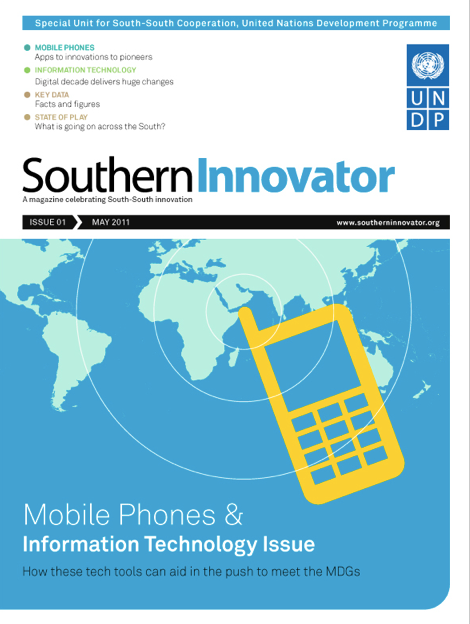
    Development Challenges, South-South Solutions was launched as an e-newsletter in 2006 by UNDP’s South-South Cooperation Unit (now the United Nations Office for South-South Cooperation) based in New York, USA. It led on profiling the rise of the global South as an economic powerhouse and was one of the first regular publications to champion the global South’s innovators, entrepreneurs, and pioneers. It tracked the key trends that are now so profoundly reshaping how development is seen and done. This includes the rapid take-up of mobile phones and information technology in the global South (as profiled in the first issue of magazine Southern Innovator), the move to becoming a majority urban world, a growing global innovator culture, and the plethora of solutions being developed in the global South to tackle its problems and improve living conditions and boost human development. The success of the e-newsletter led to the launch of the magazine Southern Innovator. 

    Creative Commons License

    This work is licensed under a
    Creative Commons Attribution-Noncommercial-No Derivative Works 3.0 License.

    ORCID iD: https://orcid.org/0000-0001-5311-1052.

    © David South Consulting 2023

  • Mapping to Protect Kenya’s Environment: the eMazingira Solution

    Mapping to Protect Kenya’s Environment: the eMazingira Solution

    By David SouthDevelopment Challenges, South-South Solutions

    SOUTH-SOUTH CASE STUDY

    Powerful new grassroots crowd-mapping tools have sprung up in the past few years across the global South, from Brazil’s Wikicrimes (www.wikicrimes.org) real-time crime mapping technology to the now famous Ushahidi (http://ushahidi.com) – a non-profit company making the free and open source Ushahidi software for information collection, visualization and interactive mapping – from its base in Kenya. They share some common features. All draw on the widespread use of mobile phones in the global South combined with growing access to the Internet, either through 3G mobile phone services, WiFi wireless connections, Internet centres or increasingly available broadband Internet services.

    They then connect the mobile phones to the new mapping services available either on the phones or on the Internet. One example is Google Maps (http://maps.google.com).

    These mapping services are revolutionary in what they bring to poor communities. They allow people to quantify in real time what is happening in their area, as well as see what is happening around the world. Where in the past this sort of mapping and statistical data collection was chiefly the domain of government departments and private services for wealthy corporations, individuals can now participate in the collection of data and map what is happening in their area. This can include mapping actual crime as it occurs, or slum-mapping, where a visual snap-shot of a slum area is made to better target aid and development.

    This is a game-changer for human and sustainable development. It has the potential to close the gap between the collection and analysis of data and action. Accurate, real-time data makes it easier to push government agencies to deliver on their promises, especially during a crisis.

    Kenya’s eMazingira website (www.emazingira.org) is showing the difference these tools can make. It allows people to identify potentially destructive practices that harm the environment – unregulated forestry, pollution, dangerous animals, land degradation, climate change – and alert others to what is happening. This level of awareness, it is hoped, will in time reduce the destruction of local environments and improve the quality of life for both humans and wildlife.

    Mazingira means “environment” in Swahili. The website’s motto is “Keeping the environment clean for the future generation”.

    The eMazingira website is a visually simple affair with a leafy banner image and an interactive map showing what is happening. It is in its first iteration and future upgrades are on the way. A rolling list of incidents keeps readers briefed on what is happening, from “Fire burning” to “Sewer burst” to “Rogue elephant”. There are five main categories to choose from and users can file reports by text message, email, sending a Tweet (www.twitter.com) or filling in an online form on the website.

    “We got to know about Ushahidi during its first deployment which was in Kenya, when it was used to map post-election violence incidents in early 2008,” explains Dunston Machoka, director of BTI Millman Limited (www.btimillman.com) inNairobi,Kenya, a custom software development firm leading the project.

    “We were inspired to develop eMazingira, on one hand, because of the passion we had for environmental conservation and on the other hand, from the success stories we had observed of Ushahidi deployments inKenya,HaitiandJapan.”

    Machoka believes this is a critical time forKenya’s environment: “eMazingira comes at a time when environmental conservation is a huge concern inKenya. Our key observation was that there was no effective reporting mode for environmental incidents for citizens.”

    The website hopes to better engage citizens in tackling the country’s environmental problems and sees this as a way to spur further government action.

    One of eMazingira’s proudest moments came when it won the World Summit Youth Award as the 2011 Runner Up for the use of ICT towards attaining the United Nations Millennium Development Goals.

    But how easy is it to work with this technology? Machoka advises those starting out to turn to the Ushahidi team for support.

    “I would advise them to get in touch with the Ushahidi team through their website and by doing so the deployment will be easy, fast and there will be adequate assistance in case of any challenges,” he said.

    For the next two years, eMazingira will be focusing on rolling out the service to the country, from the main towns to rural areas.

    “At the end of the period we hope to start similar programmes in East Africa based on the lessons learnt inKenya,” confirms Machoka.

    And that isn’t where the eMazingira story will stop: its creators also want to deploy the technology globally, if countries have the right conditions.

    “The key necessity for the application would be good mobile and Internet infrastructure and government that can promote citizen participation in environmental conservation,” Machoka said.

    Published: December 2011

    Resources

    1) With less than five years until the 2015 deadline to meet the Millennium Development Goals, any tool that can make development decisions more precise is a benefit. Website:http://www.undp.org/mdg

    2) The Map Kibera project uses an open-source software programme, OpenStreetMap, to allow users to edit and add information as it is gathered. This information is then free to use by anybody wanting to grasp what is actually happening in Kibera: residents, NGOs, private companies and government officials. Website:http://www.openstreetmap.org

    3) NGO called Rede Jovem is deploying youths armed with GPS (global positioning system)-equipped (http://en.wikipedia.org/wiki/Global_Positioning_System) mobile phones to map the favelas of Rio de Janerio. Website: http://www.redejovem.org.br

    4) Mobile Active.org: MobileActive.org is a community of people and organizations using mobile phones for social impact. They are committed to increasing the effectiveness of NGOs around the world who recognize that the over 4 billion mobile phones provide unprecedented opportunities for organizing, communications, and service and information delivery. Website: http://www.mobileactive.org

    https://davidsouthconsulting.org/2020/12/04/big-data-can-transform-the-global-souths-growing-cities/

    https://davidsouthconsulting.org/2020/12/11/cyber-cities-an-oasis-of-prosperity-in-the-south/

    https://davidsouthconsulting.org/2020/12/04/data-surge-across-global-south-promises-to-re-shape-the-internet/

    https://davidsouthconsulting.org/2022/02/17/digital-mapping-to-put-slums-on-the-map/

    https://davidsouthconsulting.org/2022/10/25/indian-city-slum-areas-become-newly-desirable-places-to-live/

    https://davidsouthconsulting.org/2021/03/04/indian-id-project-is-foundation-for-future-economic-progress/

    https://davidsouthconsulting.org/2022/10/31/mapping-beirut-brings-city-to-light/

    https://davidsouthconsulting.org/2021/03/31/new-weapon-against-crime-in-the-south/

    Development Challenges, South-South Solutions was launched as an e-newsletter in 2006 by UNDP’s South-South Cooperation Unit (now the United Nations Office for South-South Cooperation) based in New York, USA. It led on profiling the rise of the global South as an economic powerhouse and was one of the first regular publications to champion the global South’s innovators, entrepreneurs, and pioneers. It tracked the key trends that are now so profoundly reshaping how development is seen and done. This includes the rapid take-up of mobile phones and information technology in the global South (as profiled in the first issue of magazine Southern Innovator), the move to becoming a majority urban world, a growing global innovator culture, and the plethora of solutions being developed in the global South to tackle its problems and improve living conditions and boost human development. The success of the e-newsletter led to the launch of the magazine Southern Innovator. 

    https://davidsouthconsulting.org/2021/03/05/southern-innovator-issue-1/

    Creative Commons License

    This work is licensed under a
    Creative Commons Attribution-Noncommercial-No Derivative Works 3.0 License.

    ORCID iD: https://orcid.org/0000-0001-5311-1052.

    © David South Consulting 2022

  • Anti-bribery Website in India Inspires Others

    Anti-bribery Website in India Inspires Others

    By David SouthDevelopment Challenges, South-South Solutions

    SOUTH-SOUTH CASE STUDY

    An Indian website tackling corruption has been so successful it has inspired a wave of followers in China.

    The I Paid a Bribe website – motto: “Uncover the Market Price of Corruption” – was set up by the Janaagraha Centre for Citizenship and Democracy (http://www.janaagraha.org), a non-profit organisation based in Bangalore, India.

    Janaagraha is dedicated to working with government and citizens to “improve the quality of life in Indian cities and towns,” according to its website.

    Janaagraha’s initiatives strive “to make government departments transparent and accountable,” and the ipaidabribe programme (http://www.ipaidabribe.com) fits in with that goal. It seeks to harness the collective voices of the citizens to report and quantify incidents of corruption. The website will help to paint a picture of the level of corruption in cities and help the NGO in its fight to improve government oversight systems and procedures and to improve law enforcement and adherence to regulations.

    The website tackles the “pernicious effect of corruption on destroying city life and disempowering citizens,” according to Raghunandan Thoniparambil, the site’s programme coordinator. “The original idea was that the website could become a simple means of tracking the market price of corruption – a kind of price prediction mechanism.”

    He said the original idea was tongue in cheek and propelled by cynicism – but the site’s creators soon realized that “such an effort was indeed a very powerful one.”

    The website displays reports and analytics on bribe patterns by city and by transaction amounts, frequency and averages.

    The long-term goal is to reduce corruption faced by Indians when they use government services. The website asks users to log both recent and past incidences of bribery. It says: “Please tell us if you resisted a demand for a bribe, or did not have to pay a bribe, because of a new procedure or an honest official who helped you. We do not ask for your name or phone details, so feel free to report on the formats provided.”

    Neither accusers nor accused are identified by name – only the incidents are logged. The website is funded by a grant of US $3 million and the NGO is planning to launch a mobile phone application as well.

    The website doesn’t pursue individuals because it has found this approach is a distraction to getting systemic improvements by government.

    “By not allowing names to be published, we have eliminated any incentive for any individual to make a false or malicious complaint,” said Thoniparambil. “Since nobody will gain anything by reporting a false complaint on our site because we do not act on complaints, we expect that the stories on the site are true.”

    The site has been so popular it has spawned imitators in China and elsewhere. Thoniparambil said Janaagraha has been approached by civil society organisations in 13 countries about collaborating.

    After a story was published in the Beijing News about I Paid a Bribe, a flurry of ‘tips’ and accusations flooded the Internet in China, and people set up similar websites to gather information on bribery and corruption in their country. One web developer called “Peater Q” set up a Chinese version of I Paid a Bribe, calling it wohuilule.com. Another two websites that popped up included “I Bribe…” (http://www.wxhwz.com) and http://www.tmzg.org. Some of the dozens of websites have been taken down, but others have received official support and encouragement.

    “Peater Q” says he is a young Communist Party member and has received government permission for his site. He says the name of his site, wohuilule.com, is a Chinese translation of “I paid a bribe.”

    These are still early days as these websites work out how to balance the need to ferret out corruption and bribery and the need to avoid gossip, rumour and slander. It is clear the damage done to a country when corruption and bribery get out of control is significant.

    The United Nations’ Global Compact on anti-corruption calls it “one of the world’s greatest challenges.”

    A report by the Carnegie Endowment for International Peace on Chinese corruption (http://carnegieendowment.org/2007/10/09/corruption-threatens-china-s-future/g4) found it threatens the country’s future by increasing socioeconomic inequality and social unrest. The report found 10 percent of government spending, contracts, and transactions goes to kickbacks and bribes, or is simply stolen. It also found the indirect costs of corruption to include efficiency losses, waste and damage to the environment, public health, education, credibility and morale.

    “Corruption both undermines social stability (sparking tens of thousands of protests each year), and contributes to China’s environmental degradation, deterioration of social services, and the rising cost of health care, housing, and education,” the report said.

    I Paid a Bribe is being used to build up an intelligent picture of corruption and bribery in India so that real change can be made.

    “Citizens’ reports on the nature, number, pattern, types, locations and frequency of actual corrupt acts and values of bribes will add up to a valuable knowledge bank that will contribute to a reduction in bribe payments,” Thoniparambil said.

    Not only does the website raise awareness about the problem and its dynamics, it maps out the path corruption takes through a public service. This, the website hopes, will enable better “more consistent standards of law enforcement and better vigilance and regulation.”

    “We believe that every citizen who reports a story on our website about paying a bribe is angry enough to begin to resist it,” explains Thoniparambil.

    “Except for using the data that we receive for further analysis, we will not take the complaints and stories forward. We do not intend to invoke the courts.”

    But these websites need to be run with caution and care and they do have their critics.

    “If you wanted to tarnish the reputation of the government or a department within it, or settle a vendetta, you could just get all of your friends to post claims against them,” Raymond Fisman, a professor at Columbia Business School who has studied corruption, told the BBC.

    “There is no way of credibly aggregating the information to assess the magnitude of the problem,” he added.

    Thoniparambil, however, remains positive that corruption and bribery are problems that can be tackled.

    “I believe that corruption has grown this big only because as citizens, we have tolerated it,” he explains. “If we actively oppose it and there are enough of us, the government has to buckle down and tackle the problem effectively.

    “Corruption may be rampant in India, but it is not endemic,” believes Thoniparambil. “Blaming it on our value systems is a poor alibi with no substance in it. I do not believe that Indians are inherently corrupt; our value systems are as good or as bad as anybody else’s. Corruption is not a social trend that arises out of an erosion of value systems; it is born out of systems failure. Corruption flourishes because we have poorly designed governance systems in the country.”

    Thoniparambil sites a number of Indian successes to back up his optimism: competition in telephone service providers has reduced corruption; booking of railway tickets online has taken the power away from corrupt ticket sellers; and government departments have been forced to state how long services will take to complete.

    Thoniparambil believes it is about changing the relationship between citizens and the public services they receive.

    “We would like citizens to begin to realize that public services are our entitlements,” he says. “These are not favours dispensed from above. They ought not to be pessimistic about corruption. Countries have cleaned up very dramatically and the processes by which it has been done have been documented.

    “Reduction of bribery in India will improve access to government services, particularly for the poor, reduce the cost of delivery of such services, speed up business and recourse to legal remedies. It will improve the quality of infrastructure and will be deeply empowering for Indian citizens.”

    “It is only the collective energy of people that can turn the tables on the corrupt.”

    Published: August 2011

    Resources

    1) United Nations Global Compact: A website packed with resources on how to tackle corruption and how to network globally with others to tackle corruption. Website:http://www.unglobalcompact.org/Issues/transparency_anticorruption/

    2) India Against Corruption: India Against Corruption movement is an expression of collective anger of people of India against corruption. This is their campaign website. Website:http://www.indiaagainstcorruption.org/

    Read more about the perils of bribery here: The Strange Saga of “South-South News”

    Development Challenges, South-South Solutions was launched as an e-newsletter in 2006 by UNDP’s South-South Cooperation Unit (now the United Nations Office for South-South Cooperation) based in New York, USA. It led on profiling the rise of the global South as an economic powerhouse and was one of the first regular publications to champion the global South’s innovators, entrepreneurs, and pioneers. It tracked the key trends that are now so profoundly reshaping how development is seen and done. This includes the rapid take-up of mobile phones and information technology in the global South (as profiled in the first issue of magazine Southern Innovator), the move to becoming a majority urban world, a growing global innovator culture, and the plethora of solutions being developed in the global South to tackle its problems and improve living conditions and boost human development. The success of the e-newsletter led to the launch of the magazine Southern Innovator. 

    https://davidsouthconsulting.org/2022/10/18/indians-fighting-inflation-with-technology/

    https://davidsouthconsulting.org/2020/04/23/the-strange-saga-of-south-south-news-may-2018/

    https://davidsouthconsulting.org/2022/02/09/ugandan-project-pioneers-transparent-development/

    https://davidsouthconsulting.org/2022/11/18/web-2-0-networking-to-eradicate-poverty/

    https://davidsouthconsulting.org/2022/06/16/web-2-0-to-the-rescue-using-web-and-text-to-beat-shortages-in-africa/

    Creative Commons License

    This work is licensed under a
    Creative Commons Attribution-Noncommercial-No Derivative Works 3.0 License.

    ORCID iD: https://orcid.org/0000-0001-5311-1052.

    © David South Consulting 2022

  • Bringing the Invention and Innovation Mindset to Young Kenyans

    Bringing the Invention and Innovation Mindset to Young Kenyans

    By David SouthDevelopment Challenges, South-South Solutions

    SOUTH-SOUTH CASE STUDY

    A highly innovative new way to teach the basics of electronics, computing and technological innovation is being pioneered in the slums of Nairobi, Kenya. Driven by the desire to counter perceptions of apathy among young people, NGO Kuweni Serious is running a training course for girls aged over 8 years in some of the poorest parts of the city to turn on a new generation to the power of technology to make change.

    “Technology is pivotal in our work, as Kuweni Serious is a primarily online platform that seeks to create offline action,” according to Kuweni Serious’ Rachel Gichengo. “It’s positive in that you can reach a lot of people with solid messages that are in bite-size pieces that are easy to disseminate and consume. Everyone can pass on the information with a simple click – it’s an easier way to begin socio-political discussion among people who would otherwise not be drawn into these kinds of discussions because they’re not presented in a way that appeals to them. The typical profile of a KS volunteer is someone in their 20s, middle-class, has some experience volunteering, has never been to a slum despite living in Nairobi, but wants more for their country.”

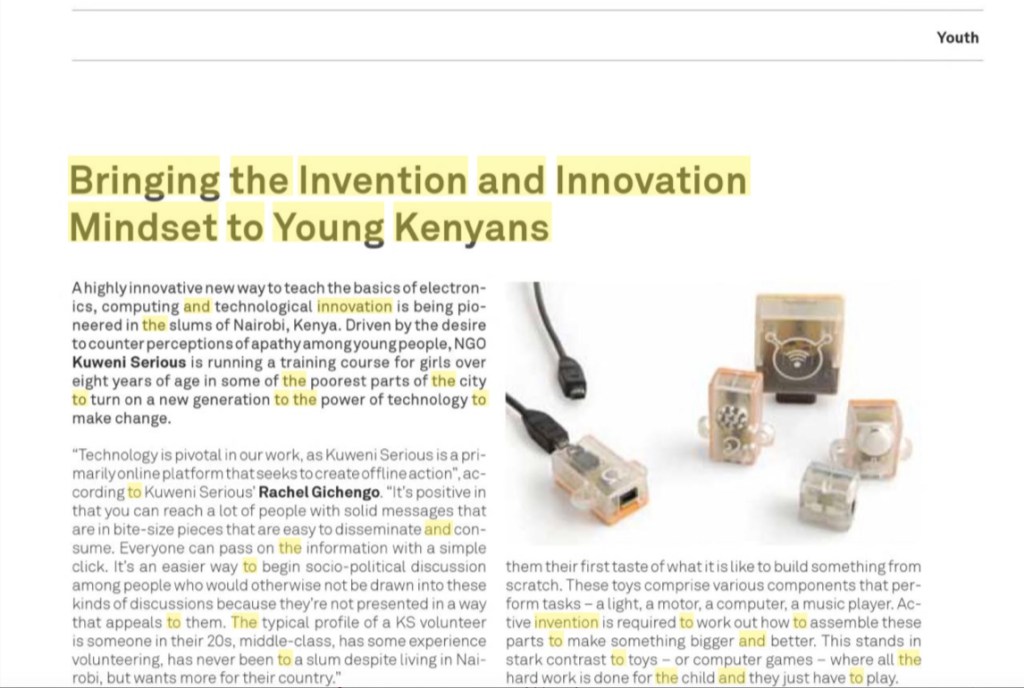
    The course uses a clever, hands-on approach to teaching. Instructors use a new generation of learning toys that help young people understand how technology works and gives them the first taste of what it is like to build something from scratch. These toys comprise various components that perform tasks – a light, a motor, a computer, a music player. Active invention is required to work out how to assemble these parts to make something bigger and better. This stands in stark contrast to toys – or computer games – where all the hard work is done for the child and they just have to play.

    “We chose tech training because it’s a traditionally under-represented area when it comes to reaching this particular group (underprivileged girls), yet such an important set of skills to be taught in this day and age,” confirms Gichengo. “We want to expand these girls’ thinking – to get them interested in the possibilities of careers in science and tech, rather than perpetuate the idea that all they’ll ever do, based on their circumstances, is tailoring or dance. We hoped to open our girls’ worlds a bit, as well as link them to our Kuweni Serious community of volunteers.”

    Called PicoCrickets (www.picocricket.com), and manufactured by the Canadian Playful Invention Company (PICO), the toys were developed from research and ideas at the Lifelong Kindergarten group (http://llk.media.mit.edu/) at the MIT (Massachusetts Institute of Technology) Media Lab (www.media.mit.edu).

    “Pico Crickets are cool,” continues Gichengo. “They’re a fun way to learn to build things, to learn the connection between hardware and software, to begin to understand what computers can do. They make learning easy, and they make science seem accessible to a group that tends to see it as too hard for them. The kits were paid for by a grant from the Girl Effect (www.girleffect.org).”

    The MIT lab conducted intensive research into creative learning environments for children. One of the first fruits of this research was Lego Mindstorms (http://mindstorms.lego.com), kits that allow children to make and program their own robots.

    Inspired by this work, the PicoCricket places more emphasises on artistic expression. The company created the PicoCricket Kit (www.picocricket.com/whatisit.html) as a way to integrate art and technology to “spark creative thinking in girls and boys 8 years and older,” according to its website.

    A typical kit includes a central PicoCricket that a child then plugs in to various motors, sensors, lights and other devices to make something that can spin, light up or play music. It is intended to give free rein to both technological innovation and artistic expression.

    Kenya experienced violent rioting during the 2007 and 2008 elections. The shock of the events produced a number of initiatives to counter the violence and the social and economic disruption it has caused. One of the most well-known innovations, Ushahidi (www.ushahidi.com), a crisis-mapping platform, has been deployed around the world and led to many other new innovations.

    Kuweni Serious (www.kuweniserious.org) is also a result of this crisis. The NGO sets out to counter the stereotype of Kenya’s youth as a “hedonistic generation of brand-obsessed youth, moving from party to party in the night and congregating on Facebook during the day.”

    Kuweni Serious believes young people in Kenya were shocked into action when violence broke out during the elections. Prices jumped for everything – from fuel to food – and water and power started to be rationed. It was a wake-up call to youth: it was getting harder and harder to ignore what was happening in the country.

    Kuweni Serious was founded by Kenyan youth and asked the question “how do Kenya’s youth feel about all the chaos around us?” It seeks to rally young people to their motto: “Fighting the evil forces of apathy.”

    Their 125/100 program set out to train 125 girls on a 100-day course. It ended with a graduation ceremony on July 2, 2011.

    The program, run by volunteers from the University of Nairobi, has taught basic computer skills, got the children working on Google Maps and making – and inventing – using the PicoCrickets.

    The girls on the course came from Baba Dogo and Kibera, Nairobi’s largest slum.

    The technology training program lasted between three and six hours a week for 12 weeks. The inventions made by the children included merry go rounds, a lamp stand and fan and miniature automobiles. Participants even got to grips with Google Maps and learned how to use mobile phones in citizen journalism. At the end of the course, all the children received a certificate reinforcing their sense of accomplishment and achievement.

    “We hope to continue doing similar projects, scaling up 125/100, and working on developing a corps of everyday change makers among young, educated, middle class Kenyans,” according to Gichengo. “We’re also preparing for the 2012 elections, so we need to have more conversations about what a new election means, given the outcome of our previous one.”

    Another initiative seeking to improve life chances for Kenyan girls is ZanaAfrica (www.zanaa.org). It focuses on educational opportunities for girls, consulting them to find out what would increase their chances of graduation from school. Because of this back-and-forth dialogue with the girls, they have come up with various strategic programs, one example being providing girls with sanitary pads for menstruation (http://en.wikipedia.org/wiki/Menstruation) every month so that they do not skip classes and lose vital class time. ZanaAfrica was born around tackling the issue of lost school days for girls because of poor provision of sanitary pads in Kenya: an estimated 868,000 adolescent girls were missing 3.5 million school days a month, according to ZanaAfrica.  Sanitary pads in Kenya cost twice most people’s daily wage. Just to provide pads to all the school girls in Kenya, they estimated, would cost US $13 million a year, increasing by 5 percent every year.

    Another disadvantage for these girls is finding the right support environment and strong, positive role models. ZanaAfrica’s solution is Empowerment Clubs (www.zanaa.org/empowernet-clubs), places where small groups of 15 to 20 students meet with field officers and tackle difficult topics not discussed at home or in school: drugs, relationships, self-confidence, health and disease. There are already 1,000 students in the Kibera area in these Empowerment Clubs. This approach has also been combined with something called EmpowerNet Clubs: these clubs take place in the schools and combine blogging and tweeting (www.twitter.com) with the discussions on life issues. Already in five schools, the clubs include a field officer and 20 girls meeting once a week.

    ZanaAfrica was started in 2007 by social entrepreneur and Harvard University graduate Megan White, who has been living and working in Kenya since 2001. ZanaAfrica identifies poverty-eradicating, African-led innovations and then tries to build them up and find ways to replicate them and make them sustainable. They look for innovations in the areas of health, education and the environment.

    “Kenyans are definitely early adopters, and are rushing to take advantage of new technologies,” confirms Gichengo. “The Kenyan success stories have been a huge inspiration, largely because they developed localized solutions that could then be exported to the world, rather than the other way around, which tends to be the case. There’s always value in looking further afield to see what else is being done around the world, but the iHub and Ushahidi (and the Kenya ICT Board, Safaricom, etc.) have gone a long, long way in inspiring local innovation.”

    Published: July 2011

    Resources

    1) Make Magazine: “MAKE Magazine brings the do-it-yourself mindset to all the technology in your life. MAKE is loaded with exciting projects that help you make the most of your technology at home and away from home. We celebrate your right to tweak, hack, and bend any technology to your own will.” Website: http://makezine.com/

    2) Lego Mindstorms robot-making kits. Website:http://mindstorms.lego.com/en-us/Default.aspx

    3) Southern Innovator Issue 1: New global magazine celebrating innovation across the global South. Website:http://www.scribd.com/doc/57980406/Southern-Innovator-Issue-1

    4) iHub Nairobi: iHub Nairobi’s Innovation Hub for the technology community is an open space for the technologists, investors, tech companies and hackers in the area. This space is a tech community facility with a focus on young entrepreneurs, web and mobile phone programmers, designers and researchers. It is part open community workspace (co-working), part vector for investors and VCs and part incubator. Website:http://ihub.co.ke/pages/home.php

    5) Maker Faire Africa 2011: MFA 2011 continues to cultivate new and existing maker communities across Africa. As was the case in Accra (‘09) and Nairobi (’10), MFA 2011 will present and spotlight the vibrant and endlessly creative individuals that have come to represent the spirit of ‘making’ throughout the continent. These innovators, artists and tinkerers will be exhibiting a fusion of the informal and formal; ideas, inventions, hacks and designs both low-tech & high-tech.  From cuisine to machines, come see their re-imagining of products, exploration of novel materials, and original solutions for some of the continent’s most important challenges and opportunities. Maker Faire Africa 2011 will be a celebratory showcase of unhindered experimentation and curiosity. Website:http://makerfaireafrica.com/2011/06/09/maker-faire-africa-2011-cairo/

    6) Social enterprise (http://en.wikipedia.org/wiki/Social_enterprise): Learn more about the vibrant world of social enterprise and connect with others. Website: http://www.socialenterpriselive.com/

    Development Challenges, South-South Solutions was launched as an e-newsletter in 2006 by UNDP’s South-South Cooperation Unit (now the United Nations Office for South-South Cooperation) based in New York, USA. It led on profiling the rise of the global South as an economic powerhouse and was one of the first regular publications to champion the global South’s innovators, entrepreneurs, and pioneers. It tracked the key trends that are now so profoundly reshaping how development is seen and done. This includes the rapid take-up of mobile phones and information technology in the global South (as profiled in the first issue of magazine Southern Innovator), the move to becoming a majority urban world, a growing global innovator culture, and the plethora of solutions being developed in the global South to tackle its problems and improve living conditions and boost human development. The success of the e-newsletter led to the launch of the magazine Southern Innovator.  

    Creative Commons License

    This work is licensed under a
    Creative Commons Attribution-Noncommercial-No Derivative Works 3.0 License.

    ORCID iD: https://orcid.org/0000-0001-5311-1052.

    © David South Consulting 2023