Tag: 2011

  • Happy Nigeria: West African Nation Has Good Attitude

    Happy Nigeria: West African Nation Has Good Attitude

    By David SouthDevelopment Challenges, South-South Solutions

    SOUTH-SOUTH CASE STUDY

    In the last 10 years, an increasing amount of attention has been paid to the concept of national happiness. The notion was first developed in the tiny Asian Kingdom of Bhutan (http://en.wikipedia.org/wiki/Bhutan), whose advocacy of ‘gross national happiness’ (http://www.grossnationalhappiness.com/) as a measure of national achievement just as important as Gross National Product (GNP), has been met with equal parts ridicule, respect and research.

    Recently it has moved from being the realm of philosophers, therapists and self-help gurus to a growing academic discipline.

    One country to consistently clock high results in polls and studies of national happiness is the West African nation of Nigeria. Africa’s most-populous country – and one of the continent’s economic powerhouses and fast-growers – its positive outlook has left many perplexed because it is a country of extremes of poverty and wealth.

    In the World Values Survey (http://www.worldvaluessurvey.org) Nigeria came top for happiness in 2003, followed by Mexico.

    Nigerians also scored highly for optimism in a Gallup International poll of economic prospects, optimism and personal well-being for 2011, which found the largest number of optimists to be in emerging market countries like China, India and Brazil. The most pessimistic country in the survey of 64,000 people in 53 countries was the United Kingdom.

    Gallup’s global polling identified the qualities of a good, productive life: a highly engaging job, spending six to seven hours a day socialising, and exercising five to six days a week.

    It also found another factor: the more a person rates their country as positive, the better they feel. This was an especially important factor for the poor and people in poor countries.

    In a related factor, researchers of the World Values Survey found that the desire for material goods is “a happiness suppressant.”

    Nigeria takes pride in its status in these surveys: airports proudly boast on signboards about the country being “The Happiest Place in the World!”.

    But how does Nigeria’s optimism square with its well-documented problems, from endemic corruption and sectarian violence to civil unrest and poverty?

    In the Guardian newspaper, Bim Adewunmi tried to nail it down: “Daily life is hardly one glorious Technicolor dance sequence, but I have never lived in such a happy place – and I once lived in hippyville California. I can’t give a definite answer, but I think the joy comes from seeing and living through the worst that life can offer; it is an optimism born of hope.

    “There’s a spirit of entrepreneurship – people seem bewildered if you admit a lack of ambition. Nigerians want to go places and believe – rightly or wrongly – that they can. That drive and ambition fuels their optimism; they’re working towards happiness, so they’re happy.”

    Nigerian writer T. C. Ubochi made an attempt in an essay to get to grips with why Nigerians are the happiest people in the world, writing:

    “I’ve come to learn to basically have hope … The best thing about living in Nigeria is the abiding knowledge and expectation of a Miracle – even if it doesn’t happen in this lifetime.” 

    And despite its woes, Nigeria has many things to be positive about: a fast-growing economy that saw gross domestic product rise by 7.85 percent in 2010; a big influence in Africa and its fate; and a powerful cultural reach, from musicians like Fela Kuti to writers like Chinua Achebe, Chris Abani and Wole Soyinka, to its celebrated art. And of course oil, a blessing of wealth and a curse.

    While arguments abound over what constitutes true happiness, academics are honing in on which lifestyle choices best lead to happiness and which should be avoided. It is a scientific approach akin to the one taken by the medical profession on human health.

    Nigeria consistently ranks top in happiness but just middle for life satisfaction. But surveys are notorious for people’s values skewing results. In Latin America, it is better to be upbeat about life. In Asian cultures, there is no shame attached to being unhappy and collective well-being is more valued.

    Shinobu Kitayama at Kyoto University in Japan and Hazel Rose Markus at Stanford University, California, told the New Scientist that an individual’s level of life satisfaction depends largely on how successfully they adhere to their particular cultural “standard”. Americans tend to value personal achievement, while Japan places greater emphasis on meeting family expectations, social responsibilities, self-discipline, cooperation and friendliness.

    And single-minded pursuit of personal happiness – something that tends to lead to a high score on surveys – also comes from societies with high levels of suicide.

    “There are some real downsides to individualistic cultures,” Ed Diener of the University of Illinois at Urbana-Champaign told the New Scientist. “People with mental illness are in real trouble with no extended family to watch over them.”

    And a good attitude just may be the thing that gives Southern economies that extra edge in the years ahead.

    Published: March 2011

    Resources

    1) Journal of Happiness Studies: The peer-reviewed Journal of Happiness Studies is devoted to scientific understanding of subjective well-being. Website:http://www.springer.com/social+sciences/well-being/journal/10902

    https://davidsouthconsulting.org/2022/11/21/africa/

    https://davidsouthconsulting.org/2022/11/11/african-breakthroughs-to-make-life-better/

    https://davidsouthconsulting.org/2022/11/20/african-bus-to-tackle-african-roads/

    https://davidsouthconsulting.org/2022/10/20/african-countries-re-branding-for-new-economic-role/

    https://davidsouthconsulting.org/2022/11/19/african-culture-as-big-business/

    https://davidsouthconsulting.org/2022/10/20/african-hotel-boom-bringing-in-new-investment-and-creating-jobs/

    https://davidsouthconsulting.org/2022/11/17/african-ingenuity-attracting-interest/

    https://davidsouthconsulting.org/2022/10/21/african-media-changing-to-reach-growing-middle-class/

    https://davidsouthconsulting.org/2022/11/02/african-online-supermarket-set-to-boost-trade/

    https://davidsouthconsulting.org/2022/10/20/african-tourism-leads-the-world-and-brings-new-opportunities/

    https://davidsouthconsulting.org/2022/04/01/new-african-film-proving-power-of-creative-economy/

    https://davidsouthconsulting.org/2020/11/30/nollywood-booming-nigerian-film-industry/

    Development Challenges, South-South Solutions was launched as an e-newsletter in 2006 by UNDP’s South-South Cooperation Unit (now the United Nations Office for South-South Cooperation) based in New York, USA. It led on profiling the rise of the global South as an economic powerhouse and was one of the first regular publications to champion the global South’s innovators, entrepreneurs, and pioneers. It tracked the key trends that are now so profoundly reshaping how development is seen and done. This includes the rapid take-up of mobile phones and information technology in the global South (as profiled in the first issue of magazine Southern Innovator), the move to becoming a majority urban world, a growing global innovator culture, and the plethora of solutions being developed in the global South to tackle its problems and improve living conditions and boost human development. The success of the e-newsletter led to the launch of the magazine Southern Innovator.

    https://davidsouthconsulting.org/2021/03/05/southern-innovator-issue-1/

    https://davidsouthconsulting.org/2021/03/05/southern-innovator-issue-2/

    Creative Commons License

    This work is licensed under a
    Creative Commons Attribution-Noncommercial-No Derivative Works 3.0 License.

    ORCID iD: https://orcid.org/0000-0001-5311-1052.

    © David South Consulting 2023
  • Bolivia Grabs World Media Attention with Salt Hotel

    Bolivia Grabs World Media Attention with Salt Hotel

    By David SouthDevelopment Challenges, South-South Solutions

    SOUTH-SOUTH CASE STUDY

    Tourism is a great way to attract foreign currency to a country and build local economies, especially in remote or isolated places. But the catch is finding a way to get people to go the distance and come and visit and spend their money.

    In a global South twist on the well-known Ice Hotel in Sweden(www.icehotel.com) – a hotel entirely built out of ice – enterprising Bolivians have built a hotel out of salt.

    A Bolivian hotel in the middle of the world’s largest salt flats has found a clever way to attract tourists to this remote holiday destination: build the hotel entirely out of salt, right down to its furniture.

    The South American nation is one of the poorest inLatin America, and its income distribution is among the region’s most unequal. Bringing in foreign currency and attracting more tourists can help to reduce this poverty. According to the World Travel and Tourism Council, travel and tourism will contribute 2 percent to the country’s gross domestic product (GDP) in 2011. Around 75,000 jobs are directly dependent on the tourism business in the country and this is projected to rise to 96,000 jobs by 2021.

    And it is a good business to be involved in: “Travel and tourism is one of the world’s great industries, providing 9 percent of global GDP and 260 million jobs; it drives economic growth, business relationships and social mobility,” according to David Scowsill, President and CEO of the World Travel and Tourism Council.

    The Hotel de Sal Cristal (http://www.hosteldesal.com/?L=2), near Colchani, hosts guests who come to visit the salt flats of Salar de Uyuni (http://en.wikipedia.org/wiki/Salar_de_Uyuni). They are believed to store 50 to 70 percent of the world’s lithium supplies and an economic boom has started in the area. The striking and blinding white salt flats were featured in the James Bond film “Quantum of Solace.”

    The hotel’s unique construction from rock-hard salt hewn from the salt flats is working to encourage tourists to stay longer in the area during their holiday. Before, they would just take a quick excursion on to the salt flats before moving on to their next destination.

    The Hotel de Sal Cristal is built using blocks of salt cut from the surrounding flats. The architectural design is inspired by the ancient Chinese balancing philosophy of Feng Shui (http://en.wikipedia.org/wiki/Feng_shui). Following the principles of the philosophy, it faces the sun and balances both masculine and feminine energies. Shaped like three coca leaves, the feminine side, this balances with the more masculine side reflected in the salt flats, the hotel’s website claims.

    The hotel has 27 rooms with hot water and heating. – and beds made of salt. In the dining room, people can sit on chairs made of salt and eat at salt tables. The rooms are wall-to-wall salt, bright and white.

    The hotel’s pool is surrounded by sand-like salt.

    The hotel’s ‘Resto-Bar’ offers views of the salt flats and promises it will “allow the cosmic energy…” to flow freely.

    The menu offers llama meat and risotto of quinoa (http://en.wikipedia.org/wiki/Quinoa) alongside traditional Bolivian dishes, salads and soups and Bolivian-themed treats.

    The hotel has an ‘astronomic observatory’ for star gazing, making the most of the low level of light pollution on the flats.

    One of the hotel’s tour guides, Pedro Pablo Michel Rocha from Hidalgo Tours (http://www.salardeuyuni.net/), told the Daily Mail newspaper: “I love it when visitors come to this place for the first time.

    “They can’t get over the fact that everything is made out of salt and I’ve even seen a few people lick the furniture to make sure!

    “It is a wonderful experience to come somewhere like this where they’ve used the natural materials available to create something like a hotel.”

    The salt flats, formed from prehistoric lakes, have a salt crust hard-baked by the sun with a pool of salty water underneath which is rich in the rare element lithium. Lithium (http://en.wikipedia.org/wiki/Lithium) is sought-after for its use in things like re-chargeable batteries for mobile phones, computers and electric cars.

    The area’s economy has boomed since 3.4 million tons of lithium – believed to be half the world’s supply – was discovered underneath the salt flats.

    The power of tourism to alleviate poverty has been documented by Caroline Ashley, co-author of Tourism and Poverty Reduction: Pathways to Prosperity (http://www.earthscan.co.uk/?TabId=92842&v=497073), after extensive research on tourism’s impact on poverty in countries across Africa andAsia.

    She argues that “tourism can fight poverty.”

    “Note, we say ‘can’, not that it always does. The share of spending by tourists within a destination that reaches poor people can vary from less than 10 percent to a high of 30 percent,” Ashley told BusinessFightsPoverty (http://www.businessfightspoverty.org).

    “When it works, international tourism is actually a very good way of channelling resources from rich to poor. In destinations as diverse as hiking on Mount Kilimanjaro in Tanzania, business tourism in Vietnam and cultural tourism in Ethiopia, between one quarter and one third of all in-country tourist spending accrues to poor households in and around the destination.”    

    Ashley said a successful tourism strategy needs to focus on “the 4Ps: pay, procurement, persuasion and partnership.”

    “Pay a living wage to local employees; take a hard look at procurement and potential to source locally … persuade – or at least inform – your clients how to take up opportunities to spend in the local economy…” and build a partnership with government to integrate tourism into the local economy.

    And it looks like the hotel can’t get more connected to the local economy than being made of the very salt that surrounds it.

    Published: November 2011

    Resources

    1) The Global Summit: World Travel and Tourism Council: Taking place in Tokyo/Sendai from 16-19 April 2012. Website: http://www.wttc.org

    2) A website packed with resources for planning a trip to Bolivia. Website: http://www.boliviacontact.com/turismo/

    3) The Intercontinental Hotels Group has an interactive website showing the many ways hotels can become sustainable. Website: http://innovation.ihgplc.com/

    4) Hotel designs: A website for interior designers, architects and hoteliers. Website: http://www.hoteldesigns.net/home.php

    https://davidsouthconsulting.org/2022/10/20/african-tourism-leads-the-world-and-brings-new-opportunities/

    https://davidsouthconsulting.org/2022/10/20/africas-tourism-sector-can-learn-from-asian-experience/

    https://davidsouthconsulting.org/2022/02/07/boosting-tourism-in-india-with-surfing-culture/

    https://davidsouthconsulting.org/2022/09/27/caribbean-island-st-kitts-goes-green-for-tourism/

    https://davidsouthconsulting.org/2022/11/20/ecotourism-to-heal-the-scars-of-the-past/

    https://davidsouthconsulting.org/2022/11/21/from-warriors-to-tour-guides/

    https://davidsouthconsulting.org/2022/11/23/kenyan-safari-begins-minutes-from-airport/

    https://davidsouthconsulting.org/2022/10/10/a-solution-to-stop-garbage-destroying-tourism/

    https://davidsouthconsulting.org/2021/03/05/southern-innovator-issue-2/

    https://davidsouthconsulting.org/2021/03/05/southern-innovator-issue-5/

    Development Challenges, South-South Solutions was launched as an e-newsletter in 2006 by UNDP’s South-South Cooperation Unit (now the United Nations Office for South-South Cooperation) based in New York, USA. It led on profiling the rise of the global South as an economic powerhouse and was one of the first regular publications to champion the global South’s innovators, entrepreneurs, and pioneers. It tracked the key trends that are now so profoundly reshaping how development is seen and done. This includes the rapid take-up of mobile phones and information technology in the global South (as profiled in the first issue of magazine Southern Innovator), the move to becoming a majority urban world, a growing global innovator culture, and the plethora of solutions being developed in the global South to tackle its problems and improve living conditions and boost human development. The success of the e-newsletter led to the launch of the magazine Southern Innovator. 

    Creative Commons License

    This work is licensed under a
    Creative Commons Attribution-Noncommercial-No Derivative Works 3.0 License.

    ORCID iD: https://orcid.org/0000-0001-5311-1052.

    © David South Consulting 2023

  • Pulque: Aztec Drink Ferments New Economy

    Pulque: Aztec Drink Ferments New Economy

    By David SouthDevelopment Challenges, South-South Solutions

    SOUTH-SOUTH CASE STUDY

    Reviving traditional foods and drinks can be an income-boosting source of new economic activity. Many cultures can benefit from looking again at their rich traditions to find new ways to increase enterprise. This can be difficult at first. Big global brands have many initial advantages: they are backed by wealthy and experienced international companies and can deploy aggressive marketing and distribution power to get products into the hands of consumers. The power of Coca Cola to reach all corners of the earth is legendary.

    But the case of Mexican drink pulque shows how marrying the power of an ancient taste with a younger demographic can rejuvenate businesses. This is important because many emerging countries across the South have young populations – and yet unemployment is also high among these youthful populations. Engaging the youth market will be critical to the future prosperity and development of these countries.

    Pulque is also playing a part in Mexico’s tourism strategy: the state government in Tlaxcala (http://www.tlaxcala.gob.mx)has created a ‘Pulque Route’ to draw in tourists.

    Having for decades lost ground to slickly marketed alternatives like beer and tequila, pulque drinking is being revived with the help of a new generation of Mexicans re-discovering a beverage that boasts origins reaching back to the Aztecs (http://en.wikipedia.org/wiki/Aztec).

    There is also another benefit to reviving ancient food and drink: alarm has been raised over the diminishing range of food products consumed by people around the world. Throughout the history of farming, around 7,000 species of plants have been domesticated. Yet everyday diets only draw on 30 percent of these plants, and even this number has been going down as more people consume mass-market foods (FAO).

    Once-rich culinary traditions have wilted and left many people unsure what to do with formerly common vegetables and fruits, even if they can actually find them in markets.

    One consequence has been poor nutrition resulting from the reduction in consumption of high-vitamin foods, leading to stunted mental and physical development across the global South.

    Pulque (http://en.wikipedia.org/wiki/Pulque) is made from the juice of maguey or agave (http://en.wikipedia.org/wiki/Agave), a spiky green plant. It has between three and four percent alcohol content. Unlike the well-known Mexican drink tequila, which is fermented and distilled to make a strong, clear alcoholic drink, pulque is a foamy and milky beverage that is fermented, not distilled.

    Made from a sap harvested when the agave is mature, it appears in the Codex Borbonicus written by Aztec priests in the 1530s.

    Advocates for the drink say it is high in Thiamine, Riboflavin, Niacin, Pantothenic Acid and packed with beneficial microbes for human digestion. It also has vitamins C, B-complex, D, E, amino acids and minerals such as iron and phosphorus.

    Pulque had developed a bad reputation, with an image as a peasant drink lacking the class of tequila or beer. The stigma had built up over decades from its reputation as the favourite drink of alcoholic farmers, commonly depicted drinking pulque all day long.

    Once pulque was available only at makeshift pulquerias: a few tables and chairs with farm animals roaming about. Portions were large, using gourds or, by the 1970s, plastic buckets. Some still sell the drink in this rough-and-ready fashion from containers hitched to donkeys.

    Those behind the rebranding of the drink hope to move away from the former drinkers – largely poor, old and rural – to young urban drinkers. Pulque has taken on a “cool, retro” image tapping into a taste for connecting with Mexico’s Aztec roots.

    In Pulqueria Las Duelistas in Mexico City, the young crowd like the new taste. “It is cooler than beer and a lot cheaper than Tequila,” Jaime Torres, a 22-year-old design student and computer tech for an advertising agency told the Washington Post. “It’s old Mexico.”

    By 1886 a census found 817 pulquerias in Mexico City serving the residents of just 9,000 homes. By the 20th century, they had become so common that neighbourhoods would have a handful each. Now estimates place the number in Mexico City at between 60 and 100, with many closing when their owners die.

    Las Duelistas is trying to buck that trend.

    “This place has been in business for 92 years, and I have six as the owner, and I have totally changed the image of the pulqueria, a totally new concept, with different clientele,” said proprietor Arturo Garrido. “Most of my clients are young, and it is my way to continue giving life to the pulque.”

    So, how have the pulquerias made themselves appealing to a new generation of drinkers? Music and new interior design have made the establishments more attractive to youth.

    Pulque sells for 30 pesos, or about US $2.50, a litre. The most popular version is called curado (cured) and is infused with other flavours like strawberry, guava and celery to add greater appeal to a younger demographic.

    “My customers aren’t old anymore. Now they’re young people,” said Nabor Martinez, the owner of another pulqueria, La Risa.

    The drink is difficult to export because it keeps fermenting in the bottle or can. This makes it something special to Mexico, only enjoyed by a visit to the country.

    Some, however, like Everado Gonzalez, director of the 2003 documentary “Pulque Song,” about an old-school establishment, lament the loss of the old atmosphere.

    “A pulqueria is not a cantina. It’s not a bar,” Gonzalez said. “It is a refuge, or was, for the lowest classes of society. Your drink is cheap. You are not sitting at a table, with good manners. You don’t need a table. You sit on a bench, where you can do what you want, say what you want.

    “It was a beautiful island of freedom.”

    Published: September 2011

    Resources

    1) Teh Botol Sosro: It is a drink of cool, black, sweetened tea with a hint of jasmine. Invented by the Indonesian family of Sosrodjojos, Sosro was founded in central Java in the 1940s. Website: http://www.sosro.com

    2) Just Food is a web portal packed with the latest news on the global food industry and packed with events and special briefings to fill entrepreneurs in on the difficult issues and constantly shifting market demands. Website:http://www.just-food.com

    3) Small businesses looking to develop their brand can find plenty of free advice and resources here. Website:http://www.brandingstrategyinsider.com

    4) Brandchannel: The world’s only online exchange about branding, packed with resources, debates and contacts to help businesses intelligently build their brand. Website:http://www.brandchannel.com


    Mezcal or mescal, is a distilled alcoholic beverage made from any type of agave (Wikipedia). In the summer of 2022 Southern Innovator was introduced to the brand Marin&Marin (https://www.marinymarinmezcal.com). Their mezcal is hand made in a traditional Mexican way and is 100% organic and Fair Trade.  

    Development Challenges, South-South Solutions was launched as an e-newsletter in 2006 by UNDP’s South-South Cooperation Unit (now the United Nations Office for South-South Cooperation) based in New York, USA. It led on profiling the rise of the global South as an economic powerhouse and was one of the first regular publications to champion the global South’s innovators, entrepreneurs, and pioneers. It tracked the key trends that are now so profoundly reshaping how development is seen and done. This includes the rapid take-up of mobile phones and information technology in the global South (as profiled in the first issue of magazine Southern Innovator), the move to becoming a majority urban world, a growing global innovator culture, and the plethora of solutions being developed in the global South to tackle its problems and improve living conditions and boost human development. The success of the e-newsletter led to the launch of the magazine Southern Innovator. 

    Creative Commons License

    This work is licensed under a
    Creative Commons Attribution-Noncommercial-No Derivative Works 3.0 License.

    ORCID iD: https://orcid.org/0000-0001-5311-1052.

    © David South Consulting 2023

  • Indonesia Best for Entrepreneurs

    Indonesia Best for Entrepreneurs

    By David SouthDevelopment Challenges, South-South Solutions

    SOUTH-SOUTH CASE STUDY

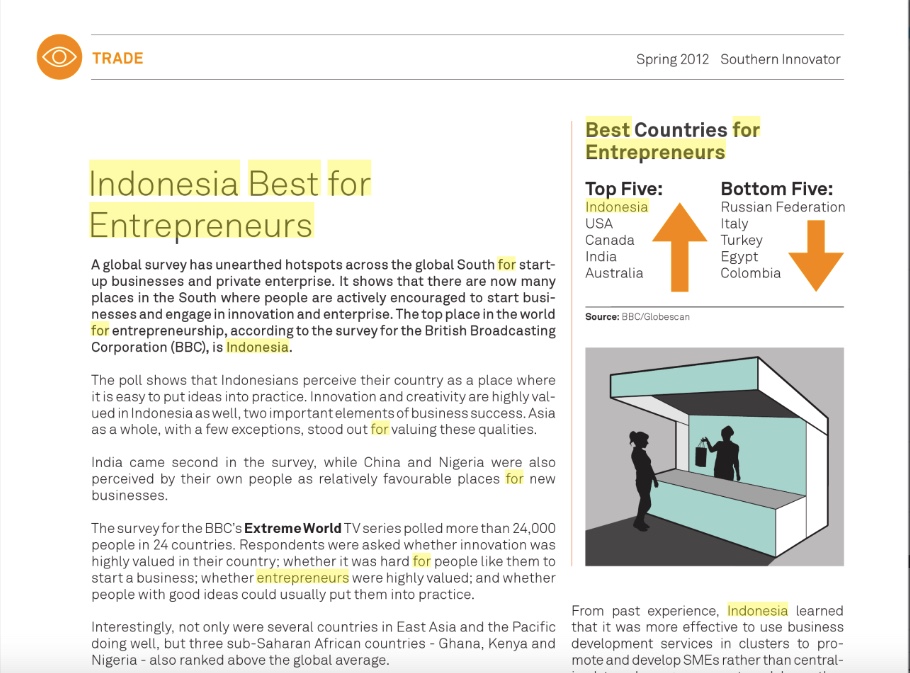
    A global survey has unearthed hotspots across the global South for start-up businesses and private enterprise. It shows there are now many places in the South where people are actively encouraged to start businesses and engage in innovation and enterprise. The top place in the world for entrepreneurship, according to the survey for the British Broadcasting Corporation (BBC), is Indonesia.

    The poll shows that Indonesians perceive their country as a place where it is easy to put ideas into practice. Innovation and creativity are highly valued in Indonesia as well, two important elements of business success. Asia as a whole, with a few exceptions, stood out for valuing these qualities.

    India came second in the survey, while China and Nigeria were also perceived by their own people as relatively favourable places for new businesses.

    The survey for the BBC’s Extreme World TV series polled more than 24,000 people across 24 countries (http://www.globescan.com/news_archives/bbc2011_entrepreneur/backgrounder.html). Respondents were asked whether innovation was highly valued in their country; whether it was hard for people like them to start a business; whether entrepreneurs were highly valued; and whether people with good ideas could usually put them into practice.

    Interestingly, not only were several countries in East Asia and the Pacific doing well, but three sub-Saharan African countries – Nigeria, Kenya and Ghana – ranked above the global average.

    The survey found work still needed to be done in Latin America. While Mexico and Peru scored highly, Brazil and Colombia ranked below average.

    So, what are the things that make Indonesia so positive for entrepreneurs and private business? And what do they do – or not do – for small business start-ups?

    According to Bali International Consulting Group, the Indonesian economy is highly dependent on small and medium-sized enterprises: they make up 99.95 percent of the total number of enterprises, and provide most of the country’s jobs. Authorities have identified a problem with the sector, however: productivity per worker is very low compared to large enterprises. Poor productivity matters because it means people are working very hard for low return and this affects the overall standard of living in the country and its human development.

    The Indonesian government has set about boosting productivity in the sector, adopting a ‘clustering’ approach in partnership with non-governmental organizations (NGOs). Like-minded businesses tend to cluster together across the archipelago of islands that makes up the nation. By targeting these places with resources and support, it can use those resources more efficiently. The country has a dedicated ministry for small and medium enterprises (http://www.depkop.go.id) and a wide range of businesses and services targeting them. From dedicated trading and office facilities (http://www.smescoindonesia.com) to an online marketplace to display, trade and sell SME products (http://www.smescotrade.com), extensive resources are applied to give SMEs a boost and a competitive edge in the global marketplace.

    From past experience, Indonesia learned it was more effective to use business development services in clusters to promote and develop SMEs, rather than centralised, top-down government models or other approaches.

    As Bali International Consulting Group notes, “The government has introduced many models for promoting SMEs, including business incubators, business consulting clinics and technology centers. However, those sponsoring programs have not been productive and could not sustain themselves for a long time. The government then turned to supporting BDS (Business Development Services) providers to serve a certain cluster in a selected area.”

    Developed countries like the United States significantly grew their wealth by allowing entrepreneurs and small and medium-sized enterprises to flourish. The USA’s highly innovative and globe-straddling high tech and information technology businesses would not have been so successful without entrepreneurs. Think of Bill Gates, one of the founders of Microsoft, or Steve Jobs, one of the pioneers behind the Apple computer brand.

    China – the country that has seen the largest lifting of people out of poverty in our time – is awash with entrepreneurs. So successful at providing manufacturing services to foreign companies, China is fast on track to become the wealthiest country in the world. The International Monetary Fund recently issued a report predicting China would be number one within five years.

    Entrepreneurs play a key role in any country’s economic strategy. The more they are encouraged to flourish – and build wealth and their businesses – the better a country can do. Large human development gains can come about when entrepreneurs are matched with a fair and transparent tax system, balancing between social and economic needs.

    China is the source of one of the most successful aids to small business growth in the global South. Hong Kong-based Alibaba (http://www.alibaba.com) is an online trading and selling marketplace aimed at small businesses and start-ups. Packed with support, advice and inspiration, it makes it possible for people anywhere in the world to get trading and selling.

    To help small businesses trade with each other, New Delhi, India-based Go4World Business.com (http://indonesia.go4worldbusiness.com) has for the past 12 years helped exporters and importers to explore new markets and increase their international business in a simple, cost effective manner.

    The Internet has not only radically transformed how to trade and sell, it has also opened up many ways for small and medium-sized businesses to raise funds and borrow money. Examples include Zopa (www.zopa.com) – “Where people meet to lend and borrow money”; social lenders like Kiva (www.kiva.org)w, whose mission is to connect people, through lending, for the sake of alleviating poverty; and Betterplace (www.betterplace.org), an online marketplace for projects to raise funds. It is free to use, and it passes on 100 percent of the money raised on the platform to the projects. For those with a creative business idea, Kickstarter (http://www.kickstarter.com) is a funding platform for artists, designers, filmmakers, musicians, journalists, inventors, and explorers.

    Published: June 2011

    Resources

    1) Small business guide: An online resource packed with advice and resources on starting a small business. Website: http://www.smallbusiness.co.uk/

    2) The red dot logo stands for belonging to the best in design and business. The red dot is an internationally recognized quality label for excellent design that is aimed at all those who would like to improve their business activities with the help of design. Website: http://www.red-dot.de

    3) Dutch Designers in Development: The Dutch NGO works with producers to develop skills and adapt producers’ products to present and future demands in Europe. By following this approach, Southern producers can reduce the risk of making products nobody wants, or that lack originality in the marketplace and thus won’t sell. Website: http://www.ddid.nl/english/index.html

    4) SME toolkits abound: Here are two from Africa: SME Toolkit Kenya Website: http://kenya.smetoolkit.org/kenya/en and SME Toolkit South Africa: Website: http://southafrica.smetoolkit.org/sa/en

    5) African Alliance for Capital Expansion: A management consultancy focused on private sector development and agribusiness in West Africa. Website: http://www.africanace.com/v3

    6) World Business Fair: The World Business Fair is an international trade platform for global entrepreneurs and professionals. Website: http://www.worldbusinessfair.com

    7) Small businesses looking to develop their brand can find plenty of free advice and resources here. Website: www.brandingstrategyinsider.com

    8) Brandchannel: The world’s only online exchange about branding, packed with resources, debates and contacts to help businesses intelligently build their brand. Website: www.brandchannel.com

    9) ZanaAfrica (ZanaA) is a non-profit whose mission is to craft tools from within Africa to slay the giants of poverty. The tools are in the nexus of health, education, and environment with a particular focus on gender and technology. These tools address root causes of poverty, and are primarily market-based solutions with a national and replicable scope to provide leveraged, lasting solutions with significant multiplier effects. Website: http://www.zanaa.org/

    10) Small Business in Indonesia by Peter Van Diermen. Explores how critical families are to business success in Indonesia. Website: http://books.google.com/books/about/Small_business_in_Indonesia.html?id=WSu1AAAAIAAJ

    11) SME Toolkit Indonesia: The SME Toolkit Indonesia offers a wide range of how-to articles, business forms, free business software, online training, self-assessment exercises, quizzes, and resources to help entrepreneurs, business owners, and managers in emerging markets and developing countries start, finance, formalize, and grow their businesses. Website: http://indonesia.smetoolkit.org/indonesia/en

    12) The 3rd Indonesia International Conference on Innovation, Entrepreneurship, and Small Business 2011: From July 25 to 28, is aimed at challenging researchers, Indonesians in particular, to study and create local knowledge on Innovation, Entrepreneurship, and Small Business. Website: http://www.ciel-sbm-itb.com/iicies2011

    Development Challenges, South-South Solutions was launched as an e-newsletter in 2006 by UNDP’s South-South Cooperation Unit (now the United Nations Office for South-South Cooperation) based in New York, USA. It led on profiling the rise of the global South as an economic powerhouse and was one of the first regular publications to champion the global South’s innovators, entrepreneurs, and pioneers. It tracked the key trends that are now so profoundly reshaping how development is seen and done. This includes the rapid take-up of mobile phones and information technology in the global South (as profiled in the first issue of magazine Southern Innovator), the move to becoming a majority urban world, a growing global innovator culture, and the plethora of solutions being developed in the global South to tackle its problems and improve living conditions and boost human development. The success of the e-newsletter led to the launch of the magazine Southern Innovator. 

    Creative Commons License

    This work is licensed under a
    Creative Commons Attribution-Noncommercial-No Derivative Works 3.0 License.

    ORCID iD: https://orcid.org/0000-0001-5311-1052.

    © David South Consulting 2023