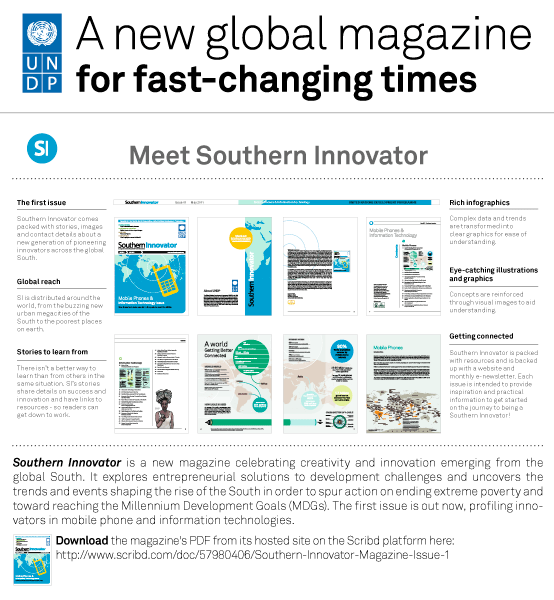
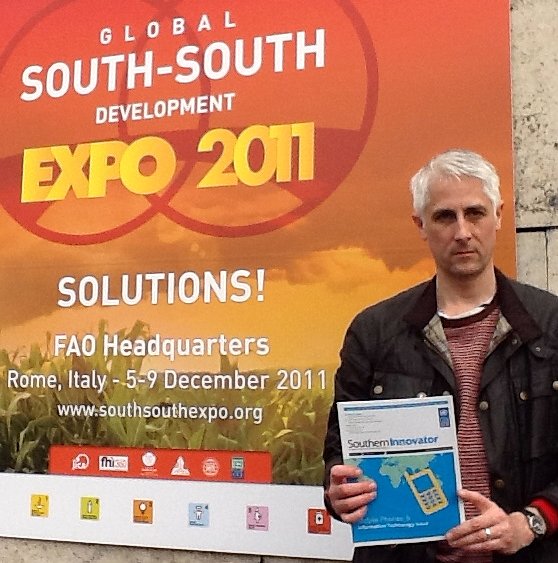
It was 10 years ago this month that Southern Innovator‘s first issue launched in New York during the UN’s General Assembly week (UNGA). It focused on mobile phones and information technology for a reason: these connectivity transformations were re-shaping how people lived their lives, even in the poorest and remotest places on earth.
The content was based on global research, beginning in 2007, funded by the United Nations.
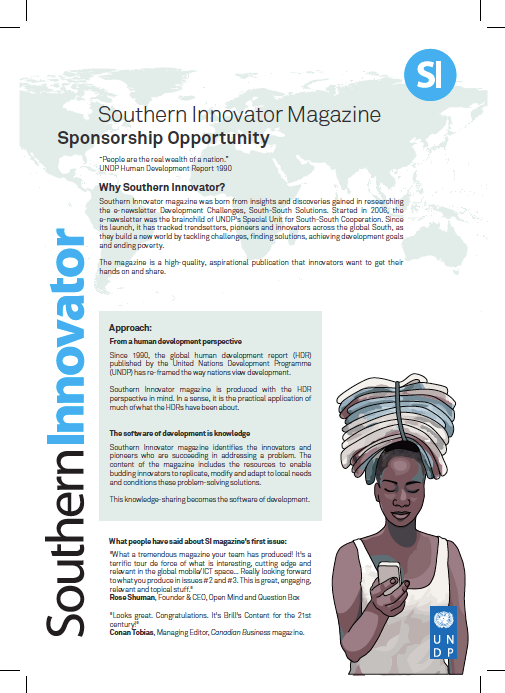
“What a tremendous magazine your team has produced! It’s a terrific tour de force of what is interesting, cutting edge and relevant in the global mobile/ICT space… This is great, engaging, relevant and topical stuff.” Rose Shuman, Founder & CEO, Open Mind and Question Box, Santa Monica, CA, U.S.A.
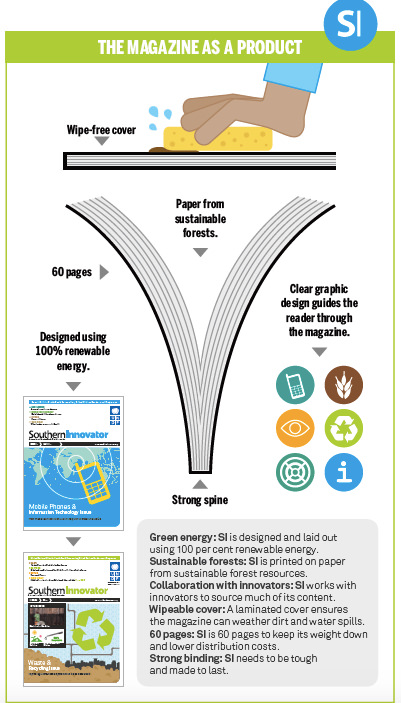
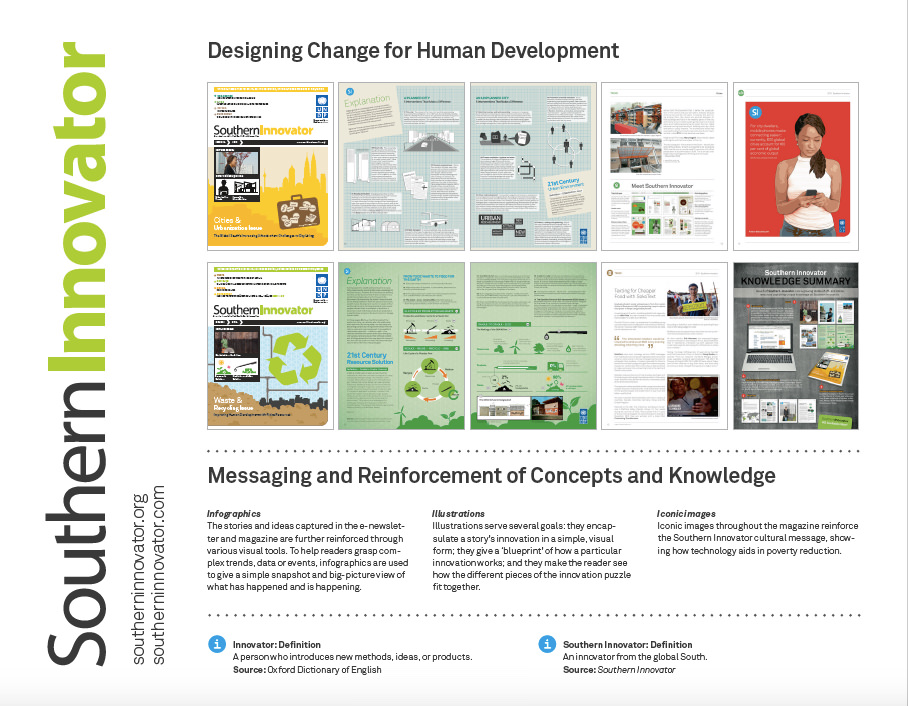
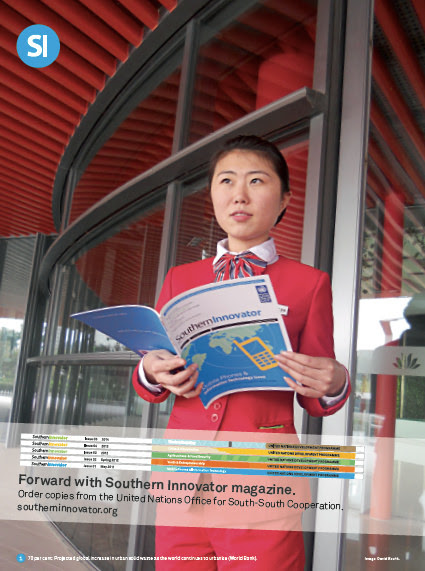
Every issue was launched somewhere new around the world. While Southern Innovator’s digital presence has been key to its success and global reach, the hard copy of the magazine was designed with special features. The magazine needed to be robust and able to stand a fair bit of abuse and hard wear. It needed to be easy to read in low light conditions. And it needed to look sharp and eye-catching to reach as wide an audience as possible.
In 2010, as we prepared to launch Southern Innovator, the branding and website for David South Consulting was re-visioned by Icelandic graphic designer and illustrator Sólveig Rolfsdóttir. David South Consulting has been working with clients around the world since 1991.
Graphic Designer and Illustrator: Sólveig Rolfsdóttir.
In the past decade, there have been many devastating natural disasters, from Iran’s 2003 Bam earthquake and the Asian tsunami of 2004 to Hurricane Katrina in the United States in 2005 and the earthquakes in Chile and Haiti in 2010. All of these events received extensive media attention and drew a large aid response. Those who track natural disasters have noticed a serious increase in frequency over the past decade (http://www.marketoracle.co.uk/Article26290.html).
But rapid aid and media attention do not necessarily lead to long-term recovery. More than a year after the earthquake in Haiti, pace of recovery remains slow. Numerous media stories highlighted the lack of progress.
For the people caught up in these tragedies, quickly returning to a normal life is paramount for psychological and physical health. But this is often the hardest part. Some countries do this well and others do not.
On January 26, 2001, an earthquake laid waste to a large region of the Indian state of Gujarat (http://en.wikipedia.org/wiki/2001_Gujarat_earthquake). Ten years later there is a remarkable recovery that has taken place. So how did they do it?
The 7.9-magnitude quake killed an estimated 20,000 people, injured 150,000, made a million homeless, and destroyed around 8,000 villages. It devastated the Kutch district capital, Bhuj, and other major towns.
In the decade since the earthquake, the state has averaged double-digit growth. Despite having only five percent of the country’s population, Gujarat racks up impressive economic achievements: it has a fifth of India’s exports and a sixth of its industrial production. It has a long-standing entrepreneurial culture based on trade. It can draw on a well-connected global diaspora that ensures a steady inflow of new thinking and investment. Members of this diaspora also contributed to the US $130 million in aid that poured into the region after the quake.
One of the factors contributing to the successful recovery is effective government action.
The disaster has been turned into an opportunity to jolt the region out of the “Middle Ages and into the modern world,” NGO worker Navin Prasad told the BBC.
All the media attention, support and cash at the time forced the Indian government to pay attention to a region it had ignored in the past.
The army came in to help with the emergency and the Indian government allocated US $2 billion to the reconstruction that followed.
Aid was used well and in the first two years many of the damaged villages were rebuilt. And not just rebuilt to what they were, but completely modernized. New houses were constructed to high standards, with more rooms and lots of light. They also came with running water and a toilet. New facilities like medical centres and communal areas were put in place.
The district capital of Bhuj was levelled in the earthquake. But new plans for the city were drafted in the following years. Now Bhuj has two new ring roads, a new airport, parks and shops. Streets were widened and new water and sewage works installed.
But along with the new infrastructure and plenty of cash, came something more important for the region’s long-term recovery: economic growth. The Indian government created tax-free zones drawing in private investment. An astonishing US $10 billion in private investment has come in with US $7 billion more to come, according to the BBC.
One miraculous turnaround is in the former tiny fishing port of Mundra. Prior to the earthquake, it sat in the middle of a salt marsh. It is now India’s largest private port and rivals Mumbai with its Mundra Port and Special Economic Zone (http://www.portofmundra.com/), incorporated in 2003. The Adani Group, a very large Indian private company with global interests (http://www.adanigroup.com/index.html), owns the port now worth US $7 billion, hiring many people once dependent on aid agencies for income.
The head of the Adani Foundation the charitable wing of the Adani Group, Sushma Oza, told the BBC how the company is spending its profits on further developing the area: “Our own budget for social development in this region is $6m a year, so you can imagine how we are trying to change the lives of people to live in a better way,” she said.
In the western portion of the state, in the administrative district of Kutch which is home to Bhuj, around 300 businesses have been established, including the Welspun towel factory (http://www.welspun.com/content.asp?Link=Y&SubmenuID=24). The biggest towel factory in the world, it was built in just nine months and makes 250,000 towels a day. An ambitious firm, it bought the British company Christy (http://www.christy-towels.com/), maker of the official Wimbledon Lawn Tennis Championship towels.
So why towels in Kutch? Welspun chairman Balkrishan Goenka laid down the incentives to the BBC: “There were no local taxes for the first five years and no excise duties. Nor were there indirect taxes to government – they were exempted for five years.”
“Those were the primary benefits,” he said. “More than that there was huge support from the local government so industry can come faster.”
Since the earthquake, 110,000 jobs have been created in Kutch alone. More importantly for the area’s future, it is has gone from neglected backwater to a significant pillar of the Indian economy.
Another driver of recovery was the growth of the dairy industry. The Bhuj dairy plant collapsed in the earthquake and was then rebuilt by the National Dairy Development Board (http://www.nddb.org/). The plant can now process 50,000 litres of milk a day and is run by the Gujarat Cooperative Milk Marketing Federation (http://www.amul.com/organisation.html), India’s largest food products marketing organization. It has 2.9 million producer members and represents 15,322 village societies.
Not everyone has turned their lives around, however. Aid workers estimate thousands are still living in temporary shelters. They defecate in the open and few have clean water. Just getting two meals a day is a problem.
There are complaints about the landless and tenants not receiving the same help.
“Many are tribal, others are low-caste communities, some are Muslims – but they all have one thing in common: poverty,” Bharat Parmer, program coordinator for ActionAid International in Kutch, told Alertnet.
“A large number of these people were tenants and did not own land and so it has been much harder for them to claim their rights as rehabilitation was very much focused on home and land owners.”
But local authorities say rehabilitation schemes have been comprehensive, covering all those who were hit by the quake.
“I don’t think that there are people who did not get what they were due – there may be a rare case here and there but we have rehabilitated all that were in need,” said Gunvant Vaghela, the second-most senior civil servant in Kutch district.
Published: February 2011
Resources
1) How to activate support from the global technology community in a disaster. Website: http://crisiscommons.org/
2) UNICEF: Community-Based Disaster Preparedness Projects (CBDPs) in India have been helping communities restructure to survive when disaster strikes. Website: http://www.unicef.org.uk/campaigns
3) The US Government has extensive resources online on how to prepare for a wide variety of natural and man-made disasters. Website: http://www.fema.gov/areyouready/
4) The magazine Popular Mechanics has excellent resources on how anyone can prepare their family and community for disasters. Website: http://www.popularmechanics.com/survival/
5) Telecoms Sans Frontiers: Focuses on providing communications in the first days after an emergency. Website:http://www.tsfi.org/
Development Challenges, South-South Solutions was launched as an e-newsletter in 2006 by UNDP’s South-South Cooperation Unit (now the United Nations Office for South-South Cooperation) based in New York, USA. It led on profiling the rise of the global South as an economic powerhouse and was one of the first regular publications to champion the global South’s innovators, entrepreneurs, and pioneers. It tracked the key trends that are now so profoundly reshaping how development is seen and done. This includes the rapid take-up of mobile phones and information technology in the global South (as profiled in the first issue of magazine Southern Innovator), the move to becoming a majority urban world, a growing global innovator culture, and the plethora of solutions being developed in the global South to tackle its problems and improve living conditions and boost human development. The success of the e-newsletter led to the launch of the magazine Southern Innovator.
India is in the midst of the biggest national identification project in the country’s history. The aim is for every Indian to receive a voluntary electronic identification card containing his or her details and a unique number. Called an Aadhaar, it is a 12-digit unique number registered with the Unique Identification Authority of India (http://uidai.gov.in) (UIDAI). The project joins a growing trend across the global South to map populations in order to better achieve development goals.
About one-third of the world’s urban dwellers live in slums, and the United Nations estimates that number will double by 2030 as a result of rapid urbanization in developing countries. How to improve slum-dwellers’ living conditions and raise their standard of living is the big challenge of the 21st century.
With just four years to go until the 2015 deadline to meet the Millennium Development Goals (http://www.undp.org/mdg), and the current economic downturn reversing some gains, any tool that can make development decisions more precise has to be a benefit.
Innovators are turning to the opportunities afforded by digital technologies to reach slums and poor areas. The approaches vary, from India’s national identification system to new ways of using mobile phones and Internet mapping technologies. With mobile phones now available across much of the global South, and plans underway to expand access to broadband internet even in poorly served Africa, it is becoming possible to develop a digital picture of a slum and poor areas and map population needs.
Put to the right use, this powerful development tool can fast-track the delivery of aid and better connect people to markets and government services. In a country of severe regional disparities and caste (http://en.wikipedia.org/wiki/Caste) divisions, the national identification number has the advantage of not documenting people in a way that would bring prejudice.
India’s Aadhaar is intended to serve a number of goals, from increasing national security to managing citizen identities, facilitating e-governance initiatives and tackling illegal immigration. While critics of ID schemes complain about the civil liberties implications of national identity card projects (www.bigbrotherwatch.org.uk), it is a fact that countries that want to increase the social benefits available to their citizens need to understand who those citizens are, where they live and what their social needs are. India’s problem to date has been a lack of knowledge of its citizens: many millions exist in a limbo world of not being known to local authorities.
The unique number is stored in a database and contains details on the person’s demographics (name, age, etc.) and biometrics (http://en.wikipedia.org/wiki/Biometrics) – a photograph, 10 fingerprints and an iris scan. Residents in an area find out about the Aadhaar through various sources, from local media to local government agencies. An ‘Enrolment Camp’ is established in the area where people go to register, bringing anything they have that can prove their identity. The biometric scanning takes place here. ID cards are issued between 20 and 30 days later.
On January 13, 2011 the project declared it had registered its millionth person, a 15-year-old named Sukrity from North Tripura. The goal is to register 600 million people in the next four years.
One of the immediate advantages to many poor people is gaining access to banking services for the first time, because an Aadhaar number is accepted as sufficient ID to open a bank account. The identification authority says the scheme will be “pivotal in bringing financial services to the millions of unbanked people in the country, who have been excluded so far because of their lack of identification.”
The Times of India reported in 2010 that Khaiver Hussain, a homeless man in an addiction treatment programme, was able to get a bank account after receiving the identification number. He was able to open an account with the Corporation Bank along with 27 other homeless people. Having a bank account has removed the fear he had of being robbed of his meagre savings while he slept.
Another homeless day labourer, Tufail Ahmed from Uttar Pradesh, said “This passbook and the UID card have given people like me a new identity. It has empowered us.” He has been able to use the saved money to rent a room with four other day labourers.
In countries where no national ID card schemes exist, people are turning to other methods to register and map populations in order to improve their living conditions.
In Kenya and Brazil, digital mapping projects are underway using mobile phones to paint a picture of the population living in slum areas and shanty towns. An NGO called Map Kibera (www.mapkibera.org) began work on an ambitious project to digitally map Africa’s largest slum, Kibera in Nairobi, Kenya. The Map Kibera project uses an open-source software programme, OpenStreetMap (www.openstreetmap.org), to allow users to edit and add information as it is gathered.
Powerful tools now exist to aid digital mapping. Google Maps (www.maps.google.com) is one example.
While the project is impressively ambitious – and it remains to be seen if it is completed as planned – the economic and development implications of this vast data collection and national identification are enormous. It will enable very accurate identification of markets and needs and also of development challenges and needs. This should lead to many business innovations in the country in coming years and also draw in more business from outside the country.
Published: April 2011
Resources
1) Ushahidi is a website that was developed to map reports of violence in Kenya after the post-election fallout at the beginning of 2008. The new Ushahidi Engine has been created to use the lessons learned from Kenya to create a platform that allows anyone around the world to set up their own way to gather reports by mobile phone, email and the web – and map them. It is being built so that it can grow with the changing environment of the web, and to work with other websites and online tools. Website:http://blog.ushahidi.com/
2) Google Android: Get inventing! This software enables anyone to start making applications for mobile phones. And it offers a platform for developers to then sell their applications (apps). Website:www.android.com
“Unique Identity for All”: Biometric identity is being rolled out across the planet. HSB is one of the many players in this fast-growing data collection sector.
Development Challenges, South-South Solutions was launched as an e-newsletter in 2006 by UNDP’s South-South Cooperation Unit (now the United Nations Office for South-South Cooperation) based in New York, USA. It led on profiling the rise of the global South as an economic powerhouse and was one of the first regular publications to champion the global South’s innovators, entrepreneurs, and pioneers. It tracked the key trends that are now so profoundly reshaping how development is seen and done. This includes the rapid take-up of mobile phones and information technology in the global South (as profiled in the first issue of magazine Southern Innovator), the move to becoming a majority urban world, a growing global innovator culture, and the plethora of solutions being developed in the global South to tackle its problems and improve living conditions and boost human development. The success of the e-newsletter led to the launch of the magazine Southern Innovator.
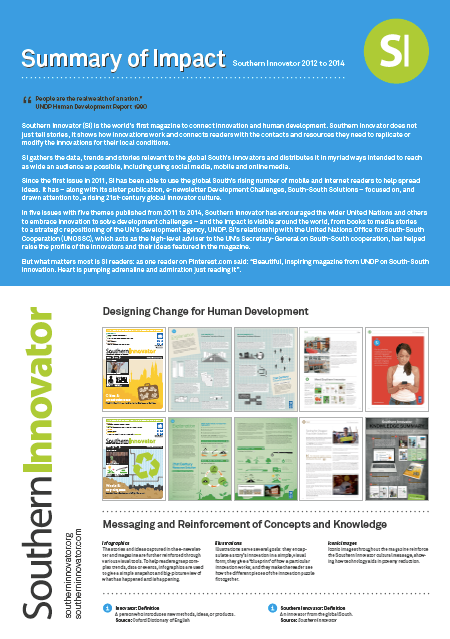
By 2014, Southern Innovator had published five issues and become a recognised global innovation brand.











 David South Consulting

You must be logged in to post a comment.